- I posted The Cunning Blood on the Kindle Store 61 days ago, and in those two months it’s earned just a hair over $3,600. 46% of that came from KU page turns. Fellow indie authors, I think we have us a business model.
- Tom Roderick sent me a link to a very nice graphical COSMAC ELF emulator, designed to look as much like Joe Weisbecker’s unit from Popular Electronics (August, 1976) as possible. You can toggle in opcodes like we did almost forty years ago, and run them. (The Q line drives an LED.)
- In cleaning out the garage, I took a look at the motor/battery module of my robot Cosmo Klein (which I built in 1977-1978) and realized it wouldn’t take much to get it running again. The original Cosmo had two COSMAC systems and a glass-screen TV for a head (which made him very top-heavy) along with a cranky robotic arm. (Here are some photos of my COSMAC projects and Cosmo himself.) I could hide an RPi2 in that thing and you’d never find it. Funny how stuff changes in 38 years…or maybe not funny at all.
- From Astounding Stories: Spacemen beating the crap out of one another in zero-G with…yardsticks. By Edmond Hamilton. Not sure of the year, but you can download the whole thing.
- From the Weirdness-I-Just-Learned-About Department: The tontine, a financial arrangement in which a pool of people contributes equally to buy a pool of assets, and as they die, each deceased’s share is distributed to survivors. Apart from an inceptive to murder your tontine siblings, what could go wrong?
- In the fever of a house hunt, I missed this item: Amazon is going to create its own line of house brands for food. I have a peculiar curiosity about house brands, which is a sort of shadow business that doesn’t get much press. Why would an industry-leader cereal manufacturer sell its cereal in bulk to other companies to sell as competing house brands? It happens, but nobody wants to talk about it. Big store chains have house brand versions of many products, including most mainstream cereals. There’s a book in this somewhere, though I don’t intend to write it.
- If you’re not a balls-out supporter of nuclear power generation, I don’t want to hear a word out of you about global warming. We need base load, and neither Sun nor wind can provide base load. In truth, all that stands between us and a completely nuclear future is fear (i.e., political tribalism) and money. The money issue can be fixed. Alas, the gods themselves, etc.
- It’s been 119 months since a major hurricane (Class 3 or higher) has hit the American mainland. Unless Joaquin goes ashore along the east coast somewhere in the next several days (and current winds argue against that) it’ll be 120 months–ten years–come October 24. That’s an all-time record since records have been kept. Global warming causes everything else; why not better weather?
- And you wonder why I’m a global warming skeptic. Hey, fellow (potential) morlocks: I hear that our Educated Elite is delicious with melted butter.
- Americans are embracing full-fat foods, thus spitting in the face of government advice. As well they should: The War on Fat is based on fraudulent science put forth by ace scientific con-man Ancel Keys, whose only real talent was getting government to take his side. Go butter, eggs, and meat. You’ll lose weight, and feel better.
- Yes, I bring that up regularly, because I’m trying my best to ruin Keys’ reputation. His deadly advice has killed tens of millions, and is still killing them. “I’m supported by the government. I’m here to kill you.”
- Some good news: A judge kneecapped champion patent troll eDekka by invalidating its only significant patent.
- And more…for some people, least: Charlie Martin pointed me to an article from Harvard summarizing a study on the beneficial effects of coffee. Coffee appears to delay, improve, or prevent just about everything but insomnia. And what’s my main problem?
- There! A month’s worth of grouchiness in one Odd Lots! (With a few other items thrown in for spice.) I don’t do that often, but it feels good when I do.
hardware
Odd Lots
Odd Lots
- This may explain a certain amount of the drama coming out of the anti-Puppies camp…or, for that matter, a great deal of modern politics: Histrionic Personality Disorder (HPD). (Thanks to Adam Baldwin for the link.)
- OMG! Global warming may mean stronger weed! (That makes it all better, right?) Colorado’s on it.
- BitTorrent recently released Bleep, a private encrypted P2P messaging system. Of special note is “whisper mode,” in which a message sent vanishes from both devices 25 seconds after it arrives. Whisper mode also blurs out the display so the message can’t be screencapped. It’s available for iOS, Android, Windows, and Mac.
- Ok. This is weird: KFC in Germany developed a tray liner…that was a disposable Bluetooth keyboard. Pair it with your phone, and you can type with the same greasy fingers you’re scarfing chicken with. It was a test, and only available for a single week. Most of the tray liners, furthermore, went home with customers.
- Where’s my flying car? Well, there was once a flying Pinto. (For a little while. Until the wings came off.) I’m still not sure that counts as a flying car. (Thanks to Bill Higgins for the link.)
- Fred Richardson messaged me to say that he had built a Shive torsional wave machine, just like the one that starred in the Carl & Jerry story, “The Bell Bull Sessions.” It’s now for sale on eBay.
- I’m interested in what SFF authors have bichons. I’m one, Jim Butcher is another. Are there more? I’m also interested in bichons that appear in SFF stories. Toby from Varley’s The Golden Globe is the best-known. A bichon also appears in The Last Policeman trilogy, and, of course, my own Mr. Byte appeared in David Gerrold”s excellent “The Martian Child.” Any others?
- I recently learned of Dabble, which is basically Uber for teaching one-off courses. Would I make any money teaching Pascal/Lazarus programming? I could also try teaching SF writing, except that I’m not always sure how I do it myself.
- The Raspberry Pi Model A+ is the beating heart of the do-it-yourself PiGRRL GameBoy-like retro game console. A good video for a chance, though not a step-by-step. I love that little bitty display. (Thanks to Eben Upton for the link.)
- The opah has recently been identified as the only known fish with whole-body endothermy; that is, it’s warm-blooded.
- The National Park Service has posted a number of recordings of the Edison Talking Doll, which was a great deal like Chatty Kathy (and similarly electronics-free) except it was sold in 1890. People have commented that the dolls sound creepy or possessed. To me they sound like the women who made the recordings were shouting at the tops of their lungs to provide enough energy to move the recording needles on the wax cylinders. Listen to the recordings again and see what you think.
Odd Lots
- I’m less sure of this than the author, but it’s something to think about: Apple may not always rule; look at IBM.
- Researchers who were testing Android apps to see what-all they connected to (generally without notifying their users) found that dopey little apps of no special character were connecting to thousands of tracking sites. Then they did the obvious, and created an app that watches the other apps and logs what connections they make.
- The EM Drive makes my head hurt, though in a good way. NASA Spaceflight’s article on the gizmo doesn’t exactly make its mode of operation clear, but the fact that NASA is even testing it is reason to stand up and cheer. Somewhere in my notes is an old concept (predating The Cunning Blood by a decade, in fact) that posits an antigravity device built out of the parts in old microwave ovens and harvests energy from the quantum vacuum. It would be so vindicating if this thing works out! (Thanks to Pete Albrecht for the link.)
- The Atlantic takes on lifestyle panic. Don’t miss this one. (I may have been ahead of the curve when I talked about it in 2010.)
- The Sun just ain’t wakin’ up nohow. Barely a year after Cycle 24’s sunspot maximum, whatever sunspots exist are barely discernable. Last year we had the weakest peak since 1906, and the cycle as a whole may eventually become the weakest in recorded history.
- Don’t relax too much: The Carrington Event occurred during a weak solar cycle.
- Recruiters looking to discriminate against older people are now asking for “digital natives.” Lawsuits are beginning. The real problem: It’s legal to charge employers more for group health policies when their staff skews older. Outlaw age underwriting entirely, and that problem will mostly go away.
- Will TV just die already? Cable subscribers drop below Internet subscribers at Comcast. Anything you can watch on TV, you can watch on the Internet. TV is now a redundant nuisance.
- As an Army radio operator stationed in Italy, my father watched the March, 1944 eruption of Vesuvius, and called it the scariest thing he ever saw. That was 71 years ago. If (nay, when) it erupts again, we’re going to have a lot of very serious problems.
- Everybody’s aggregating this, but it sounds bogus to me: The more coffee you drink, the longer you’ll live. (Some people I know should therefore live forever.) I’ll stick with my theory: You can do worse than your genes, but you can’t do better.
- And might I also suggest, for those who attempt immortality the Folgers way, to recall the dangers of invoking the invisible, jet-packed Mr. Coffee Nerves.
- How long would one of Tesla’s new Powerwall home-power batteries keep your house running? Wired does the math.
- If you want to read Larry Correia’s Monster Hunter saga, start at the beginning. The books make much more sense if you read them in order. Baen offers the first three as an ebook bundle.
Odd Lots
- The xenon flash problem with the Raspbrry Pi 2 board has been explained reasonably well on the Foundation site, by Liz Upton. Key seems to be that U16 is not a typical SMT chip encased in black resin, but a naked BGA (Ball Grid Array) chip, which allows light to hit the chip’s silicon directly. HackaDay’s Brian Benchoff says that a cheap green laser pointer will also do it, suggesting that the wavelength of light hitting U16 matters crucially. Hey kids, this is a science fair project: What wavelengths of light trigger photoelectric emission on an exposed silicon die? (Many thanks to Michael Covington for the link.)
- Adafruit has a nice benchmark page for the Raspberry Pi 2, which also provides detailed descriptions of the differences between the new board and the older boards.
- What’s going on in the Martian atmosphere?
- There’s a single SMT chip at the heart of the Baofeng radios I described recently: The RDA1846. I would love to see this on a cape/shield for one of the popular embedded boards, especially the Raspberry Pi. Not quite a true SDR, but mighty close, and I’d guess damned useful for radio tinkering. (Thanks to Bob Fegert for the link.)
- By the way, “Baofeng” and “Pofung” are the same company. It sounds like they were trying to make “Baofeng” easier to pronounce for Westerners, but in truth I don’t think it was much of a problem to being with, and I admit I was confused when I first ran across “Pofung.”
- Norse’s real-time IP attack map is very cool in a War Games sort of way, but it takes some study to figure out what exactly it is that you’re seeing. (Thanks to Pete Albrecht for the link.)
- Here’s a nice collection of homebrew radio projects from Jim McNutt WA6OTP, with pictures and schematics. Fine work!
- An interesting short introduction to the geophysical differences between Earth’s north pole annd south pole.
- More crazy weapons, including but hardly limited to the Panjundrum. I’ve always liked the Triebflugel, which was a great idea until you had to land it, kind of like the XF-85 Goblin.
- That’s not a monkey on that marathon runner’s back. It’s a tomato-dispenser robot. I guess we’re in somebody’s vision of the future. It certainly isn’t mine.
Odd Lots
- Scott Adams reminds us that science has failed us on diet and health so often that some people assume that science itself is unreliable. His point is good: Being wrong is part of the scientific method, but humans see patterns in things, and that pattern simply means that science is slower than we’d like, and refines knowledge over time by identifying our mistakes. We forget this at our peril.
- Intel’s latest rev of its NUC (Next Unit of Computing) has a Broadwell CPU and a swappable lid that provides a standard form factor for 3rd party extensions. The only big mistake is the total lack of SD card slots. We’re well along toward my 15-year-old prediction that computers will ultimately be swellings on the backs of monitors.
- Why the Feds are terrified of hobby helicopters. (Drones? No, you’ve got it backwards. Those are the Feds.) This is nonsense, and the whole thing is a dodge. I made this point some time back: Governments do not want to be watched. No governments, anywhere. That’s what the whole “drones” thing is about, top to bottom.
- Wired staffers bid farewell to Radio Shack. Me too. I considered a TRS-80 in 1978, and occasionally regretted not getting one once my friend Jim Dunn bought one in 1979.
- Radio Shack, yes. We also forget how the Model 100 (noisily) transformed tech journalism. In 1984 Xerox tried to field a competitor to the Model 100, which I evaluated for our department. It was hideous, and (worse) cost $2500, which would be $5700 today!
- Here’s the mother lode of scanned and browsable Radio Shack catalogs. I still have a few of these. (Thanks to Esther Schindler for the link.) As an example, here’s the page describing the stereo I bought the first Christmas Carol and I were married, 38 years ago. It still works, and we still use it.
- Very cool physics demo on YouTube: An AA battery and four disk magnets pull themselves around inside a tube made of coiled copper wire. (Thanks to Bob Fegert for the link.)
- A supercapacitor made from nanoelectrodes and a kitchen sponge. (Again, thanks to Bob Fegert for the link.)
- Tides do not seem to affect earthquakes and volcanic eruptions. The discussion is plainly written and I think anybody can follow it.
- I hadn’t heard of the Sad Puppies before a few days ago. (Whatever you may think of the concept, they have a great logo.) I guess I’ve been away from Fandom for awhile.
- Lileks has a feed on Tumblr. Worth following, as is Weird Vintage.
The Strangest Computer I’ve Ever Built

Lee Hart sent me the guldurndest thing for Christmas: One of his RCA COSMAC CDP1802 Face Card kits. I needed a distraction from a number of things, starting but not ending with publisher disputes. Lee’s Face Card was just the ticket. I haven’t done much PCB soldering in the last few years. Most of what I have done in the electronics sphere was point-to-point, generally on tube circuits. I hadn’t soldered a 40-pin DIP in, well, um…decades?
There’s a knack to it, and I had to dig around a little to find my roll of Ersin .022 Sn63 solder, but after a few minutes’ careful practice it all came back. The kit doesn’t include a 40-pin socket, but I always socket CPUs. The CPU chip I used (see above) has a distinguished history: It was the very same chip I ordered for my original COSMAC Elf project in the fall of 1976. Later it migrated to my second, heavily hacked Elf design (here’s the board mounted on what really was a scrap Xerox 3100 platen cover) with ten banks of CMOS memory (2,560 bytes!) a breadboard block, and a hex keypad. That second Elf board, in turn, became one of two CDP 1802 machines in my well-known robot Cosmo Klein:
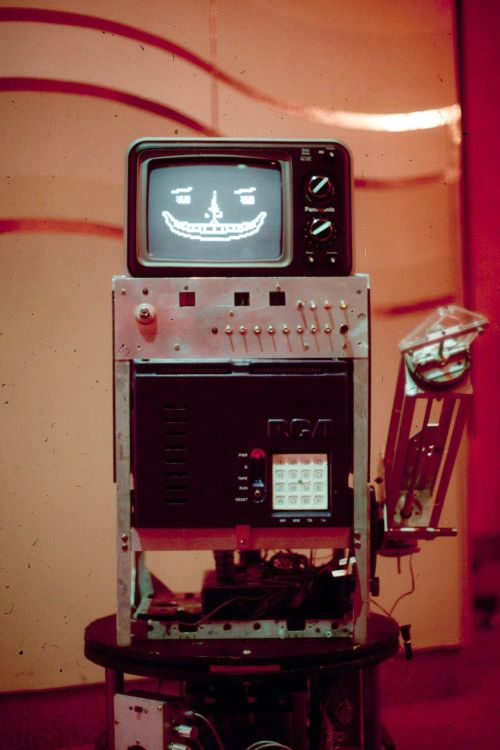
Cosmo and I did the SF con circuit from 1978 to the early 80s, and we were actually featured in Look Magazine, as well as an early cable TV program that no one saw.
So I have a certain history with RCA’s peculiar COSMAC architecture, and have built a number of peculiar computers with it. I’m pretty sure none of them were ever quite as peculiar as Lee’s Face Card. Why? The Face Card has no memory, volatile or nonvolatile. It does not run software. Actually, it’s strapped specifically so that it doesn’t run software. (More on this in a moment.) What it does is light up groups of LEDs to make an animated face. How it does this is, well, peculiar: The LEDs are driven from the 1802 chip’s address lines. The data bus is left floating. The 1802, when reset, begins executing code starting at address 0000 in memory. If there’s no memory and the data bus is floating, the chip just executes empty air. The patterns that appear on the address lines aren’t quite random, but close enough so that the LED eyebrows, face, and mouth move in almost random variations. Oh, and the clock speed? One cycle per second.
Peculiar enough for you?
One of the data bus lines has to be pulled high to prevent the binary instruction 00 from executing. This is the HALT opcode, and if empty air delivers 00 to the data bus, the Face Card will freeze and the face pattern will no longer change.
I have special affection for the Face Card because one of the two COSMAC machines in Cosmo displayed an animated face on a portable TV atop his body. Cosmo could look around, smile, frown, and (on a touchtone signal from my 2M HT) lick his chops.
I built the Face Card in about an hour and a half. I’m careful, I work slowly, and I test most components before soldering them into a circuit board. It worked as designed when I turned it on. Theoretically, the system can run on any power source from 4-6VDC. I found that a 5V supply didn’t quite cut it. Some of the LEDs didn’t light fully, and the patterns seemed to get “stuck” now and then. The board has been running at 6V for two days now, and things are brighter and livelier. They’ll be even livelier when I cut the clock generator resistor in half and double the clock speed to two cycles per second.
$19.95 + $5 shipping. CPU socket not included, but I think using one is a good idea.
Highly recommended.
Odd Lots
- Verizon refuses to stop using tower-side cookies (which can’t be deleted by mobile device users) even as AT&T has caved on the issue. The solution is to stop using Verizon. That’s what Carol and I are about to do.
- Relax. Microsoft did not pull the plug on Win7 updates on 1/13. That won’t happen until 2020. What’s going away are new OS features and phone support, two things I don’t think the world desperately needs.
- I like molten lava as much as the next guy. (Just wait until you read my novella Firejammer, coming out–finally–this spring.) That said, I’m not sure I like it quite this much…
- With January only half over, the Great Lakes ice cover is now up to 34%. Lake Erie has pretty much iced over completely.
- Britain’s Royal Society has published some evidence that people born during solar maxima do not live as long as people born during solar minima. It may be folate depletion by UV. Or something else. However, the correlation appears to be real. (Thanks to Neil Rest for the link.) Carol and I are solar minima babies, whew.
- Discovered two very good red wines recently: Menage a Trois Red, and Menage a Trois Midnight. Both are dry reds, both are fruit-forward, and (in contradiction of the vintner’s Web writeups) neither has any detectable oak. I guess if you’re going to get the hipster market you have to claim oak, even if you lie about it. In this case, nothing of value was lost.
- I doubt that my readers are dumb enough to think you can lose weight by ingesting chemistry sets like Slim-Fast. But just in case, read what Tom Naughton says about recent diet rankings in content-free publications like US News. Hint: The same doofi who bleat endlessly against “processed foods” (which now means “any foods I don’t like”) are endorsing fructose cocktails like Slim-Fast over Atkins and paleo.
- Popular Mechanics lists the 14 best cities in America for startups. None are in Silicon Valley, and all are in relatively low-cost areas. Maybe hipster city cachet is finally starting to lose its cachet. Or so we can hope.
- Lots has happened in CPU architectures since the 1980s, when a lot of us learned it. (I started a little earlier, but the IBM PC brought most of us to a new starting gate at the same time.) Here’s a decent summary. One consequence of all this is that human-written assembly language is less of a win over compilers, and the best reason to learn assembly these days is to understand what your damned compilers are up to in there.
- Before he broke into the SF business, Keith Laumer was an ace model airplane designer. (Thanks to Pete Albrecht for the link.)
- Physically small, fanless PCs have been around for awhile, and I was bullish on them until I began using Dell USFF (ultra-small form factor) machines like the Optiplex 780, which are pretty small and almost entirely silent. Should we settle for 1.6 GHz? Only if there’s a specific application in mind, like education (think RPi) or embeddedness.
- Bill Cherepy sends us news of a thermostatic butter keeper that can keep a stick of butter (block? It’s a form factor we don’t make in the US) at any arbitrary temp from 15 to 23 degrees C. Butter is definitely coming back into its own, bravo halleluia!
Odd Lots
- Intel’s announced the Compute Stick, a complete $150 Win8.1 machine in the format of a fat thumb drive. Looks like the plug is HDMI, though, and the device gets power from an uncommitted USB port. I could see this melting seamlessly into a big-screen TV (or any monitor with an HDMI input) and giving you something that indeed approaches (as Michael Abrash said probably 20 years ago about 21″ CRT monitors) Windows on your bedroom wall. (Thanks to Eric Bowersox for the link.)
- It’ll be awhile before this becomes available, but a brand-new antibiotic has been isolated from bacteria that live in dirt. I’m doubly enthuisastic because this may encourage researchers to look harder at bacteriophages, which live in dirt and worse.
- If you haven’t heard of Smart Pascal, it’s an interesting concept and worth a look: A commercial Object Pascal compiler that generates HTML5 apps. It’s basically a way of writing sophisticated Javascript apps without having to wash your mental hands and rinse your brain out every twenty minutes. To me that would be worth $42/year.
- From the Words I Didn’t Know Until Yesterday Department: A selfie stick (also known as a narcissistick) is a camera holder that allows you to take pictures of yourself or groups by parking your camera on it and holding it up in the air so that the camera is facing you. It’s usually just a rod with a handle, sometimes telescoping. Many support bluetooth to trigger the camera, though the details remain obscure to me.
- Beware the Facebook Logic Fallacy: One member of Group X is evil, therefore all members of Group X are evil. Much of my objection to Facebook memes is that this is a very common template. Attack memes must die. Not sure how to get there from here.
- The percentage of ice cover on the Great Lakes is now 18.7%. Keep an eye on this graphic, as I think our current winter stands to be an…interesting…season from a Great Lakes ice perspective.
- In general I’m no fan of government regulation, but here’s an excellent argument that both broadband providers and airlines could use a little consumer-oriented regulation.
- Related to the above: Air travel is a lousy business (rather like health insurance, in fact) and merciless price competition has led to creative fee-hiding and generally charging extra for a travel experience that hasn’t been made deliberately miserable.
- From the Department of the Painfully Obvious: There are many benefits in finding a spouse who is also your best friend. I guess it’s nice to have some research behind it, but damn, is this really news to anyone? (Maybe New Yorkers.)
Daywander

“Hey, Contra Boy! Are you dead or something?”
Me? No. C’mon, if I were dead I would have mentioned it. So I’m not dead, though I am something, and while I can tell you it isn’t ill-health (for either of us) I can’t say much more about the something beyond that.
It’s certainly gotten in the way of other pursuits.
Anyway. For the first time I am hands-up-to-the-elbows in Windows 8. Carol wanted a new ultrabook-class laptop for Christmas, and we shopped together. She chose the 11.5″ version of the Lenovo Yoga 2, which (like my Transformer Prime) attempts to be both a loptop and a tablet. Unlike my Transformer Prime, I think it actually succeeds. The pivoting display (see above) lets it work as a tablet, and while I’m still not used to grabbing keys on its virtual backside while gripping the little slab in tablet mode, the machine ignores the keypresses. If the keys themselves are robust, no harm will come of it. The 1366 X 768 display isn’t retina-class, but it’s gorgeous and good enough. It’s got a 1.5 GHz Core i3 and 500 GB hard drive, which is more than sufficient for how we intend to use it.
Like all retail machines, the Yoga 2 is loaded with crapware, some of which I’ve never heard of and haven’t looked up yet, like the Maxthon Cloud Browser. Some of the crapware is crapware by virtue of being preinstalled; Evernote is a worthy item but I do not want it on the machines I buy. Ditto Zinio. Doubtless a lot of the other dozens of thingies cluttering up the display are there for Lenovo’s benefit and not ours; remember that crapware slots on consumer machines generate lots of money for their vendors through sales conversions, and Lenovo gets a cut.
My biggest problem is that I will eventually have to replace the MacAfee crapware with something that works. We standardize on Avast at our house, but getting rid of security suite crapware is notoriously difficult. Most people eventually just give up and pay for it. Not me.
I’m spending considerable time on the project not only because Carol needs a machine that works well, but also because I need a new laptop myself. A 13″ Yoga might do the job, assuming I can learn to love Windows 8, or at least hold hands with it. A big tablet would be useful for reading PDF-format technical ebooks. Now, having been set up the way Carol likes, it goes back in its box, the box gets wrapped, and it joins the pile under the Christmas tree. Much better that way than trying to figure out what’s crapware and what isn’t on Christmas morning.
Quick summary of what I’ve been reading:
- The Call of Distant Mammoths, by Peter T Ward (Copernicus Books, 1997.) Why did the ice age mammals vanish? It wasn’t simply human predation or climate change. It was a combination of things, especially human predation and climate change. (Wow! The brilliance!) Cost me a buck plus shipping, and the gruel was thick enough so that I won’t claim the time spent on it was totally wasted. Still, not recommended.
- Neanderthal Man, by Svante Paabo (Basic Books, 2014.) It seems like carping, but the book is mis-titled. It’s not about the Neanderthals themselves but rather the sequencing of their genome, which the author spearheaded. Paabo’s writing style is solid and amiable, and he does a good job explaining how DNA can be found in very old bones (with tremendous difficulty and peculiar luck) and how it was teased out over a period of almost twenty years. I must emphasize that if you have no grounding at all in gene sequencing, it will be a bit of a slog. However, if you pay attention, you will learn a lot. Highly recommended.
- 1848: The Year of Revolution, by Mike Rapport (Basic Books, 2008.) My Duntemann ancestors arrived in the US in 1849 or 1850. We haven’t found the crossing records yet, but we have a strong hunch why they left: the European upheavals of 1848. Like WWI, 1848 doesn’t summarize well. The people rose up against their elites, who were in many cases so afraid they were facing Jacobin 2.0 that kings resigned, constitutions were given, and (alas) the roots of commoner suffering remained misunderstood and mostly uncorrected. Again, this may be a slog even if you have some grounding in European history. History doesn’t always make sense. Sometimes you just have to describe the squirming details of what will always remain chaos. Cautiously recommended.
The odd lots are piling up too. Will try to get some posted tomorrow.
Odd Lots
- Yes, I changed my mind and signed up for Twitter, after pondering somebody else using my name and creating a Fake Jeff Duntemann. (Thanks to Bob Fergert for prompting me to imagine the unimaginable–and I’m a good imaginer.) More on this a little later. I have yet to post anything due to lots of top-priority projects here, but I’ll get to it within the week.
- Dietary saturated fat is not related to plasma fatty acids. In other words, it doesn’t matter how much saturated fat you eat; your blood levels of fatty acids are controlled by other factors. What other factors? Care to guess? Are you reading this on Contrapositive Diary? Is the Pope from Argentina? Is the atomic weight of ytterbium 173.04? It’s the carbs. Wow. Whodathunkit? (Thanks to Jonathan O’Neal, who was the first of several to put me on the scent.)
- There is actually a prize for the worst sex scene in literary fiction. It is not a coveted award, and I guess is seen as a sort of booby prize among literary writers. The WSJ recently posted a brief guide on how to avoid writing such scenes. (I avoid writing really bad sex scenes by not writing sex scenes at all. Works amazingly well.)
- Two people in my circles who don’t know one another have independently recommended Ting as a cell carrier. First impression: Sounds too good to be true, and sheesh, they were created by Tucows. (That said, Tucows is no longer what most of us grayhairs remember it being.) Any other opinions? Getting new phones and a new carrier is my next big tech research project.
- I’d also like to hear some early impressions of Lollipop, if anybody’s got it or is about to get it.
- Here’s something you don’t see every day; in fact, I don’t think I’ve seen it even once, ever: A square flat-panel monitor, with a 1920 X 1920 resolution. Assuming these survive their launch (not a sure thing by any means) I’d be sorely tempted. As the story says, “Enough of the ultra wideness already.”
- I wasn’t sure whether good technical books could be created as reflowable ebooks, but Yury Magda is doing it. He has five self-published Arduino-related titles now, and what I can see in the samples looks damned good. I’m going to buy a couple, less for the Arduino content as for how he does the layout. (Thanks to Jim Strickland for putting me on to this.)
- Gizmodo/Sploid has a very nice short item on the XB-70 Valkyrie, certainly the most beautiful and possibly the second-scariest military aircraft ever built. Do watch the video of how the second prototype crashed–and if you’re ever within striking distance of Dayton, don’t miss the other Valkyrie at the Air Force museum there. (Thanks to Bruce Baker for the link.)
- Barðarbunga is emitting over twice as much sufur dioxide every day as all of Europe’s smokestacks put together, and the volcano is still hard at it. SO2 is well-known to be a powerful cooling factor in the atmosphere. Combine that with a quiet Sun, and nobody really knows what might happen.
- Best video illustration of how tumbler locks work that I’ve ever seen.
- For that special, short, hairy, ironic someone in your life: You can get a genuine Flying Nun-inspired Weta-made Bofur winter hat, shipped all the way from New Zealand. Not cheap and not sure if it’ll arrive before Christmas, but if this winter keeps going like it’s going, you’ll be all set to face dragons, ice ages, or both.