Jeff Duntemann's Contrapositive Diary Rotating Header Image

health

The Algernon Conundrum

My previous entry on drug prohibition (December 5, 2008) triggered a great deal of discussion, and prompted someone to send me a link to a story on chemical cognitive enhancement. People are using a number of drugs and non-regulated chemicals to give themselves a performance edge at work or school, and the question of whether this is a good thing or not is complex. Caffeine tops the list of cognitive enhancers by popularity; I also have an intuition that certain “smart drinks” containing herbals like ginko biloba really work because they have more caffeine than Mountain Dew. Most cognitive enhancers are stimulants of some kind, and people who depend on them often lose sleep, which some research suggests is behind a great many health problems from obesity to hypertension. Other less obvious effects may exist. Caffeine is ancient but most other nootropic drugs are not, and we have no clue what they might do to the human system over an adult life of forty years or more.

However, someday we will know. The question then becomes: If we can improve brain function with chemicals that have no adverse effects, should we? And if those chemicals actually make human beings brighter, less angry, more social, or more effective in other ways, are there grounds for restricting their use? One could argue that life’s game is now all about brains and personality—brawn went out of fashion as a career choice a generation ago—and letting people “cheat” with pills or patches is fundamentally unfair to those who can’t afford the pills or patches or by some odd quirk of physiology do not respond to them. Beyond that, objections thin out pretty quickly. The benefits are immense, and if the costs were modest, we could make the enhancers available to anybody who wanted them.

The remaining objection is subtle: There are rarely any free lunches. Assuming that we can find cognitive enhancers without some sort of damaging side effects might be naive. Evolution made us as we are, and did so at the cost of billions of “bad throws” of the genetic dice. Making better humans may come at a cost, and the SF writer in me wants to ask questions like this: Suppose you could boost your intelligence radically using a chemical that cranked up brain chemistry at the cost of burning your brain out after forty years or so. I’m not talking about a little better detail recall or a little more personal energy to work through your do-it list. (That’s what people who use Ritalin or Provigil today are achieving.) I’m talking about being able to grasp and integrate massive amounts of information into your daily experience of life; of being able to hold dazzlingly interesting discussions with other people that range across all human knowledge; of being able to understand the ways that widely separated facts interlock and shed light on things that you would never have thought were related at all. Burning through a do-it list a little faster is just a temptation to add more drudgery to your life. But being able to kick back and your chair and Put It All Together, wow! That would tempt me. I’m not naturally prone to envy, but I confess to being a little envious of the dazzlingly bright people I’ve met in my life. Looks, eh. Wealth, eh. Power, yukkh. Brains, yeah.

Now, suppose that being such a person would reduce the length of my life from eighty-five to sixty years. Would I still be tempted? That’s a tough question, especially if the last twenty-five years of my life were assumed to be lived within a gradually deteriorating body. To have a dazzling mind while still having a body capable of making use of it—that’s the temptation. If the cost is early death, well…what would you do?

I call this the Algernon Conundrum, from Daniel Keyes’ seminal story and novel, Flowers for Algernon, which I read in high school and which affected me deeply. A mentally handicapped man becomes a genius through medical intervention, but the effect is short-lived, and discovered to greatly shorten the life of the lab mouse (Algernon of the title) that first underwent the procedure. Charlie soons reverts to his original self, with the implication that he will die far younger than his peers. The novel side-stepped the obvious question: Was it worth it? That was forty years ago, and I still haven’t decided. I doubt I’ll live long enough for it to be a choice I’ll have to make, but I often wonder how our grandchildren will deal with the difficult tradeoffs that medical technology will inevitably offer them. Drugs? Getting high, well, that’s going to be the least of it.
A Nose Was Blown, But Not By Me

Uggh. Today has been misery punctuated by mere discomfort, and you won't get anything profound from me tonight. What time I didn't spend in bed with Aero's butt in my armpit and QBit lying across my ankles I spent reading in my big chair, pulling Kleenexes from the box as needed and tossing them atop my desk when I finished with them. A few minutes ago, I looked at the pile of snotty Kleenex and asked myself, “Did I do all that nose-blowing this afternoon?” I was so bleary I barely remember.

Yet objective evidence (the head-sized pile of snotty tissues) suggests that I did.

And on that note I will make a very strong recommendation for the book I am mostly through reading, though I will probably have to read it a second time once I'm no longer blissed out on antihistamines. Do not miss this one: Mistakes Were made, But Not By Me, by Carol Tavris and Elliot Aronson. (Thanks to Michael Abrash for recommending the book.) It is a masterful piece of pop psychology, beautifully written and well footnoted, that offers to explain why we justfy foolish beliefs, bad decisions, and hurtful behavior. It has been a painful read in that I have seen myself in every other paragraph, and you will too. It has been a hopeful read, however, in that I have been intuitively struggling against these damaging psychological mechanisms for much of my adult life; in fact, the book has allowed me to define what I mean by contrarianism: the act of swimming against the torrent of stupidity and falsehood that flows from the deeper mind.

If you are a person given to certainty, the book will enrage you, since it almost defines certainty as a species of mental illness. (This is also the thesis of another book that I have read but not yet reviewed here, On Being Certain, by Robert A. Burton.) No matter what you're certain about, you're wrong. So am I. All knowledge is tentative, and our memories are full of holes and scrambled pointers. I'll start talking about that once I feel better and this damned election is over.

At this point it's time for shower and bed, and my nose is running. Damn. I'm out of Kleenex. I was sure that the box was still half-full!

The Answer to All Difficult Questions

I apparently brought a headcold home from Chicago, and it was in full bloom by this morning, so I don't think I'll be able to continue my anger-free politics series tonight. Things got off to a good start, and the LiveJournal comments are worth reading. I hope to get back to it tomorrow, if I can get a decent night's sleep. Right now I'm pretty wobbly.

Halloween is slow this year. It's 7:15 PM and even though it was a gorgeous day and is still 68 degrees outside, we've had exactly three groups come to the door so far. To be fair, the last group consisted of most of the ten-year-old girls in the western hemisphere, all of whom wanted to pick QBit up and hug him, and were willing to fight one another for the privilege. I quelled the riot before it got ugly, and passed out a decent number of Kit Kat bars so that I won't be tempted to off them myself tomorrow morning. QBit concealed his annoyance, even though what he wanted were not hugs but handouts.

I do want to relate one anecdote from our Chicago trip. We were hanging out in Gretchen's family room after dinner, being funny as is out wont. (Gretchen and Bill are good enough at it to do it onstage.) We were talking about Katie Beth's exploding vocabulary, and I was reflecting that sooner than we think, Katie (who will be two in a couple of weeks) will be engaging us in real conversation. So, in a fit of godfatherly ridiculosity, I looked soberly at Katie and asked her, “Where do you stand on the issue of transubstantiation versus consubstantiation?”

Katie wrinkled up her forehead in rapt concentration for a few seconds while she thought it over, and then, through a radiant smile, announced, “Pie!”

She probably thought I was asking her what she wanted for dessert, but clearly, the girl would make a good Episcopalian.

The Other Kind of Fifties Moment

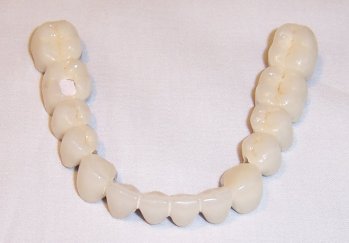
The massive urban renewal project that is the inside of my mouth got into high gear again this morning, with what I call a three-p procedure: It took six hours, with three pee breaks, and (I am not exaggerating !) fifteen separate injections of local anaesthetic. Uggh. The surgeon removed my lower horseshoe, which has been in my mouth since September 2001, and cleaned up what damage had occurred during seven years in place. Two fillings had to be drilled out and replaced, and all the teeth had to be re-margined. One tooth, while not infected, had broken into three pieces underneath the horeshoe (probably due to my perpetual clenching and grinding during the night) and no longer has enough structure above the gum line to be retained. It will have to be pulled, and later this year (once the bone heals) an implant post will be put in place to carry the eventual crown.


So here I am at home, groggy on painkillers, watching out my window as a blizzard rages on the slopes of my mountain. What month is this again? We already have four inches out there and it's still coming down hard. A friend at church told us that this has been the wettest, coldest, longest winter he's seen the whole sixteen years he's lived here.

And tomorrow morning at 7, I go back for six more hours to accomplish a similar treatment on the uppers. Alas, the upper horeshoe is in pretty tight (a good thing, actually, for my teeth's sake these past seven years) and the surgeon will have to cut it out in chunks using diamond burrs. (I'll be tasting stainless steel for weeks.)

But to the story at hand: I asked the young dental surgical assistant if I could have the lower horseshoe back so I could put it on my curio shelf. She said sure, and asked what else I had on the shelf. I ran down the short-form list:

  • A horse vertebra.
  • A cow skull that wears my Lane Tech high school mortarboard.
  • A radio-controlled rat.
  • A Pope Benedict XVI bobble-head.
  • A stuffed squirrel that giggles when you press his tummy.
  • A meteorite fragment given me by Pete Albrecht.
  • A Giant Squid action figure.
  • A Tim-Bird ornithopter
  • My father's slide rule.

She smiled, nodded, and then asked, “What's a slide rule?”

I explained as best I could. I realized that this was the other kind of Fifties Moment; that is, when you realize that you're in your fifties and almost everybody else isn't. I ache for the day—though I will probably not live to see it—when graying Gen-Y fiftysomethings talk about their vintage gear collection, and some young punk asks, in all sincerity: “What's an iPod?”

Odd Lots

  • I've had a difficult week here; new dental problems have arisen, culminating in an unplanned root canal this past Thursday, followed almost immediately by a much-delayed flight from Denver to Chicago for an Easter visit, where they happened to be having a blizzard. (The earliest Easter since 1913 corresponded with a lingering winter across the Midwest.) Tooth troubles continue, so if my posts have been (and continue to be) a little sparse, that's most of the reason.
  • Our early Easter this year caused some people to ask how the date of Easter is calculated. Well, it's not pretty. At least next year it happens in April, whew.
  • Here's a nice article describing a problem that is by no means recent: The split between people in the Catholic Church who can worship with a light heart, and people who invariably equate reverence with grimness . This has been an issue at least since Pope Pius IX lost the Papal States in the mid-1800s, after which the Papacy became obsessed with its authority and lost any ability to laugh at itself or anything else. (Pope John XXIII bucked the trend, but we didn't have him anywhere near long enough to make a permanent difference.) Roman Catholicism needs a sense of humor far more than it needs a Pope, but this may be one of those things that won't be solved within my own lifetime.
  • In keeping with its long history of contempt for the consumer (which, in all fairness, is rife in Japan) Sony attempted to charge purchasers of its laptops $49 not to install a crippling load of crapware on the machines. Apparently they've taken so much flak for it that they recently dropped the fee. What I find boggling is that they willingly cripple their own machines by selling huge numbers of crapware slots, which makes you wonder how much money they make in the crapware business. We may be heading down the same path here for laptops that printers have followed, in which the printer is a thin, shabby thing sold for very little that makes money for its parent company by consuming artificially expensive ink/toner cartridges.
  • It seems that I've been hearing a great deal within my own circle of contacts about people who try to help nontechnical folks (often parents) make Vista work with existing peripherals and software. The script goes like this: Nontechnical person brings home a new Vista PC or laptop from Best Buy and tries to install older software or connect it to various external hardware devices. Install fails; system aborts in various weird ways; technical person tries to fix (or simply understand) the failure, to no avail. Moral here: Do not use Vista. Everything that isn't needless window dressing is there for Microsoft's or Big Media's benefit, not yours. (Reread the venerable Vista Failure Log if you haven't read it for awhile.) You can still order PCs from vendors like Dell with XP preinstalled. Do it while you still can. And failing that, start researching Ubuntu/Kubuntu.
  • Speaking of failure, WiMax (which we have seemingly been waiting for since the last ice sheets retreated) may be a failure because it's lousy technology. The wireless DOCSIS technology mentioned in the linked article as a solution has been around for some years and doesn't have a much better reputation. We may in fact be asking too much of low-power microwave broadband systems—fixed point-to-point broadband is totally at the mercy of topography and even vegetation—and I keep coming back to the conviction that some sort of “roof-hopper” mesh network may be the best path to follow. People are doing this in some areas; why it isn't seen as a more general solution puzzles me.

Odd Lots

  • Here's a nice article from NPR on sleep. Worth noting is the author's comment that in 20 years, the stylishness of getting only five hours of sleep a night may be seen the same way that the “stylishness” of smoking is seen today: As something that kills you before your time.
  • Pertinent to the above: I have notes on an SF novel postulating a drug that lets people sleep as much as 23 hours a day, with a side effect that lucid dreaming is not only normative but shared: People using the drug encounter one another in their dreams, and struggle for control of the weird collaborative colony they've created within the human collective unconscious. As years of use roll by, research shows that drug-induced sleep occupying over 75% of each day leads to reversal of aging and what might actually be physical immortality. Sleep forever and live in your dreams! Take that, you short-sleepers!
  • I stumbled upon Gos earlier today, and it's an interesting concept: A Linux distro focused on Web apps that might be ideal for ultra-mobile PCs, tablets, and ebook readers. (Alas, it's not mature and may not be as “small footprint” as people would like.) Many of the Web apps it installs by default are Google apps, which led me to wonder if the product's creators intended from the start to sell the company to Google someday.
  • Pete Albrecht put together a long and detailed resources page for model rocketry. Perhaps only peripherally related to model rocketry but interesting nonetheless is the linked-to story of Miss Bomarc. (I had a model Bomarc when I was a kid, and Pete is building a flying model.)
  • From George Ewing comes a pointer to an intriguing article about 13 Things That Do Not Make Sense. Actually, they do make sense—the problem is that we don't understand them yet. (Humanity's most grievous sin is refusing to admit its own ignorance.) I'm glad they included cold fusion, and the one I would add is poltergeist activity.
  • Jim Strickland sent me a pointer to an item about a pair of prosthetic legs that communicate via Bluetooth in order to help a double amputee walk more effectively. The story I currently have doing the rounds (though all the majors have bounced it) posits a prosthetic leg with a 128-core Intel processor, a snarky AI personality, a thigh speaker, and WiMax, with all that that implies. If I don't sell it soon, you'll see it in Souls in Silicon later this year.
  • This June, ContraPositive Diary will be ten years old. (How many blogs can make that claim!) What would you all suggest I do to celebrate? Should I publish a print book “best of” on Lulu? (Might make good bathroom reading…)

Dreams of a Gum Surgery Fiend

This is getting old. No, scratch that—it was old before it started. It is now real old. This morning, while I was still blearily sipping coffee and waiting for the microwave to cook my oatmeal, Carol looked at me across the table and said, “You're turning black and blue.” And it was true: The damage I had previously been able to conceal by just keeping my mouth shut is now leaking through my cheeks somehow, and I have blotches. Not many, not big, but sheesh, this was gum surgery. I didn't have a limb stitched back on. I didn't have my gallbladder removed. I wasn't in a brawl.

Carol, at least, tells me that the swelling isn't any worse than it was yesterday. Yay wow halluluia. It is, however, increasingly asymmetrical, as the left side appears to be going down a little faster than the right—or maybe the right side is still swelling and the left side finally stopped. The pain drugs keep me a safe distance from suicidal, but there are…side effects.

My dreams are changing. They are moving from otherworldly to thisworldly, and I'm not sure that's entirely a good thing. I've had my very personally specific brand of dreams for 55 years, and a guy should go with what works. Magnetic monsters that rise from my tool cabinet and look like walking globs of stuck-together screwdrivers and ratchet sets, well, fine. I can deal with tools. Rotating horned skyscrapers, sure. I used to live in Chicago and I like innovative architecture. Freeze-dried dinosaurs stacked up like cordwood out on the parkway, no sweat. I have a fireplace. Talking doughnuts—hey, I knew guys in college who not only talked to their doughnuts but argued with them. If that sounds weird to you, well, you don't remember the 70s.

I wish I was artist enough to do CGI. I would show you some things, man…

But no. Last night I woke up at 5 ayem from a new kind of dream. I am not making this up; you can ask Carol yourself. There was nothing freaky in the dream at all. There was nothing in the dream that does not already exist in this world, and that's a first for me. It was disturbing in the extreme: I was wandering around Hilary Clinton's red-brick condo in Park Ridge (outside of Chicago, where she grew up and near where I grew up) looking at her record collection while Hilary was talking strategy with two of the senior guys from her campaign team. She had a lot of Steely Dan. Ms. Clinton was charming, pleasant, and every so often came over to me to see if I wanted more nachos or another soda. I looked at my watch and remembered that I had volunteered to give them all a lift downtown in a few minutes, and decided I didn't want any more Diet Mountain Dew.

She was good with that. So I took my toolbag and went out to look for my car. It was gone. I had parked it in a no-parking zone, and the old guy on the second floor leaned out the window and told me he had reported me and they towed it. Dayam.

The nachos had nothing to say. There were no talking doughnuts. Where were the weird creatures? The space habitats? The mutant Frank Lloyd Wright bungalows floating on antigravity cushions? The fiendish intelligences breaking through from the eleventh dimension to steal our souls? No. Nothing at all. I dug for my car keys and pulled a spool of corotron wire out of my pocket, and woke up in a cold sweat.

Last night I dreamed I was Hilary Clinton's copier repairman. You couldn't beat that for weirdness by tossing in a Maidenform bra. I want off these drugs. Dear Lord, please let it be soon. Please.

And On the Third Day, He…Ached

Figgered I'd surface for a few words; I'm between pain pills and can think a little bit. However, my face is badly swollen and I've lost three pounds in as many days, largely because eating requires the detailed use of your mouth.

Before the surgery, the medical office handed me pages of fine print about the procedure and its aftermath, which I skimmed, as it was depressing. However, it was true in an interesting respect: The worst doesn't come until three days after the procedure itself. In truth, I was so sedated that I no longer remember much about being in the chair and getting worked on. And the first and second days weren't too bad. But this morning, mon dieu…

And there it was, in the fine print: Swelling peaks on the third or fourth day post-surgery. Now, I'm no Hugh Grant and don't care that much how I look, short-term. But swelling hurts.

So I'm reading, daydreaming, and lying on my back in bed being bored. I'll report more when I can think clearly enough to report on something.