Jeff Duntemann's Contrapositive Diary Rotating Header Image

hardware

Scarcity Leaves Its Mark

Whether or not an unexamined life is worth living, examining what goes on inside your head is a lot of fun. I’ve become interested in psychology late in life (after treating it with contempt when I was a cocksure young rationalist) and identifying my biases and tracing them back down to their sources has become a minor hobby here.

My recent study of CSS reminded me of one of those biases: I hate windowing. I just hate it, and hate it so deeply I don’t even notice the hatred anymore. If you were to look over my shoulder as I work, you’d notice that I don’t use it. Whatever app I’m working in gets the whole screen, and when you can see the desktop at all, it means I’m in neutral and nothing useful is going on. I came to the insight after practicing fluid layouts in CSS. BTW, If you’re interested in learning how to do fluid layouts, I haven’t found anything better than Nate Koechly’s Web article “Intricate Fluid Layouts in Three Easy Steps.” Nate created the Yahoo UI Grids CSS system, which I may begin using once I learn enough CSS by building things from scratch. I like YUI because it supports fixed widths. Fluid layouts are not mandatory.

This is good, as I find fluid layouts peculiarly repellant. Things like this suggest a live frog nailed to a tree, squirming in agony. (Drag the corner of the window around and you may start to see what I mean.) Part of it is my long history with fixed page layouts in magazine and book work, and part of it is a desire to focus and not be distracted by things going on in other windows. The bulk of the bias, I think, proceeds from the same reason that the Greatest Generation were tireless savers and hated to waste anything: They grew up in conditions of scarcity. I ducked the Great Depression and WWII, but I followed personal computing from its rank beginnings, when displays were 16 X 64 character text screens or worse. I learned computers starving for screen real estate.

The IBM PC gave us 24 X 80 displays, but that was never enough. Text windowing systems like TopView seemed insane to me, and back in April 1989, when I was doing the “Structured Programming” column in DDJ, I wrote and published an “anti-windowing system” that treated the crippled 24 X 80 display as a scrollable window into a much larger character grid. Full-page text displays eventually arrived: The MDS Genius 80-character X 66-line monochrome portrait-mode text display (left) sat on my desk from 1985 through 1992, when Windows 3.1 finally made text screens irrelevant. (Lack of Windows drivers for the display soon forced MDS into liquidation.) It wasn’t until I bought a 21″ Samsung 213T display in 2005 and started running at 1600 X 1200 that I first recall thinking, “Maybe this is big enough.”

And only just barely. People who were born with a 1024 X 768 raster in their mouths may not be able to figure it, and I guess there’s really no way I can explain. It’s just me. Starve a man for screen space for thirty years, and he is unlikely to want to share what he has with more than one app at a time. Scarcity leaves its mark.

Odd Lots

  • I've had a difficult week here; new dental problems have arisen, culminating in an unplanned root canal this past Thursday, followed almost immediately by a much-delayed flight from Denver to Chicago for an Easter visit, where they happened to be having a blizzard. (The earliest Easter since 1913 corresponded with a lingering winter across the Midwest.) Tooth troubles continue, so if my posts have been (and continue to be) a little sparse, that's most of the reason.
  • Our early Easter this year caused some people to ask how the date of Easter is calculated. Well, it's not pretty. At least next year it happens in April, whew.
  • Here's a nice article describing a problem that is by no means recent: The split between people in the Catholic Church who can worship with a light heart, and people who invariably equate reverence with grimness . This has been an issue at least since Pope Pius IX lost the Papal States in the mid-1800s, after which the Papacy became obsessed with its authority and lost any ability to laugh at itself or anything else. (Pope John XXIII bucked the trend, but we didn't have him anywhere near long enough to make a permanent difference.) Roman Catholicism needs a sense of humor far more than it needs a Pope, but this may be one of those things that won't be solved within my own lifetime.
  • In keeping with its long history of contempt for the consumer (which, in all fairness, is rife in Japan) Sony attempted to charge purchasers of its laptops $49 not to install a crippling load of crapware on the machines. Apparently they've taken so much flak for it that they recently dropped the fee. What I find boggling is that they willingly cripple their own machines by selling huge numbers of crapware slots, which makes you wonder how much money they make in the crapware business. We may be heading down the same path here for laptops that printers have followed, in which the printer is a thin, shabby thing sold for very little that makes money for its parent company by consuming artificially expensive ink/toner cartridges.
  • It seems that I've been hearing a great deal within my own circle of contacts about people who try to help nontechnical folks (often parents) make Vista work with existing peripherals and software. The script goes like this: Nontechnical person brings home a new Vista PC or laptop from Best Buy and tries to install older software or connect it to various external hardware devices. Install fails; system aborts in various weird ways; technical person tries to fix (or simply understand) the failure, to no avail. Moral here: Do not use Vista. Everything that isn't needless window dressing is there for Microsoft's or Big Media's benefit, not yours. (Reread the venerable Vista Failure Log if you haven't read it for awhile.) You can still order PCs from vendors like Dell with XP preinstalled. Do it while you still can. And failing that, start researching Ubuntu/Kubuntu.
  • Speaking of failure, WiMax (which we have seemingly been waiting for since the last ice sheets retreated) may be a failure because it's lousy technology. The wireless DOCSIS technology mentioned in the linked article as a solution has been around for some years and doesn't have a much better reputation. We may in fact be asking too much of low-power microwave broadband systems—fixed point-to-point broadband is totally at the mercy of topography and even vegetation—and I keep coming back to the conviction that some sort of “roof-hopper” mesh network may be the best path to follow. People are doing this in some areas; why it isn't seen as a more general solution puzzles me.

The Big Dog Walking Qudripedal Robot

Don't have much time today, but I did want to call your attention to an item aggregated on Slashdot: The Boston Dynamics “Big Dog” robot prototype, developed as a cargo mule for DARPA. Here's a must-see video of Big Dog in action, climbing up a wooded hillside, tramping through snow, and walking on ice. At one point a technician kicks the device hard on one side, and it recovers its balance beautifully without falling over, all the while carrying a load that weighs 30% more than itself. It uses a gait that looks more like a show dog's than a draft horse's, and while they do not demonstrate it in full gallop, they're clearly trying to teach it to run.

Scary item, considering that this would have been impossible just a few years ago. I flashed on Cordwainer Smith's Manshonyoggers (from the German Menschenjaeger, man-hunter) which are human-scale Berserkers that run around a ruined world and kill any human being they see. Though hardly stealth creatures now, that's mostly engine noise and is a minor engineering problem. It'll be interesting to see what we do with them in a few years—or what the Bad Guys do with them in another fifteen or twenty.

Odd Lots

  • While chasing an interesting “out of the blue” idea that came to me while exercising the other day, I happened upon an RV surplus shop. Not surprisingly, it's in Elkhart, Indiana (Ground Zero for the American RV industry) and it sells leftovers and overstocks of RV parts and interior furniture. If I were to want to built a custom RV dinette table with a built-in keyboard, well, this might be the place to start.
  • Good grief: Has Big Media run out of Republicans to torment? ABC News posted this story about the pastor of Obama's Chicago church, who repeatedly condemns the US in his sermons and tells his people that they should be singing “God Damn America” instead of “God Bless America.” Expect those sermons (which are offered for sale by the church) to become very popular in coming months.
  • Illinois is famous for a lot of things, but being the historical capital of manufacturing of fraternal organization initiation and hazing equipment is not one of them. However, the De Moulin Company of Greenville, Illinois, now known for making band uniforms, used to do a big and almost unimaginably bizarre business manufacturing expensive gag items used to make new Masons and Elks feel like one of the gang. The precise psychology here is obscure to me (the last remotely fraternal organization I joined was the Boy Scouts) but the devices are just insane. Browse and boggle.
  • Here's another source for home-made telescope optics and truss telescope kits up to 32″ in clear aperature. Even though I'm not a big Dobsonian fan, the scopes look good, and if you want light-gathering power above all else something like this is as good as you're going to do short of a full-concrete observatory. The optics are not cheap, but they're good. (Thanks to Pete Albrecht for the link.)
  • Also from Pete comes a link to a site selling Swiss Army Ohmmeters. Should the Swiss Army encounter resistance, well, they'll be ready.
  • Mike Burton (who worked in the industry for some time) wrote to say that “double shot” keyboards are no longer produced due to their expense. A double-shot keyboard is one in which the keycaps are molded in two steps: One step to mold the body of the cap, with a void in the shape of the letter, and a second to fill the void with black plastic. Such keycaps never lose their legends, like my decal-equipped Avant Stellar is now doing at great speed. I guess I had better stock up on period Northgates.
  • We have evidently found the gene that triggers the onset of puberty. One wonders what suppressing this gene would do long-term. What would be the psychology of a 75-year-old boy who had never gone through puberty? Larry Niven toyed with the idea in World Out of Time, speculating that stopping puberty would stop aging, but I intuit that much more could be done with it. Would I give up sex for a shot at becoming immortal? (Answer from this side of the fence: No. Ask me in 1962 and you might have gotten a different answer.) Much depends on whether emotional maturity is a process inherent in or only affected by puberty. Sooner or later some renegade will try this, and we'll know.

Odd Lots

  • Do not fail to read Bruce Schneier's latest short item in Wired, which is his simple demolition of David Brin's peculiar “transparent society” concept, which I first read of in his so-so novel Earth (1990) and thought was BS even then. Having no secrets doesn't help where the differential of power between two parties is high. This seems pretty obvious to me; I do not understand why Brin gets points for this “no secrets” notion of his.
  • Some of the worst horror films (as well as SF films and some westerns) can be streamed without charge here. Where else can you find “Attack of the Giant Leeches” or “Killer Shrews,” both of which I recall seeing on Channel 7 at 4 PM on Thursdays back 1965-ish. Even at age 12 I could roll my eyes and say, “Those aren't giant shrews. Those are dogs in bad shrew costumes.” But hey, that's what makes a B-movie a B-movie, right?
  • It may be clever, but can a gun this small really be deadly? (That is, assuming you don't aim it up your left nostril…)
  • This is freaking amazing: Images of a landslide on Mars, taken while it's happening. (Thanks to Pete Albrecht for the link.)
  • Jim Strickland pointed out a pneumatic tennis-ball based antenna launcher. We always used slingshots back in the day, and I have a Greenlee Cablecaster that was designed for dragging CAT5 over suspended ceilings via fishline, but something about the ball shooter is very appealing.
  • Glover Wright is bringing back Science Fiction Quarterly as an online pub, and it looks promising. I recall reading a few ancient issues of the original SF Quarterly pulps from the late 50s and was pleased, though the world and I were, um, at least thirty years younger then. The first issue will be out in March.
  • Gripe of the week: The keycap letters on my expensive Avant Stellar keyboard are decals, and they are already wearing off. It's only been a year. What's this thing going to look like after another ten?
  • Speaking of keyboards: I need a wireless keyboard for use while sitting on the couch and running photos or video clips on our big TV. The SX270 is under the TV in plain view of the couch. The keyboard needs to have an integral pointing device. (I prefer things like IBM's TrackPoint nipple to the ubiquitous scratchpad.) Anybody got any suggestions?

Review: Tom Igoe’s Making Things Talk

Triage is a harsh mistress. I started out in computing with the CDP1802, a microprocessor designed for embedded systems work (it was used on the Viking Landers!) and for all the software I've used and the code I've written since then, I miss poking wires in breadboard holes and hitting the trigger of a wire-wrap gun. There's only so many hours in a life, and embedded work has not made the cut.

That may change. Embedded systems tinkering is easier now. Much easier, and for a couple of reasons: 1) The processors themselves can be had on small boards with appropriate I/O connectors; you don't have to fool with loose chips anymore. 2) Development software is better, mostly because now there is development software. In 1976 I literally had to write binary code by hand. (F8 FF A2… Yes, yes, I know, barefoot and uphill both ways. But if you think I'm exaggerating, you simply weren't there.) And, the point of the current discussion, 3) there are books like Making Things Talk, by Tom Igoe. Wow.

The first time I saw the cover I was confused: It shows a stuffed monkey and the completely inane blurb, “Projects and ideas to create talking objects from anything.” I literally thought it was about fooling with speech synthesizers. But no: It's about networking embedded systems modules with technologies including Ethernet, USB, Bluetooth, and Zigbee. The microprocessor modules under discussion are the Atmel AVR-based Arduinos, augmented by a host of sensor modules and connectivity modules that can be breadboarded on the same 0.1″ spacing blocks we used to use in 1976. In a sense, we now have modules the way other people have chips. (And in saying so I am indeed just boasting.) We can raise our consciousness to the level of connecting functional blocks rather than individual inverters and logic gates. That is a very big win.
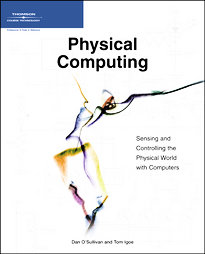
The book is patient (as good tutorials must be) and begins with probably the finest introduction to low-level networking that I have ever seen. If you are a software developer you will understand it; if you have no experience whatsoever in networking or programming, you may have some trouble. A good prerequisite text would be Tom Igoe's 2004 Physical Computing (written with Dan O'Sullivan) which focuses on the older Basic Stamp modules and their close relatives. Physical Computing introduces both electronics and programming to a degree that Making Things Talk cannot. That said, Making Things Talk presents examples using a Java-derivative programming environment called Processing, which is free and open source and much gentler conceptually than programming in raw Java or, merciful God help us, C. (Pascal would be gentler still, but as we all know, Pascal is a kiddie language that cannot accomplish anything useful. You must believe this. A C programmer said it. QED.)

Once the essential groundwork is done, the book teaches through projects, good projects that are mostly fun and in many cases even useful. The book explains how RFID tags work and how to read them, and how to read 2-D barcodes with a Web cam. The most fascinating projects are those that involve physical location sensing, using modules that perform infrared ranging, ultrasonic ranging, GPS, and “digital compass” modules, all of which made the robot guy within me itch like hell. We didn't have stuff like that thirty years ago.

Although it doesn't get a huge amount of coverage in the book, the XBee module (which implements a Zigbee data radio system) fascinates me: It's basically jelly-bean logic implementing a short-range mesh network, and I intuit that hobby robots of the future may well consist of swarms of semi-independent functional blocks knit together coherently through the Zigbee network protocols, under the control of a multicore master processor. And damn, I would love to build something like that.

Anyway. Here are a few additional observations on the book:

  • It has at least process color on most pages, with beautifully shot full-color photos on many of them.
  • The technical figures are abundant and very well done.
  • The type is very small, the margins narrow. This 425-page book would have been a 600-page book back in the 90s. My guess is that O'Reilly wanted to the keep page count down because of all the costly interior color. Note to my age cohort: Prepare to squint, or go get yer readers.
  • There is far less discussion on debugging than I'd like. Coding is easy—as is plugging jumper wires into breadboard blocks. But when something doesn't work the way it should, where do you start? The book is mostly silent on that crucial point.
  • In general, the book probably covers a little too much ground, and doesn't go for quite enough depth. Zigbee is subtle, and its subtler features are not explored here. This may not be a completely fair criticism, but it supports my conviction that you must be a journeyman embedded systems type to really get the most from this book, as a lot of the blanks you must fill in yourself.

Don't let any of that stop you: If you have some clue about embedded systems modules and want to learn embedded systems-level data communications, there is nothing like this book anywhere. And if I do decide to go back to embedded systems tinkering, this will be the book that pushes me over the edge. Not yet—I have a rocket or two to finish and a few other things to do—but soon, soon.

Highly recommended.

Odd Lots

  • Sorry for the silence here; I rarely go a week without posting but a lot of things ganged up on me. Many have noticed that I'm gradually moving toward posting less often but doing longer posts. I've discovered that it doesn't take me a great deal more time to write more detailed posts than shorter ones, but not posting at all on some days allows me to concentrate more fully on other projects.
  • There is a major total lunar eclipse tomorrow night, 2/20-2/21, which will be almost perfectly positioned for viewing in the US. See the NASA page for details. And if you're not up on lunar eclipses generally, ask Mr. Eclipse.
  • Flash memory is getting bigger; a 16GB SDHC card would hold a lot of ebooks.
  • Pertinent to the above: I'm not bullish on solid-state drives based on Flash, especially if they're positioned to replace ordinary spinning-disk hard drives. Flash storage cells can change state only so many times until they cease holding a state reliably, and extra hardware is needed to “spread the wealth around” so that frequent write activity in a particular location doesn't kill cells. Flash is thus best used for things like storage of music and ebook files, where you write data rarely but read it a lot.
  • Also, Flash may evenually be superceded by nonvolatile phase-change memory. We're still a few years off, but phase-change is faster than Flash and may even replace volatile RAM. No information yet that I've found on whether the cells degrade or die after a certain number of write cycles.
  • One other ebook note: Although most early reviewers claimed that the Kindle's SD slot was limited to 2 GB cards, the truth is that the card slot is SDHC and many owners have reported success with larger cards up to 8 GB. I don't have 8 GB of ebooks yet and may not for several more years. I just don't read that fast. For people who are actively converting their print library to ebooks, however, larger cards are a very important issue.
  • This nice link to NPR came over from Don Doerres, concerning the growing hobby of watching satellites. We used to go out and freeze butt looking for Echo in the early 1960s, but these guys are calculating orbits, photographing flares (momentary bright sunlight glints off polished satellite parts) and profoundly irritating the spooks. Watch the videos. Really watch the videos.

Odd Lots

  • Robert Jastrow, the well-known NASA space popularizer, has left us, at age 82. My copy of Red Giants and White Dwarfs is in pieces from overuse, but as with Jastrow himself, I can only say: Mission accomplished.
  • I stumbled upon an interesting piece of art today (while following an unrelated link sent by Pete Albrecht) by the late French Impressionist Albert Besnard. Rather too casually entitled “Decoration for a Ceiling,” to me it suggests something altogether more cosmic: The reunion of all things and all people with God at the end of time. As Pete suggested for a caption: “Honey, I picked up your wings from the cleaners.” (And how about using it as a book cover? Right there in the middle is space for a title!)
  • D-Stix are amazingly rare on eBay (considering all the rest of the bizarre and obscure crap that I see there regularly) but today I finally scored the 464-piece set from the mid-1960s, and for only $10 at that. I've mentioned D-Stix here on Contra in the past, and on our second date, Carol and I flew a tetrahedral kite that I had made out of D-Stix. Building a replica of that kite has been on my do-it list for some years now. All I have to do now is find some purple madras tissue paper…
  • Jim Strickland sent me a link to a nice page from a German chap (it's in English) who has done considerable work with spark speakers. This isn't quite a flame speaker as I saw one in 1969 (which used an ionized propane torch flame) but is more like a modulated Tesla coil.
  • Also from Jim (in honor of the Westminster Dog Show, which ran last night) is an entry from what might as well be LOLDogs. Alas, the bichon didn't win his group last night. (There are too many poodles in the world, and not enough melted butter…)
  • Still again from Jim is a fascinating short history of the Teletype.
  • While we're talking ancient communication technologies, I finally remembered to link to a summary of Western Union's “92 code,” which is a list of 19th century telegrapher's numeric abbreviations that includes the ''–73–” that has been my email signature since my MCI Mail days in the early 80s. This is as good a summary as I've found, but it's missing a few codes that I've heard, like –86– which is short for “We are out of…”
  • And further in that same direction, here's as good a list as I've seen of the 10-codes used by CBers, police, and, of course, Broderick Crawford.

Standard Wall Warts

I lost the wall wart charger for my Sony Reader a couple of months ago, and a new one should be here in a few days. I don't love the Reader, as its USB transfer software unapologetically refuses to run on Windows 2000, but a guy in my business should have one, just as he should have a Kindle. In the meantime, I've been thinking a lot about wall warts, chargers, and one area of electronics that could really use a standard or two. The high road is something like the WildCharger featured recently on Crave, which is basically a pad that induces a trickle of electricity into whatever you place on it. Wotthell, that technology should be available built into computer desks, but it's not up to me.

I am very sick of wall warts. I have a bin of them downstairs, probably thirty in all, and I doubt that any two source the same voltage. The barrel connectors are of wildly different diameters, and some of them put the positive conductor on the outside. A few, furthermore, are not even barrels but weird connectors of no conceivable justification.

Damn, I want a standard.

Consider this as a possibility: A code for wall warts that could be printed on both the wart and the electrical device it's shipped with. The code would be human-readable and contain the essential parameters:

DC5-20-100-6P

The code begins with AC or DC. (There are AC wall warts, lord knows why.) The next number is the whole number voltage, separated from the fractional voltage by a dash. A second dash sets off the current sourcing capacity in milliamps. The code ends with the diameter of the barrel connector in millimeters, followed by either an N or a P, depending on the polarity of the inner conductor. For example, the code shown above would be for a DC wart sourcing 5.2V at 100 ma, with an 6mm barrel connector having positive on the inside.

There's no reason these things can't be like jelly-bean logic, and there's no reason why anyone should have to dig too hard or pay too big for a replacement wart. The IEEE should be doing something like this, but isn't.

My new Sony Reader charger will show up the day after tomorrow via DHL. And the day after that, I'm sure I'll find the original. At least then I'll have a spare.

Booting Kubuntu from a Removable Drive

Pete and I discovered something interesting recently, almost by accident. Ok, it was almost entirely by accident. But it's useful nonetheless: We figured out how to install and boot Kubuntu on a removable hard drive after Kubuntu's installer failed to see the removable drive.

I've written about Dell's SX260/270 small form factor desktop here a number of times. It's a tiny little micro-tower made from laptop parts, especially Dell's Inspiron line. Its single most useful feature is its “media bay,” a front-panel slot that accepts several different kind of removable drives, including floppies, Zip 100s and 250s, CD and DVD drives of all stripes, and hard drives in appropriate cartridges. These cartridges are available empty, and Pete and I each bought such a cartridge plus an 80 GB notebook drive to install in it. The idea was to install Kubuntu on the cartridge drive, and then figure out how to dual-boot between Windows on the main hard drive and Kubuntu in the cartridge drive.

Except that I couldn't get Kubuntu's installer to see the cartridge drive, and thus couldn't do the install. Oh, well. We were interested enough in configuring Kubuntu and experimenting with some OSS titles accessible by KDE package manager Adept to pull the main Windows hard drive out of my SX270 lab machine and drop the new, empty hard drive into the main internal drive slot in its place. From there it was a typical and easy Kubuntu install, and we spent an afternoon trying things out. (Adept is a marvelous thing!) The next day I wanted to use my scanner downstairs, but the scanner software was installed under Windows, and HP infamously does not provide Linux drivers for its products. So I pulled the Kubuntu drive out of the SX270 and put the Windows drive back in. On a whim I installed the Kubuntu drive in my empty media bay cartridge and plugged the cartridge in to the machine's media bay to see what the boot process would do. I restarted the SX270, and wham! Kubuntu booted.

It's obvious in hindsight: The BIOS lists the CD drive ahead of the internal hard drive in boot order, and the CD drive lives in the media bay. In fact, anything with a master boot record plugged into the media bay will boot (or try to boot) before the internal hard drive.

There is a downside to using Kubuntu from the SX260/270 media bay: There's only one media bay, so with the Kubuntu hard drive cartridge plugged in, there's nowhere to put my media bay optical drives. (I could buy a USB optical drive, but that's yet another piece of hardware to keep track of.) The real solution is to figure out how to make grub dual-boot Windows and Kubuntu from separate partitions on the 120 GB internal hard drive. Remarkably, O'Reilly does not have a book on grub, even though they have whole books on numerous deep-geek software packages with user bases (barely) in double digits. (There are millions of grub installs. Maybe tens of millions.) So I've been reading the scraps posted here and there online and will figure it out eventually.

I guess I should have known that anything in the media bay would boot before the main hard drive. I freely admit that I didn't. Sometimes, well, you just get lucky.