Jeff Duntemann's Contrapositive Diary Rotating Header Image

hardware

The Yard’s All Out of 3 X 4s…

I’ve gotten far enough into the revision of Assembly language Step By Step that I need to have a Linux machine running up here in my office all the time. I often spend hours in Ubuntu on this dual-boot machine, but there are still some things I need to do in Windows, and booting in and out to bounce from one to the other is time wasted, and pointless when I have old PCs stacked like cordwood in the basement.

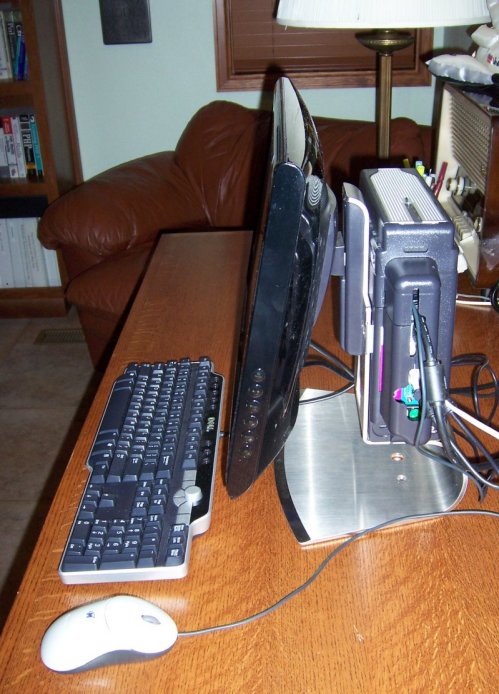
SX270AndBracketOnDesk2.jpg

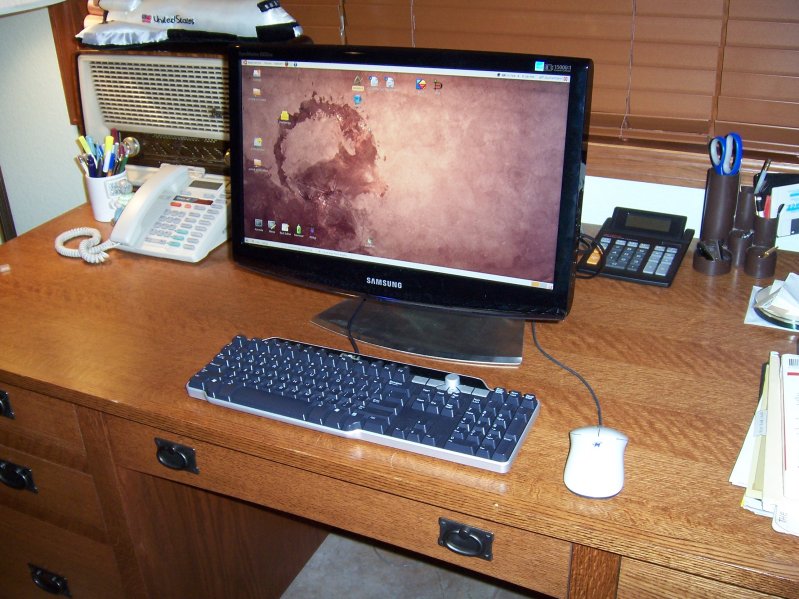
I have one of the very cool SX270 stainless-steel all-in-one brackets that combines a 10cm VESA monitor mount with a couple of tangs to hold an SX270 mini-PC behind the monitor. It makes for a very compact system, and in fact it was the integration of the SX270 and the monitor on the bracket that first brought the SX270 to my attention some years back, when I saw a couple of them at our optometrist’s office. So I took my spare SX270, parked it on the bracket, dug a Dell keyboard and a mouse out of the odd lots box, and realized that I did not have a VESA monitor to hang on it. So off we went to Best Buy, where I learned from the earnest young woman in the computer department that they had not sold 4:3 monitors for almost a year now. Every single one in the long line on display was 16:9.

I know why this is the case (home theater) and whereas it wouldn’t be my first choice, I’m willing to use that form factor, and really needed a monitor. I was apprehensive for a simple reason: The SX270 was made in 2003, and I don’t recall the machine supporting the 1600 X 900 resolution of the smaller 16:9 LCDs. I took a chance, figuring (or at least hoping) that I could rummage around online and come up with a newer driver for the Intel 82865G graphics chipset.

What I bought was a Samsung SyncMaster 2033SW. It’s VESA-compliant, and I bolted it to the stainless steel bracket without difficulty. It was on sale for $179. The machine itself cost me less than that; I think $150 on eBay some time last summer. 2.8 GHz, 1 GB RAM, with XP Pro–used and used hard, and ugly up close, but completely functional. I went up to Dell’s site to see if newer video drivers were available, but what they had was what I had. The closest that Windows could come to 1600 X 900 was 1280 X 768. The monitor centered the smaller raster in the middle of its screen, with the surrounding pixels dark. There was a “stretch” option that spread the raster out to the full extent of the screen, but it looked hideous.

Fortunately, Windows wasn’t the goal here. I booted the Ubuntu Intrepid installer CD in LiveCD mode to see what the OS would detect and how it would respond, considering that the machine dates back to 2003. Without a grunt of complaint, it detected the graphics hardware and loaded a 1600 X 900 driver. I tried a few things, pronounced it good, and told the OS to go install itself in earnest. Twenty minutes later, I was downloading NASM, Kdbg, the Bless Hex Editor, Nemiver, ddd, and a few other things through the Synaptic Package Manager. Not once did I have to face a command line. Everything Just Worked. The age of the machine (apparent from its collection of dents and inventory-tag stickum) didn’t seem to matter at all.

The display is gorgeous; it’s easily the brightest LCD I’ve ever seen. The whole gadget takes up about as little space as anything with a 20″ monitor possibly could. And after spending an afternoon with it, I realize that a long horizontal aspect can be handy: Editor on the right, Kdbg on the left, and just enough of a terminal peeking out under the editor to run make as needed.

I’ve been fooling with Linux intermittently for well over ten years, and the craziness of today’s events still boggles me: It installed much faster and way more easily than Windows generally does, and on old hardware to boot. This was not the case in 1999, let me tell you. If MS isn’t in trouble by now, it’s nobody’s fault but our own.

Odd Lots

  • The United States has overtaken Germany as the world’s lead producer of wind energy, measured in total kilowatts. Way to go–keeping in mind that Germany still beats us all hollow with kilowatts per capita. I’m a big believer in NWS, in that order, and part of the reason N comes before W is that over the past few years, when Carol and I have passed giant wind turbines along I-80 on our way to and from Chicago, they were only turning about a third of the time. Wind energy is great, but it does not stand alone.
  • Small children should be allowed to get dirty as a way of building their immune systems. I was digging in the back yard since before I can remember, and never had much trouble with allergies. There may be a downside to our dirt- and germ-averse culture that has nothing to do with the risk of antibiotic-resistant pathogens. (With Gretchen’s approval, I think I’m going to buy our nieces a couple of garden trowels next Christmas…)
  • Few people today remember that Apple Computer was once a Pascal shop, and had a promo poster in the late 70s incorporating a classic “railroad” diagram of Pascal language syntax. Yes, the 70s really did look like that. (At least it wasn’t all done in Harvest Gold.) Thanks to Paul Santa-Maria for the link. Paul created his own version of the poster in black and white, which I hope he makes available at some point. The Waite Group sold (or gave away; not sure if it was a boom promo) a similar card in the same era, but it’s long since vanished from my collection.
  • Has anyone here ever read any of the Very Short Introduction books from Oxford University Press? Are they useful? I just ordered several, and I’m curious as to the quality of the series. I’ll report here once the books show up and I’ve had a chance to read them. There are many subjects I’m interested in sufficiently to read 150 pages on, but not 600 pages.
  • A German publisher wrote an article claiming that cheaper ebooks will put them out of business. (The article is in German; take what you can from the English summary or if you know the language, click through to the original.) The gist is that there are special costs associated with e-publishing that more than balance the special costs associated with print publishing. My take: If true, it’s only until we get up to speed. (I also think it may be true that many publishers don’t really understand all the forces that bear on how they make their money. Many things lead up to the cash-register’s beep, not all of them obvious.
  • I’m a lot less sanguine about the OLPC than I used to be, but the recent unveiling of future designs intrigues me: The next-gen OLPC will have two displays, and can be held and read portrait-style, like a book. When a keyboard is needed, rotate the device 90, and one of the two displays becomes a keyboard. Very cool, and something like that should be sold worldwide by every electronics retailer. (Their peculiar distribution mechanism will eventually be the end of them.)

Odd Lots

  • In one of my rambles around the Web looking for interestering perspectives on education, I ran across this very insightful (if possibly misnamed) blog post. My take: We are teaching an entire generation that their own blathery opinions are unassailable. Be Afraid. Be Very Afraid.
  • From Frank Glover comes a link to recent research suggesting that too much artificial light at night correlates with higher risk of breast and prostate cancer. More research is needed, but if the answer is to go to bed early and sleep in a dark room, Carol and I have it covered.
  • Rocky Jones’s Silvercup Rocket is well along on its restoration, and this page has both period and recent photos, as well as the best history of the Rocky Jones TV show that I’ve seen anywhere. (Ok, I’m biased–two of the photos are mine!)
  • Many people who have read my Hi-Flier Kites article have asked me what sort of paper was used to make the dime-store paper kites of the 1960s. I’ve asked around and tried any number of papers, but now I think I’ve come fairly close with a type of paper made in Germany and called–sunuvugun–“kite paper.” For some reason it’s popular with the Waldorf school crowd, though not for making kites. You can get it in 19 1/2″ X 27 1/2″ sheets, albeit only in 100-sheet lots, from A Toy Garden. That’s a little smaller than the Hi-Flier 30″ kite, but it’ll work. As spring gets a little closer, I’ll make one and report back here.
  • What the Waldorf schools do with kite paper is in fact impressive; this Flickr album scrolls through a good many photos of Waldorf traditional origami stars made with kite paper.
  • From Bill Higgins comes a link to Low End Mac, a site devoted to older Mac machines, especially pre-OS/X.
  • Pete Albrecht sends hope that Maurice Lenell may not be out of business, though their suburban Chicago plant will be razed to make way for yet another damned shopping mall.
  • I have several reasons for opposing contact team sports in schools (as opposed to careful weight training and aerobics). This is another one.
  • The three things I was afraid of as a six-year-old were robots, mummies, and volcanoes. I’ve made my peace with robots and mummies, but volcanoes still give me the willies, and our Alaskan citizens are watching another one nervously.
  • In case I don’t remember to mention it tomorrow or Sunday, Puppy Bowl V on Animal Planet kicks off at 3 PM EST Sunday, 2 PM central, 1 PM Mountain. When you get good and tired of watching spoiled-brat millionaires get the crap beat out of them by other spoiled-brat millionaires, the puppies may be a blessed relief. We never miss it anymore.

Cruzer Micro Skin

I’ve been using removable storage for a long time, and five years ago I moved from Iomega ZIP 250 MB disk cartridges to Cruzer Mini 256 MB thumb drives. I chose the Cruzer Mini line for a slightly weird reason: They fit comfortably in the pencil groove of my Northgate keyboards. Not all thumb drives do, and I’ve found it very convenient to have all of my active removable storage devices sitting there right where I can grab them.

Five years on, and not a single one of the Cruzer Minis has ever given me a lick of trouble, though I destroyed one once by working too fast. SanDisk no longer makes Cruzer Minis, and the ones I have are fairly small, some only 128 MB. This makes for lots of thumb drives lying around; for example, I had to put each one of the five Carl & Jerry books on its own Cruzer. It was time to scout out something else that would fit in my pencil groove, and with considerable delight I discovered the SanDisk Cruzer Micro Skin. They’re shorter than the Cruzer Minis, and a little narrower. No problems keeping them in the groove.

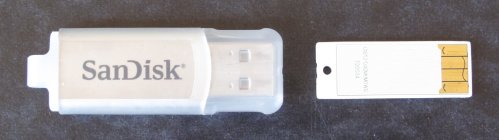
I bought them for their size, and didn’t understand the line’s gimmick until I had one in my hand: The Cruzer Skins are inside a flexible, tough plastic sleeve with an end cap of the same material. The skin and cap fit the metal body of the device very closely, enough so that if you dropped one in the sink the works wouldn’t even get wet if you pulled it out within a few seconds. (I’m guessing that they float, in fact, though I’ll let somebody else do the experiment.) You can remove the sleeve and apply a Brother-style label to the drive body, and then wiggle the sleeve back over it. This protects the label, especially if you drop it in your pocket with your car keys, as I’ve done a time or two. (Brother labels mar very easily.)

They’re yawning huge compared to my five-year-old Cruzer Minis. I recently bought several 4 GB units for $12 each, and an 8 GB (for $20!) to hold all five Carl & Jerry books, including high-res raw scans of all the 300+ illustrations. I’ve been able to consolidate several ongoing book projects from separate 256 MB cartridges onto a single 4 GB unit. The caps don’t fall off; you have to yank them. They don’t come with lanyards, but you know, I have yet to see anybody keep a thumb drive on a lanyard. (A lanyard loop is there at the end of the unit if you want to make your own, like we did at summer camp in 1965.) We’ll see how they hold up over time, but right now, I say highly recommended.

Odd Lots

  • From the Words I Didn’t Know Until Yesterday Department: The Ranters were a wild-eyed seventeenth-century religious fringe group, who were perhaps most notable for incorporating nudity into their worship. (Whatever else they might have been, they sure weren’t Catholic.)
  • From ditto: In modern urban slang, a “butterface” is a homely girl with a great body, as in, “Every part of her was perfect but her face.”
  • And elsewhere on the words front, even William Safire, from whom the scariest words recoil in terror, was unable to determine the origin of that very up-to-date and with-it 90s expression, “it is what it is.” Wikipedia suggests that it was coined by John Locke, circa 1680. So much for being up-to-date.
  • From the Microprocessors I Never Heard of Until Yesterday Department: There was an 80376. It was an embedded variant of the 80386 that did not support real mode, but only protected mode, and was produced from 1989 until 1994.
  • Much angst is flowing about the blogosphere concerning the Conficker worm, but this is the first page about it that I respect at all. I’ve long since disabled Autorun, and in fact, “autorunning” things is one of the worst ideas in computing since DLLs. Make sure you’ve got that November patch they speak of
  • And while we’re talking worms, here’s some news on a piece of malware that comes in on pirated Mac software, evidently with the intent of creating an all-Mac botnet. The dangerous thing here is that a lot of nontechnical people seem to believe that the Mac is immune to malware somehow. OS/X is certainly tougher to infect than Windows, but it can be done, especially when people are sure that it can’t.
  • Carol and I launch our Internet-facing apps under a clever mini-utility called DropMyRights, which basically runs such apps with limited user account privileges instead of admin privileges, even if you’re running as admin. Doesn’t work on Win2K, so I have not used it myself until fairly recently, but I installed it on Carol’s XP box probably two years ago, and she has used it daily without any issues since then.
  • I have tried and failed to make a Linux utility called KGrubeditor work under my instance of Ubuntu Intrepid. When I attempt to launch it, an item appears in the taskbar for about fifteen seconds before vanishing, and nothing else happens. At least one another person I know has made it work correctly, but I just don’t see what I’m doing wrong. I installed it through Ubuntu’s apt-get shell and saw no errors during the process. If any of you are users and are aware of any trickiness in the utility, I’d love to hear more.

Michael Arrington’s Crunchpad Gets Real

crunchpadb.jpg

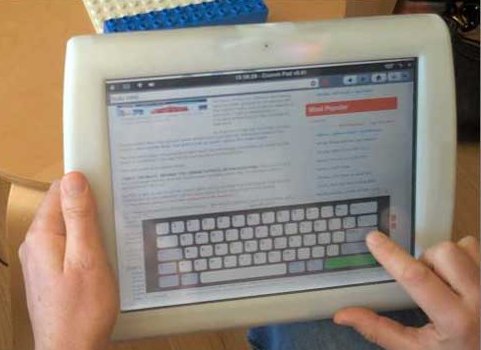
I read about Michael Arrington’s concept for a low-cost Web tablet back last summer, and was intrigued. Web is useful, but the resolution on this gadget (1024 X 768) would make it ideal for reading PDF ebooks, particularly textbooks and scientific/technical nonfiction with lots of illustrations. Not every type of book can be read on a cellphone, and the sorts of ebooks that require larger displays are getting precious little respect in the gadget world.

But I learned today that the Crunchpad (as the TechCrunch crowd is now informally calling it) has reached the prototype stage. They sound like they’re aimed in the right direction, but remarkably, I see no discussion at all of the device’s usefulness as an ebook reader. (I added a comment to the entry to this effect.) It looks like it can work in portrait mode, and has an accelerometer to sense when it’s been “spun.” Ebook reader utilities are not cycle-hogs, and would add little to the burden on the CPU or SSD storage.

I’m a little queasy about on-screen touch keyboards; I would use the USB port for a “real” keyboard when one is needed. I would also add an externally-accessible SDHC card slot for loading content without waiting for the inevitably slow Wi-Fi link. But beyond that, if the thing can render PDF and CHM ebooks well, I’d buy one like a shot, and pay $300 for it without regret. This is one to keep an eye on.

The New Economics of Cool

There was a very funny article by Daniel Akst in the Wall Street Journal this morning, about a very stylish New Yorker who converted his entire family to Macs years ago because, well, they were cool. This is easy to do when you have a good job and you know your co-op will continue to appreciate at the rate of 30% a year forever. However, now that Big Media is reminding us every day that we are being crushed under the worst Depression in world history, even the cool people are buying Windows machines because the cost of cool may far outweigh its benefits.

(By the way, although Dan looks cool–click to his Web site–he is actually a highly insightful writer who could make his reputation by puncturing cool culture as his writer’s mission. Read his stuff. I think he should start by buying a suit and getting a professional publicity photo taken. At least he hasn’t shaved his head, which the majority of cool guys do, especially once they start to go bald.)

There’s nothing wrong with Macs apart from the fact that they cost too much. I have some technical quibbles about the UI–using a one-button mouse was a hideous mistake, founded in Jobs’ condescending view that All Users Are Idiots–but it’s a very solid, well-engineered box, basically a Unix system that has been beaten about the head until it learned some manners. But that’s not why people buy them, and once The New Austerity goes mainstream, either their prices will come down or they will become the next NeXT.

MAKE Magazine regularly runs articles about making furniture out of old cardboard boxes. Odd, though, that I rarely hear anybody say that used computers work just as well as new computers–better, actually, when the new runs Vista and the old runs XP.

And cheap. You want cheap? On eBay right now as I write this, there’s a used 2.8 GHz Dell SX270 with 1 GB of RAM, a keyboard, and a mouse. Starting bid is $89.95, the auction expires in an hour, and there are no bids. I can tell you from personal experience that this is a very good machine, because I have one almost exactly like it in our condo in Des Plaines, and I very happily lay out books on it and process graphics. Add an SX270 Windows install CD (which may cost you $30) and a monitor (which you may already have) and for under $200 you have a machine that is built like a tank and will do anything you need to do. The install CD is BIOS-locked to the model (not the individual machine) and you don’t have to activate it. The only thing it won’t do is be cool.

Interestingly, there are pockets of coolness in the free software world, as I’ve discovered as I’ve kicked into high gear revising my assembly language book to be all-Linux. The cool index of Karsten “Rasterman” Heitzler’s Enlightenment desktop manager is off the charts, and Raster’s been working on it for 12 years now. He himself is one of the coolest geeks I’ve ever met, and he does it without any condescension or venom. (I’ve spoken with him in person on several occasions, though it’s been awhile.) How well it works I won’t know until I try it, but that’s a separate issue. The cool is there. Few people know about it because cool is a proxy for status, and status is a proxy for money. If it doesn’t cost money, and if just anybody can get it, then in our culture it’s almost by definition not cool.

This may change. It may change in weird ways, too. It’s currently cool to live in Manhattan, but once companies move most New York jobs to Iowa, Iowa may have to become cooler. Pockets of uncool places are sometimes cool, like Boulder and Austin, but such cool places are so expensive that they may eventually share New York’s fate. You can buy a three-bedroom bungalow outside of Ogallala, Nebraska for 10% of what a similar house would cost in Santa Cruz, and you’d be closer to the beach than much of Santa Cruz. (It’s a way better beach, too.)

Jobs will eventually follow affordable housing. Are you too cool to live in Nebraska? Heh. We’ll see.

Odd Lots

After giving it much thought, I’ve decided I rather like gathering links and other short items into lists rather than publishing each as a separate entry. Don’t know why, and I may change my mind. But for the time being, I’m continuing the ancient Contra custom.

  • While in Chicago over Christmas, we watched a movie I wholeheartedly condemn: Knocked Up. The film was completely unlikeable, and consisted almost entirely of out-of-control people screaming obscenities at one another. Sheesh.
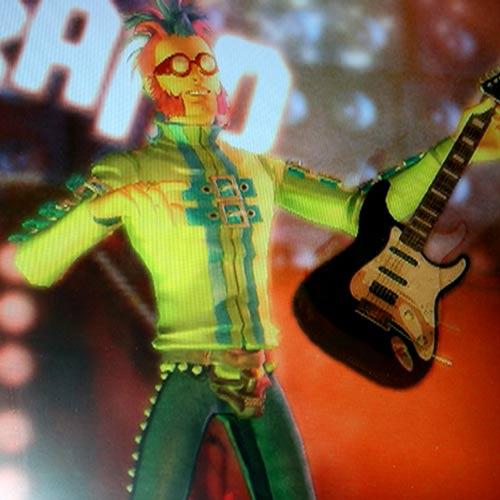
  • That was depressing, but the other thing we did that same evening was play Rock Band, a Wii app with a string-less guitar and drum-less drum kit. That was way more fun. I’d hoped it would be a sort of Miracle Rock Music Teacher, but that’s not its mission. However, I did reasonably well at the drums and quite well on voice, even though there were only three songs on the whole list that I had even heard of, and none that I especially liked. You have to choose an animated avatar (there’s that word again) and after much searching for a bald-headed middle-aged white boy, I had to settle for the wonderfully named Duke of Gravity. The Duke was my choice because he had big bushy sideburns, which (apart from the color) resembled what I used to have in the 70s. Next time, can I be the Duke of Electromagnetism? (I didn’t know codpieces could have teeth.)
  • Spaceweather posted one of the spookiest sky photos I’ve ever seen, and I take some delight in the fact that atmospheric experts can’t explain it. If things like this happen every so often (even if only every 30 or 40 years) no wonder our ancestors believed in gods and angels.
  • The BBC has a very nice article on the mysterious Soviet Buran shuttle, which made precisely one flight comprised of two orbits plus an effortless return to Earth, all without a single human being in the cockpit. Thanks to Frank Glover for the link.
  • Pete Albrecht reminded me that, sandwiched between the end of the steam era and the beginning of the diesel-electric era, we had a very thin sliver of railroad locomotive evolution called the steam turbine-electric era. Behold the most formidable example, the C&O M1, a 4-8-4-8-4 (!!) in which a coal-fired steam turbine spun a generator, producing electricity that turned electric motors over the wheels. Man, they don’t make trains like that anymore. But they could. (After all, we have more coal than they have oil.)
  • The teeny, gummy Cruzer Micro Skin (so named because the whole thing is encased in a soft and slightly sensual plastic sleeve) is available in an 8GB version, and Amazon is now selling them for $12.99. (Marked down from $90!) I grabbed one; every MP3 I’ve ever ripped from my CDs will fit on that, with room to spare. The “big” 16 GB Cruzer Micro is already out there for $32.99–that’s a thousand times the capacity of my first thumb drive, which I bought back in 2001 for $50.
  • Here’s The Secret Origin of Clippy, a 15-slide retrospective based on Microsoft’s patent filings for animated screen assistants, of which Clippy was the least obnoxious. Tapping on the inside of the glass was clever and funny for the first twenty minutes, but now (with a plastic flat screen in front of me) it’s just, well, tired.

Odd Lots

  • Foxit Software (which sells a line of very good PDF-related software, including the Foxit Reader, which I use daily) has announced an e-ink based ebook reader, the eSlick. The device isn’t being shipped yet, but there have been some early reactions in Wired and other places. I’m interested because Foxit is unlikely to claim (as most ebook enthusiasts do) that PDF is the spawn of the devil. Worth watching.
  • The Loopy Idea of the Month comes from two Ohio academics who have recently patented the notion of collapsing hurricanes by flying around them in supersonic aircraft and (somehow) using the sonic boom shockwaves to scramble the storm. Apart from the fact that supersonic aircraft use fuel at a prodigous rate, I still don’t quite follow the physics of how this is supposed to collapse the storm. (Thanks to Pete Albrecht for the link.)
  • Jim Strickland passed a long a detailed how-to for extracting metallic titanium from white pigment. The process is straightforward, if (as it must be) highly energetic. I think the stickier question is working the titanium after it’s been isolated. Titanium is difficult to melt and very difficult to machine. I have a piece in my curio cabinet, and I’m very glad I don’t have to make anything from it.
  • Many people sent me the latest version of the old joke that “If Programming Languages Were Religions…” most of them lamenting that my favorite language—and my favorite religion—were not included. So it goes. I’m guessing that Pascal, like Catholicism, is patient: There will be only one programming language in use in the hereafter, and it will not be C++. You’ll have to go somewhere else for that.
  • The Wall Street Journal tells me that the RIAA is abandoning its mass-lawsuit strategy of copyright enforcement. It hasn’t worked at reducing music piracy, and its sole effect was making the music industry bigshots look positively evil. One can only wonder why it took so long to figure this out, and whether the damage can ever really be undone.
  • Here’s a wry peek at what we may see come out of the Big 3 bailout. Thanks to Pete Albrecht for the link. Have you driven a Pelosi lately?
  • Also from Pete comes word that Werner Von Braun wrote SF. This actually looks pretty good—gotta love that cover!

Bending Your Thumb

I was given Carol's sister's old 2002-era Dell laptop recently, in hopes of degunking it and making it useful in Carol's hobby room for Web lookups. My approach in dealing with the machine was what I generally do: Leave it off-network, and plug in a USB thumb drive full of portable degunking utilities. Being in a hurry rarely leads to anything good, and what I was not used to was a laptop in which the USB ports are on the spine of the machine rather than one side or another. So I plugged it into the back, and at some time during my first ninety seconds in front of the laptop, I tipped it back and up on its spine to see if the battery lock had come loose on the bottom plate. The obvious result is shown above.

Dratz. Cruzer Minis are getting increasingly uncommon, and this was literally the first time that I have ever had one go bad on me, whether I was the proximal cause of badness or not. Astonishingly, the drive still works, though the metal USB connector is now holding on solely by its printed circuit contacts. Fortunately, there was nothing on the drive but software that I have elsewhere, so it went into the trash without huge regrets. Not huge. Not small. Middling.