- Several people have asked why I didn’t post any photos from the big 4-day dog show in Denver, and I must admit (with profound annoyance) that my camera bag vanished sometime on Monday, and both of my digital cameras were in it. That’s a Canon G10 and a Nikon CoolPix S630, and with the biggish SD cards I put in them, it’s close to a $1000 loss. Neither the hotel nor the National Western Complex recovered the bag, so I can only assume it was stolen during the show, and with it went all the photos we took through Sunday night.
- Slashdot reports that 80% of all software exploits during the fourth quarter of 2009 were malicious PDF documents. I’ve been a Foxit user for some time, but as Foxit becomes more popular, the bad guys will begin exploiting its flaws as well. (There is evidence that this has already happened.) It may be time to test software like Evince and Sumatra, both of which are available for Linux and Windows.
- As I write this, you have eight hours to bid on the Compaq II machine that Anders Hejlsberg used to develop Turbo Pascal 4.0. The proceeds from the auction go to the Clinton Bush Haiti Fund. It’s one of those green-screen luggable that I always admired, but bidding is currently at $2025, yikes. (Thanks to the many who pointed this out, with Larry O’Brien being the first.)
- Something confirming a phenomenon that I’ve noticed: Food expiration dates are conservative, and most food is good for a reasonable period after they supposedly time out. Still, after expiry, your nose is your stomach’s best friend.
- For whatever it’s worth, here’s a list of the top-grossing movies of all time, with inflation-adjusted values. (Thanks to Frank Glover for the link.) Unsurprisingly, Gone With the Wind still beats all comers with a mind-boggling 1.5 billion dollars, the though the original Star Wars is right behind it at $1.3B. What’s worth noting is that all but six films in the top 14 were either Disney animation or special-effects extravaganzas. (It’s all but five if you think the opticals in The Ten Commandments were significant, as I do.) Lesson: We don’t go to the movies to watch unpleasant people screaming at one another.
- Also from Frank comes a pointer to a short item suggesting that we kiss to enforce reproductive monogamy by developing immunities to one another’s specific viruses. I’m not sure I buy it either, but evolution has done far weirder things than this.
health
Odd Lots
Odd Lots
- Here is the entire sky projected on a plane, and zoomable. (LINK REMOVED–SEE COMMENTS.) That doesn’t do it anything like justice. Cruise the image a little and gasp. (Give the site time to refresh; it’s newly slashdotted.) Read the rest of the page too–it’s fascinating, and full of great photos. Chile looks a great deal like Mars in some places.
- There is apparently a correlation between sleep loss and amyloid tangles in the brain, which are a key element in Alzheimer’s Disease. Causation is still a little unclear, but I find it significant that in our era of Anything But Sleep, the incidence of various dementias is exploding. Be in bed by 10:00PM and keep your brain. Now there’s a deal I can live with.
- Wired has an interesting retrospective on tablet computing, which I found worthwhile mostly for the mention of a steampunk-era electromechanical handwriting encode-and-transfer device, which ferdam sounds like what Sherlock Holmes would use to IM Watson.
- Here’s another worthwhile perspective on the Google Books Settlement.
- A chap who calls himself the Jolly Pirate wrote to tell me that the Pirate Party is alive and well in the US (I was under the impression that it was a European thing) and some interesting links may be found on its site, many of which have nothing to do with piracy. Now, would an American instance of the Pirate Party lean left or right? (Or would it be port and starboard?) I’ll be damned if I can decide…
- It’s been a bad season for big-time wine critics, who can’t seem to find a business model and keep getting busted in conflict-of-interest scandals. The Internet allows the crowdsourcing of critique of all sorts of things–why should wine be any different?
- Pertinent to the above: What we need is the wine implementation of the “People who liked this also liked…” mechanism I see (and use) in the book world. I very much like Campus Oaks Old Vine Zinfandel, though the 2007 vintage now in stores is a pale shadow of 2005. What would be a wine similar to that? (If you know of such a system for wine, please share.)
- There are candy Legos.
- The charger for my Kodak pocket camera is a thin little slab with two 110V power plug pins that swivel out to plug into the wall, and then swivel back into hiding when they’re not needed. Why can’t they build that mechanism right into the back of an ebook reader? (I was without my Sony Reader for a couple of months after I lost the charger.)
- After an unexplained absence of several weeks, Fort Carson’s cannon is back. (See my entry for September 15, 2009.) Maybe the cannon was broke and they had to send it back to the factory for repairs…
Tell Me What “Junk Food” Is
Much opprobrium has been heaped on junk food in recent years. I’m willing to listen–but if we’re going to eliminate it from our diets, we first have to know what it is.
So…give me a definition.
The definition must be precise; that is, terms like “empty calories” or “having no nutritional value” are subjective judgments and thus not useful. Specify ingredients, and proportions (as percentages) if necessary. Furthermore, the definition must be about the food itself. Where it’s prepared or served is a separate issue and cannot be part of the definition. If an ingredient is junk, it’s junk whether it’s served at Mickey D’s or at Olive Garden or at the $75-a-plate fancy dinner joint of your choice. (Or at home.)
Methods of preparation may be cited, but again, such citations have to apply across the board, no matter who does it or where. Expensive junk is still junk.
Finally, “the term is meaningless” is a legitimate answer. However, if that’s the case, let’s make it meaningful, by creating a clear definition.
Let’s hear from you.
Rant: The Case for Killing Newsweek
 I am aghast. Yesterday afternoon I was at Barnes & Noble, and at the checkout stand I saw what must be the most appalling magazine cover ever to appear on a mainstream US magazine. It wasn’t on Hustler or Soldier of Fortune. It was on the latest Newsweek.
I don’t dabble in politics much here, and I haven’t had much to say about the health care debate that others haven’t said many times, and probably better than I would. But I want to make my position clear: If health insurance reform collapses, it won’t be due to any vast, right-wing conspiracy, not with ol’ Newsweek leading the charge. Salon ran this piece back in August. Same gist. Similar stupid title.
There is a meme abroad, and while I don’t know if it has a name, I call it “Lammism.” The gist of the meme is that the elderly are an expensive extravagance, and money spent on them would be far better spent on younger people. This is not a new thing. I gave the meme its name in honor of former Democratic Colorado governor Richard Lamm, who famously said in 1984 that the ill elderly “have a duty to die…and let our kids build a reasonable life.” I guess it’s us or them, Dick, right?
It doesn’t matter that the Newsweek article is far more nuanced than its moronic title suggests. It doesn’t matter if “society needs to have this conversation with itself.” All that matters is that we are scaring the living crap out of our elderly, and if the elderly don’t sign on to health insurance reform, we don’t have a bill. Furthermore, if we dismiss their fears out of hand and pass a bill anyway, there could well be another party in control of Congress after the next election.
The elderly are not simply being paranoid. They know that Medicare is a very sweet deal, especially compared to the insurance situation of a great many younger people. They know that the government spends a huge amount of money on their care and sustenance. Given articles like those I mention above, they can be forgiven for fearing that when the government goes looking for health care cost savings and “waste,” that they will be first in line for close examination. They know that without fairly constant and often expensive medical intervention (paid for through Medicare) many of them would be disabled, dependent and suffering, and a great many more would simply be dead. Small wonder that they’re willing to believe the fearmongering lies of death panels that do not exist.
(The elderly might wave the magazine and reply: Yet.)
In Newsweek, we have a classic example of a print publication floundering to survive, and willing to risk it all on a misleading and alarmist cover line that bears little connection to the cover story. The plug on the cover of the latest issue isn’t connected to Granny. It’s connected to Newsweek.
Please join me while I pull it.
Review: Banting’s A Letter On Corpulence
“Do you like Banting?”
“I don’t know. I’ve never banted.”
Unlike the oft-quoted line about our man Rudyard, this isn’t really a joke. I have banted, I’m still banting, and I do like it. However, I didn’t know it had a name until a couple of months ago, when I read William Banting’s A Letter on Corpulence, Addressed to the Public, and began to research the booklet’s background.
Dr. Atkins, shove over. Mr. Banting was here first.
In London in the early 1860s, an overweight undertaker was talking to doctors about his obesity. He had watched himself put on weight over the previous thirty years until, at age 65, he weighed 202 pounds, and stood only five foot five inches. He was having trouble getting up and down stairs and doing simple things like tying his shoes. He was annoyed. He had tried everything local physicians suggested, including buying a boat to row on the Thames and walking briskly every day, and taking various medicines that we would today consider worthless nostrums. Nothing worked. Then he came upon Dr. William Harvey, who made a suggestion that seemed too simple to be useful: give up beer, sugar, and “farinaceous” (starchy) foods.
Banting did so, beginning in September, 1862. And fortunately for us, he was of a scientific turn of mind, and wrote down both what he ate daily, and what he weighed every three weeks, for the following year. And in that year he dropped 46 pounds, eating mostly meat and non-starchy vegetables, plus a piece of dry toast or rusk (zweiback) for tea. And he lost the weight even eating four meals a day and drinking an amount of alcohol that would leave me unconscious on the floor.
After losing about a pound a week for that year, he felt better than he had in two decades, could navigate stairs without hyperventilating, and do whatever he needed to do in terms of ordinary activities. He felt that his eyesight and hearing had improved. He was, in short, a happy guy. And having achieved his goal of losing significant weight, he did a remarkable thing: He wrote up his experience as a pamphlet addressed to the public (what today we’d call an “open letter”), printed it at his own expense, and then handed it out to anyone who was interested.
It was popular enough to warrant two sizeable addenda across several printings, but even with those included the whole thing is only 25 pages long, and available as a free facsimile scan from Google Books. You can read it in fifteen minutes, though people who are not used to Victorian diction may find the text a bit of a slog. The pamphlet became popular and was much discussed in the London area at that time, enough so that “to bant” became a new verb, and meant to adopt Banting’s diet as a means of losing weight.
The Google Books edition include two longish contemporary commentaries, one from Blackwood’s Magazine, the other from Harper’s Weekly. Both are snarky wanders intent on demeaning Banting’s experience, and neither confronts the truth face-on: Banting did an experiment, recorded his results, and made them public without any attempt to profit from them. (In fact, he gave 50 pounds to a local charity hospital in thanks.) Instead, Blackwood’s tries to convince its readers that Banting was not all that fat to begin with, and besides, fat people tend to be affable and law-abiding citizens, so it’s good to be fat! There’s not a lot to be taken away from the two reviews except the sense that things don’t change much; many of the same groundless arguments are thrown today at low-carb diets, simply because “everybody knows” that eating fat makes you fat and the best course is a “balanced diet,” which, as always, means “a diet that I favor.”
William Banting is important because his experience predates the modern carb wars by close to a century. He wasn’t trying to debunk Ancel Keys’ fraudulent research or establish a diet-book empire. He was just writing down something that had worked for him, and he cautiously suggested that, under advice from their own physicians, overweight people might try the same method. It may not work for everyone, but (in contradiction to the ridiculous critique in Blackwood’s) that does not mean it will not work for anyone.
Highly recommended, especially since you can read it over your eggs and bacon at tomorrow’s breakfast. (I read it on my X41.)
Odd Lots
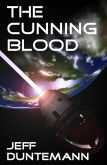
- What the Hell: Some researchers at the University of Michigan have created an 8-bit processor incorporating pneumatic gates, pointing toward a computer that doesn’t require electricity at all. Make sure you watch the videos. It’s not going to beat your local Beowulf cluster on the speed side, but if you find yourself on a planet where nanomachines eat electrical conductors (as they did in my novel The Cunning Blood) such a machine might well come in handy.
- The Make Blog aggregated probably the best writeup of a homebrew railgun that I’ve ever seen. Make sure you prowl around the site, and make double sure you see the pictures and watch the videos!
- Bill Cherepy sent me a link to a short writeup on the still-hypothetical Asus 2-screen ebook reader. You can use it as a netbook, with one screen doubling as a touch keyboard, or you can use it as a facing-pages ebook reader display. Now, displays are probably the most expensive part of devices like this, so I doubt a 2-screen model will be the low cost leader. Still, it’s an idea that’s well worth a try. (And please, guys, make the card slot XDHC compatible, ok?)
- If you ever loved whole milk and wish you could go back to it, read this. And then go back to it. No guilt. No apologies. And yes, no heart attacks.
- Back in the ’50s there was a product called Siz that was (I kid you not) foaming Napalm in a spray can. It was for starting charcoal. Lileks does a wonderful riff on it. (They had such indescribably cool toys in the ’50s.)
- On the other hand (with Lileks always there to remind us) they did some ungodly weird stuff in the ’50s too.)
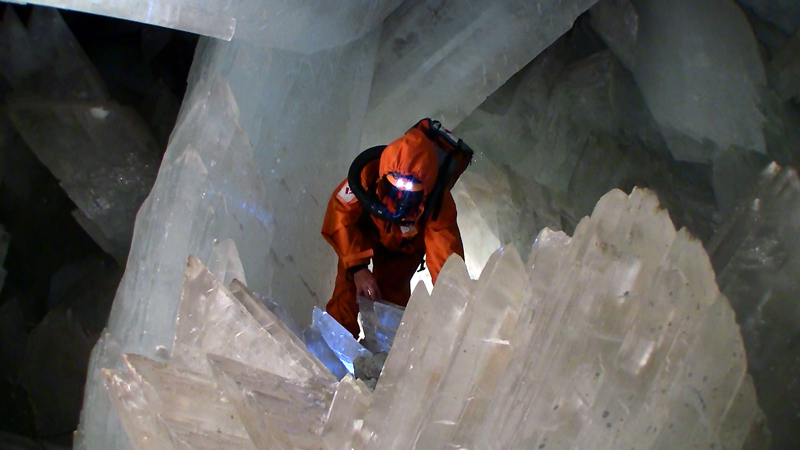
- When I was a kid, Verne/Wells films were all the rage, and by far my favoriate was Journey to the Center of the Earth . Small boys aren’t equipped to appreciate Arlene Dahl, but I was quite the fan of James “Nemo” Mason, and was willing to tolerate Pat Boone even though my older cousin Diane thought he was “dreamy.” The film was dazzling in 1959, especially the “cave of crystals,” which flooded out when dreamy Pat Boone got too agressive with a geologists’ pick. Well, some years ago Mexican miners discovered a real cave of crystals 1200 feet beneath Naica, Mexico that makes those old 1959 movie sets look sick. National Geographic has more textual coverage, and it’s worth noting that the cavern is unliveable without life support suits, being at a constant 122 degrees and 90% humidity, which is worse than Houston, if that were possible.
Review: Fat Head
 For twelve years now I’ve been intrigued by the fact that every time I cut “habitual carbs” from my diet (and by that I mean carbs I eat every day, and not a couple of cookies or an ice cream cone now and then) I lose weight. I was even more intrigued when I spent a few weeks eating almost no carbs at all (basically, lots of protein and animal fat) and lost even more weight. I’ll have my latest bloodwork results back in a week or so, and (as requested) I’ll summarize the numbers here. I’ve read several books on the topic, as well as a pamphlet on obesity dating back to the Civil War. And having read the history of the carb wars in some detail, I see it as a classic “bad science” issue: Egos, agendas, lobbyists, grant money and slimy politics distorted the public message on diet and health, and even though the original science has long been discredited, too many people would lose too much face if the health establishment abruptly reversed itself…so the low-fat nonsense persists.
It’s a rich field of study, and if my last six months hadn’t been swallowed by rewriting a 600-page programming book, I would have begun reviewing the material here already. So let’s get started.
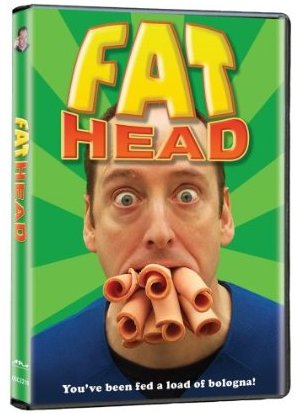
Tom Naughton’s DVD Fat Head is known mostly as a counterpoint to Morgan Spurlock’s much-hyped video complaint Supersize Me, but that’s not fair. Spurlock is a very small part of of it. What Naughton’s done here is create a witty 104-minute video overview of the carb wars that touches all the bases, from the historical origins of our low-fat hysteria to Flash-style animated illos of basic carb/fat metabolism, as well as a chronicle of a personal eating experience that weirdly echoes mine. (I had not heard of Fat Head until a few months ago, and did not watch it until last night.)
Naughton has done stand-up comedy, and it shows. He’s a disarming and engaging interviewer, buttonholing people outside of McDonald’s to see whether those people think fast food is high-calorie or unhealthy, or whether they feel addicted to it. At one point, he buttonholes a young woman with an accent. “Where are you from?” he asks. “Russia,” she replies. “Oh–can you say ‘Moose and Squirrel?'” She looks at him funny, but then she does say it, and it’s perfect.
I’m not a big consumer of video, documentaries least of all, but the lighthearted approach kept me going through a systematic debunking of Spurlock’s lard-it-on experience in Supersize Me that was in many respects the least interesting part of the film. Tom ate 2000 calories per day at McDonald’s or some other fast food joint for a month, and recorded what he ate. At the end of that period, having ingested a boggling quantity of what most of us could not have put down without vomiting, he found that he had lost weight. (At the end he said he was really tired of fast food–so much for it being addictive.) Most damning there is the fact that Spurlock refuses to release his food logs, suggesting that there was some exaggeration going on. (If not, why not just come clean and post the stuff?) And that’s one suggestion I have for future releases of this DVD: Put Tom’s food logs in a file on the DVD and allow people to view them without hunting for them. (The logs can be found online here.) My view: If you do not publish the data, what you’ve done is not research.)
As if that were not enough, after the McDonald’s month he spent another month doing what I did this past January: Eating almost no carbs at all, but feasting on bacon, eggs, marbled steaks, cheese fried in butter, and other yummy things that most people today find as frightening as the mythical Com’nists were in the 50s. When it was over, he had his blood numbers run again, and they improved.
Whoosh, can you spell “cognitive dissonance?”
That out of the way, Tom gets down to business, and explains how this came about, and then what the real story is, according to the best science we have today–rather than 1957, when the whole thing started going sour. He has short interviews with physicians and academics like Drs. Mary and Michael Eades, Dr. Al Sears, and Eric Oliver. He summarizes the whole problem with the 1950s-era research of Ancel Keys in a minute or so: Keys cherry-picked his data points correlating fat consumption and heart disease, ignoring nations where the two do not correlate. (He had data from 22 nations. He threw out all but 4 because the others made his graph a random walk.) Keys was originally opposed by almost everyone (including the American Heart Association) but he was a Right Man and would not back down over piddly things like additional research. Once politics got into the act in the early 1970s, government money started flowing to the low-fat partisans, and the war on fat began. (Funny how the obesity explosion began just about the same time.)
Probably the best part of the DVD is the summary of the health science behind his conclusions, done in simple animated diagrams. It’s not tremendously detailed and there are no citations to follow, but by watching it, you get your bearings. And that’s really what Fat Head is: orientation, and a starting point for further research. It doesn’t stand alone. After seeing Fat Head, you have to hit the library or the bookstore and pick up a few books, particularly Good Calories, Bad Calories by Gary Taubes, Fat Politics by Eric Oliver, and Protein Power, by the Drs. Eades. I would add Calories Don’t Count by Herman Taller (1962) and Banting’s Letter on Corpulence (1865). (I’m still working through Barry Groves’ Trick and Treat and have a few others on the shelf.) People cite much-ridiculed Dr. Atkins as well, but there’s nothing in the Atkins books that isn’t mentioned in many other places, and his conclusions have been vindicated in research that he had nothing to do with.
Finally, the closing credits roll over a wonderful original funny song (I guess you could call it a filk) called “The Experts,” which in some respects is worth the price of admission. I don’t see the lyrics on Tom Naughton’s Web site, but damn, don’t miss it!
Highly recommended.
Odd Lots
- Sleep seems to be key in allowing the brain to infer big-picture relationships from scattered facts–and by implication, memories. I’ve never been a strong sleeper, and I wonder if some of the “fails” in my older memories stem from inadequate deep sleep.
- Also from Wired Science: People who don’t get enough sleep are touchy and angry. (Not like that’s news to anyone who’s prone to sleepless nights.) Could this explain the peculiar unpleasantness of the political blogosphere? I’ll vouch for the fact that peace, love, and tolerance of people who disagree with you is much easier on nine hours’ sleep than five.
- If you’ll forgive the expression, here’s a long, beefy article on why everybody thinks animal fat is a bad thing (hint: it’s because a Right Man cherry-picked his data to confirm his hypothesis) and why, to the contrary, animal fat may be very, very good for us.
- Maybe this will bring the issue of bad patents to the top of the queue. (Thanks to Pete Albrecht and numerous others for the link.)
- From Jim Strickland comes a link suggesting that your family dog may be smarter than the average toddler. (Your dog, maybe. Mine, probably not.)
- I was wrong about it coming from a Kum & Go store; while sorting my charge card receipts I discovered that Fat Dogs (see my entry for August 7, 2009) is a small chain of Conoco-franchised gas station/convenience stores limited to Western Nebraska. They had some water private-labeled by Sandhills Water, and put their wry corporate motto on the top of the label.
- Lileks takes on the Sears Catalog for 1973. I remember that catalog. Fortunately, my clothes came from Goldblatts. And did real, human, breathing girls wear these things? Maybe the girls in Hoffman Estates did. In my neighborhood, well…no.
- From the Words I Didn’t Know Until Yesterday Department: juiceboxer, a young, arrogant, high-status preppie-type. Their parents got their juice from bottles. And their grandparents mostly got it while it was still inside the fruit. Juice as a product is a relatively new thing; keeping juice from fermenting is difficult and one of the unappreciated miracles of our modern age.
Odd Lots
- Pete Albrecht alerted me to Collecta, an interesting twist on a general Web search engine, in that it gathers news being posted Right Now, and displays it item by item on the screen in realtime While You Wait. Alas, most of what it seems to index are tweets, which may just barely count as information, for small values of “information.”
- And yet another stab at the same concept.
- Kingston has just announced a 128GB flash drive. Figuring an average MP3 is 5 MB in size, that’s 25,600 MP3s. And if the average MP3 runs 4 minutes, that’s 71 days of music running 24/7 with no repeats.
- Rich Rostrom sent me a link to a (pretty dense) medical research paper suggesting another possible benefit of low-carb diets: ameliorating schizophrenia. A 70-year-old schizophrenic woman went on a low-carb diet and after eight days ceased experiencing hallucinations. Not any reasonable cause-effect here in this one case, but boy, this suggests a promising avenue of research. (Steak, cheese, and fish are way cheaper than designer drugs.)
- It’s gotten cold enough in Brazil this year to allow Brazilian vineyards to make the first-ever Brazilian ice wine. (Babelfish translation of the original Portuguese.) Ice wine is a dessert wine delicacy made from grapes that are allowed to remain on the vine long enough to freeze in the first cold nights of autumn. Trouble is, there are almost never enough freezing nights in autumn in Brazil to make ice wine. (Most ice wine comes from places like Austria.) Ice wine is great stuff: I’ll continue to worry about global cooling but damn, I’ll buy a bottle!
- Ten years or so ago at Coriolis, we had an underwear policy. We did not, however, have an open wounds policy. HR gets more complex all the time…
Odd Lots
- The Atlantic tells us that a growth industry in NYC and other crowded cities is training dogs to sniff out…bedbugs. Dogs who can tell live bedbugs from dead earn as much as $325 an hour, and work for kibble. I got some peculiar bites on one side of my right leg while we were down in Champaign-Urbana last week for Matt’s graduation, and while I can’t prove that bedbugs did it, that side of my right leg is the side that contacts the bed while I sleep (as I nearly always do) on my right side.
- From Chris Gerrib comes word that The Espresso Book Machine has finally been installed in a bookstore, where it prints from a selection of half a million books on the attached server. No word on whether these are all out-of-copyright titles or what, but after what seems like decades of screwing around (I first reported on the Espresso Book Machine, originally called the PerfectBook 080, in 2001) we’re finally getting somewhere.
- I’ve heard tell recently that Vista doesn’t play nice with the Xen hypervisor. Anybody had any crisp experience there?
- William Banting’s Letter on Corpulence is now available from the Internet Archive, and it’s interesting as the very first detailed description of the effects of low-carb diets. Way back in 1864 Banting lost weight by eating protein and fat, and seemed surprised enough by his results to write up his experiences in detail. The more I research this, the more I’m convinced that carbs are what’s killing us, and this is not new news.
- Lulu recently cut some kind of deal with Amazon to put all their books (I think; it certainly includes all of mine) in the Amazon database. However, they added five or six bucks to the cover price. Will people buy Carl & Jerry books for $21? Don’t know, but somehow I doubt it.
- Machines can often see things that we can’t (which is one reason that we build machines) and they’re willing to share what they see with us. Sure don’t look like this in an 8″…
- Ars Technica published a good article on how DRM actually makes the piracy problem worse–an insight I had years ago, and a painfully obvious one after thinking about it for a nanosecond or two.
- No rest for the weary; several people wrote to ask what I would be writing next. Not sure. I still have to get our butts back to Colorado, but once I do, I want to finish my second SF story collection, and work on Old Catholics. You can bet that I’ll be posting more on Contra too, if that counts. Further than that I won’t venture, though I think I’ll be leaving computers alone for a little while.