- Maybe I thought of it first. I don’t care. This guy did a great job. What He Said.
- I was wrong about the Alice programming environment: There is in fact a version for Linux, though the developers admit it’s a little buggy and largely “proof-of-concept.” (Thanks to xuwande on LiveJournal for the tip.) To me, Alice looks a lot like the primordial Alto-based Smalltalk environment described in the seminal 1977 Xerox publication, Personal Dynamic Media, and I’ll install and explore the product (probably under Windows) as time allows.
- And even though this is mostly a research project (with no promises or even strong hints that it will ever become a product) the Microsoft Courier looks mighty good to me from an ebook reader standpoint. The interface is a little busy for my tastes, but we’ll see how it goes. Maybe it would be a waste of the device to use it for nothing but reading ebooks, but I consider it my prerogative to waste whatever part of a device I don’t consider useful.
- Maybe it’s not just me. As much as I like the Kodak EasyShare pocket cameras (Carol and I each have one) the EasyShare software is hideous and has given me nothing but trouble. This seems to be a trend. Can you imagine a new Mac app from a major vendor that still needs PowerPC emulation? Egad.
- I guess it’s better for a church to be full of books than empty of prople, and these guys did not do a bad job.
- Suddenly we have not one but two large sunspots visible at once, a situation not seen for over a year. Alas, I spun the dials earlier this morning, and 15 meters isn’t any livelier than it usually is here, which is to say, dead.
- The Google Books Settlement may well be dead on legal grounds, something that doesn’t surprise me at all. What Google needs to do now is just publish an open invitation: “Anybody who holds rights to a printed work and wants the work to be posted on Google Books under the terms below, fill out this form. We’ll handle the scanning.” I’d be first in line in what I’m pretty sure would be a stampede that would sooner or later bring in all the the stubbornest skeptics. The key: I’m willing to admit that my out-of-print works aren’t worth much. 1% of a loaf is still better than no loaf at all.
- ADDED 9/24/2009: Here’s a guy saying something that isn’t often said: Google Books is a fantastic research tool, and far from being evil, the Google Books settlement was just the first (now aborted) effort at something that simply has to be done.
hardware
Odd Lots
Odd Lots
- What the Hell: Some researchers at the University of Michigan have created an 8-bit processor incorporating pneumatic gates, pointing toward a computer that doesn’t require electricity at all. Make sure you watch the videos. It’s not going to beat your local Beowulf cluster on the speed side, but if you find yourself on a planet where nanomachines eat electrical conductors (as they did in my novel The Cunning Blood) such a machine might well come in handy.
- The Make Blog aggregated probably the best writeup of a homebrew railgun that I’ve ever seen. Make sure you prowl around the site, and make double sure you see the pictures and watch the videos!
- Bill Cherepy sent me a link to a short writeup on the still-hypothetical Asus 2-screen ebook reader. You can use it as a netbook, with one screen doubling as a touch keyboard, or you can use it as a facing-pages ebook reader display. Now, displays are probably the most expensive part of devices like this, so I doubt a 2-screen model will be the low cost leader. Still, it’s an idea that’s well worth a try. (And please, guys, make the card slot XDHC compatible, ok?)
- If you ever loved whole milk and wish you could go back to it, read this. And then go back to it. No guilt. No apologies. And yes, no heart attacks.
- Back in the ’50s there was a product called Siz that was (I kid you not) foaming Napalm in a spray can. It was for starting charcoal. Lileks does a wonderful riff on it. (They had such indescribably cool toys in the ’50s.)
- On the other hand (with Lileks always there to remind us) they did some ungodly weird stuff in the ’50s too.)
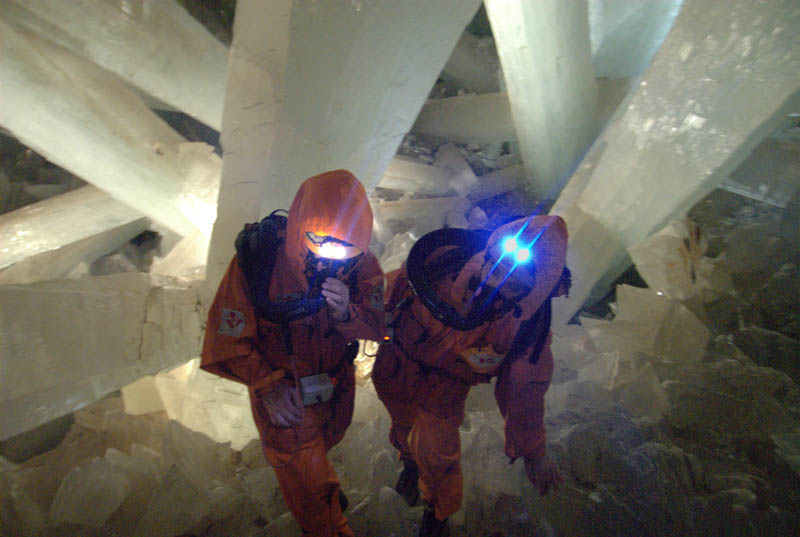
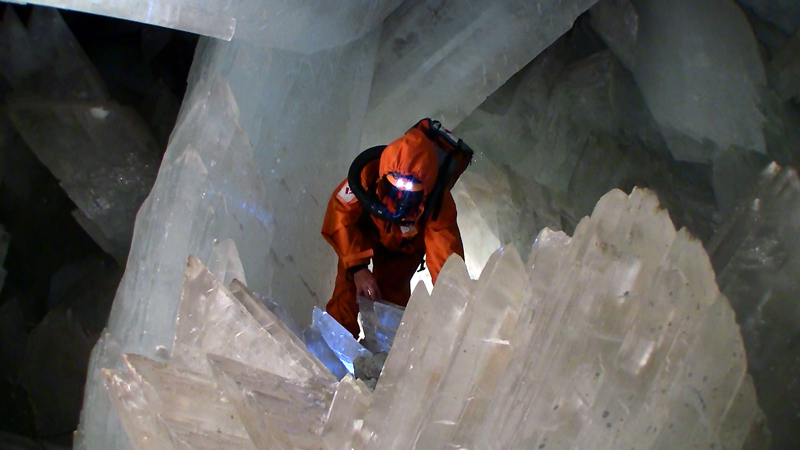
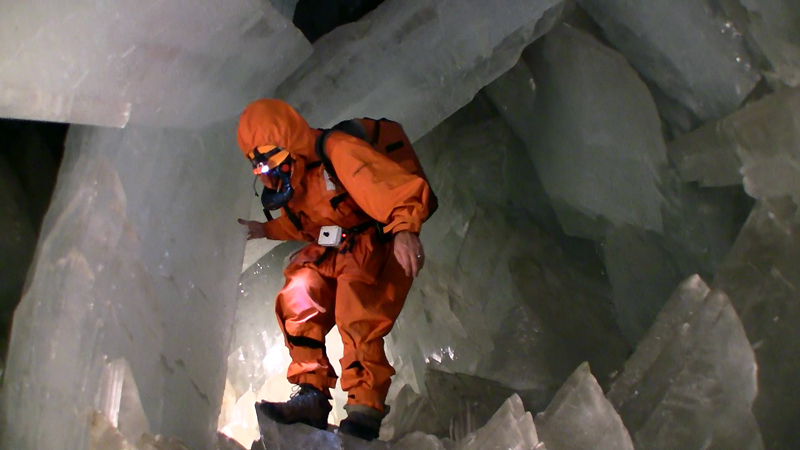
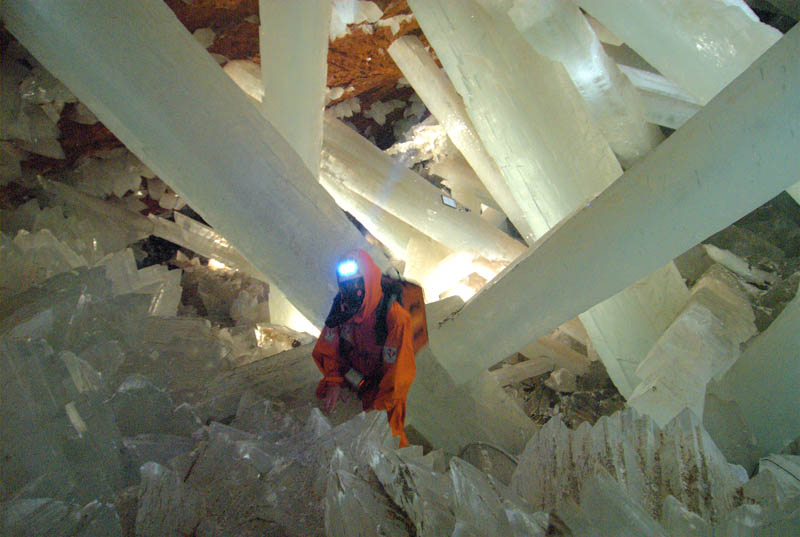
- When I was a kid, Verne/Wells films were all the rage, and by far my favoriate was Journey to the Center of the Earth . Small boys aren’t equipped to appreciate Arlene Dahl, but I was quite the fan of James “Nemo” Mason, and was willing to tolerate Pat Boone even though my older cousin Diane thought he was “dreamy.” The film was dazzling in 1959, especially the “cave of crystals,” which flooded out when dreamy Pat Boone got too agressive with a geologists’ pick. Well, some years ago Mexican miners discovered a real cave of crystals 1200 feet beneath Naica, Mexico that makes those old 1959 movie sets look sick. National Geographic has more textual coverage, and it’s worth noting that the cavern is unliveable without life support suits, being at a constant 122 degrees and 90% humidity, which is worse than Houston, if that were possible.
Odd Lots
- On Monday I returned the last third-pass page proofs (of a very gnarly part of the book, the partial instruction reference) and if the publisher’s schedule is to be believed, Assembly Language Step By Step, Third Edition goes on press tomorrow. Real books should be out of the bindery and in the warehouse by September 22.
- We came within a few hours of having a sunspot-free calendar month in August, but then very late Monday night, a barely visible sunspeck showed up, ruined the run, and then immediately started to vanish. The sunspot minimum appears to be heading for a double bottom, and there are people at NASA suggesting that deeper mechanisms are changing within the sun, and we may be a long time before seeing anything like a proper sunspot peak. So much for DXCC on 10M.
- Cory Doctorow speaks up on cloud computing, the goal of which, he says, is to allow companies to make money in a mature computing market by charging you month by month for computional facilities that you already have at home. So tell me: How many people actually collaborate in the Cloud, as a percentage of people who actually compute? I think it’s in low single digits–which suggests that the Cloud as an idea is something like 95% scam.
- If you’re following Michael Arrington’s CrunchPad project, the CrunchPadFans blog is worth a visit every week or so. It’s a little sparse, but there hasn’t been much news generally on the long-awaited gadget in recent weeks. I intuit that it would make a jack-fine ebook reader, if software to handle the major formats is included or installable.
- And speaking of ebook formats, Sony has announced that it will be supporting the EPUB format in its new reader products, days after Google’s announcement that it will be doing the same within its Google Books system. EPUB is a reflowable open standard not controlled by any particular firm, and if I had to finger a winner in the ebook standards wars (at least for primarily textual works) this would be it.
- Further relevant to ebooks is a reader app I’ve been fooling with on Ubuntu: Okular, which is nominally a PDF viewer but can open and display lots of other formats, including DjVu, CHM help files, Epub, Plucker, MobiPocket, and a few others. Although it’s a KDE 4 app, I’ve had no difficulty making Okular run under GNOME. Okular on a suitable handheld Linux-enabled device could make a helluvan ebook reader.
- And Okular led me to the KDE on Windows project, which aims to create native-code ports of KDE apps to Windows, with an installer to make it easy for non-techies. It’s early and the product doesn’t look as easy as it should be, but then again…it’s early.
- I’ve discovered a much higher-resolution photo of the old Turtle Wax building at the Ashland/Ogden/Madison intersection in Chicago here. We would pass that building on the way to my grandfather’s house Back of the Yards back in the late 1950s, and my mother would always point out the 25-foot tall turtle on the top of it. Cool building, too, turtle or not. Gone now, alas–the turtle and the building both.
Odd Lots
- Probably because I don’t work that much in the realm of historic images, I did not know that scanned or photographic copies of public-domain images are also in the public domain, at least in the US. I’ve been gathering scans of pre-1923 artwork for possible use on book covers for several years now, but the uncertain origin (and thus the copyright status) of most of the copies themselves has given me pause. I guess it’s time to end the pause and hit Play.
- We’re currently in peak season for noctilucent clouds, which are high-altitude ice-crystal plumes of mysterious origin. Because they’re so high, they reflect sunlight long after the land beneath them is in night-time darkness. NLCs are appearing farther south recently for reasons not understood; predictably, it’s been ascribed to global warming, but some research indicates that southward excursions of NLCs are a proxy for low solar activity, which we’ve certainly been seeing the last couple of years. (Spaceweather has been covering NLCs a lot in recently weeks, with good photos.)
- Here’s an R2D2-shaped toilet paper cozy. Hey, why is this any weirder than the crocheted teal-yarn poodle-nose cozies that my Aunt Josephine used to keep her toilet paper in?
- I have a strong affection for Nebraska, and here’s an interesting article about abandoned farmsteads and structures in the western Great Plains portion of the state. (Thanks to Pete Albrecht for the link.)
- A chap named Julian Beever may be the real master of 3-D sidewalk art. (Thanks to Roy Harvey for putting me on to him.)
- We’ve now had cheap desktop CD-R burners for at least ten years, and the lifetime of the media is supposedly about that. Here’s a reasonable article on optical disc longevity that isn’t from an industry source. Has anybody noticed any burned (not stamped) data discs from the 90s going bad yet?
- When we lived in Arizona, I used to climb an elderly neighbor’s thirty-foot-tall grapefruit tree to help her get the high-hanging fruit. I was in my early forties and that was the last time I ever climbed trees on a systematic basis. If I had to do it again, I would probably stay on the ground and build something like this.
- Has Bucky Fuller’s Cloud 9 cities concept ever been used in SF? There’s not much to be found online about them, but in brief, he was talking about geodesic spheres as much as several miles in diameter, each containing whole cities that could float via thermal lift by virtue of as little as a degree or two of temperature delta between inside and outside. I’ve been imagining Cloud 9 spheres made of drumlin parts (with possibly a Hilbert drive ring around the sphere’s equator) and I’m a little surprised that I haven’t already seen the idea used in fiction, given that Bucky wrote about it in 1960.
Odd Lots
- Here’s a nice, high-school physics level lab demonstration of an aluminum air battery, made from aluminum foil, aquarium charcoal, salt water, and a paper towel. A few of these in series will run a simple solid-state radio. It would be fun to figure out how to expand the concept into something a little more durable, with thicker aluminum plates, in some kind of container that will confine the messy materials and yet admit oxygen to sustain the reaction.
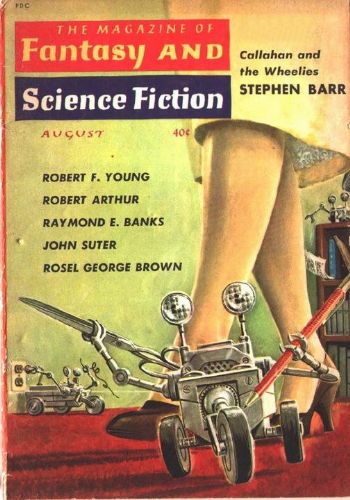
- Damned if the photo of this beambot doesn’t remind me of the Ed Emshwiller F&SF cover for “Callahan and the Wheelies,” a 1960 story by Stephen Barr that I blatantly imitated in my own high-school fiction.
- When I first got into computing in the midlate 1970s I had a number of CPU green cards, but was always a little puzzled that none of them were…green. (The COSMAC green card was blue, and the 8080 green card was white.) In truth, I didn’t know at the time why everybody called them “green cards,” and if you still don’t know, here’s a site where you can see the real deal. (Thanks to Richard Haley for the link.)
- And from Richard’s own hand comes a list of instruction mnemonics that you won’t find on most green cards, of whatever color. My favorite is EMW, Emulate Maytag Washer, which the crotchety frontloading 3330 disk packs back at Xerox building 214 were very good at doing, except that they were in the spin cycle all the damned time.
- Google Books has mounted most (if not quite all) of a fascinating book called Hi There, Boys and Girls! which is a history of local children’s TV programming in the US. The book is organized by TV markets around the country, and the Google Books version is intriguing for how much material is actually available for free. The Chicago material is available, and excellent, if not as detailed as Jack Mulqueen’s full-book treatment in The Golden Age of Chicago Children’s Television, which has a much more limited Google Books preview.
- We are getting close to the release of Michael Arrington’s Crunchpad Internet tablet, but little or nothing has been said about the only thing I really want it for: a large-display ebook reader. It needs an SDHC slot (which I think it has) and some decent ebook software (anybody’s guess) but given those two things, it could remake the ebook biz. July is flying. Wherezit at, Mike?
Odd Lots
* From the Words I Didn’t Know Until Yesterday Department: “Forcemeat” is meat ground sufficiently fine to make it cohere with a fat base, and mixed with spices and sometimes other ingredients before incorporating in patés, stuffings, and sausages.
* The Weather Channel is running saturation-level advertising for a “3D chalk” product from Crayola, which is apparently a selection of very bright, almost day-glow colors of sidewalk chalk, plus a pair of 3-D glasses with which to view your sidewalk artwork. Done correctly, the warmer colors seem to float above the sidewalk a little. It’s almost impossible to think of this product and not flash on the sequence in Disney’s Mary Poppins in which the gang jumps into Bert’s sidewalk chalk drawing.
* The venerable Alfred Morgan borrowed some of the circuits found in his boys’ books on electronics. I found the phono oscillator circuit from The Boys’ Second Book of Radio and Electronics in a 1943 Meissner data book, and now Peter Putnam sent me a link to a 1955 article in Popular Science showing something very close to the diabolical Geiger counter circuit that I tried and failed to build (out of the same book) in 1964.
* There are fake high-capacity USB thumb drives going around. (Thanks to Frank Glover for the link.) Nobody’s making 128 GB thumb drives yet (though they will eventually) so don’t fall for it.
* Also from Frank comes a link to an interview with Eric Lerner, the man who claims to have developed a new kind of fusion reactor he calls “focus fusion.” I’m not enough of a particle physicist to know whether this is a scam or not (though it sure smells like one) and I hope that my readers who are particle physicists can tell me whether the physics is as dicey as the business plan.
* Our long, long sunspot drought may be coming to an end. Spot 1024 is the largest seen yet of the new Cycle 24, and the largest sunspot seen in almost a year. I guess I better start shielding the fire alarm sensor wires, so I can get on 10 meters!
Odd Lots
- One of the most remarkable photos of a volcanic eruption ever taken apparently happened by sheer chance, when the ISS passed over the Kuril Islands just as the Sarychev Peak volcano let loose. The rising plume literally punched a near-circular hole in the cloud cover.
- Just in case you happen to see a nuclear weapon go off, having one of these in your pocket would be handy to quantify things. (Thanks to Pete Albrecht for the pointer.)
- From Bruce Baker comes a pointer to a NYT article about the perils of being an outsourcee for an unscrupulous publisher. And so much for our textbooks being created by experts with advanced degrees.
- John Cleese’s lighthearted but still informative documentary “Wine for the Confused” can now be seen on Hulu, at the cost of a few Toyota commercials. I’m good with that–and in complete agreement with Cleese that knowing good wine from great wine is not automatic, and in fact knowing good wine from bad takes more effort than most would think. Don’t miss it. (Thanks to Roy Harvey for letting me know it was there; I saw it on TV a couple of years ago and much enjoyed it.)
- We may gasp at 64 GB thumb drives now, but storage technologies coming to market in the next few years will make 1 TB thumb drives not only possible but commonplace. (Thanks to Frank Glover for the link.)
- The annual amateur radio Field Day event happens this weekend, from 1800 zulu on Saturday to 2100 on Sunday. I’ve got the radios boxed up, and will be experimenting with a interesting rotatable dipole made from a pair of AN-45G collapsible military whip antennas, on top of a pipe mast made of four 5′ sections of 3/8″ pipe mounted on my ancient telescope pipe base. The rotator is my right hand, turning a greased 2″ pipe joint on its own threads. I’ll describe the dipole with photos if it works; if it doesn’t work I’ll admit failure and quietly forget about it. But if you’ll be on the air, I’ll be working solo from a nearby campground as K7JPD. Listen for me.
- From the Too Weird To Be True but True Anyway File: The woman who may well become our first Hispanic supreme court justice stated quite flatly in her Princeton University senior thesis that “…in Spanish we do not have adjectives. A noun is described with a preposition.” I’m a Polish-German-Irish-French ubermongrel who last took Spanish in 1973, and even I know better than that. So…can I be on the Supreme Court instead?
Odd Lots
- Pete Albrecht alerted me to Collecta, an interesting twist on a general Web search engine, in that it gathers news being posted Right Now, and displays it item by item on the screen in realtime While You Wait. Alas, most of what it seems to index are tweets, which may just barely count as information, for small values of “information.”
- And yet another stab at the same concept.
- Kingston has just announced a 128GB flash drive. Figuring an average MP3 is 5 MB in size, that’s 25,600 MP3s. And if the average MP3 runs 4 minutes, that’s 71 days of music running 24/7 with no repeats.
- Rich Rostrom sent me a link to a (pretty dense) medical research paper suggesting another possible benefit of low-carb diets: ameliorating schizophrenia. A 70-year-old schizophrenic woman went on a low-carb diet and after eight days ceased experiencing hallucinations. Not any reasonable cause-effect here in this one case, but boy, this suggests a promising avenue of research. (Steak, cheese, and fish are way cheaper than designer drugs.)
- It’s gotten cold enough in Brazil this year to allow Brazilian vineyards to make the first-ever Brazilian ice wine. (Babelfish translation of the original Portuguese.) Ice wine is a dessert wine delicacy made from grapes that are allowed to remain on the vine long enough to freeze in the first cold nights of autumn. Trouble is, there are almost never enough freezing nights in autumn in Brazil to make ice wine. (Most ice wine comes from places like Austria.) Ice wine is great stuff: I’ll continue to worry about global cooling but damn, I’ll buy a bottle!
- Ten years or so ago at Coriolis, we had an underwear policy. We did not, however, have an open wounds policy. HR gets more complex all the time…
The Cloud in Your Pocket
We’ve been getting rained on a lot this week, in more ways than one. Carol’s garden is going gangbusters, and I’ve never seen an explosion of wildflowers along my accustomed hiking paths as I’m seeing right now. There’s a bee shortage somewhere in the country, I’ve heard, but the little buggers are thronging the wildflowers here. Temps are deliciously cool, for June, which seems to be a trend this year.
On the flipside, some dorks broke into my hosting directory a few days ago and inserted porn spam links into all my static HTML. They tried to modify the PHP in my instances of the Gallery photo manager for purposes unclear, but Gallery stopped working and I had to delete both instances. (I have backups of all the photos and captions and will reinstall as time permits.)
That whole adventure happened while I was on deadline reading copyedits on the first five chapters, and it did not endear me to cloud computing. I’ve had some time to think about the whole sorry mess, and some larger questions arise:
- How do we keep crap like that from happening? (This is a mostly rhetorical question; I’m not sure that we can.)
- Apart from portability (i.e., accessing your data on the road) what’s the real value-add in cloud computing? Remember to figure in the cost-benefit of having to find and sometimes pay dearly for a broadband connection to use it.
- And if portability is the only value-add, why screw with something as inherently pricey and dicey as the Cloud?
Why not put the Cloud in your pocket?
I just ordered my very first 32GB thumb drive. I skipped the 16 GB size entirely, because my trusty and much-missed 2001 Thinkpad X21 had a 32 GB hard drive, and I never filled it up. It contained all my major apps (Word, Excel, PowerPoint, MapPoint, InDesign) and all my Internet apps, plus a scattering of smaller utilities. It also contained a great deal of data, including everything I had written electronically since 1979, though in truth much of the bulk lay in MP3s. Document files are remarkably small.
One of the most significant trends of the last two years is the explosion in “portable” apps, meaning software that does not require a formal installation process beyond unzipping it into a directory. Nothing goes into the Registry, nor into \windows\system32. The whole app lives in a single folder. What a brilliant idea! (Wait…all software used to be like that…)
There have always been portable apps, but for the last fifteen years or so it’s been seen as declasse to produce them. Why? Think for a second: Once installed, a conventional Windows app can’t simply be lifted out of its folder and copied to another machine. It was one of the earliest forms of stealth DRM, invented, I suspect, specifically to keep MS Office from wandering.
No more. There are now lots of portable packages, many or most of them completely free. See PortableApps and 100 Portable Apps for Your USB Stick. You can get OpenOffice, the Gimp, Thunderbird, Firefox, Kompozer, and just about anything else you might need in portable versions. You can unzip them into directories on a thumb drive, and execute them from File Manager. (There are also portable app managers like CodySafe that give you a separate UI for your portables and stick data.) Portables run like conventional Windows apps, except that they don’t crap in your machine.
I got into portable apps while thinking about degunking for Windows. The Registry is Gunk Central, and much havoc is caused by duelling and mis-versioned DLLs dropped like softball-sized hailstones into the system32 directory. When I got my new Core 2 Quad last summer, I resolved to install only what conventional apps I absolutely needed, and use portable apps for everything that I could. The results? I have a cleaner-running machine that boots fast and has a remarkable lack of line items in Task Manager’s Processes tab. I’ve tried to stick with FOSS apps, because commercial apps are always down there in your taskbar popping up nag balloons, trying to upsell you or force updates down your throat.
It’s worked very well. What I want to try is having a single largish thumb drive containing not only data but also the programs used to manage it. Other people have been doing this for years, and it’s time I gave it a try. In the meantime, my view of the Cloud cooks down to this:
Take from the Cloud what can only be had from the Cloud–and keep the rest in your pocket.
Marvell’s SheevaPlug
Two years ago, I discovered PowerLine networking and have used it ever since, first to cover a CAT5E “dead spot” in my Colorado house, and more recently to finesse Wi-Fi outages at Carol’s sister’s house. The Linksys PLE200 Ethernet bridges work fantastically well within our house, and have sufficient bandwidth to stream HD video. With one unit near my router downstairs, I can take the other unit and plug in to the Internet anywhere in the house where there’s a power outlet, and there are power outlets every six or eight feet on every wall in the place. So whereas it’s not quite Internet Anywhere, it’s pretty damned close.
I remember thinking with a smirk back when I first got the units that it wouldn’t be too long before somebody made Linux run on it. And suppose somebody did? What would be the use of that?
Well, a use occurred to me a few months later, though it wasn’t anything I felt like discussing at the time. But this morning I saw something on Slashdot that made me change my mind. It’s the Marvell SheevaPlug. It’s an 1.2 GHz ARM-based Linux box in a wall wart, and bears a striking resemblance to the various PowerLine brick bridges that I’ve seen in the last few years. It’s got a gigabit Ethernet port and a USB 2.0 connector, but no other interfaces. You talk to it through the Ethernet port, and can use the USB port for external mass storage or whatever. It takes its power from the wall outlet it’s plugged into. It’s only missing one (obvious) thing: PowerLine connectivity.
One of these plugged into a wall is cute, but not a major win. Equipping them with jelly-bean PowerLine logic changes everything: One plugged into a wall downstairs with a terabyte hard drive on the USB port, and three or four plugged into the wall upstairs acting as USB peripherals to computers, and you’ve got a media distribution system for cheap, with no dependence on CAT5 or even Wi-Fi. You can do that now via Wi-Fi, piecing together a system from components. Products based on the SheevaPlug (which is actually an OEM-able hardware platform) already allow this, with more or less kafeuthering, usually more. (See HipServ and PogoPlug.) My take is that if the idea is in fact to make a cheap and simple media distribution component for home use, PowerLine is a no-brainer.
The SheevaPlug does not have PowerLine connectivity, but someday it or something like it will. And a cheap (in my view, ~$80) implementation could turn an entire hotel into a LAN party–a LAN party where nobody knows precisely who or where anybody else is.
I’m not sure if that’s important to gamers or not. I’m not a gamer and have never been to a LAN party. I have read online, however, that there are LAN parties at which the games are almost a secondary attraction, behind the unusual ability to share files at high speeds with few (if some) concerns about Big Media’s enforcers. At public LAN parties, it’s always possible that the MPAA could plant a mole at the party. But if everybody’s sitting quietly in their hotel rooms either gaming or sharing files (or both) any moles tuning in with their own Sheevas would have a hard time knowing whom to call the cops on. Unlike Wi-Fi, it’s hard to get a directional fix on a PowerLine node, and without routable IP addresses, there’s no way to connect a node to a particular person.
This may or may not be technically feasible; it’s an SF concept for me, and I have a couple of story ideas that follow from it or at least make use of it. Much depends on how hotels are actually wired–and if something like this catches on, I’m guessing that they’ll begin soldering a low-pass filter on the 110v feed to every room.
But in the meantime, it’s cool to see my long-time prediction that computers will eventually become bulges between peripherals moving toward actualization. (I did not guess that computers would become their own wall-warts.) And there’s much more to say about what I call “backnets,” which are networks that happen in unexpected ways, often parasitically on other connections. Backnets may be the third coming of pirate radio, in which tweaking the Man is often more important than accomplishing anything useful. (Is there any fiction about pirate radio out there that you know of? Drop titles in the comments if you’ve got any. Thanks!)