Jeff Duntemann's Contrapositive Diary Rotating Header Image

writing

Theme Creep

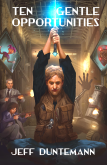
Sorry for being gone so long. I guess I just had to get past January. We saw the last of the painters this morning, and the only remaining big piece of this ever-expanding remodeling puzzle is the floor coverings. I wouldn’t have thought that getting bids on carpeting would be this hard. It is, at least if you don’t want to get crap carpet and have it installed by idiots. (Now on our seventh house, we’re fussy. Real fussy.) I’m doing two more Elfa buildouts, and shopping for some new office furniture. When I’ve had the energy and presence of mind to write, I made an executive decision to devote it to Ten Gentle Opportunities rather than blogging.

I lost a lot of time in the last few months, but that had nothing to do with the novel. It’s cooking along, and I got another 1,600 words down yesterday. In reading the new material over last night, I realized that something interesting had begun happening when I wasn’t quite looking: The theme was changing, and not necessarily in a good direction.

Maybe that shouldn’t be a surprise. The idea came out of a thoroughly trunk-ish humorous novelette that I wrote in 1981 and buried in embarrassment, concerning a newly built but malfunctioning AI copier that decides that it’s God, and declares jihad against the hapless AI process controller that runs the copier factory. In 1984, my fiction mentor Nancy Kress agreed to collaborate with me on a revision of the concept at novel-length as a half-fantasy love story, adding in a universe-jumping magic hacker (in the manner of Harold Shea) who drops in on a small advertising agency in Rochester, New York to hide from a berserk magician, and magic that “maps” to software in our boring, magic-free world. The magic hacker acts as a catalyst to heal the relationship of two middle-aged people, and in the process learns about software. When he returns to his own universe, he discovers that software “maps” to a form of magic far more potent than anything his erstwhile tormenter can summon. End of story.

In our 1984 effort, there were only two AIs: one the factory controller, and the other a tinkered-up magical intelligence that maps to software in our world. In a brief (and silly) subplot, the magical software falls in love with the factory controller, and in a sort of virtual sexual union, they combine into something a good deal more capable than either was on its own. Mostly, the AIs were played for laughs and acted as foils to the human hero and heroine, whose relationship they loosely echoed.

The concept had promise, but in 1984 I was only barely a grownup (32) and just couldn’t pull it off. Nancy graciously ceded me her portions, and everything went back into the trunk, where it stayed until 2006. I pulled it out and read it over that year, and very abruptly, brand-new scenes began rising out of the cluttered back rooms of my subconscious. I sat down one evening and wrote a new opening, “just for fun.” Boom! Suddenly I had a rigorous system of magic, a magical intellect that spoke only in poetry, an evolved magical predator resembling a lamprey from the astral planes, zombies dancing the Macarena, a 3-D processor technology that packs tens of thousands of execution cores into a blade module, the Triumph of Pascal (as a fictional but heavily parallel language called HyperLang, get it?) and several more AIs.

The love story was still there in the middle of it all, at least in the outline. Now, I have this old habit of heaving ideas into a story with a pitchfork. Once I grabbed my pitchfork, the love story started to get buried in ideas, most of which lay in the AI characters. What does it really take to make an AI that looks and sounds like a human being? If you start with something powerful but alien and make it human by shooting it full of NOPs and bad animation, is that a win? What would the AIs think once they understood what was going on?

Is virtual suffering real suffering?

I’ve done idea stories all my writing life, but I’ve never done a love story. I guess it’s not surprising that I’m having a lot of fun with the ideas, and a lot of heartburn over the human relationships. I’m doing my best. The path of least resistance, however, is to have fun with the AIs and their virtual lives in the Tooniverse while the human characters recede into the background. If I’m not careful and don’t begin paying attention to my outline, that is precisely what’s going to happen. I looked in the mirror this morning while shaving and said, “Be warned.”

In some ways the story has come full-circle. It was originally a battle between a humorless factory controller system and a psychotic AI living in a faulty networked copier. I’m having to struggle a little now to keep it from becoming The League of Exceptional Software pitted against slobbering malware from another universe, while their human friends look on in befuddlement and occasionally cheer.

Most of my stories have evolved as they crossed the brain/fingers barrier. A lot of them have died in the evolving, which is why my trunk, in terms of paper alone, weighs thirty or forty pounds. I’m determined not to lose Ten Gentle Opportunities the same way. After all, it’s taken literally half my life to write, and I have only so many half-lives to go.

Unhappy Old Year

So. Once again we rebooted the calendar, and it worked. Whew. Couldn’t have happened soon enough. This year had its moments, but it wasn’t among the best I can recall, though it stands shoulders above 2002.

The year began with the worst flu I’ve had in 35 years. Lesson: Get your flu shots! Carol did. I didn’t. Q.E.D. There was other illness in the family that I won’t talk about, though nothing life-threatening. For that we have to move out into our friendscape. We lost Prudy Stewart, a stalwart from the local Bichon Frise Club, along with Harold Shippey, a gentleman in our camping group. Two of my grade school teachers died within a couple of months of one another: Mrs. Mary Clare Toffenetti, who taught art and French at IC school, and Mrs. Mary Veronica Condon, who taught third grade and also French. Dan Matthews, one of the kids in my grade school class, who had been a close friend for several years, died on Christmas Day. Just last night, one of our parishioners, who generally sat two pews behind us at church, had a serious heart attack. He’s in a coma and is not expected to survive.

All this since November 1, sheesh.

Oh, and my house almost blew up. Settling soil has been our bane here for years now. We had to empty the lower level and get the slab mudjacked, and are still fooling with paint chips and carpet samples now that the carpet’s been torn up anyway. All of my SF and most of my electronics magazines are packed and out of reach. It’s a mess.

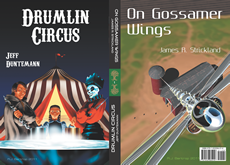
For good things to report I’ll begin with the completion of Drumlin Circus, a 53,000 word short novel that came together in one furious six-week period, during which I wrote as much as 5,000 words in a single day. Jim Strickland and I put a tete-beche double novel on the market, incorporating Drumlin Circus and On Gossamer Wings, both tales from the Drumlins World.

Jim and I attended the Taos Toolbox writers’ workshop in July, conducted by Walter Jon Williams and taught by Walter and my SF mentor Nancy Kress. I described the workshop in two entries after we got back, and would have continued if my damned gas line hadn’t threatened to ignite virtually under my feet. (I hope to write a little more about the workshop in coming days.) I will say right now that if you have a little experience in SF or fantasy, Taos Toolbox is spectacular. Granted, it’s expensive, and almost unbelievably intense. Jim describes it as a 500-level graduate course in the art of the novel compressed into two weeks, and that sounds about right. Walter is currently accepting applications for the 2012 workshop, and I give it my wholehearted recommendation. I met a lot of wonderful people, workshopped 15,000 words of my current novel-in-progress, Ten Gentle Opportunities, and returned with new dedication to the craft of fiction. I’d hoped to finish TGO by the end of the year, but (as described above) the year did not cooperate. The new target is April 1. Snotty AIs, zombies dancing the Macarena, a copier factory gone rogue, magic as software, physics as alternate magic, and malware from another universe…hey, what else d’ya want?

On October 2, Carol and I celebrated our 35th wedding anniversary. We spent ten days on Oahu, generating enough gumption to start having the lower level rehabbed when we got back. It took everything we could generate, and more.

I joined the Writers Write! group here locally, and have made many friends there. The group’s motto is Just write the damn book! It’s advice I need to take.

Those are the broad strokes. Scattered among the days were little flashes of light and minor grunts of annoyance. My brakes have needed work three times. I met Cynthia Felice. My new superregenerative FM receiver has dead spots. I finished a nice steampunk computer table. That sort of thing; up and down on an almost daily basis.

I have high hopes for 2012. Carol and I have deliberately held back opening our Christmas presents until January 6th to get an upbeat start on the year, and 2012’s first 18 hours have gone pretty well. I won’t try to draw any conclusions from the data points presented. Hey, sea level dropped 6mm in 2010 alone. Blips happen, so let’s not read too much into any of them. It’s not the end of the Holocene…yet. Then there’s the Mayan calendar. Y2KXII, anybody? Let’s party!)

Happy new year, everyone. Strive to appreciate your friends this year. (You won’t have them forever!) Write more. Worry less. Go outside and check your gas pipes. Eat fat and drink sweet wine, and make sure you share what you have with others. I’ll be here when you need me.

Odd Lots

  • Here’s a great site on older toy and hobbyist robots; if you’re a collector or just a nostalgist, it’s a must-see. (Maybe some here have never seen my late 70s robot Cosmo Klein.) Alas, the link came from an old email sent by the late George M. Ewing WA8WTE, who suggested it as an Odd Lot. Better late than never.
  • We used to giggle at the name in the mid-60s, but the founder of Blonder-Tongue Labs is still alive, and maintains a site full of interesting tech information about crystal sets and old radios, as well as the firm’s patents and products from long ago. (Thanks to Michael Covington for the link; again, set aside more than a year ago and never used.)
  • No tablet here yet (waiting to see what if anything pops up at CES 2012) but I’m tempted to get a Nook Color so I can at least quit reading ebooks on my dinosaur of an X41. My friend Erbo has learned a lot about rooting it and running CyanogenMod, and has much good to say about the combo.
  • If you’re considering that step, consider the peculiar nature of the Android OS itself, which may not exist in precisely the same way that Windows exists. This is still good, but you need to understand it, as it’s a newish thing in the computing universe.
  • I’ll never buy one of these, but I admire the concept: An off-the-shelf smartphone-controlled video-equipped RC helicopter. And I admit: If it weren’t for OWS I wouldn’t have heard of them at all.
  • Henry Law called my attention to the fact that County Down in Northern Ireland is often called “Drumlin Country” because of its landforms. Odd then that “The Star of County Down” is one of my favorite Irish folk songs, and has been since I first heard it circa 2000–which is precisely when I wrote “Drumlin Boiler,” the first tale in the Drumlins Saga.
  • And of course, when the starship Origen is marooned in the Drumlins system, it is the mere handful of collectible print books on board that allow the castaways to gradually re-create a modern society on an alien world. The cheap consumer-grade tablet PCs in every passenger pocket were all dead inside of fifteen years (most far sooner than that) and nobody thought to create printing presses before they were gone. No wonder that the cult of the printed book rises as the age of the printed book fades. (Thanks to Bruce Baker for the link.)
  • Talk partisan political hatred all the time, and prepare to reap the wind.
  • Can we please add “Google is your friend,” “denier,” and “talking points” to this list? (Thanks to Pete Albrecht for the link.)
  • And with that, the curtain falls on 2011. May the impact of the curtain give it multiple broken bones, concussions, contusions, internal bleeding, hemorrhoids, the heartbreak of psoriasis, and whatever else it might take to keep this year from darkening our doorsteps ever again.

MileHi Con 43

Just got back last night from MileHi Con 43, held at the Denver Tech Center Hyatt. I haven’t been to a lot of cons lately, and my congoing skills are definitely rusty. One of these skills is new to me: Remember that your phone contains a camera. Duhh. My V530 camera jammed with the lens open so I didn’t get any photos, but I’ve requested some from friends and will post a few here as time allows.

What was a little surprising is how much a con in 2011 feels like a con in 1981. The big difference comes down to one word: smartphones. Nobody spends any time searching for friends at cons these days because everybody always knows where everybody else is, and if somebody wanders outside a general understanding of their whereabouts, well, it’s one tap and they’re back within earshot.

Costuming has also changed, though this may be old news. However well-done, the costumes were basically hall costumes rather than elaborate and fragile stage-show assemblages that you could barely move in, much less sit down. The con organized a zombie crawl around the 16th Street Mall on Saturday afternoon, and it got into the Sunday Denver Post. The Post also did a good job snapping most of the better costumes, and you can see them in a slide show on the newspaper’s site. I had never heard of absinthe fairies, but boy, there were a lot of them around. (And, later, “wingfic.” Yes, there is a subsubsubsubgenre called wingfic. It’s about characters who have wings. Beyond that, anything goes.)

I hung a lot with close friends Jim Strickland and his wife Marcia Bednarczyk, as well as Taos Toolbox colleague Sean Eret. Jim and I both did panels, and we shared a late-night author reading slot at 10PM on Friday. The reading was interesting for a peculiar reason: I did not get an email that the other five panelists apparently did, reminding everybody (but me) that the reading had been slotted late to allow for sex and violence. I was fourth of five in order to read. In quick succession we heard some bishonen fiction (there’s a descriptive Japanese word for the genre that I can’t find right now but sounds like “yowee”) and some heavy-duty mayhem (including a gripping section of Jim’s novel-in-progress, Brass and Steel: Inferno) plus a sex scene with Dr. Moreau’s squid-woman. Then it was my turn. “And now for something completely different,” I said, and began: “STORMY vs. the Tornadoes…”

They loved it. Comic relief exists for a reason.

Speaking of which: I had chosen STORMY because I was on a panel about writing SF humor the next day. The panel was great: We dissected the machineries of humor, and delivered quite a bit of it ourselves. (I sang a little of my 1976 filk from “West Side Story,” “I’m a Trekkie,” if you can picture that.) I was a little surprised that out of an audience of forty or fifty, only two people had ever heard of The Witches of Karres, which I was using as an example of that rarest of things, SF whimsy. Another person asked me to spell “Laumer.” Egad. I guess I’ve been away a long time.

My other panel was about robots, and once we got past some problems with definitions (Robots, to me, are “AIs in a can,” not cyborgs) we did some good things. Again, I was puzzled that so few people were familiar with AMEE, which I consider the scariest robot in film history. I was delighted to be sitting on the panel beside longtime SF writer Cynthia Felice, whom I had read years back but never met. She is gracious, interesting, and, well, tall. (She also grew up in Chicago and now lives in Colorado Springs, which I did not know.) At the end of the panel, the moderator took a quick audience poll, and we discovered that (within this microcosm, at least) Marvin the Paranoid Android is our favorite robot.

I hugely enjoyed it, and with Carol away in Chicago and all of the Pack except for QBit vacationing at Jimi Henton’s, I hope to use some found energy to make progress on Ten Gentle Opportunities over the next few days. I talked to people at the con who write four novels a year. I started work on Ten Gentle Opportunities in 1984, and it’s based on an (unpublished) novelette I originally wrote in 1981. Gotta pick up the pace a little, whew.

Daywander

Why would anyone read two histories of Byzantium? Well, if the first one is mainly useful in putting you to sleep on a bad night, you might need a second to actually understand Byzantium. I finished John Julius Norwich’s A Short History of Byzantium about six weeks ago, and I suspect it didn’t satisfy because it was, well, short. (It’s an abbreviation of a much longer 3-volume work by the same author.) Norwich tells us all the things that happened in the eleven hundred years that the Byzantine empire existed, but he doesn’t have room in a mere 400 pages to analyze why things evolved as they did. By the time I was done, the Byzantine empire seemed to cook down to pseudocode:

REPEAT
New(Emperor);
Rivals.SlitThroat(Emperor)
UNTIL MuslimsKnockOverConstantinople;

So unless you’re an insomniac like me, I recommend A History of Byzantium by Timothy E. Gregory (Blackwell, 2005) which trades some of the repetitive detail for more and better analysis. It’s a much more readable book overall, and seems targeted at laypeople who don’t already know the broad outlines of the story. (I’m guessing it’s a 300-level textbook.) Recommended.

In other recent reading, I went back to Colin Wilson’s New Pathways in Psychology (Taplinger, 1972) to locate his definition of a “self-actualizer,” which may help me in designing a character for an upcoming story. The book is an explication of Abraham Maslow‘s views on psychology, which Wilson admires and mentions in many of his other books. I ended up reading a lot more than I intended, and realize that I may have to buy another copy of the book. The one I have was cheap, sure, but it was previously owned by a person who underlined probably 50% of the book without more than a handful of marginal notes. How is it useful to have all that underlining, if the purpose of underlining is to call attention to especially brilliant or pertinent passages when you want to find them later? And when she (her name is on the flyleaf) decides to make a note, it only proves that she is stone deaf to Colin Wilson’s ironic sense of humor.

I’ll come back to Wilson’s books in a future entry on designing characters, but in the meantime, New Pathways in Psychology is useful, as is A Criminal History of Mankind (Mercury, 2005.) His 1956 breakout book, The Outsider, nails existentialism–right through the head. Not as engaging as his other work, but if you’re trying to design a disaffected young man (especially if you yourself are well-adjusted and generally happy) the blueprints are all right there.

Yesterday Amazon delivered the 32 GB MicroSD HC card I’d ordered for the Droid, and I had this insight: You know you’re old when the fact that a thing the size of your pinkie fingernail could swallow everything you’ve ever written without a burp (plus ebook editions of every book in the house, if they existed) still makes you boggle. I don’t know precisely how much stuff it could hold because I don’t have that much stuff. But I’ll do some math: At 3 MB per MP3, the card could hold 10,000 songs. At 3 minutes per song, that’s 30,000 minutes, or 500 hours of music. At 500 KB for an .epub novel, that’s 60,000 novels, which at a novel every single night is…165 years’ worth of novels.

I guess I’m old. My boggler is in excellent working order.

Odd Lots

  • Wired has a nice piece on the 1859 Carrington Event; basically, the strongest solar storm in the last 500 years, assuming ice core data is a reliable proxy for storm strength. Early landline telegraph operators actually disconnected their batteries and passed traffic solely on power induced in the lines by solar activity. Whew. Now that’s QRP!
  • Alas, even with sunspot numbers hovering at 120, I’m not hearing much DX out here. I’m not even hearing the East Coast. So much for Cycle 24.
  • There’s a difference between “loving reading” and “loving reading what the literary class loves to read.” We can teach the first. By teaching the second, we may teach a good many students to stop reading completely. (Thanks to Rev. Sharon Hart for the link.)
  • Here be the history of Godwin’s Law.
  • From the September 1922 issue of Popular Science comes a crystal radio in a corn-cob pipe, shown in one of the geekiest Roaring Twenties radio geek photos ever taken. I doubt this would work (well) but I suppose it had to be tried. (Thanks to David Stafford for the link.)
  • This radio geek photo shows a set that would certainly work (schematic here) but I’m not sure he would have been let on an airliner even in 1936.
  • By 1949, radio geek photos were in serious decline, but 15-year-old Hope Lange gave it a damned good try.
  • By sheer coincidence, the cover of that very same issue of Popular Science cited above for the corn-cob radio shows a drawing of a “monocopter,” an unlikely but at least physically possible device modeled on maple tree seeds, which I mentioned in Odd Lots back on July 28. This should be easy to model; has anybody ever seen it done?
  • Maybe I’ve been writing SF for so long that this article sounds a little obvious to me, but some of the points do need to be borne in mind by writers new to the field, particularly #3. (Thanks to Frank Glover for the link.)
  • This was Big News in Germany. Those people need to get out more.
  • I’m not sure what it is either, but if you’re going to cite its name as PIGORASS, you’d really better expand the acronym.

Ten Gentle Opportunities and Virtual Assistants

djdenise.jpgI’ve been getting notes from all corners the last few days about a $200 virtual DJ program that has been been given her own show on radio station KROV in San Antonio. The program is actually an application of a more general “virtual assistant” product from Guile 3D Studios. DJ Denise goes on the air at KROV tomorrow, from 1 PM to 4 PM. You can listen over the Web; I intend to.

Most of the horsepower in creating Denise seems to have gone into rendering her lip gloss, which is odd for something used as a broadcast audio DJ. I’m more interested in whatever AI lies behind the pouty face, though early indications are that she has more lip gloss than AI. It’s an issue of special interest now, because I’m making slow but steady progress on a near-future SF novel that explores (among other and stranger things) the border between real AI and “fake” AI, a category that goes back to the ELIZA program at MIT in 1966. Ten Gentle Opportunities contains both. A cheap coffee maker contains an animated barista that talks a lot and understands little. A model-year 2020 Mazda RX9 has an annoying dashboard cartoon that understands more deeply but very narrowly. Both handle natural language well, and people are easily fooled into thinking that smooth natural language processing implies true intelligence.

I don’t think that’s true, as the more advanced AIs in the story demonstrate. One of them is Pyxis (Latin for “compass”) a high-end commercial product sold at a five-figure price as an executive assistant. Brandon Romero, an executive trying to manage a completely automated AI-controlled copier factory, has his own copy of Pyxis. (I posted a glimpse of the copier factory and its AI controller Simple Simon in my June 26, 2011 entry.) Far from being a geek-dream sex kitten, Pyxis is obedient without being especially pleasant. Worse, she holds her boss to his word, to the point where he begins to wonder who’s working for whom.

Romero dislikes having human underlings, but as he soon comes to understand, AI staff might be described the way Jerry Pournelle once described the Bomarc as the Civil Service missile: “They don’t work, and you can’t fire them.”

Pyxis saw him approaching his office door, and Brandon heard the lock bolts snap back. The coffee machine on the teak credenza was hot and full, and the air was rich with the scent of dark roast and Irish Crème. The human interns always scattered magazines on the glass coffee table against his preferences; the day when paper magazines became extinct could not come too soon. One of those interns had recently left a stuffed moose on the credenza. This was at the direction of HR, which (as he later discovered after much annoyance) wanted to “soften the human side of his persona.” The ugly abstract art shotgunned at the eggshell walls was bad enough. God forbid he should meet with a Chinese parts supplier without his stuffed moose.

Brandon sat down at his teak desk, its oiled vastness divided into the rigorously rectangular regions he maintained at all times, including a small square for coffee and another for mints: charts, summaries, two tappers full of notes and test-run videos and model animations, all at his fingertips. Defining the far sides of his desk were three brushed-stainless OLED panels currently animated with some slow-flowing pearlescent liquid that looked like shampoo. Far too soon, the triptych would spring to life with more views of this lunatic’s kingdom than any one man could possible follow.

Pyxis saw him sit down, and a window in the panel to his right burst into existence with her scowling image. “Twenty-six messages vetted and queued, five urgent.”

“Later.” If it wasn’t from that ass-covering coward Amirault, he didn’t want to hear it. Brandon set his primary tapper down in its vacant rectangle on the desk, and pulled a few loose papers from his briefcase. Like everything else, each had an appropriate place, and he scanned the piles that had been accumulating for most of a week, dropping a sheet here and a sheet there. The stapled set describing Zircon’s looming Retirement Incentive Program (was that a hint?) needed to go somewhere. A new pile? For corporate suicide notes? Brandon scanned the desktop almost automatically, but there was only one empty rectangular region left.

He stared at the tidy strip of oiled teak and felt himself tighten inside. Not big enough for anything except bad memories-but like those infuriating little sliding-square plastic puzzles, he had never hit upon an arrangement that would eliminate it.

“Here it is, Mr. Romero.” A new window popped into view, with a high-res scan of the framed photo that had stood in that teak rectangle for many years: Carolyn in a white cotton V-neck sundress out in her garden, holding a cardboard sign reading, “Greek Fire.” To a newly minted second lieutenant on the ground after Desert Storm, it meant that Carolyn Helena Ankoris was waiting impatiently for him to come home and marry her. To Major Brandon Louis Romero, US Army, Retired, it meant only failure.

“I didn’t ask you to open that.”

“You were staring at the space where the photo had been.” Building 800 was as full of electronic eyes as it was empty of human beings. Pyxis not only knew where he was at all times, she knew where he was looking.

His AI assistant was unfailingly obedient, but Brandon had set her obsequiousness parameter to zero. What was the point of having a virtual suckup? It wasn’t like the physical world suffered a flunkie shortage. “Your job isn’t to read my mind.”

Pyxis folded her arms implacably. “My job is to anticipate your needs and help you stay productive. We have a line start in a little over an hour. You have a lot to do. Mr. Amirault asked you to copy him on a call to…”

“Ok.” Brandon tossed back the last of his Red Hen coffee, and flashed with sad longing to his Army B4 training, when he had aimed an M16A4 at line-drawn enemies printed on sheets of cardboard, and nailed every damned one through the heart. “Get me Simple Simon.”

Our Reading At Who Else! Books

WhoElseBooks08-13-2011.jpg

As I mentioned in my entry for August 10, 2011, Jim Strickland and I landed a reading/signing slot yesterday afternoon at the wonderfully quirky Who Else! Books at The Broadway Book Mall in Denver. I wasn’t sure what to expect; but let’s call that needless anxiety. It was all good: Who Else! Books owners Nina (pronounced Nye-Nah, not Nee-Nah) and Ron Else were wonderful, and had the coffee machine running and a table set up for us long before we got there. How many people would show was the great mystery. I was expecting six or seven–and by my count, we got 19. That was actually a lot of people for a smallish space filled with that many books, especially on a hot Saturday afternoon in the summer.

We followed Mark Stevens, a local writer of what I might characterize as eco-mysteries set in western Colorado. Mark has two well-regarded novels in print from People’s Press, and I think most of the people who attended stopped by to hear him. However, almost no one left when he was finished. Our friend Eric Bowersox was there, as was our fellow workshopper Sean Eret from Taos Toolbox 2011. Sean, who had broken his ankle shortly before the workshop began and was wheelchair-bound the whole two weeks, was on a walking crutch yesterday and is getting around pretty well.

I did a brief intro to the Drumlins World concept, and then Jim and I both did short readings from Drumlin Circus and On Gossamer Wings. After the readings we took questions. One gentleman in the first row looked familiar, and asked some excellent questions. It was a hard virtual whack to the side of the head to realize that this was Ed Bryant. I had met and spoken with Ed at some length back at LACon in 1984, but as I suggested (and he confirmed) I’d had more hair then, and he less.

A few rows back was Eytan Kollin, author (with his brother Dani) of The Unincorporated Man and its two sequels, The Unincorporated War and The Unincorporated Woman. Eytan asked whether 800 people (the number cast away on the Drumlins World) represented enough genetic diversity to survive long-term. I’d fretted over that issue, and added another thousand or so frozen embryos to bring it up closer to 2,000 genetically distinct individuals. Eytan suggested (and there’s research to back him up) that the number is closer to 10,000–but that’s a big starship! (I’ll freely admit that I fudged a little there, though I’ve seen some speculation that fewer than 5,000 individuals were the forebears of nearly all of modern humanity.)

So overall it was a very sharp crowd. We sold some books, we had a lot of superb conversation, and I dropped $80 on various titles at the store, much but not all of it SF. The photo above is toward the end of the event, after most people had left the store. L-R: Ed Bryant, Jim Strickland, Eric Bowersox, and Ron Else.

Overall a fine time, and very heartening to see a small indie bookstore almost literally packed to the walls with people. I came home with a head full of ideas for another short novel called Drumlin Strongbox, and those notes still need to be taken. Tomorrow fersure.

Jeff & Jim at Who Else! Books in Denver

Carol and I just got back from a short trip to the mountains near San Isabel, Colorado, so we’re a little bit beat and (especially Carol) just a little bit sunburned. We rented a cabin at Aspen Acres campground, and walked the dogs all the way around Lake San Isabel. Not much else got done there, which was the whole point. Some new scenes from Ten Gentle Opportunities occurred to me, and that’s as far as the doing went.

But I do want to remind my Denver metro-area readers that Jim Strickland and I will be at Who Else! Books this coming Saturday, August 13, to talk about and read from our double novel Drumlin Circus / On Gossamer Wings. We’re slotted at 3 PM. The bookstore is at 200 S. Broadway, Denver 80209.

I’ve not been to the Broadway Book Mall before, so I may be up there a little earlier than that to poke around. I’m hoping to find some evidence that independent bookstores are on the rise again, after two decades of deepening eclipse. I remember the first time I ever saw a Borders, when Carol and I visited Rochester NY in 1991. I recall thinking: This is going to put a huge dent in the indie bookselling business, and I was right. What I couldn’t guess in 1991 was that the Internet was eventually going to put a huge dent in Borders–like, right between the eyes.

The Internet can do a lot. It can’t do everything. Something will replace Borders. Sooner or later we’ll find out what.

Anyway. I like bookstores. Always have, always will. Most that were in Colorado Springs when we arrived in 2003 are now gone. We have to go to Denver for certain things like Elfa shelving, and it’s starting to look like we’ll have to go there for books as well. I’ll be going on Saturday with my usual hunger for serendipity, and if you’re in the area see if you can stop by.

Odd Lots