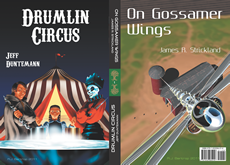
- I’ve been thin on Contra entries this month for a number of reasons, mostly because I’ve been putting the bulk of my creative energy into finishing “Drumlin Wheel.” Nailed the first draft (after nine years!) about an hour ago. Originally scoped out at about 11,000 words (like “Drumlin Boiler”) it ended up at 14,500. As always, when something major emerges from my subconscious I tend to hate it for a couple of weeks, after which I can fix what’s wrong and like it again. More on this at some point.
- While in Hawaii recently, we heard whale songs through a hydrophone that the tour boat crew had tossed into the water, and I immediately wanted one of my own. (We hope not to wait another five years to go back to Hawaii.) Here’s an article on how to make your own hydrophone, which is nothing more than a waterproof mic on a (long) cable.
- I finished reading Fat and Cholesterol Are Good For You by Dr. Uffe Ravnskov shortly after we got back from Hawaii, and was about to write a review when I realized that Tom Naughton had already done it–and written just about what I would have.
- Somebody put a window in the side of one cylinder of a 4-stroke engine, and took a slow-mo video of the action inside the cylinder during actual operation. An amazing thing, even though some frames are missing from the exhaust stroke.
- Oh, I’ve seen sillier things than this…but not recently.
- And finally, CNN reminded me that the original Xerox copier, model 914, was fifty years old yesterday. The article is marginal and doesn’t even include a color photo of the gadget, of which I repaired many many many between 1974 and 1977. There’s a better photo of the Brown Beast here, along with numerous other Xerox goodies.
hardware
Odd Lots
Odd Lots
- Here’s a great article from NASA on the unexpected success it’s had with the WISE (Wide-field Infrared Survey Explorer) spacecraft in spotting previously unknown asteroids in the infrared spectrum. WISE is detecting hundreds of new asteroids every day, which is unnerving, since a rock no bigger than a Motel 6 could cause regional devastation greater than any nuclear weapon yet produced.
- From Larry Nelson comes a pointer to the AirStash, an interesting $100 USB Wi-Fi gadget that can accept up to a 32 GB SD card and act as a content server over Wireless b/g. Anthough nominally a thumb drive, the USB plug also charges the internal battery, and (though it’s not screamed from the rooftops) the thingie works all by itself, no computer connection required. This suggests “wearable file sharing”: Drop one in your pocket and nearby people can download files from the device without having any idea where it actually is. Little by little, the jiminy (an AI wearable computer I thought up in 1983, and figured would be mature by 2027) creeps toward realization. The AI is actually the tough part; everything else already exists, if not in as small a package as I imagined 25 years ago.
- And if you ever wanted to run Linux on one of your fillings (ok, one of your elephant’s fillings) this would be the solution. (Thanks to Bill Cherepy for the link.)
- Here’s a gadget that builds you an external USB storage device by dropping in (literally) a naked SATA hard drive. I may not need it, but I admire the elegance of the concept.
- I’ve been arguing in favor of dual-screen reader devices for years, and this one is a good start. Sounds like the user interface software needs work…but when has that not been an issue for a first-gen device? We’re closing in on it, though.
- Nice status update on some of the current non-Tokamak fusion research approaches, link thanks to Frank Glover.
- Also from Frank comes a reasonable article on how people would die in a vacuum and how they wouldn’t. I had heard of lung shredding; heart failure was new to me. But take, um, heart: Your blood wouldn’t boil.
- If you ever wondered why you cry when you slice onions, well, it’s the sulfuric acid released by cells in the onion when they’re cut open. Supposedly living things evolved this mechanism (or at least key parts of it) half a billion years ago. Onions evolved their chemical weapons to avoid being laid on hamburgers in slices–but we evolved Vidalias to prove that we were smarter than onions, and that fast food will prevail against all threats.
- Interestingly, the Canon G11 camera reduces the size of the image sensor to 10 megapixels, down from the 12.5 on the G10. The new sensor gives you fewer pixels but better ones, and faster, which is all for the best.
- Burger King is testing a new retailing feature in Brazil. When you order a burger, they take your picture and print your face on the burger wrapper.
Odd Lots
- It happens all the time, but it’s rare that we actually watch it happen: a comet falling into the Sun. (It’s unclear to me what the brief tiny streaks are, since SOHO is a spacecraft and the image was not taken through Earth’s atmosphere, where meteors would look like that. Meteors in the solar atmosphere?)
- The SOHO spacecraft may also be shedding some light on why the recent solar minimum was so deep.
- We’ve identified what may be a much better proxy for ancient climate: clam shells. Unlike tree growth rings, which may be affected by several factors like rainfall, sunlight, soil chemistry, and so on, clam shell growth (and the mix of isolotopes, particularly oxygen) seem very closely correlated to the temperature of the water in which the clam lived out its life.
- Intel’s Nehalen-based Gulftown CPU has been officially announced, with six 3.33 GHz cores and 32 nm traces connecting a boggling 1.2 billion transistors. They’re calling it the Core I7-980X Extreme Edition, and it fits the LGA 1366 socket, which implies than it can be swapped in as an upgrade. (No confirmation on that yet.) You may be able to get an overclocked desktop system running all six cores at 4.3 GHz by April. And if that’s not enough cores for you (four is way more than enough for me, if this past year’s experience is any guide) we’ll be seeing the eight-core Nehalen-EX (with 2.3 billion transistors) later this year, nominally for the server market.
- I know, I know, AMD has its Magny-Cours 12-core Opteron server CPU, but the cores only run at 1.7 GHz–and more to the point, exist on two separate side-by-side six-core dies, which may be cheating a little. I’m sure they’re very good chips, but sheesh! We still don’t know how to do parallelism in general terms. Even AMD is puzzled, so they launched a contest titled, “What would you do with 48 cores?”
- And if you don’t believe me, open Windows Task Manager, click the Performance tab, and watch all your cores but one do nothing. To paraphrase George Carlin: What do cores do on their day off? They can’t just lay around…that’s their job!
- Frank Glover put me on to an interesting hand-drawn animated movie that I hope to see fairly soon, if I can find anywhere playing it. (Distribution in the US is inexplicably a problem for them.) The Secret of Kells is about the Book of Kells, and (more intriguingly) is drawn in the style of medieval manuscript illumination. It took a few seconds watching the trailer to catch on, but eventually I had the feeling that I was watching manuscript illuminations come to life. Damned cool.
- And 229 years ago today, Sir Frederick William Herschel first spotted Uranus.
Odd Lots
- Never fear; I’ll return to the pulps discussion shortly. I’m way behind on a lot of projects right now.
- One of the few things I remember about the old 40s Flash Gordon serials (which played incessantly on Saturday morning TV in Chicago circa 1960) are the Rock Men, who could blend into the rocks to escape giant lizards with poison breath. They talked weirdly, and eventually we figured out that they were talking backwards, but none of us had a tape recorder in 1960 to reverse it and see what they were actually saying. Finally, somebody has done it.
- Popular Science has posted the entire 137-year run of its back-issue archives on the Web via Google Books, and you can read it all for free. The whole mags have been posted, including the advertisements. Maybe this time I can find one of those weird ads for the Rosicrucians.
- Gizmodo is beginning a series on Microsoft’s Courier project, which is starting to look more like the ebook reader I’ve always wanted.
- A link on the Make Blog concerning the Vacuum Tube Radio Hat (which I’ve seen before, on Wikipedia, with schematic) led me to Retro Thing, which has just eaten a goodly portion of my morning. Be warned.
- BTW, the model in the Radio Hat cover story above is Hope Lange at age 15.
- I had plum fergot about Boeing’s X-37 spaceplane (and this is probably just what the Air Force wanted) but it will apparently be launched on April 19. Don’t get too excited; it’s a robot and won’t carry humans. (Of course it won’t. It can’t. Impossible. They said so. The subject is closed. How ’bout those Blackhawks?)
- I’ve seen this time and again among the Pack here, but I never knew it had a name: The Nose of Peace. (Thanks to Bruce Baker for the link.)
- Be careful how you talk in front of very small children, even (or especially) girls. (Thanks to Mary Lynn Jonson for the link.)
- I have no idea what to think about this: A site that creates techno music from…Web sites. Read the algorithm description under “About.”
Odd Lots
- Here’s the best discussion I’ve yet seen on why Flash may never work well–or perhaps at all–on touchscreen devices like the iPad.
- Most recent laser printers have Ethernet ports, and some older printers (like my Laserjet 2100TN) can accept a JetDirect network adapter. Installing a printer on a network port means you don’t have to worry about whether the machine it’s attached to is turned on. If you’d like to do this but you’re not a network geek, here’s the best XP-based step-by-step on the topic I’ve ever run across. Same tutorial for Windows 2000.
- Bruce Baker passed me a link to a nice item on the issue of broadening publisher book production to allow all formats to be generated from a single master file. Follow and read the link to The New Sleekness as well. Pablo should take it down a notch; XML is not a markup language; it’s a general mechanism for creating markup languages, and what may happen eventually (perhaps in ten years or so) is a standard book-production markup language derived from XML and built into a new generation of word processors. Still, what nobody in either article mentions is the problem of pages verses reflowable, which is the 9 trillion pound gorilla in the business. If you don’t solve that problem, absolutely nothing else matters. (And it is not as easy to solve as some may claim–I’ve been thinking about it for several years now and see no solution whatsoever on the horizon .)
- Kompozer 0.8b2 has been released. I just got it installed in a VM and will be poking at it in coming days. According to Kaz, most of the changes are code cleanups, but any progress on the editor is a fine, fine thing.
- I’ve done model rocketry here and there over the (many) years, and I’ve seen some very odd things lofted on D engines. Back in high school, my friend George built a Harecules Guided Muscle (which was from the Beany & Cecil cartoon show) in the form of a big whittled balsa wood fist on a short, thick body. I’m amazed it flew as well as it did. Well, here’s a fire-’em-together pack of 8 rockets shaped and colored like Crayola crayons. The guy took his time (six years) but he did a great job–and created a spectacular Web page documenting the project.
- We rarely go to WalMart, but last time we did, I picked up a bottle of Diet Mountain Lightning. It has nothing on Kroger’s Diet Citrus Drop, easily the best of all the Diet Mountain Dew clones I’ve ever had the opportunity to try.
Ebooks: Wholesale/Retail vs. Commission
I’m guessing that by now, most of you have heard of Amazon’s little dustup with Macmillan, one of the world’s largest book publishers. As long as Kindle was the only significant online retailer for ebooks, Macmillan accepted Amazon’s sales terms, which set a ceiling of $9.99 on most ebook prices, at Amazon’s option. But the instant Apple popped up as a second significant ebook retailer, Macmillan cut a better deal with Apple, and demanded that Amazon match Apple’s terms, which include a higher price ceiling. Amazon responded by refusing to sell Macmillan’s titles.
Amazon caved yesterday, and agreed to reinstate Macmillan’s books at Macmillan’s higher prices. People posting in the comments sections of some news sites seem puzzled that a more competitive market would raise prices for consumers, but that’s just the way truly free markets work. Until Apple showed up with their iPad, Amazon had a monopsony relationship with ebook publishers, rather like WalMart has (still) a monopsony relationship with a multitude of small-to-middling goods manufacturers and wholesalers. In a competitive retail market, neither monopoly (one seller, many buyers) nor monopsony (one buyer, many sellers) dominate. There are lots of buyers and lots of sellers, and we quickly find out what the “real” price of a product is, as manufacturers and retailers jockey for the greatest market share among consumers.
That’s not, however, what I find interesting about the recent conflict. Look closer, and you’ll see two fundamentally different approaches to selling a product to consumers: Amazon is selling on the conventional wholesale/retail model, and Apple is selling on an agency model. Amazon wants to buy ebooks from publishers at a wholesale price and make money on the margin between that wholesale price and a retail price that it controls. This allows it to create occasional “loss leaders” to generate traffic, as conventional goods retailers have done as long as anyone remembers. Apple, by contrast, wants to sell ebooks at prices set by their publishers, and take a percentage of every sale.
Publishers like the agency model since it gives them more control over pricing, and does not train the public to expect all ebook prices to be $10 or less. How much better the agency model is for publishers and authors is unclear, and depends in part on how fungible you think books are, which is a very weird business that I’m still thinking about. It may also depend on how many players can participate on the publisher side. A B&M bookstore can only contain and manage so many physical books, and publishers play lots of dicey scarcity games to get more shelf space than their competitors. (“Stock our whole frontlist and we’ll give you an extra 2 points’ margin…”) An online ebook store’s capacity is essentially unlimited, and any number of publishers can play. If there are a million publishers and 999,900 of them sell products at lower prices than you do, your control of pricing is less than it was in the era when it was tough to get your books into stores and a relatively few large publishers dominated the market.
Nor does it end there. If you look even closer, Apple’s model starts to look familiar in another sense: It starts to look like a publisher paying authors a royalty. The royalty rate is insanely high by historical standards (70% or thereabouts) but there are no atoms to push and protect. Without atoms getting in the way, being a publisher becomes an entirely different challenge, and the difference between conventional publishing and self-publishing implodes to the process of contracting for services you need with people who have the skills you don’t have. As experience in that process becomes more common, being Macmillan gradually becomes less and less important. I wonder whether Macmillan understands that.
Most of all we need to remember: The ebook business is still in its infancy. Everything remains in play. The readers can only get better. People are doing weird things that seem to work, like giving away your older ebooks to develop a market for your newer ebooks. Lots more ideas will be tried, new technologies will appear, and older technologies will change and improve. Maybe Amazon’s crazy action against Macmillan had to happen, just to show everybody that such things won’t work. (Sure, it was obvious…in hindsight.)
Me, I’m with Apple…for now. Why? Because Apple’s business model smells more like a free market than Amazon’s–and more like a game I can compete in. That could change, and much of that decision will hinge on the nature of Apple’s ebook DRM. (We don’t know all the details yet.) Kindle’s DRM is mandatory–whether I as a publisher want it or not. In a sense, its purpose is not to protect the publishers or the authors from piracy so much as to protect Amazon from a freer market, in which consumers can move their books from device to device at will. Apple could adopt that same strategy, leaving us with two paranoid and incompatible ebook retailers and readers. Hey, that’s nothing that another five or six major ebook retailers couldn’t fix, and they’ll happen. Give ’em time.
Odd Lots
- The iPad’s ebook store is evidently US-only, less likely because of copyright laws themselves (as many are claiming) than because a lot of books are licensed to publishers by country, and if an author did not contract a book for distribution in Asia (for example) it can’t legally be sold in Asia. Some authors think this will allow them to contract separately by country or language and make more money…when in fact it only means that people outside the US will have yet another reason to steal the damned book. The only way to reduce content piracy is this: Sell it cheap, sell it easy, sell it everywhere. Anything else is wishful thinking.
- Here’s a great short piece by nanotech guru Eric Drexler on why tokamaks won’t ever be widely used in commercial power generation. My favorite line in the whole thing: “…[the Sun] puts out less power per unit mass than a good compost pile.” Fortunately for us, the Sun is a little bigger than a compost pile. (Thanks to Frank Glover for the link.)
- When I finally worked up the courage to go to the Meetup Web page for the Paranormal Erotic Romance Book Club of Colorado Springs, I discovered that one of the topics they list for the group is “New in Town.” I belonged to the New In Town Meetup for awhile in 2003, and I’m guessing that that’s why I got the email mentioned in yesterday’s entry. Lesson: Never ascribe to vampires what can be explained by simple spamming.
- And while we’re talking weird emails, I got one the other day thanking me for using Minitab statistical software…which I had never heard of until I opened the message.
- If you ever had the urge to click on a cloud formation, this is the kite for you. (Thanks to Michael Covington for the link.)
Daywander
(“Daywander” is a new category I’m trying out. The idea is something less crisp than Odd Lots but still a collection of different things I thought about or did during the day. It may not work out, and if it doesn’t I won’t miss it overmuch.)
So. We have an iPad. It’s not like it was a surprise, and in broad strokes it was pretty much what everybody thought it would be. I’m very glad that Apple anointed the ePub format for ebooks…the last thing anybody needs is a new proprietary text container. Now we need to know if the Jobs Gang can face down Big Books over prices and DRM. News items I’ve seen recently indicate that books from the iPad store will be allowed to cost more than books on the Kindle, and I’m good with that. I routinely pass on supposed “bestsellers” because they don’t smell like they’re worth $25 to me. The market can decide…and the publishers need to learn that lesson. The bigger question is how much access small publishers will have to the Apple store. One of my goals for 2010 is to get some of my titles onto the Kindle to see how they do. Anybody can be on the Kindle, and the price of goods can be $0.00. I haven’t seen an indication…yet…whether free books will be available in the Apple store, or whether other stores will be accessible, or how difficult it will be for one-person publishers to get in on the action.
And for that matter, is there an SD card socket, so I can drop in the ebooks I already have?
As an ebook reader it looks socko; finally, color and enough resolution to display technical books with figures and detailed art. How well you’ll be able to read the screen outside is another big question that ebook freaks will obsess about. Not me…when I’m outside I’m enjoying the outside for being the outside.(Books to me are an inside thing.) The iPad display isn’t e-ink…but it could be. Why not two displays? Frontside for inside, backside for outside. Apple could do that blindfolded. The thing already costs $500 minimum. Another $75 for a second display wouldn’t kill it.
Hardware, mon dieu. I tried and failed to tweak the Intel driver for the SX280 this afternoon, as suggested by my sister’s friend Chris Meredith on my LiveJournal mirror, and described in this eye-crossing article. Bits don’t scare me, and I follow directions well, but the machine failed to present the tweaked 1600X900 resolution as an option. Hardware can be stubborn sometimes.
Getting away from hardware for the nonce, it’s been revealed that the late Pope John Paul II beat himself with a belt and slept naked on the floor to move himself toward spiritual perfection. The Jesuits were big on this, and did this well into the 1950s: Each Jebbie had a little whip called “the discipline,” and was to use it on himself every night, presumably for the same reason. (Garry Wills wrote about this in his excellent book, Why I Am a Catholic.) What has never been clear to me is why hurting yourself has anything to do with spiritual perfection. (This is especially puzzling given JPII’s ecstatic writings about the holiness of the human body…so holy that we apparently must beat it up, mortify it, make it bleed. I guess.) Sorry. Don’t buy it. What “mortification of the flesh” really is is a powerful temptation to pride: People who hurt themselves and deny themselves can never quite hide the smugness that seems to come with the territory. My take? Real saints help others. Hurting yourself does not help others. Get real.
And in other news from the God side of things, this past Sunday’s Old Testament reading contained orders from the Hebrew Scribe Ezra, in the Book of Nehemiah, Chapter 8: “Eat fat, and drink sweet wine…” Hey, Ez! Got it covered!
The SX280 Comes Out of Depreciation
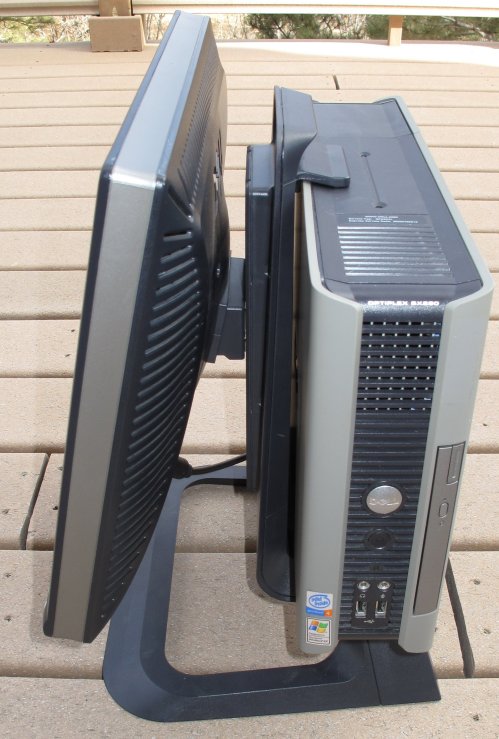
I’ve changed my mind again; take note, and remember that it’s good practice. I recommended the Dell SX270 here over the SX280 last fall. Having had some time to spend with a couple of SX280s, I’m thinking that the SX270’s day may be past.
I’ve been configuring and using Dell’s SX270 Ultra Small Form Factor (USFF) machines for several years now, and mostly I love them. They’re rugged, tiny, quiet, reliable, and come with a BIOS-locked version of XP Professional that does not need activation. (The disc can’t be installed on anything but a Dell SX270, and because every last SX270 out the door had a paid-for Windows instance on it, Microsoft figures they won’t lose anything by giving over WPA, and they’re right.) The SX270s were made and sold between 2003 and 2005, and given that they were almost entirely corporate fleet machines, five years later they’ve mostly been written off by their corporate owners and dumped on the resale market. That’s why they’re so cheap; a quick check of completed auctions on eBay right now shows dozens of units selling for between $60 and $100, and a few full systems (including flat panel monitor, keyboard, mouse, and the combo system unit/monitor stand) for between $100 and $150.
There are a nonetheless few downsides to the SX270:
- They’re limited to 2 GB RAM. This can be an issue, depending on what you’re doing with them.
- They use 2.5″ laptop IDE hard drives, which are more expensive (and less capacious) than the conventional 3.5″ drives most larger PCs contain.
- Their integrated graphics systems are not meant for animated video games, and the slower machines (slower than 3 GHz) do not render video very well.
In 2005, Dell replaced the SX270 with the SX280 USFF, which is about 15% larger but still mighty small. The SX280 is a better machine in a number of ways:
- It can take up to 4 GB RAM, though you have to be careful what you put in it. (More on this in a moment.)
- It uses ordinary 3.5″ SATA drives, which means you can pack 1.5 TB into the little box for about $120.
- The integrated graphics chipset is faster and more versatile–if still not quite versatile enough.
- It opens up and field-strips a lot more easily than the SX270.
Until very recently, SX280s were fairly scarce and went for $250-$350 used. But a few months ago I noticed that SX280 prices were imploding, and they’re now as cheap (and in many cases cheaper) than the SX270, sometimes as cheap as $50. In fact, a week or so ago, a full 2.8 GHz system like the one shown above (which I will be installing in our parish office shortly) sold for $103, including the Dell HC317 17″ monitor on stand, mouse, and keyboard.
The SX280 is a little fussy about the sort of DDR2 DIMMs you put in it. Crucial has a nice lookup service for Dell (and many other) computers, and I ordered 2 2GB DIMMs from them. Go here and look for the Crucial Memory Advisor. If you buy the ones specified for your model, they’re guaranteed to work, and mine did.
Seeing SX280s cheaper than 270s is a little odd. It may be that the supply of workable SX270s is drying up; after all, they went out of production five years ago. Doesn’t matter; the SX280 is a better machine, and if you mount it on an HC317 stand behind the 17″ monitor, it’s no larger than the similar 17″ piggyback system incorporating an SX270. The HC317 stand is VESA compatible, so if you have a larger VESA monitor it’ll bolt right on.
The big downside, as I’ve alluded to before, is that neither the SX270 nor SX280 will display a native 16 X 9 raster under Windows. I’ve tried to coerce the Intel chipset to do 16 X 9 to no avail–which is infuriating, since Ubuntu detects my widescreen monitor and somehow drives the Intel GMA 900 controller at 1600 X 900 automatically, with no input from me.
Anyway. If you’re looking for a small and quiet officework machine for cheap, the SX280 just got cheap. Highly recommended.
Authors Get 70% Royalty from Kindle Sales
Wow. This is big: Amazon just opened up an option for Kindle author/publishers under which royalty rates are 70%. (Some analysis here; ignore Jeff Bezos’ open mouth.) We’re now closing in on the sort of royalty structure that reflects the realities of ebook economics: No paper, no ink, no physical warehousing. (Server space is way cheaper than maintaining pallet loads of print books out in meatspace somewhere. Trust me on that one!)
To qualfy for the new royalty rate, author/publishers (funny how the two are now blurring together!) must satisfy a few requirements:
- Ebooks must list for between $2.99 and $9.99
- The ebook list price must be at least 20% below the cover price for the printed book.
- The ebook is made available everywhere that the author/publisher has rights.
- Author/publishers must agree to accept the full list of Kindle features–current and to come–without quibbles, pointedly including text-to-speech.
- Although Kindle won’t demand an exclusive, an ebook’s price at the Kindle store must be at or below the price at other ebook retailers from which the ebook is available.
- The 70% rate applies to in-copyright works only. Reprints of public domain material do not qualify.
It’s no secret what’s going on here: Apple’s not-quite-top-secret tablet is really a game-changer ebook reader, and having seen how Apple basically created and still rules the market for individual music tracks, Amazon wants to make sure it retains its hard-won early lead in ebook retailing. This is certainly the reasoning behind Point #4, which basically prevents author/publishers from cutting sweeter deals with other ebook stores like Nook and whatever retail mechanism Apple eventually puts together.
If I hadn’t had to update my assembly book, my SF titles would be available for the Kindle by now, and this makes the effort all the more urgent. Looks like I have a lot to do this year–and maybe now I can expect a little more money in the bargain.