- My installation of Thunderbird 3 has correlated with a lot of weirdness, not only in system performance but in taskbar “stalls” in response to clicked links in messages. I’ve heard a lot of people having trouble with it as well, and we are apparently not in the minority.
- How can I have lived the last ten years as an SF writer and never heard of John Titor, Time Traveler?
- Stephen Hawking has told us that we must abandon Earth or die. Agreed. Now, Dr. Hawking, would you please invent us a hyperdrive already?
- No, bichons are not groomed this way. (That’s for miniature poodles.) Thanks to Jim Strickland for the link.
- Microsoft is working on a tablet prototype with keys on the back surface, opposite the display, so you can type with the fingers that you’re using to grip the device. (Thumbs remain on the front.) This looks better than it tells; do follow the link. Will it work? No opinion until I try it.
- If anyone here has not yet been to thereifixedit.com, Go. There. Right. Now. (Via Make.)
- Many people have sent me a link to this item from City Journal , which may indicate that some sense is finally creeping into the nutrition world. Sugar and grains may be killing you. Meat, eggs, dairy, and animal fat are probably not. I’ve known this from my research for a long time. Now, to get the government to admit that they’ve been slowly killing their citizens for over 30 years…
- Not convinced? Fructose seems to be the preferred sugar of cancer cells.
- Still not convinced? The inventor of Cheese Doodles just died at age 90. So much for salt and fat being deadly. (The food dyes worry me more than either.)
- Pete Albrecht points out that LA coffee shops are beginning to unplug their Wi-Fi access points and plaster over all their wall outlets. They’ve found that people buy more coffee and snacks when they actually talk to one another. No shirt, Sherlock!
- Formufit: PVC pipe fittings for when you’re not using PVC pipe for plumbing. Fine stuff!
- I think that what we’ll miss most about our deathwish-afflicted newspapers are all the silly headlines.
- And anyone who has ever scratched his or her head over that famous if gappy Latin expression “Et in Arcadia ego” should look at the variations here. (I find myself thinking of a paraphrase of another classic expression from junk mail: “You may already be in Arcadia!”)
- Heh. As long as Carol’s beside me, I am.
hardware
Odd Lots
Odd Lots
- Everyone’s talking about a recent Copyright Office ruling that jailbreaking of smartphones is no longer illegal, but few have mentioned that several other significant exceptions to the DMCA’s anticircumvention provisions have been issued in the same ruling. Most interesting to me are limitations on ebook DRM where they prevent audio interpretation of texts from working.
- Could Popular Electronics be returning? Let us pray. (And thanks to Don Lancaster for the link.)
- Carol and I have begun avoiding movies in 3D. They give her headaches and they make me seasick. I thought it was just us being weird, but there’s some evidence that 3D isn’t the crowdpleaser that everybody (especially in Hollywood) thinks it is. Here’s some explanation.
- And even the 2D movies we’ve seen recently seem excessively loud. We may not be imagining things.
- A new dual-core Android-based tablet by an otherwise unknown German firm is really calling to me. We may not see this one here for awhile (if ever) but if it’s evidence of an evolutionary explosion in Android tablets, I’m good with that. Ours will arrive eventually.
- I’ve always been taken aback by the near-psychotic venom with which certain people treat an informal, likeable little font called Comic Sans. Scan the Internet and you’ll get a sense for what I mean. From ten steps back it looks like a tribal identity thing: You must slander Comic Sans to prove that you’re a member of the tribe, especially if you’re insecure about your membership. Secure people just keep their mouths shut and use something else.
- The little red guy running with a hatchet (see my entry for June 27, 2010) appears to be the logo of Psychopathic Records, not the Insane Clown Posse band itself, granting that the label was founded by the Insane Clowns and is probably owned by them. (Thanks to Ricky C on LiveJournal for the tipoff.)
- I solved another band logo question with the help of Google’s new output format for their Images search. Carol and I saw a band logo that resembled a bright red ballet dancer, apparently headless. I typed “red dancer band logo” into Images and there it was, an emblem of the Dave Matthews Band. I’m starting to like the new Google Images search output because it allows me to scan more images at once, rather than page repeatedly through a more limited matrix. This isn’t always useful, but I’m guessing it’s useful more often than not.
- Bicyclists in NYC seem to be preparing early for the coming Ice Age.
App Inventor for Android
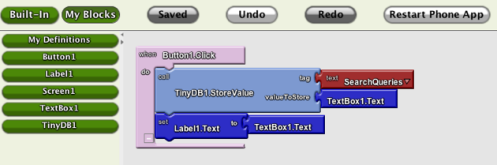
Whoa. Yesterday morning Google took the wraps off App Inventor, a visual development environment for the Android mobile OS. I’m still trying to slurp from the firehose, even though I’m finding that all the hoses have basically the same information, and in truth not a great deal of that. But I’ll tell you right now: It stopped me in my tracks on the iPad decision. As of yesterday morning, I wanted something that runs Android. The new search is on.
You know me. I’m the Visual Developer guy, and the fact that my magazine’s been dead for ten years doesn’t change that. I still believe that visual metaphors for programming are not only useful but necessary, if certain kinds of software development are to happen at all. (More on this below.)
If you haven’t looked into App Inventor at all yet, a very good place to start would be Jason Kincaid on TechCrunch. He’s got a good overview and some screenshots (including the one I show above) that will give you a sense for what Google’s cooking up. I’ll summarize here. App Inventor has two major subsystems:
- The Designer is basically a form designer, not conceptually different from that in Delphi, VB, and many other more recent environments. You drag UI components from a palette and arrange them on a form.
- Far cooler (if less proven in its approach) is the Blocks Editor. Here’s where program logic happens, and it happens by snapping together logic blocks that look literally like jigsaw puzzle pieces. Clusters of blocks become event handlers. You connect a cluster to an event generated by a component on the form, and the blocks in that cluster execute.
(This may not be the correct jargon. Please understand that I don’t have an instance to play with yet, so all I can do is relay what I’ve read from the fortunate few who were given early copies.)
I knew what the major problem was going to be before Jason told me: In any system like this, you’re limited by the selectable elements on your palette. He didn’t mention where the blocks come from (I assume they’re written in Java using some relative of the MIT Open Blocks technology) nor whether user-created blocks will be importable into the product as shipped. I’m a lot less worried than he seems to be about this, because Google isn’t stupid, and they know damned well that the system lives or dies by the richness of the set of available logic blocks from which the apps are generated. If it’s anything like an open system, there will be an explosion in third-party blocks once a few Java guys get the system and figure out how to do it.
Jason provides some screenshots with his article, and I borrowed one above to get your attention. Here’s another page with a description of a more complex app, with a much more representative Blocks Editor display.
There’s not a lot more that I can say about App Inventor itself, at least until I can get a workable instance installed here. But it’s been interesting seeing all the dorks in the comments to the news stories, dumping on the system for its simplicity, and for the (frightening) possibility that the hoi-polloi will be able to use it to write their own software. They scream the obvious: You can’t write a word processor with a tool like this!
Fersure. And that’s not what it’s for. I’ll respond with something that should be equally obvious: The mobile phone environment is fundamentally different from the desktop environment. From the beginning, it’s been about smallish apps that do one or two things of interest, and no more. Mobile phone computing for the most part is about getting in, doing something with a few quick clicks, perhaps reading the screen, and getting out. The apps are very focused and often extremely specialized. Some are obviously going to be a lot more difficult to write than others, but a useful mobile app does not necessarily require man-years of development time.
And if it ever did, it won’t anymore once App Inventor hits its stride.
I think that I’ll use App Inventor for the same reasons that I use Delphi: To play with ideas, see how things work, and gen up one-time test apps that may lead in useful directions. I’m guessing that App Inventor will enable people to create apps for an audience of one–themselves–and not have to spend six months of free time to do it. Companies may experiment with different approaches to mobile computing without having to commit millions of dollars in dev costs to any one approach, just to see if it’s useful or even doable.
I have never had a smart phone, and I’ve been waiting for my current cell provider contract to expire early next year before getting one. I may have to accelerate the schedule a little. This thing’s making me itch in places I haven’t itched in for a long time.
Review: The Ineo Toaster Dock
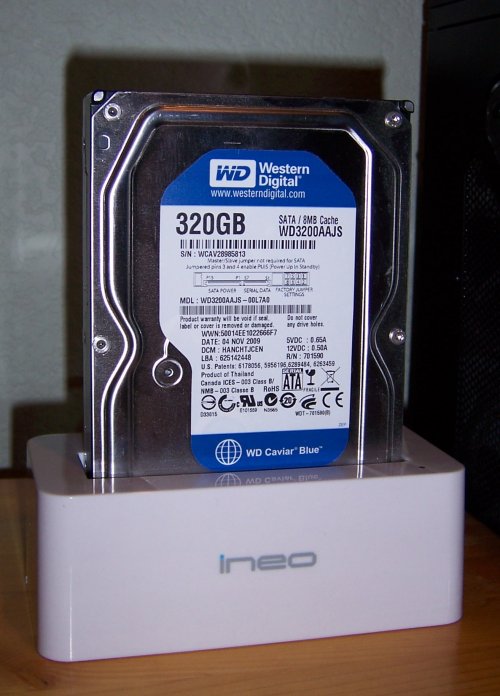
I have a 320 GB SATA drive that got corrupted when power dropped during a thunderstorm. I lost nothing in terms of data (I do backups well here) but now I have this naked drive in the drawer. I want to go through it and make sure there’s nothing worth taking from it that wasn’t in my backups, and then low-level reformat it and see if it could again be of use.
This is something that most of us do from time to time. I have a small pile of hard drives downstairs on my shelves, pulled from defunct machines before they went to the recycler. A couple of the older ones (1.6 GB anyone?) I treated with one-clunk degunking (in which that single clunk is applied out on one of the flatter boulders behind the house, with a five-pound sledge) but there are some that are still large enough to be useful.
Ordinarily I stick them inside a system to examine and reformat them, but most of the systems in the house are now USFF Dells, and don’t have an “inside” as we define insides. My current Antec desktop tower, as nice as it is in some ways, is miserable to open up. I used to use my old Antec and just left the covers off, but then the mobo died, making it junk. It would be damned fine to have an easy way to connect the occasional drive to a system to work with it, without having to fuss with Metric screws and cables and covers.
 One solution is shown above and (top view) at left: The Ineo I-NA317U+ “toaster” dock. It’s a USB 3.0 device (which works at reduced speed at a USB 2.0 port) with a spring-loaded hatch on the top. You drop a SATA hard drive into the hatch and shove it down until the drive data and power connectors mate with those in the dock. That’s it. The drive then appears as a USB storage device to Windows and Linux without any additional fuss or installing of drivers. The hatch has a notch in the connector corner sized to fit a 2.5″ laptop SATA drive. When you drop in a 2.5″ drive, the hatch doesn’t push down and away, but acts as a positioning guide. The SATA connectors are physically identical irrespective of the size of the drive, and located on the drive end plates so that the dimensions from the corner of the drives are the same on both 3.5″ and 2.5″ drives.
The dock requires a separate wall-wart power supply; there’s not enough power available from a typical USB connector to run both the drive and the dock. (USB 3.0 is more power hungry than 2.0, evidently.) The cable is also different from the conventional USB 2.0 model, and relatively short, at 3′. SATA drives are hot-swappable, and you don’t have to power-down the dock or the system to change drives in the dock. Just do the usual USB unmount, and you can then pull the drive up and out of the dock without damage.
The Ineo device worked flawlessly the first time. It’s SATA only, and I have begun looking for something similar for ordinary parallel ATA drives. I know that ATA drives aren’t hot swappable, so I may be forced to use an ordinary external USB enclosure and just not screw the top back on, but I can live with that. SATA is the future, and as I migrate away from ATA-equipped SX270 USFF machines to SATA-equipped SX280s the Ineo dock will become more and more generally useful.
About $50. (Mine came from Amazon.) Highly recommended.
EPub and Word Processors
Well. Got your heart medicine handy? Jeff is considering a Mac. Well, not exactly. (Put down that nitroglycerine.) I’m strongly considering getting an iPad. And I’ll bet you didn’t know that I already have an iPod, thanks to Jim Strickland, who may in fact persuade me to get a Mac someday. I worry about some of Apple’s cultural issues (like not providing clear guidelines on what you can sell in their stores and what you can’t, and changing your &!$#*% mind about it every other week) but their engineering is extremely good. I spent some quality time with an iPad at a recent Enclave Meetup, and basically, I’m sold. Those guys pretty much nailed the ebook experience, or at very least came up with the best possible compromise between fixed-page and reflowable presentation that anyone might strike. And I want my books out there in the iBooks marketplace.
This means that I need to be able to create EPub files, and good ones. What boggles me is the scarcity of visual tools for that purpose. Among the mainline desktop publishing apps, only InDesign CS4 and CS5 can export finished EPub files, and some people think the feature itself isn’t finished yet. (I don’t have either version so I can’t do my own testing–and at $700 for the app, I don’t expect to get it.) Some odd comments I’ve seen online suggest that the Scribus developers don’t think that reflowable document export is a suitable task for a fixed-layout desktop pubber, and that they’re not going to do it. There are lots of converter programs for taking various types of files and turning them into EPubs. As best I can tell, most people code their EPubs up manually, as though they were writing a C++ program. Gakkh. But also as best I can tell, affordable WYSIWYG EPub editors begin and end with Sigil.
The format itself is not a skullcracker. You’ve got one or more XHTML files expressing content (plus image files, if present), one or more CSS files defining styles, and one or more XML files describing document structure and metadata, all placed in a container file that’s not much more than a .zip with a different extension. There’s an optional DRM layer in the spec, but it’s technology-agnostic and not much used. The spec is simple enough so that people write the damned things by hand. I can’t imagine that parsing and generating the XML/XHTML/CSS would strain any sort of editor.
My point here is that you don’t need a fixed-layout desktop publishing program like InDesign or Quark to create and maintain EPub ebooks. In a sense, EPub is a modern XML-based word processor file spec, and even a middling WYSIWYG word processor could be twisted a little bit to read, render, edit, and write EPub files that could be loaded right into iBooks without further processing.
Sigil comes close. I’m using it and I’m reasonably impressed, considering that the team is basically writing a brand-new word processor from scratch. What boggles me is that it’s the only WYSIWYG EPub editor in the universe. And as a word processor, well, it’s pretty spare.
There’s no reason for this. Existing word processing apps like OpenOffice Writer and AbiWord could easily be extended to import and export EPub files, or forked to create a ramcharged ebook development system using EPub as its primary file format. Fork or not, I’m convinced of this: All word processors will eventually become ebook editors. The ebook market is closing in on reality. We now have the file format we need. The software will follow.
But sheesh guys, how about picking up the pace a little!
Odd Lots
- As I polish up this Odd Lots, I see that Sectorlink.com is down, which is significant to me since they host duntemann.com and copperwood.com. Have no idea what’s going on yet, nor how long the outage has existed. (I was over at one of Carol’s friends’ rebuilding some very ad-hoc tomato shelters in honor of George Ewing until an hour or so ago.) If some of my pages are inaccessible, it’s not about me; it’s the whole damned hosting service.
- We lost Martin Gardner the other day, at 95. Amazing man, something like a technical Colin Wilson, who wrote the “Mathematical Games” column in Scientific American for 25 years, edited Humpty Dumpty’s Magazine for Little Children (which I read circa 1957-59) and cranked out books for most of his life. Every one I’ve read has been terrific, and I especially endorse Fads & Fallacies in the Name of Science (1957) and The Annotated Alice (1960.) I should look for a few more.
- Art Linkletter too, who made it to 97. It was in Linkletter’s very funny book Kids Sure Rite Funny that I found the wonderful kid-quote: “Now that dinosaurs are safely dead, we can call them clumsy and stupid.” The book’s copyright was not renewed and it is now in the public domain; you can read it online or get free ebook copies in various formats here.
- The problem with how to carry your iPad made it all the way to the Wall Street Journal, which devoted an A-head story to the issue. My correspondents (including a couple who have the iPad) think a belt holster is unrealistic. Best iCartage solution I’ve seen so far (including a photo endorsement from Woz himself) is the Scott eVest, with 22 hidden pockets, including one custom-designed for the iPad.
- Then again, there’s some unexplored form factor territory between smartphones and iPads. I find the Dell Streak (formerly the Mini 5) intriguing for its size/shape alone. (Here’s an interesting perspective on display size from Engadget.) The 5-inch model that will launch later this year (and in the UK on June 4, I hear) is about the size of an old HP scientific pocket calculator, and in the fevered days of my youth alpha geeks carried those around in leather belt holsters. Even the rumored 7-inch version could be belt-holstered with some care; beyond that it gets dicey. (Dell supposedly has a 10-incher in development.)
- After asking mobile developer David Beers about his thoughts on the Android OS, I discovered that Google will let you download an Android LiveCD so you can mess around with the OS on an ordinary Intel PC without having to lay out for an actual mobile device.
- That unpronounceable volcano in Iceland, perhaps fearing that the world was starting to get bored with it, blew a volcanic smoke ring the other day. Many people, perhaps thinking that smoking may be hazardous to a volcano’s health, are cheering it on.
- After several calm days here, the winds came up again yesterday morning. As Carol and I were driving back from Walgreen’s, we saw dust clouds crossing Broadmoor Bluffs in front of us on several occasions. It’s dry here, and construction sites generate a lot of brown dust, true. But then the winds calmed for a few seconds before starting up again, and when they did, we saw a large pine tree shake in the wind and let go a thick cloud of yellow dust. Pine pollen by the pound. No wonder I can barely breathe.
Odd Lots
- Jupiter has always looked better with a few belts, but now, astonishingly enough, one of them has gone missing.
- Ever want a stuffed muon? Head right over to the Particle Zoo, where that and many other cuddly plush species of atomic debris can be had, including a few (like the tachyon) that have never been observed and probably don’t exist. Oh, you can get stuffed dark matter too–and does that Higgs Boson look happily stoned or what?
- I’d heard about it a while ago, but only recently began reading up on the Haiku OS, inspired by ahead-of-its-time BeOS. What intrigued me is Haiku’s inherent suitability for multicore CPUs, since it’s pervasively multithreaded, and damned near every piece of an app is spun off into a separate thread. Alpha release 2 is now available. I’ve downloaded the ISO and will report back here when I test it on my quad core.
- One of the more interesting issues involving the iPad is where to put it: Do all of us macho geeks need to get used to carrying man-purses? Hardly. We wore our leather-holstered slide rules on our hips like mathematical six-guns back in the 60s. A quick check online showed nothing comparable for the iPad and its inevitable imitators, but trust me: Leather belt holsters for slates will be the Christmas gift in 2010. Draw, pardner! Whoops. Visio isn’t available for the iPad yet. Surf, pardner!
- The Hong Kong knockoff artists are beginning to fill the Fake iPad niche, and according to Wired may well clone the Google Android slate before Google even admits that it exists.
- And Bill Roper sent a link to a barely $100 Android slate shaped to better fit your stylish black leather belt holster. With one of the new Android-based e-reader software packages like FBReader and Aldiko, a gadget like that could serve as a socko indoor ebook reader.
- From Pete Albrecht comes a link to Lehman’s, a vendor offering mostly non-electrical products and catering (presumably) to an Amish clientele. (Preppers too, I suspect.) An amazing number of items in the catalog (the red rubber hot water bottle, for example) were commonplaces in my youth, and some (like the strangely retro-deco Stirling engine fans) would be right at home on planet Hell from my novel, where electrical devices don’t work. All in all, a fascinating flip.
- The May 2010 Scientific American published an article suggesting that carbohydrates may be worse for you than saturated fats. This is not news to me (when I eat carbs I gain weight rapidly, and lose just as rapidly when I stop) but it’s encouraging to see a “big-time” publication take the notion seriously. After all, the Federal government has been telling us that fat makes us fat for thirty years now, and all we could do in response has been to…get fatter. I’ve doubled my fat intake in the last year or two, and have remained at my customary 155 pounds. Something’s screwy somewhere. (Found via The Volokh Conspiracy. Read the comments; amazingly good signal-to-noise ratio there.)
Odd Lots
- Well, Ubuntu 10.04 Lucid Lynx is out there, but I had other committments yesterday and couldn’t download it on Day One. This may have been a good thing; there was a last-minute bootloader bug that interefered with dual-booting with Windows. Still, I’ll be installing it on one machine or another ASAP and will report here.
- Tom’s Hardware posted a solid comparison of Linux office apps yesterday, and if you’re considering Linux for day-to-day work, it’s worth a close read.
- I got the Audiveris sheet music OCR app installed the other night, and it does work–however, it requires 300 DPI sheet music scans in order to operate, and none of the ragtime sheet music I found online was anything close to that high-resolution. (I tested it using high-res example scans installed with the app.) As with most Java apps, it is agonizingly slow: It took seven seconds to pop up a simple Save As dialog, on a 3.2 GHz SX270 with 1 GB RAM. I also had trouble getting audio output via its MIDI support; however, after saving the generated MIDI to a disk file, the MIDI file played normally through several different player apps.
- Rich Rostrom did send me a link to another composition by Irene Giblin, the author of the Ketchup Rag: The Chicken Chowder Rag. Here’s a video of an ancient record playing it, and another (far better) video of a piano roll of the song playing on a player piano. Here’s a short bio of the long-lived composer…and (finally) a MIDI file of the Ketchup Rag itself.
- ZDNet posted one of the better ebook reader evaluations I’ve seen lately, and while it appears to be Kindle vs. iPad, it’s really e-ink vs. backlit LCD. I’m currently with LCD. I don’t read outside for many reasons, including a lack of comfortable chairs out there, and a feeling that if I’m outside I should be walking or climbing or digging or something.
- Making large numbers of books portable is what the ebook thing is all about. Here’s another approach: Climb inside your circular bookshelf and start walking.
- Of course there’s lots of 2010 still ahead of us, but charts from the NOAA indicate that severe weather in the first four months of the year has fallen to what looks like a ten-year low.
- The post was 23 days late, but better late than never: Fear the homeopathic bomb!
Odd Lots
- From the Words-I-Didn’t-Know-Until-Yesterday Department: Fixie, a fixed-gear bicycle; i.e., a bike in which the pedals always move with the rear wheel and coasting is impossible. Fixies are currently the rage among hipsters in stylish cities. It sounds deranged to me, but I lack the hipster gene and value my knees, so what do I know?
- From Aki Peltonen comes a link to probably the best volcano blog I’ve ever seen. Great photos, interesting analysis, and reasonably courteous comments. (Boy, you don’t see that everywhere!)
- While we’re talking volcanoes, how are the sunsets in the UK? Denmark? Any personal reports from readers here?
- Many have sent me a link to the Panoramic Wi-Fi Camera, a fascinating gadget that consists of 20 cantennas arranged in a vertical line on a frame that spins 360 degrees horizontally. Spin the device, and a netbook builds a panoramic image of the 2.4 GHz field in the immediate vicinity. Watch the videos. Fascinating on its own merits, and pay attention to what happens when somebody throws a cup of coffee into a nearby microwave oven: The oven blinds the camera to everything else. For all the tooth-gnashing we hear over cellphone radiation, microwave oven RF leakage never seems to get a whisper.
- This should surprise no one: Google’s Street View carcams have also been wardriving. There’s less to this than meets the eye (there was a project, now defunct, doing this in 2002) but it’s yet another reason I don’t power-up my Wi-Fi access point unless I need it for some reason. (My house has Cat5E in the walls, and I use PowerLine bricks for high-speed Net access in odd corners.)
- Dave Schmarder N2DS has given his homebrew radio site a major upgrade and its own domain, so even if you saw it a few years ago, do take another look. Gorgeous work.
- We blew through the range of SDHC Flash memory cards in record time: 32 GB cards are now in the supportable $60-$80 range…and 32GB is as big as they get. We did this in four years. Admittedly, SDHC was a cheap’n’easy hack, but hell, what kind of damfool memory standard only increases capacity by 16X? (Even SDXC, which takes us to 2 TB, should have gone much farther.) My guess: Standards authors don’t want to be wrong about future advances in hardware, and certainly don’t want to be a drag on future innovations by being too explicit about how hardware is supposed to work ten or twelve years on. I can see both sides. That doesn’t make it any less annoying.
- From Michael Covington comes a pointer to a 1952 riff on beer and ham radio, and a glimpse of what cash-poor radio guys dreamed of the year I was born. I’ve never met anybody who ever had such a rack (the radios, the radios!) but beer was and remains very big in radio shacks to this day. K1NSS is the cartoonist behind the Dash books, about a dog who does ham radio. (I found him last year while researching names for our current puppy…)
A Kingly Gift
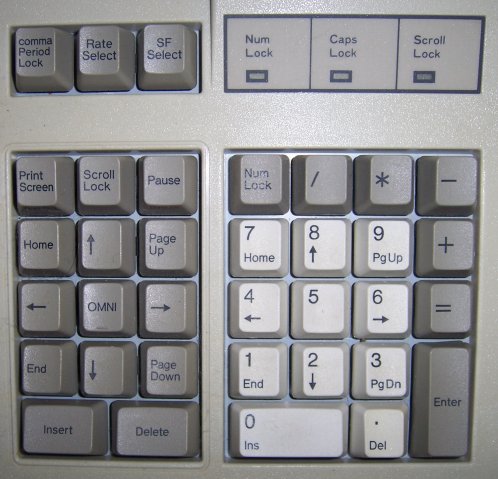
Last night, my brother-in-law Bill Roper presented me with a truly kingly gift: An unused Northgate Ultra keyboard, which he bought many years ago but never attached to any machine. I’ve been using Northgate Omnikey 102 keyboards almost without interruption since 1991 or so, and whenever we upgraded an early system at Coriolis to something that came with its own keyboard, I snatched the old Northgate and took it home with me. Several have died since then, though they may be repairable and still live in a box in my shop closet.
As I’ve reported here on a couple of occasions, I bought an Avant Stellar (an OmniKey clone) a couple of years ago, only to find that the decal keycap legends have begun wearing off on the most popular keys. “Double shot” key caps (one shot of plastic into the mold for the cap, a second for the legend) are mostly extinct, which is yet another reason I value the keyboards that I still have.
This one will take up its position as King of Duntemann Keyboard Country when I get it back home and attach it to the primary system in my office. It will go home by UPS (in a box surrounded by boxes of Trader Joe’s Joe’s O’s cereal) so to minimize the risk of getting dog piddle or McDonald’s iced coffee on it while we trek back to Colorado Springs.
There is a little exploring to be done. As shown above, the numeric keypad is significantly different from the Omnikey 102s that I’ve been using all these years. There are five keys I’ve never seen before:
- comma Period Lock
- Rate Select
- SF Select
- Pause
- OMNI
Bill did not have the booklet that came with the keyboard and I have no idea yet what any of these do, although the SF Select key is intriguing. (And sure, an OmniKey should have an OMNI key, right?) The rest of the keyboard is basically an OmniKey 102 with the second set of function keys across the top, just below the thumb-drive groove.
All in all, a truly kingly gift. I’ve never had an Ultra before. Now I do–and it’s NOS. Bill, you are a prince!