- I remember reading somewhere years ago that having a photo of a box on your Web store improves your sell-through of downloadable software, even if the product is never sold in a box and even if the box doesn't even exist. Anyway, here is a product that helps you create imaginary product boxes.
- Here's another very similar product. We evidently have a small industry here that I had never heard of before this morning.
- And yet another: This time, it generates a 3-D rotating video of an imaginary box!
- After a little further research, I'm guessing that the “online affiliate marketing” industry is driving the imaginary box subindustry. On the other hand, the online affiliate marketing industry is itself imaginary, and basically a scam that labors mightily to stay just half a hair on the legal side of the razor. It's what the 419 scams would be if Nigeria had something like the FTC.
- From Pete Albrecht comes a link to a video showing how well a 21-foot (!!) X-wing model rocket flies. (Flies? So-so. Dies? Spectacularly!)
- Don Lancaster has a detailed article (PDF format) about why rooftop PV solar power isn't as big a win as everybody says it is. Definitely worth reading, and pay especial attention to the description of exergy, a concept I had heard of but not understood until now. As with TTL and CMOS logic, Don finally made it click for me.
- Is Flash memory “write endurance” (i.e., the number of times you can change the state of a Flesh emmory cell) a serious issue or not? I always thought it was, but Eric Brombaugh (one of my EE friends who knows a thing or two about such matters) sent me a link to an article that changed my mind. If you're interested in Solid State Drives (SSDs) the parent page is worth a look as well.
Odd Lots
The Friction Is In the Discovery
I don't buy a lot of music anymore, and in thinking back, I suspect that I stopped buying when I stopped listening to the radio. (I stopped listening to the radio because the stations play the same sixteen stupid songs every twenty minutes…forever. But that's a separate rant.) The tough part in selling anything is discovery—basically, getting the prospective customers to know that you exist—and it becomes a lot tougher when you slide from machine screws to wine, and incomparably tougher yet when you move from wine into the realm of art. Absent radio, I discover new music a lot less often. Here's a recent discovery tale that did lead to a purchase, and if I were the artist I'd be maybe a little annoyed:
Carol and I don't watch a lot of TV, but we turn on the Weather Channel before we go to bed to catch Local on the 8s, and then again in the morning over breakfast. The Weather Channel plays “smooth jazz” during its canned local forecasts. My affection for smooth jazz is sparse, albeit less sparse than my affection for what I call club jazz. No sax please; we're contrarians—I think I dislike sax music because almost everybody else worships it. A few mornings ago, I looked up over my Cheerios to watch Local on the 8s, and realized that there were no saxophones playing. Better still, it was not the usual mournful, shapeless noodling, but a purposeful, upbeat (nay, near-manic) piano piece. Two minutes later, the forecast over and the music cut short by yet another Mucinex mucus man commercial, I ran out of the kitchen to the machine here, muttering, “I gotta have that!”
Alas, the Weather Channel does not announce the artists on its forecast music, so I hammered out a quick email to them, after spending several minutes digging through their site looking for a contact link: Please, folks, what was the title/artist of the bouncy piano piece playing during today's 6:58 AM Local on the 8s?
I only half expected an answer, and was working on memorizing the piece so that I could whistle it to whomever I might know in smooth jazz fandom. But yay wow, by late afternoon, I got a nice note from a Weather Channel junior staffer who confessed that she didn't know precisely, but the February AM playlist was attached. And so it was: The email carried an Excel spreadsheet containing the titles and artists for 15 songs, one of which was by implication the bouncy piano piece. I just didn't know which one.
I had done this kind of detective work a time or two before. I first looked up the artists, separating the pianists from the sax maniacs. It came down to either Leo Tizer or Bradley Joseph. I went over to Amazon, looked up the artists, and started playing the samples for the album tracks named in the playlist spreadsheet. On the third try, I got it: Brandley Joseph's “Rose-Colored Glasses” (and Bradley himself) had been discovered. Ninety seconds later, I had purchased the track through One Click for 89c, and had a DRM-free MP3 in my music directory. Ninety seconds after that, I had his CD album (Hear the Masses) on its way. The friction was all in the discovery.
Amazon supposedly sells two million music tracks as unencumbered MP3s. I shop for music so rarely that I didn't even know this. I did know that Amazon has been selling PDF-formatted short stories (and other short textual works, including nonfiction) for a couple of years now, for 49c a pop. Alas, by the time I decided to apply to the program, they had closed it to new submissions, but the delivery mechanism is the same as for MP3s: If you have One Click enabled, you get the item in a few seconds.
I think Amazon Shorts may have been doomed because Big Name Writers would not sell unencumbered PDFs, and Small Name (or No Name) writers do not sell enough of anything to justify the effort it takes Amazon to vet them and post them. Or perhaps Amazon is simply migrating the program to Kindle. We'll find out eventually. The point to be taken away here is that we have digital delivery down cold. Discovery is fluky and always will be, especially for things like fiction, which (with vanishingly rare exceptions) you do not hear on the radio. Amazon can make the gumballs drop into your hands. We're still not sure how they'll make you want the gumballs, but tougher problems have been solved.
In the meantime, Bradley Joseph has another fan, and might have more if the Weather Channel would just put his name in the corner of the screen while they're playing his music over their forecasts. I hope he got some cash for the license, because not everybody is going to dig as hard as I did!
Open That Bottle Night
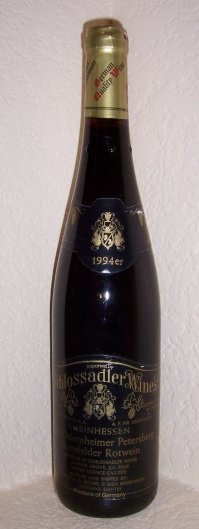 Last night was Open That Bottle Night, the annual event that Wall Street Journal wine columnists John Brecher and Dorothy Gaiter created almost by accident a few years ago. The idea is for people who have been saving a bottle of wine with emotional or historical connections to their lives to stop hoarding it, just open it, and enjoy it. It was a golden opportunity for us to pull out the dusty bottle of the Schlossadler Gau-Odernheimer Petersberg Dornfelder Rotwein 1994 that we had originally intended to open on our 25th wedding anniversary in 2001. The bottle has a peculiarly effective sort of self-preservation instinct: We forgot and left it behind in Phoenix when we drove to Chicago to celebrate our 25th in 2001. (9-11 was only a week before we left, and other things than wine were on our minds.) We then figured we'd open it on the 35th anniversary of our meeting one another in July 2004, but again we were in Chicago. The following year we figured we'd open it on July 31, for the 36th anniversary of our meeting, but were famously foiled by my flop into a patch of poison ivy. We then figured we'd open it for our 30th wedding anniversary in 2006, but by that time the bottle had gotten so far back in our memories that we clean fergot.
That bottle was a survivor, heh.
So a couple of weeks ago, while reading John and Dorothy's column in the WSJ, Carol looked up from the paper and said, “We have to open That Bottle on February 23.” This time for sure, Rocky!
And so we did. David and Terry Beers were here for dinner, and we cobbled together a Polish feast, with some kielbasa, honey millet bread, and cheese pirogi. Although I was concerned that the wine might not have survived (like all dornfelders it's fairly light, with only 9.5% alcohol) 14 years isn't all that long a time, and just as several people reassured us, the wine was unbowed.
What I did find remarkable was how indistinctly I recalled it. (We had bought half a case in October 1996, for our 20th, and I would think it would have remained clearer in my mind.) Dornfelders are almost invariably off-dry to semi-sweet, and this one is about as sweet as any dornfelder I've ever had. I remember it being a little drier, perhaps because I've had numerous drier dornfelders since then. The fruit was explosive, with some of the most intense black-currant flavor I ever recall in a wine of any stripe. It went well with the kielbasa, and the four of us had a wonderful evening talking about life, relationships, dogs, writing, ebooks, and ultra-mobile PCs. (It's that kind of crowd.) I don't recommend dornfelders to everyone—sweet reds bother a lot of people—but this one was a keeper, and if you have an open mind, sniff around the odd corners of your larger wine shops and try one.
Alas, we have no bottles of anything even remotely that old, and certainly nothing with that memorable a run of brushes with consumption. So next February we may just go eenie-meenie-mynie-moe and pull something from the rack. The wine is the thing, sure, but more than that, it's about friendship and having history together. This July, Carol and I will have known one another for 39 years, and we're pondering a whomper party somewhere in summer 2009. I guess it's time to shop for That Special Bottle so we'll have something to pass around in celebration of friendship, ours and that of all the many people we value in this beautiful and extravagant world.
Tabor Hill’s Classic Demi-Red
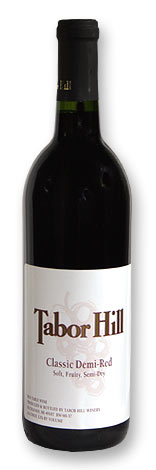 We brought a wine home from Chicago last summer that sat quietly in one of the top slots in our kitchen island rack, mostly out of sight and until a few days ago, completely forgotten. The wine is Tabor Hill's Classic Demi-Red. It's a $9 wine from Michigan, and I broke it out looking for something that would go well with a spicy (for us at least; read here: has some spices in it) chicken goulash that Carol threw together just for fun.
Yes, it's fairly sweet by wine snob standards, but it's less sweet than St. Julian's excellent Red Heron, and on a sweetness par with most white zins. It has the virtue of not being sour, as semi-sweet wines too often are, probably by imitating white zin. It's fruity and does not have the sour white zin ragged edge. The label calls it “soft” and I agree. No perceptible bitterness, and not grapey, though “grapey” is not a show-killer for me. (It usually means having a whiff of concord in it, which is not always a bad thing.)
It's a 12% wine and went down very easily, making a good complement to the goulash. I don't know where all you can get it. We saw it in several of the Meijer's markets outside Chicago, and I can only assume it's common in Michigan. I have yet to see it in Colorado, and we probably won't have it again until our next trip in.
Nonetheless, if you like sweetish wines, I call it highly recommended.
By the way, tonight is The Wall Street Journal's Open the Bottle night, and we will (finally!) be opening the bottle of 1994 Schlossadler Dornfelder that we failed to open for our 30th wedding anniversary back in '06. Maybe's it's vinegar. I don't know how well dornfelders age. But we'll let you know.
Odd Lots
- From Jim Strickland comes this report of a new coinage. How many seconds did it take for you to get the joke? Did you get it at all?
- Alas, neither the Death Star Grill nor the Darth Vader gumball machine made it past the first cut. Dayum. (Thanks to Pete Albrecht for the link.)
- This, on the other hand, is a real product. (Again from Pete. Don't miss the video.) On the other other hand, if you have to ask, well…
- Here's an interesting discussion on the economics of rooftop PV solar power systems. (Thanks to Frank Glover for the pointer.) As with a lot of posts like this, the real action is in the comments. Had we stayed in Arizona—and possibly built a new custom house there, which we were considering—I would have installed a system like that. Note that batteries are not necessary unless you're completely off-grid. (A lot of people still don't understand this.) The power companies are basically paying you for adding peak power capacity to their grid by reducing your monthly bill. Doesn't work well everywhere, but where it does work well (basically the Southwest) it will become a great deal cheaper over the next fifteen or twenty years.
- Sometimes I can spot a hoax. Sometimes I can't. And sometimes I just can't decide. (I know enough artistes to understand that anything's possible.) So you tell me.
- It's hardly new news, but I don't generally walk in those precincts: Romances represent 21% of the $6.31B print book industry. SF/fantasy comes in at $495M and mysteries are at a surprisingly low $422M. (Those are print book sales only. Ebooks not included.)
- Chris Gerrib called my attention to a great rant by John Scalzi on what's still wrong with SFWA, which I still haven't re-joined, and may not until I know that Andrew Burt has removed himself from their environs to, say, Uranus. And even with Burt out of the way, I'd like to know what the organization thinks that it is, because I myself have never been quite able to figure it out.
- The generally clear skies in Colorado Springs failed us on Wednesday night for the eclipse, and while we could tell there was a moon up there (and could tell that it was partially occluded) details were utterly lacking.
Review: Tom Igoe’s Making Things Talk
 Triage is a harsh mistress. I started out in computing with the CDP1802, a microprocessor designed for embedded systems work (it was used on the Viking Landers!) and for all the software I've used and the code I've written since then, I miss poking wires in breadboard holes and hitting the trigger of a wire-wrap gun. There's only so many hours in a life, and embedded work has not made the cut.
That may change. Embedded systems tinkering is easier now. Much easier, and for a couple of reasons: 1) The processors themselves can be had on small boards with appropriate I/O connectors; you don't have to fool with loose chips anymore. 2) Development software is better, mostly because now there is development software. In 1976 I literally had to write binary code by hand. (F8 FF A2… Yes, yes, I know, barefoot and uphill both ways. But if you think I'm exaggerating, you simply weren't there.) And, the point of the current discussion, 3) there are books like Making Things Talk, by Tom Igoe. Wow.
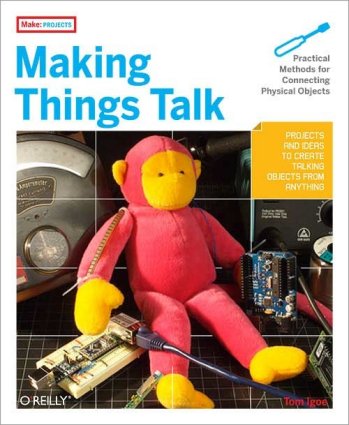
The first time I saw the cover I was confused: It shows a stuffed monkey and the completely inane blurb, “Projects and ideas to create talking objects from anything.” I literally thought it was about fooling with speech synthesizers. But no: It's about networking embedded systems modules with technologies including Ethernet, USB, Bluetooth, and Zigbee. The microprocessor modules under discussion are the Atmel AVR-based Arduinos, augmented by a host of sensor modules and connectivity modules that can be breadboarded on the same 0.1″ spacing blocks we used to use in 1976. In a sense, we now have modules the way other people have chips. (And in saying so I am indeed just boasting.) We can raise our consciousness to the level of connecting functional blocks rather than individual inverters and logic gates. That is a very big win.
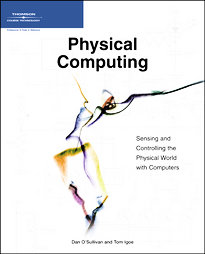 The book is patient (as good tutorials must be) and begins with probably the finest introduction to low-level networking that I have ever seen. If you are a software developer you will understand it; if you have no experience whatsoever in networking or programming, you may have some trouble. A good prerequisite text would be Tom Igoe's 2004 Physical Computing (written with Dan O'Sullivan) which focuses on the older Basic Stamp modules and their close relatives. Physical Computing introduces both electronics and programming to a degree that Making Things Talk cannot. That said, Making Things Talk presents examples using a Java-derivative programming environment called Processing, which is free and open source and much gentler conceptually than programming in raw Java or, merciful God help us, C. (Pascal would be gentler still, but as we all know, Pascal is a kiddie language that cannot accomplish anything useful. You must believe this. A C programmer said it. QED.)
Once the essential groundwork is done, the book teaches through projects, good projects that are mostly fun and in many cases even useful. The book explains how RFID tags work and how to read them, and how to read 2-D barcodes with a Web cam. The most fascinating projects are those that involve physical location sensing, using modules that perform infrared ranging, ultrasonic ranging, GPS, and “digital compass” modules, all of which made the robot guy within me itch like hell. We didn't have stuff like that thirty years ago.
Although it doesn't get a huge amount of coverage in the book, the XBee module (which implements a Zigbee data radio system) fascinates me: It's basically jelly-bean logic implementing a short-range mesh network, and I intuit that hobby robots of the future may well consist of swarms of semi-independent functional blocks knit together coherently through the Zigbee network protocols, under the control of a multicore master processor. And damn, I would love to build something like that.
Anyway. Here are a few additional observations on the book:
- It has at least process color on most pages, with beautifully shot full-color photos on many of them.
- The technical figures are abundant and very well done.
- The type is very small, the margins narrow. This 425-page book would have been a 600-page book back in the 90s. My guess is that O'Reilly wanted to the keep page count down because of all the costly interior color. Note to my age cohort: Prepare to squint, or go get yer readers.
- There is far less discussion on debugging than I'd like. Coding is easy—as is plugging jumper wires into breadboard blocks. But when something doesn't work the way it should, where do you start? The book is mostly silent on that crucial point.
- In general, the book probably covers a little too much ground, and doesn't go for quite enough depth. Zigbee is subtle, and its subtler features are not explored here. This may not be a completely fair criticism, but it supports my conviction that you must be a journeyman embedded systems type to really get the most from this book, as a lot of the blanks you must fill in yourself.
Don't let any of that stop you: If you have some clue about embedded systems modules and want to learn embedded systems-level data communications, there is nothing like this book anywhere. And if I do decide to go back to embedded systems tinkering, this will be the book that pushes me over the edge. Not yet—I have a rocket or two to finish and a few other things to do—but soon, soon.
Highly recommended.
Odd Lots
- Sorry for the silence here; I rarely go a week without posting but a lot of things ganged up on me. Many have noticed that I'm gradually moving toward posting less often but doing longer posts. I've discovered that it doesn't take me a great deal more time to write more detailed posts than shorter ones, but not posting at all on some days allows me to concentrate more fully on other projects.
- There is a major total lunar eclipse tomorrow night, 2/20-2/21, which will be almost perfectly positioned for viewing in the US. See the NASA page for details. And if you're not up on lunar eclipses generally, ask Mr. Eclipse.
- Flash memory is getting bigger; a 16GB SDHC card would hold a lot of ebooks.
- Pertinent to the above: I'm not bullish on solid-state drives based on Flash, especially if they're positioned to replace ordinary spinning-disk hard drives. Flash storage cells can change state only so many times until they cease holding a state reliably, and extra hardware is needed to “spread the wealth around” so that frequent write activity in a particular location doesn't kill cells. Flash is thus best used for things like storage of music and ebook files, where you write data rarely but read it a lot.
- Also, Flash may evenually be superceded by nonvolatile phase-change memory. We're still a few years off, but phase-change is faster than Flash and may even replace volatile RAM. No information yet that I've found on whether the cells degrade or die after a certain number of write cycles.
- One other ebook note: Although most early reviewers claimed that the Kindle's SD slot was limited to 2 GB cards, the truth is that the card slot is SDHC and many owners have reported success with larger cards up to 8 GB. I don't have 8 GB of ebooks yet and may not for several more years. I just don't read that fast. For people who are actively converting their print library to ebooks, however, larger cards are a very important issue.
- This nice link to NPR came over from Don Doerres, concerning the growing hobby of watching satellites. We used to go out and freeze butt looking for Echo in the early 1960s, but these guys are calculating orbits, photographing flares (momentary bright sunlight glints off polished satellite parts) and profoundly irritating the spooks. Watch the videos. Really watch the videos.
Odd Lots
- Robert Jastrow, the well-known NASA space popularizer, has left us, at age 82. My copy of Red Giants and White Dwarfs is in pieces from overuse, but as with Jastrow himself, I can only say: Mission accomplished.
- I stumbled upon an interesting piece of art today (while following an unrelated link sent by Pete Albrecht) by the late French Impressionist Albert Besnard. Rather too casually entitled “Decoration for a Ceiling,” to me it suggests something altogether more cosmic: The reunion of all things and all people with God at the end of time. As Pete suggested for a caption: “Honey, I picked up your wings from the cleaners.” (And how about using it as a book cover? Right there in the middle is space for a title!)
- D-Stix are amazingly rare on eBay (considering all the rest of the bizarre and obscure crap that I see there regularly) but today I finally scored the 464-piece set from the mid-1960s, and for only $10 at that. I've mentioned D-Stix here on Contra in the past, and on our second date, Carol and I flew a tetrahedral kite that I had made out of D-Stix. Building a replica of that kite has been on my do-it list for some years now. All I have to do now is find some purple madras tissue paper…
- Jim Strickland sent me a link to a nice page from a German chap (it's in English) who has done considerable work with spark speakers. This isn't quite a flame speaker as I saw one in 1969 (which used an ionized propane torch flame) but is more like a modulated Tesla coil.
- Also from Jim (in honor of the Westminster Dog Show, which ran last night) is an entry from what might as well be LOLDogs. Alas, the bichon didn't win his group last night. (There are too many poodles in the world, and not enough melted butter…)
- Still again from Jim is a fascinating short history of the Teletype.
- While we're talking ancient communication technologies, I finally remembered to link to a summary of Western Union's “92 code,” which is a list of 19th century telegrapher's numeric abbreviations that includes the ''–73–” that has been my email signature since my MCI Mail days in the early 80s. This is as good a summary as I've found, but it's missing a few codes that I've heard, like –86– which is short for “We are out of…”
- And further in that same direction, here's as good a list as I've seen of the 10-codes used by CBers, police, and, of course, Broderick Crawford.
Standard Wall Warts
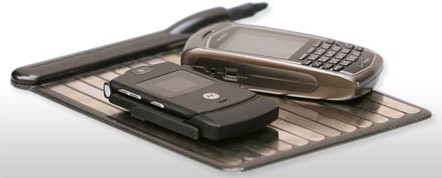
I lost the wall wart charger for my Sony Reader a couple of months ago, and a new one should be here in a few days. I don't love the Reader, as its USB transfer software unapologetically refuses to run on Windows 2000, but a guy in my business should have one, just as he should have a Kindle. In the meantime, I've been thinking a lot about wall warts, chargers, and one area of electronics that could really use a standard or two. The high road is something like the WildCharger featured recently on Crave, which is basically a pad that induces a trickle of electricity into whatever you place on it. Wotthell, that technology should be available built into computer desks, but it's not up to me.
I am very sick of wall warts. I have a bin of them downstairs, probably thirty in all, and I doubt that any two source the same voltage. The barrel connectors are of wildly different diameters, and some of them put the positive conductor on the outside. A few, furthermore, are not even barrels but weird connectors of no conceivable justification.
Damn, I want a standard.
Consider this as a possibility: A code for wall warts that could be printed on both the wart and the electrical device it's shipped with. The code would be human-readable and contain the essential parameters:
DC5-20-100-6P
The code begins with AC or DC. (There are AC wall warts, lord knows why.) The next number is the whole number voltage, separated from the fractional voltage by a dash. A second dash sets off the current sourcing capacity in milliamps. The code ends with the diameter of the barrel connector in millimeters, followed by either an N or a P, depending on the polarity of the inner conductor. For example, the code shown above would be for a DC wart sourcing 5.2V at 100 ma, with an 6mm barrel connector having positive on the inside.
There's no reason these things can't be like jelly-bean logic, and there's no reason why anyone should have to dig too hard or pay too big for a replacement wart. The IEEE should be doing something like this, but isn't.
My new Sony Reader charger will show up the day after tomorrow via DHL. And the day after that, I'm sure I'll find the original. At least then I'll have a spare.
The Revenge of the Classics
I've lived such an overstuffed life for so many years that I'd almost forgotten a psychology that was a very big part of my youth: Sniffing around for “just something to read.” I'm a very deliberate reader these days because I don't have a lot of completely uncommitted time. I have a reading buffer of 50-100 books on hand here, all of which were chosen because they touch on one of my interests or another. (My library as a whole contains somewhere around 2500 books, down from 3000 before we left Arizona.) I never have to cast about at random for just something to read.
For many people, reading is an even bigger part of their lives, believe it or not. (Maybe fewer than we'd like, but they're out there.) These people are driving the ebook industry right now, and I've noticed a phenomenon few others have commented on: the explosion of interest in out-of-copyright books by people who might not have been slobbering Dickens or Jane Austen fans in the past. At numerous sites online, people are uploading ebook versions of many classic texts. I follow Mobileread, which now has about 3,800 free ebooks online for download, the bulk of them pre-1923 works, some well-known (they have Dickens' complete works now) and some pretty obscure, like the Scottish Psalter of 1650. Mobileread is interesting because people are creating versions in the popular small-screen ebook reader formats like Ebookwise, MobiPocket and BBeB rather than raw text—nor formats used primarily on PCs, like PDF and MS Reader.
I continue to boggle at people reading Thackeray on their cellphones, but boggle or no boggle, it's being done. The classics are coming back. I can't entirely explain it, but I have some hunches:
- Many of these ebook editions are beautifully done. The Dickens canon is the work of one man named Harry in the UK, and they include some of the nice old 19th Century woodcut illustrations plus color covers where those were available. (Oliver Twist, yes. Martin Chuzzlewit, no.) They are not shot full of OCR errors and gaps like some of the stuff I've downloaded from other places, including the venerable Project Gutenberg.
- They are free and they are easy to get. There are no hurdles to jump, nothing to sign up for, no money to lay out, and no DRM to drop sand in the gears of the experience.
- There are no ethical issues involved in obtaining them or passing them on. I still think people are basically honest, and they do consider the rights of copyright holders.
- They're classics because they have withstood the test of time. They're good.
The classics have always been available in bookstores, of course, at prices comparable to those of newly published books. But if you're shopping for something to read on the train going in to work because it's a dead hour coming and going, it's hard to beat free, especially if free is easy and involves no pokes from the conscience.
What we're seeing here might as well be called open-source literature. It's being done by volunteer labor, including people who are drawing new artwork and contributing it without copyright claims. It's significant because people writing new ebooks have to take into account that the total available number of reader-hours in the audience is finite, and the friction involved in obtaining and reading the classics is now approaching zero. Like Linux, it will take a while yet for the well-formatted library of classic ebooks to mature, but like Linux, they will eventually become a competitive force to reckon with.
And wow, dare we hope that the premodern will put a fat boot up the ass of the postmodern? A lot of those “dead white males” must be grinning about now.