Jeff Duntemann's Contrapositive Diary Rotating Header Image

hardware

Daywander

Well, it’s the end of a long March, either way you want to see it, and finally we’re starting to get a little weather I’d consider springish. Old Dan Beard had this at the start of the kites chapter in his Outdoor Handy Book (1900):

Though marble time can’t always last,
Though time for spinning tops is past,
The winds of March blow kite time here,
And April Fool’s Day, too, draw near.

The winds of March were way too strong for any kite I have in the house–they were shoving my 200-pound gas grill all over the back deck and making my fireplace vent pipe sing like Lady Gaga–so here’s hoping April calms down a little and I can get something in the air again.

And on the air, too: For the first time in six or seven years I’ve been seeing daily sunspot counts (not smoothed sunspot numbers) greater than 100. Here and there midafternoon I’ve actually heard human voices on 15 and even 10 meters. Time to get the inverted vee off the shelf and set it up off the back deck again.

The long march this March was getting a new book produced in cooperation with Jim Strickland. I haven’t said much about it because I want it to be available before I start talking it up too much, but we’re finalizing the cover art and getting the ebook versions prepared, looking toward a launch on or about April 15. We read from the book (which consists of two short novels) at Anomaly Con last weekend. I hadn’t read publicly from my own fiction since the mid-80s, specifically at a 1984 SF event at SUNY Brockport where I read one of my stories (“Marlowe”) between Nancy Kress and Norman Spinrad. (No pressure!) I need to work on my presentation skills, which were honed in eighth grade, when I was chosen to be one of the readers for the daily morning masses at Immaculate Conception grade school. Carol critiqued me prior to the con, and suggested that I strive to make Drumlin Circus sound a little less like Paul’s Second Letter to the Corinthians.

If I didn’t intend to make all of my work available in ebook form before, I certainly did yesterday, after finally getting a little hands-on time with the Motorola Xoom at the Verizon kiosk at Chapel Hills Mall. Unlike the Galaxy Tab (which I briefly groped a few months ago) the Xoom has an ebook reader demo, and I spent a minute reading Jane Austen on its very crisp display. I would like to have loaded a technical PDF, but the Xoom’s XD card slot isn’t (yet) recognized by the OS, and that will keep me from pulling the trigger right now. My former collaborator Joli Ballew (Degunking Windows) is much of the way through a Xoom book, and she thinks that the XD slot issue (and a few other loose ends) will be corrected by summer. Let us pray.

freepistol.jpgAnd triggers, yeah. One of the most popular events at Anomaly was a do-it-yourself maker session for building steampunk ray guns. Pete Albrecht sent me a note about a whole category of real-world firearms that has a certain steampunk whiff about it: free pistols, which are highly evolved single-shot .22 caliber handguns designed and often hand-crafted to excel at target accuracy. They must be held in one hand only, and aimed using purely mechanical (i.e., metal) sights. The outlandish-looking wooden grips are designed to enclosed the entire hand for maximum stability, and are often sculpted specifically for a single competitor’s hand. The idea is to sink 60 rounds into the two-inch center of a target at fifty meters, each round loaded by hand and all within two hours. The sport is very old and was practiced in the Victorian era, so it has a steampunk pedigree, at least, even if the machinery is inescapably high-tech.
Much remains to be done here. The SF portions of my Web presence haven’t been touched since the release of The Cunning Blood in 2005, and need to be completely rewritten. The goal is to mount something useful on hardsf.com, a domain I’ve owned for over ten years without ever quite deciding what to do with it. I’m sure I’ll think of something.

The Star-Rite Type C Heater

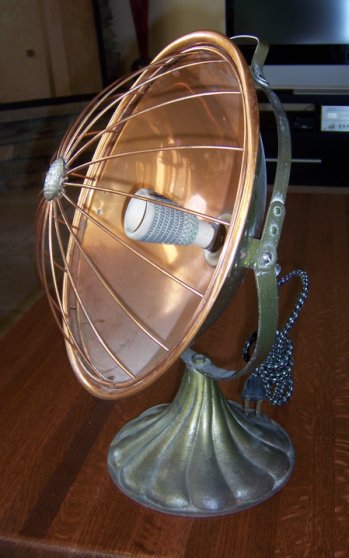
StarRightTypeCHeater.jpgI happened by a consignment antiques shop yesterday while shoe-shopping. My first thought on seeing this item in the window was Captain Nemo has hocked his labs! So I bought it. It’s a Star-Rite Type C heater, made circa 1925 by Fitzgerald Manufacturing Company of Torrington, Connecticut. 630W at 110V, and it even works, not that I left it plugged in for very long. It’s seen some hard use but the paint appears to be original, and only the clips holding the wire cage to the dish are missing. (The cage stays in by spring pressure, and not much of that.)

The parabola seems reasonably accurate, and when I took it out on the deck and pointed it at the Sun it smoked a piece of an advertising flyer in a second or two. It needs a little cleanup, but nothing heroic. Anybody care to guess what I’m going to do with it?

Odd Lots

  • A 20-year study does suggest that personality affects longevity, though interpreting the results sounds tricky. The question arises whether personality can be changed, and if not, well, longevity is (as I’ve long suspected) almost entirely in the genes. (Thanks to Frank Glover for the link.)
  • I had never heard of Kindle novelist Amanda Hocking until a week or two ago, but she’s obviously doing something right. What I think she may be doing right is accruing fans, as Kevin Kelly suggested back in 2008. Get to 1000 fans, and you can make a living. (She clearly has more than 1000 fans.)
  • A Wi-Fi only Xoom will go on sale at the end of March at a $599 price point. I’m still waiting for them to make the SD card slot work, but it’s nice to see some flexibility in other areas.
  • A 128GB SDXC card was inevitable (and still expensive–though check back in an hour or so) but I wonder what devices can actually use it. Most of the “barrier” issues are with Windows; Linux does not differentiate between SDHC and SDXC cards as long as they have compatible filesystems.
  • It’s not blogs that have debased American politics. It’s email–email sent to you by your aunt, who tells you to forward it to everyone in your address book. We laugh, but new research suggests that the strategy works.
  • Digging around in the shop the other night I found an envelope of crystal pairs for my old Standard 2M HT, which I bought in 1976. That was a great radio, built like a brick, and I’m looking to get another one. I’m watching eBay, but if you have one in the pile somewhere you might part with, I’m interested.
  • OMG! There are still potato chips fried in lard! Glorioski!
  • We’re finally starting to admit it: Fruit will make you fat. I ration fruit to three or four servings a week. Fruit is candy and almost entirely sugar, much of it fructose, which basically goes straight to your gut.
  • And while we’re talking food, consider: If a dozen eggs cost about $2 where you live (as they do here, sometimes cheaper) that means that two eggs plus a little butter to fry them in will set you back about 35 cents. That’s cheap calories, and good ones.
  • While listening to the 1968 Association song “Six Man Band” the other day, a line in the lyrics caught my attention: “We’ve got the seventeen jewels that dictate the rules…” How many people under the age of 25 or so have any idea what this refers to?

Odd Lots

  • Finally, the epic review of the Motorola Xoom that we assumed we’d eventually see from Ars Technica. My only gripe is that somebody over there needs to learn how to take sharp, close-in photos of hardware.
  • While we’re talking Xoom, I learned that my Degunking collaborator Joli Ballew is doing a Xoom book for Wiley. According to Amazon, it will be out on June 7.
  • Ibuprofen (Advil etc.) may provide some protection against Parkinson’s. It may also tear up your stomach lining, as happened to me in 1999. Be careful.
  • And damn, I shoulda gone to Polish school when I was four, like my mom wanted. (Thanks to Pete Albrecht for the link.)
  • Here’s a list of the ten most powerful earthquakes since 1900. (They have not yet included the Japanese quake, which has recently been promoted from 8.9 to 9.0.) I remember the stories in the papers about the 1964 Alaska quake. Man, that was ugly. Let’s be glad it wasn’t in the Cascades.
  • My assembly language book is now for sale on both the Kindle and the Nook stores. Kindle: $36.86. Nook: $52.00. Print: $65.00. (But nobody pays cover anymore.)
  • I’ve been called a crank for my position on this, but I don’t care: Sleep is more important than food. (If you won’t listen to me, maybe you’ll listen to Harvard.)
  • Here’s a nice page on magic eye tubes, which are remarkably little-known (especially among the young) given their off-the-charts coolness factor. And another photo page. Some of the miniature types were used well into the 1960s. We had a Grundig tape recorder from 1961 or so, and it incorporated a DM70, which I still have in a box somewhere, along with a 6AL7 and a couple of 6U5’s.
  • From the Ideas You Can Have For Free And Are Worth Every Nickel Department: Somebody should start a Wikipedia extension wiki that automatically grabs and posts anything deleted from Big Wiki for that peculiarly intense Wikipedia fetish, non-notability. In this era of pervasive broadband and $50 terabytes, why shouldn’t the 6U5 get its own page? It’s certainly notable to me.
  • From the Law of Unintended Consequences Department: Scrupulously green San Francisco is turning brown because government-mandated low-flow toilets aren’t moving solid waste through the system quickly enough to forestall clogging. Be glad you live in New Yawk, Ed. (Thanks again to Pete Albrecht for the link.)
  • Although I’ve always known what hops are used for (beer, basically) I realized this morning that I had no idea what a hop looked like. Now I know.
  • Classmates.com has evidently been bought out by a nostalgia site called Memory Lane. I haven’t gotten any email pitches from them lately, so I’m quietly hoping that either Memory Lane has reformed their fraud-laced marketing practices (telling me of girls who supposedly attended my all-male high school back when I did) or that the whole mess will soon sink into bankruptcy and vanish.

Taking a Breath

This has been a helluva month. To finish Drumlin Circus I wrote 26,000 words in two weeks, and then by six days later had polished it, laid it out, proofed it, and combined it with a second short novel (by the formidable Jim Strickland) to make something book-sized, with a twist. (More on the twist in a later entry.) We’re now waiting for the cover art, and so for a day or two I’ve had a chance to pick up my office, read a little, run the dogs around, and ruminate on what I’d learned.

coincellgrab.jpgOh, and I bought a TV for downstairs. A TV. 55″ wide and 1.37″ thick (!!) by my digital calipers. Sure, I’d like a flying car. But this again reminds me that we really do live in the future.

The do-it list was getting long. I’ve needed to replace a couple of coin cells in the Dell USFFs we have here and at church for some time. In most PCs this isn’t difficult, but Dell put the coin cell holder in a bad spot, especially in the SX270. Pulling out the old cell, no sweat–that’s what God made needle-nose pliers for. Reinserting a new cell would be easier too, except that the pliers would short out the cell. So I put a short length of shrink tubing over one of the two jaws and held it over a match for a bit. Shazam! The cells survived the operation, and I broke no fingernails trying to coerce them in either direction. It’s a trick worth remembering if you can’t use your fingers to get coin cells into place behind that plumber’s nightmare of a heat sink you’ve got.

One of the things I had to do to write Drumlin Circus was adopt an older style for the first-person narrator, who is an educated city guy in an 1890s sort of culture, albeit one not on Earth. This isn’t normal diction for me and I had to train myself to do it, first by reading largish chunks of The Time Machine and Food of the Gods, and then by going back to Gene Wolfe’s boggling 5-volume New Sun saga, which I hadn’t been through in ten or fifteen years. Again, the complexity of the tale boggled me a little (as did more than a few of the words he repurposes but never invents) but this time I was ready: I had ordered Michael Andre-Driussi’s Lexicon Urthus and kept it at my elbow. It’s a 420-page index of terms, concepts, and proper names from the series, with not only their meanings in the story but also their derivation from myth, religion, and other languages. If you intend to read the Urth cycle closely, you’re gonna need this. Highly recommended.

Over the next few days here I’ll try to cover a few more noteworthy things associated with Drumlin Circus. Mostly I want to reassure you all that I’m back and looking forward to writing here a little more regularly than I’ve been.

Odd Lots

  • Okay, I promised more about circuses and steampunk today, but odd lots are piling up.
  • From the Words I Didn’t Know Until Yesterday Department: spudger, a small tool like a miniature putty knife that helps you pry the backs off of watches and electronics, like the monitor I repaired last month. (Thanks to Tom Roderick for alerting me to its existence.)
  • Also from the Words I Didn’t Know Until Yesterday (ok, last month) Department: algophilist , a person who takes sexual pleasure in pain. Broader and more ancient term than “masochist” or “sadist.” (One such appears in Drumlin Circus.) And to think I first thought it was a guy who liked algorithms…
  • Given that Amazon buries the cost of Kindle’s 3G connection in publisher content fees, the lack of graphics (big) within text (small) makes sense. I always thought it was about the crappy low-res e-ink display. It’s not. Here’s how it works.
  • Alas, this may be too late for me. (Thanks to Pete Albrecht for the link.)
  • From Bill Higgins comes a link to a list (alas, not searchable) of the 200 Borders bookstores that will be disappeared shortly. (PDF) Bogglingly, neither of the Colorado Springs stores are on the list, even the small, always empty, and mostly pointless one at Southgate. I will miss the one in Crystal Lake, though.
  • Guys who come up with schemes like this talk about avoiding government censorship and such, but what will actually drive adoption (if it ever happens) is anonymous file sharing. And nertz, I outlined a novel a couple of years ago describing a technology very much like it. The late George Ewing called this The Weaselrats Effect.
  • Years ago I remember reading somewhere that steam calliopes are hard to keep tuned because the metal whistles expand as steam passes through them, throwing their notes off enough to easily hear. Can’t find a reference now. Running a calliope on compressed air from a tank might be problematic as well, because air stored under pressure gets cold when it’s released. Surprisingly (perhaps unsurprisingly) good technical information on calliopes is hard to come by.
  • Whoa! If you’re interested in solar astronomy, do not miss this video of new monster sunspot 1158 forming out of nothing. It will give you a very crisp feeling for the tubulent nature of the photosphere. Those aren’t spots: They’re solar hurricanes!
  • If you’re reasonably high-latitude (45+ degrees) look north after dark for the next few days. That giant sunspot 1158 is spitting a great deal of energetic chaos in our direction, and the sky could light up as a result.
  • Samsung has announced a new, larger 10.1″ Galaxy Tab, running Android Honeycomb. Details are sparse, but I’m wondering if we’re not ultimately going to see the slate market divide into 7″ and 10″ form factors.
  • Beating cancer may mean we’ll have to be three and a half feet tall, like these mutant Ecuadorians. I’d be good with that–as long as everyone else was three and a half feet tall as well.
  • Gawker Media has a new Web UI that I find so annoying that I’ve mostly stopped reading their sites, which include Io9 and Gizmodo. I could do without sites like Jalopnik and Jezebel, but damn, I’m gonna miss those other two.
  • I have yet to find a good popular history of refrigeration. Somehow I doubt people are going to feel sorry for me about that.

Odd Lots

The Inexplicable Pirate Box

PirateBoxCafe3.jpg

I’m still on the long climb back to functionality and can’t do much computing because the current bug has hugely irritated my eyes. However, I did want to call quick attention to one more thing in the pirate universe before going back to bed: David Dart’s Pirate Box. I got the tip from the Jolly Pirate a couple of days ago, and most of the gadget blogs have now picked up the story. It’s a make-it-yourself wireless filesharing node in a pirate lunchbox.

Lesse here: You carry this into a crowded coffee shop so that people can connect from their laptops and smartphones and download whatever pirate goodies are in the box, at least until somebody calls the Bomb Squad.

Ok, I’m just funny that way. But read through the DIY, and ask what I’m asking: Isn’t this a lot of fooling around just to create a wireless file-sharing node? Even a five-year-old beater of a laptop can run Debian and a file server, and software router apps are routine. Furthermore, a laptop looks like a laptop, and when there’s a dozen people at Panera running laptops, it’s a little less easy to tell who’s the pirate.

Unless that’s the idea. This certainly seems to be more about cachet than practical piracy. I’m reminded of warchalking, a silly near-hoax that was getting people’s twickers in a nist back in 2002 or so: marking the locations of wi-fi networks on the sidewalk in chalk, god help us, as though there were no other way to know something was there.

I have the late Harry Helms’ books about pirate radio and I think I understand the psychology. It’s about being a Merry Prankster more than actually getting anything accomplished. And I’m good with that, especially since the 17 people on Earth who will actually build this thing and hang out with it are unlikely to do much damage. (I do grant them points for creativity.)

The Pirate Box reminds me a little of AirStash, which has the advantage of being able to hide in your pocket. The notion of hidden local physical filesharing is an interesting one, and I’m sure that there are better concepts for it hiding out there somewhere. (A USB thumb drive mortared into a brick wall is just one of the gonzo notions I’ve seen recently; something like geocaching with data.) If you know of any more, send me links.

And now it’s back to bed for me.

Odd Lots

  • At our most recent nerd gathering here, four of my friends and I managed to carry our 1997-vintage, 198-pound Sony CRT TV set up our precipitous stairway out to the 4Runner, and a few days later I paid Blue Star recycling $37 to see it to its final rest. Many thanks to the guys–we had been pondering how to get rid of it for the past several years. Friends are most excellent to have, especially for people like me who can’t lift 100 pounds anymore.
  • And this means we’re shopping for a downstairs TV. I came across a good site focused on plasma TVs, which as a class may be problematic at our current altitude of 6600 feet. Apparently they buzz and run far too hot, though the physics of the phenomenon remain obscure to me.
  • I’ve found the first (thin) review of the Motorola Xoom. Few details yet, but I will say up front that the cloud-based ebook system doesn’t thrill me. Early releases of Honeycomb may not support the XD card slot, but Motorola hints that an OS update will take care of that. That’s important here: Given that 16GB MicroSD cards are already down to $35, sideloading my entire ebook library would be a snap, with room left over for lots of music and videos.
  • I also recently found out that the Xoom GUI borrows from the quirky but interesting BumpTop, recently bought by Google and then pulled from general distribution.
  • I may be too old to appreciate the BumpTop 3D metaphor (I always think it looks like working inside a refrigerator box) but some good themes have been created for it, including this steampunk specimen.
  • Xoom has a “barometer.” Most commenters, including the LA Times , don’t seem to understand that a barometer can measure altitude with more accuracy than GPS. I doubt that the Xoom’s barometer will have anything to do with weather reports. (Else there’d be a thermometer and a hygrometer as well.)
  • There’s a long-running feud between Samsung and US cell carriers over who pays for Android updates, with the result that many Samsung phones are stuck at Android 2.1 and may never get an update from the vendor. (Applying the update yourself is not for the squeamish.) Yesterday afternoon, of course, Samsung denied it all. As intriguing as the Galaxy Tab looked when I played with it back in November, issues like this may keep me away from Samsung wireless products entirely.
  • Some images speak for themselves. Like this one. (Thanks to Pete Albrecht for the link.)
  • Oxytocin may be the biochemical basis for tribalism, racism, political parties, and just about everything else that the human species would be better off without. “Cuddle hormone” my ass.
  • Good-bye to seigniorage, not that one person in ten thousand ever knew what it was–or how to spell it.
  • Ahh, well. I may have eaten my last pistachio.

Displaying Wallpaper on One Monitor Only

DualMonitorSetup500Wide.jpg

I got annoyed the other day (finally!) after being annoyed off and on since, well, almost forever. The problem was this: I was following a Web tutorial explaining how to do something in InDesign. I had InDesign up and maximized (as I always use it) and the Web tutorial in a Firefox window. Firefox wasn’t maximized, but that didn’t matter: Each time I selected a menu item in InDesign to tweak a setting, Firefox vanished under InDesign. That’s just the way Windows has always worked, and for a long time (ten years? more?) I was wondering if there were a better way. Tiling is not an option, not if I want to work on spreads in InDesign. So I just kept on keeping on, with Firefox appearing and vanishing as I ticked off steps on the tutorial.

Until this morning, when shadows on the wall told me that the light bulb had appeared over my head. Yes!

I ran downstairs and got an old monitor off the shelf. It’s a 15″ Samsung SyncMaster 570B, bought for Carol in 2003. She used it until I got her a 20″ display a couple of years ago. It has a mount pivot, and can be used in either portrait or landscape mode. I plugged it into the idle VGA video connector on my desktop, and without any fuss I had dual displays.

I’ve done that before to see how it was done, but never had the desk space for two identical (big) monitors. It wasn’t until today that I hit upon the refinement of putting the second monitor in portrait mode, which takes some space but not as much as anything in landscape mode. Now I can put a Firefox window on the secondary display while working on something full-screen on the primary display, without having to rescue the tutorial window from behind the app window each time I do something in the app window. Victory is sweet–and contains no fructose.

One peculiarity: My desktop wallpaper was partially duplicated on the second, lower-resolution display. The wallpaper image is a desktop blotter (complete with stains) and it just looked wrong having only part of it on the smaller monitor. I wanted the wallpaper on the primary display only, with just a blank color field on the secondary. Remarkably, there is no obvious way to do this. I dug around for most of an hour, trying things in both Control Panel’s Display applet and the NVidia control applet, without success. Then I hit upon this article. The gist is this:

  1. Return the wallpaper image setting in Display | Desktop to None; that is, turn off your current wallpaper. Both screens will now have the same blank color field for background.
  2. Select Desktop | Customize Desktop | Web. What you’re going to do is add a static image (the wallpaper of your choice) for Active Desktop, instead of a Web page.
  3. Click New. In the New Desktop Item dialog, click Browse, and select your wallpaper image from wherever it lives. Open it. Click OK on New Desktop Item. Click OK on the Web tab. Click OK on the Display applet as a whole to close it.
  4. The image you selected will be displayed, probably spanning both monitors. (It did on mine.) Hover over the top edge until the Active Desktop title bar pops up. Click and drag the image to whichever minotor you want to have it as wallpaper. When it’s moved completely onto one display, click the maximize button in the title bar. Bang! There’s your wallpaper, on one display only.

Now, as best I know Active Desktop was eliminated from Windows Vista, so this mechanism applies only to XP and (I presume) earlier versions. (Let me know if I’m wrong about that; I have no Vista or 7 instances here.) Active Desktop used a lot of CPU time and memory, but I think that was due to continuous refresh of the Active Desktop HTML and inane things like Pointcast that people have long forgotten. I don’t see any resource hit for having a static image in place of a Web page.

If I see any system flakiness in coming days I’ll reverse the change and let you know, but so far I haven’t seen a downside. I may try other uses of the secondary display, but I also think I may just turn it off unless I need to read a Web page while doing something else on the primary display. We’ll see.