- Antique Electronic Supply in Tempe, Arizona, has created a new DBA for their tube audio amplifier business: Amplified Parts. The tube stuff still predominates but it’s hardly “antique” and has definitely gone upscale. They rate their power tubes like fine wine: “This Russian tube [6L6GC] has tight lows, straightforward body, and smooth highs. In overdrive, it offers a tight and frosted crunchy bite.”
- My Taos Toolbox 2011 colleague Alan Smale just won the Sidewise Award for Alternate History at the 2011 Worldcon in Reno. We workshopped an expansion of the winning story, “A Clash of Eagles” and it was terrific. I’m guessing this will make it perhaps a little easier to sell the novel-length work. Bravo, Alan!
- Even though HP announced yesterday that they were killing their cloud-centered TouchPad tablet, Carol and I saw an expensive commercial for the device on The Weather Channel this morning. Cloud? Did you guys say “cloud”? (No wonder they got the ad…)
- If you haven’t seen it yet, definitely take a look at Stellarium, a free planetarium program available for Windows, Mac, and Linux. It’s one of the best I’ve ever tried, more polished (if not as deep) as the venerable Cartes du Ciel, which is remarkable in part by being a Lazarus app.
- David Stafford sends word that an elaborate steampunk loft apartment has gone up for sale in Manhattan. The price? A “mere” $1,750,000.
- This is killer cool as binoculars go, but would they capture anything at night? (Somehow I doubt it.)
- Bill Higgins writes to tell us that Catholic University has placed a scan of the 1964 Treasure Chest comics series “Pettigrew for President” online, for free download. I blogged about this years ago, but the comic was not available for download then.
- Nick Kim does Cowboys and Heavy Metals. (Thanks to Pete Albrecht for the link.)
- Fellow carnivore Jim Tubman and I share an appreciation for The Periodic Table of Meat. Most of it, anyway. (No thanks on Meat 75. Oh, and 95.)
- Back from meat to metals again: Given that it’s the cornerstone material required to build the Hilbert Drive as used in many of my SF yarns, I was a little surprised that ytterbium is so cheap.
- Did you ever wonder about the physics of coffee rings? Wonder no more.
- From the Please-Give-Those-Guys-Something-To-Do Department: New taxpayer-funded NASA research tells us that unless we take prompt and serious action against global warming, aliens may invade and wipe us out. UPDATE: This turns out not to be entirely true: The chap who co-wrote the paper works for NASA but he did it on his own time and there was no public funding involved. The Guardian has corrected the piece.
hardware
Odd Lots
Odd Lots
- A lot happened while I was down in Taos, and I’ll do my best to catch up a little here today. But as you’ve seen from my two entries about the workshop, it was tough to pay attention to anything there but the challenge at hand.
- More photos from the workshop: Christie Yant has established a single page linking to all four of her Flickr albums from Taos Toolbox 2011.
- Several people sent me invites to Google+, and I established an account several days ago. (I already had a Google account, so it was no big deal.) Google being insanely paranoid about how real your name is, look for me as…Jeff Duntemann.
- In the wake of Tuesday night’s epic natural gas leak here, I discovered that the ethyl mercaptan molecule resembles a balloon animal weiner dog with its hindquarters on upside down. Hey, I wonder if a balloon artist has ever done balloon hydrocarbons? (Google comes up empty.)
- Motorola is finally rolling out an Android upgrade that enables use of the Xoom’s SD slot. Guys, why was that so hard?
- Only a handful of people ever make it to 114 years old. And, weirdly, that’s when virtually all of the oldest of the oldest of the old actually die.
- Here’s a photo of the largest cannon ever built. No points for guessing who built it.
- And while you’re browsing Gizmodo’s Monster Machines category, don’t miss the largest Diesel engine in the world. Your flip-flops got paddled across the pond by something very like that.
- This SSD might well make that seven-year-old PC a little bouncier…but I still recommend maxing out RAM to 4 GB, cleaning the registry, and getting rid of crapware. I’m less convinced than some people that hard drive speeds are a serious bottleneck when your registry looks like an empty lot in a war zone.
- QBit, who on beach walks favors dead fish but will gladly settle for seaweed, has refused to answer the question: Why do dogs roll in stinky stuff?
- I doubt that this would ever work, irrespective of its cool halfway-to-dieselpunk looks. It does make me wonder what other cool stuff might have been drowned out in the racket coming from WWI. (Thanks to Gary Kato for the link.)
- And I know damned well that this wouldn’t work, but it goes all the way to full-bore, balls-out dieselpunk fantasy. (Thanks again to Gary Kato.)
- Perhaps you’ve seen the Dyson Fan on TV ads. Here’s how they work.
- The site is in German, and is well-known in Europe for high-end licorice. Pete Albrecht assures me that the name of the company really does translate as “Bearshit Pharmacy.” Wow.
Odd Lots
- Strahinja Markovic, the chap who created the very good Sigil epub editor while he was a CS undergrad, now has a master’s, a good job, and…a life. (How dare he? ) In a recent blog post, he’s asked for prospective maintainers of the code (which is open source) to introduce themselves and make a case to him as to why they should be trusted to carry on the work. He doesn’t know me; I’m just spreading the word, because I use Sigil and I want it to continue to evolve.
- We have the same problem with the Kompozer WYSIWYG HTML editor; poor Fabien “Kaz” Cazenave has a new job and very little time to devote to the product. I like Kompozer but it has some rough spots, and I hope someone will take over and keep the wheels turning.
- In the meantime, I’ve installed and am testing BlueGriffon, and so far I like what I see. The editor incorporates the Gecko rendering engine used in Firefox 4, so if it looks good in BlueGriffon it’ll look good in Firefox. It has HTML5 and CSS3 capability, and an interesting business model: The editor is free, and the developer sells various add-ons. That doesn’t bother me at all; the whole suite of 9 add-ons can currently be had for $35 Euros, or about $50US. If BlueGriffon performs well on my existing Web documents, I’d pay that like a shot, even if I don’t use the add-ons.
- As brilliant as the original Turbo Pascal was, it wasn’t alone. From Andrew Stuart comes a link to the deep history of Nick Gammon’s G-Pascal, an enviable piece of assembly-coding work that put a potent Pascal compiler for the Commodore 64 in…16K. If you used G-Pascal back in the 80s, this is a must-see, especially the links at the end, to the sorts of ads and programming newsletters that were the lifeblood of personal programming in the early 80s.
- I don’t know if you’ve ever needed an 18″ USB A-B cable, but I did, and after a great deal of looking around, I finally found them at Other World Computing. It’s mostly a Mac shop, but has the short A-B cables for both USB 2 and USB 3. The cable connects the USB hub on my Dell 20″ monitor to the GX620 USFF machine mounted immediately behind it, and keeps cable clutter down behind the monitor.
- Little things sometimes matter: The Toshiba Thrive has a full-sized SD card slot. Not micro. This means that I can use the SD cards I already have. A mini-USB adapter will also allow me to use my existing thumb drives. Ports and card slots have been the deal-killer so far on tablet after tablet. This one (though it won’t be in stores until July) still has an edge. (Bill Roper reminded me that I needed to post about this.)
- From Smithsonian comes a long and detailed article on what amounts to beer archaeology. (Thanks to Rich Rostrom for the link.)
- For those who asked: Simple Simon’s formal name (from my entry for June 26) is Factory Automation Real-Time Supervisor, and yes, the acronym was highly deliberate. His robotic factory is the Automated Reprographic Fabrication Facility, and (as you’ll learn in the novel) the project had always been a dog.
- WUTZ 4 DINR?
Odd Lots
- After being in the water for as many as four years, a broken camera turns up on a California beach with the SD card still in it…and still functional, complete with a hundred-odd photos taken before the camera was lost. I marvel first at the durability of these cards in a corrosive medium–and then at how little circuit board there actually is inside the SD card itself. Wow.
- There is an ice cream truck that goes down Alles Street here in Des Plaines, playing a midi riff of a familiar old song–and, periodically, a slightly creepy woman’s voice calling, “Hello!” This is evidently pretty common, but judging by some quick online research, the songs are different for almost every ice cream truck out there. (The “Hello” voice appears to be the same.) The truck came by here late yesterday, shortly before the storm rolled in, and I suddenly recognized the song: a bouncy variation on the old Southern hymn “Holy Manna,” often known as “Brethren We Have Come to Worship.”
- And pertinent to the above: I only recognized the melody because Lorie Line played it in a medley with “The Lord of the Dance” on her Heritage Collection Volume 1 CD. She plays it fast, much faster than I’ve ever heard the majestic old hymn itself played in church. (The song is not credited by name on the CD, but it’s there–and the CD is very much worth having.)
- Damned if these don’t look like drumlins. On Mars. (The other kind of drumlins–and yes, I am very familiar with them. More on the naming of alien artifacts in an upcoming entry.)
- I’ll come back to this issue once I’m home and decompressed a little, but Glenn Reynolds posted a case history of a man who had non-alcoholic fatty liver disease (also called NASH in some circles, for Non-Alcoholic Steatohepatitis) eventually ascribed to eating/drinking fructose. Depending on your genetics and how much you consume, fructose can send you all the way to cirrhosis and death. This article (linked to by Reynolds) is a must-read. This one is worthwhile as well. (Thanks to Bruce Baker for alerting me to the post.)
- And while we’re slogging through the Carb Wars, well, fake fat makes you fat. (More and more research indicates that real fat does not.) And let’s not forget that little issue of “anal leakage,” gurrkh. (Thanks to Pete Albrecht for the link.)
- Xoom, meet SD slot. SD slot, meet Xoom. You guys have been traveling together for over a year. It’s time to shake hands. In Europe . The problem in the US has to do with the “Google Experience.” Somebody at Google is holding back card slot support, and thus (I’m guessing) a great many sales, including one to me. I smell rentseeking somewhere.
- On the other hand, if all you want is an Android ebook reader, this might be worth a look. $99? Who cares if it’s only Froyo? (Forgive me if I’m skeptical that it’ll ever see retailer shelves at that price.)
- The creator of this device calls it “technofetishism,” and it is. That doesn’t keep it from being amazing, and killer cool. (Thanks to Bill WB4WTN for the link.)
- Finally: How To Make a Mask With Photoshop. I always wondered if that would work.
Odd Lots
- Heads up here; this is important: Something called EasyBitsGo.exe appeared in a directory under Documents and Settings/Application Data/All Users this morning about half an hour ago. The executable was already installed and running and wanted permission to install Flash Player. (I do not allow Flash Player on Windows machines, as it’s exploit fertilizer.) The timestamp on the executable’s directory tree indicated that it had been installed no more than a minute before it popped up. There appears to be a Skype connection, and I was using Skype at the time. Be careful. If you see it, close Skype, kill the easybitsgo.exe process in Task Manager to close it, and then nuke that directory. Then go to Add/Remove Programs and uninstall it. Reboot. If Skype did in fact install this thing without asking, it may be the beginning of the end of my own use of Skype.
- Per the above: Launch Skype. Select Tools | Options | Advanced, and un-check Automatically Start Extras. Then reboot again and make sure it’s not still running.
- All RAMmed up and nowhere to go: KingMax has announced a 64GB MicroSDXC card…and there’s almost nothing on the market that will use that much storage in one chunk. If we’ve learned nothing else in the last thirty years, it’s that “barriers” are a mark of either hardware vendor cheapouts, or software vendor incompetence. Are address lines so dear that we can’t raise the barriers to a level at least five years out? (I suggest 256 TB. Ok, six or seven years out.)
- What if Babbage had outsourced tech support to the Pacific Rim? (Thanks to Ernie Marek for the link.)
- Yet another longstanding dietary fetish is now in jeopardy. The case against salt always looked weak to me, in that it was clearly hazardous to people who already had certain kinds of heart disease, but that the case that it caused heart disease was mighty thin and mostly anecdotal. All roads continue to lead back to carbs, and especially sugar. More in coming days as time allows. (Thanks to Carol for the link.)
- If just rooting your Nook Color isn’t quite enough, here’s a description of how to turn it into a complete Android tablet. If it sounds scary to you, well, you may not have the computing experience to do it; but when I read the article I thought, Sheesh, that’s easy. You can even boot from the SD slot to get a sense for the mod before making changes to device memory. The process appears to be reversible, and the mod allows you to use Bluetooth-capable GPS receivers and other Bluetooth devices. Given how cheap the NC is, I’m tempted to try it while I wait for the high-end slates like Xoom to mature.
- We could maybe use a few more of these.
Odd Lots
- I’ve just added a book catalog page to my primary WordPress instance of Contra. There’s a link on the title bar at the top. If you’re using LiveJournal, here’s the direct catalog link. From my WordPress instance you can also go direct to an individual title within the catalog by clicking on one of the cover thumbnails in the right sidebar. It’s a little barebones for now, but it’ll do until I finish getting the Copperwood Press site rehabbed.
- This sounds worse than it probably is: B&N has restricted sideloaded content to only 1 GB of the Nook Color’s internal memory. The NC has become very popular as a somewhat broader device than an ebook reader, and I’m sure B&N is worried that people will fill the little slab up with so much of their own stuff that there’s no room to buy more from B&N. The key is the MicroSD slot, which (for the time being) can hold up to 32GB. If sideloaded content stored on the MicroSD card is completely accessible to the Nook’s machinery, it’s really not a terrible problem. (I don’t have an NC so I don’t know for sure.)
- B&N’s certainly been busy: There’s a new, inexpensive, smaller, lighter e-ink Nook in the pipe called Nook Simple Touch. 6-inch display and two months on a charge (sheesh!) will appeal hugely to commuters who just want to read books and not do seventeen things at once. $139; mid-June arrival.
- Then again, if you want a cheap Nook ($99) and don’t mind the orginal model, go to eBay.
- Here’s an expert’s braindump on ebook creation/formatting, which clearly highlights the appalling nature of ebook formats and ebook creation tools. Mobipocket in particular comes in for some (well-deserved) hard whacks with the baton. None of this crap should be necessary. An epub file is basically a collection of HTML documents with an external TOC, all wrapped up in a ZIP archive. Why is this so hard to do? (My thought: Immature rendering engines, like Web browsers in 1994. We are compensating for bad software.)
- This is the high road toward SSTO, and I hope to hell they can pull it off. The trick isn’t so much getting to orbit as getting back intact. We’ll see.
- From the Words-I-Didn’t-Know-Until-March-But-Forgot-Until-Yesterday Department: oneiric; meaning of or pertaining to dreams. Also the adjective in the next Ubuntu animal version code: Oneiric Ocelot, due this November. Not new news, but I forgot to mention it in March. Dreams, sure. But having read some of the fights that the discussion of Ubuntu Natty’s Unity desktop has triggered since then, I also picture an ocelot that lost one ear in a bar brawl.
- Bichons are notoriously hard to housebreak. Carbreak too, evidently.
- From the Painfully Obvious Research Department: A study (PDF) suggesting that when we see people breaking the rules, we assume that they’re powerful. Duh. (One wonders if a lifetime of watching powerful people be abject shitheads could have anything to do with it.)
- And a much more interesting study on the role that some airborne bacteria play in acting as seeds for precipitation. Get a look at that hailstone! (Duck!)
- Amen, brother. (Thanks to John Ridley for the link.)
Odd Lots
- It’s been a rough week here (hence the current post paucity) and I just got Carol on a plane to Chicago to look after some unexpected family issues. As we left the driveway it was snowing like hell again, this on the morning of May 15. Even today, halfway to lunchtime, it’s still gray-grim and 39 degrees. I guess it’s going to be another indoors week. Much planned for coming days, including the ebook release of Cold Hands and Other Stories. Stay tuned.
- I stopped in Denver on the way home from the airport to pick up some Elfa parts to expand the shelf system in the back of our garage. It’s an Erector set for storage, and if you don’t know about Elfa I think it would be worth taking a look. I have a hodgepodge closet in my workshop downstairs that desperately needs to be Elfa-whacked, and it’s on the project list for this summer.
- I used to spend a lot of time poking around in Google Earth, mostly looking for abandoned railroad right-of-ways near where I’ve lived in the past. Since then The Daily Google Earth has appeared, full of interesting things visible from space. Today’s desert triangles post intrigues me, since my parents bought land in that general area in the 1960s and I still own it.
- Carol and I have moved incrementally to CFLs as our incandscents have died, but the can fixtures we have in our ceilings are too narrow to pass the necks of CFL floods. Alas, this promising new technology won’t fix that (the necks are, if anything, wider) but it’s a promising alternative to incandescents and doesn’t contain mercury. As the author suggests, it won’t be long before the Maker community figures out how to focus the output into a beam and perhaps even scan it across the bulb’s face.
- I’m not generally one for weird case mods and exotic custom cases, but this Priarie School item engenders a certain amount of lust. I also realize that I could easily make a case of Stickley-style dark-stained quarter-sawn oak–not that I need another thing to do. Would be killer cool, though.
- As a programmer guy with old roots in embedded systems, I feel a very deep itch to try the Android Open Accessory Kit. Alas, as an SF writer with only so many hours in the day, I may not get to it soon. But I greatly rejoice that it’s even possible.
- The data caps issue has gotten to the WSJ, which probably means that it’s off geek turf and Really Quite Sincerely Real. What few people are talking about with respect to ISP data caps these days is the perverse incentive they present for video piracy: Why pay an additional “bandwidth tax” on your favoite films each time they’re streamed when you can download them once and watch them any time you want without further payment? This has always been the case, but moving to a metered Internet only makes it worse.
- From the ‘Bout-Damned-Time Department: Samsung’s Galaxy line of phones and tablets will be getting its Gingerbread update any day now. We hope. Any day now. Guys, really?
- Bruce Baker sent me a link to sculpture made of books, sculpture as I suspect termites understand it. The last picture made me cringe a little: It’s a carved-up copy of all three volumes of the 1936 New Century Dictionary, which has been my go-to word source now for almost thirty years. What other dictionary (none here!) can show you drawings of a wanderoo and a wanigan on the same page?
- Not all engineering problems are nice and clean and up on top of a well-lit bench. Especially this one.
- If ebook readers ever push print books over the edge of the world, it’ll be due to much higher resolution displays. This one, at 458 DPI, is very close to what you see on mass-market four-color interior printing. At 600 DPI (and we’ll be there in a few years) the war will be over.
- Boy. Here’s a kind-of-a-sort-of-a-thing-a-ma-jigger. A display that hinges in the middle? As a friend of mine once said: “Laugh or lust? Flip a coin.”
- Inevitable: I Can Has Zeppelin.
Dell’s USFF Internal Amplified Speaker
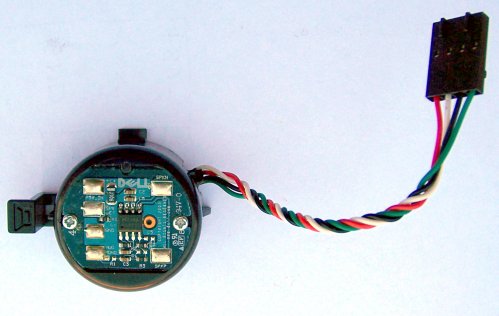
I bought a Dell Optiplex GX620 USFF (Ultra-Small Form Factor) machine last week, and it came without an internal speaker. I didn’t know the speaker was optional until a machine turned up without one, but a look at my three SX280 USFF machines (built in exactly the same case) showed a very small plastic unit that pulls easily out of the chassis when you lift a plastic tab. It’s wired to the mobo through a conventional 4-pin header. And most interesting of all, it has circuitry on its back.

A look through a loupe showed four solder pads (on the left in the photo above) labeled P5V IN, SPK DET, GND and AUD MONO. These correspond to the red, white, black, and green leads respectively. It took me ten minutes to lash up a test on my Heath ET-3200 breadboard. With 5V on the red lead, common on the black lead, and some sine wave from my audio generator on the green lead, that one tiny little doodad filled the shop with an 800 Hz tone.
I’m pretty sure the SPK DET lead allows the computer to know if there’s a speaker in place; my VOM shows it tied to ground. The IC is almost certainly an LM4871 1.1W audio amp. The National Semi logo is on the chip, and the printed number is RA4871. The Dell part number for the assembly as a whole is Y2298.
I needed to order one for the GX620, so I ordered two, and if I need a subminiature speaker amp for a project, it’ll be in the drawer with my other small speakers, ready to go. $2.69 at the CompuFlea eBay store.
Odd Lots
- Good Friday — bad weather, at least where I am. When I was in second grade, Good Friday included a whomping thunderstorm that rolled over the Northwest Side about 3PM. It got very dark and scary looking, and (after several days of intensive Holy Week preparation in school, especially about Christ’s death on the cross) it was natural for me to think that Good Friday was always dark and stormy, a reflection of what happened in our Bible stories. Alas, the next year Good Friday happened on a beautiful warm spring day. Lesson: Characterization matters more than setting. Don’t get distracted by the special effects.
- Besides, Friday is, well, Friday. How bad could it get? (Jesus could have died on a Monday.)
- Finally, if you haven’t seen this, do take a look. (2.4 MB PDF but well worth it.) You may miss some of the humor if you don’t know theology-geek things like who Bart Ehrman is, but overall it’s hilarious, and in a weird way rather touching. “Roman Soldier is considering early retirement.” I’ll bet.
- Carl Elkin has given the Jewish Haggadah the Facebook treatment as well. I’m sure I miss most of the humor by simply not being Jewish, but I do like God’s comments.
- This is an old article (2003) but allowing a little for inflation it looks to me like an accurate systematic treatment of the costs inherent in mass-market print book publishing. The takeaway is that print publishers were suffering even eight years ago (they’ve been suffering since midlate 2000, in fact) and that it’s miserable trying to turn a profit on an $8 mass-market paperback.
- The author of the above piece doesn’t talk much about per-book author earnings, but some quick envelope math indicates that (with some variance by contract terms) MM paperback authors get about 35c – 40c per book sold. (Note that I have never sold a MM paperback myself, nor did my company publish them.) This may explain why indie authors are willing to sell ebook novels for 99c: Authors get about the same amount per sale on a dollar ebook as they do on an $8 print book.
- Here is a slightly scary but as best I can tell accurate description of the problems confronting print publishers. From the same author come unsettling hints that traditional publishers are botching the ebook business, and botching it badly. Misfeasance or malfeasance? What’s going on here is unclear, but the situation bears watching. (Thanks to Amy Ranger for putting me on to it.)
- Pointers to this article by Gary Taubes have been coming in from all sides, but Dave Lloyd was the first to send it to me. The question of whether or not sugar should be called “toxic” is far less important than the question of whether sugar makes you fat–and whether some types of sugar (i.e., that ol’ devil fructose) make you fatter faster than others. Sure looks like it from here.
- I don’t know how well this works, but it’s a brilliant concept: Put a pico projector in an unused laptop optical drive bay. Not cheap. Not now, at least.
- How well things work? Wow: I haven’t seen a hardware review this negative in a long, long time. A tablet that won’t do anything useful unless it’s tethered to your Blackberry? WTF?
- Hey guys! Long integers!
One-Clunk Hard-Drive Degunking

Stuff piles up. You know how it goes. Perhaps the worst of it is down in my workshop, where I’ve done nothing ambitious in almost a year. (My steampunk Geiger counter was the sole exception.) Predictably, when something comes to hand and no good place for it is found in a few seconds, it goes downstairs and ends up on my workshop floor. I still have some work to do down there to make the place habitable again, which brings me to the question of degunking hard drives.
What I’m referring to here is the pile of old hard drives on my workshop shelves. They’ve been there a long time, and they’re taking up space. I took a look at them earlier today. One of them is an 80GB drive of 2003 vintage that I took out of my old Dell Dimension before scrapping it last year, and that’s worth keeping. Most of the rest of them date back to 1998 or before. Many are not even mine. People I barely know have given me mid-90s vintage PCs, from which I generally pull the drive and SIMMs, and then take to the local computer recycler. What I haven’t done in some time is look at the capacities of the drives. That was an eye-opener: Two were 1.2 GB; another 3.5 GB, two more were 4 GB, another 6 GB. The biggest was an 18.3 GB Seagate Barracude, which may sound useful except that it uses the “wide” SCSI interface common in high-performance desktops in the late 1990s, now present on no machine in my collection.
They have to go. I used to dismantle old hard drives to pull the magnets out of them, but I already have a bin full of hard-drive magnets. I suppose I could connect each of them in turn to one of my machines, run Eraser on them a time or two, and then give them to the recycler. (After all, some of the data on those drives isn’t mine, and I no longer remember which drives are which.) Or…
…I could use One-Clunk Degunking: You place the drive in question on the driveway, and give it one good hard clunk with a five-pound sledgehammer. (I have granite boulders in abundance, which spares my concrete in case I miss.) That should do it, but as the incremental cost of clunks is small, two or three more for good measure won’t hurt. (Won’t hurt me, at least.)
I remember when hard drives (and the computers they were in) cost a great deal of money, and it’s tough not to look as those drives and think that whacking them is a terrible waste, but no other uses come to mind, and my shelves are pretty full. So out I went a few minutes ago, laid six drives on a flattish boulder, and gave each one a good hard clunk with the sledge. I was a little disappointed that they didn’t look more destroyed than they did, but trust me: No one will be reading those drives again. At this point (with plenty of shoveling still to do down there) I’m good with that.