- How about a steampunk Segway? It’s self-balancing as long as its rider is self-balancing, I guess–and certainly burns more calories.
- Or (while you’re pretending to be King Edward VII) a steampunk snowboard? Are there any steampunk types who are my age, or is it all a twentysomething crowd? I recently saw an antique foot-powered dentist’s drill machine circa 1890. Nice ornate cast ironwork and bronze–and made me very glad I’m 120 years away from it.
- If you use Linux, staythehell out of Boston. It’s considered prima facie evidence of criminal activity. Damn, those people need another invasion of the Mooninites. (Thanks to Bruce Baker for the link.)
- Ah, the price of increasing popularity: There is now a Mac botnet launching DDoS attacks. (Or…I wonder…could Symantec be about to launch a new Mac security product?)
- Our TV Guide listings stopped working on Comcast basic analog cable a few weeks ago. We thought it was our TV–and the Comcast people were less than helpful–but apparently it’s a consequence of the big move to digital TV. The TV Guide listings data rode in on an analog sidecar to the analog PBS signal, and now that PBS has gone all-digital, there’s no sidecar anymore. (Thanks to Bill Roper for digging this one up–he has a similar problem with his DVR.)
- There is a pizza place in San Diego called Killer Pizza from Mars. (Thanks to Pete Albrecht for the link.) Interestingly, my best friend Art and I did some brainstorming about opening a pizza place in Rogers Park called Tranquility Base when we got out of college in recession-year 1974, but nothing came of it. (He would have been the cook. I would have been the waiter; probably the one thing that paid less than fixing Xerox machines.)
- They do things big in Nebraska: The last full week of September sees the Nebraska Junk Jaunt, in which ten midstate counties hold a collective garage sale along a 300-mile route, with 500+ vendors participating, and that’s only the ones they know about. Start early, see them all! (Damn, I’m tempted!)
- Finally, it’s April 17, and we’re in the midst of a blizzard here in Colorado Springs. The carpet cleaners had to postpone the job, and we had to cancel our gym session today. We may get a foot or more between here and Sunday, and peeking out the window I already see 3″ or so. This has been the damndest coldest, longest winter in our six years here. Has Al Gore been sneaking around the Springs somewhere?
Odd Lots
Cuisine

For those who care, I’m 124,266 words in at the moment, shooting for 175,000. Chapter 10 must be submitted before the end of April, and I’m rustier on some of this stuff than I thought.
I recognize that I’m way overdue for writing something profound here, but my head’s still too full of conditional jump instructions. So I’ll punt and offer something less than profound: Whether or not the book cover at left is funny depends heavily on whether or not you have very young children underfoot.
(Couldn’t they have drawn Pooh stirring a pot of spaghetti sauce?)
Odd Lots
- From the Words I Didn’t Know Until Yesterday Department: “charcuterie,” meaning cured meats like bacon, ham, prosciutto, and the preparation thereof.
- I talked to the realtor who’s handling the listing of the old Heinlein house here in Colorado Springs. What she said astounded me: Heinlein’s 1950 custom house is still in there. They built that ugly thing around it in 1995 or so. Parts of the original structure were removed, but most of it still exists, although it evidently was used as framing more than anything else.
- And further relevant to the Heinlein House is a report from elder SF fan Bruce Pelz, who not only visited the house in Colorado Springs in 1963 when the Heinleins were still living there, but he slept in their legendary fallout shelter. (Cool photo there–definitely click through! And thanks to Bruce Baker for the link.)
- Needless to say, I haven’t visited the Heinlein fallout shelter (I stood in line to shake the great man’s hand at MidAmericon in 1976, and that was the only time I ever met him) but I frequently visited the 10-foot-deep underground fallout shelter of the late William A. “Bill” Rhodes in Phoenix, which he was using as a cool (literally) computer room until his death in 2006. It was culturally jarring–people of my parents’ generation took fallout shelters for granted, and people of my generation (for the most part) found them appalling.
- CFLs may not be the big environmental win that they’re being touted as, because the power factor of the lamps is very low. Thery’re still a win, but the hype needs to be pruned back a little.
- The whole idea of a CAPTCHA may be flawed, and although there are a number of objections to CAPTCHAS, this article pins down the primary and probably unfixable one: You can pay people to solve them. There are apparently some porn/pirate sites that charge for access in solved CAPTCHAS. And if nothing else works, hire a CAPTCHA-breaking firm in the third world. It looks to me like CAPTCHAs are becoming at best speed-bump hindrances to bots. If I had to guess, I’d say make it slower to establish accounts, and certainly slower for one IP to sequentially attempt a CAPTCHA. Could teergrubing make a comeback?
- For the benefit of those who asked, here is the Web site of the people who did my crowns over this past year. They are artists, especially Dr. Frank Seaman. The 15-month project was actually a collaboration between two independent offices in the same building. Dr. Jeanne Salcetti did the periodontal portion (gingivectomy, tooth extraction, bone graft, and implant) and she was wonderful too. I recommend both of them without hesitation.
Boy, That Took a While…
…but it’s over. (No, not the book.) I’ve felt this way a time or two. The best example is the day I woke up after graduating from college. I remember thinking: Yikes! It’s over! I’m done! I don’t ever have to go back there! (I enjoyed high school a lot more than college.)
On January 14, 2008 I started in on a major dental project. My long-time readers have seen me post reports here from time to time. It involved removing the two botched sets of joined crowns that I had had installed in September 2001–which took almost four hours and a fortune in carbide burrs all by itself–a gingivectomy all the way around my lowers and parts of my uppers, two root canals, an extraction, a bone graft, an implant, and an immense amount of fussy work to create 25 individual crowns and a bridge over the bone-eroded gap where I haven’t had a tooth since 1991.
Today I went in and had the last crown attached to the implant post that was inserted November 6. Dr. Seaman used a little torque wrench to tighten it down, and even quoted me a torque value in newton-meters, which I have already forgotten. This one was easy, as there was no biological material involved. Some cranking and torque wrenching and a little grinding to get the bite right, but there was that thought again as I got in the car to head home: It’s over!
It’s not entirely true that I never have to go back there. Bionic or not, teeth need cleaning and looking over a couple of times a year, and I’m happy to go back for that. I now have 28 chewing surfaces for the first time in a long time, with nothing loose, nothing bleeding, and nothing inflamed; in short, everything is as it should be.
Let me reiterate: I’m as nervous as anyone about the state of the world today (though I worry about different things than most people) but as much as I enjoyed the early 1960s and even the late 1970s, I would never go back in time unless I knew that I could fast-forward again for dental work. I miss 60’s Sunshine Pop and sometimes I miss my hair, but I’ve had enough agonizingly crude dental work done in the last 50 years to kiss the point in time I’m standing on and shout to the sky: God bless the 21st Century!
Jeff Pours Himself a Strong One
No. I am not revising this book. I am not tinkering at the margins. I am rewriting it mostly from scratch, and the farther along I get, the more mostly the rewriting gets, and the closer to uttermost scratch. I am now about 2/3 of the way through Chapter 9, of 13; and 113,000 words in, of about 175,000. It has to be done by June 30. I was always a pretty ruthless writer. In recent days I’ve begun feeling desperate.
A little while ago, I thought to myself, damn, you need a drink. So I went to the fridge and poured myself a strong one when Carol wasn’t looking. It was strong indeed, stronger than anything I think I’ve ever had. Not wanting to slam back too much, I grabbed one of the little 4-ounce plastic Tupperware water glasses, and filled it about three quarters of the way up with…whole milk. Not skim. Not 1%. Not 2%. The whole she-4%-bang. Eight proof–if any of my friends are drinking that hard these days, I haven’t heard about it. But then, in my desperation, I pulled down the little half-pint carton of heavy cream from which I take a few hazardous drops in my coffee every morning, and I filled the rest of the glass with it. Two quick spins with a teaspoon, and I held in my trembling hands a species of white lightning I have never tasted before. I raised it to my lips, and thought, moderation is for monks! Five or six gulps later, it was gone.
Oh. My. God.
This is a dangerous formula. It recalls my heedless days as a very young man (no more than seven or eight) when I would have a bigger glass of something almost this strong every single morning–and then another one when I got back back home after a hard day diagramming sentences and saving pagan babies. It reminds me of many things, including drinking melted vanilla ice cream with a straw at Aunt Josephine’s house one day when one of my cousins left the carton on the kitchen table too long one afternoon in July. Still cold; barely liquid; flowing, but under protest–and going down felt like wiping your throat with an expensive silk scarf. It reminds me of milk from my dairy farmer uncle’s refrigerator in Green Bay, which had still been inside the cow at 5 AM that morning. Smooth. Intoxicating. Satisfying. Almost beyond description.
Mostly it reminds me of what milk used to be. The day was when we didn’t cringe in terror at milk with 4% butterfat–we paid the milkman to leave it on the porch three times a week. 5% milk from Jersey cows bred to give richly could be bought from Hawthorn Mellody Farms at a premium. And the cereal commercials all said, “Great with milk or cream!” Picture yourself pouring table cream over a bowl of Cheerios. I don’t think you can. (I had trouble myself, and I’m a good imaginer.)
So. Are you man (or woman) enough to reclaim your heritage? Are you courageous enough to stop seeing all fat as radioactive waste? Can you do it?
Damn, that was good. You won’t know how good until you try it yourself. But be careful: Whole milk is not for sissies.
You Can Buy Heinlein’s Address (But It’s Not His House)
Larraine Tutihasi sent me a note that Robert A. Heinlein’s house is for sale in Colorado Springs. Here is the real estate listing. The agent is mistaken; although this is indeed the great man’s address, this is not his house. The Heinleins built a custom home in the Broadmoor area of Colorado Springs in 1950. It was a wonderful design, distinctly Frank Lloyd Wright-ish, with lots of techie grace notes designed by Heinlein himself. The house was supposedly “remodeled” after the Heinleins moved to Santa Cruz, but several people have told me that virtually the whole thing was torn down circa 1995, and the current larger but very ordinary home built on the site. The bomb shelter is apparently still there, as is the very appropriate address of 1776 Mesa Avenue.
I’m floored by the asking price: $650K for a good-sized house on a 1.5 acre lot in the poshissimo Broadmoor is a steal, unless the house has serious problems of some kind. It’s 2.75 miles linear distance from me, but over six miles street distance because of all the damnfool gated communities between here and there.
Oddly, Carol and I lived almost as close to Heinlein’s Santa Cruz home when I worked for Borland, and in fact Carol’s boss’s wife was the listing realtor when Virginia Heinlein sold it in 1988. Alas, I had just been laid off by Borland, and had no clue where I would be working after that, so we didn’t even go see it. I’ve been kicking myself for that idiotic lapse ever since!
Odd Lots
- My Web article on how I designed my workshop has just been aggregated on the Make Blog.
- Here is the best summary of sunspot-less days I’ve yet seen. We may be coming out of a freakish-high period of solar activity; five of the ten most intense solar cycles ever recorded have occurred in the last 50-odd years.
- Even NASA admits that our near-record solar minimum may get even deeper. I guess I don’t need to build that 6M vertical any time soon. (Thanks to Mark Moss for the link.)
- On the other hand, the DX can be had, with some–heh!–effort. In fact, some guys in Germany recently bounced a radio signal off of Venus and heard the echo. They used the same 2.4 GHz radio frequency as Wi-Fi–just with 6 KW of power. No word on antennas or ERP, though the words “big” and “parabolic” come to mind.
- Print-on-demand meets the magazine business with MagCloud. Basically, the magazine is printed when you order it. All pages are in full color, printed using the HP Indigo technology, with a saddle binding. The price is still steep: 20c per page, giving you a 48 page mag for $9.60. Of course, that’s all content and no ads, so it’s not utterly insane when you consider that a lot of modern magazines are lucky to have 48 pages of Real Stuff. The system works like Lulu for the most part, and if you have the need to publish a short, full-color booklet of some kind it might be worth a look. (Thanks to Jim Dodd for the link.)
- Pete Albrecht sent a link to some WWII posters, and the interesting one is about not using broadcast receivers. Few people know that nearly all ordinary radio receivers are also very low-level radio transmitters, courtesy of the local oscillator or oscillators in the frequency conversion stages. It’s possible to detect superhet receivers at considerable distance using a good directional antenna, and this was evidently done during the War. The BBC also used to do this (and may still, for all I know) to enforce receiver licensing rules, by sending a truck around towns listening for local oscillators and logging street addresses. (I learned this from the UK pub Meccano Magazine circa 1962.)
- It’s the not the fat. It’s the high-fructose corn-syrup. Here’s another brick in the edifice of evidence. (Thanks to Frank Glover for the link.)
- And finally, a food pyramid that I can get behind.
The Last 290 Miles…
…were without incident, but not without irritation: Virtually the entire 200 miles to Denver I had to fight a 30 MPH crosswind, and I was very glad that our good bright sun had dried out the roads before we left Ogallala at 11:00 AM. QBit started getting kennel fever in the great big featureless nowhere that I-76 crosses in northeast Colorado, and Carol had to put him in her lap to keep him from chewing a leg off.
We took a short detour up to Lake McConaughy before setting out this morning, and found that the lake is now two feet higher than we’ve ever seen it, and higher in fact than it’s been since the now-fading drought got serious in 2001. Whatever’s been eating Nebraska’s climate seems to have gotten fixed somehow, and since our atmospheric CO2 level has kept increasing all the while, I can only conclude that–gasp!–climate changes all by itself, in ways that we simply can’t predict because, like the Wizard of Oz admitted in the basket of the Omaha State Fair balloon, we don’t know how it works.
Anyway. The short form is that we’re back in Colorado Springs, where last Thursday’s blizzard shows a bare few remnants in habitual shadows but has otherwise melted into the soil. The house smells like plasticizers (as it always does when we’re gone for a month) but the plants survived, and although we’re exhausted and will be digging out for a day or two, the trip is over and I can get back to work on the book. I’m a little late with Chapter 8, but I’m now 105,000 words in (of about 175,000 words total) and I suspect I’ll make the rest of the deadlines with a little scrambled eggs and caffeine.
Aero Gets the Point
We made 460 miles today, from West Des Moines to Ogallala, Nebraska. I would have posted last night, save that the iBahn Internet system used by the Sheraton in West Des Moines simply wouldn’t work. They want $10 a day for the service, which could not complete a DHCP transaction to save its pointless little life. They gave me my money back, at least. And let’s be clear on this: The hotel is excellent, with some of the best beds we’ve found anywhere along I-80. The food is great, the service wonderful…why is Internet access so hard for them? i-Bah-n.
So here we are, at the Holiday Inn Express in Ogallala, watching an already soggy world freeze solid right outside our window, while the wind howls like something out of a bad Vincent Price movie. (So much for Global Warming.) The last 50 miles were a bit of a thrill ride. It had been sunny and 62 degrees noonish when we blew through Omaha (which, alas, has recently begun looking like the name of our President, at least from the corner of my eye) with the temps dropping steadily after that, amidst a constant 25 MPH crosswind. Come North Platte we were seeing light rain, which soon turned to sloppy snow. By the time we got off I-80, things were starting to look like black ice, and I was very glad to be done with the day’s wander.
But enough about the weather. On Sunday, Aero decided that pulled pork trumps the desire to jump on the other contestants, and on the second day of the Clinton Iowa Kennel Club dog show, he beat Leeward’s Ron Stoppable and got his sixth point. (Ron, a formidable 2-year-old recently arrived from Finland, got the point on Saturday by beating Aero.) Nine more (plus a second major win, meaning a win against at least three other dogs of his sex) and he’s an official champion.
It was the way we like our dog shows: two contestants, and each one takes home a point. Nobody loses, everybody gets some pulled pork, and the whole gang goes home happy. If only the Hugo Awards and government bailouts would work as well.
Between DeWitt and Clinton
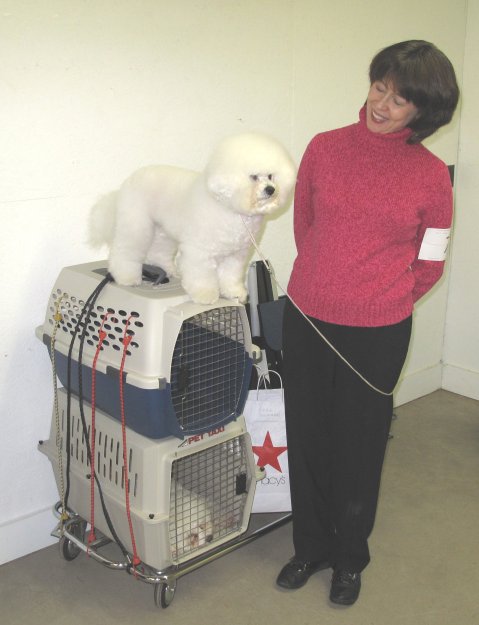
Carol and Aero at the Clinton Kennel Club show, March 28, 2009
Carol and I left Chicago yesterday afternoon, and made it to Clinton, Iowa by suppertime. We’re now camped out at a Best Western on US 30 somewhere between Clinton and the next town west, DeWitt. I’m still depressed over Mike Sargent’s death and haven’t felt much like posting anything here, but judging from this morning’s email, people are starting to worry about me, so I figured I’d better surface and at least wave.
Hey, I’m all right. I get quiet when I’m sad, and between the ongoing crap weather and all the death and illness among friends and family, I haven’t had much to feel good about.
But today I think we turned a corner. Carol and I got Aero cleaned up and brushed out this morning and entered him in the Clinton Kennel Club dog show at the Clinton County 4H grounds in DeWitt. Carol’s been working very hard at sculpting his coat (under the tutelage of master groomer Jimi Henton) and he looks better now than he ever has in his two short years. He performed reasonably well this morning, in a small slate that included only one other male bichon. He probably would have won, but instead of prancing sedately around the show ring under the judge’s watchful eye (the judge’s name is Fred Bassett, by the way) Aero kept acting up and turning around to look at the dog behind him and get into play posture. Carol has tried various treats to keep his attention at shows, including the usual cocktail sausages and raw meat, all to no avail. Today we tried little pieces of Twizzler licorice, which didn’t work any better than raw meat. He’s a hard dog to motivate, I guess.
The second day of the show is tomorrow, and Aero gets another chance to behave and perhaps win a point. We’ve brainstormed what to wave in the air to keep him focused, and we’re down to desperate possibilities like dead squirrels and dirty diapers. We have a chunk of a fair bacon cheeseburger in the mini-fridge, and if that doesn’t work, I’d be scanning US 30 for roadkill…except that tomorrow is the last day, and after that we’re (finally!) heading for home.