Jeff Duntemann's Contrapositive Diary Rotating Header Image

Happy Beginnings vs. Happy Endings

Left to right: Patricia Labuda (later Sr. Maristella), John Malone, Bea Berbach, Victoria & Frank Duntemann, William Mark, and Kathleen DuntemannSixty years ago today, my parents were married, at St. Mary of Perpetual Help church on West 32nd Street in Chicago. It was a remarkable event, not so much because history will consider my parents remarkable (though I do) but because it was, well, unlikely. This remarkableness was not unique, but occurred countless times around America in that era, as social and ethnic barriers that had stood for centuries started to crumble, and men and women began to marry for love and not to satisfy family demands.

Consider Frank William Duntemann, the only son of a bank officer at the First National Bank of Chicago. He had been born and raised solidly middle class in East Rogers Park, of a German father and an Irish mother. Hard-headed, ironic, optimistic, stubborn, bright, slightly snotty, and short–5’6″ of solid muscle, fearless and (especially as a young man) a little pugnacious. He drove his parents crazy sometimes, running off to join the Army in 1938 when he was only 16 (the Army sent him home) and getting suspended from Lane Tech for beating the crap out of the six-foot president of the Lane Tech Nazi Society, after the Nazi had made the mistake of stabbing my father in the stomach with a wood chisel during an argument.

And consider Victoria Albina Pryes, the youngest of ten children, born of penniless Polish immigrants in a ramshackle farmhouse in Stanley, Wisconsin. Artistic, fretful, possessed of a beautiful voice, pious to the point of mysticism, and ethereally beautiful, she trained as a nurse in Chicago after WWII and struggled with the question of what to do with her life. Her family thought she should become a nun, because her high-school sweetheart had died in the War, and that could only be a Sign. But she held back, and one day in 1946 a nursing school friend suggested a double date. Mary’s boyfriend knew this interesting guy from the North Side…

Frank was smitten. Victoria was terrified. He asked for her phone number, and in a panic she made something up. Undeterred, the man who had slept through the bombardment of Monte Cassino sent a postcard to her nursing school (we have that postcard) asking her to get in touch. Even though torn between what she felt to be her family and religious obligations and her own infatuation, she did. Not sure what to expect from a man so far removed from her ethnic heritage and socioeconomic class, what she found was passionate friendship. In 1948 he asked her to marry him. By then, there was no hesitation.

But it was not without challenges. Frank’s parents were furious. They had expected him to marry a nice German girl from the neighborhood. Instead, he had chosen a Polock farm girl living in what they considered the slums. Harry Duntemann was not a man to be trifled with, and he told his son to break it off. Harry had managed to browbeat Frank into a bookkeeper’s job that he hated, and was nagging him to return to Northwestern for a degree in business. But the War had changed Frank, as it had changed thousands of men who had been frightened boys the day after Pearl Harbor. Frank took his father aside and told him, “Look, I’ve made my decision and it’s not open to discussion. I’m going to marry Victoria, and then I’m going to Georgia to get my engineering degree on the GI Bill. If you want us to come back here, and if you want to see your grandchildren, you’d better start seeing things my way.”

Harry, perhaps recognizing his own stubbornness in his son, gulped and agreed. (And to ensure that his son would return from Georgia, helped buy him a house–on the North Side.) And so on that gorgeous June day in 1949, my parents made their Happy Beginning, bridging two widely disparate cultures, he confidently, she (as always) apprehensively.

By any measure it was a successful marriage. Frank and Victoria changed one another: He taught her confidence, and persuaded her that she was beautiful and worthy; she taught him moderation and compromise. She was not sure she wanted children, but he did; he was not sure that a gentle style of childrearing would work, but she did. They were in fact spectacular parents. They read to us, they bought us books, they insisted that we speak correctly and tell the stories of our days at the dinner table. My father threatened to call the Alderman if the Chicago Public Library refused to give me a library card for being underage. (I was six; you had to be seven.) I got the card. He gave me money for electronic parts and bought me a microscope; later, when I was deeply into junkbox telescopes, my mother always had a dollar for one more pipe fitting. We were not especially flush, and were taught frugality, but money was always there for things that mattered. Stubborn as he was, my father had the courage to avoid his own father’s mistakes: He told us that no matter what careers we chose, he would support us in that choice.

My father loved my mother fiercely, and the lesson was not lost on me. More than once, when I was sitting at the kitchen table doing my homework, my father came home from work a little early, went up behind my mother at the stove, kissed the top of her head, and told her he loved her. When I was fifteen, he made it explicit: “Love comes out of friendship. If you’re lucky and smart, you’ll marry your best friend.” I did as he said (and also as he did) and no better advice has ever been given to me.

Happy beginnings are often easy. Alas, happy endings are not automatic. I’ve told most of the rest of the story here. In 1968 my father was diagnosed with oral cancer, from his two-pack-a-day habit he had picked up in Italy during the War. He fought back, and it took nine years, but the cancer killed him a piece at a time, in a gruesome progression that still gives me nightmares. It broke his spirit and finally took his mind; at our wedding in 1976 he was weak and confused. By 1977 he no longer knew who I was, which broke my heart, and in January 1978 it was finally over.

My mother was never the same. Living alone in their house for another 18 years allowed her to brood on questions of divine justice that had always haunted her. What had she done to offend God? How had she failed? My mother’s understanding of Catholicism was suffused with peasant superstition amplified to absurdity by her odd mystical personality. It was a cruel and often bizarre religion, full of prophecies and portents and dark powers, overlaid against the looming background of an angry God and an animate Hell. She was tormented by hideous dreams of accusing demons, dreams that may have led (as Gretchen and I have speculated) to the insomnia that plagued her last years. She was literally afraid to sleep, fearing what she might dream. Her doctors tried various drugs, but nothing helped, and even with Gretchen and Bill’s constant companionship and loving care, she lost her ability to speak, and slowly withered away to almost nothing. When I carried her out to Gretchen’s van the day before she died, she may have weighed fifty or sixty pounds, and looked like a victim of the Biafra famine.

It made me furious then, and I still get a little nuts to think about it. How can people who tried so hard, who loved one another so truly and unfailingly, who were generous and industrious and offered their children nothing but unconditional love, suffer such hideous ends? Where’s the justice here? The answers are complex, if in fact they are answers at all, and my readings on theodicy have been scant comfort.

Yes, they deserved a happy ending. And because they never had that happy ending, the day after my mother died in 2000, I sat down and wrote them one. (Warning: Major tearjerker material. The goal was closure, not publication.) They allowed me to be a writer, which is not as secure a career as an engineer (or almost anything else) so it was the least that I could do.

Still, the question stands: Where is the justice? If God does in fact exist, He owes me an answer to that painful question–but if God does in fact exist, (as I think He does) He’s already provided the answer–and the happy ending–to those, like my parents, who are farther along the Great Path than you or I.

The Cloud in Your Pocket

We’ve been getting rained on a lot this week, in more ways than one. Carol’s garden is going gangbusters, and I’ve never seen an explosion of wildflowers along my accustomed hiking paths as I’m seeing right now. There’s a bee shortage somewhere in the country, I’ve heard, but the little buggers are thronging the wildflowers here. Temps are deliciously cool, for June, which seems to be a trend this year.

On the flipside, some dorks broke into my hosting directory a few days ago and inserted porn spam links into all my static HTML. They tried to modify the PHP in my instances of the Gallery photo manager for purposes unclear, but Gallery stopped working and I had to delete both instances. (I have backups of all the photos and captions and will reinstall as time permits.)

That whole adventure happened while I was on deadline reading copyedits on the first five chapters, and it did not endear me to cloud computing. I’ve had some time to think about the whole sorry mess, and some larger questions arise:

  1. How do we keep crap like that from happening? (This is a mostly rhetorical question; I’m not sure that we can.)
  2. Apart from portability (i.e., accessing your data on the road) what’s the real value-add in cloud computing? Remember to figure in the cost-benefit of having to find and sometimes pay dearly for a broadband connection to use it.
  3. And if portability is the only value-add, why screw with something as inherently pricey and dicey as the Cloud?

Why not put the Cloud in your pocket?

I just ordered my very first 32GB thumb drive. I skipped the 16 GB size entirely, because my trusty and much-missed 2001 Thinkpad X21 had a 32 GB hard drive, and I never filled it up. It contained all my major apps (Word, Excel, PowerPoint, MapPoint, InDesign) and all my Internet apps, plus a scattering of smaller utilities. It also contained a great deal of data, including everything I had written electronically since 1979, though in truth much of the bulk lay in MP3s. Document files are remarkably small.

One of the most significant trends of the last two years is the explosion in “portable” apps, meaning software that does not require a formal installation process beyond unzipping it into a directory. Nothing goes into the Registry, nor into \windows\system32. The whole app lives in a single folder. What a brilliant idea! (Wait…all software used to be like that…)

There have always been portable apps, but for the last fifteen years or so it’s been seen as declasse to produce them. Why? Think for a second: Once installed, a conventional Windows app can’t simply be lifted out of its folder and copied to another machine. It was one of the earliest forms of stealth DRM, invented, I suspect, specifically to keep MS Office from wandering.

No more. There are now lots of portable packages, many or most of them completely free. See PortableApps and 100 Portable Apps for Your USB Stick. You can get OpenOffice, the Gimp, Thunderbird, Firefox, Kompozer, and just about anything else you might need in portable versions. You can unzip them into directories on a thumb drive, and execute them from File Manager. (There are also portable app managers like CodySafe that give you a separate UI for your portables and stick data.) Portables run like conventional Windows apps, except that they don’t crap in your machine.

I got into portable apps while thinking about degunking for Windows. The Registry is Gunk Central, and much havoc is caused by duelling and mis-versioned DLLs dropped like softball-sized hailstones into the system32 directory. When I got my new Core 2 Quad last summer, I resolved to install only what conventional apps I absolutely needed, and use portable apps for everything that I could. The results? I have a cleaner-running machine that boots fast and has a remarkable lack of line items in Task Manager’s Processes tab. I’ve tried to stick with FOSS apps, because commercial apps are always down there in your taskbar popping up nag balloons, trying to upsell you or force updates down your throat.

It’s worked very well. What I want to try is having a single largish thumb drive containing not only data but also the programs used to manage it. Other people have been doing this for years, and it’s time I gave it a try. In the meantime, my view of the Cloud cooks down to this:

Take from the Cloud what can only be had from the Cloud–and keep the rest in your pocket.

Odd Lots

  • Have been reading copyedits and catching up on any number of things after five weeks away from home. We’re going to have real books out of the bindery on or about October 1. For the time being, I’ll be glad to just Not Be Doing Book anymore. (And that should be on or about June 30.)
  • Some twit (maybe twits) wrote Twitter apps that store unique tweet ID numbers in signed 32-bit integers. The tweet count since startup is approaching the magic number 2,147,483,647. After that, tweet IDs become negative, and hilarity reliably ensues. Should be tomorrow; let’s watch.
  • In other recent software fails, Ubuntu 9.04 broke Skype out here, and made sound support work a little weirdly generally. The Mute button gets checked all by itself for no apparent reason. This is evidently not a problem I’m having all by my lonesome, but time to fix it has been scarce.
  • A 14-year-old boy got hit by a meteorite, albeit a smallish one. He got a 3-inch scar on the back of his hand, which (once the bandanges come off) will be the most interesting conversation piece he is ever likely to own, since he evidently had to give up the meteorite itself.
  • Building this must have been a picnic. (But I’ll bet the view’s to die for.) It’s a tourist thing, like the tchochke shop atop Pike’s Peak, but way cooler. And yet another reason I have to get back to France someday.
  • If everything goes well and the IC-729 still works, I may be out in the (pacified) woods somewhere working Field Day on June 27-28. (I hate to haul my IC-736 into the wilds, but I will if I have to.) I have an RV with a generator, an AH-3 antenna tuner, and an obscene amount of wire. I know I can’t use an RV park’s electricity, but can I use their water pipes for an RF ground?

Souls in Silicon on Amazon at Cover

SISSmall.jpg Boy, I sure wasn’t expecting this: An email this morning from Lulu informed me that my SF story collection Souls in Silicon was now being offered through Amazon Marketplace at its $11.97 cover price–not cover plus 30%, as I reported in my May 29, 2009 Odd Lots entry. It’s evidently a test program of some kind, and not all Lulu books are included; in fact, of the eight Copperwood Press titles, Souls in Silcon is the only one in the program. Somebody’s giving up significant margin here, and odds are it’s not Amazon.

But this is an awesomely good thing. I have a hunch that Lulu heard that POD publishers like me were going with other systems (like Amazon’s own BookSurge) to get into the Amazon database somehow and started to worry. Hey, I’d worry too. All Copperwood books would probably be on another system (probably BookSurge) by now had the assembly book project not taken over my life last November. I would not have pulled them off Lulu, but everybody knows that Amazon is the first place people go looking for books online.

I want this program to continue and go mainstream, not just for me but for everybody, so I’m going to make a slightly weird request: If my writeups on the book piqued your interest and you figured you might order Souls in Silicon someday, now is the time to do it–if you do it through Amazon. I’m about to order a few here, and if I could scare up a couple more orders from elsewhere it could support the test and convince them that the decision could pay off for them, by generating higher unit sales even at obviously lower margins.

Here’s the Amazon sales link. (The same link is on the cover image above.) And if you know any other Lulu books in the same program, consider buying them as well. If Lulu’s going to survive it has to be able to get its products into the Amazon database. This may be their best shot, at least until they allow me to use ISBNs from my own set.

UPDATE: I just discovered that within the past hour, all the rest of my Copperwood Press titles were updated on Amazon to their Lulu cover prices. Dare we hope that the test program succeeded?

UPDATE: Chris Gerrib wrote to tell me that his Lulu SF novel The Mars Run is also in the program, which in fact includes the top 100,000 Lulu titles by sales rank. Even my slowest seller, The Pope and the Council, is at #37,303, which makes me wonder how many copies the bottom two million Lulu titles have sold…

Jaunty Jackalope in Only 2:45

I finished and packed off the introduction to the book today, which doesn’t leave a great deal more to do. I’m still “discussing” how to handle my two ASCII charts, which I laid out in InDesign and exported as PDFs. It boggles to imagine that nobody there knows how to insert a PDF into a print image, but that’s the impression I’m getting. Now and then I think publishing was better off when we strung books together with X-Acto knives and waxers.

Let it go, I keep telling myself. Nobody’s going to hang me if I don’t include a concise representation of the IBM-850 code page, as useful as it might sometimes be.

And my do-it list is calling to me. I knocked off an item today that’s worth relating: I upgraded the Ubuntu 8.10 instance on this machine to 9.04. I let the updater do it, just to see how automatically and how accurately it would happen. I’ve got a lot of software installed there (including several Windows apps under Crossover) and lots of configuration tweaks.

It happened completely automatically. I was asked twice if I wanted to keep the existing menu.lst file, which I didn’t recognize and didn’t run downstairs to look up. Alas, I told it to keep the existing one, which it obediently did–and thus didn’t update the menu display for Grub. I can fix that, but I’m annoyed at myself for being too lazy to look first.

Beyond that, as best I can tell, nothing was corrupted or left out or changed in any significant way. It took two hours and forty-five minutes, most of which was spent downloading 1,413 files from the repositories. It didn’t demand to reboot until the end of the process, which is a trick Microsoft should learn.

I admit, I was a little disappointed that there’s no funny animal in the default wallpaper. I liked the Hardy Heron art a lot; and Intrepid Ibex wasn’t bad once I got used to it, as much as it resembled a soda glass ring on a leather couch. Jackalopes don’t exist except in our imaginations (though there was one on the wall of the Pie Pan restaurant in Sauganash where we lunched with my grandmother in the early 1960s) so perhaps omitting it makes a rough kind of sense. Come October we’ll see what a Karmic Koala looks like. Maybe.

Anyway. It went great. Completely trouble-free so far. Highly recommended.

Odd Lots

  • Our good president is creating czars right and left, to the point where you can’t tell the czars without a program. So maybe we need a czar czar–I know a guy named Binks who could do the job…
  • Jim Strickland sent me a decent video demonstration of superfluidity in liquid helium. Liquid helium had a starring role in my 1980 story “Cold Hands,” and Richard Bartrop’s cover image of my upcoming story collection Cold Hands and Other Stories includes Richard’s visualization of liquid helium floating free in atmosphere at zero-G. I don’t think we’ve ever fussed with liquid helium in orbit, but if we have, I’d like pointers to any mentions.
  • In my novel The Cunning Blood, I postulated fluidic computers, which use fluid pressure and flow rates as the encoding units of information. People think I made this up completely, but not so: The technology was in use as early as 1948, and was written up in Popular Mechanics in the 1970s. (That’s where I first heard of it, though I can’t find the citation right now.)
  • If you’re at all interested in the future of the publishing industry and newspapers in particular, be sure to read James Fallows’ take on it. Ad-supported print media are being bled white by eBay and especially Craigslist, which is the direct digital analog of print classified ads.
  • From the Words-That-Sound-Exactly-Like-What-They-Are Department: “Dudelsack” is German for “bagpipe.”
  • Ethanol is a terribly inefficient use of corn (corn stoves that burn it for home heat are a far better use of corn as fuel) and it may destroy engines as well. Thanks to Pete Albrecht for the link.
  • Some years ago, while bumming around my old neighborhood in Chicago, I noticed an observatory dome on an addition to a late 40s house about three blocks from where I grew up. It was right across the street from Olympia Park, where I tried and failed several times to become good at softball. Pete Albrecht noticed that the New York Times did an article on home observatories a couple of years ago, which included some photos of the observatory, built by an accountant named John Spack.

Notes on the Journey

dogsatbeach06012009.jpg

We rolled back into Colorado Springs at 4:30 PM this afternoon, right into the thick of a whompin’ thunderstorm that was rapidly flooding streets on the west side of town. When we left, there was snow on the daffodils. Now summer is in full roar. I wonder sometimes where spring went. No matter; we’re back in our own house, and tonight I can sleep in my own bed. In the meantime, a few notes on the trip that admittedly may be a bare half-notch above sock-drawer reports:

  • Trucks were not speeding on I-80. In fact, they were often going 5-8 MPH below the posted limit in states where speed limits apply identically to all vehicles. (This has not been our experience in past trips.) One wonders if trucking companies are strapped enough by the flagging economy to tell their drivers to back off on the lead foot a little and save on Diesel.
  • There were an appalling number of deer lying dead on the side of the road in central Iowa. In fact, I’m guessing that the nation’s deer held their village idiots’ convention just east of Des Moines this year. We saw twenty-five or thirty in a fifty-mile span of Interstate.
  • Near Lincoln, Nebraska we saw a convoy of six or seven black SUVs marked “National Severe Storms Laboratory” with a rack of the damndest geegaws on top of them, and a mobile radar unit bringing up the rear. I took some notes, and found out once I got home that this was part of the Vortex2 project, which has been getting much coverage on the Weather Channel. The vehicles in question were part of a “mobile mesonet,” which gathers data on winds out where tornadoes happen. Even the weirdest Texas Bugcatcher never had anything on those!
  • I must be getting really old. Faced with paying $9.95 for one night’s Internet access at the Sheraton Iowa City on Saturday night, I said “no thanks” and went to bed.
  • And you know what? Nothing of value was lost.
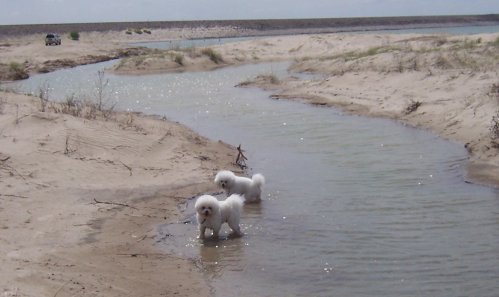
  • Lake McConaughy was higher than we’ve ever seen it. In fact, the lake is starting to put feelers back into the upper reaches of Martin Bay, where the less-than-half-full lake hasn’t been in over eight years. The dogs romped in shallow bath-warm water between low dunes, and we ran them along the beach until they dried out. The flies haven’t come out yet, and a wonderful time was had by all.

There’s much to be done this week, as there always is after five weeks away–and we’ve got the Colorado Springs dog show next weekend. Quite a few bichons are entered, enough so that the show will be what they call a “major.” Aero needs a second major win to get his championship, and this may be the one, if we can spiff him up sufficiently and get him to behave in the ring.

And I have a book to finish. But “finish” at this point really means putting the icing on. The cake itself is done.

Odd Lots

  • The Atlantic tells us that a growth industry in NYC and other crowded cities is training dogs to sniff out…bedbugs. Dogs who can tell live bedbugs from dead earn as much as $325 an hour, and work for kibble. I got some peculiar bites on one side of my right leg while we were down in Champaign-Urbana last week for Matt’s graduation, and while I can’t prove that bedbugs did it, that side of my right leg is the side that contacts the bed while I sleep (as I nearly always do) on my right side.
  • From Chris Gerrib comes word that The Espresso Book Machine has finally been installed in a bookstore, where it prints from a selection of half a million books on the attached server. No word on whether these are all out-of-copyright titles or what, but after what seems like decades of screwing around (I first reported on the Espresso Book Machine, originally called the PerfectBook 080, in 2001) we’re finally getting somewhere.
  • I’ve heard tell recently that Vista doesn’t play nice with the Xen hypervisor. Anybody had any crisp experience there?
  • William Banting’s Letter on Corpulence is now available from the Internet Archive, and it’s interesting as the very first detailed description of the effects of low-carb diets. Way back in 1864 Banting lost weight by eating protein and fat, and seemed surprised enough by his results to write up his experiences in detail. The more I research this, the more I’m convinced that carbs are what’s killing us, and this is not new news.
  • Lulu recently cut some kind of deal with Amazon to put all their books (I think; it certainly includes all of mine) in the Amazon database. However, they added five or six bucks to the cover price. Will people buy Carl & Jerry books for $21? Don’t know, but somehow I doubt it.
  • Machines can often see things that we can’t (which is one reason that we build machines) and they’re willing to share what they see with us. Sure don’t look like this in an 8″…
  • Ars Technica published a good article on how DRM actually makes the piracy problem worse–an insight I had years ago, and a painfully obvious one after thinking about it for a nanosecond or two.
  • No rest for the weary; several people wrote to ask what I would be writing next. Not sure. I still have to get our butts back to Colorado, but once I do, I want to finish my second SF story collection, and work on Old Catholics. You can bet that I’ll be posting more on Contra too, if that counts. Further than that I won’t venture, though I think I’ll be leaving computers alone for a little while.

INC Whew

Well. A few minutes ago I found myself staring at the last line of the last page of the last chapter of Assembly Language Step By Step, Third Edition. I’m sure it’s a feeling a little like that described by some of my friends who took their time getting through college, and one morning at the end of a term found themselves thinking, “Hey! I have enough credit hours now! I can graduate!”

It took so long that I wasn’t quite ready when I realized that it was finally over.

I celebrated by playing the MP3 of David Buskin‘s “Flying Child” and singing along. Loudly. That felt so good that I played Dean Friedman‘s “Ariel” and sang along louder still. Rather than make myself a little too nuts by singing Danny Hutton‘s manic cover of “Funny How Love Can Be” I poured myself a Diet Green River and ate too many Cape Cod Robust Russet potato chips before collapsing in my comfy chair.

Ten minutes later, Carol got back from Crystal Lake after a two-day sojourn wrapping up our trip and (not coincidentally) leaving me free to work here in Des Plaines. That was a piece of timing, but Carol’s good like that. We understand one another in a quantum-entanglement sort of way that is the very best part of loving a woman for forty years.

In truth, I’m not quite finished. Chapter 12 is still first draft and needs a polish pass. I have to write a new introduction and bibliography, and add two pages to the instruction reference. After that, of course, comes proofs and so on, but it’s starting to look like I’ll have real books sometime this fall, probably by November and perhaps as early as October. It ran a little long (187,000 words instead of 175,000) but not long enough to fuss about. It soaked up almost all of my creative time and energy since last December. I learned a lot doing it, and as often as I found myself feeling ragged and annoyed at the scale or the pace of the project, I’m still glad I did it. The book has been in print now for 21 years across three editions (the first from a now-defunct publisher under another title) and could well be in print for another ten or fifteen. It paid off my mortgage. In fact, it’s made me more money than all my other paid writing projects put together, in all of the 35 years that I’ve been writing for money. It’s gotten to be kind of an institution around here, and I’ll rewrite it again if I have to.

But not this week. Please.

The Sugar Bowl Is Back!

sugarbowl.jpgWhile going over to get my shirts back from the cleaners last week, I noticed with delight that the Sugar Bowl has reopened under new ownership, having been closed since early 2007. The Sugar Bowl is a venerable restaurant in downtown Des Plaines, a little to the east of the even more venerable Des Plaines Theater, which has been a Bollywood cheaps house for about ten years now. My cousin Maggie McGuire worked at the Sugar Bowl for 17 years until a very peculiar incident forced it to close. It was sold and reopened for a few years in the early oughties, then closed again and sat empty for more than two years.

Carol and I walked over there this morning about 7:30 for breakfast, and I was most pleased. The Sugar Bowl was purchased by two Greeks, who rehabbed it down to the bones and made it sparkle. Around here, nobody does breakfast places like the Greeks, who also operate Kappy’s in Niles about four blocks north of where Carol grew up (along with countless others). Their coffee is strong but not in the least bitter, and probably ideal for the breakfast-out crowd. I had two eggs scrambled with bacon, and Carol their cheese blintzes. The eggs were completely cooked (not always the case in restaurants, and important in this Era of Salmonella) and the bacon done to a perfect crisp. Carol would have liked her blintzes a little bit warmer. We think they’re trying to make an impression by being fast, and they were, but you have to finish the job.

They’re open every day from 6:00 AM until 3:00 PM. It’s great to have a Greek-run breakfast and lunch place within a quick trot of our condo, and while it’s not “fine dining,” it’s still dead-center in the grand Chicago tradition of locally owned one-off family restaurants. Highly recommended.