Jeff Duntemann's Contrapositive Diary Rotating Header Image

sf

Ten Gentle Opportunities and Virtual Assistants

djdenise.jpgI’ve been getting notes from all corners the last few days about a $200 virtual DJ program that has been been given her own show on radio station KROV in San Antonio. The program is actually an application of a more general “virtual assistant” product from Guile 3D Studios. DJ Denise goes on the air at KROV tomorrow, from 1 PM to 4 PM. You can listen over the Web; I intend to.

Most of the horsepower in creating Denise seems to have gone into rendering her lip gloss, which is odd for something used as a broadcast audio DJ. I’m more interested in whatever AI lies behind the pouty face, though early indications are that she has more lip gloss than AI. It’s an issue of special interest now, because I’m making slow but steady progress on a near-future SF novel that explores (among other and stranger things) the border between real AI and “fake” AI, a category that goes back to the ELIZA program at MIT in 1966. Ten Gentle Opportunities contains both. A cheap coffee maker contains an animated barista that talks a lot and understands little. A model-year 2020 Mazda RX9 has an annoying dashboard cartoon that understands more deeply but very narrowly. Both handle natural language well, and people are easily fooled into thinking that smooth natural language processing implies true intelligence.

I don’t think that’s true, as the more advanced AIs in the story demonstrate. One of them is Pyxis (Latin for “compass”) a high-end commercial product sold at a five-figure price as an executive assistant. Brandon Romero, an executive trying to manage a completely automated AI-controlled copier factory, has his own copy of Pyxis. (I posted a glimpse of the copier factory and its AI controller Simple Simon in my June 26, 2011 entry.) Far from being a geek-dream sex kitten, Pyxis is obedient without being especially pleasant. Worse, she holds her boss to his word, to the point where he begins to wonder who’s working for whom.

Romero dislikes having human underlings, but as he soon comes to understand, AI staff might be described the way Jerry Pournelle once described the Bomarc as the Civil Service missile: “They don’t work, and you can’t fire them.”

Pyxis saw him approaching his office door, and Brandon heard the lock bolts snap back. The coffee machine on the teak credenza was hot and full, and the air was rich with the scent of dark roast and Irish Crème. The human interns always scattered magazines on the glass coffee table against his preferences; the day when paper magazines became extinct could not come too soon. One of those interns had recently left a stuffed moose on the credenza. This was at the direction of HR, which (as he later discovered after much annoyance) wanted to “soften the human side of his persona.” The ugly abstract art shotgunned at the eggshell walls was bad enough. God forbid he should meet with a Chinese parts supplier without his stuffed moose.

Brandon sat down at his teak desk, its oiled vastness divided into the rigorously rectangular regions he maintained at all times, including a small square for coffee and another for mints: charts, summaries, two tappers full of notes and test-run videos and model animations, all at his fingertips. Defining the far sides of his desk were three brushed-stainless OLED panels currently animated with some slow-flowing pearlescent liquid that looked like shampoo. Far too soon, the triptych would spring to life with more views of this lunatic’s kingdom than any one man could possible follow.

Pyxis saw him sit down, and a window in the panel to his right burst into existence with her scowling image. “Twenty-six messages vetted and queued, five urgent.”

“Later.” If it wasn’t from that ass-covering coward Amirault, he didn’t want to hear it. Brandon set his primary tapper down in its vacant rectangle on the desk, and pulled a few loose papers from his briefcase. Like everything else, each had an appropriate place, and he scanned the piles that had been accumulating for most of a week, dropping a sheet here and a sheet there. The stapled set describing Zircon’s looming Retirement Incentive Program (was that a hint?) needed to go somewhere. A new pile? For corporate suicide notes? Brandon scanned the desktop almost automatically, but there was only one empty rectangular region left.

He stared at the tidy strip of oiled teak and felt himself tighten inside. Not big enough for anything except bad memories-but like those infuriating little sliding-square plastic puzzles, he had never hit upon an arrangement that would eliminate it.

“Here it is, Mr. Romero.” A new window popped into view, with a high-res scan of the framed photo that had stood in that teak rectangle for many years: Carolyn in a white cotton V-neck sundress out in her garden, holding a cardboard sign reading, “Greek Fire.” To a newly minted second lieutenant on the ground after Desert Storm, it meant that Carolyn Helena Ankoris was waiting impatiently for him to come home and marry her. To Major Brandon Louis Romero, US Army, Retired, it meant only failure.

“I didn’t ask you to open that.”

“You were staring at the space where the photo had been.” Building 800 was as full of electronic eyes as it was empty of human beings. Pyxis not only knew where he was at all times, she knew where he was looking.

His AI assistant was unfailingly obedient, but Brandon had set her obsequiousness parameter to zero. What was the point of having a virtual suckup? It wasn’t like the physical world suffered a flunkie shortage. “Your job isn’t to read my mind.”

Pyxis folded her arms implacably. “My job is to anticipate your needs and help you stay productive. We have a line start in a little over an hour. You have a lot to do. Mr. Amirault asked you to copy him on a call to…”

“Ok.” Brandon tossed back the last of his Red Hen coffee, and flashed with sad longing to his Army B4 training, when he had aimed an M16A4 at line-drawn enemies printed on sheets of cardboard, and nailed every damned one through the heart. “Get me Simple Simon.”

Our Reading At Who Else! Books

WhoElseBooks08-13-2011.jpg

As I mentioned in my entry for August 10, 2011, Jim Strickland and I landed a reading/signing slot yesterday afternoon at the wonderfully quirky Who Else! Books at The Broadway Book Mall in Denver. I wasn’t sure what to expect; but let’s call that needless anxiety. It was all good: Who Else! Books owners Nina (pronounced Nye-Nah, not Nee-Nah) and Ron Else were wonderful, and had the coffee machine running and a table set up for us long before we got there. How many people would show was the great mystery. I was expecting six or seven–and by my count, we got 19. That was actually a lot of people for a smallish space filled with that many books, especially on a hot Saturday afternoon in the summer.

We followed Mark Stevens, a local writer of what I might characterize as eco-mysteries set in western Colorado. Mark has two well-regarded novels in print from People’s Press, and I think most of the people who attended stopped by to hear him. However, almost no one left when he was finished. Our friend Eric Bowersox was there, as was our fellow workshopper Sean Eret from Taos Toolbox 2011. Sean, who had broken his ankle shortly before the workshop began and was wheelchair-bound the whole two weeks, was on a walking crutch yesterday and is getting around pretty well.

I did a brief intro to the Drumlins World concept, and then Jim and I both did short readings from Drumlin Circus and On Gossamer Wings. After the readings we took questions. One gentleman in the first row looked familiar, and asked some excellent questions. It was a hard virtual whack to the side of the head to realize that this was Ed Bryant. I had met and spoken with Ed at some length back at LACon in 1984, but as I suggested (and he confirmed) I’d had more hair then, and he less.

A few rows back was Eytan Kollin, author (with his brother Dani) of The Unincorporated Man and its two sequels, The Unincorporated War and The Unincorporated Woman. Eytan asked whether 800 people (the number cast away on the Drumlins World) represented enough genetic diversity to survive long-term. I’d fretted over that issue, and added another thousand or so frozen embryos to bring it up closer to 2,000 genetically distinct individuals. Eytan suggested (and there’s research to back him up) that the number is closer to 10,000–but that’s a big starship! (I’ll freely admit that I fudged a little there, though I’ve seen some speculation that fewer than 5,000 individuals were the forebears of nearly all of modern humanity.)

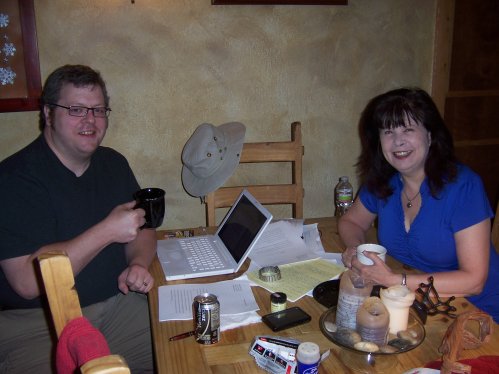
So overall it was a very sharp crowd. We sold some books, we had a lot of superb conversation, and I dropped $80 on various titles at the store, much but not all of it SF. The photo above is toward the end of the event, after most people had left the store. L-R: Ed Bryant, Jim Strickland, Eric Bowersox, and Ron Else.

Overall a fine time, and very heartening to see a small indie bookstore almost literally packed to the walls with people. I came home with a head full of ideas for another short novel called Drumlin Strongbox, and those notes still need to be taken. Tomorrow fersure.

Jeff & Jim at Who Else! Books in Denver

Carol and I just got back from a short trip to the mountains near San Isabel, Colorado, so we’re a little bit beat and (especially Carol) just a little bit sunburned. We rented a cabin at Aspen Acres campground, and walked the dogs all the way around Lake San Isabel. Not much else got done there, which was the whole point. Some new scenes from Ten Gentle Opportunities occurred to me, and that’s as far as the doing went.

But I do want to remind my Denver metro-area readers that Jim Strickland and I will be at Who Else! Books this coming Saturday, August 13, to talk about and read from our double novel Drumlin Circus / On Gossamer Wings. We’re slotted at 3 PM. The bookstore is at 200 S. Broadway, Denver 80209.

I’ve not been to the Broadway Book Mall before, so I may be up there a little earlier than that to poke around. I’m hoping to find some evidence that independent bookstores are on the rise again, after two decades of deepening eclipse. I remember the first time I ever saw a Borders, when Carol and I visited Rochester NY in 1991. I recall thinking: This is going to put a huge dent in the indie bookselling business, and I was right. What I couldn’t guess in 1991 was that the Internet was eventually going to put a huge dent in Borders–like, right between the eyes.

The Internet can do a lot. It can’t do everything. Something will replace Borders. Sooner or later we’ll find out what.

Anyway. I like bookstores. Always have, always will. Most that were in Colorado Springs when we arrived in 2003 are now gone. We have to go to Denver for certain things like Elfa shelving, and it’s starting to look like we’ll have to go there for books as well. I’ll be going on Saturday with my usual hunger for serendipity, and if you’re in the area see if you can stop by.

Odd Lots

Taos Toolbox 2011, Part 2

Jim And Nan Coffee 500 Wide.jpg

(Part 1 here.) The Snow Bear Inn is really a set of ski condos only a quarter mile from one of the Taos Ski Valley lifts. The units are complete apartments including kitchens, some with single bedrooms, some with two. Jim Strickland and I shared a two-bedroom suite. The kitchen was well-equipped; indeed, far better equipped than we needed. It had a separate wine refrigerator, coffee grinder, four-slot toaster, blender, crockpot, and probably a few other things on the high shelf that we never poked at. Food was provided in the common room for tinker-it-up breakfasts and lunches. Four dinners a week were catered in by a local woman who really knew her stuff.

Jim and I quickly fell into a daily routine: I’d be up at 6, showered by 6:15, and shoveling grounds into the coffee maker by 6:30. Jim got up about then, and I’d scramble two eggs for each of us. By 7:30 we were already hard at work unless someone stopped by for coffee, as Nancy Kress did more than once. (See above.) But even with morning visitors, by 8:30 both of us were reading mail and hammering out notes on the manuscripts up for critique later that day.

By 10:00 we were gathered around the conference table in the common area downstairs, and if anybody wasn’t there by precisely 10, Walter would lean out the door and give a blast on the Air Horn of Summoning. This happened rarely; mostly we were all present and ready to roar by 9:45. On most days work began with a lecture by Nancy, followed by a short break and then either two or three stories for critique. Lunch happened as time allowed, often before the third critique but always limited to thirty minutes. The class day wrapped up with a lecture from Walter. At that point, typically between two and three PM, we would shift into edit mode, and begin work on the following day’s critiques and our own second-week submissions. Some worked in the common room. Most of us went back to our own rooms. (Alan Smale preferred to sit with his laptop on a folding chair between the buildings.)

I quickly fell back into college-student mode, taking notes on a quad pad in my frenetic block printing, precisely as I did at DePaul in 1974. By Tuesday July 12 we were definitely into drink-from-the-firehose mode, critiquing first-wave submissions (distributed via email before the workshop began) that ran as long as 11,000 words. Toward midweek we were also working hard on our second-week submissions, which nominally demonstrated what we’d learned in the first few days.

Peter Ed After Dinner.jpg

Dinner was catered in at 6PM every day but Friday. While not exotic, the fare was beautifully prepared, and included barbecued ribs, coconut shrimp, broiled tilapia, grilled steaks, baked chicken breast, home-made potato & egg salad, and lots of other things I may have been too tapped-out mentally to recall. There was always good conversation over dinner (see above: Peter Charron and Ed Rosick) but by 6:45 most of us to our scattered laptops went, continuing work for the following day. I sometimes kept hammering until 8 or 8:30. At that point I was toast and generally gave Carol a call before falling exhausted into bed. There was a little late-night fellowship over bottles of wine down in the common room, but it all happened long after my bedtime.

Some people managed to get the 20-odd miles down the valley to Taos for occasional shopping or touristing, but my old bones preferred to stay put and rest while rest was possible. The impression I want to give here is that this was boggling hard work, and unlike my Clarion experience back in 1973, there was almost no clowning around.

My camera doesn’t do a great job with indoor shots. For a good collection of captured moments from the workshop, see Christie Yant’s Flicker album.

Next: How critiquing worked.

Taos Toolbox 2011, Part 1

SnowBearLodge500Wide.jpg

I got home yesterday afternoon, and the smoke is still coming out of my ears. I haven’t posted here recently because it was all I could do to stay ahead of the coursework and the critique. My friend Jim Strickland described it as “a 500-level course on the art of the novel crammed into two weeks.”

That’s putting it mildly.

What I’m talking about is Walter Jon WilliamsTaos Toolbox writers’ workshop, which just concluded yesterday morning at the Snow Bear Inn at Taos Ski Valley, New Mexico. The workshop was taught this year by Walter Jon Williams and Nancy Kress, with a guest lecture by Jack Skillingstead. Jim Strickland drove down from Denver Sunday morning and stashed his car in our garage, then joined me in the 4Runner for the 225 miles to Taos. I took my completed steampunk computer table, to which I had grafted the Aethernet Concentrator scant days before we left. Carrying the table, the pipe legs, the Concentrator mast, a Dell GX620 system with 20″ monitor, an ammo can full of tools, plus clothes and a cooler full of food up the stairs from the parking lot took some doing, as we were at 9,800 feet. Mountain geek I may be, but one chases oxygen atoms like fireflies up there.

SteampunkWorkstation500Wide.jpg

This is not a workshop for beginners. Jim and I were two of fourteen students, of which I was the oldest. Not one was under thirty. Most of us had already sold one or more short stories, and at least three of us have sold novels. Jim has two novels in print (plus a short Drumlins novel), and astrophysicist Alan Smale was recently nominated for the Sidewise Award for alternate history. Christie Yant is Assistant Editor at Lightspeed Magazine. One had the sense of a mass of talent around the common-room table that could (with just a few more neutrons) go critical.

For two weeks we heard lectures, took notes, discussed the issues, and presented both written and oral critiques of one another’s work. Oh, and sometimes we ate and (more occasionally) slept. When we were not at the big conference table, we were back in our respective lairs, reading manuscripts and hammering on laptops or (like me) larger iron. All told, we each read and critiqued about 200,000 words of material. It took ten days for us to loosen up sufficiently to set aside time to crack a few bottles of wine and a bottle of The Kraken 94-proof dark rum. (This was highly appropriate, as student Jeffrey Petersen had presented a novel starring a giant…flying…squid.) Walter complimented us as being the hardest-working class he’s hosted in several years conducting the workshop. We worked so hard that almost nobody hit the hot tub. By the last day, Nancy Kress herself told the class, “I am just about out of words.”

Words. It was about words. It was about making our words do precisely what we want them to do, and then getting them into the hands of our readers. It was one of the most intellectually challenging things I have ever done. I left emotionally and physically exhausted and am still catching up. It was expensive, but worth every penny. It may have rebooted my career as an SF writer.

More tomorrow.

Drumlin Neologism

Now that the Copperwood Double #1 (containing Drumlin Circus and On Gossamer Wings by Jim Strickland) has been out there for awhile, people have begun asking me again:

  1. You do know that a “drumlin” is a kind of hill, don’t you? (Yes.)
  2. Whythehell did you call your alien whatchacallits “drumlins”? (Read on.)

Language evolves to meet the needs of ordinary people. When a word doesn’t exist for a new concept, one will show up pretty quickly. Trade names will be genericized (xerox and kleenex are the best examples), wordsmiths will glue two or three things together, sometimes existing but obscure word will be repurposed, and occasionally something brand new will just appear out of nowhere.

SF writers are faced with this problem all the time. Back in the Sixties we assumed that three-dimensional television was just around the corner, and we struggled to come up with snappy terms for the idea. In my very early SF I used “triovision” and (later) “tridiac.” William Tenn’s “teledar” has always been one of my favorites. It has to be short and it has to trip easily off the tongue, or nobody will use it. Utterly invented words are hit and miss: I have long gotten flack for using the (invented) words “snerf,” “gront,” “blik,” and “frot” in stories involving witchery, as in “Whale Meat“; they are terms for difficult-to-describe mental powers that ordinary humans do not have. This was dangerous pre-Google: I innocently thought that I had invented the word “frot” in 1974 but, alas, I had not. (The witch-power later became “zot.”) Schmitz did a lot better with his “Sheewash Drive”, and never explained the origin of the term. Wholly fabricated words like that often sound silly, and work much better in whimsical or outright humorous tales. (Remember “lesnerize“?)

So there I sat in the summer of 2000, working out the details of a new story that I eventually called “Drumlin Boiler.” The concept had been cooking in the back of my head for some time: A starship full of human castaways on an unknown Earthlike planet discover alien machines scattered every few miles across the landscape. Today we might call the alien machines 3D printers or nanofabricators, because they make things: You tap in a 256-bit binary code to the machines’ two control surfaces, and an artifact bubbles up from a wide, shallow bowl filled with gray dust. What would people call the machines? I considered and threw out a number of outright fabrications, none of which I clearly recall. I tried a lot of derivatives, especially compressions of existing terms. “Cornies” was short for “cornucopias,” but it sounded more like breakfast cereal. Pass. Ditto “nanners,” for “nanofabricators.” “Tappers” had a lot more promise, and the alien machines were almost called tappers. I hesitated because the machines were not what was doing the tapping. Ultimately I went with “thingmakers,” because, well, that’s what they did.

I still needed a snappy name for the artifacts that came out of the thingmakers. My first candidate actually won, in a way: “thingies” are what rural people call the devices constructed by the thingmakers, particularly ones with no obvious use. It’s evocative, but it’s also inherently informal. I needed something better, something city people might use as readily as rural people. I had a long brainstorming list, which has perished, but included existing and invented terms like “dusters,” “drigs,” “drins,” and “yaags” (Yet Another Alien Gadget). The short list favorite was “tappit.” About then I got the notion that the two control surfaces would provide feedback with distinct sharp sounds. Adding sound to the images in my mind, what tapping out a code on the thingmaker pillars suggested more than anything else was banging on a set of bongo drums. Drummits? I liked that better. Drummings? Closer to purely descriptive–but somehow it suggested the slightly silly word “dumplings.” Then the word “drumlin” popped into my head. I’ll admit, I had heard the word before but didn’t know crisply what it was. I looked it up. I liked the word a lot. It spoke easily and suggested a thing that came about by drumming. The true definition seemed mighty obscure to me: A teardrop-shaped glacial hill. I figured not one person in fifty would know that.

So I repurposed it.

The word works very well in its new context, and the hills it truly refers to are rare enough so that I don’t think much confusion results. It can act as both a noun and an adjective. I think most people, especially those outside the hiking and skiing communities, probably assume that it’s a neologism.

The Naming of Invented Things is a serious challenge in SFF. I’ve written about it before. It’s about making the un-real not only sound real, but familiar–and it’s way tougher than it looks!

Sampling Yesterday’s Output: Ten Gentle Opportunities

Getting back from Chicago a few days ago took a fair amount of doing: Our 8:30 PM flight did not take off until 11:45, and when we landed in Denver we called for a shuttle to the hotel. It was 2 AM, and the driver who handled such calls after midnight served a whole list of hotels. Alas, he didn’t know where ours was. He got lost. After half an hour of confused wandering around the wide empty spaces in the vicinity of DIA, a young woman in the first row of the shuttle bus looked up the hotel on her GPS smartphone, touched a button, and held the phone up in the air. The phone then began dictating directions to the hotel right out loud–and the driver, perhaps a little reluctantly, obeyed. Ten minutes later we were at the hotel, though I doubt we were asleep until 3:45 ayem.

It sounds like a story, but no, it really happened. I’ll have to tuck it away for future reference.

In the meantime, I’ll give you a sample of the novel I’m working on, a bit of whimsy involving magic-as-alternate-physics and spells-as-software. It involves a jump between a magical universe and ours. It also involves 2018-era AI, and a robotic copier factory in a town I’ll call Merriam, NY. Here’s a representative 850 words of what came out of the keyboard yesterday:

Simple Simon’s office didn’t look like an office. Simple Simon’s office did not have a desk or a chair. “Simple Simon” had not even been his original name. The space in which he worked was not fully rendered, though there were artifacts here and there, most of them gifts from the painfully earnest Dave Mirecki and the infuriating Dr. Adele Sanderson. Simple Simon removed his five-pointed jester’s cap (which had once had bells, now mercifully deleted) and hung it on the hook beside the door. The lights came up, and Simon was now officially on the job.

To Simon’s perception, his office was a pale blue ellipsoid formed of countless minute polygons, and no matter where he walked within the ellipsoid, he was always at the center of the ellipsoid. Walking was therefore pointless.

So much, so infuriatingly much of the Tooniverse was simply pointless.

Like his costume: a particolored tunic over green tights, and shoes with points that curled up over the toes he didn’t have. They could have dressed him in a business suit like the managers wore, or (better) a polo shirt and khaki slacks like Dave. There had been a time, a comfortable, reasonable time, when he had been an unrendered polygon model like the Kid-until Dr. Sanderson began speaking of “resonances” and “human interface friction.” Dr. Sanderson was not the author of his archetype–that had been Dr. Emil Arenberg, founder of Zircon’s AI division and architect of its AI technology–but rather his Human Interface, what in older times was called his “skin.” She looked at his job, and declared him a jester. It was a metaphor, and wrong, at that. But nobody dared tell her that she was wrong, so they made him look the part.

On the wall hung a framed image containing three words:

Be the metaphor.

It was Dr. Sanderson’s slogan, and (evidently) a direct order. Simon resisted the order with all his might. He was not a jester.

He was a juggler.

“Thirty minutes,” said the Shift Clock. Simon nodded, and took a step backwards. He didn’t move, but the step was significant: All around him on the inner surface of his ellipsoid, Windows appeared and illuminated. Some were Windows to the desks of the humans who supervised the assembly floor, and the engineers who had designed it and were constantly perfecting it. Not all Windows were open. Dr. Sanderson’s was (mercifully) closed, as was Mr. Romero’s. (Ditto.) Dave was there, and waved to him. So did nine or ten others.

Most of the Windows were views of the Floor. 90% of Building 800 was a cavernous hall filled with industrial robots. There were seven-hundred fifty-seven robots in Building 800. Simon knew them all as though they were extensions of his own mind-which they were.

The boundaries between his mind and the building were “soft.” Simon leaned his head back slightly, and relaxed. The optical network channels opened to receive him, and he slipped into them, sending his awareness out to control hubs all over the building. At his touch, each robot on the assembly floor came to fluid life, testing the quality of its communication and the limits of its motion, all the while diagnosing its own condition. Each returned a status to Simon, and with each status signal Simon felt himself growing more and more complete.

The welders pivoted their laser heads down toward their testplates, and fired. Sensors measured the strength and purity of their beams, and responded. Parts bins vibrated and checked for the presence of parts in their chutes. Hydraulic drills spun up and down again, indexing forward and back.

He felt them self-test. He felt them reply. He became one with them. Ready. Ready. Ready. Ready…Ready!

Most critical were the Positioners. Nearly half the robots on the Floor did not wield lasers or wrenches or drills. Their job was to move assemblies and ultimately finished copiers around the Floor. At one time this had been done with motorized rollers and belts. No more. The Positioners were arms, with exquisitely controllable wrists and hands. The hands were coated with foam and equipped with hundreds of minute pressure sensors. Some were only inches wide. The largest had grips six feet across, on hydraulic arms as thick as a human’s thigh.

Together, they implemented Transfer Over Separated Spaces. Parts, assemblies, and finished copiers were not rolled around the building. They were thrown, on minutely calculated paths, each path computed and timed so that a part would arrive precisely when needed, with a Positioner’s hand opened to grip it, slow it, and then hand it to whatever device required the part to continue the assembly process. With the Floor running at full speed, as many as five hundred separate objects were in the air at once. Every single one of them was thrown, and tracked, and caught by the GAI Simple Simon, Factory Automation Real-Time Supervisor.

Simon’s smile broadened as the last of the robots responded. Jester, no way. Juggler, yeah.

Odd Lots

  • Here’s another take on the EasyBits GO debacle, from a guy who used to work at Easybits. Even if it’s not a trojan, it’s still crapware, and careless crapware at that. The Microsoft connection is intriguing: MS will soon be reviewing the entire Skype ecosystem, and may decide to do some decontamination. I don’t think it will go well for EasyBits.
  • Down in the trenches in the Carb Wars, people who yell, “A calorie is a calorie! It’s just the laws of thermodynamics!” don’t understand thermodynamics. I’ve known this for years. Here’s a good explanation. (Thanks to David Stafford for the link.)
  • Mike Reith saw a pure white squirrel awhile back, up near Denver. I had never heard of non-albino white squirrels before, but they exist, and appear to be spreading due to evolutionary selection–by humans.
  • Maybe it wasn’t us who extinctified the Pleistocene megafauna. (Or at least our paleolithic ancestors.) Maybe it was the Sun. Scary business. (Thanks to Jim Strickland for the link.)
  • From the Words-I-Didn’t-Know-Until-Last-Week Department: prosopagnosia, the inability to recognizes faces or familiar objects. (Thanks to Bruce Baker for calling it to my attention.)
  • From Pete Albrecht comes a link to a video of a train wreck caused by a tornado–with the wrinkle that the wreck is filmed from a security cam on one of the freight cars. Toward the end we see a derailed tanker striking sparks as it’s dragged against the rails. Made me wonder what would have happened had it been full of LP gas…
  • Forgive the vulgarity and the pervasive comics/movies influence, but this is a point that needs to be made, and textual fiction is no exception. (Thanks to Frank Glover for the link.)
  • I like sprouts. I haven’t eaten them for ten years. Here’s why. Alas, being organic doesn’t help. (Thanks once again to Pete.)
  • Here’s a cogent (and funny) illustration of a great deal of what’s wrong with science these days. Hint: It’s not science. Most of the problem is the butthead festival we call the media. (The rest is the grant system.)

Sampling Today’s Output: Ten Gentle Opportunities

Having gotten stuck on The Everything Machine a couple of days ago, I went back to my whimsical novel of magic-as-alternate physics (and spells-as-software), Ten Gentle Opportunities. Sales of my 99c ebook fantasy novelette “Whale Meat” (epub) have been unexpectedly good. You guys want magic? I give you magic: object-oriented magic. Oh, and zombies. Gotta have zombies these days. Here’s a snippet from this morning’s work, which comes immediately after the short piece I posted last Halloween:

Styppkk’s snerf-sense brought him fresh indication that Jrikkjroggmugg was hard at work on something on the other side of the wall. The angry Adamant had his number by now, and would not use any cheap stock spell that could be subverted by a mere Hkkrr.

Quickly, then! Using his left pinkie as a lamp, Styppkk dumped both the material and immaterial contents of one of his many pants pockets on the ground. A zombie activator: basically a quarter of a prtynytty, ground fine and mixed with some blood, bile, and toad stool, all rolled into the payload of a small black-powder bottle rocket. A packet of obedience dust clipped to a packet of etheric intelligence booster might also be useful, assuming the trigger spell wasn’t broken. (Always a risk when you bought cheap magic at Shazam’s Club.) A reputedly unreliable can of generic zombie repellant rounded out the kit; next time he would pay another bkk to get real Zom-B-Gone, and worry less.

Styppkk stuck the little rocket’s bamboo tail into the eyesocket of a nearby skull and struck a match. After a moment for the very short fuse to sizzle, the activator rode a little arc of fire four or five cubits into the noisome air. With a quick pop! it burst, scattering its foul-smelling dust in every direction. Styppkk ran out toward the center of the lychfield, rubbing his hands in anticipation.

Through the twin daggers in the visor of his iron helmet he watched the process begin: little glowing wisps twisting and darting in short motions synchronized to the unheard but deeply felt double beat of the World Heart. Twist-twist and pause, dart-dart and pause, descending and flowing into the stiff bodies lying everywhere around him.

He watched them shudder and stretch, gathering limbs beneath them and shoving away from the ground. The odor in the air changed from the dull, dank smell of stagnation to the sharp reek of rot. In waves radiating out from the center of the lychfield they stood, staggered, and scratched their heads. Those that still had noses raised them, turning to follow the strong scent of magic that surrounded Styppkk. Step by shambling step, they lurched toward him.

Styppkk gave himself a few quick schpritzes with the bargain-bin zombie repellent–head, crotch, and armpits–in case things got a little too cozy. He then picked up a sit-by-nellie spell from the pile of oddments at his feet.

“You guys need something to do,” he said aloud. The spell seemed reasonably well-made and certainly strong enough, somewhere past yellow if not quite green. Styppkk cranked the range up as high as it would go, poked the repeat-until-break spot to set it, and then hit the trigger.

Tapping his teeth together to keep the beat, Styppkk began a hoary old folk dance he’d learned at his cousin’s wedding years ago: Hands out, hands flipped, hands on hips, hands behind head, wiggle butt, jump and turn 90 degrees. All around him the newly animated zombies imitated his every move. He went through it a second time (more slowly, to go easier on decomposing limbs) and then, spinning his middle finger for emphasis, poked the segno.

The auto-arrange property of the spell worked beautifully: In perhaps a score of beats the zombies had spaced themselves equally into a perfectly rectangular constellation of wiggling, writhing doom.

Styppkk had the cover he needed. It was now Jrikkjroggmugg’s move.