- You’re getting two Odd Lotses in a row for a reason. Stay tuned–I’ll try and explain tomorrow, if I don’t run out of Aleve.
- Bruce Eckel is returning his Kindle Fire because the damned thing will not render .mobi files. C’mon, Amazon. I mean, come on. (Thanks to Mike Bentley for the link.)
- Xoom 2, where are you? Whoops, it’s going to be called the Droid XYboard to distance itself from the Xoom brand, which was done in because Somebody Didn’t Want It To Have a Card Slot. (Don’t know who. Have suspicions.)
- Charlie Stross makes a good case that DRM on ebooks (as required by the Big Six) is a stick handed to Amazon with which to pummel the Big Six. Read the piece, follow the links (make sure you know what a “monopsony” is) and then read the comments.
- Schumann resonance waves can apparently be detected from space. This is surprising, as my earlier readings suggested that they only exist by virtue of a sort of immaterial waveguide formed by layers in the Earth’s atmosphere–the same waveguide effect that allows hams like me to bounce signals around the world.
- Femtotech? I postulated a “femtoscope” in my novel The Cunning Blood, but it was used to plot quantum pair creation and did not rely on exotic matter. I’m not sure such things are possible, or could be done in any environment where we could live or even work through proxies. But as with a lot of things (especially LENR) I would hugely enjoy being wrong.
- I torrented down the brand-new Linux Mint 12 Lisa the other day, and like its predecessor it will not detect the video hardware correctly on my 2009-era Core 2 Quad with NVidia 630i integrated graphics. Somewhat surprisingly, it will install on an older Dell GX620 USFF with (as best I can tell) no video problems. Not sure if I like GNOME 3, though. MATE, a GNOME 2 fork, has promise.
- I may have made this point once before, but hard steampunk authors should have the Lindsay Books catalog on hand, or at least have the site bookmarked. These are books explaining how to actually do steampunk technology, often in the form of reprints of original Victorian-era reference texts. Thermite, brass, steam engines, and loads of other goodies just as great-great grandpa learned them. (Thanks to Bruce Baker for the noodge.)
- One of my German friends told me that plagiarism in German doctoral theses is so widespread that it’s spawned a crowdsourced mechanism for detecting it. That’s the abbreviated English-language version; if you have a reasonable amount of German, go to the richer, fuller main page.
- Very spooky time-lapse video of a little-known physical phenomenon. (Thanks to Pete Albrecht for the link.)
- I originally thought this was a hoax. On the other hand, I have a Tim Bird and I love it. It’s hard to believe that such things actually work as well as they do.
- Sometimes you wear what you eat–or at least a reasonable facsimile.
publishing
Odd Lots
Pirates and Dummies
I used to go up to the Pirate Bay on an almost weekly basis, to see which Paraglyph Press books were listed there. It ceased to be a priority after Paraglyph folded, and I don’t think I’ve been up there for over a year. Then last week I learned that large NY publisher John Wiley & Sons is preparing a multiple “John Doe” style lawsuit focused on torrent piracy of its staggeringly popular “For Dummies” series. So I sailed back up to the Bay to see how bad it is on the ebook side.
For dummies in search of “For Dummies,” my initial impression is that it’s pretty good, which means that for Wiley, it’s pretty bad. The word “Dummies” can be found in TPB’s torrent catalog 691 times, and although some of those may not be “For Dummies” titles, I’m guessing that nearly all of them are. Individual books are listed, of course, but what probably worries publishers more is that a 6.3 GB file containing 572 “For Dummies” books is listed as well. 6.3 GB sounds like a lot. It’s not. It’s about the size of a single 720p feature-length Blu-Ray rip. 572 PDF ebooks in one lump, egad–in truth, I didn’t know that there were that many “For Dummies” books in existence. (GURPS for Dummies is not something I would have gone looking for.)
Alas, the pirates have forgotten about me personally, and for that matter, about Paraglyph Press itself. Only one Coriolis book is listed, Michael Abrash’s Graphics Programming Black Book. (There may be others that weren’t cited with the word “Coriolis;” I didn’t search deeply.) As I said, my own last name isn’t present even once. Much more startlingly, David Brin is listed only three times. Connie Willis, twice. Vernor Vinge, once. Nancy Kress, not at all. Being hot must help; Neil Gaiman is listed 49 times.
One gets the impression that reading isn’t a priority among pirates. To find out just what is, you need a better metric, and The Pirate Bay offers one: the number of complete torrents. “Seeders” are people who make available complete copies of a given file. “Leechers” are those who are currently downloading the file. The more seeders, the more popular a file, and the faster it will download to the leechers. (The protocol is interesting and described well here.)
Although there are hundreds of torrent trackers, the Pirate Bay is by far the most popular, ranking 91 on Alexa. I think it’s pretty characteristic of the pirate world in general. So let’s go count Pirate Bay seeders:
- The top audio book is Double Your Reading Speed in Ten Minutes. 548 seeders. (Irony alert! Near-toxic levels!)
- The top ebook is Do Not Open: An Encyclopedia of The World’s Best-Kept Secrets. 1,442 seeders.
- The top pirated app is Photoshop CS5. 6,412 seeders.
- The top music track is “We Found Love” by Rihanna. 7,010 seeders.
- The top game is The Elder Scrolls. 12,438 seeders.
- The top movie is Conan the Barbarian. 17,422 seeders.
- The top TV show (in fact, the top torrent of any kind) is an episode of “How I Met Your Mother.” 23,259 seeders.
I hope I don’t have to beat you over the head with it: Video is twenty times more popular on torrent sites than ebooks. Down in Dummies land, it’s worse: The 572-book “For Dummies” collection has all of 99 seeders. Neil Gaiman’s best (46) is less than half of that.
So why is a major book publisher suing a relative handful of torrenters? I’m guessing that it’s because it can. BitTorrent is extremely “open” in terms of who’s doing it, and if you’re downloading you’re automatically uploading too. Recording the IPs of people in a torrent swarm is easy. Suing them is dirt simple. Some money can be harvested offering settlements, but at those minuscule usage levels, not much. I’m sure that Wiley wants to exert a “chilling effect” on sharing of Dummies books, and they are–but only in the torrent world. Even though my books vanished from the Pirate Bay, it didn’t take Sherlock Holmes to find them out on the bitlockers and Usenet, which for various reasons are much tougher nuts to crack on the legal side.
Video rules the torrent world because video is big, and the BitTorrent protocol is the most effective way to get video downloaded quickly. Small files like ebooks are elsewhere, unless they’re gathered into massive collections the size of Blu-Ray rips. Ebook piracy seems to be a minor issue today because ebook piracy is mostly invisible. It’s out there, and for all that I’ve pondered the problem, I return to the conclusion that the problem has no solution other than to sell the goods easily and cheaply, and to stop teaching people to be pirates by making the media experience complicated with DRM.
In the meantime, announcing mass lawsuits of torrenters of a specific product line pulls the Streisand chain hard. You might as well yell “Come and get it!” to people who hadn’t known that all 572 Dummies books (or ebooks generally) could be found on torrent sites. This has to be balanced against whatever chilling effect the lawsuits may have, and I can’t help but think that it’s a wash, at best. The real result of such suits over the years has been to push piracy into places where it’s difficult to see and almost impossible to police. The First Principle of whatever we try has to be this: Don’t make the problem worse. If this means that no solution presents itself, we may have to content ourselves with that.
Hephaestus Books and Deceptive Titles
Here’s an emerging story, first pointed out to me by Bruce Baker: There’s a new POD business out there selling free content that isn’t quite what it appears to be. A firm called Hephaestus Books in Richardson, Texas is listing literally hundreds of thousands of POD titles (166,000, as of this morning) on the major online booksellers, including Amazon, B&N, and BooksAMillion. Some are familiar public domain material. Some of them are eye-crossing minutiae that maybe seventeen people in the world would find interesting. Some sound scholarly. (Here’s an example.) But many of the newest sound like compendia of popular modern novels that in no way are in the public domain, like Jerry Pournelle’s CoDominium stories. And for $13.85, yet.
Sounds like. And here’s the catch: The POD books in question do not contain the novels listed in the title.
That would be difficult, considering that most of the books from Hephaestus are 40-80 pages long. They in fact contain discussion about the novels, much of it harvested from Wikipedia, all of it shoveled (presumably by scripts) into a file accessible by POD print machinery. Most of the big-name writers in SF are represented in the Hephaestus catalog, including Larry Niven, David Brin, and Charlie Stross, but lots of far more obscure names are there, too, like Robin Hobb. Check for yourself: Go to Amazon’s search page and type the name of any (reasonably) well-known writer, followed by “Hephaestus.” Prepare to be surprised–after all, there are 166,000 books to choose from. (Alas, don’t look for me. Already checked.)
So what precisely is this? Copyright infringement? Given the scorched-earth penalties called out by the DCMA, I doubt there’s any infringing material in these books. They’d be nuts to do that. Some online have suggested that this might be a legal issue called “tort of misappropriation” of a celebrity’s publicity rights (which, interestingly, are very well protected by Texas law) but I myself don’t think so. There are strong fair-use protections of discussion and criticism of events, things, and people, and a lot of redistributable content online. This seems to be what Hephaestus is selling. If they trip up, it’s likely to be on consumer-protection grounds, since the titles of many of these books are very deceptive. It’s a tough thing to prove, though, and the whole business seems to have been constructed with considerable skill.
One thing I still don’t understand is the cost of the ISBNs. Every book I’ve seen has an ISBN, and the ISBNs appear to be legitimate. ISBNs are not free, and in fact cost about a dollar each, even in blocks of 1,000. Given that the vast majority of these books are never likely to be ordered, even once, the burden falls on the rest to make back the investment in ISBNs given to all of them. ISBN’s for 166,000 books must have cost them about $150,000. That’s a hefty upfront cost for a revenue stream as dicey and unpredictable as this one.
How much they’re making per book is impossible to tell without knowing more about how they’re being distributed. Ingram and similar companies charge fees for mounting POD books on their systems, which would send the upfront cost for the press hurtling into the millions dollars–before they sell a single book. I’m still looking into this, but it’s a head-scratcher first-class. If you know anything more than I’ve summarized here, please pass it along.
Ah, well. This is only the latest emergence of a phenomenon that’s been with us for some time. I call such presses “shovelshops.” The big retailers could kill them in an hour by restricting the speed with which titles can be registered. Even presses like Wiley and Macmillan don’t publish more than a handful of books per day. The Hephaestus business model depends upon thousands upon thousands of books appearing very quickly. If no press can register more than ten or twenty books a day, it’ll take a long time to get the title count to the point where the number of clueless customers begins to pay off.
And then there’s always that sleepy dragon, the FTC, which may or may not be prodded enough to take notice. In the meantime, buy nothing from Hephaestus Press. You’ll be glad you didn’t.
Sixteen Inches in Seven Books
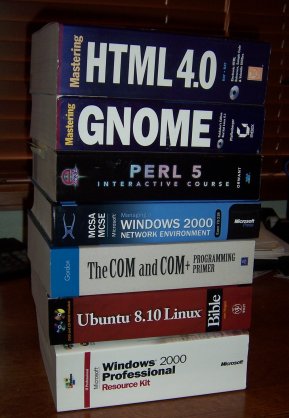 Space is getting tight in here again, and books are getting tossed on top of other books. It’s long past time to thin the ranks a little–both on the shelves and in the closet–and in standing in front of the computer section here it occurred to me that if I were attempting to free up shelf-inches I should probably go after the biggest spines first.
And so I did. After no more than five minutes, I freed up sixteen inches of shelf space–in seven books. None of these are essential. I have other, much newer books on HTML and GNOME, and given that I haven’t written a line of Perl in five years or more, one Perl book (out of two) is plenty. There is no longer a single instance of Windows 2000 here beyond a VM, so monster Win2K tomes are doing nothing but crowding out other, more useful things from my shelves.
Speaking of which: The top two titles date back to the mid-1990s, and illustrate the “spine wars” raging at the time among computer book publishers. If your books were all three inches thick, there would be fewer shelf-inches in the bookstores for your competitors, so we all wanted to make ours three inches thick. (Sybex was a champ at that, as you can see.) Coriolis published a few thick books, the thickest of which was Michael Abrash’s Graphics Programming Black Book, but compared to the other presses we were pikers. Huge spines tended to crack and spill pages in regular use, as we discovered after Michael’s book was out there for awhile. Page count was not always in proportion to spine width, either. Mastering HTML 4.0 was barely 1,000 pages long. The Coriolis HTML Black Book by Steve Holzner (2000) was 1,200 pages long, and only 1 5/8″ thick. That’s 200 more pages in one fewer inch. The difference was thicker, pulpier paper.
The Microsoft Press book at the bottom is a sort of circus freak and may never be equalled in the spine wars: It’s 1,800 pages long and a full 3″ thick. It’s not a bad book, but I’ve wondered here before it it was mostly a stunt.
Anyway. I’ve already culled an additional six or seven books, but I doubt I will ever have a stack equalling the one shown above. Ahh, computer book publishing in the spine-swellin’ 90s–what a ride that was!
Taos Toolbox 2011, Part 2
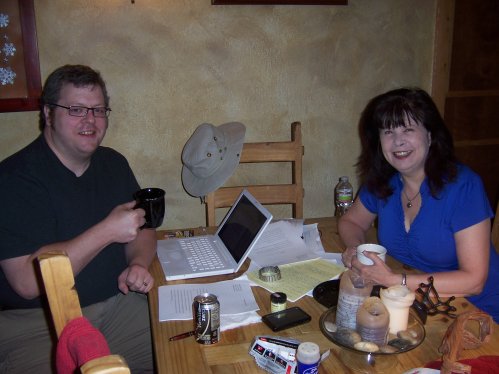
(Part 1 here.) The Snow Bear Inn is really a set of ski condos only a quarter mile from one of the Taos Ski Valley lifts. The units are complete apartments including kitchens, some with single bedrooms, some with two. Jim Strickland and I shared a two-bedroom suite. The kitchen was well-equipped; indeed, far better equipped than we needed. It had a separate wine refrigerator, coffee grinder, four-slot toaster, blender, crockpot, and probably a few other things on the high shelf that we never poked at. Food was provided in the common room for tinker-it-up breakfasts and lunches. Four dinners a week were catered in by a local woman who really knew her stuff.
Jim and I quickly fell into a daily routine: I’d be up at 6, showered by 6:15, and shoveling grounds into the coffee maker by 6:30. Jim got up about then, and I’d scramble two eggs for each of us. By 7:30 we were already hard at work unless someone stopped by for coffee, as Nancy Kress did more than once. (See above.) But even with morning visitors, by 8:30 both of us were reading mail and hammering out notes on the manuscripts up for critique later that day.
By 10:00 we were gathered around the conference table in the common area downstairs, and if anybody wasn’t there by precisely 10, Walter would lean out the door and give a blast on the Air Horn of Summoning. This happened rarely; mostly we were all present and ready to roar by 9:45. On most days work began with a lecture by Nancy, followed by a short break and then either two or three stories for critique. Lunch happened as time allowed, often before the third critique but always limited to thirty minutes. The class day wrapped up with a lecture from Walter. At that point, typically between two and three PM, we would shift into edit mode, and begin work on the following day’s critiques and our own second-week submissions. Some worked in the common room. Most of us went back to our own rooms. (Alan Smale preferred to sit with his laptop on a folding chair between the buildings.)
I quickly fell back into college-student mode, taking notes on a quad pad in my frenetic block printing, precisely as I did at DePaul in 1974. By Tuesday July 12 we were definitely into drink-from-the-firehose mode, critiquing first-wave submissions (distributed via email before the workshop began) that ran as long as 11,000 words. Toward midweek we were also working hard on our second-week submissions, which nominally demonstrated what we’d learned in the first few days.

Dinner was catered in at 6PM every day but Friday. While not exotic, the fare was beautifully prepared, and included barbecued ribs, coconut shrimp, broiled tilapia, grilled steaks, baked chicken breast, home-made potato & egg salad, and lots of other things I may have been too tapped-out mentally to recall. There was always good conversation over dinner (see above: Peter Charron and Ed Rosick) but by 6:45 most of us to our scattered laptops went, continuing work for the following day. I sometimes kept hammering until 8 or 8:30. At that point I was toast and generally gave Carol a call before falling exhausted into bed. There was a little late-night fellowship over bottles of wine down in the common room, but it all happened long after my bedtime.
Some people managed to get the 20-odd miles down the valley to Taos for occasional shopping or touristing, but my old bones preferred to stay put and rest while rest was possible. The impression I want to give here is that this was boggling hard work, and unlike my Clarion experience back in 1973, there was almost no clowning around.
My camera doesn’t do a great job with indoor shots. For a good collection of captured moments from the workshop, see Christie Yant’s Flicker album.
Next: How critiquing worked.
Taos Toolbox 2011, Part 1

I got home yesterday afternoon, and the smoke is still coming out of my ears. I haven’t posted here recently because it was all I could do to stay ahead of the coursework and the critique. My friend Jim Strickland described it as “a 500-level course on the art of the novel crammed into two weeks.”
That’s putting it mildly.
What I’m talking about is Walter Jon Williams‘ Taos Toolbox writers’ workshop, which just concluded yesterday morning at the Snow Bear Inn at Taos Ski Valley, New Mexico. The workshop was taught this year by Walter Jon Williams and Nancy Kress, with a guest lecture by Jack Skillingstead. Jim Strickland drove down from Denver Sunday morning and stashed his car in our garage, then joined me in the 4Runner for the 225 miles to Taos. I took my completed steampunk computer table, to which I had grafted the Aethernet Concentrator scant days before we left. Carrying the table, the pipe legs, the Concentrator mast, a Dell GX620 system with 20″ monitor, an ammo can full of tools, plus clothes and a cooler full of food up the stairs from the parking lot took some doing, as we were at 9,800 feet. Mountain geek I may be, but one chases oxygen atoms like fireflies up there.

This is not a workshop for beginners. Jim and I were two of fourteen students, of which I was the oldest. Not one was under thirty. Most of us had already sold one or more short stories, and at least three of us have sold novels. Jim has two novels in print (plus a short Drumlins novel), and astrophysicist Alan Smale was recently nominated for the Sidewise Award for alternate history. Christie Yant is Assistant Editor at Lightspeed Magazine. One had the sense of a mass of talent around the common-room table that could (with just a few more neutrons) go critical.
For two weeks we heard lectures, took notes, discussed the issues, and presented both written and oral critiques of one another’s work. Oh, and sometimes we ate and (more occasionally) slept. When we were not at the big conference table, we were back in our respective lairs, reading manuscripts and hammering on laptops or (like me) larger iron. All told, we each read and critiqued about 200,000 words of material. It took ten days for us to loosen up sufficiently to set aside time to crack a few bottles of wine and a bottle of The Kraken 94-proof dark rum. (This was highly appropriate, as student Jeffrey Petersen had presented a novel starring a giant…flying…squid.) Walter complimented us as being the hardest-working class he’s hosted in several years conducting the workshop. We worked so hard that almost nobody hit the hot tub. By the last day, Nancy Kress herself told the class, “I am just about out of words.”
Words. It was about words. It was about making our words do precisely what we want them to do, and then getting them into the hands of our readers. It was one of the most intellectually challenging things I have ever done. I left emotionally and physically exhausted and am still catching up. It was expensive, but worth every penny. It may have rebooted my career as an SF writer.
More tomorrow.
All Thumbs
Now that I have books to sell in more than one format, I need to erect some machinery to drive sales to more than one retailer. Time was, when all my books were conventionally published print books, a simple link to each book’s Amazon page was enough. Now I have a conventional print book, several POD print books, and ebooks in two formats.
The Copperwood Press catalog page needs a total rewrite, and I’ve been working on that. (It’s one reason I’ve been a little bit scarce here.) One thing I did do today is mount a generic WordPress HTML window in the wide sidebar, and then fill it with thumbnails of all my books. The thumbnails will eventually be clickable links into the catalog, from which you will be able to choose your format and jump to a retailer. (I will not be mounting a cart myself; it’s far too much kafeuther if Amazon and B&N will both give me 70% margins on my $2.99 ebooks.) If you’re reading Contra on my WordPress site, look to your right to see the thumbnails. If you’re reading Contra on LiveJournal, go here.
When you do, you’ll understand the conclusion I came to earlier today: My covers are not very thumbnailable. Some work better than others, and you can only do much with an image that’s 115 pixels high. I’m not an artist but I do know layout. The problem is that I learned it under the assumption that the purchaser would make his or her decision based on a much larger view of the cover, including true face time at bookstores.
With ebooks the cover game changes radically, and it’s all about thumbnails. Here’s an intriguing article on the issues associated with cover design for ebooks. When all you get is 90 pixels, it’s tough to do flourish. The best you can hope for is legibility for the title. (Interestingly, Amazon seems to have bumped search results thumbnails up to 115 pixels in the six months since Joel posted his essay. Cold comfort.)
 As I explained in my May 19 post, I’ve done well so far because I’ve published the sorts of books that people search for by name, as with Carl & Jerry. But if Cold Hands and Other Stories (now available on Kindle) is being browsed in the very big bin labeled “Hard SF,” the thumbnail cover image has a crucial selling job: getting above the noise represented by everybody else’s 115-pixel search results thumbnails.
Clearly, I have some work to do. What you see to the right are 165-pixel thumbnails, which are one and a half times the size of what the readers see in search results listings. The little Cold Hands cover above is 115 pixels high, and the more pixels you have on your screen, the smaller it looks. I’ve already done some surgery on the cover for Jim’s On Gossamer Wings, and I think I may well just start over with “Whale Meat.”
It’s hard to avoid the conclusion that covers are becoming icons. Alas, the job of an icon is precisely the opposite of the job of a cover thumbnail: An icon stands in for something that we’re already familiar with and see constantly. A cover thumbnail stands in for something that we’ve never seen before. Worse, covers are becoming icons that must contain readable words. Of all the examples shown by Joel Friedlander in his article linked above, only Christopher Smith’s Fifth Avenue really works at 90 pixels. It works because there’s almost no image involved. You get a little color, and a tiny black stick that could be just about anything. (If I didn’t know where “Fifth Avenue” was, I might not have guessed a skyscraper.)
I’m not entirely sure what to think about the problem. If cover images get too small, they carry too little information to be useful. We can read the title in text beside the thumbnail; do we need to be able to read it in the thumbnail too? Will people get so used to minuscule cover thumbnails over time that they’ll basically stop noticing them?
Subtlety and beauty have not always been the domain of book covers. Maybe this is yet another indication that we’re returning to the pulps: Our covers may need to become very small collections of iconic symbols (bug-eyed monsters, V-2 spaceships, traffic-cone breasts, ray guns) to be recognizable as anything at all.
I’m not sure that worked for the pulps. I’m even less sure it will work for us. The real bummer is that I’m not sure what else to suggest.
Cold Hands and CreateSpace
For the last several days I’ve been tinkering with my collection Cold Hands and Other Stories to get it ready for sale as an ebook. The book is now available in epub format on the B&N Nook store ($2.99; no DRM) and should appear in mobi format on Kindle in the next day or so. All of my shorter Drumlins stories are in that book, so if you liked Drumlin Circus and On Gossamer Wings, do please consider it.
Print is a more interesting issue. Cold Hands has been available as a printed paperback on Lulu for some time now, but I haven’t been satisfied with the book’s visibility, especially on Amazon. Lulu is certainly the easiest of all the POD services to learn and use, but to sell books you have to drive customers to the Lulu site, and they have to buy through the Lulu shopping cart. That’s a huge drawback, especially for fiction, where the per-sale earnings are low and you’re not targeting the books at an easily reachable audience; i.e., if you’re not a big name in SF. Also, many people won’t buy a book unless it can be had through Amazon, because online account proliferation is an issue for them. (I understand that hesitation completely.)
I’ve done well with my Carl & Jerry reprint books on Lulu for several years now because people go looking for Carl & Jerry. The audience knows the stories, many having read them in the 1960s. I have a substantial index page, and the page is the top search hit whenever anybody searches for “Carl and Jerry.” My two books on Old Catholic history are almost cult favorites by now, and I sell a couple of copies per month on Lulu without even a detailed summary page. (I do have descriptions on the Lulu storefront.) They sell when people talk about them in the many Old Catholic email groups, which is far oftener than I would have thought. I mention them in a post now and then, and the books keep selling. Word of mouth works well within close-knit enthusiast groups like that who understand what the books are about.
Breaking in to SF is harder. To sell paperback books of my SF I simply have to be on Amazon. That’s Lulu’s #1 issue. My Lulu books are sometimes listed and sometimes not, for reasons I don’t really understand. A search just now for Cold Hands and Other Stories does not show the book, and that’s unacceptable.
So I’ve been giving CreateSpace a look. It’s Amazon’s in-house POD service, and was originally called BookSurge before Amazon broadened it to embrace other kinds of content, like music CDs. I can use my own ISBNs there, and if you publish on CreateSpace, you will be listed on Amazon.
CreateSpace is more complex to use than Lulu, though it has nothing on Lightning Source. If you’re serious about publishing your material and expect to sell more than four or five copies it’s worth studying. The economics are better, and I’ll close out this entry with a quick summary.
First, Lulu: Cold Hands and Other Stories has a cover price of $11.99. Lulu’s per-copy manufacturing cost for the book (232 pages) is $9.14. Lulu’s commission is 57c, leaving my per-sale take as $2.28. That’s as complex as it gets over there.
CreateSpace has a more complex pricing system, and the easiest thing for me to do is just copy out a screenshot of the royalty calculator for Cold Hands:

They don’t state a fixed unit manufacturing cost, but they tell you how much you’ll make in the various retail channels. The “Pro” option here is a $39, one-time-per-title cost that has to be earned out before you see any profit. (I think of it as a processing fee for the title, while allowing CreateSpace to compete with Lulu on the “free to post” issue. There’s no charge to mount a book, if you’ll take less per copy.) For Cold Hands that would be about twelve copies, depending on the channel mix. The eStore figures are for sales through CreateSpace’s online system. The Expanded Distribution option is for sales made through other online retailers and independent print booksellers. Obviously, if you’re going to drive sales, it pays to drive them to the CreateSpace eStore rather than simply referring them to Amazon.
I had originally intended to mount Cold Hands on Lightning Source, but I wanted to get some real-world experience with CreateSpace. It’s not up there yet (their review process takes a couple of days) but should be there by early next week.
The missing link, of course, is a Web page to drive sales to CreateSpace, and I’m working on that. More as it happens.
Now Available: Copperwood Double #1
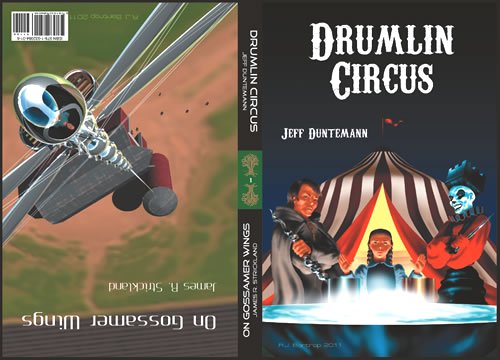
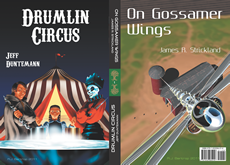
I am pleased (and you wouldn’t believe how relieved!) to announce the availability of the first Copperwood Double, Drumlin Circus / On Gossamer Wings, in both print and ebook editions. The ebook edition is available from Amazon’s Kindle store in mobi format, and from B&N in epub format, both at $2.99. No DRM in either case. And because there’s no DRM, you can download the free app Calibre and use its excellent conversion utilities to convert mobi or epub to any of several additional ebook formats. The print edition is distributed through Ingram/Lightning Source and is thus available from online retailers who work with Ingram, which would be basically all of them. $11.99. (Note: The print book is not available from Lulu.com. This was a major decision that I’ll talk about in a future entry.)
If the cover image above seems bizarre to you, well, you’re younger than you look. The grayhairs among us know precisely what I was reaching for: The Ace Doubles of the period 1952-1973. Each volume consisted of two short novels from 25,000-50,000 words in length, bound back-to-back and inverted, each with its own cover image. Ace did not invent the physical print/bind arrangement, which is called tete-beche (head-to-tail) and has existed for almost 200 years. They did make it a mainstay of recreational reading for two decades, and most of us back then had a pile of them.
A lot of people thought it was a weird idea (and many made fun of it) but we forget that the short novel as a form essentially vanished from SFF after Ace stopped publishing doubles. The magazines won’t publish something 40,000 words long, and 40,000 words is too short for a conventional print book unless you’re way out there in small and very small press. So there was this huge hole between 20,000-word novellas and 80,000 word novels. I fell into that trap in 1981, when my Firejammer clocked in at just under 30,000 words. I shopped it, but unless you’re Larry Niven no one’s going to seriously look at something that length.
I like the short novel as a distinct literary form. It’s long enough to develop some ideas and a few interesting characters, but short enough to require a certain focus, and a fairly linear plot line. It deserves to have a place in the SFF world, and two recent developments have conspired to give it one: ebooks and print-on-demand publishing. Ebooks have no strong length requirements, and from what I’ve read, the length of original ebook novels is drifting downward. More to the point, a story can be given the length it needs, and authors aren’t under pressure to pad an idea out to print novel length, or compress it to magazine novella length or less.
Print-on-demand publishing allows publishers to try interesting things without betting the house on the outcome. I will always love print books and still buy them in respectable quantities, but in these troubled times print publishers must be conservative to avoid going broke. (Do I know a little bit about that or what?) The beancounters require that a book recoup its capital costs, which means that books hover within certain boundaries set by retailer expectations. (Remember that if retailers won’t stock a book, customers never get the chance to vote on it. Retailers therefore have what amounts to a veto on print publisher publishing programs.) Slightly whacky things like tete-beche double novels fall outside ordinary bricks’n’mortar retail channel expectations, but POD manufacturing and online ordering make a lot of things possible.
So I offer you a book with two covers, and two authors telling two stories in one world, the Drumlins world that I introduced in Asimov’s back in 2002 with “Drumlin Boiler”. There’s much more to say, and I’ll continue the discussion (with specifics on both stories) in days to come.
Ebooks and Adding Value to the Public Domain
I just got our first two Copperwood Press ebooks posted to the Kindle store, and they’re now available for sale: Drumlin Circus / On Gossamer Wings and “Whale Meat.” No DRM. I’m still working with Ingram’s Lightning Source to get the double mounted and sellable in its print edition. It won’t be available from Lulu, and over time I will be migrating my other print books from Lulu to Lightning. Learning their relatively unforgiving system the first time involves a little hair-tearing, but once learned it’s learned.
There’s certainly plenty to do in coming months to get the rest of my material converted to good ebooks and posted on the major retailers. One issue I’ve found troubling for some months now is the ambiguity regarding public domain material. Both B&N and Amazon make a big deal about whether a work is in the public domain. PD titles get lower royalty rates and just generally seem libri non grati on the retailer sites. This isn’t surprising in some ways. The retailers are trying to avoid having 2,774 versions of The War of the Worlds on their servers, taking up space and confusing the readership. The definition of “public domain” varies legally by country, and what may be free in Australia or Chile is not necessary free here. So they do have to be careful on the rights front.
The issue matters to me because of The Old Catholic Studies Series, a project that I’ve been tinkering for ten years now. The goal was to scan, OCR, edit, and lay out clean, indexed versions of the foundational texts of Old Catholicism so that people wouldn’t have to pay $200 to read yellowed, crumbly, scribbled-in books printed in 1874. I have two such texts currently available in print editions: The New Reformation and The Pope and the Council. They were a lot of work, but they’ve sold reasonably well, and I consider the effort worthwhile. (It was also damned good practice in making books.) Not a lot of people want them, but the people who do want them have been very happy with them. I would have done another two or three, but John Mabry’s Apocryphile Press got there ahead of me, and put out facsimile print editions of the other major works I had considered. I prefer new layouts to facsimile editions, but Apocryphile’s scans are fairly clean and I do recommend them.
It’s true that the source materials are long in the public domain (which at least in the US includes all books published before 1923) but technically, what I’m offering are derivative works. I scanned them, page by page, OCRed them to extract the text, and then went over the text character by character to eliminate OCR errors. (Some were a hoot: “The Frankish King Pepin…” became “The Prankish King Pepin…”) The books were not indexed, and I indexed them. I fixed a few typos (especially in The Pope and the Council, which was a hurried English translation of a work written originally in German) and Americanized the British spelling. Although I don’t claim to have done a copy edit on either book, I fixed a number of examples of what I consider regrettable diction. I wrote an introduction explaining what I did and how. I gave them nice covers. If I had another hundred years to live and no need to make a living, I would do a strong edit on both.
By any legal definition what I’ve produced are derivative works that are not themselves in the public domain. That said, anybody who took an OCR of The War of the Worlds and changed three words could make the same claim, and if enough people do that, the noise level at ebook retailer sites would go through the roof. Nobody’s PD ebooks would sell well enough for it to make anything like a reasonable new edition of any PD book worthwhile.
I don’t know precisely what the answer is. Vetting tens of thousands of $2.99 ebooks is a labor-intensive business, and what sorts of standards would apply? Refusing facsimile editions is obvious and easy, but I doubt anyone would even try to read 50MB page-image PDF facsimiles on a Kindle. (On the Nook Color it might be practical; grab something 1875-ish from Google Books and let me know!) A better suggestion might be to require an up-front payment from publishers for posting anything either fully in the public domain or significantly derived from the public domain. That would cut down on bothouse publications and allow people like me to genuinely add value to public domain material without drowning in unmodifed or barely modified PD books. I’d think $25 would be about right. My books would earn that back in a month or six weeks, and the bothouses couldn’t justify it.
It’s not often that I’d willingly ask to have my own costs raised, but publishing has always been a weird business, and sometimes, well, free is less than worthless.