- Here’s yet another brick in the structure I’ve been seeing in psychological research suggesting that beyond a certain (reasonable) point, the more confident you are, the less competent you are.
- The Japanese word I heard at MileHi Con but could not spell (and thus not find) is yaoi (boys’ love) which is evidently fiction targeted at women which portrays homoerotic/homoromantic relationships between good-looking young men. (Thanks to Erbo and Eric the Fruit Bat for clarifying this. I just had no clue.)
- And while we’re identifying obscure pop culture icons and references, I’ve seen this guy somewhere. Who/what is he?
- NASA’s new-technology space-based atomic clock has eight pins, and relies on high vacuum. George O. Smith would approve. (Thanks to Larry Nelson for the pointer.)
- Switch to a “mechanical keyboard”? I never stopped using them to begin with. Modern “mush” keyboards were created solely to be cheap and are mostly useless. (I love it when I’m right–and thanks to Pete Albrecht for the link.)
- How many people lived on Earth when you were born? For me, it was 2,556,061,949.
- The 99c MP3 of the Month Award here goes to Sam Spence for “Classic Battle,” which was evidently commissioned by the NFL as incidental music for football games. Dayum. Why doesn’t baseball get music like that?
- Music, heh. Ever hear a piece of music that immediately made you head for the exits? Maybe that’s the whole idea. (Thanks to Pete Albrecht for the pointer.)
- I’ve found a good home for my old Ampro CP/M system, and will be shipping it out shortly. Thanks for all the suggestions and reminiscences.
hardware
Odd Lots
Slabbed

We’ve had soil subsidence issues here for some time–years, in fact–the most recent occurring when the soil pulled down on our gas meter feed so hard that it cracked the pipe. Our driveway looks like someone carpet-bombed it. My garage slab sank enough so that my lathe pulled its wires out of the junction box in the ceiling. Now the slab on the lower level has sunk enough to cause cracks in the plaster. We’ve been patiently waiting for the settling to stop, but issue piled on issue suggests that the time to get the soil stabilized and the concrete fixed is now.
We’ve been talking with a local contractor and may get a deal done in the next few days. That means, of course, that a lot of stuff is going to be moving around, especially on the lower level of the house. Carol’s office is Ground Zero, and everything will have to be moved out of there to somewhere else. I have to move several bookcases, including one stacked full of QST, which is probably the only magazine ever printed that was denser than National Geographic. I am going to get my strength training in the next few weeks, is for sure.
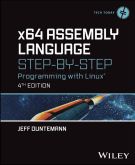
What we’ve begun doing is going through boxes, setting aside things for the various charity pick-ups, and trying to restack the furnace room shelves for maximum density. This is a time-intensive business, and time I would rather use writing has gone into sorting and stacking. That said, I’ve unearthed a number of things I thought I had long-since dumped or lost. One is the stack of Paradox reports I used to track manuscripts and issue lineup for all ten years of PCT and VDM. The database itself is gone, unless it survives (doubtful) on a 5″ HD floppy in the box of 5″ floppies I mentioned some time back. I found the 1882 copy of Oliver Twist that is certainly the oldest paperback book I’ve ever owned, or even seen. Inexplicably, it was tucked into a box full of archival copies of my own books, probably to fill a crack too small to accept yet another copy of Assembly Language Step By Step. Careless packing is a peculiar and little-understood hazard. (I’m understanding it better all the time.)
I also found a Russian-manufacture metal construction set; something like Meccano but Metric. I don’t entirely remember where I got it.
And although I knew it was there, I just unpacked a peculiar machine: A Z80 CP/M computer I put together solely to run Borland’s virtually unknown Turbo Modula-2. I assembled it in my garage in California in 1988, and ran it once or twice more early in our Arizona tenure. It’s been sealed in a box since 2002, when I tried and failed to sell it for $5 at the Fort Tuthill hamfest near Flagstaff. It uses the Ampro Little Board Z80 board, plus two DS/DD 5″ floppy drives, and a spare IBM PC power supply. I would fire it up except that it uses serial I/O, and the time to locate cables and rig a link to a serial window is time I need to spend moving other stuff out of the way. Let’s say that it worked fine when it went into the box in 2002. I’m not sure I want to keep it, but I sure hate to just heave it into the trash. Still thinking.
I’ve culled a hundred pounds or so of boxed technical books, most of which I intended to sell on Amazon Marketplace some years back and found no market for. (And now I’m ineligible for Marketplace because of Amazon’s sales tax squabble with Colorado.) I’m putting the word out that the books are here to grab, cautioning that some of them are mighty old as computer books go, though a few may still be useful. If I don’t find homes for them in the next couple of weeks, they’ll be in the recycle bin.
Other stuff needs Carol’s processing, like her Barbie dolls and other childhood odds and ends, but we made some real process in opening up space in the furnace room, to which Carol’s office furniture is likely to be evacuated in the very near future. I’ll need an Aleve tomorrow, but the work–heh, that’s only beginning.
Daywander
Why would anyone read two histories of Byzantium? Well, if the first one is mainly useful in putting you to sleep on a bad night, you might need a second to actually understand Byzantium. I finished John Julius Norwich’s A Short History of Byzantium about six weeks ago, and I suspect it didn’t satisfy because it was, well, short. (It’s an abbreviation of a much longer 3-volume work by the same author.) Norwich tells us all the things that happened in the eleven hundred years that the Byzantine empire existed, but he doesn’t have room in a mere 400 pages to analyze why things evolved as they did. By the time I was done, the Byzantine empire seemed to cook down to pseudocode:
REPEAT
  New(Emperor);
  Rivals.SlitThroat(Emperor)
UNTIL MuslimsKnockOverConstantinople;
So unless you’re an insomniac like me, I recommend A History of Byzantium by Timothy E. Gregory (Blackwell, 2005) which trades some of the repetitive detail for more and better analysis. It’s a much more readable book overall, and seems targeted at laypeople who don’t already know the broad outlines of the story. (I’m guessing it’s a 300-level textbook.) Recommended.
In other recent reading, I went back to Colin Wilson’s New Pathways in Psychology (Taplinger, 1972) to locate his definition of a “self-actualizer,” which may help me in designing a character for an upcoming story. The book is an explication of Abraham Maslow‘s views on psychology, which Wilson admires and mentions in many of his other books. I ended up reading a lot more than I intended, and realize that I may have to buy another copy of the book. The one I have was cheap, sure, but it was previously owned by a person who underlined probably 50% of the book without more than a handful of marginal notes. How is it useful to have all that underlining, if the purpose of underlining is to call attention to especially brilliant or pertinent passages when you want to find them later? And when she (her name is on the flyleaf) decides to make a note, it only proves that she is stone deaf to Colin Wilson’s ironic sense of humor.
I’ll come back to Wilson’s books in a future entry on designing characters, but in the meantime, New Pathways in Psychology is useful, as is A Criminal History of Mankind (Mercury, 2005.) His 1956 breakout book, The Outsider, nails existentialism–right through the head. Not as engaging as his other work, but if you’re trying to design a disaffected young man (especially if you yourself are well-adjusted and generally happy) the blueprints are all right there.
Yesterday Amazon delivered the 32 GB MicroSD HC card I’d ordered for the Droid, and I had this insight: You know you’re old when the fact that a thing the size of your pinkie fingernail could swallow everything you’ve ever written without a burp (plus ebook editions of every book in the house, if they existed) still makes you boggle. I don’t know precisely how much stuff it could hold because I don’t have that much stuff. But I’ll do some math: At 3 MB per MP3, the card could hold 10,000 songs. At 3 minutes per song, that’s 30,000 minutes, or 500 hours of music. At 500 KB for an .epub novel, that’s 60,000 novels, which at a novel every single night is…165 years’ worth of novels.
I guess I’m old. My boggler is in excellent working order.
Odd Lots
- Maybe it’s some of the recent solar storms (the sunspots were not spectacularly high) but I heard both Guyana and the Cayman Islands on 17m the other day–the first time I’ve seen any significant life on that band in several years.
- I have yet to find an Android ebook reader app that will open and render an MS .lit file, of which I have several. No surprise: Having blown an early and promising start in ebook reader software, MS has recently announced that it is withdrawing the app. Reader is actually a nice piece of work, and the first ebook reader program I used regularly. DRMed .lit books are now just noise, and the rest of them will have to be translated by something like Calibre. DRM, especially when it’s abandoned, trains people to locate cracks and become pirates. Way to go, guys.
- SanDisk just announced a thumb drive about the size of its own USB connector cap. 4, 8, or 16GB. I’ve now broken two thumb drives by leaving them plugged into the rear edge of a laptop and then tipping the laptop back. If that’s a common problem, this is definitely the solution.
- What do you do with the Moon once you rope it down? (Watering it would be interesting, though Mars needs it more.)
- This guy thinks like I do. Just ask Carol. (Thanks to Michael Covington for the link.)
- I recently found a PDF describing the first computer I ever programmed for money. It was a…1 MHz…8080. It cost a boggling number of 1979 dollars, so Xerox ended up using most of the initial production run in-house. The 3200 cast a long shadow: I got so used to sitting in front of it that when I built a computer table later that year for my S100 CP/M system, I made it just high enough that the keyboard was precisely as far off the floor as the 3200’s, a height that I use in computer tables to this day.
- How long did it take you to figure out what this really was? (Thanks to Pete Albrecht for the link.)
- Russian President Medvedev has taken a liking to ReactOS, a long-running and mostly ignored attempt to create a driver-compatible, win32-friendly (via WINE) open source Windows clone. He’s suggesting that the Russian government fund it. Now if Medvedev can convince Putin, we could have quite a project on our hands.
- I’d never thought much about how you recycle a dead refrigerator. Now I know.
- Begorrah! Zombies are not a new problem. (Thanks to Frank Glover for the link.)
- And if that machine gun in your hollow leg won’t slow them down, send them into sugar crash.
Annotating Reality
We’ve had evening clouds here for well over a week. Maybe ten days. I’ve lost count, but I may well have to kiss off seeing that supernova in M101. That’s a shame, because I’ve downloaded the Google Sky Map app to my new Android phone, and I want to try it out under the stars.
The app knows what time it is and where you are, and if you hold the phone up against the sky, it will show you what stars/planets/constellations lie in that part of the sky. Move the phone, and the star map moves to reflect the phone’s new position. How the phone knows which way it’s pointed is an interesting technical question that I still need to research, but let it pass: The phone basically annotates your view of the sky, and that’s not only useful, it suggests boggling possibilities. I’m guessing there are now apps that will identify a business if you point your phone at it, and possibly display a menu (the food kind) or a list of daily sales and special deals. With a rich enough database, a phone could display short history writeups of historical buildings, identify landforms for hikers, and things like that.
That mechanism is not an original insight with me; Vernor Vinge described almost exactly that (and much more) in his Hugo-winning 2006 novel Rainbows End . Most of my current boggle stems from not expecting so much of it to happen this soon. When I read the book back in 2006 I was thinking 2060. We are well on our way, and may be there by 2040. (Vinge himself said 2025, but me, well, I’m a severe pessimist on such questions. How long have we been waiting thirty years for commercial fusion power?)
In general terms, I call this idea “annotating reality.” In its fully realized form, it would be an app that will tell me in very specific terms (and in as much detail as I request) what I’m looking at. I do a certain amount of this now, but with the limitation that I have to know how to name what I’m looking at, and that’s hit-or-miss. I have an excellent visual vocabulary in certain areas (tools, electronic components, wheeled vehicles, aircraft) and almost none in others (clothes, shoes, sports paraphernalia, exotic animals.) I was 25 before I’d ever heard the term “lamé” (metallic-looking cloth) and had no idea what it was when I saw it mentioned in one novel or another. I had indeed seen lamé cloth and lamé women’s shoes, but I didn’t know the word. It’s more than the simple ignorance of youth. As much as Carol and I are involved in the dog show scene, I still see dog breeds here and there that I don’t recognize. (Is that a bergamasco or a Swedish vallhund?) Even my core competence has limits: I received a Snap-On A173 radiator hose tool in Uncle Louie’s estate, and if it hadn’t had Snap-On’s part number on it I doubt that I’d know what it was even today, because I don’t work on cars.
I want something that lives in my shirt pocket and works like Google Images in reverse: Show it the image and it gives you the text description, with links to longer descriptions, reviews, and shopping. This is a nasty computational challenge; much worse, I’m guessing, than query-by-humming. (I’ve been experimenting with Android’s SoundHound app recently. Nice work!) Dual-core smartphones won’t hack it, and we’ll need lots more bandwidth than even our best 4G networks can offer.
But we’re working on it. Facial recognition may be worst-case, so I have hopes that the same algorithms that can discriminate between almost-identical faces can easily tell a tubax from a soprillo. I can’t imagine that identifying the Insane Clown Posse band logo is all that hard–unless, of course, you don’t follow rap. (I don’t.) Bp. Sam’l Bassett did some clever googling and identified Li’l Orby for me, but as with the Insane Clowns logo, the problem isn’t so much drawing distinctions as building the database. Pace Sagan, there are billions and billions of things right down here in the workaday world. Giving them all names may be the ultimate exercise in crowdsourcing. But hey, if we can do Wikipedia in forward, we can do it in reverse. C’mon, let’s get started–it’s gotta be easier than fusion power!
UPDATE: Well, if I read Bruce Sterling more I’m sure I’d have known this, but Google’s already started, with Google Goggles. I downloaded the app to the Droid X2, and surezhell, it knew I was drinking a Coke Zero. The app said clearly that it doesn’t work on animals, but when I snapped QBit it returned photos of three white animals as “similar,” including a poodle, a kitten, and two bunnies. Close enough to warrant a cigar, at least in 2011. More as I play with it. (And thanks to the six or seven people who wrote to tell me!)
Odd Lots
- Michael S. Hart, founder of Project Gutenberg and generally acknowledged as the inventor of the ebook, has left us. He was only 64.
- That supernova that popped up in M101 about ten days ago keeps getting brighter, and the 8″ scope is out in the garage, collimated and ready to roll. I have never seen a supernova (mostly because I’ve never hunted for the pikers that have appeared in my lifetime) but this is starting to look too good to miss. Brightness should peak in the next few days, and if the clouds would break here for an evening I think it would be reasonably easy to spot.
- White dwarf stars may be able to exceed the Chandrasekahr Limit by spinning rapidly–and as soon as their rotation slows down sufficiently, they collapse and go supernova. Such stars may be more common than we think, and offer a cool SF gimmick for galaxy-level warfare: Subtract a little rotational energy from a super-Chandrasekar white dwarf, and wham! Supernova-on-demand.
- An earlier article from the same site suggests that such spinning white dwarfs may be messing up a long-established luminosity heuristic for measuring the distance to far-off galaxies. If all similar white dwarf stars collapse and blow up at the same mass, their luminosity may be assumed to be about the same. If more massive stars can delay their destruction by absorbing angular momentum along with accreted mass, the metric fails.
- Getting uranium out of groundwater is a good thing–and when you’re done, you still have the uranium. (In my view, uranium is just as useful as clean water.) I energetically wonder if this process can be generalized. If so, then anyone could become The Man Who Ploughed the Sea.
- Damn, I’ll believe it when I see it, and if I actually see it I may not in fact believe it, but Heathkit is going back into the kit business!
- I’ve never seen this before and I doubt you have either: A razor-sharp composite photo of the Moon’s north pole.
- From whence the above: I could do with more science and less Science Guy, but if you don’t visit NASA Goddard’s Flickr photostream regularly, you are missing out bigtime. (Site virgins, prepare to lose an afternoon…)
- T’hell with home theater: If this thing is quiet, it could be a spectacular desktop for office apps. (Alas, I see no published spec on how loud it is or isn’t.)
- If more ties like this were available, I might wear ties more. (Especially the, er, cable tie.)
- Back in 1948, Bell Labs polled their staff to decide on a name for what may be their most potent invention. Also-rans include the solid triode, crystal triode, and (my favorite) the Tom-Swiftish iotatron. That’s just so much cooler than “transistor.”
- Hmmm. It seems that Yale scientists may be offering me the choice between being a bald head and a fat head. I may stay where I am.
- But, Miles, it’s full of… marshmallows !
We’re All 3 1/2″ Now
Just a quick update on the vintage 5″ floppy project: I bought a half-height Teac 1.2 MB floppy drive at OEM Parts earlier this afternoon, since I was buying silver mica caps anyway. I took the cleanest of the three or four they had on the shelf. Back home, I wrestled the side panel off an EMachines box built in 2004 and put some memory in it, then pried away the space-holder from the vacant front bay and slid the Teac drive into place.
The machine came from Best Buy with neither a floppy drive nor a floppy cable. The usual floppy drive cable connector is present on the mobo. As luck would have it (or maybe not luck so much as ancient habit) I found a very old floppy cable at the bottom of my Odd PC Junk bin. It’s the five-plug model, with two sets of both types of floppy drive data connectors. I plugged the controller end into the mobo, connected the pre-twist edge connector (that is, the one closest to the mobo) to the Teac, plugged a power connector into the drive, and powered the machine up.
XP ran as expected; it’s the old machine from our church, and I know it well. Windows knew that there was now a drive on the floppy controller, but reported it as 3 1/2″. I booted back into BIOS, but unlike the older machines I recall, there was no BIOS setting to specify what size floppy drive was in the box. Using the post-twist edge connector prevented Windows from seeing the drive at all.
I guess we’re all 3 1/2″ now, if we’re floppy at all.
The drive isn’t stone dead: When I put a 1990 TopSpeed Modula 2 floppy in it, the drive sounds like it’s indexing across the surface of the disk, but never returns any data to Windows. The drive may be bad, or the disk may be bad. Certainly the machine doesn’t appear to know what a 5″ floppy drive is. All in all, it’s really not 1990 anymore.
This was an hour’s project, not a day’s project or even an evening’s project. I’ve spent about as much time on it as I think it’s worth. I’m not going to dump the diskettes, but until a machine old enough to know 5″ from 3″ finds its way here, this is as far as I’m taking it.
Odd Lots
- Does anybody here use true peer-to-peer chat? I don’t use chat much, and when I do it’s with a very small number of people, typically one-to-one. By peer-to-peer I mean via direct connect from one IP to another, without intermediation at the server level, as with things like Trillian, Skype, Jabber, etc. I know that WASTE does this, though I’ve never tried it. What else might work? I don’t want to mount a new server if I can avoid it.
- New research suggests that low-salt diets increase insulin resistance–and thus propel otherwise healthy people toward diabetes. (Via Fat Head.)
- More on Amazon’s rumored Android tablet. Print Replica (as I discussed in yesterday’s entry) has almost nothing to do with it.
- Note well: Sony’s new tablet is not really sideload-able, since the device cannot render content directly from an inserted SD card. You have to copy all material from the card to internal storage. Also, the weird cross-section makes it almost inescapably a landscape machine. No thanks.
- Interesting short piece on the other Delphi–as in, Oracle of.
- For those who asked: The 400W power supply I just bought for my Core 2 Quad is the Antec Neo Eco 400C. So far…love it!
- Having sold out all the TouchPads there were at fire-sale prices, HP now intends to…make some more. Something flaky here: Lose a little money on each sale, and make it up in volume? Doesn’t add up…unless it was a slick and risky attempt to build a demand base.
- Didn’t know this before: Setting a .jpg to quality setting 7 in Photoshop degrades the image’s quality. Stay at 6–or bump to 8.
- How about Han Solo Carbonite Slab ice cubes? Brilliant gimmick, though I wonder (given that the product is marked as “unavailable”) if they’re really out of stock or just didn’t close the deal with Lucasfilm.
Amazon’s Print Replica
A few days ago, Mike Ward tipped me off to a new ebook format coming from Amazon: Print Replica. The new format is a lot like PDF, in that it presents a fixed page layout that cannot be reflowed, only panned and zoomed. A lot of people have been scratching their heads over it, but some things were almost immediately obvious to me:
- Amazon will some time (reasonably) soon release their long-rumored high-res color tablet, capable of displaying fixed-format color page layouts at high quality.
- Amazon wants a piece of the digital textbook market.
- The whole point of the format is time-limited DRM.
- And the whole point of time-limited DRM is to prevent any least possibility of a used ebook textbook market.
I’ve spent a couple of days sniffing around for details, though not much is out there yet. The format in question is .azw4, and you can buy some titles in the new format right now. However, .azw4 ebooks will only render on Kindle for Windows 1.7 and Kindle for Mac 1.7–and only in the US. It’s not only a great deal like PDF; it is PDF, inside a proprietary wrapper. For the moment, it seems that publishers submit a conventional print-image PDF to Amazon, and Amazon places it inside the wrapper.
I’m pretty sure that Print Replica is Amazon’s version of Nook Study, which I mentioned in my April 18, 2011 entry. Nook Study is also a DRM wrapper around a PDF. The DRM is draconian and mostly hated by everyone who’s ever tried it. I’ve never seen evidence that Nook Study is being adopted broadly, but if Amazon’s imitating it, that market must have begun to move.
If it is, it’s probably the only segment of the publishing market that is moving right now, where “moving” means “better than marginally profitable.” Textbooks are the cash cows of the publishing business, and because college education is a monopoly market for books, students shrug and pay well over $100 a copy, often more. There’s very little competition and almost no choice. The prof assigns the book and that’s that. The only shopping possible is for cheaper used copies.
The argument made for digital textbooks is that they are less bulky and can be cheaper than printed textbooks, but cheaper here means $80 as opposed to $120. The argument against is that the legal waters are still very murky on used ebook sales. The doctrine of first sale makes it legal to sell used print textbooks, though there are wrinkles involving importation. Current case law for software suggests that license agreements (even ones that can’t be examined before the sale) may prohibit resale of a physical boxed software product, like AutoCAD. It’s pretty clear that if ebooks are eventually considered software, first sale may no longer apply. To be certain, publishers want textbooks to vanish once each term is over, so that they cannot be resold irrespective of future legal decisions. Once most textbooks are ebooks, every sale is a new, cover-price sale, and if time-limited DRM is taken at face value, once the term is over, the book goes poof. (And whaddaya bet that that $80 e-text will be $85 next year, and $95 the year after that?)
I still have about a quarter of my college textbooks and still refer to them occasionally, most recently Listen, by Nadeau and Tesson (1972.) It’s hard to imagine not having any of the books I studied back then (granting that I only kept the better ones) but it’s sure starting to look like that’s the future. It’s also hard to think of a redder flag to wave in front of the nascent ebook piracy scene than an $80 price tag. As I’ve said many times, I’m glad I got my degree in the 70s, when a term cost $600 and you could keep your books forever.
The Last of the 5″ Floppies
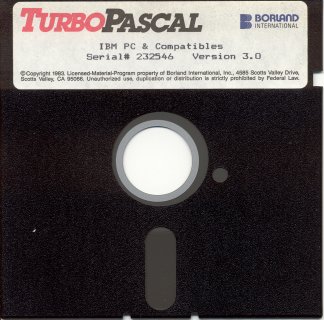 The AC works again, though now that it does, the hot spell has broken and we don’t really need it. (Love that 72 degree stuff!) However, Carol and I have some cleanup to do, as the air handler made a honking puddle on the furnace room floor downstairs, soaking the bottoms of a number of boxes. Some of those contained Christmas stuff, including my old Lionel trains. More intriguing, another, smaller, box contained a stash of 5 1/4″ floppies from the late 1980s and early 1990s. I went through it to see if there were any old backups to be destroyed (there were none) but the commercial software lineup in the box is pretty impressive:
- Turbo Pascal 2.0 (includig Turbo 87), 3.0, 4.0, 5.0, and 5.5
- Turbo Pascal for Windows
- Mystic Pascal
- QuickPascal 1.0
- TopSpeed Modula 2
- TopSpeed C
- Stony Brook Modula 2
- Smalltalk/V286
- Turbo Basic
- Quick C
- Reflex 1.0 and 2.0
- Turbo Lightning
- Paradox 2
- WordStar 3.02
- MS Word 6.0
…and lots of additional stuff from Borland and other companies, most long gone. Falk Data Systems; Software Science, Inc; Digitalk; Adapta Software, and on and on and on.
The box is toast, and I’m thinking that most or all of the disks have long since become unreadable. Still, it would be interesting to see how true that is. I checked my Paradox 4.0 3 1/2″ floppies from 1993 just now and they still read, so I suppose it’s possible. Alas, I haven’t had a 5 1/4″ floppy drive in the house in years. I’ll be going up to OEM Parts later this week to gather a few things to replenish my parts drawers, and I’ll bet they have a drive on the greasy old crap table. I’ve even got a working machine in the to-be-recycled pile with an open front bay to put it in.
I know, I know–bad use of my time. But at very least I’m going to rejoin the Turbo Pascal 2.0, 3.0, and 4.0 floppies with the manuals, which are still on the top here in my office. I’m sure I can part with the rest. Those, well…in a very real sense they helped pay for the house we’re now living in, so I’ll add them to my memoirs archive. And just in case they do read…I can bring up a DOS VM in ninety seconds flat!