- Not posting often here, but I’m ok. Working hard on several things, chief of which is getting my office and Carol’s exchanged, outfitted, and fully functional. This involves furniture, wiring, lighting, and sorting an immense quantity of glarble. I hope to return to regular in-depth posting soon.
- I have a new favorite cheese: cave-aged gruyere, which can be had sometimes at King Soopers, and is lucious with a good dry red wine. Get the oldest cheese you can find, as young gruyere tastes nothing like old gruyere. A year is as young as I buy.
- The asteroid that whacked the dinosaurs must have thrown an immense amount of material into space. How much rock might have made the journey, and how far far did it go? Here’s a good quick take on the topic. It would take a million years or more to get to Gliese 581, but suitably rugged bacterial spores might have survived, and made the origin of life on planets there unnecessary. (Thanks to Pete Albrecht for the link.)
- A book I’m not bullish on: Steven Johnson’s The Ghost Map, which describes how the cause of cholera (infected water) was proven by the persistent John Snow through charting of cholera deaths upon a map of London neighborhood water pumps. Why? The book does not include the actual ghost map named in the title. (So what else is missing or wrong?) Whatever editor let that past should be fired and spend the rest of his/her days stuffing toddler clothes in racks at Wal Mart.
- Could the TRS-80 Mod 100 possibly be 30 years old? Yes indeedy, and it was ubiquitous among tech journalists when I was at PC Tech Journal in ’85-86. Its keycaps made a distinctive sound, and sitting in a significant press conference back then was like sitting under a tin roof in a rainstorm. I yearned for one myself (the keyboard was wonderful for such a small device) but didn’t pull the trigger because the machine did so little other than keystroke capture.
- Toward the end of my tenure at Xerox I saw the Sunrise, which was a more ambitious take on the “lapslab” concept. My department was considering writing an app for it, so I had a loaner for awhile. Even better keyboard than the TRS 100, cassette data storage, modem…but the 3-line display was harder to read. Xerox private-labeled the hardware from another company, and basically killed it with a $1500 price point. (There was a flashier version that cost…$2500!) Xerox abandoned the market in 1984, after sinking what rumor held to be an obscene amount of money into it.
- One machine I did consider was the Exidy Sorcerer, which also had a good keyboard and didn’t cost $3000. Lack of software made me spend the $3000 anyway, on a huge honking S100 system running a 1 MHz 8080.
- One of the big issues between Amazon and the Big Six is an explosion of co-op fees, which according to some reports have increased by 30 times since 2011. The whole “co-op” business has always smelled gamey to me, but it had a purpose in the B&M bookselling world. How it fits into online ebook retailing is less clear, and in my view starts leaning perilously in the direction of bribery.
- Most of us think that reading is in decline. Gallup poll results suggest otherwise. Nor are today’s books worse than those of 40+ years ago. This quote is significant: “The bad [books] of yesteryear have gone out of print while the bad ones of today are alive and being sold in supermarkets.”
- I’m still watching the ASUS Tranformer Prime (their botch of its GPS support has kept me away for the time being) but the Prime has a little (as in cheaper) brother now, and it looks like a decent machine in its own right. Here’s Engadget’s detailed review of theTransformer Pad TF-300.
- Here’s another wonderful gallery from Dark Roasted Blend, this time of high-speed photos of liquids. Some of it is photoshopped, but it’s all startling. (Thanks to Ernie Marek for the link.)
- Santorini is smouldering again. Yes, the volcano that may have made the Minoans extinct and launched the legend of Atlantis (or at least put an older legend on the map) is getting restless. Like the Greeks need that right now.
- Eating meat allowed our hominid ancestors to reproduce more quickly, by accelerating infant brain growth and thus shortening the breastfeeding period. (Breastfeeding naturally inhibits ovulation.) This on top of several other issues.
- From the Words-I-Didn’t-Know-Until-Yesterday Department: Beatboxing , which is vocal generation of sounds like drums and synthesized sound effects. I heard of this in an interesting way: There’s a slightly silly commercial for the Honda Pilot that involves a Pilot full of bored tweens beatboxing the rhythm of Ozzy Osbourne’s “Crazy Train,” and by chance we had captioning turned on. When the kids started making noises, the captioning read, “Beatboxing.”
- Pete Albrecht sends a link to a map color-coding US gas prices by county. The very abrupt differences between states suggests that gas prices are more a question of state and local taxes than regional differences in demand.
- It was inevitable: A 3D printer that prints chocolate novelties. Now we need a 3D printer that prints spice-cake Easter lambs with ears that stay on.
hardware
Odd Lots
Odd Lots
- I was wrong about Diesel engines being easy to make, as I suggested in my entry for March 5, 2012. Fuel injection, as it turns out, is a bitch. You’re trying to divide oil into a multitude of very small droplets of (reasonably) consistent size. Gasoline carburetion, by comparison, is a snap. (Thanks to Pete Albrecht, an automotive engineer, for the reminder.)
- I suspect it’s easier to produce wood gas (AKA “producer gas”) at a small scale than gasoline. In a future where large-scale oil refiners are no more, a Dieselpunk society could power internal combustion engines with wood gas. This has been done a lot around the world, especially during WWII when oil supply channels were disrupted.
- This has little or nothing to do with the Holy Roman Empire, but if you’re a map freak, boy–budget a day for it. Wow.
- This looks like a good book, especially if you’re finding it hard to keep track of genre mutation within SFF. Will order and report after reading. (Thanks to Trudy Seabrook for pointing it out.)
- We found one of these in a drawer in my late grandfather’s workbench after my grandmother died in 1965 and we had to sell their house. I never knew what it was until it made the A-head story on the front page of yesterday’s Wall Street Journal , in an article about…olympic sheep shearing. My grandfather lived a quiet life in a modest house on a tiny lot on Chicago’s north side. There wasn’t a sheep for miles. (I hope he didn’t use it to cut my father’s hair.)
- I’ve noted some confusion about this: “Retina display” is not an Apple trademark, but a technical term: a display with such high resolution that the eye can’t make out individual pixels at typical reading distance. Here’s a good explanation of the whole retina display concept. The new iPad certainly qualifies, but it wasn’t the first. Asus’ Tranformer Prime was there some time ago. Retina-quality displays are made by several vendors, and will eventually appear in other high-end tablets.
- The Lytro camera has been mentioned in a lot of places, but here’s the first in-depth description I’ve seen. A camera that allows you to fiddle with the focus after the shot is taken is FM, if you know what I mean. I ditch about a third of my digital photos (mostly taken in bad light) for focus problems. It’s an awkward form factor, but if it’s the first of it’s kind, I’ll assume the next one will fit the hand a little better.
- The mad scientist in me cried out when I saw this. I need a castle. I need a kite. I need a monster.
Media System Reassembly
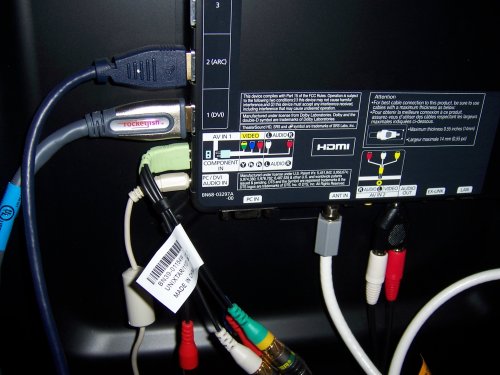
This may be obvious for some, but for whom it isn’t, I want to call it out and describe it as extremely useful: If you ever have to dismantle a complicated audio/video system, take pictures of the cabling before you pull it all apart.
We bought a flat-screen TV and associated media components last year for the lower level, and a Geek Squad guy came out to assemble and test it for us. Now, I’m not a big media guy. I watch movies when I’m on the treadmill, and sometimes TV. I’ve spent my time learning other things. So when I had to empty out the carpeted areas of the lower level, I took one look at the ratsnest behind the electronics and dove for my digital camera. I took pictures of the cables behind the TV and each of the other components. Yesterday, when it was time to put everything back in place after a two-month hiatus (which is more than long enough to forget everything) I printed out five color copies of the pertinent photos, and had it all reratsnested and working inside of twenty minutes, with no false moves at all.
I recognize that it may be difficult to get a camera behind some systems. If you can, pivot each component out far enough to snap what’s plugged into it. If you can’t, well, maybe using longer cables would be a good idea.
Having fought with media messes like this on many occasions, I’m guessing that this technique saved me hours I would otherwise have wasted and never have again. Highly recommended.
Odd Lots
- You can anodize titanium to give it a color finish using ordinary household ingredients like Coca Cola and electrons. Lots of electrons. (Alas, I don’t have enough Coke here to dunk my A-12.)
- The more I look at devices like this, the more I feel that it represents the future of high-end mobile computing. I also think it will accelerate the evolution of mobile device UIs, which are not in any shape (currently) to be productive in content creation or editing.
- This seems just, well, nuts to me, but people are using Usenet as a backup mechanism. Just bundle your stuff up in an encrypted binary file and post it to any binary group at all. With Giganews now providing 1300 days (!!) of binary retention, it could work…if you encrypt it strongly enough. (I remember the time when binary retention was six or seven days.)
- Many people have never heard of the “lineman’s splice,” which is way of joining two wires so that the join is in fact stronger than the wire itself. Now that NASA has endorsed the splice, it may see a renaissance. Only one problem: The drawing in the article is wrong. Can you spot the problem?
- I’ve always been a fan of “hi-rails,” which are small railroad vehicles used to run around the trackage looking for damage to rails and ties. Today, as often as not, they’re street pickup trucks with added small liftable flanged wheels, allowing them to operate on both rail and road. In times past, they were often street sedans with big flanged wheels and even cowcatchers. I consider them Dieselpunk, but I’ve never seen them mentioned in SFF.
- Of course, in the Steampunk era (or if your railroad was especially cheap) you had to pedal around the tracks yourself.
- An answer to a question I myself have never thought to ask: Why does it take less milk or cream to lighten iced coffee than hot coffee?
- I don’t even tweet with a keyboard yet, but with an Arduino and my trusty straight key, I’d have a long leg up on tweeting via Morse code.
- This is not the kind of glow-in-the-dark index you want to be high on, trust me.
Odd Lots
- Of all the essential elements of science, proving causation is by far the hardest. Correlation only points in a direction that further research should take; it has no value in and of itself. (The title of the article is very hokey, by the way: Science is not failing us. Human ignorance–and corruption–are interfering with the scientific process.)
- Marvelously wrought steampunk playing cards. (Thanks to Bill Cherepy for the link.)
- I went to high school with one of these guys. (Joe Lill.) Very impressive piece of work. (Thanks to Pete Albrecht–another high school colleague–for the link.)
- I got one of these for Christmas from Lee Hart. We’ll soon see if I can still write COSMAC binary machine code in my head, 35 years later. F8 FF A2…
- Carol presented me with Steven Pinker’s new book, The Better Angels of Our Nature, and I will report after I finish it. Pinker’s stuff is always worth reading, and I’ve been waiting for this one for a long time.
- The Ropers (my sister Gretchen, Bill, and her girls) gave me one of these for Christmas, and having tested it on a few Meccano parts downstairs, I suspect it may turn out to be the best hex nut starter I’ve ever had.
- This is the first waterproof (more or less) tablet I’ve ever seen, and in my preferred 4:3 format to boot. And a MicroSD slot for sideloading! Details are still sparse, but it’s the first CES 2012 announcement that hasn’t made me yawn.
- I bought a Nook Color last week; more in upcoming posts. I heard today that you can now get a Nook Color for $99 or a Nook Simple Touch for free with a one-year subscription to the New York Times or People. I don’t know if this is good for the industry or not, but it may well do wonderful things for the Nook’s market share.
- There are challenges to living in the best Effin town in Ireland. (But nothing like those of a certain town in Austria.) Thanks to G. McDavid for the link.
- I offer this interesting piece as a glimpse into my ongoing research into the drivers of climate. I have long intuited that climate is a chaotic system, and we see evidence of two states in recent geological history. What the attractors are, and whether there are other states are questions of enormous importance, as is the question of how bad a change to the other known state would be. Note well: My tolerance of Climate Madness is now close to zero. Please limit comments to the points made in the article. If you wander into politics or comment angrily your posts will be deleted without hesitation or regret.
A Rootlocked Industry
I just heard this morning that the ASUS Transformer Prime will be shipped with a locked bootloader. I wanted to spit; that machine was (until a few hours ago) at the top of my tablet prospects list. Then, about twenty minutes ago, I found the update: ASUS, having felt the Gates of Hell open upon its head for the last four days, decided that it will ship a bootloader unlocker for the product–though at the cost of your warranty.
This topic will be the tech issue of 2012: Whether or not our industry has a rootlocked future.
We’ve had hints about this for some time. I originally wrote off the fact that Android could not access the Xoom’s card slot as some weird failure at Motorola. Then I found that this was only true in the US. Europeans, once they got the Xoom, found full access to the slot. Only where the Xoom was a “Google Experience Device” was the card slot out of reach. So it wasn’t Motorola at all. It was Google declaring war on sideloading, lest sideloading thin out their revenue stream from various Google cloud services.
Looking around at promising tablets, it’s a rare one now that isn’t rootlocked. I evaluated and turned down the Nook Tablet for that reason. (The original Nook Color is still what I consider an open system–though for how long no one knows.) The Xoom 2/XYBoard no longer has a card slot. (Rounded corners are not enough to make me pull the plastic out.)
Put as simply as possible, all of the major vendors want to make the handheld market basically what the TV market is today: A completely locked end-to-end pipeline that guards content from server to screen. ASUS was very clear about that: They had to lock the TP’s bootloader to get Google to allow Google video rentals to operate on the machine. Motorola hasn’t confirmed it, but I’m sure it was the same for the original Xoom. Calling it “video rental” is a misnomer. It’s really pay-per-view, which Big Content has wanted to do for many years. The PC market evolved in too open a fashion to make that possible. The tablet market, by contrast, seems to be jumping right into their pockets.
Part of this is the idiotic “give away the razor, sell the blades” business model. Tablets are often cheaper than they would otherwise be, because their vendors expect to make money on content, with content subsidizing the device cost to the end user. People now expect a tablet to cost no more than a certain amount, and so getting a truly open tablet (without a locked content stream) on the market at a competitive price is far more difficult.
Side comment: Yes, I am an anomaly. I see two or three movies a year (at the theater) and do not watch TV at all. I do read a lot of books, and I’m certainly willing to pay for them, but I do not buy as many as I might if I were more sure that they would not simply evaporate on me someday, due to a corporate bankruptcy or some kind of patent or IP rights battle that doesn’t involve me. If an ebook costs more or less the same as a hardcover, I buy the hardcover. It’s unclear how prevalent my attitude is, but I’m sure it’s prevalent enough to depress digital revenues significantly.
I’ve already mentioned that Android isn’t an OS in the same sense that Windows is. Vendors and carriers can make mods to Android that basically fork the open-source base and turn it into separate OS species that are more “Android compatible” than anything like a single OS. Android isn’t a GPL product. It uses the Apache 2.0 license, which does not compel vendors to release changes back into the community. So Android is a hybrid of open and closed technology that makes the sealed content pipeline possible. (Otherwise, the community would just edit out what it didn’t like and recompile the OS.)
2012 will be an interesting year. The top vendors like Apple, Motorola, and Samsung have enough market share to get away with this. Smaller vendors like ASUS (and down from there) do not. My hope is that we will see smaller vendors offer truly open high-quality Android tablets that do everything but offer pay-per-view content, and are capable of booting into other versions of the OS, or another OS entirely. I’d pay more for such a tablet. A year from now we may know. Stay tuned.
Odd Lots
- Here’s a great site on older toy and hobbyist robots; if you’re a collector or just a nostalgist, it’s a must-see. (Maybe some here have never seen my late 70s robot Cosmo Klein.) Alas, the link came from an old email sent by the late George M. Ewing WA8WTE, who suggested it as an Odd Lot. Better late than never.
- We used to giggle at the name in the mid-60s, but the founder of Blonder-Tongue Labs is still alive, and maintains a site full of interesting tech information about crystal sets and old radios, as well as the firm’s patents and products from long ago. (Thanks to Michael Covington for the link; again, set aside more than a year ago and never used.)
- No tablet here yet (waiting to see what if anything pops up at CES 2012) but I’m tempted to get a Nook Color so I can at least quit reading ebooks on my dinosaur of an X41. My friend Erbo has learned a lot about rooting it and running CyanogenMod, and has much good to say about the combo.
- If you’re considering that step, consider the peculiar nature of the Android OS itself, which may not exist in precisely the same way that Windows exists. This is still good, but you need to understand it, as it’s a newish thing in the computing universe.
- I’ll never buy one of these, but I admire the concept: An off-the-shelf smartphone-controlled video-equipped RC helicopter. And I admit: If it weren’t for OWS I wouldn’t have heard of them at all.
- Henry Law called my attention to the fact that County Down in Northern Ireland is often called “Drumlin Country” because of its landforms. Odd then that “The Star of County Down” is one of my favorite Irish folk songs, and has been since I first heard it circa 2000–which is precisely when I wrote “Drumlin Boiler,” the first tale in the Drumlins Saga.
- And of course, when the starship Origen is marooned in the Drumlins system, it is the mere handful of collectible print books on board that allow the castaways to gradually re-create a modern society on an alien world. The cheap consumer-grade tablet PCs in every passenger pocket were all dead inside of fifteen years (most far sooner than that) and nobody thought to create printing presses before they were gone. No wonder that the cult of the printed book rises as the age of the printed book fades. (Thanks to Bruce Baker for the link.)
- Talk partisan political hatred all the time, and prepare to reap the wind.
- Can we please add “Google is your friend,” “denier,” and “talking points” to this list? (Thanks to Pete Albrecht for the link.)
- And with that, the curtain falls on 2011. May the impact of the curtain give it multiple broken bones, concussions, contusions, internal bleeding, hemorrhoids, the heartbreak of psoriasis, and whatever else it might take to keep this year from darkening our doorsteps ever again.
Odd Lots
- The Nook Tablet is no longer rootable, thanks to a recent stealth update applied automatically when the device connects to the Internet. The big deal with the mod is that sideloaded apps can no longer be installed; all you get are what’s available from the B&N app store.
- Lose a few, win a few: Amazon no longer blocks rival ebook apps on its Kindle Fire almost-a-tablet.
- I always roll my eyes when people say things like <YEAR> will be the Year of the <WHATEVER>. However, I’m inclined to believe that Android may finally begin coming of age in 2012, and I’m hoping to score a 10″ ICS tablet once I find one with an external card slot and (ideally) USB charging.
- Xoom 2/Xyboard is off my list because it doesn’t have an external card slot. I also agree with the review (having a Verizon-issued Droid X2 now) that the Verizon app store is hideous.
- This may well be the smallest possible USB thumb drive. No, I don’t want one. I might inhale it.
- Joe Bryer, who sent me the coal samples I described yesterday, has posted some nice videos on YouTube about using coal for home heat.
- The chemical structure of coal (granting that it’s not a uniform material but a mix of many hydrocarbon compounds) looks something like this. (Thanks to Pete Albrecht for spotting this for me.)
- My very talented Taos Toolbox 2011 colleague Lisa Nohealani Morton had her name tattoed on her arm–in binary. I myself am no stranger to binary, but if you don’t believe me you can translate it using a binary-to-text translator.
- What if you’d been at my high school lunch table in the spring of 1970? This is what you would have seen. I boggle a little at my then-habit of drinking milk and lemonade at the same meal, but I’ve done (and worn) far weirder things in my life.
- Be careful what stuffed animals you pose with over at the photography studio, especially for your Christmas photo cards. Peace on Earth and all that…
- 42% of the 100% must think they’re part of the 1%. Or something. (Thanks to Michael Covington for the link.)
- Offered without comment: The continents can be rearranged to form a chicken.
Odd Lots
- You’re getting two Odd Lotses in a row for a reason. Stay tuned–I’ll try and explain tomorrow, if I don’t run out of Aleve.
- Bruce Eckel is returning his Kindle Fire because the damned thing will not render .mobi files. C’mon, Amazon. I mean, come on. (Thanks to Mike Bentley for the link.)
- Xoom 2, where are you? Whoops, it’s going to be called the Droid XYboard to distance itself from the Xoom brand, which was done in because Somebody Didn’t Want It To Have a Card Slot. (Don’t know who. Have suspicions.)
- Charlie Stross makes a good case that DRM on ebooks (as required by the Big Six) is a stick handed to Amazon with which to pummel the Big Six. Read the piece, follow the links (make sure you know what a “monopsony” is) and then read the comments.
- Schumann resonance waves can apparently be detected from space. This is surprising, as my earlier readings suggested that they only exist by virtue of a sort of immaterial waveguide formed by layers in the Earth’s atmosphere–the same waveguide effect that allows hams like me to bounce signals around the world.
- Femtotech? I postulated a “femtoscope” in my novel The Cunning Blood, but it was used to plot quantum pair creation and did not rely on exotic matter. I’m not sure such things are possible, or could be done in any environment where we could live or even work through proxies. But as with a lot of things (especially LENR) I would hugely enjoy being wrong.
- I torrented down the brand-new Linux Mint 12 Lisa the other day, and like its predecessor it will not detect the video hardware correctly on my 2009-era Core 2 Quad with NVidia 630i integrated graphics. Somewhat surprisingly, it will install on an older Dell GX620 USFF with (as best I can tell) no video problems. Not sure if I like GNOME 3, though. MATE, a GNOME 2 fork, has promise.
- I may have made this point once before, but hard steampunk authors should have the Lindsay Books catalog on hand, or at least have the site bookmarked. These are books explaining how to actually do steampunk technology, often in the form of reprints of original Victorian-era reference texts. Thermite, brass, steam engines, and loads of other goodies just as great-great grandpa learned them. (Thanks to Bruce Baker for the noodge.)
- One of my German friends told me that plagiarism in German doctoral theses is so widespread that it’s spawned a crowdsourced mechanism for detecting it. That’s the abbreviated English-language version; if you have a reasonable amount of German, go to the richer, fuller main page.
- Very spooky time-lapse video of a little-known physical phenomenon. (Thanks to Pete Albrecht for the link.)
- I originally thought this was a hoax. On the other hand, I have a Tim Bird and I love it. It’s hard to believe that such things actually work as well as they do.
- Sometimes you wear what you eat–or at least a reasonable facsimile.
Odd Lots
- ESR on Canonical’s Unity interface. What He Said. (Thanks to Bruce Baker for the link.)
- Interfaces, yeah. Here’s a thoughtful take on touchscreen interfaces that’s worth hearing. I have a (now ancient) iPod and consider the clickwheel brilliant. I didn’t know it was becoming extinct.
- Last night Eric Bowersox showed me how he took a stock Nook Color and rebooted it from a MicroSD card into stock Android Gingerbread packaged by Cyanogen. Eric downloaded the OS and installed it on a card himself (he’s a hardware guy par excellance), but you can actually buy a MicroSD card with alternate Android distros like Cynamogen preinstalled. Just pop the card into the corner pocket of your Nook Colo and reboot. These include N2A and RootMyNookColor. I’d sure like a Xoom 2, but when we’re going to see it in the US is unclear.
- If the upcoming dual-core Nook Tablet’s screen is big enough to render technical PDFs well, I’d be sorely tempted–especially if Cyanogen and the like will boot it into stock Android. (I would like an 8″ display, though.)
- Many have sent me the link to Things That Turbo Pascal 3.0 Is Smaller Than. It’s actually a lot simpler than that: Turbo Pascal 3.0 is smaller than just about any executable file that does anything useful on a modern OS. How small? Under 40K. K, not M. You know, that letter we almost never use anymore.
- Steve Ballmer evidently didn’t blow Microsoft’s chances to compete in the tablet marketplace all by himself. Oh, no. He Had Help.
- Here’s a list of failed DRM schemes. Every one of them helped turn paying users into pirates, and accomplished nothing useful beyond stroking content industry gigaegos. DRM stinks.
- To an extent, I agree with this article: Cheap wine is not necessarily better than more expensive wine. That said, the very cheapest wines are not as good as wines in the $6-$10 range. Gallo in particular has disappointed me.
- There are USB air fresheners. I’m not kidding. If DRM stinks, is this the answer?
- FUNEX? S,VFX. FUNEM? S,VFM. OK. LFMNX.