Jeff Duntemann's Contrapositive Diary Rotating Header Image

food

Thanksgiving Break

I’m by no means finished with my current thread on how necessary Windows is, but the Thanksgiving holiday weekend intervened, and Carol and I flew to Chicago earlier this week to spend time with family. I hadn’t seen our nieces Katie Beth and Julie since the beginning of August, and kids change quickly at this point in their lives. Julie is now making short but full sentences (at 18 months) and Katie, now 3, is chattering away as she discusses some pretty interesting issues. For example, last night at Gretchen’s house, Katie looked at me and asked her mother, “What is Uncle Jeff?” (A few of my early girlfriends probably wondered the same thing.) Gretchen tried to explain that Uncle Jeff is her brother, but Katie does not have a brother and may not quite grasp the concept yet.

No sweat on that one; she’ll get there. Carol and I visited with her mom on Wednesday, did some shopping, and helped her sister Kathy prepare the Thanksgiving feast. It was drippy from the moment we got off the plane on Tuesday, and the drips continued through the day Thursday, when the family finally gathered at three. The feast included all the traditional fare: Turkey, ham, stuffing, green beans, mashed potatoes, sweet potatoes, rolls, both ceasar and Hawaiian salad, three kinds of home-made pies (with ice cream, as an option) and probably a few things that I missed, most likely green vegetables. As has become the tradition, I acted as sommelier, and brought both dry and sweet wines for the table. The dry red was Cosentino Winery’s Cigarzin 2004, a superb, fruit-forward Zinfandel without much oak but with explosive fruit flavors. Not subtle–but then, neither am I. On the sweet side I chose Bartenura’s Malvasia, an unusual sweet blush with just a little fizz. We also had a German Riesling Auslese from St. Christopher, with a bottle of White Heron in the fridge in case we needed it. As feasts go it was outstanding; much credit going to Kathy, her husband Bob, and Bob’s mother Betty for somehow making all the food appear at an appropriate time at the appropriate temperature.

I stayed out of the stores yesterday for obvious reasons, even though I’m shopping for a new subnotebook or (gasp) netbook. Instead I spent time at Gretchen’s making an old family recipe handed down from our Irish grandmother Sade. It’s called gumgash, which is essentially hamburger mixed with chopped onions, mushrooms, diced tomatoes, and shell macaroni. I dumped a little Campus Oaks Old Vine Zinfandel 2006 into the mix, which isn’t historical but adds significant flavor if you can let the whole thing simmer for 20 minutes. After we all feasted on gumgash, the girls demanded to hear their Phineas and Ferb music CD. This is a spinoff from a cartoon show on the Disney channel, about two 10-year-old nerds who invent things and drive their 15-year-old sister to distraction. The show is the girls’ current favorite (having recently upended the Madagascar Penguins; could there be stirrings of Linux culture here?) and I danced with both of them to a few of the brief but well-written cuts (some of which were hilarious) on the album. There aren’t many effective ways to dance with an 18-month-old, so I sat taylor-style on the kitchen floor and held Julie’s hands while we both swayed back and forth to the pounding rhythms of “I’m Lindana and I Wanna Have Fun!” which, while only 51 seconds long, is insanely catching, and echoed endlessly around in the back of my skull until I finally dozed off at 11 last night.

So here I am, taking a breather on Saturday afternoon before getting busy again. We’ll be home in a couple of days, when I’ll continue the current series, and then segue into some observations about writing fiction. I like lumps in my Thanksgiving mashed potatoes, and I like lumps in my exposition. The important part is what the lumps are made of. If they’re tasty enough, nobody will care…but I’ll get back to that.

Odd Lots

  • If like me you stand amazed at the precision of the English language (which is distinct from the precision of the people who use it, which is all over the map) do visit Obsolete Word of the Day. Many of the citations are old slang and many words do double duty: A slype is slang for a man who talks much about seducing women but lacks the courage to do so. Its formal use is architectural: the connection (often a covered but not enclosed passage) between the chapterhouse and the rest of a church complex. Much more there; you can sink hours on this one. (Thanks to Pete Albrecht for the link.)
  • Here’s a gatherum of peculiar or downright gross sodas from around the world. Yogurt-flavored Pepsi, anyone? Or (urrrp) Placenta? Alas, Inca Kola is not mentioned, though it should be. (Thanks to Bob Calverley, via George Ewing.)
  • The title on this article is wrong (or perhaps some people understand the term “hyperdrive” differently than I do) but it describes a new twist on an interesting and mostly forgotten 1924 speculation of mathematician David Hilbert: that a stream of particles moving at greater than half the speed of light could accelerate a nearby stationary object without subjecting that object to inertial forces. That wouldn’t be a true hyperdrive, but a genuine inertialess drive would almost seem like one if we limit the frame of reference to the starship. (I.e., we could go from here to sunlike star Zeta Tucanae in a week or so from our perspective, though 28 years from the universe’s perspective.) This is mighty exotic physics, and if there’s anything to it, we may learn more once Felber’s hypothesis is tested using the LHC, or perhaps the Tevatron.
  • I saw a trailer on what may be an interesting new film comedy: The Boat That Rocked , which had been originally (and I think more appropriately) titled Pirate Radio. It’s about the 1960’s offshore radio pirates operating just outside the UK’s territorial waters, something that’s always fascinated me. I’ve been taking notes on a novel I call (or called, sigh) Pirate Radio, exploring the notion of untraceable Internet broadcasting through large-scale powerline networking, and that research brought the old UK high seas radio pirates to mind. Probably won’t write the novel, but it’s been a good excuse to read up on things I haven’t looked at since I read them in Popular Electronics in the 1960s.
  • Don’t miss the Steampunk Genre Fiction Generator. Stumbling through it with no malice (or anything else) aforethought, I came up with: “In a leather-clad Aztec empire, a young farm boy with dreams stumbles across a talking fish, which spurs him into conflict with murderous robots with the help of a cherubic girl with pigtails and spunk and her discomfort in formal wear, culminating in convoluted nonsense that squanders the reader’s goodwill.” Somebody else write it and I’ll pay a quarter for that!
  • The ice melt across Antarctica during this past Antarctic summer (2008-2009) was the lowest ever recorded in the satellite era. I’d worry a little less about rising oceans swallowing New York City, as much as I sometimes find myself wishing for them to do so.
  • I used to wonder how corn mazes are made (and still do, for older mazes) but if you’re doing one today, you’re basically going to need a lawnmower and a GPS receiver, and a way to overlay a drawing onto a GPS-enabled map display. Oh, and a large field of corn that you’re willing to seriously mess with.

Odd Lots

  • Here is the entire sky projected on a plane, and zoomable.  (LINK REMOVED–SEE COMMENTS.) That doesn’t do it anything like justice. Cruise the image a little and gasp. (Give the site time to refresh; it’s newly slashdotted.) Read the rest of the page too–it’s fascinating, and full of great photos. Chile looks a great deal like Mars in some places.
  • There is apparently a correlation between sleep loss and amyloid tangles in the brain, which are a key element in Alzheimer’s Disease. Causation is still a little unclear, but I find it significant that in our era of Anything But Sleep, the incidence of various dementias is exploding. Be in bed by 10:00PM and keep your brain. Now there’s a deal I can live with.
  • Wired has an interesting retrospective on tablet computing, which I found worthwhile mostly for the mention of a steampunk-era electromechanical handwriting encode-and-transfer device, which ferdam sounds like what Sherlock Holmes would use to IM Watson.
  • Here’s another worthwhile perspective on the Google Books Settlement.
  • A chap who calls himself the Jolly Pirate wrote to tell me that the Pirate Party is alive and well in the US (I was under the impression that it was a European thing) and some interesting links may be found on its site, many of which have nothing to do with piracy. Now, would an American instance of the Pirate Party lean left or right? (Or would it be port and starboard?) I’ll be damned if I can decide…
  • It’s been a bad season for big-time wine critics, who can’t seem to find a business model and keep getting busted in conflict-of-interest scandals. The Internet allows the crowdsourcing of critique of all sorts of things–why should wine be any different?
  • Pertinent to the above: What we need is the wine implementation of the “People who liked this also liked…” mechanism I see (and use) in the book world. I very much like Campus Oaks Old Vine Zinfandel, though the 2007 vintage now in stores is a pale shadow of 2005. What would be a wine similar to that? (If you know of such a system for wine, please share.)
  • There are candy Legos.
  • The charger for my Kodak pocket camera is a thin little slab with two 110V power plug pins that swivel out to plug into the wall, and then swivel back into hiding when they’re not needed. Why can’t they build that mechanism right into the back of an ebook reader? (I was without my Sony Reader for a couple of months after I lost the charger.)
  • After an unexplained absence of several weeks, Fort Carson’s cannon is back. (See my entry for September 15, 2009.) Maybe the cannon was broke and they had to send it back to the factory for repairs…

Tell Me What “Junk Food” Is

Much opprobrium has been heaped on junk food in recent years. I’m willing to listen–but if we’re going to eliminate it from our diets, we first have to know what it is.

So…give me a definition.

The definition must be precise; that is, terms like “empty calories” or “having no nutritional value” are subjective judgments and thus not useful. Specify ingredients, and proportions (as percentages) if necessary. Furthermore, the definition must be about the food itself. Where it’s prepared or served is a separate issue and cannot be part of the definition. If an ingredient is junk, it’s junk whether it’s served at Mickey D’s or at Olive Garden or at the $75-a-plate fancy dinner joint of your choice. (Or at home.)

Methods of preparation may be cited, but again, such citations have to apply across the board, no matter who does it or where. Expensive junk is still junk.

Finally, “the term is meaningless” is a legitimate answer. However, if that’s the case, let’s make it meaningful, by creating a clear definition.

Let’s hear from you.

Odd Lots

  • What the Hell: Some researchers at the University of Michigan have created an 8-bit processor incorporating pneumatic gates, pointing toward a computer that doesn’t require electricity at all. Make sure you watch the videos. It’s not going to beat your local Beowulf cluster on the speed side, but if you find yourself on a planet where nanomachines eat electrical conductors (as they did in my novel The Cunning Blood) such a machine might well come in handy.
  • The Make Blog aggregated probably the best writeup of a homebrew railgun that I’ve ever seen. Make sure you prowl around the site, and make double sure you see the pictures and watch the videos!
  • Bill Cherepy sent me a link to a short writeup on the still-hypothetical Asus 2-screen ebook reader. You can use it as a netbook, with one screen doubling as a touch keyboard, or you can use it as a facing-pages ebook reader display. Now, displays are probably the most expensive part of devices like this, so I doubt a 2-screen model will be the low cost leader. Still, it’s an idea that’s well worth a try. (And please, guys, make the card slot XDHC compatible, ok?)
  • If you ever loved whole milk and wish you could go back to it, read this. And then go back to it. No guilt. No apologies. And yes, no heart attacks.
  • Back in the ’50s there was a product called Siz that was (I kid you not) foaming Napalm in a spray can. It was for starting charcoal. Lileks does a wonderful riff on it. (They had such indescribably cool toys in the ’50s.)
  • On the other hand (with Lileks always there to remind us) they did some ungodly weird stuff in the ’50s too.)
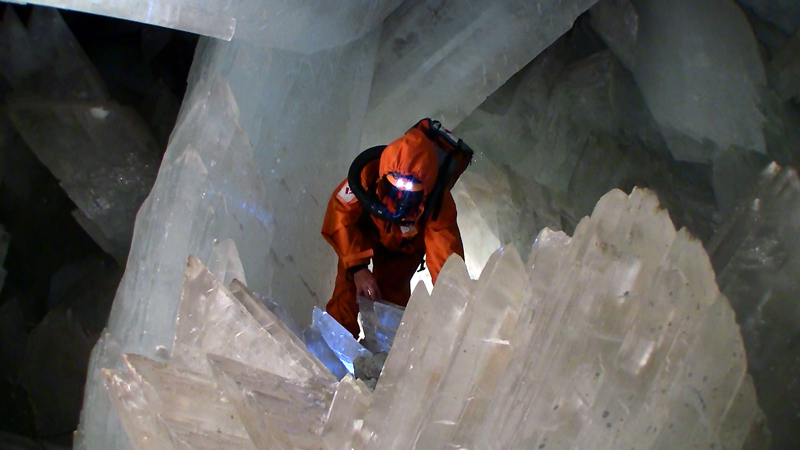
  • When I was a kid, Verne/Wells films were all the rage, and by far my favoriate was Journey to the Center of the Earth . Small boys aren’t equipped to appreciate Arlene Dahl, but I was quite the fan of James “Nemo” Mason, and was willing to tolerate Pat Boone even though my older cousin Diane thought he was “dreamy.” The film was dazzling in 1959, especially the “cave of crystals,” which flooded out when dreamy Pat Boone got too agressive with a geologists’ pick. Well, some years ago Mexican miners discovered a real cave of crystals 1200 feet beneath Naica, Mexico that makes those old 1959 movie sets look sick. National Geographic has more textual coverage, and it’s worth noting that the cavern is unliveable without life support suits, being at a constant 122 degrees and 90% humidity, which is worse than Houston, if that were possible.

Artifacts of a World Gone By

yogurtshowercap.jpgMy mother had a drawer full of them in the 60s and 70s: These little things like shower caps, circles of plastic sheet of a sort you’d recognize from shower curtains, with an elastic gather around the edge. I actually called them “shower caps” in my head, and we used them to close half-used cans of mandarin orange segments and mushrooms. I didn’t think much about them until a year or two ago, when yogurt containers stopped coming with closable lids. I don’t toss back a whole 6 oz container of yogurt every morning, so this was a major irritation. In our climate, things dry out fast in the fridge, so putting something over an opened yogurt container is essential.
For awhile there were shower caps, QuickCovers from Saran, but only the tiniest ones were applicable to yogurt, and even those were a little on the big side. We haven’t seen QuickCovers in stores in some time, and have been reduced to fighting with the plastic wrap to close a yogurt container for tomorrow. That’s an irritation to reckon with.

I always say: If you’re going to allow yourself to be irritated, be irritated at something trivial. Irritation then won’t ruin your game.

So I was out in the garage earlier today, putting my junkbox telescope together for a quick trip down to the KOA Pueblo South, to do a little summer stargazing. In the bottom of an ancient Argus slide projector case that my father gave me when he got his new projector in 1962, there were a lot of things (though not what I was really looking for) including some old eyepieces, a Herschel wedge, and…one of those old shower caps that I’d raided from my mother’s kitchen drawer in 1971. I had used it to put over the tops of eyepieces so that they wouldn’t get scratched rattling around loose in the bottom of a slide projector case. I hadn’t touched it in 30-odd years, so it was still in pretty good shape. (See photo above.)

It’s an obviously useful thing. Why aren’t they made anymore? Does everybody really eat six whole ounces of yogurt every time they have any at all? Am I really reaching this hard for Contra entries?

No. I’m serious. If you know where such things live, or even what they’re called, let me know. I’m tired of wrestling with the Saran wrap.

Review: Fat Head

fatheaddvd.jpgFor twelve years now I’ve been intrigued by the fact that every time I cut “habitual carbs” from my diet (and by that I mean carbs I eat every day, and not a couple of cookies or an ice cream cone now and then) I lose weight. I was even more intrigued when I spent a few weeks eating almost no carbs at all (basically, lots of protein and animal fat) and lost even more weight. I’ll have my latest bloodwork results back in a week or so, and (as requested) I’ll summarize the numbers here. I’ve read several books on the topic, as well as a pamphlet on obesity dating back to the Civil War. And having read the history of the carb wars in some detail, I see it as a classic “bad science” issue: Egos, agendas, lobbyists, grant money and slimy politics distorted the public message on diet and health, and even though the original science has long been discredited, too many people would lose too much face if the health establishment abruptly reversed itself…so the low-fat nonsense persists.
It’s a rich field of study, and if my last six months hadn’t been swallowed by rewriting a 600-page programming book, I would have begun reviewing the material here already. So let’s get started.

Tom Naughton’s DVD Fat Head is known mostly as a counterpoint to Morgan Spurlock’s much-hyped video complaint Supersize Me, but that’s not fair. Spurlock is a very small part of of it. What Naughton’s done here is create a witty 104-minute video overview of the carb wars that touches all the bases, from the historical origins of our low-fat hysteria to Flash-style animated illos of basic carb/fat metabolism, as well as a chronicle of a personal eating experience that weirdly echoes mine. (I had not heard of Fat Head until a few months ago, and did not watch it until last night.)

Naughton has done stand-up comedy, and it shows. He’s a disarming and engaging interviewer, buttonholing people outside of McDonald’s to see whether those people think fast food is high-calorie or unhealthy, or whether they feel addicted to it. At one point, he buttonholes a young woman with an accent. “Where are you from?” he asks. “Russia,” she replies. “Oh–can you say ‘Moose and Squirrel?'” She looks at him funny, but then she does say it, and it’s perfect.

I’m not a big consumer of video, documentaries least of all, but the lighthearted approach kept me going through a systematic debunking of Spurlock’s lard-it-on experience in Supersize Me that was in many respects the least interesting part of the film. Tom ate 2000 calories per day at McDonald’s or some other fast food joint for a month, and recorded what he ate. At the end of that period, having ingested a boggling quantity of what most of us could not have put down without vomiting, he found that he had lost weight. (At the end he said he was really tired of fast food–so much for it being addictive.) Most damning there is the fact that Spurlock refuses to release his food logs, suggesting that there was some exaggeration going on. (If not, why not just come clean and post the stuff?) And that’s one suggestion I have for future releases of this DVD: Put Tom’s food logs in a file on the DVD and allow people to view them without hunting for them. (The logs can be found online here.) My view: If you do not publish the data, what you’ve done is not research.)

As if that were not enough, after the McDonald’s month he spent another month doing what I did this past January: Eating almost no carbs at all, but feasting on bacon, eggs, marbled steaks, cheese fried in butter, and other yummy things that most people today find as frightening as the mythical Com’nists were in the 50s. When it was over, he had his blood numbers run again, and they improved.

Whoosh, can you spell “cognitive dissonance?”

That out of the way, Tom gets down to business, and explains how this came about, and then what the real story is, according to the best science we have today–rather than 1957, when the whole thing started going sour. He has short interviews with physicians and academics like Drs. Mary and Michael Eades, Dr. Al Sears, and Eric Oliver. He summarizes the whole problem with the 1950s-era research of Ancel Keys in a minute or so: Keys cherry-picked his data points correlating fat consumption and heart disease, ignoring nations where the two do not correlate. (He had data from 22 nations. He threw out all but 4 because the others made his graph a random walk.) Keys was originally opposed by almost everyone (including the American Heart Association) but he was a Right Man and would not back down over piddly things like additional research. Once politics got into the act in the early 1970s, government money started flowing to the low-fat partisans, and the war on fat began. (Funny how the obesity explosion began just about the same time.)

Probably the best part of the DVD is the summary of the health science behind his conclusions, done in simple animated diagrams. It’s not tremendously detailed and there are no citations to follow, but by watching it, you get your bearings. And that’s really what Fat Head is: orientation, and a starting point for further research. It doesn’t stand alone. After seeing Fat Head, you have to hit the library or the bookstore and pick up a few books, particularly Good Calories, Bad Calories by Gary Taubes, Fat Politics by Eric Oliver, and Protein Power, by the Drs. Eades. I would add Calories Don’t Count by Herman Taller (1962) and Banting’s Letter on Corpulence (1865). (I’m still working through Barry Groves’ Trick and Treat and have a few others on the shelf.) People cite much-ridiculed Dr. Atkins as well, but there’s nothing in the Atkins books that isn’t mentioned in many other places, and his conclusions have been vindicated in research that he had nothing to do with.

Finally, the closing credits roll over a wonderful original funny song (I guess you could call it a filk) called “The Experts,” which in some respects is worth the price of admission. I don’t see the lyrics on Tom Naughton’s Web site, but damn, don’t miss it!

Highly recommended.

Odd Lots

  • Sleep seems to be key in allowing the brain to infer big-picture relationships from scattered facts–and by implication, memories. I’ve never been a strong sleeper, and I wonder if some of the “fails” in my older memories stem from inadequate deep sleep.
  • Also from Wired Science: People who don’t get enough sleep are touchy and angry. (Not like that’s news to anyone who’s prone to sleepless nights.) Could this explain the peculiar unpleasantness of the political blogosphere? I’ll vouch for the fact that peace, love, and tolerance of people who disagree with you is much easier on nine hours’ sleep than five.
  • If you’ll forgive the expression, here’s a long, beefy article on why everybody thinks animal fat is a bad thing (hint: it’s because a Right Man cherry-picked his data to confirm his hypothesis) and why, to the contrary, animal fat may be very, very good for us.
  • Maybe this will bring the issue of bad patents to the top of the queue. (Thanks to Pete Albrecht and numerous others for the link.)
  • From Jim Strickland comes a link suggesting that your family dog may be smarter than the average toddler. (Your dog, maybe. Mine, probably not.)
  • I was wrong about it coming from a Kum & Go store; while sorting my charge card receipts I discovered that Fat Dogs (see my entry for August 7, 2009) is a small chain of Conoco-franchised gas station/convenience stores limited to Western Nebraska. They had some water private-labeled by Sandhills Water, and put their wry corporate motto on the top of the label.
  • Lileks takes on the Sears Catalog for 1973. I remember that catalog. Fortunately, my clothes came from Goldblatts. And did real, human, breathing girls wear these things? Maybe the girls in Hoffman Estates did. In my neighborhood, well…no.
  • From the Words I Didn’t Know Until Yesterday Department: juiceboxer, a young, arrogant, high-status preppie-type. Their parents got their juice from bottles. And their grandparents mostly got it while it was still inside the fruit. Juice as a product is a relatively new thing; keeping juice from fermenting is difficult and one of the unappreciated miracles of our modern age.

Contrarian Wisdom: Butter

Still on my several-day antihistamine high, but this short entry might be useful:

One of the odder things I uncovered during my ongoing research on the Carb Wars was the divide in American thought on whether butter needs to be refrigerated. You’d think something that simple and that wide, er, spread would have a simple yes/no answer that everybody accepted.

Not so: See the Yahoo Answers forum on the question, “Does Real Butter Spoil?” Almost as many people thought that butter left out even overnight would spoil as thought it could be left out at room temperature for some time.

The first answer on Yahoo Answers is correct: You can leave butter out for weeks and it won’t spoil. I don’t know precisely how long butter will last at room temperature, but it’s at least six weeks. I know that because on one of our trips to Chicago, Carol and I forgot to put the butter in the fridge before we left. When we got back a month and a half later it was fine, and we finished it.

In truth, we weren’t worried. 35 years ago, Carol’s grad school roommate was an Iowa farm girl, and Connie simply left the butter out in a covered dish in the middle of the kitchen table. It never went bad. Seeing (and tasting) is believing, and ever since then our butter has lived on the kitchen counter unless we knew we’d be away for a week or more.

I could never quite understand the confusion (nor the product category of “spreadable butter”) until I read Barry Groves’ uneven but worthwhile jeremiad Trick and Treat, which describes how margarine mostly replaced butter in American households after WWII, at first because it was cheap, and later because it was supposedly healthier. Margarine does go rancid if left at room temperature for more than a day or two, and in time margarine’s conventional wisdom replaced butter’s.

Butter is always spreadable unless you stick it in the fridge. And it makes almost anything taste better. Best of all, it isn’t shot full of chemistry-set goodies, like (of all things) nickel. (See this shrill but scary description of how margarine is made, and from what. They’re not exaggerating; I’ve seen similar descriptions elsewhere.)

Make peace with butter. The science that condemned it was weak, and little by little it’s being exonerated by more recent (and more honest) research.

Fingerpainting with a Spoon

yogurtbowl.jpg

I surfaced yesterday after several days immersed in copyedits, which are done and returned now through chapter 8, of 12. (Another batch will fly out from NY on Monday, if I understand the sked correctly.) My publisher surprised me last night by sending me a first draft of the book’s catalog copy, which was so unspeakably horrible that I immediately volunteered to rewrite it from scratch. I used to do that a lot at Coriolis and I’m good at it, and I think my editor knows me well enough to know that I’m good at it. She might have just asked me to do it (I certainly would have) but I’ll admit that seeing what other people would say about my 200,000 words if I did not added some urgency to the task.

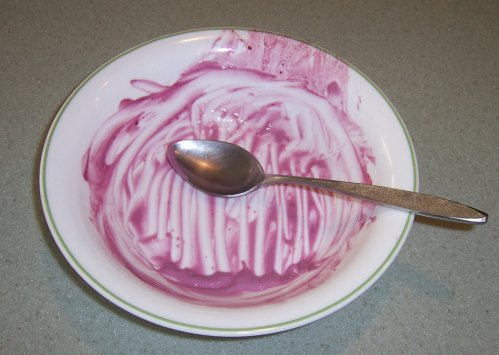
Done in a trice. So I woke up this morning with no more work to do than I generally have, and that’s a feeling I haven’t felt in some time. Over breakfast I let my mind wander, and when I got down to the bottom of my bowl of yogurt, I had an idea, an idea born out of irritation: There is no way to get the last of the yogurt out of the bowl. I mean, you can scrape with the spoon until you’re purple in the face (which can happen, with blueberries in the mix) but that’s just fingerpainting with the spoon and you’re always going to leave a little. This yogurt is peculiarly good, too: Greek Gods full-fat pomegranite, just half a notch thinner than cream cheese and capable of keeping me cranking most of the morning. (A scrambled egg, its partner-in-breakfast, takes care of the rest.) I am loath to leave any, even for the dogs…and besides, having a pure-white dog lick purple yogurt out of a bowl has consequences.

Then it struck me: All-metal spoons are just so third-century. Why are we still eating Greek yogurt with the same implements the ancient Greeks used? Is this not 2009? And so I sketched out what I wanted: Spoons with metal handles but bowls molded from heatproof silicone rubber, formulated to be a little stiffer than a kitchen spatula, but sufficiently flexible under a little force to conform to the curve of the bowl and get enough of the yogurt out so that leaving what remains wouldn’t bother me.

I looked online for such a thing this morning and came up empty. The basic concept is feasible: We have a silicone-rubber serving spoon in the drawer, but it’s far too big to fit in my mouth. Could it be that nobody else has ever thought of this? Or could it be that we just don’t like our food enough to want to finish all of it?