Jeff Duntemann's Contrapositive Diary Rotating Header Image

Daybook

Descriptions of what I did recently; what most people think of when they imagine a “diary entry.”

Meeting Juliana Leigh Roper

Bill & Gretchen returned home from Madison yesterday with their new baby, Juliana Leigh. They were a little ragged from the stress of the adventure and spending almost a week in a hotel room, but the payoff was difficult to calculate: the little girl sleeping on Gretchen's shoulder. Mission accomplished: Julie is home.

Gretchen dropped her in my lap and I held her for a little while, Gretchen having made sure that her diaper was correctly applied and (as best she could tell) tight. Julie looked around for awhile and squirmed a little, but mostly she wanted to fall asleep. Like her sister Katie before her, she is a very placid and un-fussy baby. I heard her cry some when Gretchen changed her diaper a little later, but apart from that she took it easy on Gretchen's shoulder. She lay quietly in her magic stroller (magic in the way it folds down to nothing and slides behind the seats in their van) while we had supper at Sweet Baby Ray's, even with all the fuss that the waitresses were making over her. Being six days old, she still has the ruddiness of complexion that one expects of newborns, and the pale blue eyes that most infants have before their pigment develops. Bill has blue eyes. Gretchen's, like mine, are very brown. Julie's could still go either way.

Nothing more to offer this morning than that. I'm working on Degunking Essentials as I have for the last few days, and will rejoin Carol later today. Tomorrow we launch south to Champaign to witness our younger nephew Matt graduate from the U of I, and with no crisp idea of my free time or connectivity, it's hard to know when I'll post again, but don't despair if you don't see anything before Monday.

In the Port 2525…

Finally got out to Chicago and spent a mad few days visiting family and running errands, after presenting two sessions at the annual conference of the American Society for Indexing in Denver last Friday. I gave the keynote talk and it was well-received—my position that pages are essential and reflowability is a fetish that carries a lot of subtle dangers—but the other talk, which was basically a how-to on getting Windows to work tolerably well, was SRO. People are still struggling with Windows, and when I asked, their reaction to Vista was basically unprintable. I got the impression from their questions after the session that something like Degunking Windows needs to be done again, but covering both hardware and software in the same volume. We did a separate book a couple of years ago called Degunking Your PC, and if I do something again, it will draw on both books. I'm taking notes. We'll see if and where it wanders.

Computer crankiness always seems to erupt as soon as I kick my shoes off and get to work at my Chicago-area satellite office. When I tried to answer some email here, I found to my supreme annoyance that ATT/Yahoo had changed the game again: Simply blocking port 25 and requiring that all outbound mail pass through their SMTP servers was not enough. Now they require that every From: address has to be explicitly registered on their Web site or the SMTP connection to their servers will be blocked.

Screw that. I did a little research based on a fleeting memory that some hosting services listen on ports other than 25 for outbound email, and voila! My hoster listens on port 2525, and after 90 seconds' worth of tweaking Thunderbird's settings, I was able to answer mail again.

Ructions didn't end there. About ten minutes after booting up, my video signal started going crazy. I took the SX270 apart, determined that the insides were squeaky clean and not especially hot, and was scratching my head after seeing the problem persist after a couple of reboots. In frustration I gave the Samsung 204B a hard whack on one side, and the video signal fell immediately back into line. Because the cables were quite tight, I can only assume that the damned thing has a loose connection somewhere internally.

Anger sometimes works, heh.

My Last Brin. Really.

Not ten minutes ago, my brother-in-law called to let us know that they had gotten The Call, and he and my sister Gretchen () were on their way to Madison, as their second and last child had just been born there.

Those who haven't been following Contra for very long may not know precisely what's going on here, and I still boggle a little myself, SF guy though I claim to be. Recapping: For medical reasons, my sister cannot carry children to term herself. After conceiving in vitro years ago and storing the embryos under liquid nitrogen, Gretchen and Bill went off to find a gestational carrier to bring their children to term. It wasn't exactly easy, but mission accomplished: Katie Beth Roper now has a sister, born at 8:10 AM this morning, central daylight time. Nine pounds nine ounces, no problems reported.

Deo gratias.

My immediate family is complete. We'll be on a plane Saturday to head out there and celebrate.

We Caught Bigfoot!

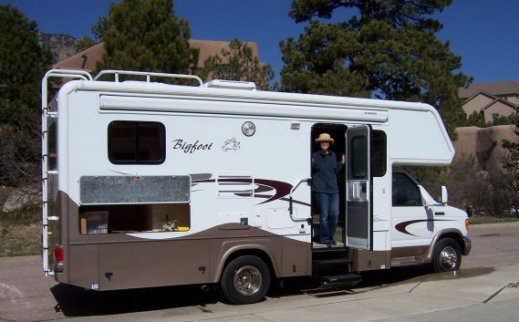
Yes, Carol and I caught a Bigfoot a couple of weeks ago. Big, yes: 25 feet long, and just under 12 feet high. Feet, no: Our bigfoot has wheels. What we caught was a never-used 2006 Bigfoot Model 30MH24DB RV, and the capture was a bit of an accident. The local Bigfoot dealer here in Colorado Springs went bankrupt, and we heard that their inventory was being liquidated. So although it wasn't precisely what we were looking for, the price asked was so stunningly good that we decided to give it a shot.

Carol and I have rented RVs before, and I've described our adventures in this space. We haven't been able to travel as much as we would like, especially here in the West. Our experience staying in hotels in out-of-the-way locations has been very mixed (you can't always find a Hyatt when you want one) and this is one solution.

We bought it about a month ago, but that was serendipity, and we didn't have a chance to actually take it out on the road until this weekend, when we went out with our church's RV group. The destination was Mountaindale Campground, which is only 16 miles from our front door, south down Highway 115 toward Cañon City. We think traveling with more experienced RVers is a good idea until we get our RV chops, and that has worked out very well, especially considering that two of the people in our group are RV repair technicians, one of whom actually worked for some time at the Bigfoot dealership that went under.

The Bigfoot is a little taller than a lot of Class C RVs (Class Cs are the ones with van-ish cabs and a bulge over the cab) and what that buys is storage space. Beneath the floor are several compartments that can hold a lot of stuff, one of them big enough to lug a considerable telescope. Being from Canada, the unit is much more heavily insulated than RVs built here, not that I intend to do a lot of cold-weather camping. Insulation works both ways, and we have hopes that it will take less A/C to keep it cool in summer.

The weather for our first outing was stunningly good. Most of what I did was learn how to operate and maintain the unit, which has a manual so thin and poorly done that it may well be worse than blissful ignorance. (I had to slap myself to keep from outlining Bigfoot RVs for Beginners in my head as I was struggling to make sense of the electrical system.) Carol and I did take QBit and Aero for a hike up to the top of a nearby hill, but most of the time we spent taking it easy in the company of friends, and listening attentively to RV war stories. I may well write my own damned manual just to keep all the heuristics straight, and if it gets good enough to go up on Lulu, so much the better. In the meantime, we have a vehicle in which to see some of Colorado, and attend local dog shows where Carol will be showing Aero. (There is a lot of RV culture in the dog show world—and in fact at the recent Tarry All show north of Denver we ran into a couple who travel in a Bigfoot unit identical to ours while showing Gordon Setters.)

I'm not sure I could live in it for weeks and weeks, but it will get us around to the mountains I've never seen and don't want to miss in this life. As for computing in an RV, more on that as time allows. I learned a lot this weekend, and am learning even more reading the RV forums online. One addditional thing I learned is this: Don't use Vista. Really don't use Vista. Every time I have to rescue somebody from its clutches—as I did this weekend—I hate it more. Ubuntu 8.04 comes out in three days, and there's a partition waiting for it, on an SX270 machine that I may “build in” to the Bigfoot. Again, more on that has it happens.

Slide Charts Are Still With Us

Reader Kevin Anetsberger is a fan of nomography (basically, the use of printed charts as calculating aids) and he wrote to say that the sorts of “slide charts” I mentioned in my April 5, 2008 entry are far from extinct—and interestingly enough, the world center of manufacturing for slide charts is back in my home town, Chicago. Kevin mentions three companies, and their Web sites are worth a quick look: Perrygraf, Datalizer, IWA, and American Slide Chart.

And although this was posted in the comments on my LiveJournal mirror, it's worth reposting for everyone else: A monograph on nomographs, courtesy Bill Leininger.

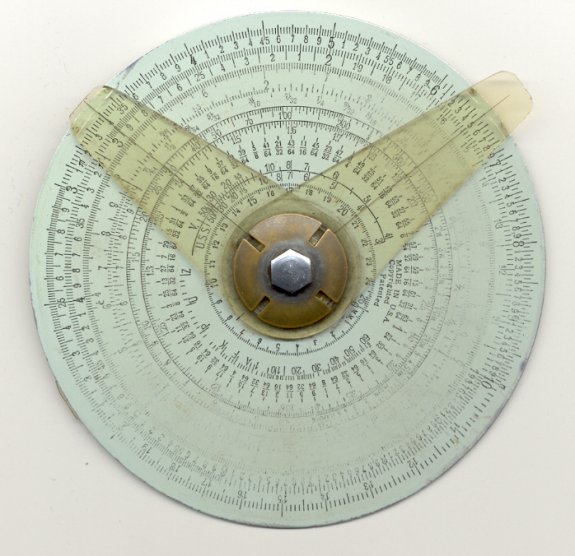
I spent a little time looking for instructions on my father's circular slide rule, and by now I'm pretty sure that the device is a Dietzgen/Gilson Midget Circular Slide Rule. I found what may be a manual for it, but it consists of bad TIF scans of the pages, and it is not easy to read—and the rule itself is so worn that making out the scales in some cases is impossible. It was evidently made by Gilson but private labeled and sold by Dietzgen to fill out their product line. The operation is something I would not have guessed: You position the two sliders separately to appropriate scales, and then slide the two as a unit to a third point to read out the answer. The friction clutch is made such that sliding the short pointer moves only the short pointer, but sliding the long pointer moves them both. (I had not noticed this while fooling around with it.) So you set the long pointer first, then the short pointer (which does not disturb the position of the long pointer) and then move the short pointer by moving the long pointer, at which time the long pointer reads out the answer. Whew.

Interestingly, about 120° of the front face is much more worn than the rest of it, suggesting that my father did a lot of calculating within a relatively narrow range of values. What he used it for is only one of a multitude of things I would ask him, if only I had the chance. What he probably would have said (over a grin) is, “I made things not blow up,” which when your stock in trade is bulk methane would be a very good thing.

If circular slide rules interest you, this page presents a number of different models, none of which precisely match the specimen that I have. And if you want to make your own circular slide rule, here's a page with a full how-to. And here's another site that explains how to make both circular and linear slide rules.

Application-Specific Slide Rules

I went in for my upper set work yesterday, and spent eight and a half hours in the chair, from 7 AM to 3:30 PM. It took two solid hours for the surgeon to cut my upper horseshoe out of my mouth, consuming (I asked) twelve burrs in the process, three diamond and eight carbide. The cottage cheese I had for supper last night tasted distinctly of machine shop.

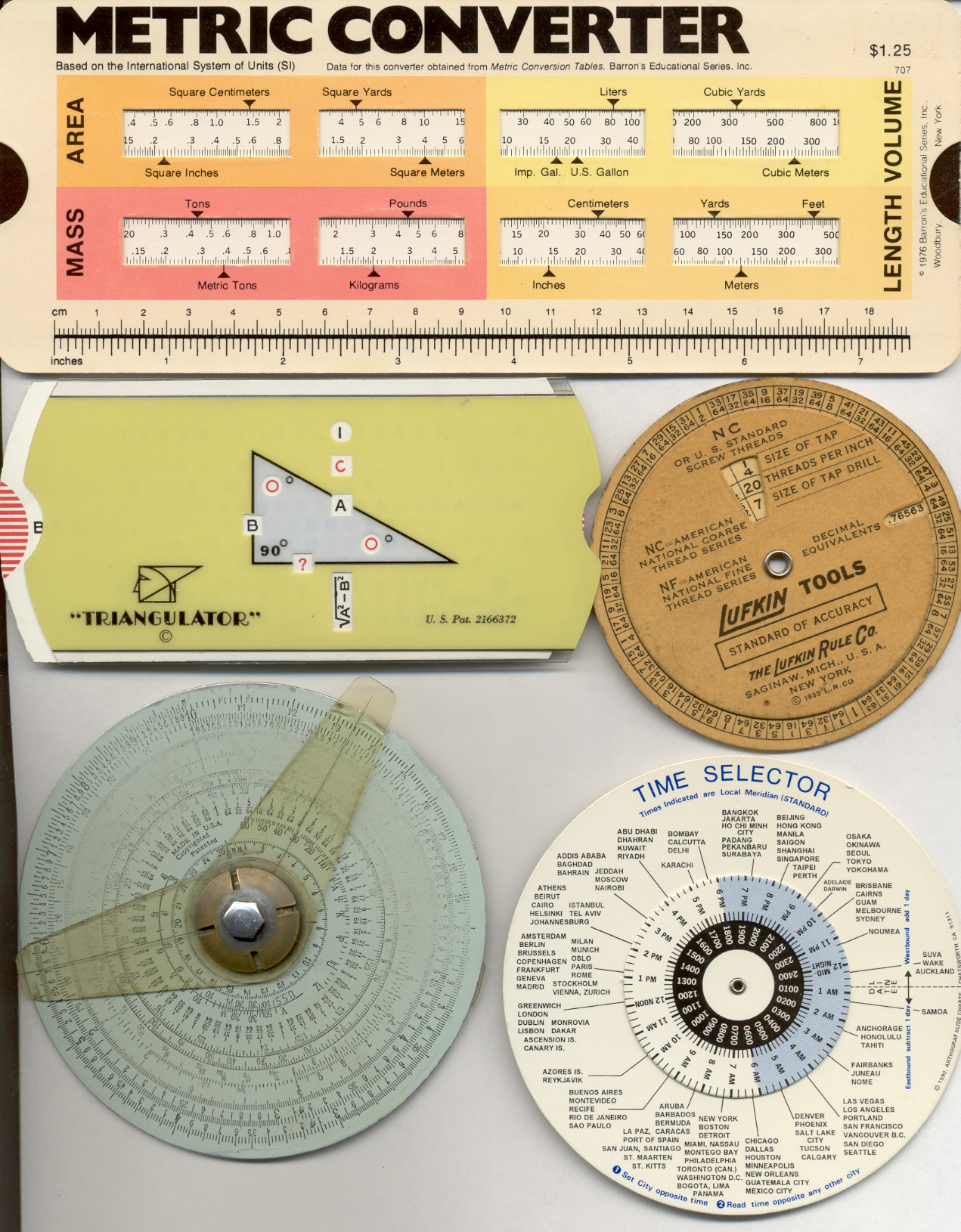
But let all that pass; the less you know the better you'll sleep. What I want to talk about this morning is the fact that slide rules are not dead. By no means; I use them regularly, if not every single day. The catch is that they're not general-purpose mathematical slide rules. They're application-specific slide rules that do one thing only—or perhaps two or three related things.

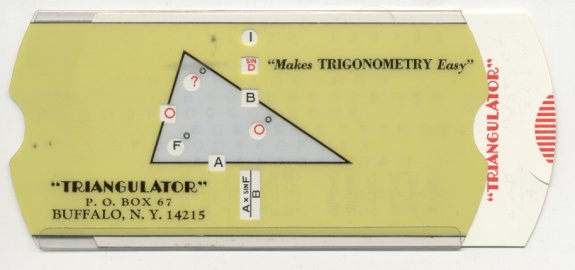
A good example is something I got from Carol's late father: The Triangulator, shown above. It doesn't do trig calculations, but it sets them up for you, depending on which values for a given triangle are known, and which are unknown. Slip the slide back and forth until the holes show you the unknown (a question mark) and the knowns (printed in black) and it will display the formula you need to run to get the unknown.

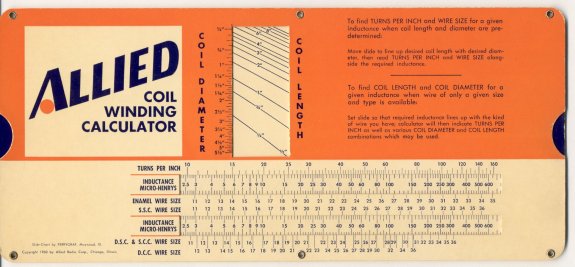
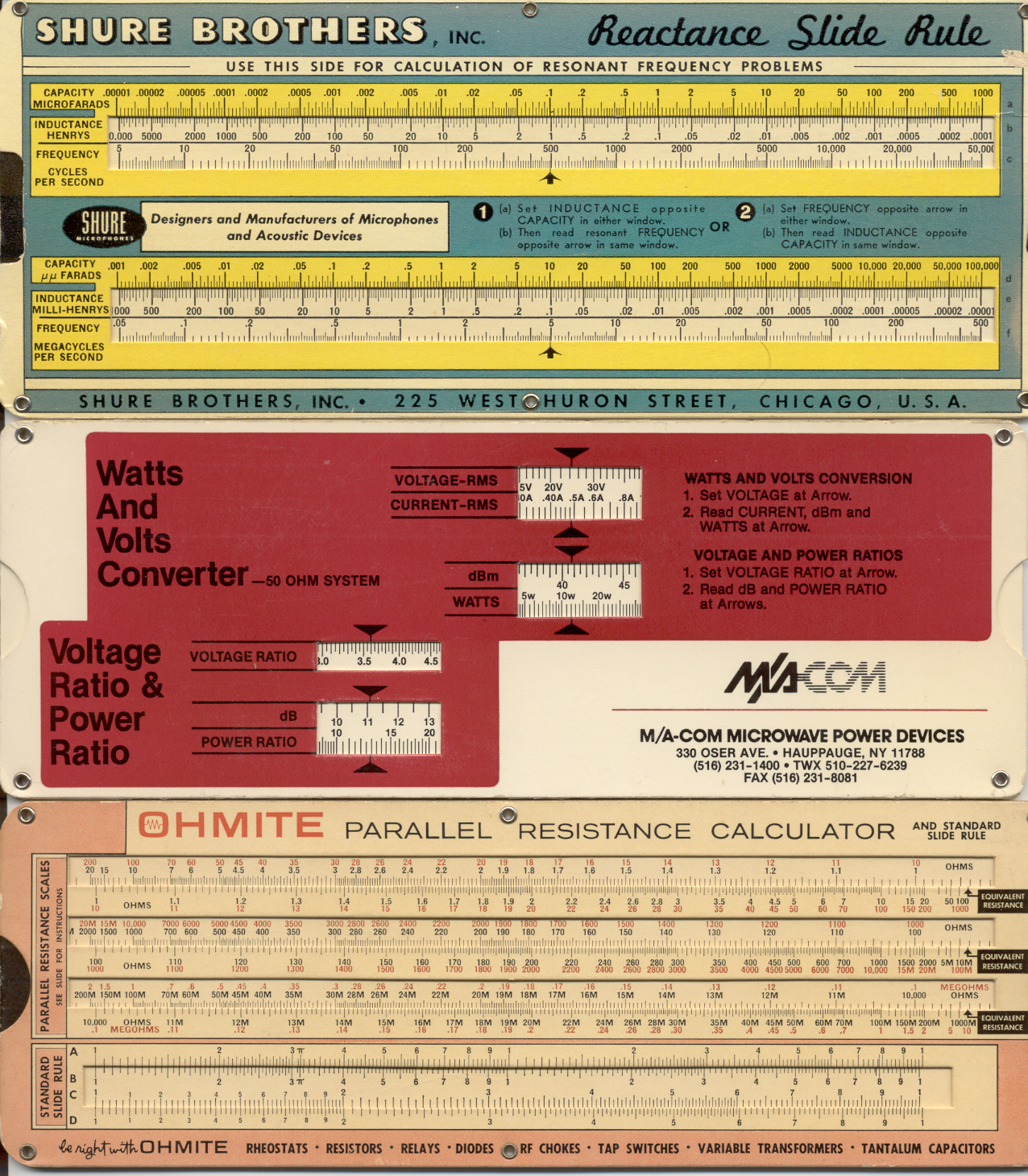
I've used the Triangulator a time or two, but the one that I've used the most is shown below: Allied Radio's coil winding calculator. The copyright notice says 1960, and I bought it at a hamfest for a dollar years'n'years ago. You can use it to quickly figure a coil for a radio project, assuming you know the inductance required, and if you don't, the flipside of the calculator calculates resonance and both inductive and capacitive reactance. (Slide rules, like records of old, generally had two sides.)

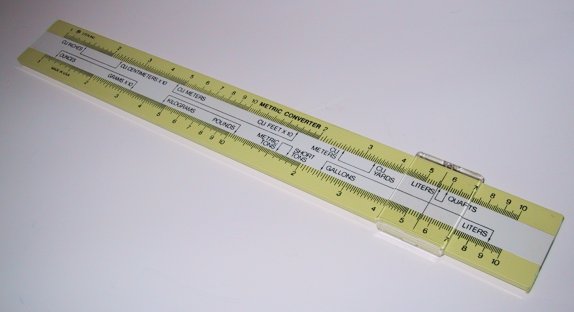
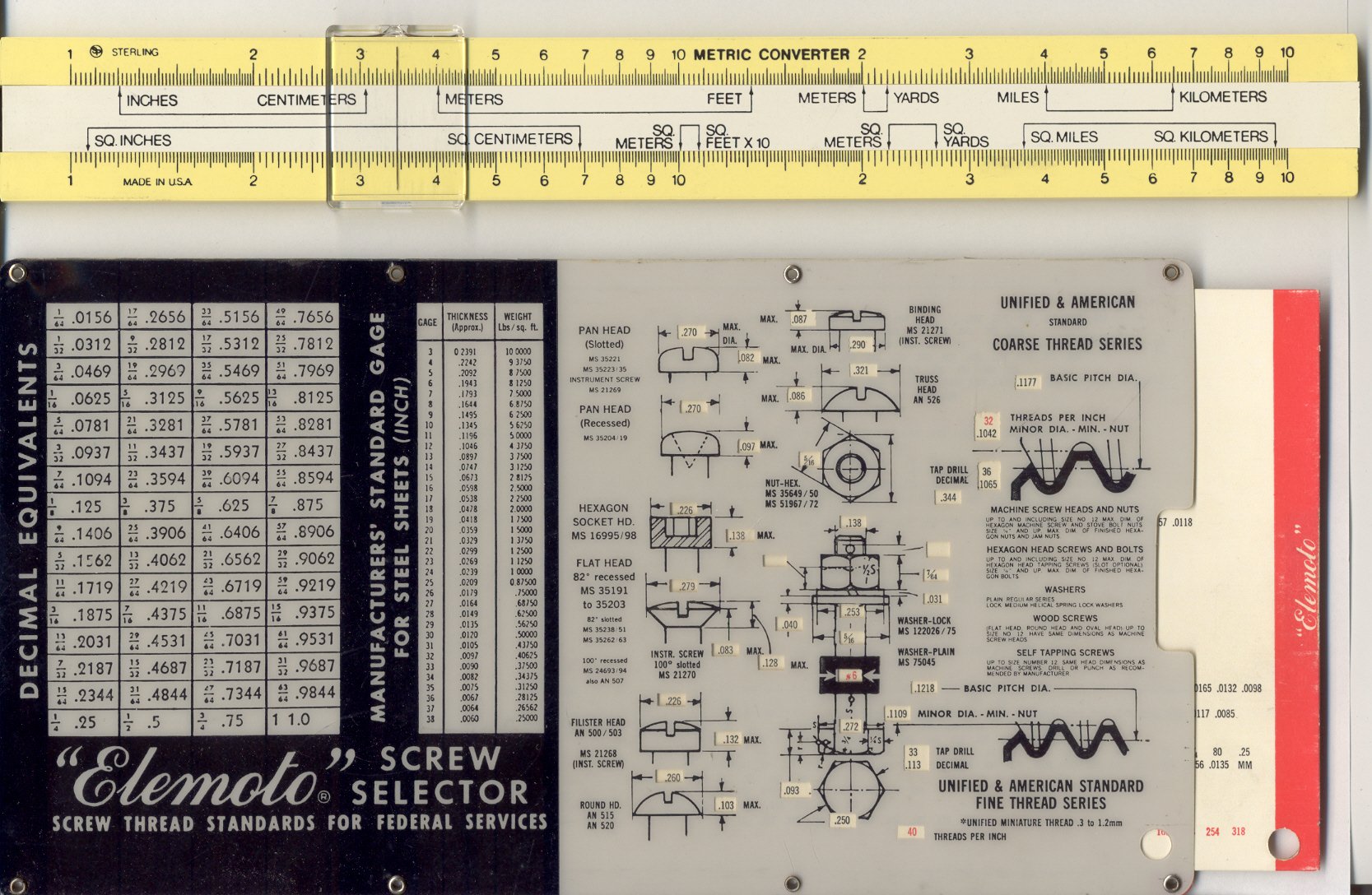
I have a similar reactance calculator from Shure Brothers, but it doesn't have the coil winding feature. Elsewhere in the collection are a couple of English/Metric conversion items, including one I've discussed here before. My favorite actually looks like a slide rule, and isn't made of cardboard:

I scanned all of what came easily to hand this morning, and if you're interested you can bring down the biggish image files. Image 1. Image 2. Image 3. The most mysterious one in my collection belonged to my father. It's circular, and he clearly used it a lot, because the scales on one side are largely worn away.

I've figured out how to do a few things with it, including fraction/decimal conversions and reciprocals, but whether it's got the ability to do general multiplication/division or even square roots is obscure. (The other side is a straightforward circular trig table.) I discern no equivalent of an A nor a D scale, nor how the two hairlines interact. I think it's this item, but lacking a manual I have no way to be sure, and there's no manufacturer's name on it.

So let it not be said that slide rules are extinct. I'm guessing that somewhere is a manufacturer still producing cardboard species as promo items, as I got a world time calculator at a trade show booth as recently as 1996. I like them, as each one doesn't need its own damned wall wart, and they can show relationships as well as values. Toss 'em in a drawer, and when you need one, well, it still works. “Analog” is a real word!

The Other Kind of Fifties Moment

The massive urban renewal project that is the inside of my mouth got into high gear again this morning, with what I call a three-p procedure: It took six hours, with three pee breaks, and (I am not exaggerating !) fifteen separate injections of local anaesthetic. Uggh. The surgeon removed my lower horseshoe, which has been in my mouth since September 2001, and cleaned up what damage had occurred during seven years in place. Two fillings had to be drilled out and replaced, and all the teeth had to be re-margined. One tooth, while not infected, had broken into three pieces underneath the horeshoe (probably due to my perpetual clenching and grinding during the night) and no longer has enough structure above the gum line to be retained. It will have to be pulled, and later this year (once the bone heals) an implant post will be put in place to carry the eventual crown.
So here I am at home, groggy on painkillers, watching out my window as a blizzard rages on the slopes of my mountain. What month is this again? We already have four inches out there and it's still coming down hard. A friend at church told us that this has been the wettest, coldest, longest winter he's seen the whole sixteen years he's lived here.

And tomorrow morning at 7, I go back for six more hours to accomplish a similar treatment on the uppers. Alas, the upper horeshoe is in pretty tight (a good thing, actually, for my teeth's sake these past seven years) and the surgeon will have to cut it out in chunks using diamond burrs. (I'll be tasting stainless steel for weeks.)

But to the story at hand: I asked the young dental surgical assistant if I could have the lower horseshoe back so I could put it on my curio shelf. She said sure, and asked what else I had on the shelf. I ran down the short-form list:

  • A horse vertebra.
  • A cow skull that wears my Lane Tech high school mortarboard.
  • A radio-controlled rat.
  • A Pope Benedict XVI bobble-head.
  • A stuffed squirrel that giggles when you press his tummy.
  • A meteorite fragment given me by Pete Albrecht.
  • A Giant Squid action figure.
  • A Tim-Bird ornithopter
  • My father's slide rule.

She smiled, nodded, and then asked, “What's a slide rule?”

I explained as best I could. I realized that this was the other kind of Fifties Moment; that is, when you realize that you're in your fifties and almost everybody else isn't. I ache for the day—though I will probably not live to see it—when graying Gen-Y fiftysomethings talk about their vintage gear collection, and some young punk asks, in all sincerity: “What's an iPod?”

Shoe-Fitting Fluoroscopes

Just got back from Chicago and there's way too much to do (and I have a six-hour dental appointment scheduled for Thursday!) but I did want to report on something I saw on our trip that I haven't seen for a very long time: A shoe-fitter X-ray machine. People my age or older may remember going to a shoe store in the 1950s or earlier, and having your parents and the shoe store man look at your feet inside a new pair of shoes to make sure they fit correctly. I know I did this, and I vaguely remember the humming machine, but I suspect I was just too short to get to look into the machine myself. (I doubt I would forget a real-time X-ray image of my own bones. Urrrrp…)
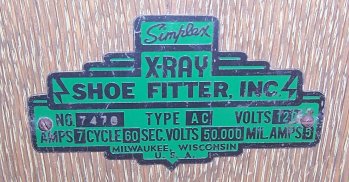
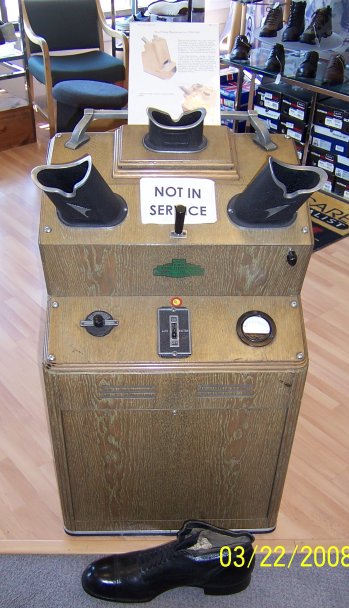
Carol and I stopped at Square Deal Shoes in downtown Des Plaines last Saturday. We both bought shoes to leave at our condo so we don't have to pack them on future trips. While browsing the stock I also looked at their Simplex X-Ray Shoe Fitter. The machine was disabled (they've been illegal since 1970) but it was otherwise in very good shape, housed in a marvelous Raymond Loewy-ish Art Deco wood cabinet.

An excellent short history of this peculiar phenomenon is here. The machine shown in the article is, I believe, a more deluxe version of the one I saw at Square Deal Shoes; both were made by X-Ray Shoe Fitter, Inc., of Milwaukee. The name plate (below) indicates that the power supply drew 7 amps and put out 50,000 volts at 5 milliamps. That kind of power will generate considerable radiation out of an X-ray tube, and the associated hazards eventually put an end to continuous-beam fluoroscopy by untrained operators, in shoe stores and elsewhere. The hazards appeared not so much to the occasional shoe store customer as to the sales reps who ran the machines and sometimes to professional shoe models who tested shoes for manufacturers using machines like this; one woman's foot was damaged so badly in testing shoes that it had to be amputated.


Square Deal Shoes has been in business since the 1920s, and in earlier times they also made custom shoes. One the current owner showed me was the shoe of Robert Wadlow, who at 8 feet 11 inches was the world's tallest man in the 1930s, and possibly the tallest man in recorded history. The shoe was technically size 37, and although I placed the shoe in front of the X-Ray machine in the photo above, it just makes the machine look small; the damned thing was as long as my forearm.

As I mentioned in my entry for March 25, 2008, the world is full of odd things like this. Get out, look around, pay attention, and you'll see them.

The Big Dog Walking Qudripedal Robot

Don't have much time today, but I did want to call your attention to an item aggregated on Slashdot: The Boston Dynamics “Big Dog” robot prototype, developed as a cargo mule for DARPA. Here's a must-see video of Big Dog in action, climbing up a wooded hillside, tramping through snow, and walking on ice. At one point a technician kicks the device hard on one side, and it recovers its balance beautifully without falling over, all the while carrying a load that weighs 30% more than itself. It uses a gait that looks more like a show dog's than a draft horse's, and while they do not demonstrate it in full gallop, they're clearly trying to teach it to run.

Scary item, considering that this would have been impossible just a few years ago. I flashed on Cordwainer Smith's Manshonyoggers (from the German Menschenjaeger, man-hunter) which are human-scale Berserkers that run around a ruined world and kill any human being they see. Though hardly stealth creatures now, that's mostly engine noise and is a minor engineering problem. It'll be interesting to see what we do with them in a few years—or what the Bad Guys do with them in another fifteen or twenty.

How (Not) to Wire Up Hotel Broadband

Was cleaning out my digital camera and came upon a shot I had forgotten. Some time back we were in a hotel room with $9.95/day wired broadband (via DSL) and I happened to look under the desk in the room. Boy, there was a mess down there like I haven't seen in a while. I never quite figured out what all that wirework was for, precisely, but it included two hasty splices partially wrapped in plastic electrician's tape, plus a hotel pen that had fallen off the rear edge of the desk and become lodged in the wad. (Dead center.) Wires had been pulled out from behind the telephone jack plate and spliced into a 4-pin phone jack that was literally dangling over a hanked-up data cable. Remarkably, broadband worked just fine—and that's the reason I didn't try to rescue the pen.