Jeff Duntemann's Contrapositive Diary Rotating Header Image

Daybook

Descriptions of what I did recently; what most people think of when they imagine a “diary entry.”

Carol’s Wild Ride

The night before last, Carol woke up at 3 ayem from some of the worst abdominal pain she’s ever experienced. After a few groggy minutes of watching her thrashing around in agony, I did about all I could: called 911 and had an ambulance get her up to Memorial Central.

I had a kidney stone in 1997 and it reminded me a little of that: No position she took would ameliorate the pain even a little. The nexus of the pain seemed wrong for a kidney stone, but science knows far less about complex systems like human biology than it claims to, and such systems don’t always perform the ways that we demand they do. I have no experience with appendicitis and worried about that as well, so off she went.

Colorado Springs Memorial Health System is a superb hospital, and though I certainly don’t want to ride over there in an ambulance (or anything else) if I can avoid it, I’m glad it’s there if I ever need it, and certainly glad it was there when Carol needed it. They got her into a comfortable room, got an IV going, and gave her pain killers almost instantly. The people we dealt with were amiable and very competent, and by mid-morning they had decided to admit her, to continue testing and give her some time to recuperate under controlled conditions. I went back home breakfastish to feed QBit and pack the other three members of the Pack off to “grandma” Jimi Henton (their breeder) for a short vacation. By the time I got back we had a diagnosis of inflamed pancreas and a treatment plan. Carol was a little groggy from the painkillers and was dozing a lot, but she was no longer in pain and according to the medical staff was in no danger.

Memorial has a bogglingly good cafeteria downstairs, where I lunched on tender London broil with almond rice pilaf, chased by an excellent oatmeal-raisin cookie–all for about $6, which is generally what I part with on any odd trip to McDonald’s.

After lunch Carol had a visit from the rector of our Episcopal parish, Fr. David Koskela, who dropped everything when he learned that Carol was in the hospital and roared over there to give her a blessing and a kiss and encouragements. (If we were still Romans there would have been no such visit; even “last rites” are tough to come by these days, with so few priests left to confect them.)

I stayed with Carol most of the day, coming home again suppertime to feed QBit, then returning until 8 or so, when I started getting crosseyed for lack of sleep. Memorial is unusual in that they allow visitors at any time, 24/7, and don’t obsess about cell phones. We talked to family back in Chicago last night on Carol’s cell, and none of the high-tech machinery in the room died in showers of Trekkish sparks.

I brought Carol her toothbrush, some clean clothes to come home in, and a stuffed bichon to keep her company during the first night she’s spent in a hospital since 1966. QBit keeps searching the house for her, and I’m sure we’ll all rejoice when she gets home. More as it happens.

UPDATE: Carol was discharged from the hospital at about 2 PM today and I now have her tucked in bed with QBit at her feet. She’s on liquids and bed rest and “the boys” are going to stay at “grandma’s” for a couple more days. (Carol really doesn’t want even a single bichon on her lap right now, considering how close her lap is to her pancreas–much less the continuous rolling bar-brawl we call the Pack.)

Steampunk Geiger Counter, Part 2

CapStack500Wide.jpg

It still hurts like hell to lean back against anything (for latecomers, I’m working through a nasty case of shingles) so I spent a good part of today sitting on my venerable and much taped-up barstool downstairs in my shop, drowning my pain in milk-jugs full of antique electronic parts. As I mentioned yesterday, having tried and failed to do so in 1963, I’m attempting to build a Geiger counter. I’m going to try to do it without active elements; that is, without including an audio amplifier for pulses coming off the Geiger tube. That makes speaker output impossible, but I have 2500-ohm “can” headphones from WWII, which are about as sensitive as that sort of transducer ever gets.

VictoreenGeigerTube500Wide.jpg

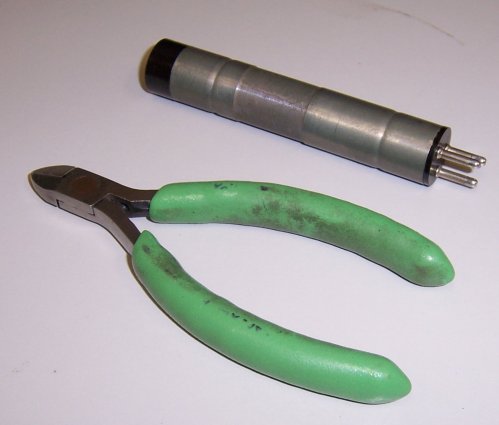
The first Geiger tube came with the morning’s mail. It’s a Victoreen OCD-D-103, a NOS spare for the famous yellow Victoreen civil defense portable counters from the 1950s. I actually found a mating 3-pin female connector in my junkbox, which is good, since I have no idea where I’d look otherwise. (The alternative is cannibalizing an octal tube socket for individual pin-grippers, generally by crushing a Bakelite socket in a vice until it crumbles.) Including the pins, the tube is just under 4″ long and 0.625″ in diameter. I’ll have to build a probe housing for it eventually, but near-term I’ll mount it in a pill bottle, of which there are legion.

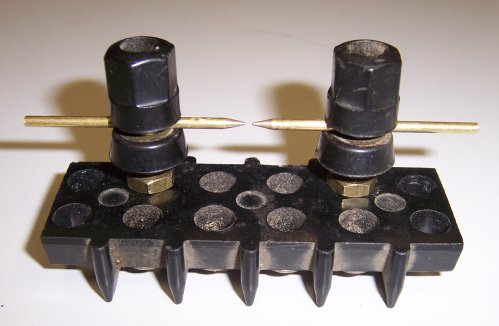
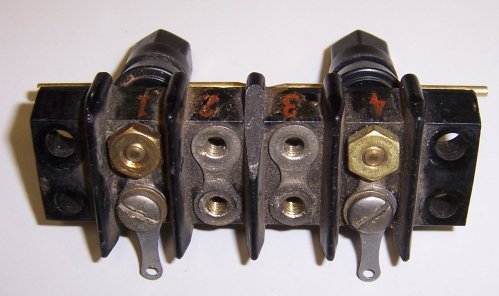
The top photo is a stack of three 1000-volt mica capacitors, adding up to .048 MFD. That’s about what one circuit calls out, but more is better, and I have a 1950s steatite banana plug bar into which two such stacks will go. So I’ll build a second and put them in parallel. That will get me to about 0.8 MFD, which ought to be enough. If it isn’t, I’ll see what else I can scrounge in the line of high-voltage caps.

I’m modifying an old ceramic wafer switch to be a current interrupter, but I need to get a little farther along before I know if that will work. Those familiar with such switches will understand: I bent down the limit tabs so that the switch shaft can be turned continuously, and at each click current will make-and-break between the wiper and the stationary contacts. Crank it like a Model T, and you generate a series of quick DC pulses to the transformer.

Or that’s the theory, anyway. We’ll see how well it works. More as it happens.

Not Your Average Roof Job

I’ve been scarce here this past week, and for a reason: I’ve felt lousy since Tuesday or so, with headaches, mild queasies, and a weird prickly surface pain on the skin of my back, just under my left shoulder blade. The headaches may be due to my trick neck, which throws all kinds of tantrums (including headaches) whenever I look up too high. The back pain was a puzzle; I thought it might have been a pulled muscle from a rough weight training session a week ago Thursday, but it’s not as deep a pain as with other muscles I’ve molested over the years.

Carol scratched her head as I downed another couple of Tylenol yesterday noonish, and said, “I sure hope it isn’t shingles.” I didn’t think so. No spots. So about 3:30, when I found myself scratching an itch on my back, I went into the bathroom and looked in the mirror.

Spots.

We called a dermatologist I saw some years back, but Friday being Friday, his office was already closed. With that not an option, Carol sent me packing to our HMO’s Urgent Care facility so fast my head spun. Sure ’nuff, the little bastards that gave me chicken pox in 1960 have been hanging out in my nerve fibers for half a century, and just happened to choose this week to come out and party.

So I’m on antivirals and Prednisone for awhile. Physician said I did very well by coming in an hour and a half after pegging the symptoms–which is all due to my brilliant wife’s intuition and expertise–since most people don’t look for help until the outbreak is much further along and the antivirals don’t work as well. That’s good, because if it gets a whole lot worse than this I’ll be a very unhappy guy.

More as it happens. Or doesn’t. Oremus.

Flying a Hi-Flier–If Not Very High

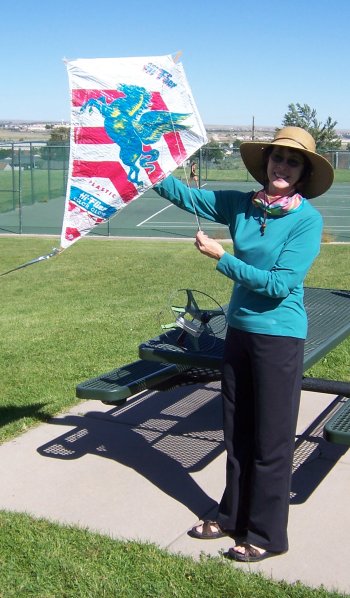
PegasusKiteFlying500Wide.jpgYesterday afternoon, Carol and I went down to the schoolyard near Safeway, and we did something I keep telling people not to do: We flew a vintage kite. It was an experiment to see if my advice was always good, or if there might be exceptions.
The advice came out of three separate experiences I’ve had in the last ten years, attempting to fly vintage kites. In each case, the kite didn’t survive even five minutes in the air. In one case, the paper sail more or less disintegrated, and in retrospect I should have seen that one coming. Mercifully, it wasn’t an especially valuable kite, and it was in lousy shape.

CarolAndPegasusKite350Wide.jpgIn the other two cases, it was the sticks that went. Both times, wind pressure against the kite caused the bow stick to snap at the vertical spar. In neither case was the breeze hurricanic, or even particularly fresh. The lesson? Thin sticks of cheap pine dry out over forty or fifty years and get very brittle.
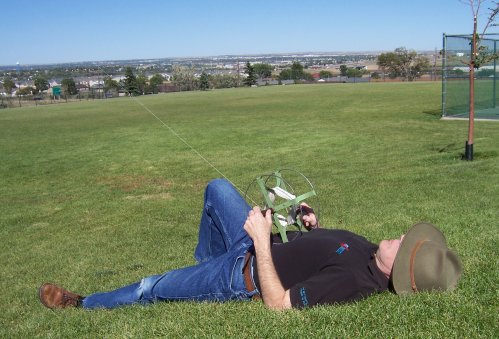
In this case, the kite in question was present in a lot of ten kites I bought at auction. It’s a 36″ Hi-Flier “Pegasus” plastic kite from the mid-1970s. Its sticks were already cracked, and I simply replaced them with new wood of similar size bought at Hobby Lobby and cut to the same length. The plastic sail had remained wrapped tightly around the sticks in an (evidently) very warm place since 1975, with the expected crinkles and bleedover of the paint on the plastic. So it wasn’t a great kite to begin with, and probably the worst in the lot of ten. If I lost it, I wouldn’t cry. (Too hard, at least.)

The wind was a little stiff for this kind of kite; probably 15 MPH. In a 6-8 MPH breeze they often fly well without a tail at all, but I gave it about seven feet of tassel-tail made out of kite-paper rectangles pinched in the middle and taped to a mylar ribbon. And well that I did: It went a little wild with about 100 feet of string out, which is all I wanted to give it. Any more, and it would have been out over Highway 115 or (worse) Fort Carson. There was plenty of leaning and looping and a couple of outright nose-down crashes into the grass, but nothing broke and nothing tore.

The mark of a truly successful flight is being able to lie on your back on the hillside, and after the wind shifted to the north a little and banked down to about 10 MPH, things got satisfyingly snoozy and I declared the outing a total success. Reeled the kite in and took it home, and I may in fact dare to fly it again at some point. So the advice against flying old kites is generally true if the old kites are really old, and all original equipment. Replace the sticks with new pine, and if the sail isn’t already crumbling to dust, well, you’ve got a chance. Tree problems, heh: That’s up to you.

JeffFlyingKiteOnBack500Wide.jpg

Dash and the Fruit Bowl Bomb Habit

DashWithBowl.jpg

All dogs have quirks, and Dash brought a new one into the house with him: When he’s done eating, he picks up his bowl and carries it around. He shows it to us, and if we don’t take it and re-fill it, he drops it from mouth height. When he was three months old (see photo above) he was closer to the floor, and the bowls sometimes survived. Now that his mouth is at adult bichon height, the bowls usually buy it.

In the photo above, Carol had just fed him, and he had bumbled into my office, standing in front of me with his bowl in his mouth, as if to say, “Please, sir, can I have some more?”

We feed the Pack out of a motley collection of small midlate 1950s fruit bowls, manufactured in an era when people ate less, particularly of the sort of fruit you got out of small cans in the 1950s. Such bowls are still made if not widely used, and we bought a couple of Corelle fruit bowls in our Shadow Iris pattern specifically for Pack meals. Supposedly they don’t break if dropped from modest heights. Dash hadn’t heard that, and when he dropped one, it exploded into dagger-like shards all over the kitchen. So the Corelle fruit bowls now await an era when we again embrace canned fruit cocktail (in heavy syrup.) They may wait awhile.

After we were married 34 years ago, Carol’s mom gave us a (mostly) complete set of Joni’s Dixie Dogwood tableware, and we used it for years as our everyday settings. A lot of it is gone now, having fallen from slippery hands at the sink or over the edge of the table, but because we rarely used the fruit bowls, we still had them until recently. That is, we still had them until Dash started dropping them.

He dropped another one yesterday, RIP (Rest In Pieces.)

The only bowls that are safe to give him are genuine Melmac, in our case Mallo-Ware, from Chicago’s now-extinct Mallory Plastics. Again, they came from Carol’s mom, and Carol used them when she was a kid. There are only two of the venerable #52 fruit bowls left, and both are usually in the dishwasher when another Pack meal time rolls around. I think there used to be more, but I don’t know where they went. Like all Melmac tableware they’re essentially indestructable, so they certainly didn’t break. I think I drilled and tapped one for a telescope attachment in the 80s. About the rest, clueless.

Even when the two Mallo-Ware bowls are clean, the problem is that we have four dogs, and after Dash scours out his own bowl, he will go hunting for other bowls to scour. The last one he finds gets carried around, and if it’s a Dixie Dogwood bowl, it’s soon off to rejoin Joni in Crockery Heaven.

So I slid over to eBay yesterday in search of more Melmac fruit bowls, to find that Mallo-Ware has become collectible. Used #52 fruit bowls now go for three bucks each…and up. I searched and grumbled until I found a pack of ten beat-to-hell pastel bowls for $25. That will certainly do the job, but…collectible Melmac? I hear Alf giggling somewhere.

I guess “collectible” is relative, and cyclical. As best I can tell, Melmac tableware was invented to prove to my Aunt Josephine that depression glass wasn’t so bad after all. Alas, Aunt Josephine didn’t get the message. She’d gathered an impressive set of iridescent orange depression glass while a teenager and used it well into the Fifties, but when Melmac came along, her depression glass was relegated to the kids table (and nobody got chewed out if it broke) with the adults dining on indestructable pastel plastic. To my aunt, depression glass was an emblem of poverty, whereas Melmac was totally Space-Age. Eventually the glass all went into the trash, which I suspect my cousins are now regretting.

There’s no real point to this essay other than a reminder that dogs are unpredictable. Mr. Byte used to chew up computer books, but only computer books. Chewy would dance on his toes for…peas. Jack will not eat raw meat, and will pick out the rice or the vegetables and leave the meat for Dash. QBit steals Carol’s ponytail Scruncis and hides them under the pillow in his kennel. I’m not sure these are mutant instincts, but they’re certainly not anything we taught them, and remain the best evidence I could cite that Behaviorism is really quite sincerely dead!

The Mutability of Immutable Decay

Boy, did this come out of left field: Something in the Sun alters the rates of radioactive decay of certain isotopes. Read that again, and slowly. You are in the presence of an exceedingly rare thing: experimental results that call into question something once thought to be about as settled as science gets.

To summarize for those in too much of a hurry this morning to click to the article: Scientists at Stanford and Purdue (hardly cranks or lightweights) have measured differences in the decay rates of certain short-lived radioisotopes. That’s boggling enough, given my own science education (granted, now 35+ years old) which indicated that decay rates were utterly immutable. But your boggler isn’t finished yet: The differences in decay rate appear to be synchronized to the period of rotation of the core of the Sun–33 days. So something the Sun is doing is influencing the timing of nuclear decay, way out here at just short of a hundred million miles’ distance.

Wow. Like, wow.

Because the core of the Sun is where solar neutrinos happen, the assumption is that neutrino flux is what does the job, as strange a notion as that is. Neutrinos are as close to nothing as things come without actually being nothing, and they can pass right through the core of the Earth without slowing down, much less hitting something two millimeters wide sitting on somebody’s lab bench. The effects are minute but measurable, and not an illusion. Somebody, somewhere (perhaps more than one somebody) is going to score a Nobel for this.

It’s too early to say much more, but I’ll put on my Scientific Wild-Assed Guesser’s Hat here and suggest that there’s another, more intriguing explanation: gravity waves generated by the rotation of the Sun’s considerable mass, particularly its core, where most of its mass lies. The rate of decay of radioisotopes might depend on the local curvature of space. If that curvature changes, as by a passing gravity wave, the rate may change. (Don’t ask for references here; I made it up on the spot and it’s nothing more than a wild speculation.)

The cool thing about this is that it might be testable, with patience and better instruments than we have right now. (Having a small black hole to play with would help a lot, but I won’t wait up for that.)

The Universe, my friends, is full of surprises!

Redeye-ing the Perseids

Just a quick reminder: The Perseid meteor shower should peak tonight just before dawn, so if you can manage to haul outside between three and four ayem you are almost guaranteed to see some interplanetary grit hit the fan.

Look east, but pay attention to your peripheral vision, because the meteors can appear in any part of the sky. If your skies are good you might well see one every minute or so, and sometimes they come in bursts. And there’s always that long-shot hope of catching a bolide.

I’m about shot for tonight, but I will draw your attention to a previous entry I did on the Perseids, which are something of a tradition for Carol and me. (It also contains my now-legendary 13-line sonnet on the meteor shower, which demonstrates that I am neither poet nor mathematician.)

Take the Off! with you, especially if you live in Chicago. Trust me on that one.

Fedora Anxiety

JeffAndHatDehalftoned1992.jpgThis morning’s Wall Street Journal persuaded me that I am, for once, way ahead of the curve. The A-head story documents the Millennials’ puzzlement over hat etiquette: When should I wear them indoors? They are baffled. They are struggling. Deep within their sensitive souls, they are suffering.

Perhaps I can help: Listen up, people! Outdoors is for hats! Indoors is for heads! Sabe?

Deafening silence. So it goes.

My father wore a felt fedora to work every day, even when he had to change it out for a hard hat when he arrived at a job site to help clueless technicians figure out why an industrial gas main was delivering only half the methane that it was supposed to. A felt fedora was part of the company uniform, and he was unapologetically a company man.

The uniform changed in the first half of the 1960s, and the canonical felt fedora almost became extinct. The newly hip in the Sixties thought that hats smelled too much like the Fifties. Ewwwww, can’t have that. (This is the same reason that Unix fanatics in the First Age declared that Capital Letters Are For Engraving In Stone: Capital letters smelled too much like COBOL. Ewwwww, can’t have that.) My father reluctantly complied, reluctantly because he had only a little more hair than I do. It turned out all right because he was working in Chicago, where we saw the sun maybe once every three weeks in the winter.

Fast-forward to 1990: Jeff and Carol move to Arizona to launch PC Techniques. Down there it’s the other way around: We saw clouds maybe once every three weeks in the winter. And in the summer. (Except for two months’ worth of late summer monsoon, when we saw a few every afternoon. A few.) Jeff (who has less hair than his father, and almost none since the late 1980s) gets scorched a time or two, up top where your skin is so thin that you can feel bottom.

Jeff, doing what makes sense, buys a hat. I had one by late summer 1990, but it wasn’t until the April/May 1992 issue of the magazine that I appeared along with my hat. (See my editorial photo above.)

Oh, the humanity. Half the readership seemed to think I’d be better off wearing a dead skunk. The other half said nothing. Even the ever-so-always-polite-and-considerate George Ewing (peace be upon him, and is) wrote in a letter-of-comment: “I dunno about the hat.”

I stuck with it. Pace Woody Allen, my brain is my first favorite organ, and this was Arizona we were talking about. (Your brain doesn’t need drugs down there. No questions.) Over subsequent years I bought a lot more hats, and now a quick count shows eleven, plus a twelfth that I leave in Chicago just in case the sun ever comes out when I’m in town. True, a couple are special-purpose, like my Ben Franklin Kite-Flying Hat, and a formal felt business cowboy hat that I had custom-made by Ronald Reagan’s hatmaker in 2000, during which I had my idiosyncratic skull measured by a mechanical hat sizer machine built in 1910.

Wearing a hat was a contrarian act in 1992, so it was a good fit for me. And now in 2010, a fifty-year ice age in the hat industry has come to an end. Having tasted the sweet nectar of hattedness, the Millennials can’t bear to take them off for a second, perhaps fearing that another Ice Age is just around the corner. One is. Wearing your hat in the bathroom won’t help.

A hat is a roof over your brain. You only need one roof. When you step under one, take off the other. It’s that simple.

Insight Is Gone From Ubuntu…

…and in fact from everything else based on Debian. Not six months after I saw Assembly Language Step By Step, Third Edition hit the shelves, the Debian team decided to pull the Insight debugger package from their seminal Linux distribution, on which Ubuntu, Kubuntu, Mint, and several others are based. Come Ubuntu 10.04 Lucid Lynx at the end of this past April, and suddenly people reading my book can’t work through the examples, because the software that I used in those examples (for single-stepping and examining registers and memory) is no longer available for their version of the OS.

This isn’t new news, and I’ve been trying to figure out how to finesse the problem ever since I heard about it mid-May. I got a number of queries this past week, suggesting that I had better get on it. (This is why you haven’t seen much from me in recent days.) Assuming at first that Insight had been dropped just to keep the distro CD-size, I tried to install it under Lucid from Software Center (not found), next a deb package, and finally from source, but nothing worked quite right. As the months have passed and more and more people are installing Lucid, I’m getting more and more mail about this. It’s a serious problem: A lot of the skill of assembly programming lies in debugging at the instruction level, and much of the tutorial depends on being able to run a debugger. Insight was that debugger. It’s GUI-based, rather than purely textual, and I think it’s a great deal easier to grasp, especially for newcomers.

So why didn’t I just use gdb?

Um…I did. Or at least I thought I did. Insight is an odd case. Most people assume (as I did) that it works the same way that Nemiver, KDbg, and DDD work, as independent front ends for gdb, passing textual commands to gdb and getting textual data back for display. Not so: Insight is gdb, and therein lies (in my opinion) most of the problem. What Insight’s originators did was take the gdb source code and add a built-in GUI, using Tcl/Tk. In effect, they forked gdb and produced a new custom version that contains all of gdb (at least gdb as of 2007) plus a windowing visual wrapper.

That in itself is unorthodox but not necessarily damaging, though forking something as fundamental as gdb should not be done lightly. Still, if you do it, you have to do it well, and I’m seeing indications that Insight isn’t nearly as clean a product as it should be. The Debian team spoke tersely; see the bug report and resolution here: “RoQA; insane packaging; unmaintained; low popcon.” (Yes, I read “popcorn” at first too.) More details may be found here. (Warning! DDG: Deep Debian Geekery.)

Quick translation:

  • RoQA means “Request of Quality Assurance”; basically, Debian’s QA team decided that the package was too broken to keep in the Debian distribution and requested that it be removed.
  • Two release candidate (RC) bugs were reported by the Debian team to Insight’s maintainer, but no one there responded. This is odd, because the maintainer is none other than Red Hat.
  • An NMU is a non-maintainer upload, which is when a package is sent to the distro team by someone other than the package maintainer of record. It is often a sign that the maintainer has abandoned the package, especially if the maintainer never acknowledges the third-party fix.
  • “Low popcon” is a reference to Debian’s unique “popularity contest” system for gaging how much individual distro packages are being used. Insight got 36 votes, which, in browsing the rest of the stats, seems low but not fatally low.

The real problem is that “insane packaging” issue. Insight contains embedded copies of software that is maintained by others and would be better linked in as libraries. The embedded bits “age” with respect to the current release of the OS and its libraries, eventually getting out of sync to the point that the package will not understand the current system well enough to function correctly. Tcl and Tk are either part of or easily installable to any Linux distro there is; you do not have to cut’n’paste them into your program source. With old software copied into its sources the package may build correctly, but might not necessarily run.

That said, the right way to approach the problem may be no more complex than taking the most recent release of Insight and making a proper Debian package out of it. The version I used last year in Karmic Koala goes back to 2007, and that’s the version pulled from Debian. The July 2009 release may be better. I’ve read enough on building Debian packages to know that I’m not the guy to do it, but I hope that somebody with better Debian chops will eventually try it, so that we can tell if Insight was just wounded, or if it’s really and quite sincerely dead.

In the meantime, the best fix appears to be falling back to Ubuntu 9.10. More here as I learn it.

Classmates: Hacked, or Poor Proctoring?

Quick update: Either Classmates.com was hacked, or nobody over there is paying the least attention to user activity. Textual obscenities and dirty pitchers abound; those with strong stomachs may see it for the time being here.

I’m divided as to whether I should alert them to it. There are 17,000 Lane alumni in the system online, and I can’t imagine that at least one of them hasn’t complained about it yet. (Lane is a big school, and has been around for a very long time.)

I’m definitely watching it, and am still interested in reports from people (especially from other schools) who have gotten forged emails from Classmates lately, containing obscenities or not.