Jeff Duntemann's Contrapositive Diary Rotating Header Image

Daybook

Descriptions of what I did recently; what most people think of when they imagine a “diary entry.”

Smoking Jackets

CloutierTimemachineCaricature1981-500Wide.png

Apropos of nothing in particular (other than that it came to hand unexpectedly a few weeks ago) I present a caricature of me by Chris Cloutier, a very talented artist/cartoonist who was a friend of mine in the 80s, during the peak of my involvement with the SF fan organization General Technics. The cartoon did me a service, because I thought I grew that slightly ridiculous foliage in 1983, but from the date it looks like I already had it in 1981.

I have never entirely understood smoking jackets, which are fragile, thin, very expensive silk robes used to keep your tobacco ashes from damaging or soiling whatever you had on underneath. As a lifetime nonsmoker I’ve never had that problem, admitting that I have burned holes in my polyester shirts by dropping molten solder gobs or occasionally red-hot lathe chips on them. I therefore wear a sort of retro-techie smoking jacket downstairs in my shop: It’s a dark gray plaid mackinaw, and its job is to keep my other clothes from smoking. Works good, too.

QRU? DE F0X

We had a little snow last night, which hit the ground, melted on the pavement, and then refroze to black ice before the morning. So I was out there right after breakfast, throwing some pet-friendly melt compound on the front sidewalk. The housecleaners are coming this morning, and that stretch of concrete can’t be a skating rink when they arrive.

So there I am, tossing capfuls of white granules around, when who trots nonchalantly up to me but our anomalously friendly neighborhood fox. Mr. Fox (and yes, it could be a female. Forgive me for not trying to do the test) stood in front of me like a dog at an obedience trial, looking up at me, full eye contact. He was on the opposite side of the front walk, no more than four feet away.

Four feet. This was as close as I’ve ever come to a wild animal that large, and probably twenty feet closer than I’ve ever been to a fox. He held eye contact for a few seconds, then looked at the cap I held in my left hand. (The melt compound comes in a white plastic jug exactly like the large size of laundry detergent.) He looked at the cap, then looked at me, then looked at the cap. And then, egad, he picked up his right front paw.

Hey! I know that drill! This is what Carol and I call the QRU gesture. QBit is especially good at it. If I’m eating a banana he will look at the banana, then look at me, then look at the banana, then look at me, and repeat until I give him some. In many cases, he will pick up one paw for emphasis.

QRU, as many readers here will know, is the ham radio Q-code for “Do you have anything for me?” (when followed by a question mark) or “I have nothing for you” when stated without a question mark. In ham radio, this refers to message traffic. However, in this house, it generally refers to banana, rice cakes, or something like that. I’m a soft touch and generally give QBit what he wants, but there are some things that invariably give him the runs, so instead of handing him a piece of lox I’ll just say, “QRU!”

Understanding happened when I looked at what I held in my hand: A detergent bottle cap made of white plastic, perhaps a little bigger than an extra-large…egg.

Well. As I’ve mentioned here before, somebody on the next block is giving raw eggs to the local fox, not just occasionally but on a daily basis. And I can just see Mr. Fox standing on the cultprit’s back patio, looking longingly through the sliding glass doors until Mrs. Clueless exclaims, “Harry! The fox is back! The poor thing must be hungry!” And then Mrs. Clueless goes to the fridge, pulls out an egg, opens the patio door, and lays it on the patio. Mr. Fox scoops it up and heads off to wherever fox spend their time around here.

This has been going on for a couple of years. We now have a partly Belyaevized fox running around, scamming the neighbors for a living and getting a little too cozy with the rest of us. Interestingly, when I put the cap back on the melt compound bottle it no longer looked like an egg, so the fox lost interest in me, continuing on past the house down into the gully.

I’d prefer it not happen, but better the local fox begging at our feet than the skunks or the bears. And I think I need to keep a camera in my pocket even when I’m only going twenty feet from the front door.

A Big Lake in Autumn

I’ve been a little out of it the past few days, in the wake of an inadvertent encounter with Chinese Five Spice Seasoning, with which I’ve tangled before. Which of the five is the culprit remains a mystery, save that it’s unlikely to be either cinnamon (Chinese or otherwise) or cloves. No matter. I’m a caveman, not a gourmet, and spices regularly cause me various kinds of grief. (This time it was a bad migraine.) All better now. Hey, is that a giant beaver over there? Where’s my club? I’m hungry.

Anyway. We took a quick trip to Lake McConaughy last weekend, to find a lake just a few feet from full. All that beautiful lake bottom is now underwater, as it should be, but for almost ten years the lake was as much as fifty feet down due to drought in the watershed. I didn’t get photos of the crib when the water was at its lowest, but the two photos below (taken last weekend and about thirteen months earlier) will give you a sense for the magnitude of the change. In one year, the water rose over thirty feet, and once the winter rains begin methinks the spillways will see their first use in quite awhile.

LakeMcC-09-2009.jpg

LakeMcC-10-2010.jpg

We’ve had a slightly cool autumn, but Saturday took a foray back up into the mid-80s. Carol broke out her bikini and we got a little more than knee-deep in the 70-degree water before deciding that the season was indeed a little past its peak for swimming. So we ran the Pack along the beach, pausing now and then to fish burrs out of their paws and get photos of the fall foliage.

CarolInLakeMcC-10-2010.jpg

MicrowaveTower-10-2010.jpgWhile driving a Nebraska county track to the south shore, Carol noticed something odd in the dry cornfields to either side: The corn had been harvested from the top halves of the stalks but not the bottom halves. This seemed consistent (we stopped to look) and had a machine-like precision about it, suggesting that corn is harvested at various times depending on how dry the cobs need to be. We passed an evidently abandoned microwave tower, which provided a natural cover photo for a short novel concept I’ve been saving for a NaNoWriMo November when I don’t have to travel. It certainly won’t be this year.
We’re shopping for a new vehicle to replace Carol’s increasingly cranky 1995 Plymouth Voyager. The Ford Flex fascinates me, as it seems designed to maximize interior space, which is always handy when you’re transporting dogs in bulk. It’s AWD (which we need given where we live) and it can park itself. Precisely how (and how well) it pulls that trick I’m not sure, but given that flying cars will not be an option in my lifetime, I think I’ll take that and be glad of it.

Steampunk Geiger Counter, Conclusion

PillBottleProbe500Wide.jpg

The Geiger counter is still a lashed-up mess of clip leads and greasy junk on my workbench, but as I mentioned in my last daywander, it does work, and detects the radium paint on a couple of sixty-year-old military aviation panel meters. I may not be able to work on it much for the next few weeks, so in this entry I’m going to summarize what I’ve learned so far.

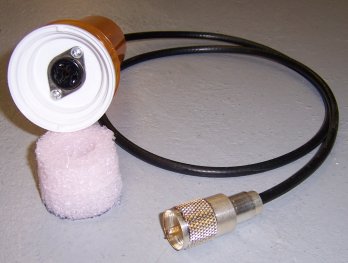
PillBottleProbeDetail350Wide.jpgBut first, a couple of notes on the probe I made. I noticed years ago that a species of pill bottle with a two-way cap allows two bottles to be connected at the cap. It occurred to me that one of these bottles was by sheer chance just about the size of an Amperex 75NB3 Geiger tube. So I mounted the JEDEC A3-1 socket in the cap, and cut a foam doughnut with an Exacto knife so that it would fit (with just a little compression) inside one of the bottles. A 5/8″ hole in the doughnut keeps the Geiger tube centered and immobile inside the bottle. I put a PL-259 on the cable because I have a lot of PL-259’s here, and they have a pleasing sort of retro look to them, especially after they tarnish. (This one was new from a sealed bag. It won’t look so shiny next year.)

My first conclusion, after a huge amount of time spent trying things, is that it’s not easy getting to 900V with nothing more than a pushbutton, a spark gap, and 3V worth of batteries. In fact, the best I could do was barely break 700V, which is right on the edge of what allows this particular tube to operate. (Smaller tubes like the CK-1026 may work at lower voltages.) Change out the spark gap for a 1N4007 silicon rectifier and you’re at 900V in twenty pushes of the button–more with a larger cap, less with a smaller cap. The transformer matters crucially. The one I’m using has a 1:14 turns ratio, which is very uncommon.

My second conclusion is that the sort of greasy black bakelite barrier terminal strips that I used for the spark gap and general connections are very leaky at high voltage. The caps are mounted on a steatite bar, which is very low-loss, and when I soldered everything else together in a sort of self-supporting wad in mid-air, the charge stayed on the caps almost twice as long. Obvious in hindsight, but I never thought about it when I was putting the thing together. The final device will be assembled with this in mind. If it doesn’t look especially retro, that’s ok.

My third conclusion is that some sort of amplification is necessary. With 900V on the tube I could clearly hear the clicks indicating activity, but they were not loud and this was in a workshop as quiet as most tombs, at least those lacking zombies and poltergeists. I set up a small homebrew two-tube speaker audio amp on the bench (lineup: 6AV6-6AQ5A) and piped the tube’s output into it. Suddenly the clicks filled the room, and I’m guessing that some of those may not have been heard with the tube running barefoot into headphones. A portable hip-hung retro counter would use battery tubes, of which I have many.

I’m still working on several elements of the design, particularly a better way to charge the caps than pushing a button twenty times. I’m almost ready to test a rotary interrupter that will be operated with a crank. I also have a small hand-cranked telephone magneto that generates 120VAC, and much can be done with that.

But as for whether a truly steampunk (i.e., no active devices) Geiger counter is possible, the answer is a qualified yes. A skilled and patient mad scientist from 1900 could do it. He might have to wind his own step-up transformer, but if I can get to 700V with greasy junk and a spark gap, 900V is not out of reach. I consider myself a citizen scientist but I’m not especially mad, and unlike most mad scientists I have a wife, dogs, and a driveway to shovel in colder weather. That being the case, I’m bringing this research project to a close. I will build a Geiger counter, but it’s going to be more 1950 than 1900. I’ll continue to discuss the project here under a different title. Deco Geiger Counter? Deiselpunk Geiger Counter? Still thinking about that, but you’ll know it when you see it.

The Fox vs. Skunk Conundrum

We got hit with a skunk cloud the other night, and as I cranked windows shut it struck me: We haven’t smelled skunk in several weeks. That’s remarkable, because when we first moved here we’d get intense skunk clouds at least once every night and often twice. (Here, a “skunk cloud” is a passing front of skunk smell, distinct from getting sprayed directly.) The cloud drifts with the breeze and half an hour later it’s gone unless the night is dead calm.

We considered these a fact of life, and they were with us for the first couple of years we lived here. In the fall of 2004 a skunk gave birth to a litter of four kits in the space between our house and our neighbor’s, and we have a video of the kits cavorting and wrestling with one another probably six feet from one of the lower level windows. After that skunk clouds gradually began to get scarcer, and at just about the same time, we spotted the first red fox we’d ever seen in the neighborhood. In fact, it was the first red fox I’d ever seen in the wild in the US, anywhere. (We did see one in Surrey, England, in 2000.) In 2007 a dead skunk appeared in the gully behind our house, stinking to high heaven but also heavily chewed on. I was unaware that anything but great horned owls prey on skunks, but something clearly did this one in, and by the smell of it, the last few minutes had been quite a battle.

Back in 2008, I first saw a fox running past the house with something white in its mouth. I thought it might have been something filched from a trash can overturned by a bear, and thought no more about it. However, after that we began seeing fox running around with small white objects in their mouths on a regular basis. It was not one fox, but at least two. (Their coloring is noticeably different, as you can tell once you see the same individuals two or three times.) I couldn’t get close enough to see what the white objects were until a month or so ago, when I spotted a fox digging furiously in the side of the hill next to our stone stairway. Right beside the hole was something I immediately recognized as an ordinary chicken egg.

We’ve seen fox carrying eggs twenty times or more now, to the point where it’s unusual to see a fox trot by the house without one. Somebody in the near vicinity is obviously feeding them, since there are no chicken coops in our squeakily tony neighborhood. I’ve been finding eggshells in the gully all summer. The fox are sleek and healthy, and not nearly as skittish as they used to be.

Feeding wild animals is never a good idea, and in most places it’s against the law. I want fox to be afraid of me, and if they can’t somehow find a sustainable place in the local ecosystem, feeding them doesn’t fix the problem. I’ve even got an idea who’s doing the feeding, by tracking the fox as we track meteors: I take note of which direction they’re running when they have eggs in their mouths, and the lines all point to somewhere down toward the end of the Langdale cul-del-sac.

I might pursue it…but we don’t need the skunks here. If the fox are driving out the skunks, overall it’s a plus, and pace Woody Allen, the fox need the eggs. (I don’t know how they repel skunks, and online research hasn’t turned up much.) On the other hand, if the neighbors in question stop feeding the fox, we’ll have starving and eventually diseased fox limping around, which is sad on the surface of it, and a possible hazard to people walking small dogs. (Guess who.)

This isn’t a storybook world. Animals compete, fight, and die–far too often in my gully. There are no good answers. But at least we can leave our windows open at night.

Prayers and Squares

prayerquilt.jpg

St. Raphael’s parish surprised Carol this past Sunday with a prayer quilt. It’s an interesting church ministry called Prayers and Squares that I’d never seen before coming to St. Raphael’s, but it’s evidently quite common and his its own Web site. It works this way: A parish’s quilters (we have several) make small quilts about 30″ by 40″. At each corner of the quilt squares is a knot with two threads about 3″ long left free. Before the quilt is presented to its recipient (often while they’re still in the hospital) it is placed at the rear of the church or in the parish hall, and people tie a knot in one of the pairs of threads while saying a prayer for the recipient. There’s enough thread so multiple knots can be tied at any given corner, and thus the quilt is never “full.”

It’s a sign to people who are in the hospital that the parish is thinking of them and that they are not alone. Carol was not in the hospital all that long, but she was touched by the gesture, and later that afternoon while she rested on our bed, she put the quilt over her. The Pack stood guard, and vowed to shred any squirrel that dared attack her. (Aero is actually in the photo, but he went undercover to Carol’s right, so as to surprise any squirrel who managed to get past the others.)

QuiltEmblem.jpgIn the corner of the quilt is an insignia with Carol’s name and the date the quilt was presented.

Religion as a concept is taking a lot of flak these days for various reasons, but few recognize the force for healing and comfort that religion can be when it remains true to its purpose. Small as it is, our parish does all sorts of things that might be listed under “aid and comfort,” including a food pantry that was recognized last year as the best in the Colorado Diocese. Nobody talks it up, nobody brags. They just do it.

Carol puts the quilt over herself every night, and I suspect she will long after her illness is just a memory. Whether or not you believe in God, I think it’s always possible to believe that helping others is the highest good that we can aspire to, and an awful lot of that happens where nobody but those involved ever notice.

Geiger Counter Articles from the Uranium Rush

I ran across a couple of Geiger counter circuits while preparing the Carl & Jerry books a few years back, but it wasn’t until I went looking in Google Books for other articles that I got a sense for the time period 1950-1960, when there was a certain Uranium madness in the air. At first it was about prospecting, but later on as the 50s drew to a close, it was mostly about fallout.

There were articles not only on building Geiger counters, but also reviews of commercial units and practical tips on how to search for the minerals. Sometimes it was a cover story (as with Popular Electronics for July 1955; scroll down) but mostly it was just a part of the electronics hobbyist zeitgeist in that era. There was a certain grim exuberance about it all: The evil Soviet Union was breathing gamma rays in the faces of our collective cultural consciousness, and we were ready to respond with our archetypal American can-do spirit. Some of us understood that the unspoken clause after “duck and cover” was “and die.” Most, I think, did not. (Especially naturally optimistic 11-year-olds like me who just wanted to build a cool gadget with a Geiger tube he already had.)

So below is a list of the construction articles I’ve discovered for Geiger counters in the 1950-1960 era. Many are on Google Books, and I’ve posted the circuits from a couple of the others. If you have any more not listed here, please pass along links or scans so I can add them. I’m considering a standalone Web article for my Junkbox site on building “legacy” Geiger counters based on my current experience, so whatever you have that might be relevant, please share.

  • Popular Mechanics, February 1949: “How to Build a Geiger-Muller Uranium Survey Meter“. Brute force power supply consisting of three 300V batteries in series! Uses K-EX GM tube in series with headphones. No audio amp.
  • Popular Mechanics, July 1950: “Uranium Survey Meter With Audio Amplifier.” Much like February 1949 PM item, plus an audio amplifier. Uses CK-1021 GM tube (others are suggested as usable) and a 3V4 battery miniature tube for audio, which requires a 1.5V filament supply and a 45V plate supply.
  • Popular Science, April 1955: “Prospecting with a Geiger Counter.” Uses a CK-1026 GM tube, with HV generated by a pushbutton interrupter. 3S4 tube audio amplifier. Basically the same circuit as in Alfred Morgan’s Boys’ Second Book of Radio and Electronics.
  • Popular Science, May 1955: “Super Geiger Counter You Can Build.” Ambitious circuit with six (!) GM tubes in parallel plus a 2-tube audio amplifier, and a vibrator high-voltage supply. The GM tubes are all Anton 310 units. Has an averaging count meter.
  • Popular Electronics, July 1955: “Home-Built 700V Geiger Counter”. Two circuits, both using batteries (300V + 67.5V) in a simple voltage doubler. (No sparks!) One circuit has no audio amplifier, and the “deluxe” circuit has a 3S4 tube audio amp and an averaging count meter. Both use the Victoreen 75NB3 GM tube.
  • Popular Electronics, June 1956: “Simple Transistorized Geiger Counters”. Calls out either a CK1026 or a Victoreen 1B85 GM tube. Three circuits: two using 300V batteries, and a third with a pushbutton interrupter for HV. Tube audio amps are replaced by transistor amps, using general-purpose devices (2N35, CK722) that are not critical.
  • Popular Mechanics, March 1957: “Prospector’s Partner.” A combination 4-tube battery superhet AM radio (with canonical 1R5/1U4/1U5/3V4 lineup) using a 1B85 GM tube patched into the grid of the first audio stage. Uses a pushbutton interrupter HV supply for the GM tube; 67 1/2 V battery for the radio.
  • Popular Electronics, July 1957: “Geiger Gun”. Compact gun-shaped hand-held counter counter using a CK1026 GM tube, pushbutton interruptor, and 2N107 transistor audio amp. Article is not online, but there are images of the counter as built in a junction box by someone here. (Scroll down.) Circuit is here.
  • Popular Mechanics, August 1961: “Treasure Finder’s Pal.” A combination metal detector and geiger counter. Uses a CK-1026 GM tube and a CK-722 transistor oscillator into a universal output transformer to generate HV. GM tube output is patched into a transistor radio for audio amplification.

Steampunk Geiger Counter, Part 5

GeigerCounterLashup1.jpg

Size matters. Last night I swapped a different step-up transformer into my very anemic Geiger counter high voltage generator: a five-pound brick of an aviation power transformer from the early 1960s, with a 465V secondary. I put the interrupted DC into the 5V rectifier filament winding for maximum turns ratio, and then started pumping the buttom.

Way better! Thirty or forty presses got spark every time, and took the voltage across the accumulator capacitor (.5 MFD @ 600V) up to about 620V. That’s not the 700V called out for the Geiger tubes I have, but I think it’ll be plenty to detect the occasional hapless gamma. One problem I knew I would have is that the capacitor leaks charge far too quickly: In about six seconds, the voltage goes down to 300V. Without more stored charge, I’d be pumping the button (or spinning the rotary interrupter, assuming it works) pretty much constantly.

SparkGapCloseup.jpgI ducked over to OEM Parts on my Monday errands wander to peruse their capacitor collection, and picked up a couple of new 1.5 MFD @ 630V caps. Two in parallel provide 3 MFD, which keeps its charge long enough to be useful, assuming the Geiger tube will still conduct with only 400 volts on it. I also turned one of the spark gap electrodes around (see macro shot above) so that the gap is between a point and a flat face. The gap became reliably unidirectional after that, and there were no more sparks on make, but only on break.

Next I tried lashing up the full Geiger counter circuit, with the signal from the tube going into a 2-stage tube speaker amp that I built fifteen years ago. Problems came up immediately:

  1. My 525V DC supply (which I haven’t powered up in almost 20 years) has a bad filter cap, so if there are detector pulses, they’re drowned in the AC buzz. No huge problem, as I can now run the Geiger tube off the pure DC in the larger accumulator cap. (That’s tomorrow night’s project.)
  2. I don’t have a reliable pinout for the Geiger tube. Weirdly, none of the articles in the old magazines show a basing diagram, which is three pins in an odd arrangement on a 5/8″ base. One of the three pins goes to the metal shell, as determined via ohmmeter. I’m assuming that the center electrode is the “lonely” pin, and the third pin goes to the conductive inner surface of the tube. Interestingly, in the junkbox socket I found, the two “close” pins were wired together. I sense some cut-and-try in my immediate future.
  3. I may or may not have a radioactive sample to test it with. I dug my grandfather’s 1953 gold retirement watch out of the curio cabinet, only to find (in defiance of memory) that it did not have a radium dial. My other possible sample is an 0A2WA gas regulator tube, which is salted with .03 microcurie of Krypton-85 to ensure immediate startup. Sounds great–except that the half-life of Kr-85 is 10.7 years. The tube was manufactured in 1962, which is 4.5 half lives ago. Unless I’m doing the math wrong, that means that only 4% or so of the Kr-85 is still in there throwing particles.

Of course, I can pull one of the smoke detectors off the ceiling and try that, but there’s a more intriguing possibility: WWII aircraft equipment meter faces often had radium markings, which are still radioactive even if they no longer glow in the dark. I have three or four old military panel meters from that era, and if I can find them, they may still be active enough to come up out of the background noise.

Assuming that at least one of my two Geiger tubes is good, I’d say we’re getting close.

Steampunk Geiger Counter, Part 4

SparkGapLashup.jpg

Sparks. Let’s talk about sparks. Last night I finally got things lashed up sufficiently to see whether I could translate three volts–a pair of C cells–to the neighborhood of 600 volts, using an old 25,000 ohm : 3.2 ohm output transformer and a spark gap. Got sparks. Didn’t get 600V. (Got about 350 at best) Drained the batteries pretty quickly.

Nonetheless, it was a fascinating experiment, in a technological backwater I’ve never really messed with before. In summary: Put a pulse of current through the low-impedence winding of an output transformer, and a pulse of high voltage (compared to the input voltage) will appear across the transformer’s high-impedence winding. Rectify the pulses, and you can accumulate voltage in a good, high-value low-leakage capacitor.

One way to rectify the pulses is to send them through a spark gap. The air gap breaks down against sufficiently high voltage and current passes one way across the gap. Put a cap in series with the spark gap and it will store a certain amount of charge each time the spark jumps.

At least, that’s how it works in theory. In practice, with a very high resistance voltmeter across the capacitor, I saw two phenomena I wasn’t expecting:

  1. About half the time, I get sparks on both a make pulse and a break pulse. (Ordinarily you only expect a spark on the break pulse.) If both make and break generate a spark, a pulse jumps the gap in the opposite direction as the pulse that preceded it. This means that the charge placed across the capacitor is then of the opposite polarity, which drains the cap by about as much energy as the previous pulse placed in it. Tinkering with the gap spacing didn’t help, though the effect happened more often with a higher voltage (>6VDC) into the transformer.
  2. Eventually, the spark refuses to jump. It looks to me like accumulating a certain voltage on the cap bucks the spark gap and makes it harder to jump with the same pulse from the output transformer. And of course, once the spark ceases to jump, voltage on the capacitor ceases to rise.

With my lashup, once voltage got to about 320, there were no more sparks, with about .003″ across the gap. Putting a stronger current source across the input didn’t help. I was eventually pulsing 12.6VDC from my 30 amp linear bench supply, which heated up the poor transformer pretty badly but didn’t give me any more voltage across the cap. Now, 320V may be enough to get conduction through a Geiger tube (I’ll find out shortly) but the articles I’ve read suggest 600-900V, and seem to think that this can be had from a couple of C cells and a spark gap.

I did better placing a husky 1000 PIV 1N5408 silicon rectifier diode across the spark gap. The charge went up and only up (because current reliably passes only one way through a rectifier diode) but it still topped out at about 350V. I suspect that that limit may be inherent in the relatively small output transformer I’m using, and when time allows I’m going to troll the collection for the largest one I have and swap it in.

Now, a steampunk mad scientist never runs out of #40 copper wire and thinks nothing of winding his own transformers, so if that’s the secret, a steampunk Geiger counter remains a possibility. However, I’m beginning to wonder how well I can achieve the steampunk ideal (no active devices) with only what I have lying around. Winding my own step-up transformer is just on the other side of what I’m willing to do.

The next step is making sure my two Geiger tubes are good by lashing them up to my 525V DC supply and exposing them to a (mildly) radioactive gas rectifier tube. Don’t know yet when I’ll be able to do that (real work has been piling up this week with the two of us trying to recuperate) but I’ll continue the series here as time permits.

Steampunk Geiger Counter, Part 3

With the rash fading and the nerve pain lessening (and Carol safe home!) I stole an hour or so downstairs last night to see what could be done in an hour or so downstairs. And I did well: I got a spark gap together, all made out of junk I’ve had lying around here forever. Not much to it, really: Some brazing rod, two husky black 5-way binding posts, and a battered 4-row barrier terminal strip. I had to drill out two of the holes in the barrier strip to pass a 10-32 thread, but apart from that, the only work was grinding points on two pieces of brazing rod and adjusting the binding posts so that the brazing rod pieces met point-to-point.

SparkGap2.jpg

Done. Didn’t test it; ran out of evening. However, I did put 450V on my capacitor bank to make sure the caps were good, and it took a right-fine charge. It was interesting to watch how quickly the 450V bled off into the probes of a 50,000 ohm/volt VOM. (I miss my old Heathkit VTVM, may have to pick up another.) The more capacitance, the more energy is stored from the spark rectifier, and the longer the counter will run without another crank on the interrupter. So as time allows I’m going to put together a second plug-in cap bank.

The next step is to lash up the interrupter circuit to see if it can charge the caps and make sparks on the above rig. The rotary interrupter still needs some work, but I can clip-lead in an SPST pushbutton switch to give it a go.

Damn, but it feels good to get my hands dirty again. And let me tell you, boys and girls, there is nothing quite like the smell of a gallon milk jug packed full of 40-year-old black Bakelite barrier terminal strips!