Jeff Duntemann's Contrapositive Diary Rotating Header Image

Daybook

Descriptions of what I did recently; what most people think of when they imagine a “diary entry.”

Hephaestus Books and Deceptive Titles

Here’s an emerging story, first pointed out to me by Bruce Baker: There’s a new POD business out there selling free content that isn’t quite what it appears to be. A firm called Hephaestus Books in Richardson, Texas is listing literally hundreds of thousands of POD titles (166,000, as of this morning) on the major online booksellers, including Amazon, B&N, and BooksAMillion. Some are familiar public domain material. Some of them are eye-crossing minutiae that maybe seventeen people in the world would find interesting. Some sound scholarly. (Here’s an example.) But many of the newest sound like compendia of popular modern novels that in no way are in the public domain, like Jerry Pournelle’s CoDominium stories. And for $13.85, yet.

Sounds like. And here’s the catch: The POD books in question do not contain the novels listed in the title.

That would be difficult, considering that most of the books from Hephaestus are 40-80 pages long. They in fact contain discussion about the novels, much of it harvested from Wikipedia, all of it shoveled (presumably by scripts) into a file accessible by POD print machinery. Most of the big-name writers in SF are represented in the Hephaestus catalog, including Larry Niven, David Brin, and Charlie Stross, but lots of far more obscure names are there, too, like Robin Hobb. Check for yourself: Go to Amazon’s search page and type the name of any (reasonably) well-known writer, followed by “Hephaestus.” Prepare to be surprised–after all, there are 166,000 books to choose from. (Alas, don’t look for me. Already checked.)

So what precisely is this? Copyright infringement? Given the scorched-earth penalties called out by the DCMA, I doubt there’s any infringing material in these books. They’d be nuts to do that. Some online have suggested that this might be a legal issue called “tort of misappropriation” of a celebrity’s publicity rights (which, interestingly, are very well protected by Texas law) but I myself don’t think so. There are strong fair-use protections of discussion and criticism of events, things, and people, and a lot of redistributable content online. This seems to be what Hephaestus is selling. If they trip up, it’s likely to be on consumer-protection grounds, since the titles of many of these books are very deceptive. It’s a tough thing to prove, though, and the whole business seems to have been constructed with considerable skill.

One thing I still don’t understand is the cost of the ISBNs. Every book I’ve seen has an ISBN, and the ISBNs appear to be legitimate. ISBNs are not free, and in fact cost about a dollar each, even in blocks of 1,000. Given that the vast majority of these books are never likely to be ordered, even once, the burden falls on the rest to make back the investment in ISBNs given to all of them. ISBN’s for 166,000 books must have cost them about $150,000. That’s a hefty upfront cost for a revenue stream as dicey and unpredictable as this one.

How much they’re making per book is impossible to tell without knowing more about how they’re being distributed. Ingram and similar companies charge fees for mounting POD books on their systems, which would send the upfront cost for the press hurtling into the millions dollars–before they sell a single book. I’m still looking into this, but it’s a head-scratcher first-class. If you know anything more than I’ve summarized here, please pass it along.

Ah, well. This is only the latest emergence of a phenomenon that’s been with us for some time. I call such presses “shovelshops.” The big retailers could kill them in an hour by restricting the speed with which titles can be registered. Even presses like Wiley and Macmillan don’t publish more than a handful of books per day. The Hephaestus business model depends upon thousands upon thousands of books appearing very quickly. If no press can register more than ten or twenty books a day, it’ll take a long time to get the title count to the point where the number of clueless customers begins to pay off.

And then there’s always that sleepy dragon, the FTC, which may or may not be prodded enough to take notice. In the meantime, buy nothing from Hephaestus Press. You’ll be glad you didn’t.

Slabbed

Z80-CPM-LittleBoard-500Wide.jpg

We’ve had soil subsidence issues here for some time–years, in fact–the most recent occurring when the soil pulled down on our gas meter feed so hard that it cracked the pipe. Our driveway looks like someone carpet-bombed it. My garage slab sank enough so that my lathe pulled its wires out of the junction box in the ceiling. Now the slab on the lower level has sunk enough to cause cracks in the plaster. We’ve been patiently waiting for the settling to stop, but issue piled on issue suggests that the time to get the soil stabilized and the concrete fixed is now.

We’ve been talking with a local contractor and may get a deal done in the next few days. That means, of course, that a lot of stuff is going to be moving around, especially on the lower level of the house. Carol’s office is Ground Zero, and everything will have to be moved out of there to somewhere else. I have to move several bookcases, including one stacked full of QST, which is probably the only magazine ever printed that was denser than National Geographic. I am going to get my strength training in the next few weeks, is for sure.

What we’ve begun doing is going through boxes, setting aside things for the various charity pick-ups, and trying to restack the furnace room shelves for maximum density. This is a time-intensive business, and time I would rather use writing has gone into sorting and stacking. That said, I’ve unearthed a number of things I thought I had long-since dumped or lost. One is the stack of Paradox reports I used to track manuscripts and issue lineup for all ten years of PCT and VDM. The database itself is gone, unless it survives (doubtful) on a 5″ HD floppy in the box of 5″ floppies I mentioned some time back. I found the 1882 copy of Oliver Twist that is certainly the oldest paperback book I’ve ever owned, or even seen. Inexplicably, it was tucked into a box full of archival copies of my own books, probably to fill a crack too small to accept yet another copy of Assembly Language Step By Step. Careless packing is a peculiar and little-understood hazard. (I’m understanding it better all the time.)

I also found a Russian-manufacture metal construction set; something like Meccano but Metric. I don’t entirely remember where I got it.

And although I knew it was there, I just unpacked a peculiar machine: A Z80 CP/M computer I put together solely to run Borland’s virtually unknown Turbo Modula-2. I assembled it in my garage in California in 1988, and ran it once or twice more early in our Arizona tenure. It’s been sealed in a box since 2002, when I tried and failed to sell it for $5 at the Fort Tuthill hamfest near Flagstaff. It uses the Ampro Little Board Z80 board, plus two DS/DD 5″ floppy drives, and a spare IBM PC power supply. I would fire it up except that it uses serial I/O, and the time to locate cables and rig a link to a serial window is time I need to spend moving other stuff out of the way. Let’s say that it worked fine when it went into the box in 2002. I’m not sure I want to keep it, but I sure hate to just heave it into the trash. Still thinking.

I’ve culled a hundred pounds or so of boxed technical books, most of which I intended to sell on Amazon Marketplace some years back and found no market for. (And now I’m ineligible for Marketplace because of Amazon’s sales tax squabble with Colorado.) I’m putting the word out that the books are here to grab, cautioning that some of them are mighty old as computer books go, though a few may still be useful. If I don’t find homes for them in the next couple of weeks, they’ll be in the recycle bin.

Other stuff needs Carol’s processing, like her Barbie dolls and other childhood odds and ends, but we made some real process in opening up space in the furnace room, to which Carol’s office furniture is likely to be evacuated in the very near future. I’ll need an Aleve tomorrow, but the work–heh, that’s only beginning.

Thirty-Five Years

Wedding Formal 8 X 10 - 500 Wide.jpg

Thirty-five years ago today, Carol and I stood side by side at St. John Brebeuf church in Niles, Illinois, and promised before God that we would strive to be not simply together, but together as best friends and inseparable partners, until whatever end may come. That’s the short form; I’m not sure I could say it better than I said it five years ago in this space.

So I’ll add some backstory: It was a big Polish wedding, with the ceremony at Carol’s parish church and the reception (217 guests) that evening at the now-vanished Northwest Builders Hall in Chicago. There were eight in the bridal party, and, remarkably, we have been in regular touch with seven of the eight. My childhood best friend Art Krumrey (whom I met at Edison School kindergarten in 1957) was our best man, and Carol’s sister Kathy was maid of honor.

Our Wedding Party 1976 - 500 Wide.jpg

L-R: My locker partner Tom Barounis, my sister Gretchen, Fox Patrol colleague George Murphy, Carol’s friend Eileen Schultz, me, Carol, Carol’s sister Kathy, Art Krumrey, Carol’s sorority sister Roseann Such, and my high school astronomy club colleague George Hodous. The bridesmaid dresses were mostly timeless; the groomsmen’s tuxes very Seventies. The food was Polish and spectacular, and we had a polka band that wore everybody out, which is what we hired them to do.

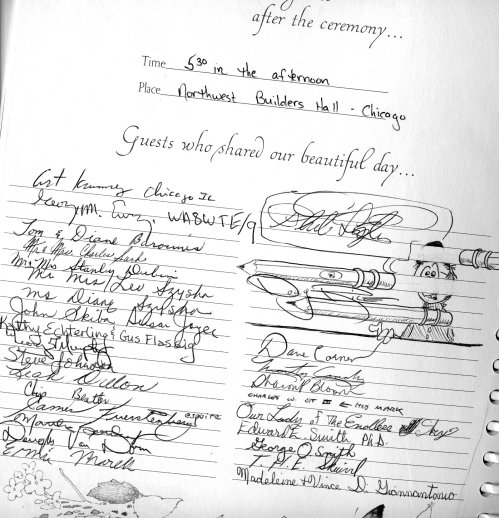
The family turned out in force, as did most of our friends. The page below is from our wedding guest signature book, and I consider it about as interesting as such things ever get. Edward E. Smith and George O. Smith were both there, though after signing the book they left at 40% the speed of light and I didn’t get pictures. The late (and terribly missed) George M. Ewing included his callsign, as always (portable 9!) and fan artists Phil Foglio and Doug Rice collaborated on some between-the-lines illumination. Mary the Mother of God signed in from the future (as Our Lady of the Endless Sky, straight from Sinus Iridum) though many of us wonder why the Blessed Mother had trouble with her handwriting.

WeddingBookSignaturePage 500 Wide.jpg

It was huge good fun. Outside the church, family threw rice and friends threw punch-card chad, which I was picking out of my ears well into our honeymoon in the Cayman Islands. Carol’s sister caught the bouquet. (I don’t recall who got the garter.) We had a martini fountain, which was the first time I’d ever seen that technology, though not the last.

Wedding Rice Thrown - 500 Wide.jpg

It’s sobering to look at the wedding photos and see an entire generation gone (except for Carol’s mom) as well as friends like George Ewing and Sharon Bloom who died far, far too soon. The photos are a snapshot of a time that few appreciate but which wasn’t as bad as conventional wisdom holds. Like the Forties (which we all mocked in our youth) the Seventies will come back someday, though I wouldn’t wait up for clones of the AMC Pacer.

JeffCarolFormal2007Small.jpgAs for Carol and me, well, the promise has been kept. We’ve taken some hits down the years but the flag still flies. Marriage works. It does. Not always and sometimes not the first time, but in our case, luck was with us and love did the rest. Thirty-five years on we have transformed one another, as marriage is intended to do, and at this point Jeff without Carol is no more meaningful than dividing by zero. Mission accomplished. Thanks from both of us to those who’ve been with us all this time, and to those others who have by now taken their places in the Community of Saints, all of whom made it possible without fully understanding how much their simple kindness and unending faith would mean to two ordinary people who made those extraordinary promises so many years ago.

Early Halloween

SpirtAtBorders500Wide.jpg

I’m starting to get notes from people asking if I’m all right, and I am, though for the last few days I’ve been fighting an anomalous migraine headache and haven’t felt much like writing. Lots to catch up on, now that I’m feeling better.

First off, I guess, would be the fate of our closest Borders. No sooner did it close its doors than a crane hoisted a banner for Spirit Halloween Stores across the name. I’m not a big Halloween fan (my sister got that gene) and so haven’t paid much attention to Halloween retailing, but Spirit is a national chain with an interesting business model: lie in wait for a big-box store to go belly-up, and then quickly reanimate the corpse for a couple of months prior to October 31. We have at least one other Spirit outlet here in the Springs, up on the north side inside the vacated remains of Ultimate Electronics. They may have year-round stores somewhere, probably in larger cities with more of a Halloween culture than we have here. The new store (in Southgate Plaza) hasn’t opened yet, even though there’s only 30 shopping days left until You Know What. Somehow they make it work.

And while we’re talking about reanimating corpses, I want to recommend a short story to zombie fans who may not have heard of it: “Impulse” by Eric Frank Russell. It first appeared in Astounding in September 1938, but it’s been reprinted many times since then. I found it in my decayed and dustbound copy of Groff Conklin’s 1962 paperback horror anthology Twisted. That’s a little remarkable, because “Impulse” is not a horror story as we usually define it. It’s pure SF, and remarkably prescient SF at that. Consider this excerpt:

It was a space vessel that carried us from our home world of Glantok. The vessel was exceedingly small by your standards–but we, too, are small. Very small. We are submicroscopic, and our number is myriad.

“No, not intelligent germs.” The ghastly speaker stole the thought from his listener’s mind. “We are less even than those.” He paused while he searched for words more explicit. “In the mass, we resemble a liquid. You might think of us as an intelligent virus.”

Basically, Russell’s talking about a colony of nanomachines living inside a dead human body that it stole from a morgue. The nanons got it running again, and even accessed memory proteins in its brain. So we’ve got a zombie here, a real zombie that doesn’t rely on supernatural machinery to make it go.

The story is better than typical pulp, although it respects all the usual pulp tropes including a mostly unecessary damsel in distress. I’m a fan of the story for an odd reason: It was the first story I ever read to a group. In the summer of 1964, my scoutmaster at Camp West in Michigan tapped me to read the story to Troop 926 while gathered around the evening campfire. It was fun, if a little tricky, because I had not read the story before sitting down to read it, and didn’t know myself how it would turn out. I remembered the title but not the author, and it took some googling to find it–else I would be flipping through the hundred-odd anthologies I have on the shelves downstairs.

By the way, Conklin is a superb anthologist, possibly the best out of the 1950-1975 era, and if you ever spot one of his books, it’s worth grabbing. (Kingsley Amis is another; his Spectrum books should be stalked and devoured.)

LowerLevelArcade500Wide.jpg

One more note about ghosts, albeit of the sign variety: While in Chicago last week I visited the strip mall retail complex at Harlem and Foster, which was an early shopping center (circa 1960) and when built contained the closest department store to where I grew up. (Turn Style, long-gone but the precursor to Target and K-Mart.) The strip mall contained the bank where I got my first account, and the Walgreens where I got my first job washing dishes at their grill. It also contained a slightly freaky windowless lower level divided into four small stores, one of which was the Arcade Bookshop. It was the first bookstore where I recall spending my own money, and I probably bought Conklin’s Twisted there. I also ordered several books on the fourth dimension from the very patient lady behind the counter. It opened when the mall as a whole opened. It became a Christian bookstore in the 1980s, and closed in the early 1990s. You can’t see it in the photo shown above, but the upper right sign space is the old Arcade Bookshop sign, reversed so the back side is out. However, if you’re there in front of it you can clearly read the store’s name through the plastic–backwards, sure, but that’s no real trick, and seeing the old store where I spent so much of my allowance in the 1960s was definitely a treat.

A One-Tube Electroscope

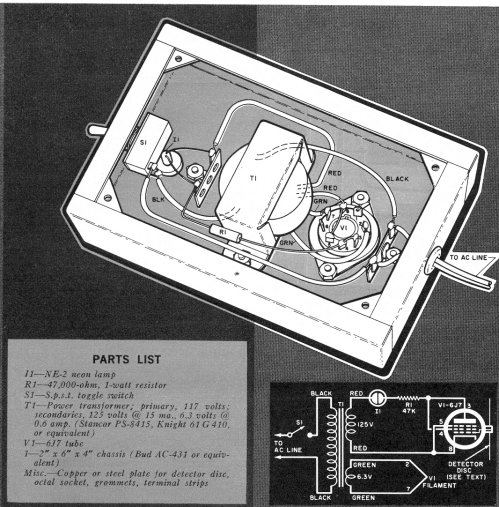
I found the circuit below by accident, while flipping through my library of Popular Electronics looking for something else. It was published in the October 1961 issue, and caught my interest because a friend of mine built it back in 1964. It was a cool thing to watch in action. It’s an electroscope that detects static charge by using the grid in a vacuum tube to control conduction. Bring an object with a static charge on it within a couple of feet of the detector disk, and the NE-2 neon bulb will light or dim, its brightness proportional to the strength and polarity of the charge. Positive charges make the bulb glow more brightly. Negative charges will dim it, or even darken it completely if the charge is strong enough to force the tube into cutoff.

PE-Electroscope-500Wide.jpg

(The full article can be found here–2.6 MB PDF.) The detector is a metal disk five or six inches in diameter. It can be any conductive metal. When Art built his he used sheet aluminum and it worked just fine. The center hole is sized to press-fit on the grid cap of a 6J7, which is connected to the tube’s control grid. The 6J7 works well here because it’s a metal tube, and is inherently shielded by its metal shell. (The article doesn’t call it out, but I think pin 1, connected to the shell, should be grounded to the chassis.) A 6K7 or 6S7 will substitute pin-for-pin, and I think any metal tube with the control grid brought out to a cap will work if you get the pin connections right for the tube type. NOS tubes of this sort can be had for $5-$6 from places like Antique Electronic Supply. I don’t know how well the GT (glass) versions of the tube will work, since they lack the total shielding of the “standard” 6J7’s metal shell.

The power transformer called out was common and cheap back in the day, but you’d be hard-pressed to find one now. The usual dodge is to use two 6.3V filament transformers, and connect them back-to-back. (These used to be sold at Radio Shack. I’m not sure if they are anymore.) You can light the filament from the joined 6.3V secondaries, and take isolated 120VAC from the primary of the second transformer. The 6J7’s heater current is 300 ma. Any filament transformer that can source that much current will do.

I find it interesting that raw AC is applied to the plate of the tube without rectification. The current is in fact rectified by the tube (tubes conduct in only one direction) with rectifier current controlled by the 6J7’s first grid. My first thought was that it works like a thyratron, but there’s no latching effect. Current through the tube is controlled by the charge on the grid, and then in a linear way.

It would be interesting to figure out a circuit that would indicate with a sensitive meter rather than a neon bulb, and if I build it I may try a few things. The only cautions I offer here relate to the voltage: 120V, even isolated from the wall, is dangerous. Don’t work on the circuit with power applied. To be safe, yank the plug out of the wall before you open the box or flip the chassis over. There’s no voltage on the detector plate, so that can be touched even while the device is on.

All that said, it’s a great entry-level demonstration of how vacuum tubes work.

We’re All 3 1/2″ Now

Just a quick update on the vintage 5″ floppy project: I bought a half-height Teac 1.2 MB floppy drive at OEM Parts earlier this afternoon, since I was buying silver mica caps anyway. I took the cleanest of the three or four they had on the shelf. Back home, I wrestled the side panel off an EMachines box built in 2004 and put some memory in it, then pried away the space-holder from the vacant front bay and slid the Teac drive into place.

The machine came from Best Buy with neither a floppy drive nor a floppy cable. The usual floppy drive cable connector is present on the mobo. As luck would have it (or maybe not luck so much as ancient habit) I found a very old floppy cable at the bottom of my Odd PC Junk bin. It’s the five-plug model, with two sets of both types of floppy drive data connectors. I plugged the controller end into the mobo, connected the pre-twist edge connector (that is, the one closest to the mobo) to the Teac, plugged a power connector into the drive, and powered the machine up.

XP ran as expected; it’s the old machine from our church, and I know it well. Windows knew that there was now a drive on the floppy controller, but reported it as 3 1/2″. I booted back into BIOS, but unlike the older machines I recall, there was no BIOS setting to specify what size floppy drive was in the box. Using the post-twist edge connector prevented Windows from seeing the drive at all.

I guess we’re all 3 1/2″ now, if we’re floppy at all.

The drive isn’t stone dead: When I put a 1990 TopSpeed Modula 2 floppy in it, the drive sounds like it’s indexing across the surface of the disk, but never returns any data to Windows. The drive may be bad, or the disk may be bad. Certainly the machine doesn’t appear to know what a 5″ floppy drive is. All in all, it’s really not 1990 anymore.

This was an hour’s project, not a day’s project or even an evening’s project. I’ve spent about as much time on it as I think it’s worth. I’m not going to dump the diskettes, but until a machine old enough to know 5″ from 3″ finds its way here, this is as far as I’m taking it.

The Last of the 5″ Floppies

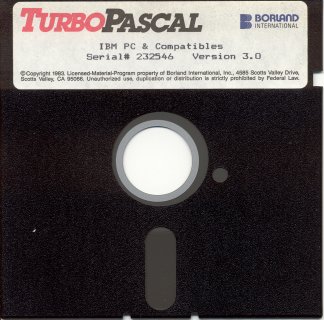
TP3Floppy325Wide.jpgThe AC works again, though now that it does, the hot spell has broken and we don’t really need it. (Love that 72 degree stuff!) However, Carol and I have some cleanup to do, as the air handler made a honking puddle on the furnace room floor downstairs, soaking the bottoms of a number of boxes. Some of those contained Christmas stuff, including my old Lionel trains. More intriguing, another, smaller, box contained a stash of 5 1/4″ floppies from the late 1980s and early 1990s. I went through it to see if there were any old backups to be destroyed (there were none) but the commercial software lineup in the box is pretty impressive:

  • Turbo Pascal 2.0 (includig Turbo 87), 3.0, 4.0, 5.0, and 5.5
  • Turbo Pascal for Windows
  • Mystic Pascal
  • QuickPascal 1.0
  • TopSpeed Modula 2
  • TopSpeed C
  • Stony Brook Modula 2
  • Smalltalk/V286
  • Turbo Basic
  • Quick C
  • Reflex 1.0 and 2.0
  • Turbo Lightning
  • Paradox 2
  • WordStar 3.02
  • MS Word 6.0

…and lots of additional stuff from Borland and other companies, most long gone. Falk Data Systems; Software Science, Inc; Digitalk; Adapta Software, and on and on and on.

The box is toast, and I’m thinking that most or all of the disks have long since become unreadable. Still, it would be interesting to see how true that is. I checked my Paradox 4.0 3 1/2″ floppies from 1993 just now and they still read, so I suppose it’s possible. Alas, I haven’t had a 5 1/4″ floppy drive in the house in years. I’ll be going up to OEM Parts later this week to gather a few things to replenish my parts drawers, and I’ll bet they have a drive on the greasy old crap table. I’ve even got a working machine in the to-be-recycled pile with an open front bay to put it in.

I know, I know–bad use of my time. But at very least I’m going to rejoin the Turbo Pascal 2.0, 3.0, and 4.0 floppies with the manuals, which are still on the top here in my office. I’m sure I can part with the rest. Those, well…in a very real sense they helped pay for the house we’re now living in, so I’ll add them to my memoirs archive. And just in case they do read…I can bring up a DOS VM in ninety seconds flat!

Thermionic Detectors

The air conditioning condensate drain clogged earlier this week, and it may have been dripping water inside the air handler for several days. I only noticed it once it started spilling out onto the utility room floor. So we shut the damned thing off until Monday, which is as soon as the HVAC guys can get out here to poke at it.

Oh, and it’s been hot. 2003 was hotter here, but 2011 is right up there. My internal thermionic detector was detecting some thermic excess, so midafternoon yesterday I went downstairs to my shop, where it’s 5 degrees cooler. After spinning the dials to make sure nobody was having any fun on 10 meters that I wasn’t having, I sat at the bench and looked around. Something, somewhere had to need fixing.

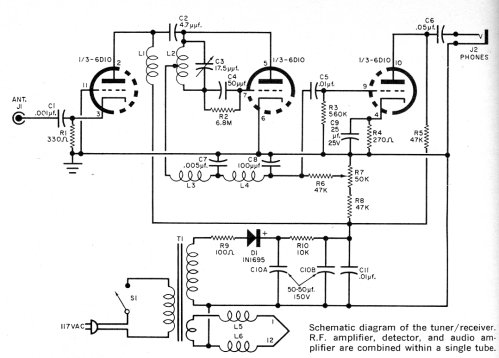
Oh. Yes, of course. Back in 2008 I built a 1-tube FM BCB receiver pretty much on a lark, from the Popular Electronics article in which GE introduced the Compactron tube. The article, “Introducing the Compactron,” by Phil Hatfield W9GFS, talked about some of the challenges of stuffing as many active elements into a 12-pin bottle as could be done. This was the last gasp of the vacuum tube, but GE gave it a good shot, and in August 1961 having as many as four active devices in one envelope was still pretty hot.

6D10Superregen500Wide.jpg

50 years ago…just about now. The example circuit was an FM BCB receiver using a single 6D10 triple triode tube. I had all the parts (even the tube) lying around, so on a whim I built it.

It worked, but it had several defects. One was touchy tuning due to hand capacitance. This is always a problem when both sides of the tuning cap are above RF ground. Another problem was that the tuning range was too wide (about 65 MHz – 120 MHz) and the entire FM band was crammed into about 20 degrees of rotation of the shaft. The last problem was that the regeneration control was just, well, nuts.

The first problem was beyond help; 50 years ago we just lived with hand capacitance. I tried to fix the second problem in 2008 but didn’t improve matters much. I’d painted myself into a corner with the physical arrangement of the tuning coil, and couldn’t easily swap it out. The third problem was still undiagnosed when I set the radio aside to do other things.

So I pulled it down off the shelf, patched it into my bench supply, and powered it up. Still worked; regeneration still nuts. I spun it, listened, spun it some more, and listened some more. (Why do I hear that song with “She wears short-shorts; I wear T-shirts…” every damned time I turn on the radio?) Regeneration was erratic, happening at different points on the pot, and sometimes didn’t happen at all. Alas, I was overanalyzing the operation of the superregenerative detector, thinking maybe I was driving the detector too far in one direction or another. Occam hit me in the head with a frying pan about then: The regeneration pot was bad.

Duhh. The wiper was making only marginal contact with the resistive element. Not sure why. Don’t care that much. Fished a new 50K pot out of the drawer, soldered it in, and wham! Regeneration worked as it should.

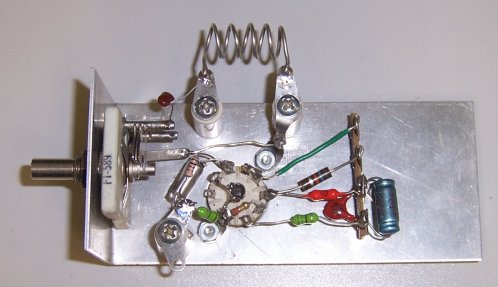
Having fixed one out of the three problems, I was on a roll, and being on a roll…I started to build another radio. John Baumann KB7NRN has a design for a similar detector with a grounded rotor. I’ve been intending to build it since, well, 2008, and had most of the parts set aside in a milk jug. So with the upstairs mostly uninhabitable until Monday, I got to work downstairs last night, and have gotten pretty far along on the RF portion of the circuit.

SuperregenRFDeck500Wide.jpg

This is only a lashup; once I get the circuit working as I want, I’m going to build another instance on a conventional chassis with its own power supply. It’s going to take a few more evenings to get to the smoke-test stage, but I’ll let you know the rest of it comes along.

Perversity Dust

The perversity fairies are flitting about the last few days, scattering perversity dust in odd places. We noticed the air conditioner flaking out at 3:30PM on Friday. By the time we called the HVAC place that services it, we were on the list for bright and early…Monday. No emergency, and it actually still works. However, the drain port in the condensate tray is blocked, and the tray is overflowing into the rest of the air handler. So we turned it off, and it will have a couple of days for everything to dry out.

Air conditioners always go paws-up late Friday afternoon. It’s going to get hot in here later on, barring a nice juicy thunderstorm. (Possible, but unlikely with the perversity fairies anywhere in the vicinity.) I may have to do something radical like…go shopping.

Shopping. I need a smartphone, and have been ducking the decision for months. Of all the units I’ve researched, my favorite so far has been the Droid 2 which, alas, just went off the market in favor of the Droid 3, which is apparently on the market but hasn’t yet made its way out into the provinces. I’ve gone so far in my smartphone research as to make precisely dimensioned cardboard cutouts of the major contenders to see whether they’ll fit in my pockets. There’s evidently a format conflict in men’s shirts: All my pockets are 4:3, and the damned phones are 16:9.

Shopping for socks is easier. But I already have a drawer full of socks.

I ordered a quiet, lower-power supply for the main tower here last week. NewEgg had it on my doorstep in three days, as usual. The “We shipped it!” email never arrived, and I assumed it went out with the spam. This happens now and then, and I’ve learned to live with it. So of course, yesterday evening, three days after the arrival of the supply and a full day after I installed it, I got the message telling me that the order would be shipped soon, and would arrive three days ago. Yup. Gotcha. Knew that. Thanks for sharing. This batch of perversity dust must have had some thiotimoline in it.

The supply worked very well, by the way. Every time I come into my office here, I feel a twinge of panic because I can’t hear the machine. Damn. Did they drop power to the house again? But no: A product worked better than advertised, and I still can’t internalize my good fortune. Quick, Murphy: the Flit!

Ten Gentle Opportunities and Virtual Assistants

djdenise.jpgI’ve been getting notes from all corners the last few days about a $200 virtual DJ program that has been been given her own show on radio station KROV in San Antonio. The program is actually an application of a more general “virtual assistant” product from Guile 3D Studios. DJ Denise goes on the air at KROV tomorrow, from 1 PM to 4 PM. You can listen over the Web; I intend to.

Most of the horsepower in creating Denise seems to have gone into rendering her lip gloss, which is odd for something used as a broadcast audio DJ. I’m more interested in whatever AI lies behind the pouty face, though early indications are that she has more lip gloss than AI. It’s an issue of special interest now, because I’m making slow but steady progress on a near-future SF novel that explores (among other and stranger things) the border between real AI and “fake” AI, a category that goes back to the ELIZA program at MIT in 1966. Ten Gentle Opportunities contains both. A cheap coffee maker contains an animated barista that talks a lot and understands little. A model-year 2020 Mazda RX9 has an annoying dashboard cartoon that understands more deeply but very narrowly. Both handle natural language well, and people are easily fooled into thinking that smooth natural language processing implies true intelligence.

I don’t think that’s true, as the more advanced AIs in the story demonstrate. One of them is Pyxis (Latin for “compass”) a high-end commercial product sold at a five-figure price as an executive assistant. Brandon Romero, an executive trying to manage a completely automated AI-controlled copier factory, has his own copy of Pyxis. (I posted a glimpse of the copier factory and its AI controller Simple Simon in my June 26, 2011 entry.) Far from being a geek-dream sex kitten, Pyxis is obedient without being especially pleasant. Worse, she holds her boss to his word, to the point where he begins to wonder who’s working for whom.

Romero dislikes having human underlings, but as he soon comes to understand, AI staff might be described the way Jerry Pournelle once described the Bomarc as the Civil Service missile: “They don’t work, and you can’t fire them.”

Pyxis saw him approaching his office door, and Brandon heard the lock bolts snap back. The coffee machine on the teak credenza was hot and full, and the air was rich with the scent of dark roast and Irish Crème. The human interns always scattered magazines on the glass coffee table against his preferences; the day when paper magazines became extinct could not come too soon. One of those interns had recently left a stuffed moose on the credenza. This was at the direction of HR, which (as he later discovered after much annoyance) wanted to “soften the human side of his persona.” The ugly abstract art shotgunned at the eggshell walls was bad enough. God forbid he should meet with a Chinese parts supplier without his stuffed moose.

Brandon sat down at his teak desk, its oiled vastness divided into the rigorously rectangular regions he maintained at all times, including a small square for coffee and another for mints: charts, summaries, two tappers full of notes and test-run videos and model animations, all at his fingertips. Defining the far sides of his desk were three brushed-stainless OLED panels currently animated with some slow-flowing pearlescent liquid that looked like shampoo. Far too soon, the triptych would spring to life with more views of this lunatic’s kingdom than any one man could possible follow.

Pyxis saw him sit down, and a window in the panel to his right burst into existence with her scowling image. “Twenty-six messages vetted and queued, five urgent.”

“Later.” If it wasn’t from that ass-covering coward Amirault, he didn’t want to hear it. Brandon set his primary tapper down in its vacant rectangle on the desk, and pulled a few loose papers from his briefcase. Like everything else, each had an appropriate place, and he scanned the piles that had been accumulating for most of a week, dropping a sheet here and a sheet there. The stapled set describing Zircon’s looming Retirement Incentive Program (was that a hint?) needed to go somewhere. A new pile? For corporate suicide notes? Brandon scanned the desktop almost automatically, but there was only one empty rectangular region left.

He stared at the tidy strip of oiled teak and felt himself tighten inside. Not big enough for anything except bad memories-but like those infuriating little sliding-square plastic puzzles, he had never hit upon an arrangement that would eliminate it.

“Here it is, Mr. Romero.” A new window popped into view, with a high-res scan of the framed photo that had stood in that teak rectangle for many years: Carolyn in a white cotton V-neck sundress out in her garden, holding a cardboard sign reading, “Greek Fire.” To a newly minted second lieutenant on the ground after Desert Storm, it meant that Carolyn Helena Ankoris was waiting impatiently for him to come home and marry her. To Major Brandon Louis Romero, US Army, Retired, it meant only failure.

“I didn’t ask you to open that.”

“You were staring at the space where the photo had been.” Building 800 was as full of electronic eyes as it was empty of human beings. Pyxis not only knew where he was at all times, she knew where he was looking.

His AI assistant was unfailingly obedient, but Brandon had set her obsequiousness parameter to zero. What was the point of having a virtual suckup? It wasn’t like the physical world suffered a flunkie shortage. “Your job isn’t to read my mind.”

Pyxis folded her arms implacably. “My job is to anticipate your needs and help you stay productive. We have a line start in a little over an hour. You have a lot to do. Mr. Amirault asked you to copy him on a call to…”

“Ok.” Brandon tossed back the last of his Red Hen coffee, and flashed with sad longing to his Army B4 training, when he had aimed an M16A4 at line-drawn enemies printed on sheets of cardboard, and nailed every damned one through the heart. “Get me Simple Simon.”