Jeff Duntemann's Contrapositive Diary Rotating Header Image

Daybook

Descriptions of what I did recently; what most people think of when they imagine a “diary entry.”

Something’s Burning…

Like, Colorado Springs.

Ok. First of all, Carol and I are fine. We’re fine in part because we’re not yet back in Colorado Springs. We’ve been in Chicago for three weeks and might have stayed a little longer, but then friends started to call and email asking, “Are you near the fire?”

Egad. I don’t talk much about being away until we’re back, so apart from locals few people knew we were not in Colorado. Once it became clear that the fire was no quick or small matter, we got things in order as best we could and started the long trip west. We’ll be home some time tomorrow.

Our house is about 11 miles SSE of the Waldo Canyon fire and does not appear to be in immediate danger. Jimi Henton is there with Aero and Jack, and we’re in regular touch with her. Over the last two days, the fire’s perimeters have moved mostly north and east. 30,000 people have been evacuated already (including several of our friends and even Michelle Malkin) and things are a stupendous mess.

More than this I can’t tell you until we get there. Stand by.

Sic Transit Gloria Veneris…

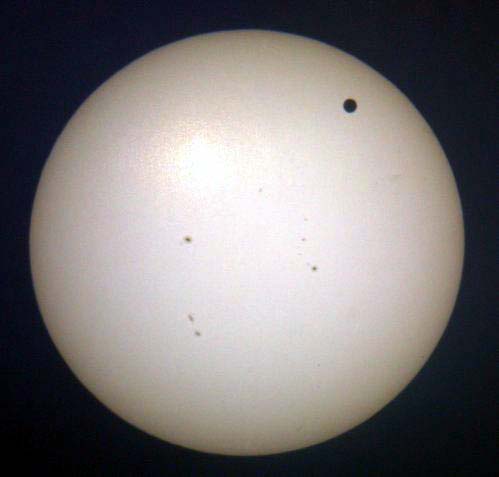
Sun With Venus 1.jpg

…for another 105 years. By 2117, I’ll be heavily involved in other pursuits and may not be able to watch–but man, did we get a show this time!

Catching any short-lived astronomical phenomenon always involves a strong measure of luck. In 1972, seven friends and I drove 1200 miles to Cap Chat, Quebec, to see a total solar eclipse. We brought out the big guns–my 10″ telescope looks superficially like a big gun, and took a little explaining at customs both coming and going–but alas, two hours before totality the clouds rolled in. We had the novel experience of watching the umbra hurtling toward us by the darkening of the undersides of the high clouds, but of totality we saw nothing.

Luck, yeah. While planning for the event I noticed that my sister Gretchen’s back yard has a near-optimum line-of-sight to the place on the NW horizon where the Sun would set on June 5, 2012. Her lot fronts on a large open space running roughly E-W, with high-tension lines and their towers the only significant obstruction. Given that my western horizon is a 9,800 foot mountain and I see granite up to about 35 degrees, Gretchen’s back yard seemed flukily ideal.

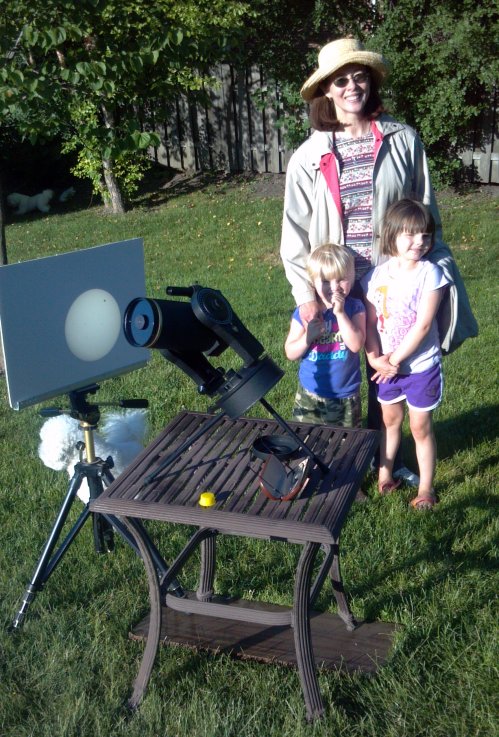
Transit Setup-500 Wide.jpg

So there we chose our ground. (Without hawks but with hounds–sort of–and elves be damned.) The instrument was my Bausch & Lomb Criterion 4000 suitcase scope, which has gone on a number of expeditions with us, including two total solar eclipses and Halley’s Comet in 1986. The technique was what I generally do for solar observing: project an image on a piece of foamcore supported by a separate tripod. The image at the top of this entry was a shot of the foamcore, taken with an ordinary and slightly ancient Kodak V530 pocket camera.

I logged first contact at 5:05 PM. Second contact (when the trailing edge of the disk of Venus enters the disk of the Sun) came at 5:22 PM. After that it was the long slow crawl of Venus downward (on the foamcore) as the Sun slowly set in the northwest. Gretchen’s girls thought it was interesting, and before the transit I showed them how the telescope brings in a magnified but inverted image of things far away, like a 55-gallon trashcan across the open space. I’m sure they didn’t completely understand what was going on, but as with all Uncle Jeff tricks they did consider it a lot of fun.

The weather was nothing short of astonishing: high 60s F, light breeze, crystal blue skies down to the horizon. So it had been the whole day, and so it stayed every minute until the Sun vanished behind some trees at 8:03 PM. I got a lot of good photos, considering that the photos were of an image projected on cardboard. Toward the end of visibility, the scope was directed square across the approach to O’Hare Field, and five, count ’em, five jet aircraft crossed the disk of the Sun while we watched. The exhaust from the engines, though invisible directly, distorted the solar image in an interesting way.

Fifteen minutes before the Sun vanished, it passed behind one of the high-tension towers across the open space, allowing me to fiddle the focus a little and get some remarkable shots, like the one below:

Sun Behind Tower.jpg

Gretchen made one of her trademark pot roast feasts, with Yukon Gold mashed potatoes almost the color of the solar disk. (A dollop of real butter yellowed ’em up gorgeously.) Dash and QBit ran around in circles, chased balls, and slept like rocks last night. As did we all.

Success just don’t get any more successful than that.

Eclipse Wrapup

By four PM yesterday I knew we were in trouble: The western sky was overcast, and weather radar showed various precipitation clouds squirming around in our line of sight to the western horizon. However, the scope and the folding chairs were already packed in the back of the 4Runner, so on the outside chance a miracle might happen, we put QBit and Dash in the back seat (Aero and Jack don’t like crowds of admirers as much) and steamed six miles east to St. Raphael’s Episcopal Church.

We had announced the event at both morning services, and several of our fellow parishioners were waiting eagerly for us as we got there about 5:30. I chose a spot in the parking lot to maximize western coverage, then stood around talking to our friends with one eye on the sky. Well, call it miracles or just call it a side benefit of chaos (in the rigorous sense, as the math that governs complex systems like weather and climate) but a little before six the sky in the northwest started to clear.

With a little help from fourteen-year-old Fred Jones (below left) I got my vintage 8″ vent-pipe junkbox scope (details and better photos here) set up in record time. We put it in the wind-shadow of the 4Runner, and while I adjusted the optics Fred went and got some additional folding chairs from the parish hall. By then a few more people had arrived, and by 6:15 we had a small crowd of chairs in a half-circle around the scope and its foamcore screen.

Eclipse Group 500 Wide.jpg

The skies were not great. We had runs of clear air and runs of dense cloud. While it was clear I pointed out the several sunspots, and at 6:24 Fred announced that there was a flat edge to the Sun’s image at the bottom of the screen. We had a chance to see that flat edge grow to a small scallop before the clouds closed in again.

At about 6:45 it cleared up, and for over half an hour we actually had a decent line on the Sun as the Moon took a greater and greater bite out of it. The coolest event of the evening happened so quickly that only a few of us caught it: A jetliner clipped across one of the horns of the sun’s roughly 50% eclipsed disk. Remarkably, Dianna Jones was taking a video of the foamcore screen when it occurred, and she’s going to try and fish out the frame or two of the plane’s passing when she goes through the video on her PC.

Eclipse 350 Wide.jpgWe had a decent view up to about 65% or so coverage, when the clouds closed in what turned out to be for good. In the meantime, there was a profound weirdness: A southeast wind blew light rain out of clouds that had already passed over us, and even though it was (mostly) clear from well east of the zenith to the Sun, we watched the best part of the eclipse in the rain. As God may well have been telling us: “Here’s your miracle. Just don’t get cocky.” And to seal the deal He gave us an intense double rainbow. What does it mean? It means we didn’t mind getting a little wet, we laughed, and we all had a wonderful time. (I threw my jacket over the most vulnerable portions of my scope.)
My emphasis was not to take great photos but to make the eclipse accessible to people who would otherwise have to be content with a few shots on TV. Our friends were able to walk right up to one side of the foamcore and see the umbrae and penumbrae of sunspots on the image. Most snapped their own pictures of the Sun’s disk, and we talked about things like heat distortion at the edges of the image (because the Sun was very low in the sky) how reflector telescopes differed from refractors, and much else.

I had hoped to catch the crescent Venus after sunset, but by then the western sky was solid clouds. We packed up and went home. I still call it a great success. After all, in 1972, a group of my friends and I drove 1400 miles from Chicago to the mouth of the St. Lawrence River for a total solar eclipse, only to be clouded out a bare hour before totality. Carol and I have seen two unobstructed total solar eclipses since then, including the “big one” in Baja in 1991. Two out of three ain’t bad.

Next stop: Grand Island, Nebraska on August 21, 2017.

Ready for the Eclipse

Solar Projection Setup 500 Wide.jpg

I put the 8″ scope together on the driveway to make sure nothing was amiss (and to be sure I could find all the parts) before packing the whole thing off to the parking lot of St. Raphael’s Episcopal Church. Observing the eclipse where I live is impossible, because I’m on the eastern slopes of Cheyenne Mountain, which rises almost 30 degrees above the western horizon. Today’s eclipse will occur while the Sun is setting here in Colorado Springs. In fact, even with a perfect western horizon, the Sun will set before the eclipse is fully past.

The church is almost seven miles east of us, and while there will still be mountains on the horizon, they will obstruct nowhere near as much of the sky as they do from my driveway. It also becomes an opportunity to have parishioners who may be interested come out and see what of the eclipse can be seen from here. The full annular eclipse will be visible from Albuquerque, about 250 miles south of us. We’d considered heading down for it, but there’s just too going on in our lives right now to spare the time.

The projection screen is simple Hobby Lobby foamcore attached to a length of aluminum angle stock with a 1/4-20 threaded hole at its center. I had to crank up my tripod almost to its vertical limit to get it to catch the image of the noonday Sun. The eclipse here doesn’t begin until 6:27 PM, when the Sun will be a great deal lower in the sky. Maximum coverage is about 7:30. The Sun sets here at 8:09.

Of course, all of this assumes that it will be clear later this afternoon. There are a lot of big puffy cumulus clouds up there now, and we had a thuderstorm here yesterday evening. So far so good. I’ll let you know how it goes tomorrow.

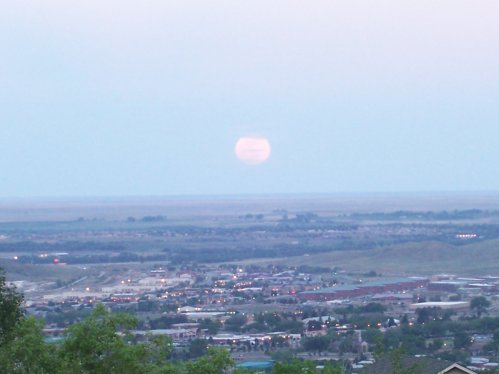
Perigee Moon

Perigee Moon.jpg

To watch the red perigee moon rise over the first city lights of evening is sublime; to understand why it is so broad and so bright is the particular pleasure of being human.

Sky Show Lookahead

Some interesting things are coming up in terms of sky spectacle, and this would be a good time to post a reminder, especially as the first will be happening…tonight.

There’s a full Moon tonight, and it’s being called a “supermoon” because it will be larger (by 14%) and brighter (by 30%) than an average full Moon. (I learned the phenomenon as a “perigee Moon” many years ago.) It will be the brightest full Moon we’ll see this year, though most years have at least one supermoon.

14% wider isn’t a lot, and in truth you’ll be hard-pressed to notice its greater size if you don’t watch the Moon frequently. For the greatest effect, watch it rising over whatever the Moon rises over in your corner of creation. But brighter, yeah. That thing will be a searchlight, and if you ever wanted to go dancin’ in the moonlight without tripping over your own feet, this would be the night to give it a try.

Then on Sunday, May 20, we’ll get something completely different: An annular eclipse of the Sun. There’s a boggling coincidence in the apparent sizes of the Sun and the Moon from here on Earth. Both are approximately 30 arc-minutes in diameter. This means that on occasions when the orbits of Earth and Moon align such that the Moon passes in front of the Sun, the Moon just barely covers the Sun. Phenomena like prominences and the solar corona that would be hidden by a Moon with a larger apparent diameter are thus revealed to us.

Now, the next time the Moon passes near the Sun, it will pass in front of the solar disk, causing a solar eclipse. But this time, the apparent diameter of the Moon will be close to its minimum, and thus the disk of the Moon will not quite cover the disk of the Sun. This provides us with an annular eclipse, meaning a ring of bright Sun with the dark disk of the Moon at its center.

The eclipse of May 20 is significant for many of my readers because the annular phase touches the western US. The eclipse happens late in the day in the US, and by the time the umbra (the darkest part of the Moon’s shadow) reaches west Texas, the Sun is setting. If this is hard for you to envision, see the wonderful animation (even more wonderful because Flash is not required) on the eclipse’s Wikipedia page.

One of the best places to see the eclipse will be Albuquerque, which is almost bang-on the center of the umbra’s path. The eclipse’s maximum extent will occur at 7:33 PM local time, just over the western horizon. A partial eclipse will be visible throughout the US except for the east coast.

All the usual cautions for observing the Sun apply. The high road is to use a small telescope to cast the image of the Sun on a piece of white foamcore. That’s generally what I do. Just be careful not to look (or allow others to look) through the telescope. Pinholes can work remarkably well, and I remember projecting one partial solar eclipse onto the sidewalk in front of a restaurant through the holes in a saltine cracker. You may glimpse a small sunspot or two during the partial phase, though this cycle’s spots are the weakest of any I’ve seen in my lifetime. We’re within a year of the Cycle 24 sunspot maximum, and the pickins are still very slim.

Then we move to something not only completely different but vanishingly rare: The transit of Venus across the face of the Sun on June 5/6, 2012. There was no transit of Venus in all of the 20th century, and there will not be another until 2117. In the continental US, it will happen before and then after sunset; i.e, Venus will still be crossing the solar disk when the Sun goes below the horizon. To see the whole thing, you’ll need to be west of Hawaii and east of central Australia.

I’ll have more to say about the transit of Venus later in May. However, in the meantime, Venus is going into its crescent phase, which is very bright and easily seen through binoculars–and glorious in even the smallest telescope. Look west after sunset and you can’t miss it; it’ll be the brightest thing in the sky after the Moon.

Quite a show coming up, starting tonight. Don’t miss it!

The Wonderful Exploding Intercom

Lafayette PA405 Intercom.jpg

Carol and I are trading offices, and trading offices is a lot of work. I’m trying to do it right and not have piles of unsorted glarble on every horizontal surface, accruing new mass like black holes. That may be impossible; I don’t know. I’ve never had an office without piles of unsorted glarble. The nature of the glarble changes over the decades, but a quick trip through the photo albums confirms that the glarble has always been there.

There’s another problem I intend to fix this time: Carol has always wanted an intercom between her office and mine. Lacking an intercom system we use our cellphones, but cellphones are not intercoms. I was born in the 1950s and I know an intercom when I see one: Intercoms have things that light up, ideally inside as well as on the front panel; and they buzz. The buzz is to remind you that their magical souls are yet alive within them. If they’re good intercoms, you can hear remote audio over the buzz.

And so it was a while back that I bought a pair of 1964-era Lafayette PA-405 4-tube wireless intercoms on eBay, for the remarkably low price of $30. A wireless intercom is a very cool thing. You don’t have to run wires between the two stations because they use your house wiring as a signal conduit. Each station has a little radio transmitter and receiver within it, and so using them is a little like using CB radios. (If you don’t know what CB radios are, well, you’re not a Baby Boomer.) Push the button labeled Talk, and you talk. Otherwise, you listen. (How ’bout that Girlfriend! This is Contraman! What’s yer 20?)

The two units are beautiful; practically pristine visually. I plugged them both in, one in Carol’s office and one on the kitchen island. Got some buzz (natch) and random racket on both sides. I was playing with the silencing control on the back panel of the unit in Carol’s office when I heard a weird concussive sound through the air from the kitchen, followed by Carol yelling, “IT EXPLODED!”

This is not something Carol yells very often, even across a 35-year marriage to yours truly. I got back to the kitchen pronto and found smoke curling out the holes in the masonite back panel and Carol cranking wide the kitchen windows. I suspected (as old-timers will agree) that a 50-year-old electrolytic had decided to go out kicking, as has happened to me more than once. Not so: Once I opened it up I found a relatively modern .05 tubular capacitor that had blown out one end and pewked up its foil-and-mylar guts in a spectacularly spiral fashion.

Exploded Cap - 500Wide.jpg

I’ve never seen a cap die quite that way, and I can only assume that it had shorted internally. Its function in the circuit appears to be feeding low-level RF signal onto the power line from an RF coil. If shorted, the cap would bridge one side of the wall mains connection to the other side, through the secondary of the RF coil. (I may be wrong about this, but that’s how it looks through a magnifier.) Although the coil looks fine, the circuit isn’t working, and shorting wall current through a small coil of #30 wire is rarely good for the coil.

I’ve ordered the schematic from Manualman and will go back to the units when it arrives. Am I annoyed? Not hardly. 1964 was one of my favorite years, and the good thing about electronics from that era is that the parts are big enough to see. If I did in fact burn out the RF coil I may have to find a parts unit, but that sort of surgery is no great challenge with parts in hand. (I may also be able to rewind the coil, which looks like about 12 turns of #28 or #30 enameled.)

Why am I so happy? Call me weird, but it’s like this: If it didn’t explode I wouldn’t have the fun of fixing it. So there.

Sparking Ideas

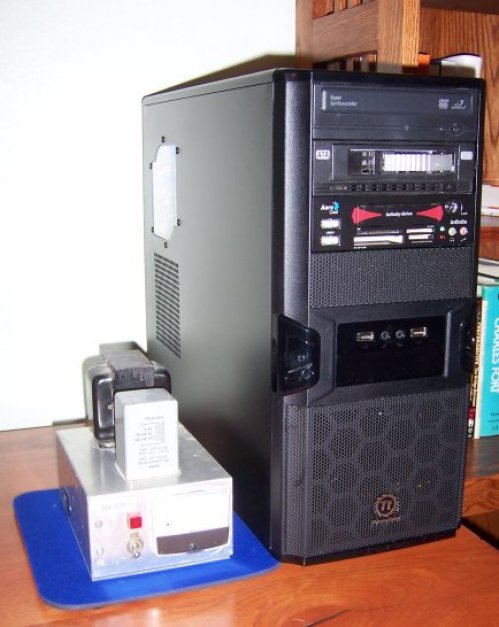
Thermaltake Box and Ground Box 500 Wide.jpg

Carol and I traded offices here after completion of our downstairs rehab, and while the process is ongoing (much stuff is still lying around in boxes) I’ve come upon a problem I didn’t have before. Back in late March, I touched the metal bezel of a conventional USB 2.0 port on my desktop quadcore, and drew a 1/4″ spark. As you might expect, the machine died instantly. The new carpet generates a lot more static than the old carpeting did–and our customary 7-9% humidity doesn’t help.

Why the USB port bezel wasn’t grounded is a mystery, since the wire coming out of the top panel encapsulated port assembly was screwed tight to the case, and the case to the third wire. I can only assume that something was broken inside the port assembly. I’ll tell you right now, I am not going to buy any Antec cases anymore. This is the second one that’s gone bad in precisely the same way: wonkiness in the front/top panel port assembly. Furthermore, I had to destroy the top panel to remove the port assembly, since the case metal completely blocked access to two of the plastic release tabs. No wonder they wouldn’t sell me a replacement port assembly, since the assembly could not be changed without destroying the case itself. Antec is off my list, now and forever.

There’s nothing bleeding-edge in the new machine. The mobo is a Gigabyte Z68A-D3H-B3, if that means anything to you, with an Intel Core i5-2400 Sandy Bridge processor on it. The cores run at 3.1 GHz, vs 2.4 GHz for the old machine. I had them put it all in a Thermaltake V3 case, which is smaller and simpler than the Antec Nine Hundred I’ve been using since late 2008. I am not a gamer and am quite content with integrated graphics, so elaborate cooling machinery is unnecessary. The case fans are quiet (though one of them seems to rattle periodically) and overall I consider it a winner.

Now to figure out how not to kill the new machine. The quick fix was to pull a homebrew 350V power supply off the shelf and plug it in beside the new quadcore. The aluminum chassis is grounded to the wall through the 3-wire cord, so touching the chassis before touching the quadcore should do it. (The blue mouse pad is just to keep the supply from scratching the table.) I know it works because I can pull quite a spark by touching it after scuffing around the lower level. Better still, if I hold an NE-2 neon bulb by one lead and wave it a few inches from the grounded power supply, I can see the static bleed off through the bulb, without even touching the other lead to the chassis. (Turning the lights off makes it more dramatic, but I can see the orange flickers in full daylight.)

The neon bulb experiment suggests that something more graceful than an old power supply could be put together as a grounding station. I have a wonderful 5″ bronze worm wheel given to me by Carol’s dad circa 1987, and with a little skill and some copper pipe fittings could build something with a VR-75 tube at the center, and the gear as the touchplate. Touch the plate, flash the tube, kill the static. I’m going to lash it up before putting a lot of work into it, but I see no reason why it wouldn’t work. More as it happens.

You Can’t Go Home Again

We’re back and I’m ok; you can stop worrying about me now. (Nonetheless, many thanks for all the concerned emails.) We flew to Chicago to house-sit for Carol’s sister for a week or so, and most of what I did there was read books and visit family and a few old friends. My arm no longer hurts…much, and that only when I put significant weight or torque on it. I’m going to strength training tomorrow, a session I suspect will be interesting.

In the meantime, I passed through my old neighborhood on the way to visit my kindergarten friend Art, and cruised down the street where I grew up, to see the house I lived in until I was 23. I was halfway down the block when it hit me: This is all wrong. I stopped where I knew my old house had been, and looked at something that was no longer my old house. In fact, it looked a lot like Dorothy’s tornado had dropped somebody else’s house on top of the house of my birth and somehow got the alignment right.

Let me show you the house shortly after its completion in 1949:

HouseFaceOn1949.jpg

It was a fairly common design, by the well-known Chicago developer Maclennan, and there were lots of them in our neighborhood. The original floor plan was just 900 square feet, with only two bedrooms and one bath. When my sister came along in 1956 my parents put a floor under the cathedral ceiling and made a third bedroom out of it, with a new dormer for a half bath upstairs. Shortly after that, they put a good-sized family room off the back side of the house that ran the full width of the structure. The family room included a brick fireplace with its own chimney. It was a little tight (especially by today’s standards) but I finished the basement in knotty pine when I was 15 and after establishing my desk and workbench there spent a great deal of my time downstairs.

My mother lived there for 47 years, and when we sold the house in 1996 I figured that somebody would put some work into it. Whew. Was I right or what? It looks like they literally shaved off the second story and the family room completely, or possibly gutted the place down to the brick walls and started over. (I’m guessing my knotty pine walls in the basement did not make the cut either.) The house as it is today looks a little topheavy, but the lot is only 35 feet wide, and it takes some creativity to maximize the useful space buildable on that little land.

No hard feelings, though forgive me for thinking that it just looks funny. The most striking change was the removal of both chimneys, which made me sigh because my first ham radio antenna was 30′ of #22 wire strung from one chimney to the other. I worked 34 states from that house (on a hacked-up Knight T-60) and saw eight planets from the front lawn. It was, let’s say, formative.

Much more to talk about. I’ll try and catch up in coming days. I have a new desktop machine here, having scragged the old one by touching it before grounding myself. When you see a quarter-inch spark jump from your finger to a USB port, you know that nothing good is about to happen. I have a sketch for a steampunk discharge station coming together, with a 5″ bronze gear and a VR-75 gas regulator tube for visual effects. Touch your quadcore before touching the discharge station, and it’s back to your Babbage barn, bunky!

Living One-Handed

SX270 Bookend.jpg

Left arm is definitely getting better. I’ve actually devised a technique for two-handed typing that doesn’t hurt too badly: I cross my right leg over my left, and then prop my left wrist on my right knee. With my wrist supported I can actually type reasonably well on the left side, but of course I’m nowhere near my accustomed 100+ wpm speed.

It’s been an interesting experiment in not using my left hand. For the first couple of days life was tough. Getting dressed was an experience. Cutting a steak proved impossible the day I pulled the muscle, though I managed the next day with only some minor screaming when I moved my wrist the wrong way.

Much of what I’ve been doing has been sorting magazines on the lower level prior to re-shelving them. My Atlantics were in a disorderly heap before, as were Electronics Illustrated, Commonweal, and Wired. I ended up sitting tailor-style on our newly cushy floor and creating year-piles all around me. Then I shell-sorted each year-pile into month order, and finally hoisted each sorted year one-handed and placed the mags on the shelf. I’ve wanted to do that for years, but it always seemed a bad use of my time…until a bad supinator suddenly made it a good use of my time.

I discovered earlier today that a dead SX270 makes a dandy bookend; see above. Very good way to keep sorted year-stacks of mags vertical while I sort the rest of the pile on the floor. I have another one upstairs that isn’t dead, but may be of more value to me as a bookend than as a computer. Then again, I use my Sixer and my Twoer as bookends, even though they’re in tip-top condition. If I can ever find anybody who wants to QRP QSO on AM, I’ve got more than enough old power transformers to hold up my QSTs.

Have some hope that tomorrow will see a return to something like normal life, with occasional yelps. I’ll let you know.