Jeff Duntemann's Contrapositive Diary Rotating Header Image

Ideas & Analysis

Discussions of various issues including suggested solutions to problems and pure speculation

The Secret to Making Good Wine

Basically, charge more for it. That's all it takes, and I roared when I read the account on the Boston Globe site. Take that, ye wannabe wine snobs! In summary, when people have not learned the subtleties of wine flavors, they fall back on the assumption that good wine is more expensive than so-so wine, so when told how much a bottle of wine costs without being told what it is, they overwhelmingly declare that the more expensive wine is the better wine—even when all the wines in the tasting are exactly the same wine.

Heh.

Perceiving the subtleties of wine is like playing the piano, or most any other musical instrument: It takes years of practice, and (though we may mightily deny it) many or even most people have no talent for the skill and cannot learn it. Add that to the fact that human taste perception varies wildly from individual to individual and cannot be quantified, and, well, it cooks down to this: Buy what you can afford and learn to like it, as the odds are that you cannot tell the difference between good and ordinary wine anyway. From the article:

After the researchers finished their brain imaging, they asked the subjects to taste the five different wines again, only this time the scientists didn't provide any price information. Although the subjects had just listed the $90 wine as the most pleasant, they now completely reversed their preferences. When the tasting was truly blind, when the subjects were no longer biased by their expectations, the cheapest wine got the highest ratings. It wasn't fancy, but it tasted the best.

The larger issue, that expectations color what we consider “objective” perception, is worth close study, as it applies to a lot more than just wine. People say that house brands are inferior to name brand only when they're told which is which. Our sense of taste is not as good as we think, nor are our skills of perception. I don't buy brand name Rice Chex anymore, nor real Diet Mountain Dew. (And we buy Joe's Os when we're somewhere that they're sold; they beat Cheerios all hollow.) I save money, and I'm just as happy as I was going with name brands. Objective quality is perceptible (and thus definable) for some things, less so for other things, and not at all for a great many (perhaps most) things. Being able to tell which is which is an important skill. Don't assume that you know more than you do, nor that you can discern more than you can.

A recent phone conversation with Michael Abrash triggered some insights in this area. More on it when I find the time. And thanks to several people who sent me the Boston Globe link; I believe Rich Rostrom was the first.

Borders Focuses on Impulse

An article from yesterday's Wall Street Journal basically confirms Borders' ceding some territory in their war with online booksellers both used and new. (And “gently used,” i.e., read once and resold online.) Borders has begun a new shelving strategy in which a great many more books are shelved face-out rather than spine-out. To make room for all those additional face-outs, the chain will be reducing the numbers of titles carried per store by 5%-10%. For the larger stores, that will mean 4,000-9,000 fewer titles carried.

The doofy marketing consultant quoted in the article tells us that “People don't want choice, they want what they want.” I hope Borders didn't pay him too much, because that's an abysmally stupid statement. People who want what they want order online at a steep discount. People who shop at Borders (and other large bookstores) often don't know what they want—which is precisely why Borders is changing to face-outs on their shelves. When I know precisely what book I want, I order online, in part because I'm contrarian in my book tastes, and in part because I don't like to drive when I don't need to. I go to bookstores these days mostly when I have to hit the mall for something else. (My own experience shows that buying shoes online is an exercise in futility.) On those occasions I budget some time for Borders or B&N, specifically to buy a few titles on impulse. Impulse will be easier now. Serendipity has value, and prowling bookstore aisles can broaden one's tastes. (Ordering only what one wants tends to narrow one's tastes, just like hanging out only with people like oneself tends to create a social circle of people a great deal like oneself.)

For impulse buying, covers can matter. A big bold title and interesting graphic make it more likely that an aisle-stroller will stop and pick the book up, which is the big win in any kind of merchandising. It may take publishers a little while to realize that their covers may actually catch the eye of impulse buyers now. We might hope for better covers, or—gasp!—better back-cover or dust-jacket summaries.

I expect there to be a lot of bitching and moaning about this, but it's actually a wise decision on Borders' part. They're emphasizing one of the few facets of bookselling where they have an edge over online merchants, and thus helping guarantee that they remain in business. And from an author's standpoint, they're leveling the customer attention field a little: If you can get into Borders at all, you have a decent chance now of being face-out. One of the guerilla tactics of small publishers used to be sending junior staffers (often attractive young women) to stores to pretend to be browsers, picking up a spine-out title published by their employers, flipping through it for a second or two, then slapping it back on the shelf atop a face-out title fielded by a competitor. I don't know how well this worked. I do know that certain enthusiastic young swirlies (as Coriolis staff started to call themselves at some point) spent an insane amount of time at this. Now there'll be less cause to do it, and I'm good with that. If I want to buy The Catholic Experience of Small Christian Communities, I'll order it online. If I just want to surprise myself, well, hey—I'll go to Borders.

Treasure Chest and Obama as Pettigrew

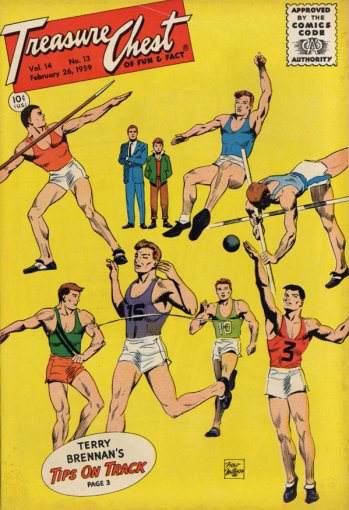
Even diehard comics fans have generally never heard of Treasure Chest of Fun and Fact—unless, of course, they went to Catholic grade school between 1946 and 1972. It was a comic book produced in Ohio for national distribution to parochial schools, and maps well to the era of Postwar Triumphal Catholicism. I was a grade schooler between 1958 and 1966, so Treasure Chest was always kicking around somewhere, along with Our Little Messenger, Young Catholic Messenger, and numerous other things that the George A. Pflaum Company of Dayton was always pumping out. I read Treasure Chest when it was handy, though I did so absent-mindedly and was never a big fan. The comic ran the gamut from preachy (always) to silly (often) and the quality was very uneven. The larger and long-running series were often beautifully done from a writing and art standpoint, though much of it glorified sports, which was a Catholic fetish at that time, in the hopes that young boys exhausted by sports will not go off by themselves somewhere and, well, you know.
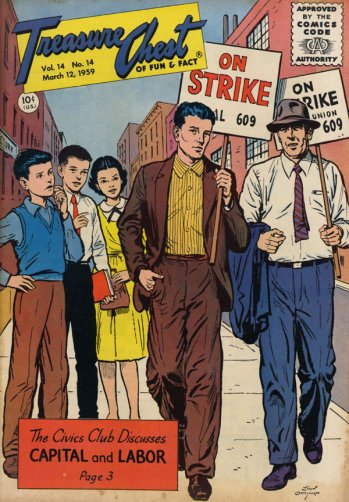
I was chasing memories around the Web the other night when I discovered the Treasure Chest archive at the Washington Research Library Consortium. This is a wonderful thing, but for copyright reasons it only has the magazines from 1946 through the end of 1963, which is unfortunate for reasons I'll relate shortly. I remembered only three of the continuing series; the rest of it had fled my brain cells until I started skimming the archive. There were textual letters from some priest (probably advising young boys not to go off by themselves somewhere and, well, you know), illustrated lives of the Saints, and insufferable lectures by Patsy Manners on etiquette and how to throw good parties. (Mixed parties! No, don't read that! We don't do such things in Chicago!) It was a real and sometimes classic comic; if you read nothing else, check out Kidnaped by a Spaceship from 1959. If they ran more like that I might have been an enthusiastic fan, but no; most of what we got was like Chuck White and His Friends, which was about an older guy who took young boys off on wholesome adventures, I'm sure so that they would not go off by themselves somewhere and, well, you know. Funny animals were big, and for a bit of prescient comic surrealism (I flashed on Cerebus) skim The Bear and the Wicked Wainwright. (At one point the Wainwright calls the Bear a “base poltroon,” which became faddish on the playground for a few weeks, though I may have been the only one of us sixth graders who bothered to look up “poltroon.”)

If Treasure Chest is currently famous for one thing, it was for the 1961-62 series This Godless Communism, which still gets the lefties het up. I rolled my eyes a little then and still do; the problem with Communism is not its godlessness but the fact that it murdered a hundred million people in the 20th century alone. Treasure Chest understood its working-class Catholic audience and was completely comfortable with praising organized labor in one of its illustrated civics lessons. No contradictions here; being a liberal has not always meant being a Marxist.

And Treasure Chest was fundamentally liberal, as the term was understood in its time. If it has been famous primarily for This Godless Communism, it may soon become even more famous for something else: a 1964 series called 1976: Pettigrew for President! inked by the well-known comics artist Joe Sinnott. Again, it was a multipart civics lesson: A very slightly futuristic tale of how a candidate runs for President during the election of 1976—12 years in our future—with a little political huggermugger thrown in to keep it from being completely boring. (There were a few scenes with the SST, but in truth not a lot of other futuremongering. I was disappointed. What? 1976? No flying cars?) What none of us noticed at the time is that we never actually saw Mr. Pettigrew full-on. We saw his back, his hands, and so on, but never got a good look at him. I guess we all figured that it was about the process and not the man himself, and in truth we were all taken in and completely poleaxed when on the final page it was revealed that Timothy Pettigrew was Black! He got the nomination, but beyond that the story was open-ended. Here's what the final panel said, courtesy NPR:

“And so this man Pettigrew became the first Negro candidate for the President of the United States. He then went out across the land, this black man, to campaign for the highest office. Would he win? Well, the year was 1976. It was the 200th anniversary of the Declaration of Independence. Could he win? Well, it would depend in part on how the boys and girls reading this comic grew up and voted … it would depend on whether they believed and, indeed, lived those words in the declaration — All Men are Created Equal.”

Alas, I have yet to see the comic scanned and posted anywhere, since content published in 1964 and after is automatically still in copyright. (The earlier issues had not been renewed and thus passed into the public domain.) The best we can do is a YouTube video, of all things.

It's a measure of our progress that what was seen as an inspiring piece of comic book science fiction in 1964 smacks of tokenism today: So we should vote for him just because he's black? Or dare we ask whether he has a chance of running the country? (The country may end up doing a lot of growing up next year, heh.) And if you ever wanted to invest in comic books, now's the time to hunt down and grab Treasure Chest Volume 19, issues 11-20. They're going to be worth something soon, no matter which way things go this fall.

The Friction Is In the Discovery

I don't buy a lot of music anymore, and in thinking back, I suspect that I stopped buying when I stopped listening to the radio. (I stopped listening to the radio because the stations play the same sixteen stupid songs every twenty minutes…forever. But that's a separate rant.) The tough part in selling anything is discovery—basically, getting the prospective customers to know that you exist—and it becomes a lot tougher when you slide from machine screws to wine, and incomparably tougher yet when you move from wine into the realm of art. Absent radio, I discover new music a lot less often. Here's a recent discovery tale that did lead to a purchase, and if I were the artist I'd be maybe a little annoyed:

Carol and I don't watch a lot of TV, but we turn on the Weather Channel before we go to bed to catch Local on the 8s, and then again in the morning over breakfast. The Weather Channel plays “smooth jazz” during its canned local forecasts. My affection for smooth jazz is sparse, albeit less sparse than my affection for what I call club jazz. No sax please; we're contrarians—I think I dislike sax music because almost everybody else worships it. A few mornings ago, I looked up over my Cheerios to watch Local on the 8s, and realized that there were no saxophones playing. Better still, it was not the usual mournful, shapeless noodling, but a purposeful, upbeat (nay, near-manic) piano piece. Two minutes later, the forecast over and the music cut short by yet another Mucinex mucus man commercial, I ran out of the kitchen to the machine here, muttering, “I gotta have that!”

Alas, the Weather Channel does not announce the artists on its forecast music, so I hammered out a quick email to them, after spending several minutes digging through their site looking for a contact link: Please, folks, what was the title/artist of the bouncy piano piece playing during today's 6:58 AM Local on the 8s?

I only half expected an answer, and was working on memorizing the piece so that I could whistle it to whomever I might know in smooth jazz fandom. But yay wow, by late afternoon, I got a nice note from a Weather Channel junior staffer who confessed that she didn't know precisely, but the February AM playlist was attached. And so it was: The email carried an Excel spreadsheet containing the titles and artists for 15 songs, one of which was by implication the bouncy piano piece. I just didn't know which one.

I had done this kind of detective work a time or two before. I first looked up the artists, separating the pianists from the sax maniacs. It came down to either Leo Tizer or Bradley Joseph. I went over to Amazon, looked up the artists, and started playing the samples for the album tracks named in the playlist spreadsheet. On the third try, I got it: Brandley Joseph's “Rose-Colored Glasses” (and Bradley himself) had been discovered. Ninety seconds later, I had purchased the track through One Click for 89c, and had a DRM-free MP3 in my music directory. Ninety seconds after that, I had his CD album (Hear the Masses) on its way. The friction was all in the discovery.

Amazon supposedly sells two million music tracks as unencumbered MP3s. I shop for music so rarely that I didn't even know this. I did know that Amazon has been selling PDF-formatted short stories (and other short textual works, including nonfiction) for a couple of years now, for 49c a pop. Alas, by the time I decided to apply to the program, they had closed it to new submissions, but the delivery mechanism is the same as for MP3s: If you have One Click enabled, you get the item in a few seconds.

I think Amazon Shorts may have been doomed because Big Name Writers would not sell unencumbered PDFs, and Small Name (or No Name) writers do not sell enough of anything to justify the effort it takes Amazon to vet them and post them. Or perhaps Amazon is simply migrating the program to Kindle. We'll find out eventually. The point to be taken away here is that we have digital delivery down cold. Discovery is fluky and always will be, especially for things like fiction, which (with vanishingly rare exceptions) you do not hear on the radio. Amazon can make the gumballs drop into your hands. We're still not sure how they'll make you want the gumballs, but tougher problems have been solved.

In the meantime, Bradley Joseph has another fan, and might have more if the Weather Channel would just put his name in the corner of the screen while they're playing his music over their forecasts. I hope he got some cash for the license, because not everybody is going to dig as hard as I did!

Standard Wall Warts

I lost the wall wart charger for my Sony Reader a couple of months ago, and a new one should be here in a few days. I don't love the Reader, as its USB transfer software unapologetically refuses to run on Windows 2000, but a guy in my business should have one, just as he should have a Kindle. In the meantime, I've been thinking a lot about wall warts, chargers, and one area of electronics that could really use a standard or two. The high road is something like the WildCharger featured recently on Crave, which is basically a pad that induces a trickle of electricity into whatever you place on it. Wotthell, that technology should be available built into computer desks, but it's not up to me.

I am very sick of wall warts. I have a bin of them downstairs, probably thirty in all, and I doubt that any two source the same voltage. The barrel connectors are of wildly different diameters, and some of them put the positive conductor on the outside. A few, furthermore, are not even barrels but weird connectors of no conceivable justification.

Damn, I want a standard.

Consider this as a possibility: A code for wall warts that could be printed on both the wart and the electrical device it's shipped with. The code would be human-readable and contain the essential parameters:

DC5-20-100-6P

The code begins with AC or DC. (There are AC wall warts, lord knows why.) The next number is the whole number voltage, separated from the fractional voltage by a dash. A second dash sets off the current sourcing capacity in milliamps. The code ends with the diameter of the barrel connector in millimeters, followed by either an N or a P, depending on the polarity of the inner conductor. For example, the code shown above would be for a DC wart sourcing 5.2V at 100 ma, with an 6mm barrel connector having positive on the inside.

There's no reason these things can't be like jelly-bean logic, and there's no reason why anyone should have to dig too hard or pay too big for a replacement wart. The IEEE should be doing something like this, but isn't.

My new Sony Reader charger will show up the day after tomorrow via DHL. And the day after that, I'm sure I'll find the original. At least then I'll have a spare.

The Revenge of the Classics

I've lived such an overstuffed life for so many years that I'd almost forgotten a psychology that was a very big part of my youth: Sniffing around for “just something to read.” I'm a very deliberate reader these days because I don't have a lot of completely uncommitted time. I have a reading buffer of 50-100 books on hand here, all of which were chosen because they touch on one of my interests or another. (My library as a whole contains somewhere around 2500 books, down from 3000 before we left Arizona.) I never have to cast about at random for just something to read.

For many people, reading is an even bigger part of their lives, believe it or not. (Maybe fewer than we'd like, but they're out there.) These people are driving the ebook industry right now, and I've noticed a phenomenon few others have commented on: the explosion of interest in out-of-copyright books by people who might not have been slobbering Dickens or Jane Austen fans in the past. At numerous sites online, people are uploading ebook versions of many classic texts. I follow Mobileread, which now has about 3,800 free ebooks online for download, the bulk of them pre-1923 works, some well-known (they have Dickens' complete works now) and some pretty obscure, like the Scottish Psalter of 1650. Mobileread is interesting because people are creating versions in the popular small-screen ebook reader formats like Ebookwise, MobiPocket and BBeB rather than raw text—nor formats used primarily on PCs, like PDF and MS Reader.

I continue to boggle at people reading Thackeray on their cellphones, but boggle or no boggle, it's being done. The classics are coming back. I can't entirely explain it, but I have some hunches:

  • Many of these ebook editions are beautifully done. The Dickens canon is the work of one man named Harry in the UK, and they include some of the nice old 19th Century woodcut illustrations plus color covers where those were available. (Oliver Twist, yes. Martin Chuzzlewit, no.) They are not shot full of OCR errors and gaps like some of the stuff I've downloaded from other places, including the venerable Project Gutenberg.
  • They are free and they are easy to get. There are no hurdles to jump, nothing to sign up for, no money to lay out, and no DRM to drop sand in the gears of the experience.
  • There are no ethical issues involved in obtaining them or passing them on. I still think people are basically honest, and they do consider the rights of copyright holders.
  • They're classics because they have withstood the test of time. They're good.

The classics have always been available in bookstores, of course, at prices comparable to those of newly published books. But if you're shopping for something to read on the train going in to work because it's a dead hour coming and going, it's hard to beat free, especially if free is easy and involves no pokes from the conscience.

What we're seeing here might as well be called open-source literature. It's being done by volunteer labor, including people who are drawing new artwork and contributing it without copyright claims. It's significant because people writing new ebooks have to take into account that the total available number of reader-hours in the audience is finite, and the friction involved in obtaining and reading the classics is now approaching zero. Like Linux, it will take a while yet for the well-formatted library of classic ebooks to mature, but like Linux, they will eventually become a competitive force to reckon with.

And wow, dare we hope that the premodern will put a fat boot up the ass of the postmodern? A lot of those “dead white males” must be grinning about now.

US Copyright’s “Weird Window”

US copyright terms are more complex than they should be—everybody seems to agree on that but Big Media. Here's a nice short summary that I have presented before. What's interesting is what happens in a sort of weird window between 1923 and 1963. Books published in that window bearing a legal copyright notice may or may not still be within copyright. The key is whether the copyright was explicitly renewed by the rightsholder. No renewal, and the book passed into the public domain after its initial 28 years of copyright, which would be no later than 1991.

Most books from that period that we even moderately successful financially have been renewed, but I've found a fair number of reasonably interesting books that were not. Most of the books I used in my researches into the fourth dimension in high school were either pre-1923 or never renewed: Coxeter's Regular Polytopes, Manning's Geometry of the Fourth Dimension and The Fourth Dimension Simply Explained, Somerville's An Introduction to the Geometry of N Dimensions. All are now in the public domain, and all are available from (surprise!) Dover Books in print editions, but I would certainly like to see them become nicely reset PDFs and not simply holographs. (My copy of Coxeter fell apart back in 1970.)

A lot of old electronics and amateur radio books were never renewed. All the Frank C. Jones amateur radio books that I have (great tube-era construction stuff!) have expired, and they were beautifully done. The late Don Stoner's New Sideband Handbook from 1958 is now out of copyright, as is Radio for the Millions. A lot of these old titles are now available from Lindsay Books.

As I've mentioned in other places, a lot of classic SF has expired, including most of E. E. Doc Smith's work, and much of H. Beam Piper. All of the Skylark books except for Skylark Duquesne (published shortly before the author's death in 1965 and thus outside the window) have expired, as have all of the Lensman books except for Gray Lensman and Children of the Lens. None of the Ace Double short novels I've checked have shown up for renewal, including Chandler's The Rim Gods and Lin Carter's Destination Saturn. Both of those could stand republishing; most of the other Ace Double entries I have are best forgotten. (It may be that the components of Ace Doubles were treated differently from a copyright standpoint; this would be useful to know. I'm looking into it.)

Nothing written solely by the Jesuit Herbert Thurston has been renewed, and his book Ghosts and Poltergeists is actually good sleepytime reading. (I'm still trying to obtain The Physical Phenomena of Mysticism, which of all his books has the best rep. The bookstores I order it from keep selling it to somebody else before I get there.) The New Dictionary of Thoughts is a decent book of quotations, well-organized by subject, and now expired. Max Freedom Long's pre-1964 books on Hawaiian religion and magic were not renewed, nor were Carl & Jerry author John T. Frye's two books on radio repair. Ditto Glenn's Theodicy and Broderick's Concise Catholic Dictionary, along with Jessie Pegis' A Practical Catholic Dictionary. The slightly peculiar Benziger Brothers' My Everyday Missal from 1948 (with print I can't imagine anyone could read in a badly lit church) does not appear in the renewal records. Ditto My Sunday Missal from Fr. Joseph Stedman (1942) and St. Joseph Sunday Missal from Catholic Book Publishing (1962). In fact, most of the odd little prayer books I've gathered over the years either have no copyright notice or were never renewed.

And that's just the stuff from my own library. When I come across a book published in the Weird Window, I often check the renewal records to see if it's expired. There's a nice lookup page here, though the lawyers always caution that it's possible for there to be errors. I suppose. Nonetheless, there's a lot of room for the release of these titles as ebooks, or their reissue in print via POD. The public domain does not begin in 1922 and go back from there.

Artificial Stupidity

Unambiguously better now. I'm no longer taking narcotic painkillers, and mirabile dictu! I can think again. The big battle now is not against pain so much as the swelling, and anti-inflammatories don't disrupt your higher brain functions. (They can mess bigtime with your stomach lining if you're not careful, though.) My mouth is still a little uncomfortable, especially after I eat something—even innocuous stuff like oatmeal and cottage cheese, which is most of what I've been eating for seven days now—but it's not like it was even two days ago. I've lost five pounds in seven days while getting no exercise at all. Try the Gingivectomy Diet—no, scratch that. Not worth it.

The swelling can and does cause some nagging discomfort, and while I'm not quite my usual ebullient self, I'm in the ballpark again. My experience this past week reminded me of the mystery that has tied our nation up in knots from time to time: Why “drugs” are an issue at all. We as a society spend an immense amount of money chasing people who make an immense amount of money selling chemicals for an immense amount of money to people who seem to think ingesting them is worth an immense amount of money—not to mention the risk of jail time . I've never been able to figure the payoff, however, and I'm gradually coming around to the realization that the mystery is really about me:

I don't get high. I've never gotten high. In truth, I'm not even sure what “high” means.

I smoked marijuana a couple of times in 1973, in part because everybody I knew was doing it, and in part because I was interested in whether drugs could enhance creativity. The answer to that was a resounding no; pot made me depressed and paranoid for days afterward. By that time I had already given up alcohol because there was no payoff apart from confusion and a tendency to talk too much—and when I drank more while looking for that elusive payoff I just threw up and felt wretched for the next several days. (It was ten years before I went back to good wine in small quantities.)

Here and there in the subsequent 35 years I've been given narcotics for pain. I vividly remember my first hernia surgery in 1978: I had eagerly packed a small bag of electronics theory books to study during what I was told would be four days of enforced bed rest. (They did not tell me who or what would enforce the bed rest, heh.) The memory of picking up an RF design text ten minutes after a shot of morphine is peculiar: Damn, I used to know what this stuff meant! After a few minutes of futile riffling, I grabbed the TV remote and happily watched “Green Acres” reruns until I fell asleep. A few years later I had my wisdom teeth pulled, and under the influence of some damned pill or another I felt stupid and took peculiar delight in watching “The Dukes of Hazzard.”

And that's been my pattern ever since, when medical issues arise and I get handed drugs: Instead of euphoria, I get artificial stupidity, memory lapses, and depression. The memory lapses I don't mind much; who wants vivid recall of a root canal or colonoscopy? (My last root canal I remember well because they tried to sedate me with nitrous oxide, and it didn't work. At all. Nada. I had to content myself with watching Raiders of the Lost Ark on a TV embedded in the ceiling while praying that the whole thing would be over soon.) But I dislike the feeling of my intelligence falling away from me as the drug takes hold; to me it's a metaphor of losing my soul and thus all that matters to me. (I drew on this feeling in describing the motivation of the Guardian in my 1980 story of the same name.)

I'm a naturally upbeat person, and perhaps that's the key: I may be immune to euphoria because I'm already there. A woman I knew in college said something once that startled me at the time: “The trouble with you, Jeff, is that you're too damned happy!” Looking back, however, she just may have been right. Having a naturally euphoric state could be like living at the South Pole: No matter which way you go from there it's toward gummy-headed depression.

It may be impossible for me to understand why people risk their lives for narcotics, just as it may be impossible to understand how people can enjoy nasty bitter wine like Chardonnay. Life's experience is not the same for all people. I taste bitter things with outrageous intensity, and for the most part I live my life in a state of nonmanic happiness. My brief spates of depression following the loss of Coriolis and several close relatives makes me wonder what life is like for people who are unhappy basically all the time. Perhaps Huxley's soma—or something similar but gentler—really is necessary for some people. (Perhaps we already have it, in the mind-changing antidepressants. See Listening to Prozac.) Mood seems to be inherited, not earned, and if it's inherited, do people have a right to tweak it? (See Stephen Braun's The Science of Happiness.) I don't claim to have the answers, but there's no better time to be haunted by unanswerable questions than when you're sitting still in a comfy chair, dosed to the eyebrows with something that doesn't permit your brain to do anything more than chase its own shadows.

Putting My Dreams on Hold

Dare I hope that I've turned the corner? We'll see in the morning. At least the black-and-blue hasn't gotten any worse, and I'm taking the pain pills less often.

And I've been thinking about dreams. A lot of people thought that yesterday's entry described a dream made up for the sake of a funny story, but it wasn't—the dream was real and unfolded precisely as described. I had another dream last night with the same odd characteristic in common: No outlandish elements. I dreamed that I was at my godfather's dairy farm near Green Bay, Wisconsin, standing in the open doorway of the farmhouse watching the cows champ grass in the pasture, like I did when I was there in the 50s and 60s. They were ordinary cows eating ordinary grass, and the house was precisely as I remember it, even though the farm was sold and the house razed over thirty years ago.

I think that's the key: My dreams for the last few nights have been composed entirely out of things remembered, not things made up from whole cloth, as they so often are. I've never met Hilary Clinton, but lord knows I see her enough on TV, and she did grow up a scant couple of miles from where I did. And the outlines of the situation were familiar: I used to visit a lot of offices when I was a Xerox tech rep back in 1974-76, and for the most part I was treated well by the office managers and secretaries who were in charge of keeping their cranky copiers running. I was generally offered coffee or sodas, often with doughnuts or chips, occasionally sandwiches, and sometimes odd things like taffy apples. (I went home once with a zucchini in my coat pocket, though I dislike them and eventually had to throw it out.) More surprisingly, these people (almost always women) generally liked me and had the wisdom not to blame me for their malfunctioning machines, many of which were ancient limping electromechanical clunkers that desperately needed scrapping. I tried to be helpful in return: I was sometimes asked to “look at this damned telephone” or see if I could make a balky radio work. My record there was spotty, but I did what I could and they appreciated it.

I think that Hilary Clinton was standing in here for the archetype of the Good Customer, the ones who knew that I did my best to help them. I enjoyed being a tech rep, even though I knew I wouldn't be doing it for long, just as I enjoyed my visits to Uncle Joey's farm in the early 60s. The Xerox job was peculiarly rewarding—I'm still not quite sure why—and I'm guessing that my dream-maker mechanism was reaching for “comfort memories” and gluing them together with the same abandon that it often glues together weird creatures and impossible architecture and machinery.

So where did the weird creatures go? I have a theory that I tested today: I think that the pain pills anaesthetize the machinery in my subconscious mind that creates brand new things. I tried working on two of my numerous “hanging fire” SF projects, and it was startling how completely incapable I was of making progress. I did a little better on Old Catholics, which is a contemporary mainstream novel about people in Chicago, not an adventure set far in the future on peculiar worlds. Still, I had a great deal of trouble being truly creative today, in any way at all—and I think I'm doing as well as I am on this entry right now simply because I'm due for another pill in an hour or so, and my gums are starting to hurt. I think it's telling that I have taken a pain pill (two of them, actually, of two different kinds) right before bed every night since Monday, so that the chemicals have had their greatest effect while I sleep. (Which is the idea—otherwise I wouldn't sleep.)

I'm starting to miss the weirdly creative theater of the mind that I have always experienced, even though it sometimes disturbs me. I have fair confidence that it will return once the pill bottle is empty. I'll let you know.

Why Is Iowa Special?

And so the whole wretched business begins again, as the anointed tribal elite in Iowa gather tonight to caucus (which comes from an obscure Kickapoo Indian word meaning “to put tribal defectives in a dark room and order them to run around in circles acting like idiots”) six months early or possibly four years late, depending on your perspective.

It's well known that I hate politics, and so don't talk much about it. I don't talk much about dark green leafy vegetables either, but that doesn't keep some knuckleheads from holding that they are the keys to eternal life. But I bring up questions now and then that no one else seems to be asking, like this one: Why does Iowa get to be first, and winnow the slate of candidates before anybody else gets a shot at them?

Here and there you may possibly see the question posed, just before the anointed elite and Big Media tut-tut and say that that's the way it's always been. (Which, by the way, was a major argument in favor of retaining racial segregation.) They then change the subject. More rarely, someone with more guts than sense dares to answer the question, generally by declaring that Iowa is somehow special in a demographic sense. Special? Hey, we're all special today, right? (Ask any third-grade teacher.) You hear the term “microcosm” a lot, generally from people who don't know what it means. As the Wall Street Journal reminded us this morning, the only Iowa caucus winner in recent memory who went all the way to the White House was Jimmy Carter.

In truth, there's nothing special about Iowa that isn't special about Nebraska, Wyoming, or South Carolina. The current primary system gives people in early states power over the choices of people in later states, and that is not a good thing. This leaves us two other alternatives: 1) Have a single national primary in all states on the same day to select November's candidates, or 2) try something else.

Alternative #1 would be better than what we have now (which is simply idiotic) but there's a strong argument against it: Without that early “momentum” obtainable in small states like New Hampshire and Iowa, the big states would select the candidates. This is a reasonable objection, and basically the same one that sustains the Electoral College, which is neither as good nor as bad a mechanism as many people think. (It could use improvement, but let's forego that discussion until November.)

What else can we try? Well, one mechanism seems obvious to me: Assign each of the 50 states a random number from 1 to 50, and then run primaries on 25 consecutive weeks, in which the states that pulled 1 and 2 hold primaries the first week, those that pulled 3 and 4 the second week, and so on, with the states that pulled 49 and 50 primarying (is that a verb? Hey, everything else is!) last. If by some fluke larger states pull small numbers in 2008, it's likely that smaller states will get the same fluke in 2012. But for the most part, it'll be a good mix, and most important of all, not a predictable one. No candidate would be able to snatch momentum by spending months studying the idiosyncratic specialness of Iowans or New Hampshirians and then pandering to that specialness. They'd have to be able to pander to the specialness of any state at all, or (better yet) give up pandering completely and stand on their records.

Such a Randomly Ordered Sequential Primary (ROSP) could make the Giant Pander an endangered species. Now that would be special!