Jeff Duntemann's Contrapositive Diary Rotating Header Image

Ideas & Analysis

Discussions of various issues including suggested solutions to problems and pure speculation

Alox Kites and Toys

I've had a little time to look at and photograph the material I received from Nancy Frier a few days ago. (See yesterday's entry.) I've begun work on a new Web article on Alox products and especially Alox kites, but I can post some early photos.


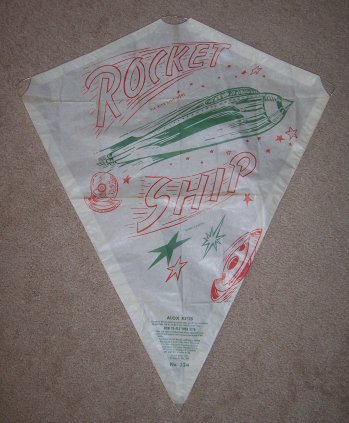
At left is the “Rocket Ship” kite design, but it's not printed from the plate I showed you yesterday. The text and the spaceship are in different colors, indicating that they had separate plates at some point for two-color printing. The kite is 30″ high and 24″ wide, the same as Hi-Flier's Playmates of the Clouds. The Rocket Ship kites were printed on four different colors of paper, in either a single color or a two-color design. The catalog number of this size of kite was #324. As best I can tell (and I will ask Nancy about this) there was no specific SKU number for a given design in a given size. Kites in this size were printed two-up on sheets of paper 30″ X 50″ and then cut and trimmed to the final diamond shape. The kite shown here is post-1964 because the Alox patent #3,330,511 is printed on it. Alox did a big business in promotional kites in this size. I have a few, and will photograph them when we get back to Colorado.

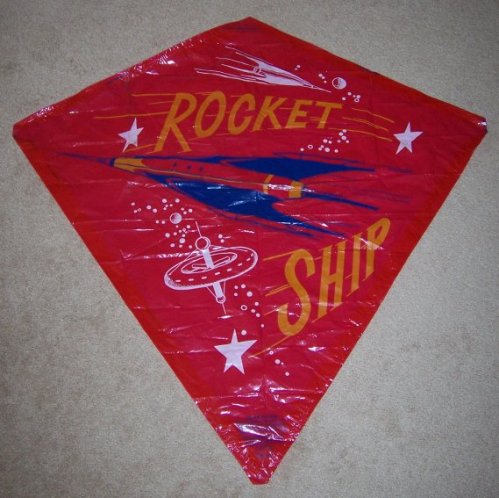
Later on Alox sold a larger kite in a form factor I don't think Hi-Flier or any other contemporary firm used: 40″ X 40″. The one I have is in plastic, with a more modern Rocket Ship design. This is size #420, and was sold in this design and an American Eagle design, in several colors of plastic and ink. Most diamond kites are a little taller than they are wide for stability (useful given that most kids have no idea how to fly kites and learn by painful experience) but bow kites in this proportion or even wider than they are tall can be flown with only a little more skill. These are called Malay kites, presumably because their design originated in Malaya.

Alox also sold barn door kites and box kites. I have a couple of the box kites and will post photos once I get back home and can (carefully) assemble them for display. (One will need some careful repair to the paper sail.) As best I know, Alox was unique in selling a plastic box kite, which was dimensionally similar to the Hi-Flier paper box kite—and probably a lot more durable.

Alox sold kite string pre-wound on hardwood dowels rather than on cardboard tubes, as Hi-Flier did. Lengths included 200 feet, 250 feet and 700 feet. Early kite cord was the familiar cotton twine, but in later years Alox sold a polyester fiber cord called “American Eagle twine” that was much stronger than cotton, and similar to Hi-Flier's Megalon. Other toys in the Alox line included yo-yos of various designs (called “Flying Disks” to avoid the Duncan trademark on “yo-yo”), whistles, sound-effects whips, “carnival canes,” jacks sets, Chinese checkers boards, and many kinds of marbles. Their sales sheets are fascinating, and once I scan them I will incorporate them in my upcoming article on Alox.

Alox closed in good part because a lot of their bread-and-butter items, especially toys, began coming in from China in huge quantities in the 1980s. Anybody who gets the Oriental Trading Company catalogs will know just what I mean here. You can get plastic kites from China (I have a few, and they're in the Oriental Trading catalog every spring) but they are lousy kites, and diabolically difficult to fly. I still think that nothing has ever beaten the 36″ paper diamond kite in stability and “getting up to speed” in young, inexperienced hands. Even with a sail badly glued from newspaper, such kites went up enthusiastically and practically flew themselves. It's a bit of a tragedy that diamond kites have become rare (the ubiquitous deltas are cranky and in my opinion hugely overrated) and a serious tragedy that paper kites as a whole have become extinct.

They don't have to be. The sticks can be had at Hobby Lobby or Michael's. The newspaper is in the recycle bin. Cotton twine is at Home Depot, and Elmer's Glue will stand in for mucilege. What are you waiting for?

Crackergate, Mon Dieu

I elbowed a bit of a wasp's nest yesterday, in briefly recounting the story of Paul Z. “PZ” Myers, the biology professor who put out a call for Catholics to mail him consecrated hosts for public desecration. There's backstory that fairness requires me to relate: Webster Cook, a student at the University of Florida, went to Mass at a Catholic Ministries liturgy held on campus, took Communion, and went back to his pew without consuming the host. Why he did this is unclear—I had a great deal of trouble sifting facts from hearsay in this case, which exists mostly in the blogosphere—but he took the host out of the building even though some of the people from Campus Ministries noisily demanded that he either swallow it or give it back. He refused, and the host went home with him in his pocket. Thus began…Crackergate.

I may catch some flack here from my Catholic readers for saying this: The church should have left it at that. But no, the well-known William Donohue, head of the Catholic League, got into the act, and suddenly it's a category 5 barroom brawl. Donohue has made a career of jumping on anybody and everybody who says something that puts Catholicism in a bad light. How effective he's been is open to debate. He was certainly instrumental in getting ABC's warm-hearted but liberal-slanted Catholic sitcom Nothing Sacred canceled back in 1997; beyond that it's hard to tell. He's gone after solid milk-chocolate statues of Jesus and tried to organize a boycott of the film version of The Golden Compass. I'd suggest that there are other, better places where that sort of energy might be spent, but let it pass. Most moderate Catholics would love to find another village that would take him.

Webster Cook returned the undamaged host to the church about a week later, but not before the Catholic lunatic fringe had begun sending him death threats. And then Prof. Myers jumped into the game, eager to play the dozens and keep the pot at a full boil. Here are his exact words, posted on his blog:

I have an idea. Can anyone out there score me some consecrated communion wafers? There's no way I can personally get them — my local churches have stakes prepared for me, I'm sure — but if any of you would be willing to do what it takes to get me some, or even one, and mail it to me, I'll show you sacrilege, gladly, and with much fanfare. I won't be tempted to hold it hostage (no, not even if I have a choice between returning the Eucharist and watching Bill Donohue kick the pope in the balls, which would apparently be a more humane act than desecrating a goddamned cracker), but will instead treat it with profound disrespect and heinous cracker abuse, all photographed and presented here on the web. I shall do so joyfully and with laughter in my heart. If you can smuggle some out from under the armed guards and grim nuns hovering over your local communion ceremony, just write to me and I'll send you my home address.

Here's the full post on Pharyngula.

Ok. Does any of this sound to you like a pack of seventh graders mixing it up on the playground? It sure does to me. The detailed facts seem to change depending on whom you read, but Cook is claiming that he was “restrained” by a woman who turns out to be about half his physical size. He is now filing charges against the Campus Ministries for violating university hazing rules that prohibit forced eating. And Bill Donohue is trying to get PZ Myers fired. So far, as best we can tell, no desecrations have taken place.

My primary comments on all this:

  • Genuine death threats are illegal and actionable. If you get one, don't just bitch. Go to the cops. That's what laws are for.
  • If your opponents are insulting you, meeting them insult-for-insult is precisely the wrong thing to do if you want the moral high ground, or to simply avoid looking stupid.
  • Respect is an inner virtue; less something you show than something you are. Desecration happens in the man (or woman) and not to the host, flag, book, shrine, or image.
  • Allowing people to make you angry gives them power over you.

Atheists who are cheering on Myers seem blind to the fact that Myers is making atheism look bad. Which leads me to ask: What is atheism actually for? If its goal is to win people away from religion, making sane arguments in a respectful manner would seem more effective than insults and ridicule. If (as seems to me at times) it's a sort of tribal venting society, then go for it, keeping in mind that few people recognize therapeutic venting for what it is, and you won't get a lot of converts from ordinary folks who are not axe-grinders by temperament. You'll just look churlish.

I'm sure I've already given this more attention than it really deserves. I've begun wondering if Webster Cook was challenged over a drink to come up with the college prank to end all college pranks (judged by the ratio of effort required to publicity generated) and he may have succeeded. I've also heard that PZ Myers is considering desecrating a copy of the Qur'an as well. I'll believe that when I see it.

Mainstreaming Sit-Down

I find much or most of the debate on the obesity explosion puzzling. Many major American cities are trying to pass laws severely limiting fast food outlets or banning them entirely, blaming them for our increasingly fat population. The sheer violence of the debate (cruise pertinent online discussions and you'll see what I mean) suggests that more is going on here than a discussion of nutrition, but I'll be damned if I can figure out just what, though I will speculate below.

As I've said here more than once, obesity, like most health issues, is more complex than most of us would like to admit. It's about calories but not only calories, and contrary to conventional wisdom, one calorie is like any other calorie…if you're a calorimeter. Sugar calories do different things in the body than fat calories, yet you wouldn't know this trying to get a grip on the problem online. The speed with which I dropped belly fat when I basically gave up sugar was startling. Sleep loss is also a factor, according to the Mayo Clinic. (Alas, the Mayo Clinic still believes in the BMI, which does not distinguish at all between fat and muscle. Ummm…and you guys are doctors?)

I've read a lot of speculation as to what kicked off the obesity epidemic in the midlate 80s. That's when high-fructose corn syrup went mainstream and drove cane sugar out of soft drinks. It was when our high-speed, high-stress always-on culture kicked into high gear and 60-hour weeks became a commonplace. It's when the overall inflation-adjusted price of food fell to historic lows. And it was also the time when something else happened: an explosion of low-end “sit-down” restaurants fielded by national franchises. You see them everywhere: Red Robin, Applebees, Black-Eyed Pea, TGI Friday's, and so on. They are legion. And if you're a true calorie believer, the caloric content of their dishes will take your breath away: One order of Outback's Aussie Cheese Fries appetizer contains 2,900 calories. Even expressed by weight, it is to boggle: A large Maggiano's pasta dish gets you over two pounds of noodles on a 15-inch plate.

Wow.

The tirade against fast-food restaurants is peculiar in that it does not recognize that fast-food portions are generally smaller than those at sit-down restaurants, and more to the point, fast-food items are what old-time IT guys would call “unbundled”: You can get menu items separately if you want them. You can get a single small burger—or a Triple. You can get fries or no fries, and fries in sizes. On the much simpler sit-down restaurant menus, you must get the potatoes with the steak, and the portion size is always…lots. And anyone who says with a straight face that there's more fat in fast food than at casual dining sit-downs is either lying or doesn't get out much.

We didn't go to restaurants much when I was a kid, in part because back then, sit-down restaurants were higher-end, and expensive. We had to dress up on special occasions to go to Llandl's or the Kenilworth Inn in Lincolnwood. The notion of “casual dining” was still pretty uncommon, and probably considered a contradiction in terms by dining purists. (What there was fell into the separately interesting category of “greasy spoons.”) Since 1985 or so, sit-downs went mainstream on a huge scale, as corporate restaurant franchises gobbled up key slots at the corners of megamalls and major intersections. Your average American went from dining out a few times a year to a couple of times a week, with portion sizes that I still find boggling.

My point here is that crucifying fast food as though it were the sole cause of obesity (or even the major contributor) is magical thinking, and has more than a whiff of politics in it. (When reading things like Fast Food Nation I see union opportunism and attacks from the Vega System.) Nothing is ever that simple, and if we keep insisting that it is, no progress will ever be made. It's not about McDonald's. It's about genetics, metabolism, portion control, exercise, sugar, stress, and sleep—and probably fifteen other things, most of which we still haven't defined. Let us not pull the trigger with the wrong guy in our sites, just to be shooting something.

Productivity Theater

Slashdot recently aggregated an article from The New Atlantis suggesting that multitasking makes us stupid. This is old news to a lot of people, myself included, but it's interesting how today's pervasive multitasking culture is finally engendering a healthy dose of backlash. Last November, there was an even blunter piece in The Atlantic Monthly that I had hoped to comment on here, but…I was interrupted. Turn your cellphone off and read both.

In human cognition as in computer systems, context changes are costly. Rational thought (as opposed to pure subconscious ideamaking) is strictly linear, and depends utterly on bringing a network of pertinent facts and relationships among facts to the forefront of the mind for easy reference. Lose that network and you will lose your train of thought; in fact, that's what “losing your train of thought” actually is. Some people may be better than others at picking up the train and slapping it down on another section of track without spilling the coal cars, but nobody delivers the load faster than the one who just brings it to the destination in uninterrupted linear fashion. Anyone who thinks otherwise is fooling himself.

That's the gist of both articles. The deeper question is this: Why do we believe that multitaking is better than focus? In part I think it's because our culture demands productivity, and multitasking is a sort of productivity theater: It makes our managers think we're productive because it gives the impression of furious constant activity. Alas, it makes us think we're productive as well, when in fact most of that furious constant activity is just us dodging what we really ought to be doing.

I've seen this effect in myself: When I'm working on something and hit a difficult spot, the less disciplined parts of me start looking for a context change. Hey, I haven't read email for awhile…hey, wasn't I supposed to call Keith? Hey, there's that corner of the basement that I keep meaning to tidy up…and so I drop my current task precisely when it would benefit the most from renewed and intensified focus.

This is hardly a modern phenomenon; what's different is that in the past it was considered a temptation to scatterbrained-ness and a failing inherent in weak minds. Today it's considered the hallmark of a truly modern intellect. Modern, sure, but hardly efficient: Allowing yourself this sort of unwarranted context change trains the mind to bounce from the easiest parts of one project to the easiest parts of another, making little genuine progress and getting very little to the finish line.

Much of the blame falls to a modern educational system that doesn't reward focus, followed by overworked managers who lack the time, the tools, and the gut instincts to understand “how things are going” in their organizations. HR doesn't help; people who insist on the time and the solitude to focus are often disparaged as “not team players” even when the work in question is not essentially collaborative. In my experience, most real productivity is achieved during “heads down” time, and most “teamwork” cooks down to kibitzing. In fact, the most productive meetings I recall were the ones where that obnoxious guy kept yelling “focus!” (Most of the time, that obnoxious guy was me.)

Flow follows focus. Systematically breaking focus leads to a state of mind that, irrespective of what it happens to be doing, is constantly wondering whether it should be doing something else. This way lies madness; nay; this is already madness. Resist it with everything you can muster.

Fantasy? Or Science Fiction?

“Hilary? Hey, John McCain here. How's it going? Yes. Understood. I read the news. Look, I'll get to the point: Do you still want to be President? I think I can help get you there. It's unorthodox, but hear me out.

“Your party is in trouble. Once the media decided to anoint Obama as our next President, they turned on you, and split the Democrats wide-open. My numbers people tell me that about a quarter of your supporters would rather vote Republican than vote for Obama. They may not actually do that; they may just stay home. But if Barack thinks he's just going to walk off with the election, he's greener than he looks.

“My party, on the other hand, is just about dead. The corpse is still twitching, but the neocons killed it a long time ago. The Democrats are split two ways. The Republicans are split ten ways. Ok, I won't lay it all out; I respect your research staff. This is not new news. Over here we're all having a bitch of a time trying to decide what the party stands for, and the party leaders don't even like me. They're keeping their mouths shut; they don't want to do what your party's doing to itself. They wanted Rudy Giuliani, and they expected me to lose gracefully and go away. I lose gracefully—when I lose. But they're gritting their teeth when they say they support me. Behind the scenes they've said a lot of the same things about me that your party bosses are saying about you. I'll admit to you privately that I'm pretty angry about that.

“But set that side for now. We both have this other problem: There are a lot of people who are disgusted with the whole business. It's not fair to say that they're in the middle, between you and me, between Republicans and Democrats. They're outside the graph. They're tired of the posturing and the tribalism and the personality cults. They know the country's in trouble, and they want it fixed. They're tired of the War, they're afraid for their jobs, they're afraid of getting cancer and losing everything they own before dying in agony. Global warming isn't on their radar. Neither is gay marriage. Those are fringe issues. It's about the economy. It's always about the economy. Bill had that dead right.

“There's a window here: Remake the Republican Party out of the rubble, put some solutions on the table, and try to find a way out of the mess we've gotten ourselves into. That's what I'm going to try to do. I'm going to piss a lot of my party people off, but I'm going to tell them to hit the road. I'm going to turn the whole thing inside out. I'm going to let the tax cuts expire. I'm going to propose another approach to universal health care. It may take a couple of years, but I intend to end the War.

“No, I don't blame you. I don't expect anybody to believe me, which is why I'm not telling anybody. But that's what I'm going to do. Look: I'm 71. I'm in decent health but I get tired sometimes. I have this one last chance to do something completely audacious, which is to break the gridlock and get this country back on track. Otherwise, I keep the status quo and go quietly into that good night, probably before the end of my second term. I do not intend to be another William Henry Harrison.

“I admire your guts and your persistence. I respect your positions, even the ones I don't hold. I think I can win this November. But with you as my VP, I don't think we can lose.

“Hilary? Hilary? You there? Yes, I'm serious. And I'll make you this promise: Run with me in 2008, and I will choose not to run in 2012. We don't have to say anything now. I'll be 75, and that's too old to do it again. The public will accept that.

“Hold on. You do not have to actually be a Republican. You simply have to pretend to be one for a year or two, until we completely re-create the Republican party somewhere in the center. My research indicates that many more Americans want consensus than ideological polarization. We may have to upset a few noisy people at the extremes who like to think that they're more important than they are. I'll cover the right if you'll cover the left. But I promise you, when we're through with it, it will be an utterly different party.

“Barack's young, and his people worship him. He'll try again in 2012. Still, I don't think there's a slate in the universe that could win against Clinton/Rice.

“Are you in? You don't have to tell me right this…

“Wow. Good. So let's do it. You've waited long enough. I've waited too long. It's time. It's just damned time.”

Josef Fritzl, Evil, and Dumb Luck

Most of you have probably heard by now of Josef Fritzl, an Austrian psychopath who created a custom dungeon under his home, kept his daughter a prisoner there for 24 years, and sired seven children by her. I haven't been this disturbed by a crime since the boggling case of John Wayne Gacy, right here in NW metro Chicago, who tortured, murdered and then buried 33 young men under his house back in the 1970s.

Like it or not, crimes like this prompt one to ask an ugly question: If evil like this is possible, why are we still here? Why are we not already extinct? (Those who have studied the history of the 20th Century might say it was a very near thing.) I have a theory, though I admit it's a little thin to hang the future of humanity on: It's difficult to be brilliant and evil at the same time. Evil as we define it generally comes with limitations, primarily the limitation of not being able to see yourself and your own situation very clearly.

Right Men (as described by A. E. Van Vogt and Colin Wilson) are the best example: They just cannot conceive of the possibility that they are wrong. A huge number of Right Men thus never get very far in life. We see through them easily, recognize them as egomaniacal psychopaths, and do our best to avoid them. They have a bad habit of getting injured or killed in conflicts with others. Even when they somehow succeed in society to a degree, they are almost invariably humbled at some point, which is unbearable to them and often causes them to die young.

This is a good thing for us, as truly brilliant evil is extremely dangerous. What most “ordinary” evil people (like Fritzl) have that isn't often remarked upon is simple, dumb, statistical luck. Most criminals get caught eventually, and the worse their crimes are, the more likely they are to get caught. Some vanishingly rare few end up skating past justice for years and years (like Fritzl), and we only see a couple per century who are so lucky that they end up in command of armies. (Think Hitler, Mao, and Stalin.)

There are a lot of Fritzls out there. Most try evil things and get caught very quickly; you see them on the news all the time with their coats over their heads. Some get by for awhile, through a combination of luck and unusual intelligence. Only a handful are lucky enough to get away with the sort of depravity that John Wayne Gacy or Josef Fritzl got away with. Choosing an easily concealable form of evil is part of that luck, and sometimes there is a lot of cunning hard work involved. (Like creating a custom dungeon with flush toilets in the basement, or burying 33 bodies under your house without stinking up the neighborhood. I still don't entirely understand how Gacy managed that.)

As for where individual evil itself comes from, I think (against all political correctness) that it's primarily genetic. We're born along a bell curve, with Mother Teresa on one end and Stalin on the other. The optimist in me would like to think that the curve is biased toward the good. But whether or not we're evenly distributed across that bell curve, good and evil as success strategies are not symmetrical. Good is outward-looking, cooperates with others, and is generally supported by society as a whole. Evil handicaps itself in various ways. (Read Colin Wilson's A Criminal History of Mankind for hundreds of pages of examples.) Evil overestimates its chances, isolates itself, picks fights, and operates within a seriously distorted view of reality. This is fortunate, otherwise we'd long be extinct. But every now and then an evil individual gets catastrophically lucky, and we witness crimes that make us gasp. Given the huge number of moving parts in our seriously overstuffed world, this is inevitable, and the real astonishment, perhaps, lies in the fact that evil remains as rare as it is.

Between Fire and Ice

Sure, maybe the guy's a nut, but I'm a contrarian and I love heresies. There certainly seem to be fewer sunspots this cycle than we're used to, and cooling climate trends are definitely correlated with things like the Dalton Minimum and the Maunder Minimum. I've sometimes wondered if the Little Ice Age was “little” because we aborted it by throwing CO2 into the atmosphere in serious quantities. Absent that, we might all be cavemen in an ice wilderness by now.

Ahh. Maybe the Earth really has a little old lady named Gaia somewhere pulling strings. Maybe prescient whales (or sentient mushroom rings in the English forests) saw it coming and carefully guided the evolution of humanity so that it would control fire. Fire is addictive. Do enough of it, and you can keep the atmosphere warm through the greenhouse effect. Maybe the Earth got tired of being cold, and it evolved us because it didn't have any leg warmers.

Climate is an interesting business. The Earth seems to teeter between fire and ice, but from what we know of our geophysical history it prefers ice. If the sunspot dearth is a leading indicator of reduced solar activity, we may have a few years to do…what? Buy Hummers? Whoops. We already tried that.

Ok, ok, correlation is not causation. I'll shut up. Still… At least in Colorado Springs, this was The Winter That Wouldn't End. And it snowed in Chicago last night. If this keeps up I'm moving back to Arizona, thank you very much. I hear that when the ice sheets get as far south as Nebraska, the mammoth hunting is better there.

Clay Shirky’s Cognitive Surplus

sent me a pointer to an article by Clay Shirky about the “cognitive surplus”—excess brainpower not needed for making a living. Thought-provoking in the extreme; read it if you haven't already. Shirky's thesis is that free time created by postwar productivity gains have been sopped up by watching TV, and if we watched only a little less TV and deployed that wasted brain-time in collaborative projects, wow! The things we could do! I'm short on time today, so I'll post a few quick observations on the article and the idea here, in the hope for more general conversation:

  • The consequences of the invention of gin are very well covered by Colin Wilson in his book A Criminal History of Mankind. The problem was not solved for 200 years—the urban poor drinking themselves to death was the primary reason for Prohibition—and it's still not entirely clear to me how it was solved. My guess: Universal education and technology (think TV) allowed the poor to entertain themselves in less destructive ways.
  • Do we really watch two billion hours of TV every year, or are TVs simply on for two billion hours? In many households, TVs provide a sort of background noise to prevent too much disturbing silence, but how much attention is paid to the box is a lot more difficult to measure, and I suspect Big Media would prefer that no one try.
  • TV is often watched for the many but very small time slices that it takes to catch the news or weather. Carol and I watch very little TV but The Weather Channel, and we watch it in small chunks of a few minutes a few times a day. It adds up, but converting those dispersed minutes into productive brain-time may not be possible. The problem here is not a shortage of time but a shortage of focus, which is a separate and worthy discussion.
  • Almost incredibly, Shirky does not say much about the immense cognitive energy already spent on collaborative noncommercial cognitive projects. Think Linux and all open-source software, tens of thousands of free ebooks scanned and formatted from out-of-copyright sources (and a few in-copyright sources, like some of mine, sigh) not to mention the work of all those Pixel-Stained Technopeasants who had their day (April 23) last week. This is not new news, though it's good for it to be pointed out now and then.
  • Nor is much said about the general rise in volunteering in more traditional social service pursuits, which by and large are not cognitive in nature. As problematic as I consider some of his conclusions, much good data on volunteering is cited in Arthur Brooks' Who Really Cares? Not all time and energy released from TV watching now goes into, or would go into, cognitive pursuits.
  • And the ugly truth that no one seems willing to recognize: A huge percentage of people simply don't have the ability to contribute meaningfully to cognitive projects. This may be by genetics or by adverse circumstances, but it's true nonetheless. I keep thinking that a lot of them, if there were no TV, would go back to gin or to worse things that didn't exist when gin was invented in 1740.

My early conclusion: There's less cognitive surplus than the article suggests, and less upside to be gained by turning away from TV. People inclined to be creative already cluster toward the bottom of the TV time curve, and a lot of the people I consider brilliant don't watch TV at all. There is almost certainly an irreducable minimum number of people who need TV as an anaesthetic, and this number may be higher than we care to admit. Loneliness, clinical depression, and other psychiatric problems dissipate and render useless an immense amount of human energy, and we don't seem any closer to solving those problems than we were in 1740. Those problems may not in fact be solvable, though saying so won't make me any friends.

Still, anything that nudges people away from the box toward creative or collaborative pursuits of any nature is a good thing. My problem at this point in my life is not TV but sleep, since I need ten hours in bed to yield eight hours of useful sleep cycles. The time I used to spend commuting I now spend wondering why I'm not asleep, and if I could lick that problem I would get a great deal more done.

Nothing is Sewn Up Yet

By the grace of the Pennsylvania Democratic primary, tonight we may know who will face off against John McCain this fall. Many were saying that by tonight we may know who our next President will be, but even though Big Media long ago declared Obama the King of the Universe, our Great Pretender has been caught saying the same stupid condescending things about rural whites that the educated white elite used to say about urban blacks. Hilary's gotten herself caught in a few gaffes herself, but she's not the naïf that Obama is and has kept herself closer to the center. It's still a tossup between them. Tonight may nail it, but it may not.

I don't do politics here very often, so I'll offer a few notes on the race so far and be done for another month or two:

  • There are clearly no such things as “private remarks” or “this is off the record” anymore. We've taught our young people for years that politics has no rules, that outright hatred of whole groups for political reasons is completely acceptable under the banner of the First Amendment and “political speech,” and that it doesn't matter how you do it as long as you win. Those striving for elected office these days have to be very careful what they say and where they say it, because the blogosphere is full of people who will gleefully publish it and by doing so make it eternal. The Internet never forgets. Better to just shut up and quietly stand on your record, if you have one.
  • Something I've noticed in talking with political independents for many years is that independents don't believe campaign promises. They understand completely that lying is legal, and that the only way to judge a candidate is to look at his or her record in detail (including—or especially—where their money is coming from) and then extrapolate linearly into the future. When you give stirring campaign speeches full of promises, you are reassuring your base, not persuading the center to move in your direction. Independents call BS on anything candidates say since they first declared themselves.
  • There is a difference between what people say to friends (and to pollsters) and what they do in the privacy of the voting booth. It's something like caucusing in the months leading up to the election: People will say the things that they think they are expected to say (like “I'm voting for Obama!”) to avoid unpleasantness and conflict within their inner circles. This is a survival tactic if you live among political tribalists from either side of the spectrum. On election day, the magic of the secret ballot makes it possible for “survival centrists” to vote their true hearts, knowing that no one will catch them out in any lies made earlier to keep their scalps intact.
  • The American electorate is still very closely divided, and it doesn't take a lot of votes to tip an election. Nobody has anything sewn up.

Some final speculation pertinent to this last point: Many across the political spectrum have already written off John McCain, but that's a mistake. McCain is not seen as a “real” Republican in some quarters on the right, but Republicans are better nose-holders than Democrats, and come November McCain will get their votes irrespective of the Democratic nominee. McCain has cleverly kept his VP spot open (and generally kept a low profile) and probably will until he is absolutely sure what he's up against. Having played the race and gender cards intensely for a couple of years now, the Democrats have legitimized this kind of tokenism in the public eye. McCain could easily win against Obama by partnering with either a black or a Hispanic. He could win against Hilary by partnering with a woman of any color. In either case, it doesn't matter who. It's sad that it's come to this, but that's how American politics is now played, and both political parties had better be ready to reap the whirlwind in unexpected ways.

LiveJournal Sentence Sunday

This is a writer thing, which I'm doing at the behest of , and for a (very) rare change it will not appear on the main ContraPositive site on duntemann.com. has declared a “Sentence Sunday,” which is a way of provoking discussion among writers on their current projects. It works like this:

1. You go to one of your current novels-in-progress, and find the page number declared for this event.
2. You choose an excerpt beginning at the first complete sentence on that page.
3. You post it where others can read it.
4. You tell everyone what you like about it.
5. People discuss it in the comments.

My only problem is that Melissa has chosen page 123 this time, and although I have a number of novels-in-progress (including a few that have been in progress since the early 1980s) none have gotten to that page yet. Old Catholics has gotten to page 81, and it's the project on which I have the most momentum right now, though with all the jackhammering my mouth has undergone in the last two months, the momentum has been thin. Alana has given me permission to knock out the hundreds column and start with the first complete sentence on page 23. Remarkably, that one page stands together very well:


—–
“They have a church building. And a woman priest! Just like your Episcopal church. That has to count for something, doesn’t it?”

Suzy didn’t nod.

“So let’s make a deal. I’ll call Peter and ask him if he can help me with my laicization paperwork-if you’ll come to their church with me tomorrow. It’s right out Devon Avenue, near Western.”

Suzy puffed out her cheeks and considered. The steam rose from her cup in slow rosettes. “Ok. Deal. But I get to be the judge. If these people are crackpots, I grab your arm, and you leave with me. No questions. No objections. You get up, we leave, and we don’t go back.”

Rob sat silently, his fingers clenching in his lap, thinking of Mrs. Przybysz reading his aura, and imagining a deacon fishing in the cold-air vents for fugitive rosary beads. Suzy’s definition of “crackpot” might not quite match his own. Cutting deals with a brilliant woman like Susan Helms was a lot like gambling, and he knew how good he was at gambling. Making ordinary, rational decisions was hard enough. Taking bets–it was an invitation to humiliation. If this were not the woman he loved, and had loved in absentia virtually his entire adult life…

“Oh–and if you don’t call Peter, I will.”

Rob opened his mouth, afraid what his face would reveal, thinking of Suzy on the phone with his old friend. People had called them a “threesome” back at Loyola, and there had been enough resentment in that to yield more than a little relief in not getting a response from Peter Luchetti. Rob remembered once–was it 1972?–walking along the lakefront with his arm around 5’2” Suzy Helms, and 6’2” Peter on the other side, his arm on her back above Rob’s.

The feeling that rose in him that evening when he was back in his room–anger, jealousy, covetousness, whateverthehell it was–had scared him half-silly and sent him screaming for his confessor. His friendship with Peter was conflicted (and stale) but Suzy’s threat was not idle: Her father, bakery magnate David Warren Helms III, had left a cool three million dollars to the Archdiocese of Chicago upon his death in 2004. Cardinal Peter Luchetti did not answer just anyone’s phone call. But he would answer hers.
—–

Those who have followed my fiction at all know that this is a peculiar thing for me to write: No starships, no aliens, no AIs, no gunfights. It's about a Roman Catholic priest who resigns his parish position in Indianapolis to return to Chicago to the woman he abandoned for the priesthood thirty years earlier. He runs across a (very) eccentric Old Catholic community that includes an ex-con, a psychic little old Polish lady, a former call girl who became a priest, a young computer geek who has a side business converting churches into condos, and a bishop who spent the bulk of his life writing advertising copy. The priest's seminary buddy has since become Chicago's cardinal, and the new Pope–a reactionary conservative from Brazil–is hell-bent on bringing the American Church's liberal wing to heel.

I like it because it's been a necessary exercise in the things that I am not naturally good at: Characterization, nuance, and a story told without chase scenes. I've had to create characters who are eccentric but not ridiculous, and treat with a light heart a set of topics that, often as not, incites people to fury: Should priests be married? Should women be priests? Do we really need a Pope? And what really defines the Catholic idea? That's what I'm reaching for. I'm not sure how successful it will be, but I intend to finish it, and will get back to work as soon as I can chew without wincing, which should be any day now.