Jeff Duntemann's Contrapositive Diary Rotating Header Image

Ideas & Analysis

Discussions of various issues including suggested solutions to problems and pure speculation

Computers Are Basically Free

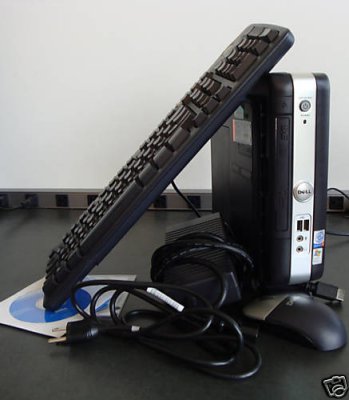
CheapSX270.jpgI keep the tired old PCs at our church running, and I’ve decided that the church office needs something new. Or at any rate, something newer, and more compact. The church office is smaller than most bedrooms I’ve had, and yet includes two desks at which people work, plus file cabinets and many other things. Small is better.

So I’ve been sniffing around for a month or so. As I’ve mentioned here many times, I like the tiny Dell SX270, but it doesn’t support video modes suitable for the widescreen displays that have basically driven 4:3s off the market. Video is done by the mobo chipset, and there is no expansion slot into which a better graphics adapter could be plugged. I bought a newer Dell 2.8 GHz SX280 last week at auction on eBay, and I got a system minus monitor for $90. Mouse, keyboard, power supply (which is a wall brick) and reinstall disk, all for $90. Boy.

And that’s a much nicer machine than the older SX270s. I checked recently completed auctions this morning, and see that a similar SX270 combo (everything but a display) went for the staggering sum of $69.50 last week, after furious last-minute bidding. (The photo above is of that system.) The PC sold at that price is exactly what I have at our condo outside Chicago: A 3.2 GHz Pentium 4 with 1 GB of RAM and a 40 GB hard drive. I’ve been meaning to drop another RAM stick into it but so far, I haven’t seen the system gag on anything I’ve been doing, suggesting that for the time being it has all the RAM it needs.

The Dell ultra-small form factor (USFF) systems like the SX270 and SX280 are pointedly not gamer machines, but most people aren’t gamers. The USFFs do static graphics superbly (Photoshop, InDesign) and play conventional videos without stuttering. I haven’t tested HD video, but DVD video and the videos I take with my Canon camera of the dogs running around play just fine. Spare parts are abundant and cheap on eBay, and anybody who’s ever built a system won’t have trouble swapping things out. The SX280 has better graphics than the SX270 (the chipset for integrated graphics is the Intel 915G Express) and uses the SATA interface for its 2.5″ internal drive. Both have gigabit Ethernet and 6 USB 2.0 ports. The adjustable-speed fans are normally silent, rising to whisper-level only when the machine is doing something intense. The SX270 (and possibly the SX280; don’t know yet) doesn’t require XP activation when you change a hard drive; they’re BIOS-locked to a specific Dell OEM reinstallation disk–which you can get for $20 on eBay, and generally comes with the used machines.

And you can get them now for under $100.

The tech world these days is about specialty devices like smartphones and ebook readers; generic Intel computers are a glut on the market, and basically free. As Joli Ballew and I learned while researching Degunking Windows five years ago, many people send systems to the recycler for being “slow” when the real problem is Windows registry clog and spyware. Do a fresh Windows install (or just be careful not to crap up the system to begin with) and those old machines still glow in the dark. The best way to keep older computers out of our landfills is to keep using them. Saying “that box won’t run Vista” is a little like saying “that petri dish won’t grow a staph infection.” Unless you need a staph sample for research, that doesn’t strike me as much of a problem.

Holy Faces

Station06-500Wide.jpg

I’ve been doing a 50th anniversary commemoration book for our Episcopal parish, and as part of the project I’ve been photographing the Stations of the Cross on the church walls. I’m strictly a hobby photographer, and admit a little sheepishly that I haven’t gone through my camera’s manual yet, page by page. So I found it a little startling when I aimed my new Canon G10 at the first station, and the camera identified Jesus’ face. The Canon G10 identifies faces for a couple of reasons, from eliminating redeye to starting the timer when an additional face (presumably the photographer’s) enters the field of view. It puts brackets around them when it identifies them.

The station depictions at our church are not photorealistic. They are done in the distinctive Mexican primitive style, by the well-known Mexican-American artist Mario Larrinaga, who (among many other things) was a matte artist for the original 1933 film King Kong. The stations are painted icons, deliberately lacking any suggestion of a third dimension (so that they cannot be mistaken for the biblically prohibited “graven images”) and as such they resemble cartoons more than portraits.

It got me thinking about how cameras identify faces. As I worked my way around the church, a pattern began to emerge. For the image above (Station #6, depicting Jesus, Mary, and Veronica) the camera tagged Jesus’ face twice–once in person and once on Veronica’s veil–but did not consistently identify the face of the Blessed Mother. Veronica did better, but not nearly as well as Jesus. The brackets flickered and did not stay on consistently.

When I got home, I tried a few other things. I brought up Google Images and aimed the camera at screen images of the Mona Lisa, various Rembrandt portraits, and a few other things. The camera got most of them. I then pulled out a couple of Lynda Barry’s books, spread them open with bookweights, and tried to get the G10 to recognize Marlys and Maybonne. No deal, but some of their friends were picked up.

These seem to be the criteria:

  • Faces need eyeballs. Marlys always has her Far Side glasses on. No eyeballs.
  • Big eyes are better than small eyes, all else being equal. This seems to be Mary’s problem in the station image above.
  • Faces need to be mostly human-shaped. Funny animals don’t cut it. But then again, neither did any of the characters in PVP. Tycho and Gabe were similarly snubbed. (It was odd to think of Marlys’ brother Freddie as being more “realistic” than Gabe.)
  • Faces need to be looking more or less straight at the camera.

This last criterion seemed to be the most significant. Profiles were never recognized, and three-quarter views only about half the time. The closer a face was to dead-on, the better the camera recognized it.

So. Got redeye problems? What Would Jesus Do? Get a G10. And look straight at the camera.

Tell Me What “Junk Food” Is

Much opprobrium has been heaped on junk food in recent years. I’m willing to listen–but if we’re going to eliminate it from our diets, we first have to know what it is.

So…give me a definition.

The definition must be precise; that is, terms like “empty calories” or “having no nutritional value” are subjective judgments and thus not useful. Specify ingredients, and proportions (as percentages) if necessary. Furthermore, the definition must be about the food itself. Where it’s prepared or served is a separate issue and cannot be part of the definition. If an ingredient is junk, it’s junk whether it’s served at Mickey D’s or at Olive Garden or at the $75-a-plate fancy dinner joint of your choice. (Or at home.)

Methods of preparation may be cited, but again, such citations have to apply across the board, no matter who does it or where. Expensive junk is still junk.

Finally, “the term is meaningless” is a legitimate answer. However, if that’s the case, let’s make it meaningful, by creating a clear definition.

Let’s hear from you.

Google Feeds the Bookstore Bookburners

This morning’s Wired blog announced the reality of something I’ve been watching for and expecting for a long, long time: Bookstores have begun installing a significant and vapor-free mechanism (starring the long-but-no-longer vaporous Espresso Book Machine) to print books on demand. The books in question (for the time being) are out-of-copyright works scanned by Google into its Google Books system.

This is a fine thing, even though it probably spells the end of the road for book preservation efforts like my own re-creation of The New Reformation and The Pope and the Council the hard way: Scanning and OCR extraction of text followed by conventional layout. Google books are facsimile editions, complete with library stamps, marginal notations, flaws in hundred-and fifty-year-old paper, and the occasional squashed silverfish. I’d prefer new editions, but I’ll settle for facsimiles, and certain scholars would prefer to see a facsimile to make sure that nothing of the original author’s work has been left out or changed.

So no carping here, except to demand of Google: Keep going. You’ve got the means and the manpower, so expand the system to allow the ordering of any book–not simply the public domain ancients–for which a printable PDF image can be mounted on one of your servers. If this happens, there would be three big benefits:

  • Bookstores would have a new reason for people to come in the door: To browse the bookburner kiosks for interesting stuff (old and new both) that just isn’t popular enough to stock on physical shelves. We need bookstores, and this is the best recent innovation to surface that may help us keep them alive.
  • New (not ancient) titles without sufficient market to warrant physical book distribution (like my SF) would have a chance to get some bookstore presence, especially if hands-on bookburner systems create new sizzle for B&M bookstores.
  • Publishers who won’t release electronic editions of low-volume books for fear of file sharing may be willing to trust a PDF to Google to sell in print form.

It’s still unclear whether anything covered by the Google Books settlement with the Authors’ Guild will become available through the system anytime soon, but in truth, if it doesn’t, I’m not sure authors of our-of-print works will see any financial benefit from the settlement. Ebooks remain a geek enthusiasm. The volume is still in paper copies, and systems like this remove the wasteful overprinting and returns privileges that make conventional book publishing such a financially risky proposition.

Much to love here, and no evil that I can see. Let’s watch, and hope for the best.

Covington on Time Management

I’m short on time today (and will be for probably the next week or two) so it’s appropriate to point you to Dr. Michael Covington’s post on how he teaches time management to graduate students. Much gold to be dug here, and most of what he says applies to writing a book as well as writing a doctorial thesis. Never let a day go by without progress is one of the toughest goals to meet, but also one of the most important. Life intrudes, especially for freelance writers who have houses, spouses, kids, dogs, and day jobs. Still, you should try. Take too many “days off” and you will waste time recovering context when you return to the task. This happened to me several times while I was writing Assembly Language Step By Step, Third Edition, and the deeper the subject, the more subtle the context, and therefore the easier it is to lose. (We had several family crises in Chicago while the writing was underway, and such things are impossible to avoid. I got better at context recovery through practice, but it’s still time lost that you’ll never have again.)

Another thing that Michael alludes to is that you can’t split up a difficult writing task into widely-scattered one-hour bursts. One hour is not like every other hour, except for well-defined rotework. More to the point, there is something I call “flow,” which means that I’ve goosed my subconscious into a state of high activity, and it’s spitting words up from the depths almost exactly as quickly as I can write them down. This is more common in fiction than nonfiction, but I did find that there were moments when I was blasting away at 100 wpm+ on things like passing parameters to libc functions, because I knew the material well and had had a good night’s sleep. But once you’re in flow, it’s best to keep going until it stops, or until you run out of evening, energy, or both. If you think recovering context is hard, just try to get back into flow after any interruption more involving than a bathroom break.

And finally, the Big One, which Michael does not place in bold but which in fact should be in dayglow colors: Productive people know what not to spend time on. In other words, half the trick of time management is interruption management. When I know that a flow attack is imminent and I have a free afternoon, I turn off Skype and my cell phone, clear all the toys out of my taskbar (including email) and do absolutely nothing but make tracks on the project. Without that discipline, I would not have finished ALSBS3E; in fact, without that discipline, I’m not sure I would ever finish anything.You don’t see me post as often on Contra these days as I used to because I’m feeling better and getting more done in other areas. But that’s also the reason I gather short items into Odd Lots entries: It’s less disruptive to bookmark something and gather bookmarks into a list later on than to be constantly formatting and posting one-liners.

Assuming that you have at least basic literacy in the topic at hand, success consists of focus plus debris. Really. And so on that note, back to work.

Odd Lots

  • I just missed seeing a nice article on the current sunspot dearth before posting my entry for August 20, 2009. The longest stretch this solar minimum is 52 days back in 2008, and we could well exceed that come early September with no additional spots. (We’re now at 45 consecutive spotless days.)
  • I’m practicing rolling my eyes for the latest showing of the Mars hoax. On August 27, multitudes of people who are rumored to posess something close to human intelligence are claiming that Mars will appear the size of the full Moon. (This does the email rounds every couple of years.) Note well that if Mars were the size of the full Moon in the sky, we’d be living a disaster movie, so be very glad it’s a hoax.
  • Stanford University reports that media multitaskers do not in fact multitask very well. I liked this refreshingly straightforward quote in the article: “We kept looking for what they’re better at, and we didn ‘t find it.” More details here from the Beeb.
  • ZDNet reports on a virus, named Win32.Induc, that pulls a trick I’ve never heard of before: It looks for the Delphi programming environment, and infects Delphi such that any apps built by that copy of Delphi will carry the virus. I can’t quite see how this manages to propagate in a herd as thin as the Delphi programming world has become, unless Delphi programmers tend to use a lot of Delphi utilities obtained from places like Torry’s. (I know I did, so that’s my theory.)
  • Maybe you had one: A die-stamped thin steel rectangular lunchbox, usually (but not always) with completely inane artwork, often branded to TV shows, toys, and other pop-culture phenomena. The Denver Westword has a “10 worst” feature on tin lunchboxes that’s worth a look. I never carried a tin lunchbox to school (we used paper bags from Certified) but I have one now very much like #1, purchased at a hamfest years ago, filled with FT-243 ham-band crystals. I’ve always wondered why the boxes always had little vents punched in the short end sides.
  • Here’s an interesting 2-tube minimal broadcast-band superhet, using 12V space-charge tubes. It’s interesting enough that I might even build one, though my own holy grail is a 2-tube FM receiver. I’ve got the schematic (courtesy John Bauman KB7NRN) and lack only the time to hack it together.
  • I’d never heard of morning glory clouds, probably because they mostly happen in a certain part of Queensland, Australia. The bigger question is why they get all the truly great Weird Stuff down there, and we have to settle for minor-league weirdness like Michael Jackson.

Out, Damned Spots! Out, I Say!

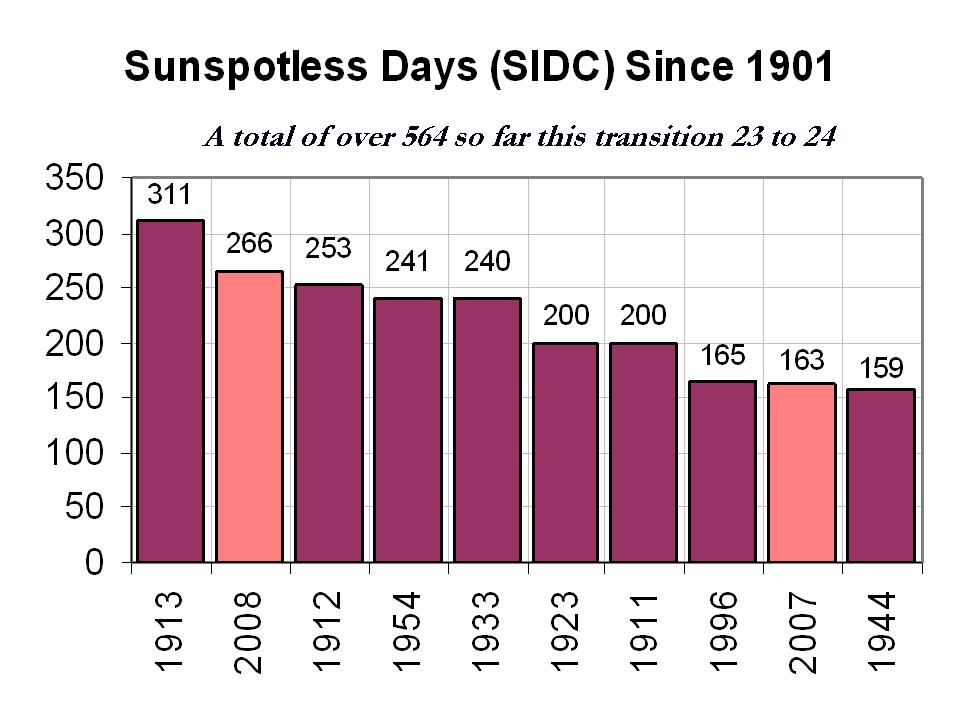
Just my luck: I get a decent dipole strung in the attic, and the sun gets even quieter than it was earlier this summer, when a flurry of tiny sunspots (and one lonely one I might promote from “tiny” to “small”) led everyone to shout that the solar minimum was over. Not so. A few weeks ago, 2009 pushed into the top ten years of sunspot-less days since 1900. Spaceweather tells me that we’ve now seen 182 spotless days this year so far, pushing past 1996 into position #8 on the No-Spot Parade. (See the graph covering complete years here.) At 40 in a row, we’re in very rarefied statistical territory, even at solar minima. And if we make it to the end of August without any spots, we could see a full spotless calendar month, which is even rarer.

The next milestone comes after 18 more spotless days, when 2009 hits 200 and pushes past tied years 1911 and 1923 into spot (as it were) #6. We need 59 more spotless days this year to surpass 1954 and reach #4. We may just possibly do that, but I’m predicting that that’s as far as 2009 will get, since there are, after all, only 133 days left this year. But yikes! This is shaping up to be a minimum like nothing seen since 1911-1913.

It’s been a cool, wet summer in Colorado Springs and, in fact, a cool, wet summer in a lot of places north of poor Texas. Maybe it’s a coincidence and maybe it isn’t. A quiet Sun is a cooler Sun, and we know far, far less about its effect on climate than we’re willing to admit. In the meantime, well, sure, I’d like to work Tuvalu on three watts into a hairpin too–but 70 degree summer days and full reservoirs are not shabby compensation.

The Impersistence of Memory, Part 4

One of the interesting questions surrounding the failures of memory that I’ve been describing is whether there’s some “motivation” for the distorted memory. Any time I see any person I know and value who’s smoking, I cringe. Dottie and Sarah were good friends who shared some context with me, so some of the concern I felt when I saw Dottie smoking may have “bled over” into memories of Sarah in a similar context.

In my readings I’ve seen examples of people who remember incidents in ways that put them in a slightly better light. For example, nobody likes to remember themselves doing stupid things, so a memory of a faux pas may be “tweaked” to be a little less faux. Memories on which your self-esteem doesn’t hang might come down through the years a little more accurately. If there is some sort of inner redactor that attempts to make our remembered lives more tolerable, one might hypothesize that memories without importance might be less vulnerable to distortion than memories of things with emotional baggage. Psychologists used to believe this, but experiments like the Challenger study blew holes in the older notion that “flashbulb memories” are more accurate than mundane memories of no great significance. So how well do insignificant memories survive?

It’s hard to tell, of course, until you come across objective documentation of some little thing that doesn’t align with what you remember of it–and insignificant things are probably the things most easily forgotten. I do have an example, though, and it’s an odd one.

Back in 1999, the editor of Kite Lines magazine asked me to write a mini-memoir of my experience as a kid flying Hi-Flier kites. I began by sitting down in a chair with a notepad and taking notes on everything I could recall about the dime-store paper kites I had flown from 1961 to 1968 or so. I went down the list, describing the commonest Hi-Flier kites and my impressions of them, including as many details as I could clearly recall.
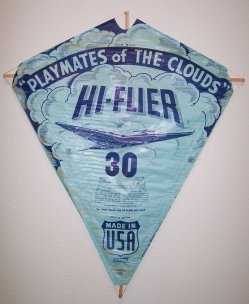
PlaymatesBlueOnBlue250Wide.jpgThe article was a great success, and after their exclusive period expired, I adapted the article to a Web article on my own site, which I have expanded over the years as new information has come to hand. In the article I described probably the most common of all Hi-Flier’s small paper diamond kites, the “Playmates of the Clouds.” (See example at left.) The three varieties of Playmates differ only in what’s immediately under the flying wing: A number, the words “Little Boy,” or nothing at all. I remembered kites with the number 30 as probably being the most common–but I remember flying Playmates with other numbers, particularly the number 94. I also clearly recall having a Playmate tagged with the number 6, and vaguely remember a number in the 40s somewhere.

After writing the Kite Lines article, I started watching for paper kites on eBay, and when the feature appeared, put a saved search on “Hi-Flier” and “paper kite.” Lots of kites have marched past the All-Seeing Eye of Ebay since 1999. I’m sure I’ve seen close to 1,000, and perhaps more. Playmates of the Clouds kites are very common, and I’ve bought a couple for use as wall art. But never in those ten years and on probably 200 Playmates kites have I seen a number other than 30.

Back in 2007 I heard from a chap who called me on it: He’s an avid collector of classic kites who has hundreds of his own and seen many more. He told me that the number 30 on Playmates of the Clouds kites indicated the size of the kite (it’s 30″ down the vertical stick) and that Hi-Flier never printed a Playmates kite with any number other than 30. I must have misrecalled.

I guess. But my memory of that magenta-on-white Playmates with a 94 on it is clear, and has some context: I had it for an unusually long time, for a paper kite. I flew it down in Blue Island at Aunt Josephine’s house on two rolls of string, out over the big railroad yard near their house, and got it back intact. I flew it for the rest of the summer, and only dumped it when I left it lying out in the rain overnight and it got soaked. It was a good kite (and a lucky one, mostly) and if it didn’t have a 94 on it, why do I remember the 94? Why not 48, or 57? Why don’t I just remember the 30?

It was never a big deal. The numbers on Playmates kites were significant to me only in that I thought they were stupid: The digits were just 2″ high, and after the kite was more than 50′ out, you couldn’t read them anymore. I assumed (with 12-year-old geek logic) that they were there to allow you to tell your kite from all the other Playmates kites in the air. Wouldn’t work. Rolls eyes. End of story.

So: The kites that I remember so clearly didn’t exist in the form that I remember them. This seems weird to me because there’s no motivation for the redaction: Remembering them differently doesn’t affect anything, and it’s a little weird that I remember small things like numbers on kites at all.

The point seems to be that we don’t always remember details well, whether the details are emotionally significant (“Where were you when Challenger exploded?”) or practically background noise (“What number was on your favorite kite?”) I’m guessing that in every life there are a staggering number of little disconnects between what we remember and what really happened, and we’re unaware of it only because we don’t generally have confirming documentation of all the little things that we remember–and mostly, we don’t care. When we notice such a disconnect, we snort, say, “heh!” and move on. No big deal.

I’ve gone on for a few days here because somebody asked me recently if I was ever going to write my autobiography, and I spent a little time thinking about it. Suppose I did: Would what I wrote bear a useful resemblance to what in fact happened? And if not, what’s the point of autobiography? How much, in fact, can we trust any kind of memoir? If memoir is read mostly as entertainment, why not just write fiction?

Perhaps we do. As best I can tell, our brains write our memories as a kind of historical fiction, drawing the broad strokes from reality and then filling in the gaps with whatever makes the best yarn. I find this troubling in a weird way, but I guess I’ll just have to get used to it: The bulk of what’s happened in my life has not only been forgotten, but was never actually remembered to begin with. If any revelation can literally be called humbling, well, that’s the one.

The Impersistence of Memory, Part 3

I had two college friends back in the early-mid 1970s; let’s call them Dottie and Sarah. I was quite close to them without getting mushy about it. (Back then it was common knowledge that I was committed to Carol and “safe,” though the term rankled me a little.) We went to a lot of the same parties, including the memorable one where a wide-eyed cheerleader type told me in slackjawed amazement: “You always talk in complete sentences!” Well, I have vivid memories of both girls smoking at one party or another. I found this appalling, because my father was dying of tobacco-induced cancer at the time, but I didn’t feel like I had enough claim on either of them to chew them out for it.

I lost track of them after 1975 or so. Dottie surfaced about ten years later, and I asked her if she had given up the coffin nails. Eyes downcast, she copped to smoking in the 70s, but said she hadn’t had one in years, and even in college only had one when the stress started to get to her. Fair enough. (And I hope it was the truth.)

I didn’t run into Sarah again until 2000. As I had with Dottie, I asked her if she’d given up smoking. She looked at me like I was a shopping-mall zombie with both arms shot off, and said a little coldly that she’d never held a lit cigarette in her entire life.

Whoa. But there’s that crystal-clear image of Sarah in 1974, leaning against somebody’s kitchen table piled high with cheese and half-empty wine bottles, holding a butt between two fingers and frowning while blowing smoke over her shoulder. The friendship had gotten very stale in 25 years, and my question did nothing to help. I dropped the subject. Still, the memory remains, as clear as ever. What the hell is going on here?

I think of Sarah and Dottie these days when the nutcase Extropians talk about uploading themselves to some sort of global Beowulf cluster. Human memory is not digital. Human memory has no checksums. Human memory comes without parity bits. Something is making me remember poor Sarah inhaling carcinogens, and whatever it is, I don’t want it to come along when I get copied into Metaspace and become one of the Players.

I’m increasingly convinced that we know less than we claim about the physical implementation of human memory, but I have a single slim clue about this particular case: One of my recurring nightmares is dreaming about Carol smoking. We’ve been together for 40 years now, and I have fair confidence that Carol has never held a lit cigarette either, but the dream images are terrifyingly real. I’m a good imaginer, and I write my stories by creating movie clips of the scenes in my head and watching them until I can describe them well. The same basic mechanism that allowed me to see (and then describe) scenes from The Cunning Blood torments me from time to time by creating scenes in which my soulmate embraces the evil that killed my father. If Carol, why not Sarah? I may have dreamed about her smoking years ago, and then over time forgot that I had seen it happen in a dream.

Michael Covington suggests that human memories get cross-linked like entries in a corrupt database, and that it’s happened to him. What I remember as Sarah smoking could be a memory of Dottie smoking, cross-linked to a memory of Sarah at a party. The two girls played similar roles in my life, and actually resembled one another in several ways. (And the parties, well, they were indistinguishable.) Most of our interactions happened 35 years ago. That’s plenty of time for analog chemical pointers to grow hair.

I have one more example to share, which in some respects is stranger than all of them. It’s one thing to forget something, and another to remember something badly. It’s truly odd to remember a person doing what a person never actually did. But in terms of pure weirdness, it’s hard to top vividly remembering an artifact that never existed at all.

Stay tuned.

The Impersistence of Memory, Part 2

Human memory is peculiarly unreliable–but verifiably unreliable. The science is there, and it’s pretty good science, too. In his excellent book, On Being Certain, neurologist Robert A. Burton describes the Challenger study: Within a day of the Challlenger disaster, a psychologist asked 106 of his students to write down precisely where they were when the explosion occurred, how they heard about it, and how they felt at that moment. Two and a half years later (hardly a lifetime, though significant for the young) the students were interviewed, and asked to recount the details of what they had written down and given to their professor. Fewer than ten percent of the students recalled all of the details correctly as they had written them. A quarter of the students’ memories were significantly different, and over half had some major differences with what they had recorded at the time.

Thirty months–and an event that stands in many people’s memories (including my own) as one of the most striking events of their lifetime. Intriguingly, even when confronted with their original notes written the day after the event, many students with conflicting memories insisted that their current memories were correct. As one said, “That’s my handwriting, but that’s not what happened.”

Egad.

I’ve been struck in recent years with an increasing number of things that happened that I don’t remember, things I remember incorrectly, and (disturbingly) things that I remember vividly that simply didn’t happen at all. I introduced this topic with a simple example: A friend of mine found a college-era manuscript of a short story I wrote that I just don’t remember writing. Getting old, I guess. The bitchy part is that it’s a pretty good story, and it was completely outside my usual aliens-and-starships turf. Somehow I would have thought it would make a more vivid impression on me.

But we forget things. Odder are things we remember vividly that we in fact remember wrong. Forty-three years ago, when I was in eighth grade, I remember talking to a girl in my class and stumbling on the fact that her father had died. Forty years later, I ran into her again at our grade-school reunion, and it came out that it was her mother and not her father who had died. The original conversation was painful, and I remember painful things very well–you’d think I would have remembered it more accurately. In a different conversation with the same girl, I asked her what high school she would be attending that fall. I remember her indicating one Catholic girls’ school, but in fact (again, verified forty years later) she had attended another. She had never even considered the school that I remember her saying, because it was a fair ways off and the other school was within walking distance.

But I remember both conversations to this day, with the sort of clarity one would expect of a bright if nerdy kid attempting to make conversation with a girl he was a little sweet on. It took considerable courage to talk to her at all, and those are the things of which solid memories are made.

Except when they’re not, I guess.

It was that particular incident that started me looking critically at my own memories, especially those that could be verified somehow. I found a lot of little things that didn’t add up, including a few “flashbulb” memories (as psychologists call them) that one would expect would be vivid and indelible forever. The most recent one is something I chased down just the other day: I vividly remember the first time I kissed Carol–who wouldn’t?–and I remember that it was after we started school in the fall, which would be at least five or six weeks after we met at the end of July. Well, on the back of her 3 X 5 card in my teen-years telephone index box (which still exists among piles of oddments I’m amazed that I still have) is the note “kissed 8/16/69.” That was only two weeks after our most fateful meeting, and school was still another two weeks off. (Remember when school started after Labor Day?)

If I don’t remember that accurately, well, what hope for the rest of it? What kind of life did I actually live?

Stand by: The weirdest part is yet to come.