Jeff Duntemann's Contrapositive Diary Rotating Header Image

Ideas & Analysis

Discussions of various issues including suggested solutions to problems and pure speculation

There’s a Nap for That

GirlsAndDash500Wide.jpg

I finally got an appointment with a local sleep specialist last week. I’ve never been a strong sleeper, and I’ve been having intermittent problems sleeping, some of them severe, since the collapse of Coriolis 2001-2002. There’s some (small) possibility that I have apnea, even though I sleep on my side and not on my back. I’m going to go in for a sleep study later this summer (when my allergies are better) and this was the initial consult.

The specialist went through all the usual sleep disturbance stuff with me, mostly things I’d read about many times in many places. One of the first things on his list he said briefly and emphatically: “No naps!”

Carol and I about cracked up.

For two reasons, actually. First of all, telling Jeff Duntemann not to take daytime naps is like telling Jeff Duntemann not to code in C++. No problem, Doc! I’m just not built that way. I can sleep during the day only when I’m sick, drugged, or both. (No comment on C++.)

The other reason goes back to our last couple of trips to Chicago. Our niece Julie, like her (slightly) older sister Katie Beth a strong-willed little girl, decided at some point earlier this year that She Will Not Take Naps. I teased her about it several times this past winter:

“Julie! How about taking a nap!”

“No!” She clutched her favorite blanket and made Angry Face at me.

“Just a little nap?”

“No nap!”

This went on for most of an evening in Gretchen’s family room, until I decided that I was in danger of jeopardizing my relationship with the person who would someday decide the fate of my legendary tube collection, and knocked it off.

But by our next trip, winter had faded to a glorious spring, and Carol and I did a lot of chasing around in Gretchen’s back yard with Katie, Julie, and the dogs. Carol has the Kid Gene and I do not; I have no intuitive grasp of what very small girls consider fun. I spin them around and roll down the hill with them, but I’m never entirely sure what they might enjoy. And the trying is nothing if not aerobic. So at one point, a little out of breath, I just lay down on the hillside, laid my hands over my chest, and stared serenely at the very blue sky. Julie, now 2, came up to me and looked at me quizzically.

“Julie, Uncle Jeff is taking a nap.”

Without a word or even much hesitation, Julie lay down on the grass beside me and laid her hands over her chest.

Lead by example, I always say.

The Persecution Gambit

I learned a great deal about tribalism in the past few years, watching a Colorado Springs drama unfold. The former rector of Grace & St. Stephen’s cathedral downtown fomented a split in the congregation, one of the largest in Colorado. His faction quit the Episcopal Church entirely and hooked up with a crew of African Anglican bishops who collect disaffected American Episcopalians like I used to collect bus transfers. Their choice and no great loss, but the group tried to take the property (including a marvelous Gothic church building, school and offices) with them. After a two-year court battle, they were thrown off the property in April of last year, and occupancy returned to the parish group that remained loyal to the Episcopal Church. During the investigation, it came to light that the rector had allegedly been siphoning off church funds to pay for his children’s college educations, and he is now facing 20 counts of felony theft that could land him in prison for most of his remaining years.

What I found fascinating is that throughout the entire period, the man claimed to be the victim of deliberate persecution, that he was merely defending all things bright, beautiful, and virtuous, and that the Episcopal Church was trying to squash him like a bug. I boggled and boggled until my boggler was sore: Beyond the surreal notion that the Episcopal Church persecutes its opponents, anyone who read more than the shallowest accounts understood that the property had always been owned by the Diocese of Colorado and not the church community itself. (This is a matter of public record.) The more the rector yelled “persecution!” the weaker and sillier he looked—and the more scrutiny he called down on himself.

I’ve touched on this a time or two here before. Sad as it is, this sort of thing isn’t unique. Leaders caught in fibs or with their hands in the cookie jar scream “persecution” more often than you might think. I had an insight recently that explains what had seemed pretty counterintuitive to me: This technique isn’t about persuading outsiders that they’re innocent or deflecting suspicion. It’s all about rallying the base, according to primal tribal instincts that we inherited from our killer-ape ancestors. Every tribe has honest members, and when tribal leaders’ misdeeds come to light, there’s a very real risk that the honest ones will bolt the tribe. The cry of “persecution!” stirs deep feelings, implying that it’s not entirely about the leaders. The tribe itself is under attack, and the defensive poo-flinging had better begin right now, or the tribe could be crushed by its evil and hugely powerful attackers. (Even if they’re just a few noisy bloggers.)

The tactic is a gamble. It works well on the tribal foot soldiers who are basically owned by the tribe, but those loosely bound to the tribe can easily see through it. Much depends on how much flingable poo those owned by the tribe can summon. Run short of FPUs (Flingable Poo Units) and the tribe can shrink, lose power, and suffer humiliation from which recovery is not assured.

If your tribal leaders are accused of wrongdoing and respond with howls about “persecution,” odds are overwhelming that they’re guilty as charged. They’re not trying to defend themselves. They’re trying to keep the tribe’s honest members from drifting away. Don’t fall for it. You gain a lot more by tearing them down, humiliating them via brutal public honesty, and throwing them to the wolves. Never allow a dishonest leader to remain in power. The Anglican tribe in Colorado Springs is now fading away. Yours could be next.

The Unenforceable Mandate

I hadn’t intended to write anything about health insurance reform, in large part because the debate has become so utterly poisonous, but also in part because I felt that the important issues have been adequately dealt with elsewhere. Well, there’s something that isn’t really being discussed and should be, because it cuts to the heart of how health insurance works, and may be the hinge upon which the PPACA (Patient Protection and Affordable Care Act) succeeds or fails. One would think that that would be discussed all over the place, but it’s not, neither in the liberal press (which I read) nor in the conservative press (which I also read.) In fact, so little has the issue been mentioned anywhere that I’ve begun to think I’m missing something crucial.

So let me begin by reiterating what most people know or should know: Health insurance is a really lousy business. Profit levels in health insurance run from 2.5% to 5%, depending on who you’re talking about and whose numbers you believe. Insurers are not making a lot of money, and what they do make they make only by doing everything in their power to exclude the people who need health insurance the most. Google “recission” and “purging” (sometimes called “reunderwriting”) in a health insurance context if you don’t believe me. Many people (including me) consider such practices tantamount to fraud, but that’s not the point I want to make. The point is that even while making full use of recission and reunderwriting, the health insurers are earning maybe 3% profits on average.

Like I said, a lousy business.

So. Enter health care reform. Insurance companies will be required to take (and keep) all comers, irrespective of pre-existing conditions. That’s called “guaranteed issue.” To make it work, all people will be required to buy health insurance, including people who choose not to buy it today, typically because they’re young and healthy. This requirement to buy insurance is the “individual mandate.” The individual mandate enlarges the pool of the insured and thus the amount of money available to pay claims. Without the individual mandate, people would buy insurance only when they needed it, which really isn’t “insurance” in any honest sense of the word. The pool of funds to pay claims would shrink, and claims would explode. The insurers would be gone like that.

Basically, the price of guaranteed issue is the individual mandate. You can’t have the first without the second. I think this is well-understood and not controversial at all. The devil, as usual, is in the fine print. In the bill as passed, people who choose not to buy health insurance will be required to pay a minimum fine of $695 in any given year, or 2.5% of their income, whichever is greater. Those fined would still be able to get insurance when they needed it under the provisions of guaranteed issue. This in itself is a problem, because the cost of insurance is likely to be much higher than 2.5% of income for a huge number of people. 2.5% of a $100,000 annual salary is $2500–dare ya to find a policy for that. A guy making $100K could just pay the $2500 and buy a guaranteed-issue $7000/year policy as soon as the bad lab tests came back, thus saving $4500/year without any downside for all the years that he stays healthy, and pushing that saved cost onto the insured.

I think this is dangerous. It’s not being talked about enough, but it’s being talked about a little, in a few relatively large publications. However, it’s not why I’m writing this entry.

A few weeks ago, I read an article by Timothy Noah in Slate about this very issue. Noah’s thrust was elsewhere, but my jaw dropped when I read Noah quoting from the health care reform bill itself. I clicked through to the monster PDF text of the final bill as passed, to verify what he had said. I blinked. I rubbed my eyes. I got up and went to the fridge for some diet ginger ale. I came back, and it was still there:

In the case of any failure by a taxpayer to timely pay any penalty imposed by this section, such taxpayer shall not be subject to any criminal prosecution or penalty with respect to such failure.

This from page 336 of the bill as it was passed. On the same page, there is a provision that the government may not

(i) file notice of lien with respect to any property of a taxpayer by reason of any failure to pay the penalty imposed by this section, or (ii) levy on any such property with respect to such failure.

Read those quotes again. The bill outlaws its own enforcement. If you refuse to buy insurance and refuse to pay the fine for not buying insurance…nothing happens. The individual mandate is thus unenforceable, but you can lay odds that guaranteed issue will be mercilessly enforced against the insurance companies. I’m sure there’s some legal interpretation to be done here, but Noah’s point is that there is considerable temptation for mass civil disobedience on the individual mandate without any downside for those disobeying. What he doesn’t say is that such mass civil disobedience could lead to the collapse of the private health insurance industry.

Others in the blogosphere have begun to notice this in the last few days. But why hasn’t it shown up in the major media? You’d think the Wall Street Journal would be screaming about it in every other issue. Didn’t anybody actually read the bill?

Don’t answer that.

Hurray for the Leaners!

Rated-S_scientific_300.jpgSay what you want about cold fusion; it’s been a great show and a huge amount of fun. If time allowed I would read more on it; right now, the only book I’ve been through is Fire from Ice by Eugene Mallove, the cold fusion culture’s first martyr. In 2004, Mallove was murdered, probably by muggers, but Certain People are sure that it was the government, or the oil companies, or Arabic shieks, or somebody else who would be on the losing end of the energy stick if cold fusion actually came true.
Mallove’s book is now 11 years old and is strongly pro, and I need to read Gary Taubes’ book Bad Science (1993) for balance. Beyond that, well, the literature, having lain low for many years, is exploding again in celebration of finding a whole new name. (More on this shortly.)

I know, I know. How can I take any of this seriously, you ask? Back off, man. I’m a scientist. I also like street theater, especially science and technology street theater. I suffer fools gladly if they entertain me, because I learn best when I’m entertained. (Fools spouting politics rarely entertain me; street theater has its limits.) I’ve stated my official position here many times, and I’ll say it again: It’s probably not fusion. But it’s almost certainly interesting, and if pursued may actually turn out to be something useful, if not a source of free energy. Desktop fusion is nothing new, after all: Philo Farnsworth, needing to do penance for having invented television, went on to create desktop fusion. The nut they couldn’t crack is releasing more energy than their gadget absorbed, but hey, neutrons are useful, and they don’t just come when you whistle.

I was pleased to learn quite recently that “cold fusion” as a term has been deprecated in favor of Low Energy Nuclear Reactions (LENR) which has the authority of an acronym and no obvious links in the public mind to a name more properly associated with margarine. A recent presentation on YouTube from a cold fusion guru admits that it’s not about fusion, and that’s a big step forward. I’m not sure that there as many rabbits in the LENR hat as Krivit thinks, but even one rabbit would be delicious, especially with melted butter.

LENR is supposedly caught up with the electroweak force. One thing I do need to do is hunt down a good summary of what we know about the electroweak force; there are a few too many Greek letters in the Wikipedia article for my tastes, and probably my forebrain as well. Suggestions always welcome.

As an SF writer LENR fascinates me, especially the notion that it could be implemented in biological system. Nuclear-powered cockroaches, anyone? The bugs wouldn’t need to make breakeven; LENR could act as a storage mechanism: After gathering and processing fuel during times of energy abundance, they’d consume the fuel when their only sun sets for a decade or two and temps go down to double digits K.

The show goes on. LENR can and should replace all mention of “cold fusion.” The LENR acronym suggests to me a general term for people pursuing (or cheering on) research in that area: Leaners. I’m a Leaner. I’m cheering for these guys, and with more lifespan ahead of me, more time, more brains, and another small fortune in machine tools beyond what I already have, I would go downstairs and see what I could throw together. Damn, this stuff calls to me.

It’s April, the month to be mad as a hatter, and you know all about me and hats.

The Pulps Reconsidered, Part 2

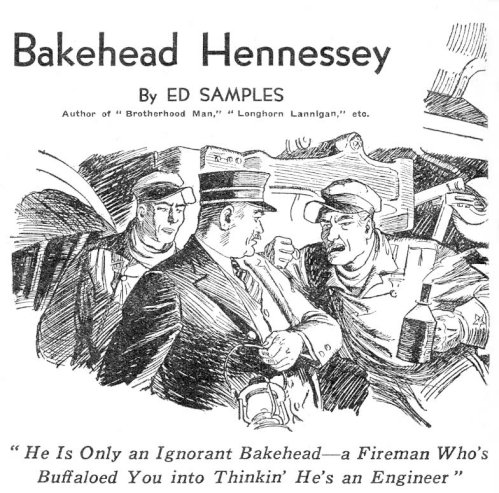
bakehead.jpg

Back in my Febrary 23, 2010 entry, I began a series about the pulp fiction mags of the first half of the 20th Century. Because most people would assume I’ll be talking about SF, I deliberately went elsewhere, to a category most of my readers have probably never even heard of: railroad fiction. I bought and have been reading some 1930s issues of Railroad Stories magazine, published by the Frank A. Munsey Company, which in 1882 basically invented pulp fiction mags as we know them.

I can give you a good flavor for the genre with a single 300-word excerpt, from a story called “Bakehead Hennessey,” by Ed Samples, in the August 1935 issue:

Barney softly coupled his two engines into the head car. An “air” man connected the hose. The compressors on the head engine cut in, racing, clicking, thumping, forcing the train line pressure up to ninety pounds. Barney glanced at his gage, then out toward the yard office, where Conduc­tor Gardner was running to the plat­form with two sheaves of green and white tissue in his hands. Behind him waddled stout Superintendent Moran. A second later Old Tom Ryan was climbing down upon the brick plat­form to meet Gardner.

Barney watched him, glanced once more at his air gage, then toward the rear. An inspector’s light was saying: “Set the air.” He opened the valve, watched the needle swing back, then closed it; and wiping his hand on a piece of cotton waste, went striding toward the men who were comparing watches and reading train orders.

The conductor handed him his set of flimsies in silence. There were only three: two slow orders and the running order. He glanced at the latter.

“Running us as Second Seven?” he asked, looking at Gardner.

Gardner nodded. Barney read the order through. He knew that never in the history of the road had such a task been laid out for an engineer: to clip sixty minutes off the time of No. 7, the fastest train through the Rockies on any line.

Air pumps were racing. The pop valve on the 3775 opened and white steam climbed skyward. A dozen lights darted hither and yonder about the steel mail cars. Superintendent Moran came panting up to the group.

“We want action on this run tonight,” he began.

“What the hell’s the use uh puttin’ out a fast schedule for that sizzlin’ bakehead?” snarled Old Tom. “He’s got you fellers all buffaloed into thinkin’ he’s a hoghead. Hoghead! Bakehead! Bakehead Hennessey!”

‘Nuff train talk for ya? I’m the son of a passionate railfan and have researched railroads more than most people, but I still had to look some of this stuff up. A “bakehead” is a locomotive fireman, who stokes the engine manually or maintains the stoking machinery. A “hoghead” is the engineer of a freight train. “Flimsies” are train orders, often printed on something just a hair better than tissue paper. Nonetheless, if you know the jargon, this scene will be utterly clear to you, and back in 1935, this was not nostalgia but the way the railroad industry actually worked.

Nor is this unusual within the genre. In the two issues I’ve read so far, all the writing is precisely like this, in that what matters are the trains. The people are types, which isn’t to say they didn’t exist in the real world or are somehow badly drawn in the tale itself. (Not everyone is an American Original.) But descriptions of their internal conflicts and personal growth were not what the reader was paying for. In a way very much like the Tom Swift books I read in the early 60s, the railroad pulp stories (and I’m guessing all pulp stories) were created to help people imagine themselves in certain roles and in certain situations. The people (thinly) depicted in the stories were like halloween costumes, in a way, to be put on by people who wanted to imagine themselves as railroad engineers and brakemen, or perhaps remember being railroad engineers and brakemen years ago.

This should be obvious, and it may be obvious to you, but I’m amazed at how some people just don’t understand why pulp fiction was ever popular. A lot of people would consider the railroad pulps bad fiction because they focus on technology (railroad tech, such that it was in 1935) rather than inner conflict and growth. Swap in “spaceflight” for “railroads” and you’ll have pulp SF of the same era. The railroad pulps had their share of adventure and fistfights and gunplay, but I was amazed at how close the action stayed to the tracks. And just as superb writers like Robert A. Heinlein stepped aside from the action to teach lessons on orbital dynamics, the railroad pulp authors sometimes taught lessons about their beloved technology. Read this excerpt from “When Destiny Calls” by E. S. Dellinger, the cover story in the August 1935 issue. It’s dense, but if you love trains you’ll understand the frightening energy contained in a boiler full of steam (enough to lift a 100-ton locomotive two and a half miles into the air) as well as how the devastating boiler explosions common during the steam era actually happened. I’ve ridden behind a couple of steam locos on tourist lines. That excerpt gave me chills.

Which, of course, was part of the package. The firms that published pulp fiction knew exactly what their customers wanted: a sense of being somewhere else, somewhere vivid and colorful, somewhere better and more exciting than a boarding house during the Great Depression, after a twelve-hour day at a mindless job in a sweltering factory that paid a quarter an hour.

The pulps were hugely successful for quite awhile. The writing wasn’t great, but it was nowhere near as bad as people make it out to be. Much of its “badness” was the focus on action, setting, ideas, and a certain sort of culture. The words could be carelessly arranged, but words can be fixed, and there is a particular skill in creating vivid settings and action scenes that few people understand until they realize that they don’t have it. The concept of pulp fiction deserves better than it’s gotten in recent decades. It didn’t even completely disappear, though the psychology is a little different these days. More in Part 3.

The Pulps Reconsidered, Part 1

RailroadStoriesCoverMay1933-500W.jpg

How bad were the Golden Age pulps, really? Thirty-odd years ago I had a few SF pulps from the late 1930s, and while I’m not sure where they ended up, I remember the cognitive dissonance that arose from knowing that I should despise them–while in fact enjoying them a lot. Reading them was a little like watching old B-movies like The Crawling Eye: You know damned well they weren’t literature, but somehow they kept your attention and made the time pass..which is exactly what they were created to do.

Few people–especially those under 40–realize just how broad a phenomenon the pulps were, and how small a part of it SF actually was. Beyond SF and fantasy there were sports pulps, many subspecies of crime/detective pulps, adventure pulps, romance pulps, aviation pulps, western pulps, railroad pulps, and doubtless others that I’ve never heard of. The SF pulps were better than I’d been led to believe, and I started wondering recently whether the SF pulps were outliers, or whether the pulps as a phenomenon and even a literary form have been slandered out of proportion by the ultrasophisticated artsy elite.

I bought a couple of railroad pulps pretty much at random on eBay not long back, and have been reading them as time permits. The cover above is from the May 1933 issue of Railroad Stories. I also bought the August 1935 issue and found with a grin that the cover author and the cover artist were the same in both issues: E. S. Dellinger writing the cover stories (both novelettes of about 10,000 words) with Emmett Watson on watercolors. I chose railroad pulps because I like railroads; I’m not sure I could have bulled through a sports pulp or a true crime pulp.

Being a magazine guy myself, at my first flip through the issue I was startled: These books had almost no ads! The back cover and inside covers were full-pagers, and the single-page TOC was set within a 4-page block of fractional ads, generally 1/8 page items hawking hair tonic or remedies for hemmorhoids. And that was it. There were no ads whatsoever set in or between the stories themselves. It’s obvious that they didn’t pay much for the paper (and we know they paid almost nothing for the stories) but I boggle that the 15c for a single issue or $1.50 for a full year carried that much of the operation.

The inside front cover ad seemed odd for a railroad pulp: Dr. Frank B. Robinson pushing his artificial religion Psychiana. On the other hand, readers of Popular Mechanics were never too far from discovering the secrets of the Rosicrucians, and this was clearly their competition.

The TOC divides each issue into three sections: Fiction, nonfiction, and departments. Fiction was less of it than I had thought. A quick tally shows about a third of the editorial to be fiction, and probably half nonfiction. The departments include a joke page, a question-and-answer column about railroad history and tech, news items submitted by readers, short items from readers who worked at railroad jobs, and a scattering of railroad poems.

So…how bad was the writing? What were the stories about? Tune in next time, kids!

An (Ebook) Fate Worse Than Piracy

I’ve had it in mind for some months now to conduct and publish an interview like this one with a backchannel correspondent of mine who calls himself The Jolly Pirate. That’s unlikely; Jolly didn’t like the idea much, and more to the point, he doesn’t pay much attention to pirated ebooks. He is not an ubercracker from the Scene and doesn’t want to be. He knows where the stuff is and he downloads its. He doesn’t upload at all, except for the uploading inherent in torrent downloading.

His motivation and modus operandi are interesting and I will describe them at greater length someday; from a height I’d describe him as a hoarder who downloads all sorts of things under the assumption that they may eventually be harder to come by. He’s read a few computer books downloaded from Usenet, all of them .chm files, and treats them like a sort of third-party help system for the technologies he’s interested in. The thing that makes me grin a little is this: He says he has over 50,000 ebook files on his hard drive, but he doesn’t own an ebook reader. He doesn’t read for fun and I get the impression that he doesn’t read much at all unless he has to. I asked him why he downloaded all those books, and his answer was simple and obvious: “Because it was easy.” Most of you have seen my entry for December 29, 2009. Jolly downloaded 10,000 ebooks in a couple of hours. That scares some authors and publishers a lot, and I’m still trying to get my head around the question. Tim O’Reilly said somewhere that piracy is like a progressive tax on success, and that’s a useful metaphor. I rarely see my own material in the pirate channels. That is not true of Steven King or Ms. Rowling.

And in truth, something else makes me worry more than piracy. This isn’t an original insight, though I don’t recall where I first read it (anybody?) but a major threat to success in writing today is the competition from books that have already been published. There are only so many hours in a life, and with most any popular print book available used but in good shape on ABEBooks for $5 or less, a given consumer never has to buy a new book at all, especially fiction. It’s less true in nonfiction covering emerging issues and technologies, but for last year’s news and mature technologies it’s operative: All the Windows XP books that the world needs have already been published, and you can get most of them from the penny sellers for the (slightly padded) cost of shipping.

My point: Existing books compete for reader chair-time with new books. An enormous number of books have been published in the past twenty years or so, and that’s not old enough for them to crumble into shreds. (Alas, my ’60s MM paperbacks are doing exactly that, reminding me constantly what “pulp” means.) They’re all still kicking around the used and unused remainder market, and will be for decades to come. All the arguing about ebook pricing that I’ve seen so far seems to ignore the fact that new books of either type compete with used print books, and ubiquitous Web access makes finding precisely what you want almost effortless.

Paying $15 for an ebook is a sort of impatience tax. Wait a few months, and used copies of the hardcover will be on ABEBooks for $5 or (probably) less, including shipping. Good books, too. If Big Media ever truly embraces ebooks, it will be as a means of defeating the Doctrine of First Sale and eliminating the used book market. (The legal issues there are still very much in play. Expect much agitation in coming years for new laws forbidding the resale of “used” electronic files.)

This shines some different light on the difficulties Google has had getting authors to sign on to the Google Books settlement. I’m not sure that all authors and (especially) publishers even want the orphan copyright issue to be settled. If it is, suddenly the Google scanning machine will drop what may eventually be hundreds of thousands of additional ebooks into the marketplace, all of them competing for quality chair time with whatever current authors are writing. That may explain why I’ve had so much trouble getting SF publishers to talk to me. People may not be reading less these days, but they’re certainly reading and re-reading things that already exist. The value of what I write now is correspondingly less.

When a pulp becomes an ebook, it becomes eternal. Don’t tell me about death due to storage or container format obsolescence. I still have SF copy I wrote using CP/M WordStar in 1979 and stored to 8″ floppies, now safely on a USB thumb drive in .rtf format. If USB ever becomes obsolete, all my files will follow me to whatever comes next–and will probably take five seconds or less to transfer.

There will always be a reliable if modest supply of book crazies and loyal fans who will pay top dollar for The Latest. Beyond that, market cruelties come into play that will make it a lot harder to break into the writing business for the forseeable future.

Piracy? What’s that again?

Ebooks: Wholesale/Retail vs. Commission

I’m guessing that by now, most of you have heard of Amazon’s little dustup with Macmillan, one of the world’s largest book publishers. As long as Kindle was the only significant online retailer for ebooks, Macmillan accepted Amazon’s sales terms, which set a ceiling of $9.99 on most ebook prices, at Amazon’s option. But the instant Apple popped up as a second significant ebook retailer, Macmillan cut a better deal with Apple, and demanded that Amazon match Apple’s terms, which include a higher price ceiling. Amazon responded by refusing to sell Macmillan’s titles.

Amazon caved yesterday, and agreed to reinstate Macmillan’s books at Macmillan’s higher prices. People posting in the comments sections of some news sites seem puzzled that a more competitive market would raise prices for consumers, but that’s just the way truly free markets work. Until Apple showed up with their iPad, Amazon had a monopsony relationship with ebook publishers, rather like WalMart has (still) a monopsony relationship with a multitude of small-to-middling goods manufacturers and wholesalers. In a competitive retail market, neither monopoly (one seller, many buyers) nor monopsony (one buyer, many sellers) dominate. There are lots of buyers and lots of sellers, and we quickly find out what the “real” price of a product is, as manufacturers and retailers jockey for the greatest market share among consumers.

That’s not, however, what I find interesting about the recent conflict. Look closer, and you’ll see two fundamentally different approaches to selling a product to consumers: Amazon is selling on the conventional wholesale/retail model, and Apple is selling on an agency model. Amazon wants to buy ebooks from publishers at a wholesale price and make money on the margin between that wholesale price and a retail price that it controls. This allows it to create occasional “loss leaders” to generate traffic, as conventional goods retailers have done as long as anyone remembers. Apple, by contrast, wants to sell ebooks at prices set by their publishers, and take a percentage of every sale.

Publishers like the agency model since it gives them more control over pricing, and does not train the public to expect all ebook prices to be $10 or less. How much better the agency model is for publishers and authors is unclear, and depends in part on how fungible you think books are, which is a very weird business that I’m still thinking about. It may also depend on how many players can participate on the publisher side. A B&M bookstore can only contain and manage so many physical books, and publishers play lots of dicey scarcity games to get more shelf space than their competitors. (“Stock our whole frontlist and we’ll give you an extra 2 points’ margin…”) An online ebook store’s capacity is essentially unlimited, and any number of publishers can play. If there are a million publishers and 999,900 of them sell products at lower prices than you do, your control of pricing is less than it was in the era when it was tough to get your books into stores and a relatively few large publishers dominated the market.

Nor does it end there. If you look even closer, Apple’s model starts to look familiar in another sense: It starts to look like a publisher paying authors a royalty. The royalty rate is insanely high by historical standards (70% or thereabouts) but there are no atoms to push and protect. Without atoms getting in the way, being a publisher becomes an entirely different challenge, and the difference between conventional publishing and self-publishing implodes to the process of contracting for services you need with people who have the skills you don’t have. As experience in that process becomes more common, being Macmillan gradually becomes less and less important. I wonder whether Macmillan understands that.

Most of all we need to remember: The ebook business is still in its infancy. Everything remains in play. The readers can only get better. People are doing weird things that seem to work, like giving away your older ebooks to develop a market for your newer ebooks. Lots more ideas will be tried, new technologies will appear, and older technologies will change and improve. Maybe Amazon’s crazy action against Macmillan had to happen, just to show everybody that such things won’t work. (Sure, it was obvious…in hindsight.)

Me, I’m with Apple…for now. Why? Because Apple’s business model smells more like a free market than Amazon’s–and more like a game I can compete in. That could change, and much of that decision will hinge on the nature of Apple’s ebook DRM. (We don’t know all the details yet.) Kindle’s DRM is mandatory–whether I as a publisher want it or not. In a sense, its purpose is not to protect the publishers or the authors from piracy so much as to protect Amazon from a freer market, in which consumers can move their books from device to device at will. Apple could adopt that same strategy, leaving us with two paranoid and incompatible ebook retailers and readers. Hey, that’s nothing that another five or six major ebook retailers couldn’t fix, and they’ll happen. Give ’em time.

Authors Get 70% Royalty from Kindle Sales

Wow. This is big: Amazon just opened up an option for Kindle author/publishers under which royalty rates are 70%. (Some analysis here; ignore Jeff Bezos’ open mouth.) We’re now closing in on the sort of royalty structure that reflects the realities of ebook economics: No paper, no ink, no physical warehousing. (Server space is way cheaper than maintaining pallet loads of print books out in meatspace somewhere. Trust me on that one!)

To qualfy for the new royalty rate, author/publishers (funny how the two are now blurring together!) must satisfy a few requirements:

  • Ebooks must list for between $2.99 and $9.99
  • The ebook list price must be at least 20% below the cover price for the printed book.
  • The ebook is made available everywhere that the author/publisher has rights.
  • Author/publishers must agree to accept the full list of Kindle features–current and to come–without quibbles, pointedly including text-to-speech.
  • Although Kindle won’t demand an exclusive, an ebook’s price at the Kindle store must be at or below the price at other ebook retailers from which the ebook is available.
  • The 70% rate applies to in-copyright works only. Reprints of public domain material do not qualify.

It’s no secret what’s going on here: Apple’s not-quite-top-secret tablet is really a game-changer ebook reader, and having seen how Apple basically created and still rules the market for individual music tracks, Amazon wants to make sure it retains its hard-won early lead in ebook retailing. This is certainly the reasoning behind Point #4, which basically prevents author/publishers from cutting sweeter deals with other ebook stores like Nook and whatever retail mechanism Apple eventually puts together.

If I hadn’t had to update my assembly book, my SF titles would be available for the Kindle by now, and this makes the effort all the more urgent. Looks like I have a lot to do this year–and maybe now I can expect a little more money in the bargain.

The Limitations of Celebration

Yesterday saw an annual ritual performed here: Popping the Christmas mix CDs out of the 4Runner’s CD changer, and dropping back in four non-Christmas selections from the 20-odd mix CDs I have in the CD wallet. Tomorrow is the Feast of the Epiphany, which, in the minds of most Catholics–my own included–is the end of the Christmas season. Our tree is drying out, and probably Thursday or Friday we’ll pull down and pack the ornaments, re-roll the 10 strings of old-style lights, and get everything back into its proper box. I’ll run the Lionel trains around the track one more time and pronounce them good, as I have now for 30-odd years of Christmas railroading. The tree will come down and be taken to Rocky Top, a local rock-and-dirt yard that recycles Christmas trees into mulch. The trains and all the decorations will go back down under the big stairs in the Harry Potter closet, to wait quietly for Christmas 2010.

It wasn’t that I was getting tired of the Christmas mix CDs, or the tree, or the decorations, or (especially) the Lionel trains. Far from it. What I don’t want is for them to become ordinary. That is in fact the risk of endless Christmas celebration, as it sometimes seems to lean in this country. Nor is it specifically a Christmas problem: Celebrate anything too much, and whatever you’re celebrating merges into the landscape of ordinary life, and loses its power to remind, to re-orient, to refresh.

It’s important to separate the mechanics of celebration with what is being celebrated. The ideas behind Christmas, whether the purely religious or the secular (there’s nothing essentially religious about “peace on Earth, good will toward men”) are worth keeping close at hand at all times of the year, and ideally through every waking moment we live. The tree, the lights, the egg nog, the creche, and all the rest of it serve as reminders, popping up on an annual basis to reinforce the importance of keeping generosity, civility, and patience in our everyday toolkits. If we engage in the mechanics of celebration for too long, the symbols lose their power, and because symbols demand attention, they can too easily become irritations.

So it’s essential to the mission of Christmas to put it all away after awhile, lest we get all Christmased out and cease to see the point of it. Come next fall (and a little later than November 1, perhaps? Please?) we’ll begin to remember again, and the symbols will re-emerge, refreshed in their power just as we left the previous Christmas season refreshed in our convictions. We’ll rediscover the delights of Christmas music and Lionel trains and colored lights all over the place. We’ll remember why we do it, and resolve to keep the ideals in our minds as we slog through yet another damned miserable winter.

It’s time. I’ll miss the trains (and maybe the egg nog) but yes indeed, it’s time.