Jeff Duntemann's Contrapositive Diary Rotating Header Image

Ideas & Analysis

Discussions of various issues including suggested solutions to problems and pure speculation

The Importance of Sideloading

You haven’t seen much of me here since the first of the year because I set myself a target for writing fiction, and, micracles of miracles, I’m sticking to it. Blogging is second priority, and if I spend my creative hours working on stories, I’m likely to post a lot less in this space. (What posts I do write I hope to make longer.)

Anyway. CES 2011 is now history, and I followed it more closely than I might have in past years because I’m actively shopping for an Android slate. (I hate to call them “tablets;” we’ve had tablet PCs for almost ten years and there’s one on my desk.) I played a little with a Samsung Galaxy Tab at a Verizon store in Tampa in late November and was much impressed, even though the demo unit did not have any kind of ebook reader installed. (Wireless carriers are pushing video hard, because video will use up a lot of deliciously profitable minutes.) I’ve played with Apple’s iPad as well and have been just as impressed, but there’s a huge worm in it for me: Apple wants to absolutely control its content ecosystem, and sideloading of apps is a gnarly business. Sideloading an iPad is easier with books and music, but I’d like to try my hand at slate apps, and I’m not going to work in a playground with barbed wire around it. The open-source Android just suits my temperament better. I have some faint hope of programming Android apps in FreePascal, but Android is really a Java-like platform (apps run on the Dalvik VM, which has its own specific register-based bytecode set) and a Pascal-to-Dalvik compiler is unlikely, as much as it has precedent in the ancient UCSD P-system.

Sideloading is important in a number of ways. (The term as I use it simply means the ability to get apps and content onto a device locally through a cable or a plug-in memory unit, rather than from a tightly-controlled online store or cloud locker of some kind.) I don’t have a lot of ebooks yet, primarily because the e-ink display on my Sony Reader makes my head hurt. Furthermore, the ones I do have are a very mixed bag, from many different sources and in many different formats. I have novels, but I also have tech books, many of which have intricate art and layouts that don’t reflow. A lot of things I’ve picked off Usenet are image scans of transformer catalogs and ancient manuals for Fifties Heathkits, none of which are legible on low-res e-ink screens. I need a good high-res color display, but more significantly, I need the ability to install arbitrary apps to render any arbitrary content format, including minority formats like DjVu, which I don’t favor but must deal with occasionally. I could readily sideload the files on an iPad, but the apps to render them are another matter.

Sideloading of ebooks is still a geek thing, primarily because the ebook business is so damned young. If you can get everything you want from Amazon or Apple, cool–and almost everybody is starting from scratch, with little or no existing ebook library to deal with. In years to come, people will be jumping from device to device and reader to reader and store to store, and at each jump must face the question of how to pack along the books they’ve already paid for. DRM makes this hugely more difficult, but even in a world without DRM, different kinds of content would require local storage transfer and different rendering apps, not all of which will be readily available from the current vendor’s store, especially for new devices incorporating new OSes.

Sideloading also allows local scanning for malware, which will become increasingly important in coming years, certainly for apps but probably for compromised content files as well.

AdamCropped.jpg

Any slate I buy will have to support sideloading of both apps and content. Android seems to be the OS for that, and I’m now watching the Motorola Xoom, a dual-core 10″ Android slate running the Honeycomb version of Android. There’s some weirdness involving the SD slot (the CES prototypes didn’t have it) but without that, there’s no sale. More intriguing for many reasons is the Notion Ink Adam, (above) which does have a MicroSD slot and 2 USB ports, and the intriguing PixelQi display. Its Android OS is a custom version that anticipates some of the Honeycomb features but is technically V2.2 Froyo with a proprietary UI. (Their blog is worth following if you’re interested in slate technology.) I just hope they don’t do a FusionGarage thing, but if they can hang in there they’ll be a contender.

I must emphasize that I’m being careful and I’m not in any particular hurry. Much of my personal Jedi self-training in recent years could be summarized as Stop wanting stuff. Buy, or buy not. There is no “want.” When jump I, know you will!

Memory and the Need to Explain

I’ve been writing my memoirs for a couple of years now, little bits here and little bits there as time allows. I don’t intend to publish them, though I may give them to people who request them. But having researched and meditated on the fluky nature of human memory, I want to record what I remember now, against the strong possibility that the remembering will not get any better.

One of my friends (who knows about my memoir-ing because she’s in my memoirs) asked me if it was a painful process. That’s a good question that I hadn’t considered; after all, I was trying to remember and record as much as I could, the bad along with the good. So was writing about the occasional tragedy in my life painful? Remarkably, no. In fact, the more I write about my life, the better I feel about it. I’ve always attributed this to the value of emotional release (especially of suppressed emotion) as documented by James W. Pennebaker in his book, Opening Up. But earlier today, while reading Daniel Gilbert’s Stumbling on Happiness, I came across another possibility: That explaining personal tragedy, even in a purely intellectual way, feels good and is healing in and of itself. There is, however, a bit of intriguing weirdness in it: It appears to work even if your explanation is bogus.

The human mind seems to like a coherent narrative, and when coherence is in short supply will manufacture as much as it needs. This may be one reason that we discover faulty memories of our past, as I’ve documented here: We value continuity over accuracy, and abhor blank spots. So when we’re telling a remembered narrative and come across something we don’t remember or don’t understand, it’s very tempting to guess and then build the guess into the narrative. (This can be and I think often is an unconscious process.)

I noticed this process at work some months back, when I was writing an account of my early relationships. Girlfriends #2 and #3 very clearly and explicitly rejected me because of my eccentricity. (I married Girlfriend #4.) Weirdly, what happened with Girlfriend #1 I simply don’t recall. I remember when the end came (August 1968) and I remember being miserable about it. I just don’t have the slightest idea what the issue was.

When I wrote about it, my first draft was the honest one: “I no longer remember why Judy and I broke up.” I didn’t like admitting that, but further thought brought no new memories to light. I do remember arguing with her and being a jerk about it. I just don’t remember what we were arguing about.

So for my second draft, I added speculation: “I no longer remember precisely why Judy and I broke up, but considering my later experiences with girls, I’m pretty sure my eccentricity had begun to wear on her after ten months of being inseparable.” That sounded a lot better to me, even though there’s not a lick of memory to back it up.

It is, however, a much better story. It ties in with my later experience and clearer memories. It just isn’t true. (I will admit that it’s a reasonably good guess.) Alas, I think that if I told the story often enough, the fact that this was simply a guess would get lost, and the guess would melt into my personal history and absorb credibility from everything else I’ve written. I wonder now how much of this has already happened.

Bottom line: Our memories may not decay naturally. We may unconsciously corrupt them by trying to knit them together into a coherent narrative, inventing or reshaping facts where facts either don’t fit well or don’t exist. That done, we convince ourselves that our guesses are true, at least until we encounter independent evidence that they’re not.

I don’t think it’s an honesty issue. If it were, you’d think it would feel better to just admit ignorance than tell a tall tale, especially when the tall tale puts the teller in a bad light. To the contrary, I think that devising narratives is a basic human need, and even when we don’t have to, some of us do it anyway, simply because it feels good. (This is how novels happen.)

Memoirists: Admit your ignorance. Label guesses honestly. The better a story your memoirs tell, the less likely it is that they really happened. (I’ll do my best to take my own advice here. Corrections gracefully accepted.)

EBooks, Foreign Rights, and Reluctant Pirates

Alana Joli Abbott reminded me that I hadn’t read Rose Fox in awhile, so I spent an hour yesterday catching up at the Publishers Weekly Genreville blog. Highly recommended. This post from last week was important because people higher in the publishing food chain than I have begun to admit that the foreign rights business model is already doing and could do hugely more damage to the ebook business.

An awful lot of people think that the Internet, being global, is truly a global marketplace. The sad truth is that if you’re in Australia, you may not be able to buy an ebook offered from England, or the US, or along many other vectors that cross a border. People in France often cannot buy English translations of French works, and in fact the world is carved up into regional and language ghettos that ebooks cannot legally leave. I’m not making this up, nor exaggerating: See Lost Book Sales for more examples than you could want.

The problem is an ancient carryover from the print book business, where publication rights to a book are brokered by language and often by nation. This used to be necessary to get international distribution at all, since gladhanding and then coddling multiple retailers on the other side of the planet is an expensive business that most publishers (especially small ones) simply can’t do. Applying the international rights/publishing/distribution model to ebooks is idiotic, since any IP address can connect with any other IP address and there is no physical inventory to manage, move, or return.

It’s easy to blame authors (which publishers are glad to do) for shouting “Mine! Mine! Mine! Mine!” about international rights, amidst fever dreams of making a fortune brokering Urdu translations of their books to the Pakistani equivalent of Macmillan–assuming that there is a Pakistani equivalent of Macmillan. In truth, midlist foreign rights sales don’t make a huge amount of money for publishers, and very little money at all for authors. (I’ve been both an author and a publisher and have worked both sides of that street.) It’s probably something like a 97/3 rule: A tiny handful of authors and books make a fortune on foreign rights, and everybody else gets peanuts, or just empty (contractual) shells.

Authors don’t help by vastly overestimating the commercial potential of their work, but the reality is this: Foreign rights sales are an easy and reliable (if minor) revenue stream for publishers, and the publishers will not give them up without a fight. There’s a lot of rentseeking involved and a lot of ego on the line. National governments generally support foreign rights agreements because local activity generates local tax revenue, whereas an EPub file flying over a national border generates nothing.

And so we have the absurdity of purchasers, money in hand, pleading in vain with retailers to sell them the product. The publishing industry is in deep denial about what comes next: The spurned buyers run over to RapidShare or Usenet and simply download the product for free. Online content is basically sold on the honor system, and if the author/publisher/retailer side of things doesn’t appear to be serious about being a business, why should readers be serious about being paying customers? I’ve often wondered whether a thwarted purchaser who figures out how to download ebooks from Usenet (it’s not trivial) will ever rejoin the legal marketplace at all.

The solution is simple, if not easy: One ebook, one world, one market. How we get there is unclear. Authors may need to get tough with publishers in peculiar and counterintuitive ways: “Take these global rights or I’ll throw them at you!”

Or maybe authors just need to take over the publishing industry. No, this doesn’t mean self-publishing. (If only it were that easy.)

More as time allows.

The Zombie Bandwagon

On this fine Halloween Sunday morning, I have to ask: W(h)ither zombies? I’ve read about why pirates like parrots, but the undying love steampunkers hold for death-in-self-denial has always puzzled me. I guess it’s part of the punk rather than the steam, and I’ve always been better at steam than punk. A recent blog post by Charles Stross has created enough noise in the blogosphere to wake the dead: Charlie is annoyed at the fact that steampunk has become a bandwagon, and he doesn’t do bandwagons. (My overall reaction to the post is that Charlie protesteth too much, and by the end sounds like he’s annoyed because he didn’t jump on the bandwagon when it rolled past his house.)

One place where Charlie and I agree: zombies. They’ve been done to, well, you know. He’s locked horns with Cherie Priest, a gung-ho Seattle steampunk writer who’s had a lot to do with populating the steampunk universe with shambling horrors, which she very aptly calls “rotters.”

The problem may be that steampunk as a subgenre is shattering, and parts of it are slithering across the floor and merging with paranormal costume fantasy. (I’ll know when I grab and read one of Cherie’s books.) Perhaps it’s time to claim a subsubgenre as “hard steampunk,” where we get to keep the pipe fittings but bury the dead. I could do that. I may already have. (See “Drumlin Boiler,” which I’d rather see considered steampunk than weird western.)

Zombies are not a new thing. I was given a zombie story called “Impulse” to read aloud at a Boy Scout summer camp campfire gathering in 1964, and it was decent. (I wish I could find it again, but I don’t remember the author. I think it goes back to the Fifties.) Unless I misrecall–and that was 46 years ago–it was about some sort of telepathic alien goo that tries to use a dead body as a disguise and finds it doesn’t work well. Surprise! I saw plenty of zombie movies as a much younger man, and have read more than my share of zombie fiction. (The best? George R.R. Martin’s “Override.”) To my hard SF mind it’s a difficult business. Biological systems are more resilient than mechanical ones, but after all, we call them “dead” when they don’t work anymore. If they get up and start working again, I find it hard to still think of them as dead.

In truth, what I mostly think of them as these days is funny. I have a whimsical novel called Ten Gentle Opportunities on ice right now that turns De Camp’s Harold Shea concept on its ear, and posits a sort of magic hacker from a universe where magic works as a consistent alternate physics (with spells a sort of immaterial software) who jumps universes to escape from an enraged magician and lands here on Earth. To escape pursuit while still in his own magical world, he makes his way into a zombie trap, where the zombies check in but can’t check out. Alas, physics is a bitch, whether magical or not.

Getting the dead to stay dead was an increasingly serious problem. Formerly living material was powerfully endomagical: Once the Great Magic of life drained out of it, a corpse would soak up any uncommitted Third Eye magic in its immediate surroundings, and if enough were available would get up and start shambling around again, breaking things and getting into fights.

For most of history, magic had been rare and valuable, and the few magicians in the world tended to be well-bred and tidy. Unnecessary or broken spells were always frotted back to the primordial chaos from which they had been drawn. Alas, as the archipelago grew crowded, younger magicians lacking an inheritance increasingly turned to drink and careless spellmaking to obtain what they wanted. Few landless magicians studied hard enough to advance to Adamant Class. The spells blikked up by drunken Ruby-classers were complicated and fragile, and rapidly broke down into increasingly tiny fragments that nonetheless had to be individually frotted to be rid of them. No one would bother, especially the Amethyst and Adamant classes, who thought of spellfrotting as something one did only to one’s own magic. So little by little, invisible grains of useless magic blew around the world on the very winds, ready to be absorbed by a corpse’s hungry substance.

Most folk lacking the Third Eye grumbled that Global Enlivening was a conspiracy by magicians, who were the only ones who could unbreakably bind a corpse to its own etheric shell such that both would comfortably and permanently disintegrate. Within Styppkk’s own lifetime, mean-time-to-shamble had fallen from a comfortable fortnight to only three days, and if a magician could not be found (and paid) to conduct a proper funeral and shellstaking by then, one’s deceased relatives would wander off, though walls as easily as through doors.

The problem had grown acute enough two centuries earlier that the world’s Adamant magicians had collaborated on the creation of the great lychfields, which were zombie traps: The bait was earth magic, which though powerful was not absorbed by dead flesh. The simple spell at the heart of every lychfield made earth magic smell like Third Eye magic, attracting zombies that were already ambulant. Once inside, they could not get out, and eventually exhausted the ambient magic they had absorbed and crumbled to bones and dust.

Styppkk had read it all in Wiccapedia, and as he got to his feet he felt around in his many pockets for the requisite spells. He knew how to command zombies and had done it a time or two, usually as a way of getting cheap if not especially skilled labor. This time what he wanted was a diversion. In only seconds, the shambling horrors in the lychfield would smell the magic he had in his pockets, and would turn in his direction. Then the real fun would begin.

Seconds passed, then minutes. Nothing. Styppkk looked around in the gloom. He saw no movement. There was no sound but the unnerving trickle of water down the granite walls enclosing the lychfield. He took a step forward, and crunched on ancient bones–then tripped over a motionless body that shuddered only slightly at the indignity.

Something was wrong, and Styppkk knew that in relatively short order, Jrikkjroggmugg would be over the wall and on his case again. He fished a clamshell phial from an inside pocket, snapped it open, and dipped his left pinkie in the dust it contained. Seconds later, his pinkie burst into brilliant but cold flame, and Styppkk could now see clearly to the far wall of the lychfield. There were plenty of zombies, but none were moving. In many places, they were stacked like cordwood or leaning against one another like tottering monoliths in a henge. Styppkk counted hundreds by eye.

On a hunch, Styppkk flipped down his helmet’s crystal daggers again, so to see how strongly the magically animated zombies were glowing. Nothing was glowing very strongly…but every zombie in sight was glowing identically. Of course! Like water, uncommitted Third Eye magic sought its own level, and newly-arrived zombies confined in close proximity to older zombies lost some of their magic to the lychfield’s older denizens, until at some point there was so little magic to go around that nothing was even twitching, much less shambling.

Styppkk fixes that, of course, and I get to make fun of the zombie fad on a large scale, while putting forth my own vision of magic-as-alternate-physics. (Want me to finish it? Then find me an agent. I’m not having much luck on my own.)

That’s my take on zombies. They’re kind of like reuben sandwiches or Drambuie: Not my thing on the consumption side, but as a bartender or deli owner I’d serve them up without a twitch to paying customers. (Hey, I sold lots of C++ books from Coriolis, right?) As for bandwagons, well, let’s consider that bandwagons don’t roll without customer demand to pull them. Sorry, Charlie. Zombies taste good, whether or not they’re in good taste. People are buying Cherie Priest’s books and those of many others who are plowing that same field, which means that zombies are now firmly planted in the fantasy landscape. I’m a starships guy by birth and I’ve been waiting for the elves’n’gnomes’n’dragons thing to die out for fifteen years or so, but by this time, them having taken over 80% of the SFF shelf space at Border’s, I’d say it ain’t gonna happen.

Which doesn’t mean I’m going to start writing zombie stories, apart from (perhaps) Ten Gentle Opportunities, which treats zombies only in passing. I will only raise for my fellow writers the possibility that unless you’re big enough to have your own wagon (as Charlie Stross certainly is) it probably makes sense to grab the first one past that you know you can ride–and if the other passengers’ arms come off as they pull you aboard, so be it.

Anger Makes You Lose

When the emails started coming in a couple of days ago, I thought it was an urban legend. I really did. (I get a lot of those here.) I went to Snopes automatically, as I always do when someone sends me an email telling me to “forward this to everyone in your address book!” Appallingly, as a single Google search showed, this time the topic was true: Well-known British director Richard Curtis (Love, Actually; Four Weddings and a Funeral) and a global warming group of some significance have created a short film showing True AGW Believers murdering those who disagree with them…including a couple of grade-school children.

The organization is 10:10. The film is “No Pressure.” I won’t post a link to the film itself here because it has been withdrawn from its original location and reposted in lots of other places. I also hesitate because if you have anything like respect for human life you will find it hideously disturbing. Seek it out at risk of nightmares, and don’t say you weren’t warned.

Quick representative summary of a scene from the film: Smug teacher is indoctrinating a group of grade schoolers about the dangers of global warming. A couple of them refuse to buy in. Teacher then pushes a button, and the dissenting kids explode into a realistic cloud of blood and guts, splattering on the walls and on their classmates.

You think I’m kidding? Then grab your barf bag and go find the movie. You won’t have to look far. (It’s on YouTube as I write this.)

No pressure. Right. Disagree with us and we’ll kill you.

This entry is not about global warming, which I’m still researching and will discuss when I’m ready. This entry is about a theme I’ve touched on here again and again over the years: Anger makes you stupid. The level of anger-driven stupidity in this case boggles the mind. To science’s sorrow, anger is now the driving force in the global warming debate. The stupidity comes in when your anger compels you to hand a cudgel to your opponents, which they will then gleefully use to bash your head in again and again and again…forever.

This is galactic-class stupidity. The film will never go away. It will become a legend, and “no pressure” will become a meme for “wanting to kill people who disagree with you.” The Right will broaden the film’s scope and cite it repeatedly as evidence that the environmentalist left is a sort of Stalinist religion that hates humanity and advocates violence against its opponents. The whole thing will inflate far past absurdity. It will tip elections and put more Republicans in power. It will reverse years of gains on environmental issues, and will make it even more difficult to entertain rational debate on any environmental topic at all.

Small price to pay for a piece of delicious tribal poo-flinging, eh?

Bottom line: Anger makes you stupid. And when you get stupid enough, you do things that make you lose.

Steampunk Geiger Counter, Part 2

CapStack500Wide.jpg

It still hurts like hell to lean back against anything (for latecomers, I’m working through a nasty case of shingles) so I spent a good part of today sitting on my venerable and much taped-up barstool downstairs in my shop, drowning my pain in milk-jugs full of antique electronic parts. As I mentioned yesterday, having tried and failed to do so in 1963, I’m attempting to build a Geiger counter. I’m going to try to do it without active elements; that is, without including an audio amplifier for pulses coming off the Geiger tube. That makes speaker output impossible, but I have 2500-ohm “can” headphones from WWII, which are about as sensitive as that sort of transducer ever gets.

VictoreenGeigerTube500Wide.jpg

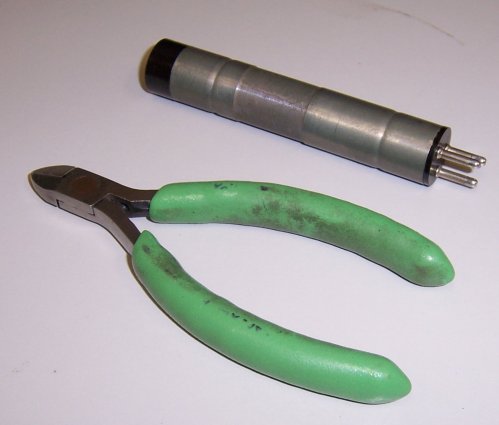
The first Geiger tube came with the morning’s mail. It’s a Victoreen OCD-D-103, a NOS spare for the famous yellow Victoreen civil defense portable counters from the 1950s. I actually found a mating 3-pin female connector in my junkbox, which is good, since I have no idea where I’d look otherwise. (The alternative is cannibalizing an octal tube socket for individual pin-grippers, generally by crushing a Bakelite socket in a vice until it crumbles.) Including the pins, the tube is just under 4″ long and 0.625″ in diameter. I’ll have to build a probe housing for it eventually, but near-term I’ll mount it in a pill bottle, of which there are legion.

The top photo is a stack of three 1000-volt mica capacitors, adding up to .048 MFD. That’s about what one circuit calls out, but more is better, and I have a 1950s steatite banana plug bar into which two such stacks will go. So I’ll build a second and put them in parallel. That will get me to about 0.8 MFD, which ought to be enough. If it isn’t, I’ll see what else I can scrounge in the line of high-voltage caps.

I’m modifying an old ceramic wafer switch to be a current interrupter, but I need to get a little farther along before I know if that will work. Those familiar with such switches will understand: I bent down the limit tabs so that the switch shaft can be turned continuously, and at each click current will make-and-break between the wiper and the stationary contacts. Crank it like a Model T, and you generate a series of quick DC pulses to the transformer.

Or that’s the theory, anyway. We’ll see how well it works. More as it happens.

Steampunk Geiger Counter, Part 1

I haven’t really done much in electronics in the last year or two, and I miss it. So when stumbling around in my scanned schematics folder tree, I came across a couple of Geiger counter circuits that I discovered while scanning Carl & Jerry out of Popular Electronics a few years ago. What struck me back then was how little there actually is to a Geiger counter circuit, and, with a Geiger tube in hand, I could have a working counter in a couple of hours or less. (A really ugly clip-lead lashup might take me half an hour.) And although Uncle Louie gave me a Raytheon counter tube when I was 11, I can no longer find it. So up I went to eBay, and discovered to my delight that somebody was selling an Amperex 75NB3 counter tube. This is significant (nay, an omen!) because I’ve been looking for one for a while. It’s the tube called out in a circuit PE published in July 1955, with the cool Ed Valigursky prospector cover. (Scroll down to it.)

GeigerCircuit-PE-July1955-P30-500Wide.jpg

The circuit is simple; nay, minimal: Basically, a 375V DC source applied to the center element of a Geiger tube through a current-limiting resistor. Any time an energetic particle passes through the tube, it ionizes some of the gas inside (generally neon with some trace gases to sharpen the pulse by quenching the trail quickly) and for an instant the tube conducts. You can pick off a pulse through a blocking capacitor and hear it with sensitive headphones as a sharp click.

Getting 375V worth of battery is nontrivial these days, but also unnecessary. Note what happens above: The batteries do nothing but charge a couple of capacitors. A circuit I found in the July 1957 issue finesses high-voltage batteries completely by setting up an output transformer as a step-up, and applying interrupted DC to the output (low impedence) winding. The interrupted DC induces high-voltage pulses in the input (high-impedence) windings, and if you capture them in a capacitor, you can power the Geiger tube from a single D cell.

GeigerCircuitPE07-1957-500Wide.jpg

The one glitch is interesting all by itself: You have to pass the pulse through a spark gap. In this circuit it’s an automotive spark plug (remember those?) but it can be anything you can crank down to a thirty-second of an inch or so. In a similar circuit published in The Boys’ Second Book of Radio and Electronics, Alfred Morgan uses two small nails held in binding posts, and lacking a spark plug in the junkbox, that’s probably what I’ll do. The spark gap acts as a crude rectifier, making sure that only the positive excursion of the induced pulse goes to the hot side of the .05 cap. The interrupted DC is generated by repeatedly pressing and releasing a momentary-contact pushbutton switch. The transistor here is a headphone amp, but again, high-impedence headphones will make pulses audible direct from the tube.

So. Is this really a steampunk technology? In other words, could someone with some skill and knowledge have built one of these in 1900? (Again, the circuit does not require a transistor, nor even a vacuum tube to amplify the pulses.) I don’t see why not. You’d need somebody who understood ionizing radiation, but that’s no stretch for a 1900-era mad scientist in brass goggles. Neon gas in a graphite-coated glass tube? Transformers? Headphones? Kid stuff.

While I’m waiting for the counter tube, I’m going to lash up the cap charging circuit and see how it works. The output transformer called out in the circuit used to be present in every single All American Five clunkerjunker tube radio I found on the curb on Garbage Day, but you may have to ask around for used units, or spend (much) more on a new transformer from Antique Electronic Supply.

And to test it? In my box of gas-regulator tubes I have a couple of old units that were “salted” with something like a trace of Lead-210 to make them conduct instantly when power is applied. Such tubes aren’t very radioactive anymore because the salting materials have short half-lives, and it’s been 55 or 60 years since most were made. And hey, if they really are dead, there’s always a few cosmic rays floating around.

I was told recently that bananas are mildly radioactive. (It’s the Potassium-40.) This seems like a stretch to me, but…we’ll find out.

The Pulps Reconsidered, Part 4

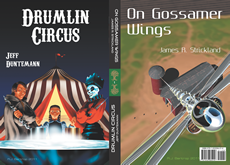
BasketballStoriesCover350Wide.jpgThe essential difference between literary (as we define it today) and non-literary fiction didn’t crystallize for me until first-person shooters happened. I’m not one for games in general, but an hour or two playing early shooter games like Doom and Quake back in the 90s was an epiphany: This is a species of fiction. The following years proved me right. Most ambitious action games have at least a backstory of some kind, and some modern MMORPG systems have whole paperback novels distilled from them. (See Tony Gonzales’ EVE: The Empyrean Age, based on EVE Online.)

Of course it’s not literature. Did anybody say it was?

What it is is something else, something important: immersive. You get into a good game, and you’re there. I can do the same thing with a decent SF novel, but the phenomenon is in no way limited to SF. I’m guessing that Farmville or almost any reasonably detailed simulation works the same way.

Immersivity is the continental divide between literary fiction and pulp fiction. Like anything else in the human sphere it’s a spectrum, placing World of Warcraft on one end and Finnegan’s Wake on the other, with everything else falling somewhere in the middle. The term measures the degree to which you can lose yourself in a work, where “lose yourself” means “forget that you’re reading/playing and enter into experiential flow.”

Don’t apply a value scale to immersivity. It’s only one dimension of many to be found in fiction, and my point here isn’t to dump on Finnegan’s Wake. Literature is intended to evoke a response in the reader, but that response is not necessarily immersion. (It can be, particularly with classics like Huckleberry Finn that are new enough to be culturally familiar to us–dare you to read Chaucer without footnotes!–and yet not so new as to be afraid of Virginia Woolf.)

Pulling the reader in and carrying him/her along requires a smooth, linear narrative style, a vivid setting, and enough going on to maintain the reader’s interest after a long day working a crappy job. Pulp characters are often types, but that’s not necessarily due to a lack of skill on the writer’s part. A carefully chosen and well-written type allows room for a reader to imagine being that character, which is important in immersive fiction. As much as I enjoyed Gene Wolfe’s massive Book of the New Sun (and I’ve read it three times since its publication) I had a very hard time imagining myself as Severian. I empathize with him and certainly enjoyed watching him against the dazzling surreality of Urth (though I had to read numerous sections several times to be sure I knew what was going on) but being him? No chance. Keith Laumer’s Retief, on the other hand, no problem. Louis Wu? Same deal.

And for the umptieth time: (I can hear the knives being sharpened) This is not to denigrate literary fiction, of which I’ve read a lot and still do. My point is that immersive fiction is a valid entertainment medium, requiring different mechanisms and different skills than literary fiction. Let’s not dump on things for simply being easy to read. Easy is good if easy is what you want–and (on the author side) if easy is what people are willing to pay for.

Which should not suggest that easy to read is necessarily easy to do. The immersive magic of the pulps is obscured by the fact that a lot of it was just badly done, and could not have been otherwise, given that some pulp titles paid a quarter cent a word and published eighty thousand words twice a month. We can do much better these days, at least on the quality side. A brilliant potboiler is eminently possible–if we as readers give authors some sense that it’s ok to take up the challenge, and that they’ll be paid for their efforts when they succeed.

More in this series as time allows.

The Pulps Reconsidered, Part 3

SDMCover.jpg

Bet you thought I forgot about this series, huh? Not so: I needed a little time to take a broader look at the field. (Click here for Part 1 and Part 2.) Someone told me that a lot of 1930s/40s/50s pulps were being scanned and posted on Usenet at alt.binaries.pictures.vintage.magazines, so I went up there and pulled down a representative sample. And I’m not talking SF anymore; what I grabbed were things like Air Wonder Stories, Mammoth Western, Strange Detective Mysteries, Adventure, and Spicy Stories.

It’s been wonderful fun. In fact, it’s a lot like watching campy old b/w TV shows, only better, because I can decide how everybody and everything looks. I don’t have to be appalled (or giggle) at the cheap crappy special effects. I just willingly enter a world in which nobody rolls their eyes at a homicidal supermarket butcher about to strangle a square-jawed hero armed with a pistol in one hand and a hacksaw in the other. (See above. No, I didn’t read that story. I still wonder what the hacksaw was about.)

I’m not the first to suggest that the pulps vanished largely because TV took over their niche. The pulps were Saturday-morning movie serials that you could enjoy any time you wanted, and once TV started showing Commando Cody, Bomba the Jungle Boy, Flash Gordon, and made-for-TV adventures like The Texas Rangers, Sky King and Highway Patrol, much of the money went out of pulp publishing. The financial pressure was eventually fatal, but over the short term, as the pulps dwindled, their quality went up. And it wasn’t just that we knew more about science and technology and hence could write better SF. The SF of the Thirties was awful because the readership didn’t care. The pulps had a monopoly on cheap entertainment and people bought it because it was all there was, and reading it was better than staring at the wall.

Print entertainment evolved out of the pulps and into other print markets, particularly glossy mags. The railroad pulps died, but glossy, ad-supported magazines like Trains and Railroad picked up the readership, which after WWII had more money to spend on locomotive picture books and model railroading. Tacky text-porn mags like Spicy Stories (which had racy drawings and a handful of “artful” b/w nude photos) gave way to Playboy and its cheaper imitators as social strictures against visual porn weakened in the 50s. In the late 50s, pulp SF improved hugely, and bootstrapped itself into the new world of mass-market paperbacks by selling reprint anthologies of the best work to come out of the pulp era. (We can be fooled into thinking 30s and 40s pulp SF was better than it was because what we read of it was hand-picked for quality decades after its publication. Read a couple of original SF pulps circa 1935 and you’ll see what I mean.) Crime pulps went both up and down, to comics on the low end (much of “crime” fiction from the Depression was actually horror) and to book-length mysteries on the high end. The romance pulps like My Romance split similarly into gossip mags and mass-market romance novels.

Fewer people may be reading these days, but those who gave it up probably never liked reading that much to begin with. Again, reading was better than staring at the wall, but TV, when it arrived, was easier, especially for people with marginal education. The audience that remained was pickier, and many had been formally exposed at the college level to classic literature, which became the standard by which all fiction was measured.

And that may be a mistake. (I’ll come back to this point in a future entry.)

Leaving the quality of the writing itself as a separate issue, after a good long look around I’d say that the lessons of the pulps are these:

  • The pulps were about specific cultures. They were tightly linked to a time and a place and a generally understood cultural subtext. This was even true of early pulp SF, much of which might be characterized as “Depression-era Chicago on Mars.”
  • Characters were intended as costumes to be worn by readers, not fully realized individuals to be admired on their own merits as independent men and women. A lot of people don’t understand this, and many still won’t admit it. Make characters too vividly fluky and original, and readers will have a hard time identifying with them.
  • As a corollary to the above: Concepts, settings, and action were as important as characters, and much more vivid. Again, it’s the difference between imagining yourself driving a fast car and imagining someone else driving it.
  • The pulps were fun. They understood and accepted their role as immersive entertainment. They were not equipped to be literature and didn’t try to be literature.

With all that in mind, the big questions become: Is there unmet demand today for good-quality immersive (non-literary) fiction? How much of this legacy can we retrieve in 2010 and do well?

More next time.

Drink Hard, Live Longer

Judging by the number of times I’ve seen links to it online yesterday and today, the liveliest Web story in recent memory is an item suggesting that heavy drinkers live longer than nondrinkers. The curve isn’t linear; moderate drinkers live longer than both heavy drinkers and nondrinkers. The WTF moment lies entirely in the correlation between nondrinking and shorter lifespans.

The science looks good here: The sample size was big enough to be trustable, and the researchers controlled for a lot of factors, including socioeconomic class, physical activity, social isolation, and so on. So we can’t write it off out of hand. But what in tarnation is going on? Is a little alcohol really good for you?

I think it may be. But let’s not get completely hung up on the alcohol. I have an intuition that what we’re seeing are not the effects of the alcohol itself, but consequences of the psychology of people who won’t touch the stuff.

I’m talking about scruples. That word is generally seen as religious jargon today, so I might better characterize it as “lifestyle panic.” There is a psychology that constantly walks on eggs, fretting at a very deep level that one false move in some direction (or many, or a multitude) will lead to early death or eternal damnation. This can be an inculcated attitude (the priests of my youth tried very hard to make us panic over “impure thoughts,” and often succeeded) but I think the underlying psychology is inborn. My mother basically died of scruples, and I’ve been fighting the tendency most of my life. If I’m “soft” on sex and divine judgment, that’s certainly a big part of the reason.

The New York Times published an article about food scruples some months back, quoting a researcher who said that “…all of these women I kept meeting…were scared to death if they didn’t eat a cup of blueberries a day they would drop dead.” This is of a piece with “fat panic,” which I see all the time. That pugnacious scientific fraud Ancel Keys has convinced hundreds of millions of people that fat will kill them, when more and more science is pointing in the other direction. Fatty acids are essential. Not eating enough fat will probably kill you a lot quicker.

My thought is this: People prone to lifestyle panic are the least likely to drink–but the most likely to live lives that are cortisol thrill rides, keeping their arteries in a continuous state of inflammation. That’ll kill you fersure if it goes on long enough.

So there’s a type of selection going on here that isn’t being adequately addressed. Some people worry constantly that they’re doing the wrong thing, no matter what it is that they’re actually doing, nor how virtuous their lives objectively are. The effect seems inborn and may not be curable. I’m not sure I buy the obvious objection, which is that alcohol makes you worry less. One reason I drink very little is that when I drink I worry that drinking will disrupt my sleep or give me headaches. It sounds weird, but becoming less inhibited does not mean worrying less. (That’s certainly been the case with me.) Inhibition and worry are two different (if perhaps related) things.

Moderate drinkers are people who are not panicked enough to avoid alcohol entirely, but still careful enough to know that too much will do permanent damage. In other words, they’re fundamentally sane. If they live the longest, well, that doesn’t surprise me at all.