Jeff Duntemann's Contrapositive Diary Rotating Header Image

Ideas & Analysis

Discussions of various issues including suggested solutions to problems and pure speculation

Victoria Duntemann and Lady Julian

VictoriaDrumMajoretteCropped1940.pngToday is Mother’s Day, and I celebrate it in eternal memory of Victoria Albina Pryes Duntemann 1924-2000. But today is also something else: May 8, the feast day of Lady Julian of Norwich, denied sainthood by the Roman Catholic Church for daring to suggest that God would triumph over Hell. Lady Julian is my personal patron saint, and I have declared her the Patron Saint of Gonzo Optimism: All manner of thing will be well. All. No exceptions. It don’t get much more gonzo than that.

Lady Julian was very careful of what she said, and had to be, lest she be burnt at the stake by her mass-murdering psychopath of a bishop, Henry Despenser, who ordered the Lollard Pits to be dug near Norwich and then gleefully filled them. The message of Lady Julian’s visions, which she hid well and could barely believe herself, was as simple as it was audacious: God will not settle for anything less than the salvation of everyone and everything.

It’s one of those painful ironies that I heard of Lady Julian only a couple of years before my mother’s death. Victoria Duntemann’s religion was an insane Polish peasant amplification of the fringes of Triumphal Catholicism, and basically consisted of Hell plus debris. That said, she took it only a little farther than the grim priests of my childhood parish, who gripped Hell to their hearts like an infernal teddy bear. Whether they understood it that way or not (and I think some did) they defined Catholicism as what you had to do to stay out of Hell, which ultimately cooked down to obeying them without question and having as little to do with sex as possible. My mother and countless other goodhearted and sensitive people swallowed this blasphemy whole, and in far too many cases (my mother’s included) it crushed all hope from them.

Hell haunted my mother her entire life. I was at her bedside when she died, and I am convinced that she died of despair, fearing that sins either wholly imagined or minor and long forgiven would land her in unending torment. (Right: She who was a nurse all her life, comforting countless people and tending to both of her parents and later her husband in their final years, and giving ceaselessly of her time and money to the church that had taken such pains to terrify her–Hell-fodder, of course.) Managing my consequent anger has become one of the great challenges of my life.

Hell has got to go. It no longer frightens the evil, and causes only suffering among the good. It is an emblem of either a sadistic or a defeated God. Do we have the guts to imagine a better God, one who will out-stubborn the worst of us and bring the whole shebang back into divine wholeness before the curtain falls?

LadyJulianCat.pngAlready done: “And so our good Lord answered to all the questions and doubts which I could raise, saying most comfortingly: I may make all things well, and I can make all things well, and I shall make all things well, and I will make all things well; and you will see yourself that every kind of thing will be well.” Julian of Norwich, Showings, Chapter XXXI.
I may. I can. I shall. I will. What does He have to do, hit us over the head with a #7 frying pan?

I’m convinced. Given a few more years, I might have persuaded my mother. She understood me poorly, but she listened to me, and she took me seriously, as all good mothers must of the children they bring into the world. I built telescopes on her front lawn, and she was always willing to give me a dollar for one more damned pipe fitting to twist into the declination axis. She read and approved of “Our Lady of the Endless Sky,” which was my first published story, written in some respects for her. She didn’t read the pile of my computer books that she kept in a corner of the livingroom, but I think they got the message across that her only son was neither crazy nor stupid. Perhaps more significant than any of that, I think she saw something of herself in me, and recognized the ache for God that she herself felt and had tried to instill in her children. She was ready to hear me out long before I knew enough to begin speaking, but I didn’t begin speaking until she could no longer listen.

I managed to avoid the trap she fell into, and maybe that’s triumph enough. Mothers want the best for their children, and what I got was what she should have had: a religion that celebrates the fundamental goodness of all creation, and the inescapable love of God. She knows the truth now. Could Lady Julian have told her? (Better late than never!)

If not, then what are patron saints for?

A Very Bright Line

Today’s Big Question cooks down to this: Is Bin Laden more valuable to Al Qaeda as a live leader or a dead martyr?

Hint: Name one Islamic martyr.

Here in the mostly unchurched West it’s easy to forget that Islam is an expression of radical monotheism. Islamic culture brooks no competitors to Allah, and takes the Old Testament proscription of “graven images” farther than any other major religion. It’s not about the images themselves, as we sometimes misunderstand, but about the underlying psychology of worship.

Catholicism’s great genius lay in absorbing the pagan cultures it converted rather than destroying them, and in consequence we revere saints and sometimes inanimate objects that are images of saints, are associated with saints (relics) or express sacred symbols. These are Christianized echoes of ancient polytheism, and looking at the myths of early Christianity, it’s easy to see the saints in the stories as small-g gods: They are larger-than-life because, well, they are larger than life, and have ascended into a graduated pantheon that from ancient times expressed the connectedness of humanity to the divine. A single, all-powerful God is a relatively recent addition to religious psychology, but Christianity simply placed God at the top of the pyramid, with all the saints below, revered but not worshipped. (I grant that drawing that line has always been a challenge.)

Here and now we’re comfortable with that, but a close reading of Eastern history shows the sometimes bloody tension between monotheism and these ancient echoes of polytheism. I just finished John Julius Norwich’s A Short History of Byzantium, which went into considerable detail about iconoclasm, a religious conflict that tore through the Byzantine Empire circa 750. People were killing one another over questions of what should be revered, and how. (I think it’s no coincidence that Islam itself appeared barely a century earlier.) Byzantium basically anathematized representational sculpture in the eighth century, and afterward confined religious artwork to painted (not graven; i.e., shaped or sculpted) images. This was a compromise. Many in the iconoclast faction at the time wanted no representational art at all.

Islam goes farther still. It reveres the ancient prophets (up to and including Mohammed, considered the greatest and the last) but demands that worship be directed to God and God only, and is constantly on guard against the temptation to idolatry. Living leaders provide inspiration and are given obedience, but once leaders die, they move into God’s territory, and some very strict rules begin to apply to those still on Earth. Revering a deceased leader too much begins to resemble idolatry, and Muslims have a very deep caution about idolatry.

We in the West don’t call it “hero worship” for nothing.

My thought is that Bin Laden’s death will be an inspiration to his followers, but not too much and not for long. He was a very bright guy, skillful and extremely lucky, and Al Qaeda will miss him sorely as a leader. His power as a martyr and a symbol will be limited, however, in a religion where history and hagiography are separated by a very bright line.

Ebooks and Adding Value to the Public Domain

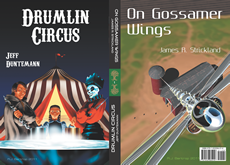
I just got our first two Copperwood Press ebooks posted to the Kindle store, and they’re now available for sale: Drumlin Circus / On Gossamer Wings and “Whale Meat.” No DRM. I’m still working with Ingram’s Lightning Source to get the double mounted and sellable in its print edition. It won’t be available from Lulu, and over time I will be migrating my other print books from Lulu to Lightning. Learning their relatively unforgiving system the first time involves a little hair-tearing, but once learned it’s learned.

There’s certainly plenty to do in coming months to get the rest of my material converted to good ebooks and posted on the major retailers. One issue I’ve found troubling for some months now is the ambiguity regarding public domain material. Both B&N and Amazon make a big deal about whether a work is in the public domain. PD titles get lower royalty rates and just generally seem libri non grati on the retailer sites. This isn’t surprising in some ways. The retailers are trying to avoid having 2,774 versions of The War of the Worlds on their servers, taking up space and confusing the readership. The definition of “public domain” varies legally by country, and what may be free in Australia or Chile is not necessary free here. So they do have to be careful on the rights front.

The issue matters to me because of The Old Catholic Studies Series, a project that I’ve been tinkering for ten years now. The goal was to scan, OCR, edit, and lay out clean, indexed versions of the foundational texts of Old Catholicism so that people wouldn’t have to pay $200 to read yellowed, crumbly, scribbled-in books printed in 1874. I have two such texts currently available in print editions: The New Reformation and The Pope and the Council. They were a lot of work, but they’ve sold reasonably well, and I consider the effort worthwhile. (It was also damned good practice in making books.) Not a lot of people want them, but the people who do want them have been very happy with them. I would have done another two or three, but John Mabry’s Apocryphile Press got there ahead of me, and put out facsimile print editions of the other major works I had considered. I prefer new layouts to facsimile editions, but Apocryphile’s scans are fairly clean and I do recommend them.

It’s true that the source materials are long in the public domain (which at least in the US includes all books published before 1923) but technically, what I’m offering are derivative works. I scanned them, page by page, OCRed them to extract the text, and then went over the text character by character to eliminate OCR errors. (Some were a hoot: “The Frankish King Pepin…” became “The Prankish King Pepin…”) The books were not indexed, and I indexed them. I fixed a few typos (especially in The Pope and the Council, which was a hurried English translation of a work written originally in German) and Americanized the British spelling. Although I don’t claim to have done a copy edit on either book, I fixed a number of examples of what I consider regrettable diction. I wrote an introduction explaining what I did and how. I gave them nice covers. If I had another hundred years to live and no need to make a living, I would do a strong edit on both.

By any legal definition what I’ve produced are derivative works that are not themselves in the public domain. That said, anybody who took an OCR of The War of the Worlds and changed three words could make the same claim, and if enough people do that, the noise level at ebook retailer sites would go through the roof. Nobody’s PD ebooks would sell well enough for it to make anything like a reasonable new edition of any PD book worthwhile.

I don’t know precisely what the answer is. Vetting tens of thousands of $2.99 ebooks is a labor-intensive business, and what sorts of standards would apply? Refusing facsimile editions is obvious and easy, but I doubt anyone would even try to read 50MB page-image PDF facsimiles on a Kindle. (On the Nook Color it might be practical; grab something 1875-ish from Google Books and let me know!) A better suggestion might be to require an up-front payment from publishers for posting anything either fully in the public domain or significantly derived from the public domain. That would cut down on bothouse publications and allow people like me to genuinely add value to public domain material without drowning in unmodifed or barely modified PD books. I’d think $25 would be about right. My books would earn that back in a month or six weeks, and the bothouses couldn’t justify it.

It’s not often that I’d willingly ask to have my own costs raised, but publishing has always been a weird business, and sometimes, well, free is less than worthless.

How Music Really Oughta Work

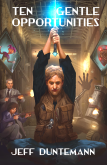
I just got back from Big Family Easter In Chicago, where it rained eight out of the ten days we were there. So I’m drying out, catching my breath, tinkering with the outline of Ten Gentle Opportunities, and trying to iron out a long list of wrinkles in several ebook projects. I’m crosseyed from poking at details, so I’ll take ten minutes out for a slightly tangled story. This may start to sound like an episode of James Burke’s Connections after awhile, but bear with me.

Marci Braun (scroll down a little) is a popular country/western DJ on Chicago’s big country station US99.5. She’s also Carol’s sister’s husband’s cousin’s daughter, and we’ve seen her here and there at family gatherings on Carol’s side since she was a pre-teen. The first time we took Dash to Chicago (he was nine weeks old at the time) he was a big hit at our nephew Matt’s college graduation party, and he bonded with Marci in a country hemidemisemiquaver. So I listen to her when I know she’ll be on the air, and she has a lot to do with my growing affection for country music. Oh, and the fact that pop music is now completely incoherent, lacking warmth, melody, harmony, and just about everything else that I value. Several of my friends among the Educated Elite grumble at me for listening to country music (“It’s so, so, well, Republican!“) but I just tell them that if they can bring back close harmony and clever lyrics to pop music, I’ll jump. In the meantime, I listen to country and classical. Draw whatever conclusions you wish. (No points for the obvious one that I take great pleasure in annoying the Educated Elite.)

Anyway. A week ago Monday night, while I was driving from our condo in Des Plaines to Crystal Lake after not seeing Carol for three days, I punched the 99.5 button on the car radio, and Marci was there. (Actually, odds are that she was a digital audio file at that moment, but that’s just how the radio business works.) She ran a commercial, and then introduced a song: Darius Rucker’s “This.” Great raving upbeat piece, celebrating a life that turned out very well somehow, in spite of all the mistakes we make and the bad luck that comes as a side dish to life’s main course, generally right there beside the lima beans.

Brilliant lyric, which you can read here. The gist:

I don’t really know how I got here
But I’m sure glad that I did;
And it’s crazy to think that one little thing
Could’ve changed all of it.

Maybe it didn’t turn out like I planned–
Maybe that’s why I’m such, such a lucky man!

For every stoplight I didn’t make;
Every chance I did or I didn’t take;
All the nights I went too far;
All the girls that broke my heart;
All the doors that I had to close;
All the things I knew but I didn’t know
Thank God for all I missed
Cause it led me here to
This.

If you like feel-good music, go buy that song, which will cost you the same as a small Diet Coke at McDonalds, and will stay with you a lot longer. Just as the song began I was coming out of the Union Pacific underpass on Northwest Highway just west of Des Plaines, and there was a freight train heading by overhead. At the song’s inspiration, I was reflecting on how much I like my life. I’ve gotten almost everything I’ve ever wanted, granting that some of it took awhile. I found my soulmate at 17, and my life’s work at 33. That may have been optimal: Had I not met Carol that early I would probably have lost her to someone else, because at 16 she didn’t know yet how hot she really was. (And anyone who knew me when I was 17 will recall how hot I wasn’t.) If I hadn’t worked at technical pursuits before I discovered that I was an editor and a tech writer, well, I might have tried to make a living on SF (ha!) or given up on writing entirely. Everything just seemed to flow, one small success from another, with equal parts luck and hard work to drive the machinery. I had it: Dogs, houses, sunsets, tube sockets, saints up and down the family tree, everything. (I even had a pickup truck once.)

Luck. Trains. Whew. In 1977 I was driving home from my mom’s house along Devon avenue, and I raced a train to a crossing. I made it by two car lengths. Why? I don’t know. It was by several orders of magnitude the stupidest thing I’ve ever done, and if my dad’s anemic, beat-to-hell ’74 AMC wagon had been just a little bit out of tune, I would have died in 1977. I had been married to Carol for less than a year, and had not yet completed wire-wrapping my first computer. I was just getting out of first gear. Damn, I’d barely gotten out of park.

Stupidity comes in smaller containers as well. I told my broker to buy $5,000 worth of Microsoft stock a month after they went public in 1986. She offered me a limited partnership instead, and I took it rather than chewing her ass to go back and do what I told her. But compared to being splatted by a General Electric U23B, hey, small potatoes.

Like I said, great song. I got home to Colorado, fired up Firefox, found the song among Amazon’s DRM-free 99c MP3s, and ninety seconds later it was playing. It’s not tied to a particular player or DRM technology, so there’s no reason to think I won’t be playing it twenty years from now. Certainly we’ll play it at our 40th wedding anniverary party in 2016, where I will wear my expensive cowboy hat and dare y’all to dance.

That’s how music ought to work: You hear a song somewhere that you’d like to hear again, so you find it online, pay for it quickly and easily, download it, and keep it forever. I remember 45s and LP vinyl. (Hell, I remember 78s.) I remember 8″ reel-to-reel. I remember 8-tracks and cassettes and CDs. I remember my Diamond Rio. I still have an iPod. Maybe we had to pass through all that to get where we are today, and maybe it might have turned out differently had some engineer been brighter or Sony not as dumb as they always turn out to be. Doesn’t matter. The message hasn’t gotten out to every last corner of the world, but as long as Amazon’s system or something like it exists, music is where it needs to be.

Play it again. Play it forever. We’ve arrived.

25 Books That Changed Me Forever

Michael Covington’s recent entry on the books that made him what he is intrigued me, and I spent an hour or so today gathering a similar list. I’m not sure that the 25 books listed below made me what I am, but each one of them changed me somehow, and sent me off in a direction that was slightly (and sometimes greatly) different from the path I had been on before. I’ve listed them chronologically in the order that I first read them, and the number in parentheses is my age at that time.

Note well that these are not all fabulous books, nor are all of the many fabulous books that I’ve read in my life listed here. These are the books that changed me in some identifiable way. It’s an interesting exercise, and I powerfully recommend it.

  • Space Cat by Ruthven Todd (6). I don’t recall all of the books that my parents read to me, nor the first few I struggled through on my own, but it was the Space Cat series that made me an insatiable reader. Not all of what I read after that was SF, but it was SF that made me absolutely desperate to read.
  • The Golden Book of Astronomy by Rose Wyler, Gerald Ames, and John Polgreen (6). My grandmother and Aunt Kathleen bought this for me for my sixth birthday. It’s a big book, filled with beautiful watercolors of stars, planets, telescopes and spacecraft, framed with text I could read myself. Once I finished it (and I read it countless times) I never looked at the night sky the same way ever again.
  • Tom Swift and His Electronic Retroscope by Victor Appleton II (8). Tom Swift, Jr was my first exposure to YA SF, and this was the first Tom Swift book that I ever had. (It was no better and no worse than most of the others.) Although I had read YA SF and fantasy books earlier, Tom Swift touched a nerve and made technological SF an obsession.
  • The American Heritage History of Flight by Arthur Gordon (10). This was the first history book of any kind that just took me by the throat and held on. I learned much about invention, and the debt that all inventors owe to those who came before them. I learned that failure is no disgrace, if the effort was diligent. This book helped me dream vividly, and Samuel Pierpont Langley became one of my earliest identifiable heroes.
  • Using Electronics by Harry Zarchy (11). I’d read a couple of Alfred Morgan’s electronics books for preteens before, but Zarchy was a better engineer, and the circuits he described in his books just worked with less aggravation, when all you had were greasy second-hand parts tacked together with Fahnestock clips on a piece of scrap lumber. The book gave me the confidence to continue my study of electronics, which continues down to this day.
  • Retief’s War by Keith Laumer (13). Although I’d read Laumer’s wry The Great Time Machine Hoax a few months before, it took Retief to drive home the conviction that SF could be funny. Humor is pervasive. There are humorous moments in most of my SF, even in serious stories like The Cunning Blood.
  • Types of Literature ed. Edward J. Gordon (14). My high school was superb, and chose its textbooks well. This book, in its tank-rugged plain black binding, broadened my enjoyment of reading beyond SF and science to poetry, drama, essay, and “mainstream” fiction. I don’t know where else I would have encountered Southey’s “The Cataract of Lodore” or John Galsworthy’s “The Pack”.
  • Spectrum 5, ed. Kingsley Amis (14). This was the book that (finally) nudged me beyond YA SF and Laumer’s simple and often silly adventures to genuine adult SF. I was stunned by the impact that Miller’s “Crucifixus Etiam” had on me, and when I wrote my first SF short story later that same year, it was the stories in Amis’s Spectrum series that I was imitating.
  • The Lord of the Rings (14). As a young teen I was no fan of magicians and elves and suchlike, and if it had not been for the insistence of the first girl I ever cared deeply for I would never have touched it. Instead, I stood poleaxed before an entirely new creation, and I trace my love of SF world-building directly to Middle Earth.
  • World of Ptavvs by Larry Niven (15). When Niven’s character Larry Greenburg sets Pluto on fire, I gasped, put the book down, and thought (about the book, not Pluto): I wanna do that! Laumer taught me how to write space adventures, but Niven taught me to think big.
  • Of Time and Space and Other Things by Isaac Asimov (16). I always loved reading about science, but this was the first of many science books to impress me with the quality of the writing. Asimov’s written voice spoke to me as though he were right there across the kitchen table, talking to me as a friend would. When a few years later I first tried to write about technology, this was approach I would use.
  • The Fourth Dimension Simply Explained by Henry P. Manning (16). For all the BS about the fourth dimension that I’d read in bad SF, this was the first book that allowed me to take higher dimensions seriously. The following year, my science fair project on four-dimensional geometry took me to the city competition and earned me a silver medal. It also shook loose (finally) the close connection between math and numbers and allowed me to look at difficult concepts from a height, conceptually. (The numbers fell into place later on. Sometimes.)
  • Clarion, edited by Robin Scott Wilson (20). This is not an especially good book. In fact, when I read it I was appalled that some of the stories had even been published, and it all seemed to be due to this writers’ workshop that they had attended. So, having noticed from the introduction that the editor was local to me in suburban Chicago, I looked him up in the phone book and called him, and asked him how I could get into that workshop too. He told me. I applied. I was accepted. Six weeks after I got home, I sold my first story.
  • TTL Cookbook by Don Lancaster (23). This was the book that first got me tinkering with digital logic. More than that, it went beyond Asimov toward my lifelong ideal of writing about technology as though I were talking across the table to a friend. This became my trademark, and ultimately sold a third of a million technical books with my name on them, plus four years of columns in Dr. Dobb’s Journal.
  • Pascal Primer by David Fox and Mitchell Waite (30). I learned FORTRAN, FORTH, APL, COBOL, and BASIC before I ever encountered Pascal (and you wonder why I write my reserved words in uppercase!) but it wasn’t until I saw Pascal that I could say that I really loved programming. This odd looseleaf book with its offbeat cartoon illustrations proved to me that writing about programming could be enhanced by humor and good diagrams. I could not have begun Complete Turbo Pascal without reading this one first.
  • Conjuror’s Journal by Frances L. Shine (35). Purchased for a dollar in the closeout bin somewhere, this understated novel of a mulatto parlor magician who wanders around Colonial America was the first book I can truly recall moving me to tears, and the one to which I trace my love of rural American settings and country people.
  • The Lessons of History by Will and Ariel Durant (42). You can read this in an evening, and if you do, you will know why reading history is important. I got it in a stack at a Scottsdale garage sale, and have read at least a hundred histories since then, few of which I would have otherwise attempted.
  • Good Goats by Dennis Linn, Sheila Linn, and Matthew Linn (43). The absurd cruelty of the idea of Hell (which eventually destroyed my mother) set me against religion for many years. This little book, more than any other, allowed me to start the long trip back.
  • World Building by Stephen L. Gillett (45). The math behind astrophysics turned out not to be as scary as I had feared. And so I began creating not just imaginal worlds, but imaginal worlds that worked. 18 months later, I finished my first adult novel, The Cunning Blood.
  • Julian of Norwich by Grace Jantzen (47). Wow! So my lifelong nutso optimism was not insane after all, and suddenly I had a patron saint. “All will be well, and all will be well, and all manner of thing will be well.” You go, girl!
  • The Inescapable Love of God by Thomas Talbot (49). This book finally made it clear to me that I could be a universalist or else an atheist. There were no other choices. A God who doesn’t want to save all his creatures is not all-good; a God who can’t bring it about (without compromising our freedom) is not all-powerful, and God must be both in order to be God at all.
  • Opening Up by James W. Pennebaker (51). To combat the deepening depression that began consuming me after my publishing company imploded in 2002, I undertook a program of “writing therapy” as outlined by Pennebaker. Maybe it didn’t save my life. It certainly saved my optimism, and got me back on the path after a nasty year of confronting the Noonday Devil.
  • The Criminal History of Mankind by Colin Wilson (55). Right Men are the cause of most of the misery that humanity seemingly cannot avoid. I would never think about authority figures the same way after reading this. Trust no one who has power over you. No one.
  • On Being Certain by Robert A. Burton, MD (56). This book put words to a suspicion I had had for some time: Certainty makes you a slave to that about which you are certain. A tribe, an ideology, anything. To be free you have to accept that all human minds (especially your own) have limitations, and that nothing–nothing!–can be known with certainty.
  • Good Calories, Bad Calories by Gary Taubes (56). I’d been losing weight and getting healthier for ten years before I read this book, mostly by avoiding sugar. Now, finally, I understood why. I also now understand how Right Men like Ancel Keys can take almost any scientific field and turn it to crap. Good science requires that we be skeptical of all science, particularly science that obtains the endorsement of government, which (like pitch) defiles everything it touches.

I’m now 58, and it’s been a couple of years since any single book has changed the direction of my thought and my life. I’m about due for another. I’m watching for it.

The Terror of Customer Expectations

As I’ve said any number of times, I loathe DRM and have since I first understood what it was. My reasons are these:

  • It makes content delivery systems fragile. DRM adds complexity to a system, and by its nature is constantly looking for a reason to cut people off. Jerry Pournelle made this point at least 30 years ago, when DRM was “copy protection” and floppies ruled the world.
  • DRM inconveniences paying users and does very little (if anything) to stop piracy. Because…
  • A DRM system only needs to be broken once. A single very bright individual (or a small cadre of them) figures out the crack, then wraps it up in a script or a simple utility that any fool can use. Bruce Schneier made this point at least twenty years ago.
  • DRM often ties content to one single company, generally through some kind of Internet permissions system. If that company goes under, DRMed content can become unavailable.
  • Related to the above: DRM often (admittedly, not always) ties content to a single device or family of devices. Users who want to move to a different content rendering system can lose everything they’ve paid for.
  • Very Large Companies Run By Comittees Of Clueless Egotists (VLCRBCOCEs) forget that the ultimate goal is to curry favor with customers so as to sell them stuff, and allow the pursuit of DRM to make them do really stupid things. Google “sony rootkit” to see how that works. Oh, and Amazon’s private dustup with the 1984 rightholders that led them to “repossess” books right off customer Kindles.
  • Consequences of much or all of the above: DRM turns paying customers into pirates. Piss off honest customers a few times, and they’ll start looking on the pirate sites before heading over to your online bookstore.

In short, DRM creates an adversarial relationship between content providers and content purchasers that benefits neither side. As a publisher, I have promised never to force it on my readers.

Which brings us to today’s issue: What happens when online stores force DRM on me? Jim Strickland and I are preparing ebook editions of all our SF, and as time allows I’m going to do the same for my Carl & Jerry books, and even the Old Catholic Studies Series. It’s not news, and certainly not news to me, but we’ve had to confront the fact that Apple forces DRM on book publishers who want access to its store. Jim and I will probably go along, and think of a clever way to get unencumbered epubs to paying iBooks customers.

I don’t know what that clever way will be yet, but you’ll hear more about it as we figure it out. In the meantime, it’s a headscratcher: Why the hell would Apple do this? I’ve been sniffing around and there’s no clear answer. Some think it’s because Apple owns the DRM technology (FairPlay) and it’s in their interest to sell books with FairPlay gunked to them. I doubt that it’s true (it’s like paying yourself for something you already own) and given that you can download bookstore apps from other vendors to iOS, encumbered ebooks are at a competitive disadvantage, right there on Apple’s home turf. (Amazon allows unencumbered ebooks on Kindle.)

If I had to guess, it would be this: One or more VLCRBCOCEs in the print publishing industry, as part of their deals with Apple, demanded that everybody selling on iBooks must be required to use DRM–or no deal. What’s really at stake are customer expectations. Big Print is in a panic over ebook pricing to begin with, as we learned a year or so ago when Amazon and Macmillan jumped down one another’s throats. Macmillan didn’t want Amazon to “train” customers to think that ebooks should cost $9.99. (I was on Macmillan’s side that time, though for a different reason: If they jack their ebook prices up to the sky, I can undercut them much more easily. Amazon, please let publishers control their own pricing–especially huge, clueless, suicidal publishers.) In this case, Big Print doesn’t want customers to think of unencumbered ebooks as normal and expected, and DRM-encumbered ebooks as undesirable anomalies.

That particular war has already been lost, pretty much. Conventional wisdom among the tech savvy is that DRM is bad, and few of the indies use it. Nontechnical ebook buyers will figure it out when they decide to move to another reader system and can’t take their purchases with them. (The ebook business is so new that most people are still on their first reader and their first forty or fifty ebooks.) The day will come in the next few years when Big Print will be a lot less big, and competing against a lot more ebook publishers who have long understood that DRM does no one any good.

And price expectations, egad. $9.99 is so 2010. Many independent publishers now think that $3.99 or even $2.99 is the new normal. Furthermore, Amazon is now worried about yet another price point–99c!–at which their own ebook business model becomes unsustainable. Ebook pricing is still a huge imponderable, and I don’t (yet) have much useful to say about it. I hope to have some real data for you by this time next year.

Do I have proof that Apple was railroaded by Big Print into requiring DRM from all comers? No. But it makes sense to me: Apple didn’t have the negotiating leverage that Amazon or B&N had. If they get bigger, things may change. And if they don’t get bigger, it may be because everybody else, and especially the indies, is eating their lunch. Either way, for weal or woe, Big Print is in trouble, and therein lie many more entries that I hope to write in the near future.

Space Westerns vs. SF Westerns vs. Weird Westerns

Back in 2002, when “Drumlin Boiler” appeared in IASFM, somebody in the comments on the IASFM Web site grumbled that the story was “a glorified western.” I hadn’t thought of it in those terms, but even though I’m sure the comment was intended to be dismissive, it was true: “Drumlin Boiler” was a story set on the frontier in a society roughly equivalent to 1870s America. The frontier was on another planet, and there were all these alien gadgets lying around causing trouble, but people were riding horses and packing six-guns.

Ever since then, I’ve used the term “space western” to describe the genre of the first several Drumlins stories. (Drumlin Circus is different for a number of reasons, but I’ll get to that in future entries.) The term was floating around in obscurity for years in the SF culture, but then Firefly happened, and abruptly what my Clarion ’73 compatriots once razzed as “cowboys on Mars” became legitimate and even hit the bigtime.

I learned not long ago that there’s a mirror image of the space western: the science fiction western. I hadn’t known that the literary classification knives were cutting that fine, but they are. Space westerns transplant themes and cultural elements of the American west onto other planets. Science fiction westerns transplant SF themes into the actual American West of an earlier time. Think of the difference as “cowboys on Mars” vs. “Martians in Texas.” (For a great example of the latter, see Howard Waldrop’s wry “Night of the Cooters.” I’m guessing, not having seen it nor read the graphic novel, that Cowboys and Aliens is much the same.)

And as if that weren’t enough, there are also weird westerns: supernatural themes transplanted onto the American West. This surprises some but doesn’t surprise me. The era of the American West was also the apex of Spiritualism, which originated near Rochester, New York in 1848 but by 1880 was everywhere in the country, including the western territories. The weird western subgenre goes way back: The mere handful of classic horror comics that I read in my cousin Ron’s basement in the late 1950s always had a few cowboy settings. These days, you can find things like Six-Guns Straight From Hell, which appears to include such genre cross-products as werewolf sheriffs, vampire bank-robbers, and “new-fangled electric zombies.” Many of the stories were first published in Science Fiction Trails, an annual anthology edited by David B. Riley. SFT goes broader and covers all three categories, sometimes with a steampunk flavor, as in Jim Strickland’s story “Brass and Steel” in the recent #6. “Brass and Steel” might well be said to include “new-fangled electric zombies,” a concept Jim pursues with a lot more rigor than the author of your average sparkly vampire yarn, ten-gallon hats or no.

I went a little cold on SF for quite awhile (I’m guessing almost 15 years) because it began to take itself a little too seriously and thereby ceased to be fun. Fun is what we do this for, after all, and sending things a little bit over-the-top is the very best way to puncture the stuffies and get the fun back front-and-center. The first three Drumlins stories were space westerns. Drumlin Circus is a steampunk western, with just a hint of weird, if a postulated sensitivity of quantum computers to human mental states counts as weird. (I stop well short of vampires.) Hell, I can wear lots of hats; hats are among the things I do best. Ask Carol. Or just look in my closet.

Uphill Melts First

We’ve had a miserable cold winter here, and whereas we haven’t gotten any more snow than average, the snow that we’ve gotten has been a long time leaving. Over the past four or five days the temps have finally been trending up, and as the snow melted on our sidestreets I once again noticed something I’ve seen the last few winters: The uphill lane melts first.

It’s a fascinating business. It’s consistent, and there are a lot of stiff inclines here on the slopes of Cheyenne Mountain. No matter what street I drive on after a snowfall, it’s the uphill lane that melts first. So the citizen scientist in me started chewing on the question: Why?

My first hypothesis was that on the eastern slope of a mountain, roads running east and west have the uphill lane on the north side, meaning that the southerly winter Sun is more likely to fall unshadowed on the north-lying lane. This may be a factor on some streets, but I quickly found hilly streets running north and south and at odd angles. In all cases (I didn’t find even one exception!) the uphill lanes melted first. This was true even on the north sides of small hills where the road surface got little if any sunlight at all.

This left me only a single hypothesis: That car engines have to work harder to move a vehicle uphill, and therefore the undersurface of the car (engine and exhaust system) are hotter going uphill than downhill, when the engine is basically idling. Heat radiating from the undersides of uphill-traveling cars melts more snow than vehicles idling their way downhill. This is a suburban area rather than rural, and there are a lot of houses up here, all on smallish lots. So traffic is significant, especially at rush hours, when conga lines of minivans and four wheelers (necessary on winter roads with 12% grades) commute down and back to Colorado Springs.

I don’t know how true this is, nor how to test it in a controlled fashion. The snow is now gone, but come next week another experiment will be set up, and I’ll have a chance to look again. (I need to keep a camera in the car so I can snap a picture of the effect in action, something I haven’t done yet.)

If you’ve seen something like this happen in your area, let me know.

The Inexplicable Pirate Box

PirateBoxCafe3.jpg

I’m still on the long climb back to functionality and can’t do much computing because the current bug has hugely irritated my eyes. However, I did want to call quick attention to one more thing in the pirate universe before going back to bed: David Dart’s Pirate Box. I got the tip from the Jolly Pirate a couple of days ago, and most of the gadget blogs have now picked up the story. It’s a make-it-yourself wireless filesharing node in a pirate lunchbox.

Lesse here: You carry this into a crowded coffee shop so that people can connect from their laptops and smartphones and download whatever pirate goodies are in the box, at least until somebody calls the Bomb Squad.

Ok, I’m just funny that way. But read through the DIY, and ask what I’m asking: Isn’t this a lot of fooling around just to create a wireless file-sharing node? Even a five-year-old beater of a laptop can run Debian and a file server, and software router apps are routine. Furthermore, a laptop looks like a laptop, and when there’s a dozen people at Panera running laptops, it’s a little less easy to tell who’s the pirate.

Unless that’s the idea. This certainly seems to be more about cachet than practical piracy. I’m reminded of warchalking, a silly near-hoax that was getting people’s twickers in a nist back in 2002 or so: marking the locations of wi-fi networks on the sidewalk in chalk, god help us, as though there were no other way to know something was there.

I have the late Harry Helms’ books about pirate radio and I think I understand the psychology. It’s about being a Merry Prankster more than actually getting anything accomplished. And I’m good with that, especially since the 17 people on Earth who will actually build this thing and hang out with it are unlikely to do much damage. (I do grant them points for creativity.)

The Pirate Box reminds me a little of AirStash, which has the advantage of being able to hide in your pocket. The notion of hidden local physical filesharing is an interesting one, and I’m sure that there are better concepts for it hiding out there somewhere. (A USB thumb drive mortared into a brick wall is just one of the gonzo notions I’ve seen recently; something like geocaching with data.) If you know of any more, send me links.

And now it’s back to bed for me.

Kill Switches and File Hoarding

I am so flat on my ass.

My own fault, too. Back in December Carol went in for a re-check on her pancreatitis issue, and the doc said, “Hey, how about a flu shot?” We’re usually good about getting them every year, but this year she got one almost by accident, and the whole issue then slipped my mind. So this past Tuesday afternoon the nausea began, and by Wednesday lunch I was coughing hard and so wobbly I could barely stand. I crawled out of bed here and there during the week to clear my spam and maybe answer an email or two, but more than that just wasn’t in the cards. This morning I’m feeling better than I have since Wednesday, but my chest still aches from the coughing and I’ve lost five pounds.

Shame; lots of interesting things have been going on this week, and I just haven’t been able to write about them. I got two notes from the Jolly Pirate after a long absence. I’ll take up the first one tomorrow. The second one was shorter, and cooks down to one sentence: “Egypt is why I hoard.”

I’ve talked about him here before. He’s one of my eccentric fans, an unapologetic file hoarder who fills hard drive after hard drive with pirated content and freely admits he’ll never even look at (or listen to) most of it. He’s not some sort of wunderkind topsite scenemaster. He’s a thirtyish single guy, and (in his own words) “not especially high tech.” We’re not talking about mysterious Darknet interconnections here. Jolly gets most of his stuff from Usenet or from his friends. They have occasional LAN parties (which are often about file sharing as much as gaming) but mostly they just pass external hard drives around, and copy content among their laptops by the terabyte while watching TV. 2 TB drives are down to $80 on NewEgg. I’m guessing his habit isn’t making him broke.

He worries a lot about the “kill switch” idea, and won’t assume that content you find in the Cloud today will still be there tomorrow, nor that it will still be safe to grab it. Mubarak very quickly and effectively knocked Egypt out of the Cloud this week. Jolly isn’t worried that our President will literally take the Net offline to combat file sharing, but that security concerns will lead to forced logging of all server traffic and detailed monitoring of every packet we send and receive, nominally to keep order but with the full encouragement of Big Content.

In essence, the Kill Switch will be the threat, and a tightening of Net surveillance will be the fallback, since, hey, we’re better than Egypt. We don’t have to shut it off. We just haveta watch it harder.

The real problem with kill switches may be something like that: They’re a form of theater, pandering to popular fears but in reality serving multiple interlocking agendas that few people understand. Lots of powerful groups dislike the Internet. Big Content is only one of them.

Pay attention to what the weasels you elect to office are doing. In the meantime, the Jolly Pirate is responding what may well be rationally: Get It While You Can. The buckets are cheap and the faucets are still wide open.