Jeff Duntemann's Contrapositive Diary Rotating Header Image

Ideas & Analysis

Discussions of various issues including suggested solutions to problems and pure speculation

Big Banks and Small Customers

I haven’t seen this come up in recent discussions, but it’s something more people need to understand: You do not hurt large banks by withdrawing your own (small) accounts. Really. On the contrary, you’re doing them a huge favor, and making them more efficient and more profitable.

Even small banks make no money on consumer checking accounts. Big banks run a sigificant loss on such accounts (from what I’ve read, on the order of $300-$400 per account per year) and would prefer not to have them at all. Banks and bank-like institutions like credit unions and savings-and-loans make virtually all their money on loans. Checking accounts especially are loss-leaders to get consumers in the door so that bank reps can sell loans and (to more affluent customers) investments.

Large banks have angered consumers by attempting to raise fees to cover the service costs of checking accounts and small savings accounts. (The recent ATM fee debacle is a good example.) It’s become stylish to protest by closing accounts and going to smaller institutions, particularly credit unions. How this hurts the big banks I can’t imagine. Small accounts provide a certainly amount of liquidity but at a high cost in customer service manpower, printing, and general overhead. The best outcome for big banks would be to drop all customers with less than about $10,000 in cash in their accounts. They’d be flayed alive in the media if they just canceled and refunded such accounts. Now these costly customers are punishing big banks by canceling the very accounts the banks would love to cancel themselves.

I guess it makes about as much sense as anything in politics these days.

UPDATE: The article that triggered my line of thought here is paywalled and I couldn’t cite it, but I’ve since discovered this discussion with the Motley Fool guy in the Christian Science Monitor. (Thanks to gmcdavid over on LiveJournal for the link.)

There’s the additional issue that if everybody pulled small accounts out of the big banks, the big banks would feel it. However, if only a relative few participate in Bank Transfer Day, the banks benefit. The effect is not linear, and cooks down to the difference between eating their lunch and washing their dishes.

Annotating Reality

We’ve had evening clouds here for well over a week. Maybe ten days. I’ve lost count, but I may well have to kiss off seeing that supernova in M101. That’s a shame, because I’ve downloaded the Google Sky Map app to my new Android phone, and I want to try it out under the stars.

The app knows what time it is and where you are, and if you hold the phone up against the sky, it will show you what stars/planets/constellations lie in that part of the sky. Move the phone, and the star map moves to reflect the phone’s new position. How the phone knows which way it’s pointed is an interesting technical question that I still need to research, but let it pass: The phone basically annotates your view of the sky, and that’s not only useful, it suggests boggling possibilities. I’m guessing there are now apps that will identify a business if you point your phone at it, and possibly display a menu (the food kind) or a list of daily sales and special deals. With a rich enough database, a phone could display short history writeups of historical buildings, identify landforms for hikers, and things like that.

That mechanism is not an original insight with me; Vernor Vinge described almost exactly that (and much more) in his Hugo-winning 2006 novel Rainbows End . Most of my current boggle stems from not expecting so much of it to happen this soon. When I read the book back in 2006 I was thinking 2060. We are well on our way, and may be there by 2040. (Vinge himself said 2025, but me, well, I’m a severe pessimist on such questions. How long have we been waiting thirty years for commercial fusion power?)

In general terms, I call this idea “annotating reality.” In its fully realized form, it would be an app that will tell me in very specific terms (and in as much detail as I request) what I’m looking at. I do a certain amount of this now, but with the limitation that I have to know how to name what I’m looking at, and that’s hit-or-miss. I have an excellent visual vocabulary in certain areas (tools, electronic components, wheeled vehicles, aircraft) and almost none in others (clothes, shoes, sports paraphernalia, exotic animals.) I was 25 before I’d ever heard the term “lamé” (metallic-looking cloth) and had no idea what it was when I saw it mentioned in one novel or another. I had indeed seen lamé cloth and lamé women’s shoes, but I didn’t know the word. It’s more than the simple ignorance of youth. As much as Carol and I are involved in the dog show scene, I still see dog breeds here and there that I don’t recognize. (Is that a bergamasco or a Swedish vallhund?) Even my core competence has limits: I received a Snap-On A173 radiator hose tool in Uncle Louie’s estate, and if it hadn’t had Snap-On’s part number on it I doubt that I’d know what it was even today, because I don’t work on cars.

I want something that lives in my shirt pocket and works like Google Images in reverse: Show it the image and it gives you the text description, with links to longer descriptions, reviews, and shopping. This is a nasty computational challenge; much worse, I’m guessing, than query-by-humming. (I’ve been experimenting with Android’s SoundHound app recently. Nice work!) Dual-core smartphones won’t hack it, and we’ll need lots more bandwidth than even our best 4G networks can offer.

But we’re working on it. Facial recognition may be worst-case, so I have hopes that the same algorithms that can discriminate between almost-identical faces can easily tell a tubax from a soprillo. I can’t imagine that identifying the Insane Clown Posse band logo is all that hard–unless, of course, you don’t follow rap. (I don’t.) Bp. Sam’l Bassett did some clever googling and identified Li’l Orby for me, but as with the Insane Clowns logo, the problem isn’t so much drawing distinctions as building the database. Pace Sagan, there are billions and billions of things right down here in the workaday world. Giving them all names may be the ultimate exercise in crowdsourcing. But hey, if we can do Wikipedia in forward, we can do it in reverse. C’mon, let’s get started–it’s gotta be easier than fusion power!

UPDATE: Well, if I read Bruce Sterling more I’m sure I’d have known this, but Google’s already started, with Google Goggles. I downloaded the app to the Droid X2, and surezhell, it knew I was drinking a Coke Zero. The app said clearly that it doesn’t work on animals, but when I snapped QBit it returned photos of three white animals as “similar,” including a poodle, a kitten, and two bunnies. Close enough to warrant a cigar, at least in 2011. More as I play with it. (And thanks to the six or seven people who wrote to tell me!)

Talking About Con Crud

I’ve been quiet here in part because Carol and I bought new smartphones on Saturday afternoon: a pair of Droid X2 units with which we are (so far) completely delighted. That said, I’ve discovered that research into the Dalvik VM and bytecode set does not help you learn how to move icons onto your Android desktop. Smartphones don’t come with manuals in the box anymore. Preston Gralla will sell me one on October 5. Until then, my learning process will consist of mildly Web-guided poking around.

More on this later. In the meantime, Michael Covington recently reminded me of a phenomenon I had not thought about in some years: con crud. Basically, people who go to SFF or media/gamer cons often come home with a nasty cold that sometimes borders on flu. Con celebrities have taken to refusing handshakes and hugs for fear of catching it (PvP guru Scott Kurtz is one) but nobody seems to agree on what-all causes it nor how to avoid it.

I’ve gotten con crud more than once. Interestingly, it wasn’t always at SFF cons. I came down with a nasty case after the 1983 (I think) Trenton Computer Festival. And the mother of all con crud episodes for me was a computer trade show in 1992, at which I came down with a bad case of bacterial pneumonia after three days in the PC Techniques show booth. It took some heavy-duty antibiotics and a week flat on my ass in bed to become functional again.

While there’s little agreement online as to causes, there are statistical bumps in the discussion on the following points:

  • Not enough sleep. Staying up all night is a form of recreation in itself.
  • Physical contact with other people. Hugs, not drugs!
  • Bad food. People eat sugar and fat at cons. (Never at home, right?)
  • Poor personal hygiene. We’re having too much fun to shower!

Sleep is certainly an issue. When I don’t sleep enough, I get sick. I have noticed that (within my own circles) morning people are generally healthier than night people, and among those I know well enough to ask, night people get way less sleep than morning people. There are of course causality questions here, but I think I can say confidently that the con crowd is dominated by night people.

The notion that fat and sugar suppress your immune system, and the flipside that fruits and veggies and whole grains strengthen it, is unproven and probably nonsense. (If it were true I’m sure I’d be long dead.) Skipping meals entirely may be more of an issue here. Hugs and handshakes may put some loose viruses on your skin, but breathing other people’s air is probably a more potent vector, and anybody who works in a big company cube farm is breathing other people’s viruses at con-scale all day, every day. Poor personal hygiene is an issue, though it may be as simple as not washing your hands as much as you do in mundane life.

I do have a suggested cause that I have not yet seen online: talking too much. Some people talk for a living. Most people work and study largely in silence. Then they go to a con and spend three days and three nights talking almost continuously. By the end of Day 2 of booth duty at early Coriolis show booths I generally felt scratchy in the throat, and when the whole thing was done and over I could barely talk at all. Basically, when you shred your vocal cords all weekend, you provide a stressed environment in your throat that’s easy prey for microorganisms. Not sleeping may then be enough to push you over the edge into serious infection.

If this is true, there’s no easy way around it. Cons are social gatherings, after all, and the real draw are not the exhibits or conference sessions but all the interesting people. My prescription will get some people angry but I think it will work: Talk all you want, but be in bed by midnight and sleep until 9:30. Try it. Let me know if it works.

Amazon’s Print Replica

A few days ago, Mike Ward tipped me off to a new ebook format coming from Amazon: Print Replica. The new format is a lot like PDF, in that it presents a fixed page layout that cannot be reflowed, only panned and zoomed. A lot of people have been scratching their heads over it, but some things were almost immediately obvious to me:

  • Amazon will some time (reasonably) soon release their long-rumored high-res color tablet, capable of displaying fixed-format color page layouts at high quality.
  • Amazon wants a piece of the digital textbook market.
  • The whole point of the format is time-limited DRM.
  • And the whole point of time-limited DRM is to prevent any least possibility of a used ebook textbook market.

I’ve spent a couple of days sniffing around for details, though not much is out there yet. The format in question is .azw4, and you can buy some titles in the new format right now. However, .azw4 ebooks will only render on Kindle for Windows 1.7 and Kindle for Mac 1.7–and only in the US. It’s not only a great deal like PDF; it is PDF, inside a proprietary wrapper. For the moment, it seems that publishers submit a conventional print-image PDF to Amazon, and Amazon places it inside the wrapper.

I’m pretty sure that Print Replica is Amazon’s version of Nook Study, which I mentioned in my April 18, 2011 entry. Nook Study is also a DRM wrapper around a PDF. The DRM is draconian and mostly hated by everyone who’s ever tried it. I’ve never seen evidence that Nook Study is being adopted broadly, but if Amazon’s imitating it, that market must have begun to move.

If it is, it’s probably the only segment of the publishing market that is moving right now, where “moving” means “better than marginally profitable.” Textbooks are the cash cows of the publishing business, and because college education is a monopoly market for books, students shrug and pay well over $100 a copy, often more. There’s very little competition and almost no choice. The prof assigns the book and that’s that. The only shopping possible is for cheaper used copies.

The argument made for digital textbooks is that they are less bulky and can be cheaper than printed textbooks, but cheaper here means $80 as opposed to $120. The argument against is that the legal waters are still very murky on used ebook sales. The doctrine of first sale makes it legal to sell used print textbooks, though there are wrinkles involving importation. Current case law for software suggests that license agreements (even ones that can’t be examined before the sale) may prohibit resale of a physical boxed software product, like AutoCAD. It’s pretty clear that if ebooks are eventually considered software, first sale may no longer apply. To be certain, publishers want textbooks to vanish once each term is over, so that they cannot be resold irrespective of future legal decisions. Once most textbooks are ebooks, every sale is a new, cover-price sale, and if time-limited DRM is taken at face value, once the term is over, the book goes poof. (And whaddaya bet that that $80 e-text will be $85 next year, and $95 the year after that?)

I still have about a quarter of my college textbooks and still refer to them occasionally, most recently Listen, by Nadeau and Tesson (1972.) It’s hard to imagine not having any of the books I studied back then (granting that I only kept the better ones) but it’s sure starting to look like that’s the future. It’s also hard to think of a redder flag to wave in front of the nascent ebook piracy scene than an $80 price tag. As I’ve said many times, I’m glad I got my degree in the 70s, when a term cost $600 and you could keep your books forever.

Paradoxical Insomnia

For all the time I’ve been struggling with insomnia, I had never heard of “paradoxical insomnia” until Michael Covington recently called it to my attention.

Sleep is a weird business from top to bottom. I’ve encountered a lot of that weirdness, especially since 2001, when my company began to implode. I’ve never been a strong sleeper, but after that I began having nights when I might sleep for no more than an hour…

…or so it seemed at the time.

One of the weirdnesses of the post-Coriolis era is that, for as little as I thought I slept, I seemed to do reasonably well during the day. I certainly wasn’t at my best, but for the most part I wasn’t falling asleep in my chair. I wonder now if I experienced paradoxical insomnia, which is an unusual sleep disorder in which patients feel like they have slept little (or not at all) when in fact they slept adequately, if not normally. In paradoxical insomnia, a patient perceives time spent awake incorrectly. He or she might feel like it takes an hour or more to fall asleep when in fact it took only a few minutes. Early-morning awakenings during which hours seem to pass may again span only a few minutes. The condition is poorly understood. Researchers now think that patients are dreaming that they’re awake. This may seem bizarre to people who sleep normally, but let me tell you, I understand completely.

Here’s why: In my case, at least, the border between wakefulness and dreaming is rubbery. I’ve had some success with a technique I read in one book or another, which involves imagining some quiet activity that reflects daily life. Counting sheep may work for people who live and work with sheep. I’ve seen live sheep half a dozen times in my life, and you can have ’em. What works for me is imagining things like taking walks, sorting books on bookshelves, and having boring conversations with unexceptional people. Although I have “interesting” dreams about one shot in ten (along with the very occasional lulu) the vast majority of my dreams are very much like that: walking alone or sometimes with a nameless companion, or doing domestic things of little consequence, like taking towels out of the washing machine and putting them in the dryer.

I know that the technique works because a time or two I recall sliding from guided meditation into a dream without any change of scenery. I know that it was a dream because it stopped following the script. Here’s the best example: Jeff and a nameless and poorly imagined female companion are walking down a country road on a generic summer evening, talking about dumb stuff. No mosquitoes.

JEFF: Hey, there’s a sycamore tree! I like sycamore trees.

COMPANION: Me too.

JEFF: My grandfather planted one in the back yard when I was a kid. It had the biggest damned leaves.

COMPANION: I remember those.

JEFF: And seed balls. We used to throw them at each other.

COMPANION: That must have been fun.

JEFF: It was. We used to be able to burn the leaves in the street.

COMPANION (Turning): Jeff, what do you want most from God?

JEFF: Unconditional love.

Bzzzzt! In my directed meditations my imaginary companions do not ask me questions. So when my imaginary companions begin taking control, I know (in hindsight) that I’m dreaming.

In the grim days after Coriolis went under, I had plenty of experience lying awake much of the night and staring at the wall. At some point it became part of ordinary life, and thus completely unremarkable dream-fodder. I also seem to slide from conscious thought into dream states very smoothly. This is why dreaming about lying awake is no stretch at all, and may have continued long after I had gotten over the loss. It may continue to this day. Short of monitoring my own brain waves, I’m not sure how to tell.

But boy, it’s probably better than talking beavers.

Drumlin Neologism

Now that the Copperwood Double #1 (containing Drumlin Circus and On Gossamer Wings by Jim Strickland) has been out there for awhile, people have begun asking me again:

  1. You do know that a “drumlin” is a kind of hill, don’t you? (Yes.)
  2. Whythehell did you call your alien whatchacallits “drumlins”? (Read on.)

Language evolves to meet the needs of ordinary people. When a word doesn’t exist for a new concept, one will show up pretty quickly. Trade names will be genericized (xerox and kleenex are the best examples), wordsmiths will glue two or three things together, sometimes existing but obscure word will be repurposed, and occasionally something brand new will just appear out of nowhere.

SF writers are faced with this problem all the time. Back in the Sixties we assumed that three-dimensional television was just around the corner, and we struggled to come up with snappy terms for the idea. In my very early SF I used “triovision” and (later) “tridiac.” William Tenn’s “teledar” has always been one of my favorites. It has to be short and it has to trip easily off the tongue, or nobody will use it. Utterly invented words are hit and miss: I have long gotten flack for using the (invented) words “snerf,” “gront,” “blik,” and “frot” in stories involving witchery, as in “Whale Meat“; they are terms for difficult-to-describe mental powers that ordinary humans do not have. This was dangerous pre-Google: I innocently thought that I had invented the word “frot” in 1974 but, alas, I had not. (The witch-power later became “zot.”) Schmitz did a lot better with his “Sheewash Drive”, and never explained the origin of the term. Wholly fabricated words like that often sound silly, and work much better in whimsical or outright humorous tales. (Remember “lesnerize“?)

So there I sat in the summer of 2000, working out the details of a new story that I eventually called “Drumlin Boiler.” The concept had been cooking in the back of my head for some time: A starship full of human castaways on an unknown Earthlike planet discover alien machines scattered every few miles across the landscape. Today we might call the alien machines 3D printers or nanofabricators, because they make things: You tap in a 256-bit binary code to the machines’ two control surfaces, and an artifact bubbles up from a wide, shallow bowl filled with gray dust. What would people call the machines? I considered and threw out a number of outright fabrications, none of which I clearly recall. I tried a lot of derivatives, especially compressions of existing terms. “Cornies” was short for “cornucopias,” but it sounded more like breakfast cereal. Pass. Ditto “nanners,” for “nanofabricators.” “Tappers” had a lot more promise, and the alien machines were almost called tappers. I hesitated because the machines were not what was doing the tapping. Ultimately I went with “thingmakers,” because, well, that’s what they did.

I still needed a snappy name for the artifacts that came out of the thingmakers. My first candidate actually won, in a way: “thingies” are what rural people call the devices constructed by the thingmakers, particularly ones with no obvious use. It’s evocative, but it’s also inherently informal. I needed something better, something city people might use as readily as rural people. I had a long brainstorming list, which has perished, but included existing and invented terms like “dusters,” “drigs,” “drins,” and “yaags” (Yet Another Alien Gadget). The short list favorite was “tappit.” About then I got the notion that the two control surfaces would provide feedback with distinct sharp sounds. Adding sound to the images in my mind, what tapping out a code on the thingmaker pillars suggested more than anything else was banging on a set of bongo drums. Drummits? I liked that better. Drummings? Closer to purely descriptive–but somehow it suggested the slightly silly word “dumplings.” Then the word “drumlin” popped into my head. I’ll admit, I had heard the word before but didn’t know crisply what it was. I looked it up. I liked the word a lot. It spoke easily and suggested a thing that came about by drumming. The true definition seemed mighty obscure to me: A teardrop-shaped glacial hill. I figured not one person in fifty would know that.

So I repurposed it.

The word works very well in its new context, and the hills it truly refers to are rare enough so that I don’t think much confusion results. It can act as both a noun and an adjective. I think most people, especially those outside the hiking and skiing communities, probably assume that it’s a neologism.

The Naming of Invented Things is a serious challenge in SFF. I’ve written about it before. It’s about making the un-real not only sound real, but familiar–and it’s way tougher than it looks!

Skype and EasyBits: Mistake or Attack?

After a strange reluctance to jump on the issue, the major news outlets have begun covering the excitement of this past Saturday morning, when untold numbers of Skype users suddenly found new software installed on their Windows PCs, without so much as a notification or request for permission from Skype. Skype has been almost silent on the issue, as has the firm that originated the software in question, EasyBits GO. EasyBits is not obviously malware, but there were some weird EasyBits/Skype connections with malware last year, and Saturday’s install certainly acted like malware. So was it a mistake? Or was it an attack? The greatest weirdness of all is that we still don’t know.

My take? It looks like a mistake. It smells like an attack.

I set up an old XP machine with Skype on it Saturday afternoon, and left Skype running in a window. It’s still running as I write, and there’s no trace of the EasyBits installer. I thought the fact that it was still at SP2 might have made a difference, but I’ve heard from people who got the install on SP2 machines. This suggests that Skype immediately stopped pushing installs once the crap started to fly online, which further suggests that Skype was in control and that it was a mistake rather than an attack.

There’s a tendency to love a great story, and we have to be careful not to read more into things than reality warrants. I’m an SF writer, and the futures I’ve tried to predict (as have many other, far more notable SF writers than I) have turned out to be a lot more dramatic and colorful than the future that actually worked itself out over the years. We underestimated small things (computers) and way overestimated big things, like space travel and (yes indeedy!) flying cars.

Here’s an example of wearing your SF hat too much: Some years back, I was predicting that malware authors would create trojans that very quietly installed file-sharing nodes behind the screen of rootkit techniques, which would then search for sharable content on the machine and then open LimeWire-style P2P connections to the Net at large. Because it was a trojan, it would provide plausible deniability in copyright infringement lawsuits–and because it provided plausible deniability for file-sharing, people would deliberately infect their machines with it. The trojan would soon be on over a billion machines, and Big Media could do nothing at all about it.

That would have made a great cyberpunkish story; maybe I should still write it. But it didn’t happen, and I think it won’t happen. Malware authors are well past this sort of Merry Pranksters stage. Malware happens for one reason only: Money. If there’s no way to monetize a malware scheme, it won’t be written. So with anything like the Skype Affair, you have to look for the money. Crapware still seems to be the likeliest explanation: EasyBits could have paid Skype by the install to push down a new version of its games platform, and make it look like a normal Skype update. Stupidity intervened, which happens all the time. (Google “Sony Rootkit” to see only one example, and certainly the stupidest. Bruce Schneier has what I consider the last word.)

That said, there’s still the possibility that a server-side infection was behind the push, and that what we got was a compromised version of EasyBits that may at some later time (patience, patience!) download the Real Deal, whatever that Real Deal might be. And whatever it is, it’ll be about money.

The end of the story hasn’t been written yet. Keep your virus checkers handy. Consider Skype alternatives. (Look into Jitsi.) And stay tuned.

EasyBits GO, Skype, and The Crapware Problem

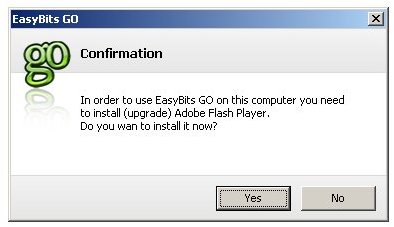
EasyBitsGoDialog.jpgThis morning at 9:59 AM local time, a dialog from an unknown app popped up and asked me if it could install Adobe’s Flash player. My reaction is the one everyone should have in response to things like this: Don’t click. Stop and think. I’ve been around for awhile and I’m not stupid. I’d never heard of EasyBits Go and certainly hadn’t installed it on my system. I brought up Windows Task Manager, and sure as hell, there was a process running called easybitsgo.exe. Worse, there was an icon on my desktop that hadn’t been there a few minutes before. And the dialog had a blatant misspelling on it. “Do you wan to install it now?”
Talk about red flags!

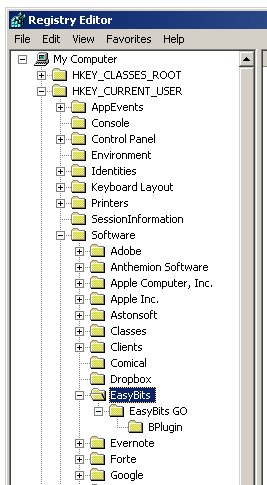
EasyBitsRegistryKeys.jpgI immediately did a search for EasyBitsGo.exe on my system, and found the executable at Documents and Settings/All Users/Application Data/Easybits GO/ There are several subfolders as well. There was an app listed in the Add or Remove Programs applet. There was a folder (dated a few minutes later) called “go” in my user tree under Application Data. It contains some kind of a log. Last and worst of all, there were Registry keys in the HKEY_CURRENT_USER subtree under Software/EasyBits.


Only after gathering that data (and taking a quick look on Google, which showed almost nothing) did I begin removing it. Online postings just a few minutes old verified my suspicion: It had ridden in on Skype. I was using Skype at 10 AM when the dialog popped up. I did not have a browser open, and in fact was not doing anything unusual. (I was editing an Odd Lots entry for Contra.)

EasyBits is a real company, and they created and have been running Skype Game Channel for some years now. I’m not a gamer and hadn’t run across them before, but they have some history, and don’t appear to be malware vendors. (This does not mean that malware could not impersonate them.) Nonetheless, however they had pulled it off, what they’d done was utterly unacceptable: They’d installed a whole app with no obvious connection to Skype without any warning, much less any request for permission.

Too, too much. I may be done with Skype. Still thinking about that. In the meantime, if this happened to you as well, here’s how to fix it, at least under XP:

  1. In Skype, select menu option Tools | Options | Advanced, and un-check Automatically Start Extras. Click Save.
  2. Shut down Skype.
  3. Bring up Task Manager. If the EasyBits GO dialog is still visible, EasyBitsGO.exe is probably running. Kill it. The box will vanish. (Kill the process even if you’ve already closed the dialog.)
  4. Make sure the SkypePM.exe process is not running. If it is, kill it.
  5. Go to the Add or Remove Programs applet and uninstall EasyBits GO. It uninstalls almost instantly, which suggests that nothing is actually being uninstalled. This was the case as best I could tell.
  6. Find the folder tree at Documents and Settings/All Users/Application Data/Easybits GO/ and delete it.
  7. Go to the Application Data folder tree under the user that was active when the damned thing installed, and find the go folder. (It contains some kind of log file.) Delete it.
  8. Go to the Windows/Prefetch directory and look for the file EASYBITSGO.EXE-364DAFD6.pf and delete it.
  9. Search for and delete all instances of ezPMUtils.dll. They may be in different locations depending on your version of Windows.
  10. If you’re comfortable editing the Registry, get rid of the keys at Software/EasyBits as shown in the screenshot above.
  11. Reboot. Theoretically that should do it, but if Skype could push this thing down to countless users without their knowledge once, it could do so again.
  12. After rebooting, I think it might make sense to update your virus scanner signature database and do a full scan on your system.

So whatthehell is going on here? There’s still not a great deal online, but I’m seeing more and more angry people posting every hour. I have a guess: EasyBits paid Skype for the install. This is the crapware business model, in which a company pays a hardware or (less often) software vendor to install stuff that the customer did not ask for, and pays by the install. This is typically trial version software, and the crapware vendor benefits when customers cluelessly upgrade to paid versions.

The crapware business model is why I no longer buy retail PCs, which come so clogged with crapware that they can barely move. I buy either custom-built machines or used corporate machines like the SX280 USFF, which were never retail machines to begin with and came with no crapware at all.

Cheap or free stuff is often less cheap or less free than its vendors imply. Crapware is one reason retail PCs are as cheap as they are. Dell, HP, and the others take a certain profit on each retail PC selling crapware slots. Absent the crapware, the machine would cost more. I buy new custom locally or used on eBay, and the machines are as cheap as new retail PCs and work a lot better. (Why does a four-year-old P4 2.6 GHz corporate box go so much faster than a current Core 2 Quad 3 GHz retail PC? Crapware.)

This is a guess, but it makes sense. Why else but money would Skype do something so absolutely certain to get them crucified in the blogosphere? With my tinfoil hat on I could imagine that certain parties at Skype aren’t happy with being assimilated by the Borg and are getting some parting shots in. It’s too late to foul the deal, but anything that makes Ballmer itch in bad places might be worth it to them.

Finally, if this happened to you, let me know in the comments or by email. It seems like a lot of people got hit with this, at least those running current versions of Skype. What if the entire installed base of current Skype instances pushed EasyBits Go down the pipe and onto user desktops? That would be a freaky thing indeed, and will make them a Mordor horde of enemies. Stay tuned.

UPDATE: I cranked up an old XP SP2 machine with Skype 5 installed this afternoon and so far, the EasyBits install hasn’t happened. Will leave it on tonight and check it in the morning. It may be that the install requires SP3, Vista, or Win7.

All Thumbs

Now that I have books to sell in more than one format, I need to erect some machinery to drive sales to more than one retailer. Time was, when all my books were conventionally published print books, a simple link to each book’s Amazon page was enough. Now I have a conventional print book, several POD print books, and ebooks in two formats.

The Copperwood Press catalog page needs a total rewrite, and I’ve been working on that. (It’s one reason I’ve been a little bit scarce here.) One thing I did do today is mount a generic WordPress HTML window in the wide sidebar, and then fill it with thumbnails of all my books. The thumbnails will eventually be clickable links into the catalog, from which you will be able to choose your format and jump to a retailer. (I will not be mounting a cart myself; it’s far too much kafeuther if Amazon and B&N will both give me 70% margins on my $2.99 ebooks.) If you’re reading Contra on my WordPress site, look to your right to see the thumbnails. If you’re reading Contra on LiveJournal, go here.

When you do, you’ll understand the conclusion I came to earlier today: My covers are not very thumbnailable. Some work better than others, and you can only do much with an image that’s 115 pixels high. I’m not an artist but I do know layout. The problem is that I learned it under the assumption that the purchaser would make his or her decision based on a much larger view of the cover, including true face time at bookstores.

With ebooks the cover game changes radically, and it’s all about thumbnails. Here’s an intriguing article on the issues associated with cover design for ebooks. When all you get is 90 pixels, it’s tough to do flourish. The best you can hope for is legibility for the title. (Interestingly, Amazon seems to have bumped search results thumbnails up to 115 pixels in the six months since Joel posted his essay. Cold comfort.)

ColdHandsCover115High.pngAs I explained in my May 19 post, I’ve done well so far because I’ve published the sorts of books that people search for by name, as with Carl & Jerry. But if Cold Hands and Other Stories (now available on Kindle) is being browsed in the very big bin labeled “Hard SF,” the thumbnail cover image has a crucial selling job: getting above the noise represented by everybody else’s 115-pixel search results thumbnails.

Clearly, I have some work to do. What you see to the right are 165-pixel thumbnails, which are one and a half times the size of what the readers see in search results listings. The little Cold Hands cover above is 115 pixels high, and the more pixels you have on your screen, the smaller it looks. I’ve already done some surgery on the cover for Jim’s On Gossamer Wings, and I think I may well just start over with “Whale Meat.”

It’s hard to avoid the conclusion that covers are becoming icons. Alas, the job of an icon is precisely the opposite of the job of a cover thumbnail: An icon stands in for something that we’re already familiar with and see constantly. A cover thumbnail stands in for something that we’ve never seen before. Worse, covers are becoming icons that must contain readable words. Of all the examples shown by Joel Friedlander in his article linked above, only Christopher Smith’s Fifth Avenue really works at 90 pixels. It works because there’s almost no image involved. You get a little color, and a tiny black stick that could be just about anything. (If I didn’t know where “Fifth Avenue” was, I might not have guessed a skyscraper.)

I’m not entirely sure what to think about the problem. If cover images get too small, they carry too little information to be useful. We can read the title in text beside the thumbnail; do we need to be able to read it in the thumbnail too? Will people get so used to minuscule cover thumbnails over time that they’ll basically stop noticing them?

Subtlety and beauty have not always been the domain of book covers. Maybe this is yet another indication that we’re returning to the pulps: Our covers may need to become very small collections of iconic symbols (bug-eyed monsters, V-2 spaceships, traffic-cone breasts, ray guns) to be recognizable as anything at all.

I’m not sure that worked for the pulps. I’m even less sure it will work for us. The real bummer is that I’m not sure what else to suggest.

Cold Hands and CreateSpace

For the last several days I’ve been tinkering with my collection Cold Hands and Other Stories to get it ready for sale as an ebook. The book is now available in epub format on the B&N Nook store ($2.99; no DRM) and should appear in mobi format on Kindle in the next day or so. All of my shorter Drumlins stories are in that book, so if you liked Drumlin Circus and On Gossamer Wings, do please consider it.

Print is a more interesting issue. Cold Hands has been available as a printed paperback on Lulu for some time now, but I haven’t been satisfied with the book’s visibility, especially on Amazon. Lulu is certainly the easiest of all the POD services to learn and use, but to sell books you have to drive customers to the Lulu site, and they have to buy through the Lulu shopping cart. That’s a huge drawback, especially for fiction, where the per-sale earnings are low and you’re not targeting the books at an easily reachable audience; i.e., if you’re not a big name in SF. Also, many people won’t buy a book unless it can be had through Amazon, because online account proliferation is an issue for them. (I understand that hesitation completely.)

I’ve done well with my Carl & Jerry reprint books on Lulu for several years now because people go looking for Carl & Jerry. The audience knows the stories, many having read them in the 1960s. I have a substantial index page, and the page is the top search hit whenever anybody searches for “Carl and Jerry.” My two books on Old Catholic history are almost cult favorites by now, and I sell a couple of copies per month on Lulu without even a detailed summary page. (I do have descriptions on the Lulu storefront.) They sell when people talk about them in the many Old Catholic email groups, which is far oftener than I would have thought. I mention them in a post now and then, and the books keep selling. Word of mouth works well within close-knit enthusiast groups like that who understand what the books are about.

Breaking in to SF is harder. To sell paperback books of my SF I simply have to be on Amazon. That’s Lulu’s #1 issue. My Lulu books are sometimes listed and sometimes not, for reasons I don’t really understand. A search just now for Cold Hands and Other Stories does not show the book, and that’s unacceptable.

So I’ve been giving CreateSpace a look. It’s Amazon’s in-house POD service, and was originally called BookSurge before Amazon broadened it to embrace other kinds of content, like music CDs. I can use my own ISBNs there, and if you publish on CreateSpace, you will be listed on Amazon.

CreateSpace is more complex to use than Lulu, though it has nothing on Lightning Source. If you’re serious about publishing your material and expect to sell more than four or five copies it’s worth studying. The economics are better, and I’ll close out this entry with a quick summary.

First, Lulu: Cold Hands and Other Stories has a cover price of $11.99. Lulu’s per-copy manufacturing cost for the book (232 pages) is $9.14. Lulu’s commission is 57c, leaving my per-sale take as $2.28. That’s as complex as it gets over there.

CreateSpace has a more complex pricing system, and the easiest thing for me to do is just copy out a screenshot of the royalty calculator for Cold Hands:

CreateSpaceRoyaltyTable500Wide.png

They don’t state a fixed unit manufacturing cost, but they tell you how much you’ll make in the various retail channels. The “Pro” option here is a $39, one-time-per-title cost that has to be earned out before you see any profit. (I think of it as a processing fee for the title, while allowing CreateSpace to compete with Lulu on the “free to post” issue. There’s no charge to mount a book, if you’ll take less per copy.) For Cold Hands that would be about twelve copies, depending on the channel mix. The eStore figures are for sales through CreateSpace’s online system. The Expanded Distribution option is for sales made through other online retailers and independent print booksellers. Obviously, if you’re going to drive sales, it pays to drive them to the CreateSpace eStore rather than simply referring them to Amazon.

I had originally intended to mount Cold Hands on Lightning Source, but I wanted to get some real-world experience with CreateSpace. It’s not up there yet (their review process takes a couple of days) but should be there by early next week.

The missing link, of course, is a Web page to drive sales to CreateSpace, and I’m working on that. More as it happens.