Jeff Duntemann's Contrapositive Diary Rotating Header Image

Ideas & Analysis

Discussions of various issues including suggested solutions to problems and pure speculation

Falling Back to Dieselpunk

My writing time has taken some hits in the last few weeks, but the weather has hugely improved. It got up to 72 here today, so with joyous enthusiasm I took a long walk. As usual, something occurred to me, this time when a badly adjusted dump truck went past and bathed me in fumes. Ahh! Dieselpunk!

The insight followed soon after: If the world went to hell for some reason and I had to build a vehicle, it wouldn’t be steam. It would be Diesel. With some study and care, you could render farm animals or even roadkill and make Diesel fuel. Diesel engine technology requires machining and some skill, but not exotic materials nor computer models. (The same is true of gasoline engines, but gasoline is harder to make than Diesel.) You can do it in a garage. Clean rooms not required.

I had some experience in thinking about recovering technology after a societal crash while creating the Drumlins world. The glitch there is that all the inadvertent colonists’ knowledge was in computers, but they didn’t have the critical mass of technology to make more computers, nor even fix the ones that broke. (Quick! We need ten pounds of indium! Jimmy, Sam! Go dig around and see what you can find!) So when the computers died, their technology died too, and they were back to a medieval style of life that might have stayed medieval except for the Thingmakers that shared the planet with them. Advanced technologies build on simpler technologies, which in turn depend on simpler technologies still. It made me wonder if there were a sort of minimum technology level, one that, with common sense, an oral tradition, and few old books, might be constructed more or less from scratch.

Speculation: Steampunk might be a consequence of ignorance (i.e., we don’t know enough yet) whereas Dieselpunk might be a consequence of a sort of poverty of connectedness (i.e., our societal matrix is neither large enough nor rich enough to build what we might find in old books or otherwise imagine, even if we knew how.)

It occurred to me that there was an interesting plateau of sorts between about 1920 and 1940. Most of the stuff that existed in 1940 existed in a slightly cruder form in 1920. During those two decades, we got better at doing the stuff we did before, but we didn’t invent a great deal of truly new stuff. WWII changed everything, of course, and nuclear energy and transistors and many exotic materials showed up by 1950.

The era 1920-1950 was the Golden Age of Back Room Science and Technology. You could do lots of interesting things with an engine lathe, a microscope, a slide rule, a gas stove, a source of electricity, and raw materials you could buy at the local drugstore, hardware store, and feed store. The science was straightforward, the technology simple. Most important of all, it was still possible to be a generalist. A hundred books (Ok, maybe two hundred) could teach you most of what we knew in the hard sciences. You could usefully master physics, chemistry, and math in less than a lifetime. Specialization has always existed, of course, but I think it became mandatory after 1950. After that, you could no longer hear street traffic near a university for Asimov’s Sound of Panting.

If the population of Earth were reduced by three quarters (especially by something limited to human beings, like a very nasty flu virus) high-tech civilization might no longer have the critical mass of human skill it would take to maintain itself. The computers would work for awhile, but after they died, all the support infrastructure (chip foundries etc.) would die with them, and what would be left after a few decades would be less Mad Max than Dieselpunk.

All that’s debatable, of course, and I could be completely wrong. I bring it up only as an insight obtained by getting out in the sunlight for the first time this cold season and making the blood pump a little. I’m taking notes on a fictional setting involving a new Ice Age, and now I’m sure it’ll be a Dieselpunk culture, with no computers but a great deal of steel, vacuum tubes, carbon black soot, and internal combustion. Neanderthals, too: Brute muscle mattered before WWII in a way it may never matter again. And airships–hey, they were huge in the ’30s! (Why let the steampunkers have all the fun?)

Now for the time and energy to finish what I’m working on now so I can get on to The Gathering Ice.

Dancing with Diction

Today is the birthday of Dr. Seuss, without whom I would care nothing for poetry. One of the great bonding behaviors I shared with my baby sister was running around the house reciting snatches (sneeches?) of kid-book poetry at the tops of our lungs. “This one has a little star! This one has a little car! Say, what a lot of fish there are!” The king of that castle is and will always be Theodor Geisel 1904-1991. Circa 1960 our parents had signed us up for what amounted to the Dr. Seuss book club, and every month we got one of his books or another book that was clearly written in his style. There were some outliers not written in verse, like Look Out for Pirates! but who remembers those anymore? (Go, Dog, Go! may be one exception.)

On the other hand, I only have to recall the title of One Fish, Two Fish, Red Fish, Blue Fish and my poetry-reciter is off at a trot. Gretchen’s even better at it than I. Don’t get us started if you’re one of those lit’ry types who feels that any poetry with rhyme and meter is worthy only of folding into the center of a Hallmark card.

Modern universities crank such out by the pallet load. Years ‘n years ago, at one damned cocktail party conversation or another (I think associated with the Book Expo America trade show) I made an energetic case that good poetry can have both rhyme and meter. A well-credentialed tribalist immediately jumped on me, steam jetting from every orifice. “So,” he jetted, “all poetry should be doggerel?”

Whoo-boy! Note the well-worn tribal tactic: I suggested that something the tribalist hated should be allowed. The tribalist immediately misrepresented me as saying that everything except what he hated should be forbidden. I called him on it. I basically humiliated him in front of several of his peers. How did I humiliate him? I dared him to begin reciting blank verse from some author who would be taught in college literature courses. He couldn’t do it. I turned the knife by immediately beginning to recite “The Hollow Men.” I stopped after eight or ten lines. I then asked him which poet had written the following:

mighty guest of merely me
–traveler from eternity;
in a single wish, receive
all I am and dream and have.

He shook his head. “You did.” Heh. Don’t I wish. It was e. e. cummings. I offered to recite the rest of the poem. The dork said “No thanks,” and slunk away.

Now, I may be a better memorizer than he was. But I had a secret advantage: Structured poetry is easier to remember. And a secret vulnerability: I had recited all of Eliot that I could recall, and I remember Eliot today largely because I used to make fun of him so much. (I wasn’t singling Eliot out–Dr. Seuss himself did not escape.) Give me Macavity any day, even if the sophisticates dismiss it as children’s poetry. (It’s a cat poem. Dare ‘ya to call it doggerel!) I can recite a great deal of that. It contains irony, subtlety, and much merriment.You can dance to it. I give it a 10.

Note that I don’t “hate” blank verse and freeform poetry, nor do I dismiss it simply because it lacks rhyme and meter. I studied it. I studied Walt Whitman, Robert Lowell, Wallace Stevens, Theodore Roethke, and all those guys of that era and that school of poetry, which has basically won the day. I still recall why my profs thought they were significant. The problem is that the poems themselves I have utterly forgotten. Lowell has a great line somewhere about ’59 Chevies rolling past like fish in a tank, in finned servility. But that’s all of him that I can remember, having read an entire book full of his stuff and discussed it at length in a 300-level class. I’m sure it was carefully crafted. I’ll grant that it was important. But in no way on this or any other world could it ever be fun.

For that you have to go back to poets like Vachel Lindsay, who opened “The Santa Fe Trail” in an eminently memorable way:

This is the order of the music of the morning-:
First from the far east comes but a crooning.
The crooning turns to a sunrise singing:
Hark to the calm-horn, balm-horn, psalm-horn.
Hark to the faint-horn, quaint-horn, saint-horn…

Damn, not only can I see that, I can feel it! It makes me want to run around the house with my baby sister (now 55) yelling “Ho for Kansas land that restores us! When houses choke us and great books bore us!” Eventually we collapse on the couch, breathless from laughing so hard and glowing from feeling so good. Kid stuff? Sure! At least for kids who haven’t yet sold their kidness for a pot of message.

Poetry is about laughter, especially laughter that comes of wishing we could be in Kansas so that we could get away from all those Great Books that are so ponderously self-important they they undergo lexical collapse and vanish into their own navels while everybody stands around scratching their heads trying to understand what the hell they were attempting to convey.

And about dancing, yes. Poetry is dancing with diction, doing the polka with participles, spinning an allemand with adverbs. It’s cutting loose from grim reality for awhile and letting language just take us. “He thought he saw an elephant / That practiced on a fife: / He looked again and found it was / A letter from his wife.” What does it mean? You’d be surprised. I’ll tell you in a minute, but…the music isn’t over yet.

If I’d had to jump straight into Lowell and Roethke I would have tossed it all overboard. But Dr. Seuss had gotten to me first. He taught me that you could dance to words, and from that dance it was a short step to Chaucer and Pope and Longfellow and Tennyson and Lindsay and Robert Frost and e. e. cummings. Having danced to the edges of rhyme and meter (cummings is a great transition) I could go the rest of the way, and watch the fins go by with Robert Lowell.

Did poetry classes leave a sour taste in your mouth? Grab a Dr. Seuss book, and find your sister if you have one. Run around the house spitting iambs and trochees until you collapse laughing on the couch. That’s how you reboot your poetry sense. Then, if you want, you can take it all the rest of the way to Walt Whitman and beyond.

But I personally wouldn’t blame you if you stopped right there.

Media System Reassembly

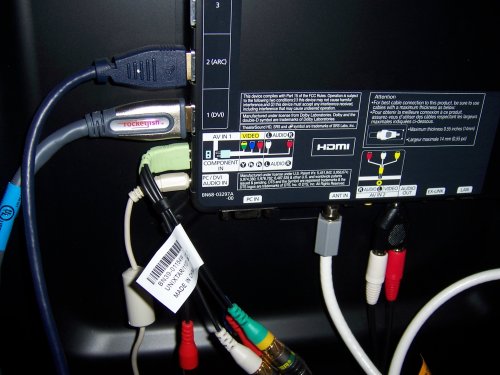
Back Of TV - 500 Wide.jpg

This may be obvious for some, but for whom it isn’t, I want to call it out and describe it as extremely useful: If you ever have to dismantle a complicated audio/video system, take pictures of the cabling before you pull it all apart.

We bought a flat-screen TV and associated media components last year for the lower level, and a Geek Squad guy came out to assemble and test it for us. Now, I’m not a big media guy. I watch movies when I’m on the treadmill, and sometimes TV. I’ve spent my time learning other things. So when I had to empty out the carpeted areas of the lower level, I took one look at the ratsnest behind the electronics and dove for my digital camera. I took pictures of the cables behind the TV and each of the other components. Yesterday, when it was time to put everything back in place after a two-month hiatus (which is more than long enough to forget everything) I printed out five color copies of the pertinent photos, and had it all reratsnested and working inside of twenty minutes, with no false moves at all.

I recognize that it may be difficult to get a camera behind some systems. If you can, pivot each component out far enough to snap what’s plugged into it. If you can’t, well, maybe using longer cables would be a good idea.

Having fought with media messes like this on many occasions, I’m guessing that this technique saved me hours I would otherwise have wasted and never have again. Highly recommended.

Bertrand Russell’s Liberal Decalogue

I was simply going to post a pointer to this item in the next Odd Lots, but I’d really like it to get more attention than it has. Bertrand Russell published the following list of ten precepts at the end of an article called “The Best Answer to Fanaticism: Liberalism” in the New York Times Magazine in 1951, and it was later published in Volume 3 of his autobiography. It meshes well with my upcoming entries on tribalism, which is indeed a species of group fanaticism. There’s no need to comment that “liberal” means something different in current discussion than it did in 1950. So does “conservative.” What the man was talking about is freedom, which is both more difficult and more valuable than waving a flag on the left or on the right. How free are you? Who owns you? Those are the questions you should ask yourself every morning before breakfast.

Note well that I am not a Bertrand Russell fanboy, and I do not endorse all or even most of his positions. However, I do endorse what he wrote below:

  1. Do not feel absolutely certain of anything.
  2. Do not think it worthwhile to proceed by concealing evidence, for the evidence is sure to come to light.
  3. Never try to discourage thinking, for you are sure to succeed.
  4. When you meet with opposition, even if it should be from your husband of your children, endeavor to overcome it by argument and not by authority, for a victory dependent on authority is unreal and illusory.
  5. Have no respect for the authority of others, for there are always contrary authorities to be found.
  6. Do not use power to suppress opinions you think pernicious, for if you do the opinions will suppress you.
  7. Do not fear to be eccentric in opinion, for every opinion now accepted was once eccentric.
  8. Find more pleasure in intelligent dissent than in passive agreement, for, if you value intelligence as you should, the former implies a deeper agreement than the latter.
  9. Be scrupulously truthful, even if the truth is inconvenient, for it is more inconvenient when you try to conceal it.
  10. Do not feel envious of the happiness of those who live in a fool’s paradise, for only a fool will think that it is happiness.

An Informal Theory of Tribalism, Part 1: Background

I’m much of the way through an excellent book: The Better Angels of Our Nature by Steven Pinker, whose previous works on my shelves here include How The Mind Works, The Language Instinct, and The Blank Slate. The book’s dual mission is to demonstrate with hard research and reliable numbers that violence in human societies has declined and continues to decline, and perhaps to explain why. So far I’m persuaded by the first element of its mission. The second, well, I’m not as sure–but I’m also not finished with the book. However, I’ve read enough to recommend it, assuming you don’t mind long, dense books that require focus and an open mind to get through. The Better Angels of Our Nature provides solid backing to the impression Colin Wilson gives in his 1984 tome A Criminal History of Mankind: that the past was a bogglingly cruel and violent place, not only in certain parts of the Earth and in certain societies, but everywhere. Today, by contrast, we live in the safest and most peaceful era in human history. The improvement has not been linear, but graphed over centuries (and not merely years or decades) it’s been steady. This is counterintuitive if anything is. Still, the citations Pinker presents are beyond my ability as an amateur historian to challenge. Much of his thesis involves things I’ve not read of in detail before. Pinker’s description of the widespread practice of infanticide in our past is especially chilling. I may recognize the evolutionary logic for some of it, but the repugnance nearly all of us feel when contemplating the idea reflects how far we’ve come.

In short, we are not fallen angels. We are risen apes.

I’ve had a suspicion for quite a few years that the root cause of human cruelty and violence is tribalism. Pinker’s book provides more evidence that I was right. He cites a number of causes of violence, but most of them are either the consequences of tribalism, or tribalism outright. Furthermore, tribalism is something primal, something we inherited from the killer primate ancestors we share with creatures like gorillas and chimpanzees, who are enthusiastic and highly calculated murderers of their own kind. We see it in our own historic records as far back as they go, and also in the societies of aboriginal peoples who have avoided contact with modern societies until recent times. (Jared Diamond has written much about his experiences with recently contacted tribes in the new Guinea highlands; see The Third Chimpanzee for a sample.)

It’s easy for those of us in the Intellectual Elite to cluck and roll our eyes at any suggestion that tribalism is still with us. Don’t. What we’ve made great progress suppressing are warfare and murder, mostly by sheer dint of will enforced via societal pressures against fountains of violence like polygamy (polygyny, more precisely) and honor cultures. We’re still having trouble with deeper evils like idealism, but idealism is not a consequence of tribalism. (It certainly takes advantage of tribalism, as Marxism did with great success in the past hundred-odd years. Let’s not confuse the horse with the rider, even if both need shooting.) Tribalism is very much with us, and whereas it causes less murder than it used to, it still shapes our thought and our societies in ways that should give us pause. It generates hatred like nothing else out there, and enslaves even the brightest of us.

The quickest way to find evidence is to read the comments sections of forums covering anything less technical than the alignment of IF strips. Everyone knows what flamers and trolls are. They’ve been around since there were online forums. I saw them in my bang-path days in the early 80s. Anonymity amplifies the temptations to flame and troll; see the very brilliant take that Penny Arcade has on the topic. I was a little surprised to see how much the psychology of flaming and trolling is rooted in tribalism. As with a lot of insights, once I knew what to look for I saw it everywhere. I’ve actually engaged the trolls here and there, to see how they react to certain kinds of provocation. (If you ever stumble across any otherwise uncharacteristic or inexplicable posts of mine online, it’s almost certainly me poking a troll with a stick and taking notes.) I now think I know enough to summarize my research and toss out an informal theory of tribalism, especially as it applies to our online world.

The series here will not be contiguous. It’s a difficult thing to write about, and I have other topics on my do-it list, most of them more fun if less provocative than this. I do want to ask that you put on your Cloaks of Heroic Courtesy before you click the Comment link. I always welcome thoughtful and polite discussion. However, if you insist on flaming or trolling, I have a perfect opportunity to tap my pointer on our virtual blackboard and use you as an example: “Kids, here’s still more evidence supporting my theory. Let me explain what’s going on in this comment…” Be the student. Don’t be the lesson.

Next: What tribalism is.

Indies and Gatekeepers

Janet Perlman put me on to this article about why indie publishers (a category that may or may not include self publishers, depending on whom you talk to) get no respect. The whole piece might be summed up this way:

  • Quality is hard work.
  • Quality is expensive.
  • Quantity is no substitute for quality.

I agree, as far as it goes. But that’s not the whole story. You can break a sweat and write a superb novel at considerable expense of time and energy. You can pay an editor to look at it and perhaps fix certain things. You can pay an artist for a great cover. You can pay somebody to do a great page layout, generate print images, ebook files, and so on. Having shelled out all that expense in time, money, and personal energy, you are not likely to sell many books or become especially well-known. Publishing is an unfair business in a lot of ways.

Perhaps the most unfair thing about publishing as we know it now is that it cares not a whit about quality. Sure, the publishers will tell you otherwise. So will the agents, and so will the retailers, assuming you can find any these days. Alas, it’s not true. Publishers, agents, and retailers are indeed our gatekeepers, and the gates are tightly kept. The gates do not open for quality, alas. The gates open in the hope of making money.

This is true not only in quirky markets like fiction (more on which in a moment) but in technical publishing as well. I’ve received and rejected beautifully written books that were well-organized and basically error-free, for a simple reason: The Radish programming language (I just made that up) is used by 117 people world-wide, which means the total worldwide market for a book about Radish is 116. (The author already has a copy.) On the flipside, the best possible book on Windows XP won’t be accepted at any traditional publishing house, because all the books on XP that the universe needs were written a long time ago.

The reverse is also true, to some extent. If a publisher thinks your book will make money, the book will probably be published. Being well-written doesn’t change this equation much. Back in the Coriolis era I spent a lot of money on developmental editors to make a manuscript readable in those cases where I suspected (after market analysis) that the book met a hitherto unmet need. I wasn’t always right, of course, but the point is that I didn’t accept or reject books based on any judgment of quality. What I was looking for was market demand.

This is true of fiction as well, in spades. I picked up Cherie Priest’s steampunk entry Dreadnought last year, and had to force myself to finish it. Two other people in my circle, who live 1,000 miles apart and don’t know one another, both described the book in a single word: Unreadable. (Another said the same of her earlier book, Boneshaker.) Dreadnought was dull, slow, short on ideas, over-descriptive in some places and far too sparse in others. Yet Cherie’s got a following and is evidently doing very well. Somebody at Tor thought her books would make money and took a chance. They were right. That doesn’t make them well-written. (I did like the covers, and covers do matter–if you can get them in front of the readers somehow.)

I don’t want to be seen as picking on Cherie, who will doubtless chew me out if she reads this. It’s a pretty common thing. Nor is it a new thing. Decades ago I read a lot of abominable novels, from Sacred Locomotive Flies to Garbage World. They got into the stores. They probably made their authors at least a little money. (They got mine, after all.) They were crap.

If Dreadnought made money, why would a book that was better written not make money? It’s a long list. The author may not have been able to get a hearing from the gatekeepers in the first place. Luck is needed here, as well as brute persistence, not that persistence is any guarantee. The topic may be considered out of style, or just worked out and already done to death. It may be too long. (I ran into this trouble with The Cunning Blood. Unit manufacturing cost matters.) The book may have been judged to push buttons in the public mind that the publisher would prefer not to push. (Back when I was in high school I read a purely textual porn comedy novel that was brilliantly written and hilarious. Would I publish it? Not on your life.) Books that demean women or minorities a little too much, or focus on cruelty to animals (or probably a number of other things) won’t be picked up as easily, and it has nothing to do with quality. It’s tough to make money in publishing, and publishers are trolling for as broad a market as possible.

This is why I think the article on HuffPo cited above is misleading. Quality is a problem, but not as much of a problem as the author thinks, and not in the same ways. Worse, solving the quality problem won’t make an indie publisher’s books any more likely to get into B&N, and suggesting to indie publishers that they will is just dishonest.

So what’s the answer? Don’t know. There may not be one. The publishing industry is in the process of changing state, and nobody knows what we’ll inherit in five or ten years. Losing B&N (or waking up one day to find that B&N is a tenth the size it was yesterday) could work to indie publishing’s advantage, at least if independent bookstores fill the subsequent vacuum. The more gates to the retail channel there are, the more likely it is that one will open when you buzz. Self-published ebooks have worked for people like Amanda Hocking with Herculean energy who write for twelve hours and then promote themselves the other twelve. Tonnage can get you noticed, even if it’s bad tonnage.

For the rest of us, again, I don’t know. Quality in all writing (fiction especially) is not the choke point. It’s an unfair and beneath it all a mysterious business. Submit good work if you can, but be prepared to have the gates shut in your face a lot. That’s just what gates do.

The Trojans Are Winning

Trojans sent as spam attachments are (thankfully) not as common as they used to be. Several years ago I would get fifteen or twenty every day. In the past year or so I only get three or four per week. Nearly all of them are executables of some kind, either simple Windows .exe or .scr files, or else an MS Office file (generally an Excel spreadsheet) containing a malicious script. This morning I got a flurry of phishing attempts delivered as PDF files. As I often do, I scanned the PDF file with both AVG and MalwareBytes to see which trojan was present. This time I got a negative from both utilities.

Now, an email telling you that you should open the attached file to see details of your order / bank transaction / payroll deposit etc. are guaranteed to be malware. If two well-regarded AV utilities call the file clean, I begin to wonder how effective our AV technology really is. I’m particularly disappointed in MalwareBytes, which has been razor-sharp so far at detecting email malware.

So I submitted the file to Jotti, which is an interesting one-file-at-a-time malware scanning service. I’ve known about it for some time but never tried it before, as I’d never received anything that managed to duck AVG and MalwareBytes both. What Jotti does is aggregate online file-scanning services, and then aggregate the results from all the services. The PDF exploit got past 14 of 20 scanning services used by Jotti, including AVG. Them’s lousy numbers.

Here’s a screen cap of the Jotti output report.

To get some perspective, I did a little additional testing. Things got worse. I saved a .zip payload out of an obvious phish email that came in yesterday, and submitted the zip to Jotti. One out of twenty scans came up positive. I then (carefully) unzipped the payload to a naked .exe, and submitted that. Zero. Zip. Nada. Nobody caught it. Wow.

What this tells me is that the Trojans are winning. Scanning things before you open them is no longer any sort of guarantee. Dodging malware now requires that you turn your paranoia knob up several notches. Here’s what I recommend for Windows users:

  • Run Internet-facing apps from an LUA, or with a privilege-limiter like DropMyRights.
  • Install and use NoScript, and allow scripting only on trusted sites. Be conservative on what “trusted” means. Javascript is evil.
  • Install and use AdBlock Plus. Until sites can guarantee that their ads aren’t serving up malware, I reserve the right to block their ads. It isn’t just small sites that are vulnerable; Gawker Media got hit a year or two ago.
  • Do not use Adobe Reader. There are lots of other PDF readers that are as good or better. I recommend PDF XChange from Tracker Software. What you want is a high-quality product with low market share. Adobe Reader is an exploit farm in part because the bad guys search it harder for exploits–and most of the exploits are highly specific to Adobe Reader.
  • Whatever PDF reader you choose, go to the options dialog and turn off Javascript. I have yet to hear any compelling reason for a PDF to execute JavaScript. Oh, and did I say that Javascript is evil?
  • Do not use Flash on a Windows system. Don’t even install it. Use a Linux instance to read YouTube or other Flash-based sites that you absolutely must browse.
  • If you’re geeky enough, get a VM manager and run Internet-facing apps (or at least Flash-equipped sites) from inside a VM. This makes bookmarking tricky, but a VM is a very tough thing for malware to get out of.
  • Don’t pirate software. In particular, don’t install something and then go looking for a crack to get past registration/activation. Cracks are virtually always malware, and the pirated apps themselves are infected as likely as not.
  • It sounds nuts, but we do it: Get an entirely separate machine for any kind of online banking. Ours runs Linux. We do nothing on the machine at all other than online banking. We turn it off except when it’s in use, which is an hour or two per week, tops.

Both Macs and Linux machines are harder to infect than Windows, but most of their supposed immunity comes from their being scarce enough that the bad guys don’t attempt to exploit them. I’ve seen a troubling increase in the number of exploits tuned for the Mac, which means that Macs are now mainstream. With success comes danger. Also, more and more malware comes in via social engineering, and since that’s a wetware problem, Macs and Linux boxes are no more immune to that than Windows. (The real malware danger in running a Mac is the all-too-common conviction that Macs are immune to malware. Uh-uh.)

It’s certainly true that the vast majority of malware infections are the result of Computing While Stupid. Alas, the line we’ve heard for years about keeping AV software installed and up-to-date is increasingly irrelevant. There is no way to harden a PC to allow you to do any damned thing you want. Nothing’s bulletproof. You have to dodge–and you have to dodge harder and harder all the time.

A Rootlocked Industry

I just heard this morning that the ASUS Transformer Prime will be shipped with a locked bootloader. I wanted to spit; that machine was (until a few hours ago) at the top of my tablet prospects list. Then, about twenty minutes ago, I found the update: ASUS, having felt the Gates of Hell open upon its head for the last four days, decided that it will ship a bootloader unlocker for the product–though at the cost of your warranty.

This topic will be the tech issue of 2012: Whether or not our industry has a rootlocked future.

We’ve had hints about this for some time. I originally wrote off the fact that Android could not access the Xoom’s card slot as some weird failure at Motorola. Then I found that this was only true in the US. Europeans, once they got the Xoom, found full access to the slot. Only where the Xoom was a “Google Experience Device” was the card slot out of reach. So it wasn’t Motorola at all. It was Google declaring war on sideloading, lest sideloading thin out their revenue stream from various Google cloud services.

Looking around at promising tablets, it’s a rare one now that isn’t rootlocked. I evaluated and turned down the Nook Tablet for that reason. (The original Nook Color is still what I consider an open system–though for how long no one knows.) The Xoom 2/XYBoard no longer has a card slot. (Rounded corners are not enough to make me pull the plastic out.)

Put as simply as possible, all of the major vendors want to make the handheld market basically what the TV market is today: A completely locked end-to-end pipeline that guards content from server to screen. ASUS was very clear about that: They had to lock the TP’s bootloader to get Google to allow Google video rentals to operate on the machine. Motorola hasn’t confirmed it, but I’m sure it was the same for the original Xoom. Calling it “video rental” is a misnomer. It’s really pay-per-view, which Big Content has wanted to do for many years. The PC market evolved in too open a fashion to make that possible. The tablet market, by contrast, seems to be jumping right into their pockets.

Part of this is the idiotic “give away the razor, sell the blades” business model. Tablets are often cheaper than they would otherwise be, because their vendors expect to make money on content, with content subsidizing the device cost to the end user. People now expect a tablet to cost no more than a certain amount, and so getting a truly open tablet (without a locked content stream) on the market at a competitive price is far more difficult.

Side comment: Yes, I am an anomaly. I see two or three movies a year (at the theater) and do not watch TV at all. I do read a lot of books, and I’m certainly willing to pay for them, but I do not buy as many as I might if I were more sure that they would not simply evaporate on me someday, due to a corporate bankruptcy or some kind of patent or IP rights battle that doesn’t involve me. If an ebook costs more or less the same as a hardcover, I buy the hardcover. It’s unclear how prevalent my attitude is, but I’m sure it’s prevalent enough to depress digital revenues significantly.

I’ve already mentioned that Android isn’t an OS in the same sense that Windows is. Vendors and carriers can make mods to Android that basically fork the open-source base and turn it into separate OS species that are more “Android compatible” than anything like a single OS. Android isn’t a GPL product. It uses the Apache 2.0 license, which does not compel vendors to release changes back into the community. So Android is a hybrid of open and closed technology that makes the sealed content pipeline possible. (Otherwise, the community would just edit out what it didn’t like and recompile the OS.)

2012 will be an interesting year. The top vendors like Apple, Motorola, and Samsung have enough market share to get away with this. Smaller vendors like ASUS (and down from there) do not. My hope is that we will see smaller vendors offer truly open high-quality Android tablets that do everything but offer pay-per-view content, and are capable of booting into other versions of the OS, or another OS entirely. I’d pay more for such a tablet. A year from now we may know. Stay tuned.

Pirates and Dummies

I used to go up to the Pirate Bay on an almost weekly basis, to see which Paraglyph Press books were listed there. It ceased to be a priority after Paraglyph folded, and I don’t think I’ve been up there for over a year. Then last week I learned that large NY publisher John Wiley & Sons is preparing a multiple “John Doe” style lawsuit focused on torrent piracy of its staggeringly popular “For Dummies” series. So I sailed back up to the Bay to see how bad it is on the ebook side.

For dummies in search of “For Dummies,” my initial impression is that it’s pretty good, which means that for Wiley, it’s pretty bad. The word “Dummies” can be found in TPB’s torrent catalog 691 times, and although some of those may not be “For Dummies” titles, I’m guessing that nearly all of them are. Individual books are listed, of course, but what probably worries publishers more is that a 6.3 GB file containing 572 “For Dummies” books is listed as well. 6.3 GB sounds like a lot. It’s not. It’s about the size of a single 720p feature-length Blu-Ray rip. 572 PDF ebooks in one lump, egad–in truth, I didn’t know that there were that many “For Dummies” books in existence. (GURPS for Dummies is not something I would have gone looking for.)

Alas, the pirates have forgotten about me personally, and for that matter, about Paraglyph Press itself. Only one Coriolis book is listed, Michael Abrash’s Graphics Programming Black Book. (There may be others that weren’t cited with the word “Coriolis;” I didn’t search deeply.) As I said, my own last name isn’t present even once. Much more startlingly, David Brin is listed only three times. Connie Willis, twice. Vernor Vinge, once. Nancy Kress, not at all. Being hot must help; Neil Gaiman is listed 49 times.

One gets the impression that reading isn’t a priority among pirates. To find out just what is, you need a better metric, and The Pirate Bay offers one: the number of complete torrents. “Seeders” are people who make available complete copies of a given file. “Leechers” are those who are currently downloading the file. The more seeders, the more popular a file, and the faster it will download to the leechers. (The protocol is interesting and described well here.)

Although there are hundreds of torrent trackers, the Pirate Bay is by far the most popular, ranking 91 on Alexa. I think it’s pretty characteristic of the pirate world in general. So let’s go count Pirate Bay seeders:

  • The top audio book is Double Your Reading Speed in Ten Minutes. 548 seeders. (Irony alert! Near-toxic levels!)
  • The top ebook is Do Not Open: An Encyclopedia of The World’s Best-Kept Secrets. 1,442 seeders.
  • The top pirated app is Photoshop CS5. 6,412 seeders.
  • The top music track is “We Found Love” by Rihanna. 7,010 seeders.
  • The top game is The Elder Scrolls. 12,438 seeders.
  • The top movie is Conan the Barbarian. 17,422 seeders.
  • The top TV show (in fact, the top torrent of any kind) is an episode of “How I Met Your Mother.” 23,259 seeders.

I hope I don’t have to beat you over the head with it: Video is twenty times more popular on torrent sites than ebooks. Down in Dummies land, it’s worse: The 572-book “For Dummies” collection has all of 99 seeders. Neil Gaiman’s best (46) is less than half of that.

So why is a major book publisher suing a relative handful of torrenters? I’m guessing that it’s because it can. BitTorrent is extremely “open” in terms of who’s doing it, and if you’re downloading you’re automatically uploading too. Recording the IPs of people in a torrent swarm is easy. Suing them is dirt simple. Some money can be harvested offering settlements, but at those minuscule usage levels, not much. I’m sure that Wiley wants to exert a “chilling effect” on sharing of Dummies books, and they are–but only in the torrent world. Even though my books vanished from the Pirate Bay, it didn’t take Sherlock Holmes to find them out on the bitlockers and Usenet, which for various reasons are much tougher nuts to crack on the legal side.

Video rules the torrent world because video is big, and the BitTorrent protocol is the most effective way to get video downloaded quickly. Small files like ebooks are elsewhere, unless they’re gathered into massive collections the size of Blu-Ray rips. Ebook piracy seems to be a minor issue today because ebook piracy is mostly invisible. It’s out there, and for all that I’ve pondered the problem, I return to the conclusion that the problem has no solution other than to sell the goods easily and cheaply, and to stop teaching people to be pirates by making the media experience complicated with DRM.

In the meantime, announcing mass lawsuits of torrenters of a specific product line pulls the Streisand chain hard. You might as well yell “Come and get it!” to people who hadn’t known that all 572 Dummies books (or ebooks generally) could be found on torrent sites. This has to be balanced against whatever chilling effect the lawsuits may have, and I can’t help but think that it’s a wash, at best. The real result of such suits over the years has been to push piracy into places where it’s difficult to see and almost impossible to police. The First Principle of whatever we try has to be this: Don’t make the problem worse. If this means that no solution presents itself, we may have to content ourselves with that.

Minty Failness

I gave it a good shot and I tried, honestly I did. But Canonical’s Unity UI simply doesn’t work for me. It’s obvious that Canonical is trying to create a single UI that will serve end-user computing from top to bottom. It’s just as obvious to me (now that I’ve had six weeks or so to play around with a Droid X2) that there is no single “end-user computing” anymore. Desktops are fundamentally different from smartphones, or anything else (tablets, possibly; we’ll see) that is primarily tap-and-consume. I’m having no trouble working the Android UI on my phone, and Android habits don’t intrude on my desktop synapses. I’m not confused or in any way slowed down by the differences between the two, no more than I’m confused about the differences between a shovel and a rake.

So if Unity is all I get under Ubuntu, Ubuntu has to go. Others seem to agree with me, and at times the discussion gets disturbingly violent. Online I’m seeing that huge numbers of people are fleeing Ubuntu for Linux Mint, which I’d barely heard of a year ago. I have to smile a little bit, because Linux Mint is Ubuntu, basically pulled back to a variation on the GNOME 2.3 interface. The upcoming release (Mint 12) will move to GNOME 3, which worries me a little (I like GNOME 2) but I’ve seen word that Mint 12 will allow users to have something very like the old UI–which is precisely what Canonical did not do with Ubuntu and Unity. It was Unity or the highway, and boy, it’s bumper-to-bumper out there.

There’s an enormous issue of why we’re suddenly tossing older and much-loved UIs away without nary a glance over our shoulders, when there’s no compelling reason to adopt one of the new models. Programmers like to create Shiny New Stuff, fersure. I in turn don’t like to change the way I interact with the machine I use, unless such changes make me a lot more effective. So far, the costs in relearning ordinary tasks far outweigh the fairly paltry benefits for me.

I’ll take up that issue eventually. In the meantime, I’ve hit the highway, and installed Linux Mint 11 Katya in its own partition here on the quad core. The OS looks great and works the way I’m used to working. I have some minor quibbles, like the failure of the Software Manager to tell me when it’s done installing something. Ubuntu does this well, but Mint installs and gives no sign. This was critical when I installed WINE, since (because WINE is not an app, strictly speaking) it’s tricky to determine if WINE was fully and correctly installed. Because running Software Manager again and selecting WINE still indicates “not installed,” I think there’s something wrong.

Small stuff. The big deal is that Mint doesn’t work well with the integrated graphics on my EVGA NForce e-7150/630i Core 2 Quad motherboard. The default graphics drivers worked, but looked clunky and don’t support effects. Installing the recommended proprietary NVIDIA drivers produced weird graphics failures, including windows refusing to render once they’re over a certain size. (Some windows would not render at all, and simply remained blank and white even when first instantiated.) Using the supposedly experimental NVIDIA 173 drivers worked better, but still fails on certain apps, especially Stellarium, which worked exactly once and then comes up with a blank, black window every time. I’m not willing to give up Stellarium, so at this point Linux Mint is on hold while I wait for Mint 12 Lisa.

Linux Mint has supposedly become the 4th most popular OS on the planet. It’ll be interesting to see if that continues to be the case once they cut in the mandatory GNOME 3 upgrade. I’ll give GNOME 3 the same consideration I gave Unity, but I’m also looking closely at the Xfce UI and Xubuntu. It’s going to be an interesting year in the Linux world. I’m keeping all my old Linux installer .iso files, trust me.