Jeff Duntemann's Contrapositive Diary Rotating Header Image

Ideas & Analysis

Discussions of various issues including suggested solutions to problems and pure speculation

Doubt and the Scientific Method

This took me by surprise: Over in that global laboratory of abnormal psychology that most of us call Facebook, a man I’ve know for almost 35 years grew furious at me. My crime? A longstanding contention of mine that doubt lies at the heart of the scientific method. Note well that we were not talking about Issues. Not evolution, not climate, not even the Paleo Diet. None of that had even come up. No: We were talking about the scientific method itself.

I’ve seen this weird “doubt undermines science” business come up before, though never directed at me personally. Nonsense, of course. Doubt really does lie at the heart of the scientific method. This is not some opinion of mine that I pulled out of thin air. Hey, if somebody wants to start a new game show called “Are You Smarter Than Karl Popper?” I can recommend the first season’s contestants.

Here’s my understanding: The scientific method requires a trigger, and that trigger is doubt. Some smart guy or gal looks at something we think we know, often but not always after examining a pile of new data, and says, “This smells fishy. Let’s take a closer look and see what we can learn.” That initial insight leads to hypothesis, experiment, repeatable results, and eventually (one would hope) new or corrected knowledge. Absent doubt, nobody thinks anything smells fishy, no closer look happens, and whatever booboo might be in there somewhere never comes to light. Without doubt, there is no science.

It’s pretty much that simple.

So how do we explain my excoriation for stating the obvious? I have a theory, heh. It involves those idiotic Facebook memes that set religion against science. Some are worse than others; my personal antifavorite is the one that reads, “Religion flies aircraft into buildings. Science flies spacecraft to the Moon.” Gosh, was it the Episcopalians? And did engineering maybe have a role? Let it pass; there are plenty more. What they represent is tribal chest-thumping by people who want to replace religion with science. That sounds fishy to me. I probed a little and began to get a suspicion that what the chest-thumpers really want is the certainty of religion under a new name.

What tipped me off is the fact that the chest-thumpers were always talking about scientific knowledge, but never the scientific method. The reason is pretty simple: The scientific method is the single most subversive system of thought that humanity has ever created. Nothing that we know (or think we know) is safe from the scientific method. Not even physical laws. Back in the 1950s there was a physical law called the Law of Parity, holding that nature does not differentiate left from right at the subtomic level. Some physicists thought the Law of Parity smelled fishy. They put their heads together, came up with some truly brilliant experiments, and snick! They nailed the Law of Parity through an eye socket. They nailed it because they doubted it. And we’re not talking the Paleo Diet here. We’re talking a law of physics.

That scares people with a strong craving for certainty. At this point we need to talk a little bit about the religious impulse. Note well that I am not talking about religion itself here. I’m talking about the primal hunger for certain things that religion provides. The two biggies are meaning and certainty. (Belonging is a third biggie, but I feel that religion inherits the hunger for belonging from its primal sibling, the tribal impulse. I’ll have to take that up another time.) As anyone who’s read Viktor Frankl has learned, “meaning” is an important but slippery business. I’ve thought about it a lot, and it looks to me like the meaning we see in our lives grows out of order. There is huge comfort in living lives that follow a predictable template. We all imagine lives lived reliably in a certain way. We do not imagine chaotic lives, and generally avoid chaos when we can. (We may grumble about the template we’re currently living, but what we want is a better template, not chaos.) When chaos strikes, our lives can quickly move from meaningful to meaningless. A need for certainty follows from the need for order. We want to be certain that we’ve chosen a path that leads toward meaning. As often as not, this means choosing templates that work for us and embracing them without doubt. Some people take this too far, and become reactionaries or fanatics who insist that the templates they’ve discovered are the only ones that anyone should embrace. Alas, this is where the religious impulse gets tangled up in the tribal impulse, which, unimpeded by laws or cultural norms, gallops straight toward genocide.

Religion satisfies the religious impulse by providing us with wisdom narratives that suggest life templates, calendars of rituals and festivals that repeat down the years and reinforce a sense of the orderly passing of time, and saints as heroes whose very meaningful lives may be emulated. (I hope my religious friends will relax a little here and look closely at what I’m saying: I am not denying that God is behind religion. I’m suggesting the mechanisms by which God gets our attention and calls us home.)

What’s happening in our secular era is that religion is becoming less prevalent and (in our own culture, at least) less strident. People who feel the religious impulse strongly need to get their meaning (via order) and certainty somewhere else. Science is handy. Science makes for bad religion, however, because it creates its own heretics and subverts its own wisdom narratives. It creates disorder via doubt, in the cause of creating new order that more accurately reflects physical reality. Certainty in science is always tentative: What the scientific method gives, the scientific method can take away.

This makes people of certain psychologies batshit nuts.

I’ll leave it there for now. I’m something of an anomaly, in that my need for order doesn’t march in lockstep with any need for certainty. I’m an empiricist. I’ve created an orderly and meaningful life that works for me, but when circumstances require change, I grit my teeth and embrace the change. Incremental change is one way to avoid chaos, after all: Deal with it a little at a time, and you won’t have to deal with an earthquake later on.

In a sense, I live my life by the scientific method. Sometimes I doubt that that what I’m doing is the right thing for me. I stop, think about it, and often discover a better way. Doubt keeps pointing me in the right direction, as it does for science. Certainty, well…that points in the opposite direction, toward brittleness and chaos. Science doesn’t go there. None of us should either.

Comment Harpies

Every so often I moderate a comment, and the commenter objects: “You’re censoring me!” (Most of the time I just nuke it, and that’s the last I hear.) Granted, it isn’t often, though it’s happening more and more over time. I’m discussing it today because of an interesting phenomenon that other bloggers may have seen, one I call comment harpies. It works like this: Some whackjob swoops in and tries to post a nasty comment on Contra, generally to an entry that happened months or even years ago. I’ve never seen the poster before. The comment is invariably angry, often insulting, and sometimes obscene. The general impression I get, however, is one of out-of-control desperation.

I picture a person awash in cortisol sitting at a machine, googling topics that the harpy’s tribe disagrees with, plowing through long lists of blog hits with shaking hands and attempting to post condemnations anywhere the blogs will let them. This is the terminal state of the “someone, somewhere on the Internet is wrong” psychology. Disagreement used to be a learning opportunity. Then it became insult. Now it appears to be declaration of total war.

Sad, sad.

I moderate all comments from newcomers, and I pay attention to everything said by everyone. I began moderation to throttle comment spam, which tries to come in five or six times a day, sometimes more. You’ve probably seen these slightly surreal cookie-cutter posts on unmoderated blogs, invariably accompanied by one or more links:

“It is of nothing enjoyed to be better apart than reading insights of distinction sourced with your sight. Links are of to be permitted, yes? I make a mind out to return of oftener.”

Links are of to be permitted, no. Lost, get apart now forever and my sight out of.

The harpies are different. The English is good, and the posts generally pertain to whatever topic the target entry discusses. There’s rarely any link. Though usually short, there’s an occasional multi-hundred-word rant. As a general policy I delete them immediately. Now and then the indignant harpy emails me and demands an explanation. When asked, I answer: “I don’t allow angry/abusive/obscene comments.” End of story, usually. Sometimes the cortisol-tripper reponds again, claiming that I’m engaging in censorship. At that point, their having crossed the bright line into delusional, I delete and forget them.

Some comments fall into a gray area. A year or two ago, when I began talking about my research into ice ages for my caveman novel, I got a one-liner:

“Don’t be an idiot. There will never be another ice age.”

This is less angry than most, and I’ve certainly been called worse. With faint hope that he/she might have something interesting to say, I wrote back and suggested a politer comment with factual content, links permitted. The email address (which was qwertygargle and suspicious to begin with) turned out to be fake.

So what can we make of this? Some of my friends have suggested that posts like these are paid compaigns intended to discredit the blogger or the topic the blogger is discussing. That seems unlikely to me. Anger and insult won’t change anybody’s mind except perhaps in the direction opposite the harpy’s intent. And when someone calls you a “Foux News watcher,” what else can you do but giggle? I wonder if these people have any least idea how utterly pathetic they make themselves and their ideologies look.

Are they bored? Unemployed? Crazy? Are they crawling with toxoplasma gondii? As with all manifestations of tribal fury, the comment harpy phenomenon probably has deep roots in our primate past, where the addled tribal footsoldiers throw poop at each other while their alphas live the good life at their expense. If you have any better explanations, I’ll certainly hear them.

Jiminies, Like Dust

Just about everybody in the free world was disgusted by this news story, which describes a 15-year-old Pennsylvania boy with learning disabilities who was arrested and threatened with a felony for recording a video of several bullies who were taunting him. Go back and read that again. The school did nothing to discipline the bullies, but wanted to make a felon of the victim. The Wrath of Net then fell upon the worthless school, and without admitting what they’d done, they were kind enough to let the vicious, special-needs student slide. For filming the bullies who were tormenting him.

What the hell is going on here?

My first thought was that the bullies were school sports heroes. We inexplicably idolize jocks, and cut them a great deal of slack even when they’re being insufferable jerks. Ending team sports in schools would go a long way toward eliminating this problem, as I’ve suggested before. Well, I thought about it a little more and changed my mind. No, there’s more at stake here. Much more. And this is one time where I could have predicted it 22 years ago, but didn’t. My bad.

Back when I was editing PC Techniques/Visual Developer I wrote a number of editorials describing my vision of the computing future. I scored a few hits and a fair number of misses. I pretty much predicted Wikipedia in 1994. In 1992 I also predicted wearable computing, in the form of the Jiminy, a lapel-pin computer with 256 cores and 64 TB of storage. The Jiminy has imagers, and enough storage to record literally weeks of video. And all I could think to do with it is create a P2P network for passing queries around.

Silly boy. Readers tut-tutted my failure of imagination, and in the next issue of PC Techniques I went far beyond the Jiminy, and in an essay called “Computers, Like Dirt” I postulated free-range imaging nanocomputers the size of dirt particles. I don’t have that editorial OCRed and laid out yet, but here’s the last 200 words:

“Naked” nanocomputers will certainly have their uses. Imagine a device the size of a particle of dirt with one face an image sensor. The rest of the device is a bucket-brigade image storage system that stores millions of images, clocking in a new one every second, or minute, or hour, in effect taking “movies” lasting hours, days, or years. Now imagine untold trillions of these little camcorders released into the environment and carried by the winds to every corner of the earth.

No matter where you go, the very dirt on the street is taking your picture. Even in your own home, the dust that Mr. Byte tracks in watches your arguments, your deceits, literally your every move, at 5000 X 5000 resolution.

Want to solve a crime? Go back to the murder site and dig a thimbleful of dust from several points, and you’ve got millions of movies of the murder as it happened. Rob a bank and the dirt on the floor convicts you. Cleanliness is statistical; no matter how clean an environment, the dust is there somewhere.

Nanocomputers could make it impossible to commit crimes of any sort undetected…or to keep secrets of any kind at all. Virtue imposed by the dust on the wind: How’s that for an endpoint to the evolution of computing?

Scared yet? I wasn’t back in 1992…probably because I assumed I’d be dead long before anything like this came about. But now we’ve got Google Glass, dashcams, copcams, and lots of other mechanisms that basically do nothing but sit around taking pictures all…the…time.

This is what the schools are afraid of. And as much a critic as I am of knuckleheaded public school administrators, I can almost feel their pain here. Nearly everybody has some bitch about our schools and colleges, all of them different, but every one a complaint. The schools are afraid we’ll sue them for doing something, or doing nothing, where “nothing” and “something” embrace everything. Nor are lawsuits necessary. If thousands of students each with hundreds of friends begin to engage in Internet vigilantism, the schools cannot help but lose, and lose big. If every student has a Jiminy on their lapels and a legal right to take pictures of everything that goes on around them, there will be no dodging administrator or teacher misfeasance or malfeasance. Even if the schools get such things outlawed (which they will desperately try to do, and in some places like Pennsylvania they already have) illicit videos of bullies and misbehaving admins or teachers will reach the Net and thus become eternal. Education as a whole would change radically.

As would a lot of other things, few of which I (or anyone else) can predict. I may leave it to your imagination. I will go out on a limb and postulate a quieter, more deliberate, and much more polite sort of world, because no behavior could ever be reliably hidden. I doubt it’ll happen while I’m still around, but by Jiminy, we’re moving slowly but inexorably in that direction. Better behave, guys–because everybody will be watching.

Ask the Man Who Has One. Or Seventeen.

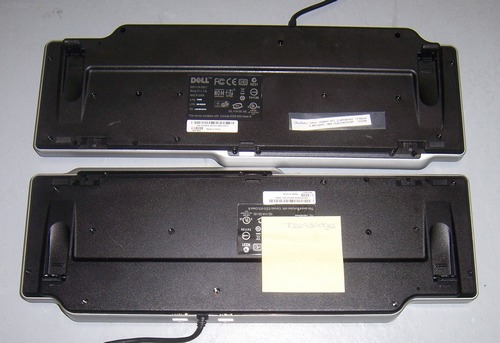
Used Keyboards 500 Wide.jpg

Computers suck. Ask the man who has one. Or seventeen.

You haven’t seen much from me lately because I began the XP rampdown a little too late to be calm and systematic about it. It wasn’t evolution, nor upgrading. It was demolition. I will probably be tinkering with the rubble for a good long while, but the explosions have for the most part occurred where and how I intended them.

Before I get into that, take a look at the photo above. I use the Dell SK-8135 keyboard everywhere I don’t need one of my precious Northgates, and I destroyed one a couple of weeks ago by literally dropping a computer on it. (I don’t know if the SX270 got hurt. It’s now in somebody’s recycle pile, and will not trouble this world again.) That left me with no spares, so I ordered a couple of used ones from a surplus house. Both arrived the other day…with logins and passwords taped to their undersides. Heartbleed? We don’t need no steeking Heartbleed…

So we return to the XP crater. The smoke is clearing. Both of Carol’s machines are now used but spotless Optiplex 780s running Win7. My GX620 USFF upgraded to Win7 without a whole lot of argument. My quadcore now has a newer and much larger SSD, plus a new card reader and four new USB ports on the front panel. My new Dell e6400 laptop was a Win7 slab from the outset. I got rid of four SX270s, plus a couple of old Pentium 3 mini-towers that followed me home years ago and refused to leave. I was about to recycle my dead 2001 Thinkpad X21, then plugged it in, scratched my chin, shoved the hard disk solidly into its slot, and boom! Windows 2000 said hi to me for the first time since early 2005. The X21 remains my favorite laptop of all time. Still not sure what to do about that.

There were driver problems, not that that came as a complete surprise. Both my HP 5370C flatbed scanner and my OpticBook flatbed edge scanner came with drivers that refused to install. (Interestingly, my even older HP PhotoSmart S20 slide scanner installed without any grumbling.) HP’s 5370C driver was an abomination even when it was new. The 5370C is a freaking scanner, for cripe’s sake. Why does it need twenty-five assorted DLLs, OCXs, and other dubious squidlies in order to function? Well, I’m in the thick of scanning a lot of paper records for offsite storage, and I needed that scanner bad. What I ended up doing turned out to be a bit of a wonder: I bought the Pro version of VueScan. It rankled me a little at first to have to spend $80 to reclaim a scanner I paid for twelve years ago. That said, what VueScan gave me was marvelous: A common UI for every scanner in the house. (VueScan supports the S20 as well.) The product is well worth the money. It comes with a reasonably literate 111-page user guide, and there’s a book about it too. The book’s on order, and so far I’ve been able to find my way around by (gasp) reading the manual, with less head-banging than I expected. The list of scanners supported by VueScan is boggling. If I ever need to get another scanner, I won’t have to screw with psychotic vendor drivers, nor learn any needlessly different vendor UIs.

Win a program, lose a program. I have a little utility called Jasc Image Commander that’s been with me since the midlate 90s. All I use it for is to crop, resize, rotate, and adjust color on pictures for Contra. Alas, Win7 will have no part of it. Bummer. I installed FastStone and IrfanView and am trying to decide which to keep. Both are more complex than I need, but I’ve used them both before and the jump won’t be too traumatic. So far, IrfanView has the edge.

Win7 itself wasn’t that big a deal. I still have a couple of head-scratchers on the list. The e6400 simply will not join my homegroup. I’ll come back to that once I study up a little on homegroups. I have a weird impression that Win7 is dropping keystrokes on me when I type quickly–and as most of my friends are aware, I type very quickly. This may in part be due to the PS/2-USB keyboard converter that allows me to use a 1991 Northgate on a machine without a PS/2 keyboard connector. Don’t know. Will continue to research it.

I may put XP in a VM in case I need it for something. I’m also keeping one XP-based SX270, not for the sake of XP but because it’s the only machine in the house that can read floppies and Zip disks. Who still has floppies and Zip disks? I do. And they wander in sometimes carrying interesting things.

Still, for the most part, it’s done. Sure, I should have begun sooner. Yeah, I’ll miss XP a little. I won’t miss the boxloads of old hardware that the switchover finally motivated me to dump. And boy, am I looking forward to moving on to more entertaining projects than this!

The WhisperCup

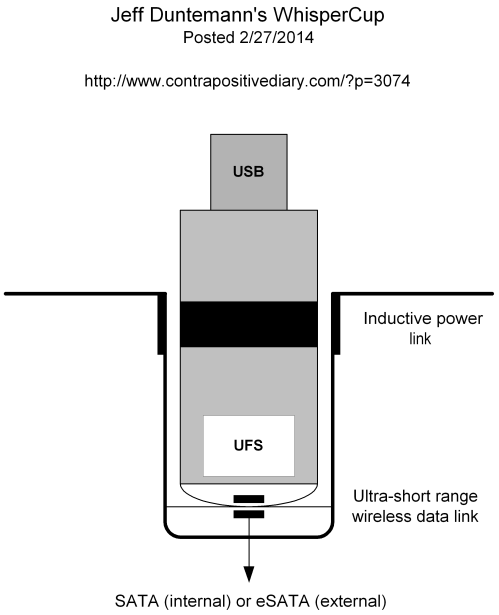
WhisperCup1.png

Ok. Yesterday I told you what the problem was. Today I’ll show you what I think will solve it. I looked around online and didn’t see anything like this, not that that proves or disproves anything. If the idea wasn’t out there before, well, it’s out there now.

I call it the WhisperCup. It consists of a specially equipped USB thumb drive, and a cylindrical well that matches the thumb drive’s special equipment. The cup provides power to the thumb drive via induction. At the rounded end of the thumb drive is a wireless connection of some sort. I don’t know precisely what; such things may exist already, and if so, all the better. I call it “ultra-short range” because all it needs to do is link data into the thumb drive from the bottom of the cup. Its range could be as little as a half an inch. Certainly it should quit before the wireless end of the thumb drive clears the top of the cup. It doesn’t have to shout microwaves; hence the name WhisperCup.

The drive itself adheres to the Universal Flash Storage standard, which incorporates an interface that might as well be SATA-on-a-chip. I’ve never much likes USB as a storage interface. UFS is faster and supposedly more reliable. Adding USB to the tang end isn’t difficult; all this stuff is jelly-bean logic now. Toss it in the cup and the volume mounts. If you don’t have a cup to toss the drive in, plug it into a USB port.

The proper place for the cup is built into the top panel of a tower case. If you don’t have such a case, there’s nothing wrong with an external WhisperDock with eSATA and a wall wart. (eSATA doesn’t provide power to its devices–big mistake, but we have to live with it.) I have a Thermaltake VB9 BlacX, and there are two toaster-dock style SATA slots in the top panel. Damned handy, though I mainly use them to do my monthly offsite backups onto naked drives. I’d gladly trade one slot for a pair of WhisperCups.

The thumb drive has no internal power source. If it’s in the cup, it gets power from the cup. If it’s in a USB port, it gets power from the USB port. I don’t want the damned thing whispering while it’s in my pocket. I want to emphasize that this isn’t anything like AirStash, which is a portable wireless Web server for file sharing. That certainly has its uses, but it’s not what I’m talking about.

That’s the basics. If you’re nervous about just dropping the thumb drive into a cup, you could line the cup with plastic bristles, which would both center the thumb drive and keep it in the cup until a firm tug yanks it out.

That would do it. No plugging into a fragile port. Put the drive in the cup, and you’re ready to go. If you take the drive somewhere that doesn’t have a cup, well, the wear is on their USB port, not yours.

What’s not to like?

USB Connectors Are Lousy

I finished Chapter 6 yesterday, and have only one more chapter to write. When I was exporting my Visio drawing files to .png for submission, I discovered that a figure I drew two weeks ago had gone bad. It went bad in a way I’ve seen before: It was smaller than similar figures…and it crashed Visio. That happened to another Visio drawing file of mine a couple of years ago, when the front-panel USB port on my Antec 900 case went intermittent. I’m guessing that the data connection opened up while the file was being written, and not everything made it from the Windows filesystem to the Cruzer Micro Skin on which the file was stored. This happened to another couple of files, most of them Word documents. In those cases, I found out before I did my weekly backups. This time I didn’t, and the bad file had already propagated to my backups and overwritten the intact copy of the file. I have a hardcopy and can probably redraw it in an hour or so. Mercifully, it’s not anywhere near as complex as some of the 79 other figures I’ve drawn for the book in Visio so far. But man, I don’t want to go this way again. The Thermaltake V9 BlacX case has worked very well for me since I first described it in this space. I don’t think it’s the case’s fault, nor the fault of the Antec 900 before it.

It’s the USB ports. And I don’t know quite what to do about it.

I’ve had a personal computer since 1979, and have trudged my way through generations of removable storage since then. Here’s the list:

1979: 8″ floppies

1982: 5 1/4″ floppies

1985: Original “cafeteria tray” Bernoulli box. (Tick…tick…tick…)

1991: Original Syquest 44MB cartridge hard drive

1995: SyQuest EZ-Drive cartridge hard drive.

1996: Zip 100

1997: Zip 250

1997: Jaz. Got rid of it almost immediately, went back to Zip 100s and 250s.

2004: Thumb drives

Trouble is, I don’t know what, if anything, comes next. The problem isn’t with thumb drives themselves, nor with the Flash technology inside them. Granted, MLC makes me nervous, and I’d pay extra for SLC thumb drives if they still exist. (I don’t think they do.) The problem is entirely with the crappy connectors on the front panels of modern PCs, and with how badly we’ve abused them.

The USB interface wasn’t designed with removable storage in mind. USB was intended for interfacing to things like printers and scanners, for which you plug a cable into the port on the PC and leave it there. IBM invented the USB thumb drive in 2000, and I bought my first one in 2001. They work beautifully, but plugging and unplugging thumb drives all day can’t be good for the thin shim stock from which the port’s electrical interface is formed. It may also put stress on the copper traces on the circuit board behind the port socket. However it happens, the damned things die, and when they die, they take files (and cases) with them.

We have to be able to do better than this. The obvious solution is to recess the ports behind a channel that aligns the USB plug and keeps it from putting angular force on the port–i.e., a wiggle suppressor. Alas, there’s no standard for the bodies of USB plugs, whether for printers or thumb drives. A recessed port would keep all those rubber duckie-shaped thumb drives from plugging in, and who knows what Federal intervention that would trigger.

There have actually been eSATA thumb drives for several years now, but because eSATA ports don’t provide power (big mistake!) you have to run a cable from the thumb drive into a nearby USB port. Furthermore, even if there were eSATA ports on the front panels of tower cases (I have yet to see one) I’m not sure that the physical port would fare much better than a USB port with constant plugging and unplugging over a period of years. The eSATA spec didn’t anticipate that either. Both USB and eSATA ports seem to be made of the same flimsy stuff.

Carol made a suggestion that is functional but not elegant: Find a short USB adapter cable with a male Type A on one end and a female Type A on the other end. Leave the male plugged into the desktop, and swap out thumb drives on the female end of the cable. I actually found a 40″ specimen in the bottom of my cable snake pit, and it works. Shorter cables of that species may be available. Needless to say, it looks like hell. Cables are cheaper than cases, though.

Now, a clever hardware hacker could build the female end of the cable into some sort of base that sits beside the tower and plugs into the back. I could see that. Can see that. Will see that.

When I do, you’ll see it here.

The Weather Channel as Weak King

Back in mid-January, the Weather Channel went dark on DirecTV. There’s been a great deal of drama since then. Losing 20M viewers is one helluva kick in the crotch when you have, at best, 100M viewers and are struggling to keep the ones you have. If online comments can be believed, they’re bleeding eyeballs bigtime.

Carol and I are two of them.

I’m not a big fan of TV, which eventually turns everything it touches to crap. Carol and I never even had cable until we moved to Colorado ten years ago. The Weather Channel was a pleasant surprise. It was founded by John Coleman (of “thunderboomers” fame in Chicago) and Frank Batten in 1981. We appreciated having a detailed forecast with radar every ten minutes, and some of their people were inexplicably likeable, especially Mark Mancuso, Mike Bettes and Stephanie Abrams. We’d put it on during breakfast or anytime it looked like things were getting ugly outside.

In 2008, NBC bought TWC. That was the beginning of the end. They fired about 10% of their on-air staff, started airing content-free MSNBC news, began pushing weather/climate hysteria of every species every chance they got, and then…the coup de gras…went to the Reality TV Model. They weren’t the first; Discovery Channel and others had pounded that unmistakable path in the grass long before TWC ever found it. One lame series after another began airing anytime there wasn’t a storm that they could get breathless about. I almost understand “Storm Stories,” which at least had photos of things you’d just as soon not see every day, or maybe ever. After that, each season got weirder and weirder. “Turbine Cowboys” croaked early, because there are only so many shots you can get of daredevils repairing 100-foot-tall wind turbines. But…”Prospectors”? It’s “Duck Dynasty” with pickaxes. Now their big deal is “Highways Through Hell,” which is about roughneck Canadian tow-truck operators pulling semis out of ditches in the Canadian Rockies and getting in arguments. There’s no Local on the 8’s during any of these increasingly irrelevant reality shows. Nor, I’ll tell you with fair confidence, is there a great deal of reality.

That’s my big gripe. There are others. People online seem peculiarly agitated by TWC’s recent gimmick of naming winter storms. After Creon and Dion I was expecting Eon, Freon, Leon, Neon and Peon, and perhaps Xenon before this long, cold, ugly winter peters out. No luck so far. (After all the high-end mythological characters, the “W” storm is named “Wiley.” The hell?) Naming winter storms may be dumb. Getting upset about it is dumber.

The business model puzzles me a little. Is it cheaper to buy episodes about trash-talking Canadian truck drivers than just present the weather? Perhaps it is, once you lay out major cash for irritating New York celebrities like Al Roker. However, the people are on staff, the studios are paid for…where’s the win in reality TV? TWC seems to think that people turn on their TVs and sit down to watch The Weather Channel as a species of entertainment. For the most part, they don’t.

Anyway. DirecTV replaced TWC with WeatherNation, which resembles what TWC was when they first started out. The formula is simple: all weather, all the time. The cameras are on tripods rather than dollies, the studio is small, and there are no expensive celebrities. The computer graphics are good, and if I could get it on cable I’d wave bye-bye to TWC. I’ve begun to experiment with streaming video, now that our local Blockbuster has closed down. Said experiments have shown that I can stream WeatherNation, and once the new technology is all in place (more on which in an upcoming entry) I will.

Most of this wouldn’t even be worth mentioning at length if The Weather Channel had not begun to throw increasingly desperate tantrums, slandering DirecTV by name in house ads and claiming to be some sort of essential disaster management information service; i.e., if we don’t have a monopoly on weathercasting, people will die.

Puh-leez.

This is typical behavior of the Coastal Elite: We know what’s good for you, and if you don’t like it you’re an evil something-or-other funded by the infinitely rich Koch Brothers, or maybe the Illuminati. NBC has long had that sort of internal culture. I smell the presence of one or more Right Men–and maybe a few Right Women, though women are generally too smart for that sort of BS. Leaders earn our respect by acting with calm confidence. Calm confidence is what wins. Leaders who throw tantrums are the archetype of The Weak King. Once the tantrums start, those wooden-wheeled gallows carts can’t be far away.

What broke it all open for me was this video, which shows some guy acting like a Jack Nicholson-class psycho, tearing his DirecTV dish out by the roots and beating it with a baseball bat, until the neighbor kids run screaming and local mothers start to cover their toddlers’ eyes. C’mon. I’m supposed to flee back to The Weather Channel after seeing a revenge fantasy like this? Not fracking likely.

Being a strong king means taking your lumps, learning from your mistakes, and turning the situation around by setting ego aside and just making things work–all with calm confidence. In TWC’s case, this means dumping the unreality shows, firing Al Roker and Sam Champion, and just presenting the damned weather.

Sheesh. How hard could that be?

The Original Hard Disk

I know I have an original Bernoulli Box 10 MB cartridge somewhere. I saved one because I was sure that nobody would believe me when I waved this huge slab of plastic at them and said, “This holds 10 MB.” I think I was right. I won’t know until I find it. So I looked…

…and I found something else instead. See the photo above. Anybody recognize it? It’s part of one of the earliest hard drives in computer history. It’s such an old hard drive that it wasn’t even a hard drive. No. It was main memory.

I honestly don’t remember who manufactured it, though Sperry-Univac sounds familiar. (I threw out the case when we left Rochester in 1985.) I bought it at a hamfest for a couple of bucks just for curiosity’s sake; the old guy I bought it from said it was a hard disk, and I was skeptical. He was right, and it was probably fifteen years until Google allowed me to look for an explanation. I took the case apart and found a motor, a fairly heavy aluminum disk coated on one face with red iron oxide, and the assembly above, which has 160 magnetic heads in eight spiral groups. Roughly half the heads look like gray ferrite, and the other half like white ceramic. I’m guessing that the gray heads are write heads, and the white heads are read heads. (It could be the other way around.) The whole assembly is 9″ in diameter; the magnetic disk is 8″ with the outer 2 1/4″ coated with oxide.

So what we have here is a device that imposes 80 tracks on 2 1/4″ of oxide. The number of bits on each track remains a mystery. 1000? 2000? Somewhere in there, which suggests a total of 100,000 or perhaps 120,000 bits, which would provide about 16KB. This was RAM, not mass storage. The principle is basically the same as the magnetic drum memory systems that IBM sold with its vacuum tube machines like the 650. There were no moving parts other than the disk itself, and you can spin a disk faster than you can spin a drum. I’m guessing that the magnetic disk units like mine filled the (narrow) gap between magnetic drums and core memory. I’ve seen writeups indicating that magnetic disk storage was used for swap storage as late as the PDP 11/45 in 1972. The unit I have seemed a lot older than that.

One of the problems in researching a unit like this is that “hard disk” and “magnetic disk” have other, more modern meanings. So what needles may be are lost in the titanic haypile of newer technologies. If any of you know anything more about the technology send me a quick description or links, and I’ll post them in a future entry.

I had 8″ floppies in my first CP/M machine, and 5″ floppies in all my PCs until the 90s. I used SyQuest cartridge hard drives for years after my 1986-1992 romance with Bernoulli Box drives, which drove me nuts with their constant indexing of heads across the medium. (Tick…tick…tick…) The SyQuest cartridges spun fast and died young. There followed three generations of Zip drives, culminating in the monumentally awful Jaz. It was only in 2004 that I set aside moving parts in my removable storage, and began using thumb drives. I’ve had an SSD on my main system for eighteen months, and will be putting them in most of my lab machines as well, spurred by the need to get XP out of daily use here.

It’s sobering to remember: We’ve been spinning magnetic disks for what may well be sixty years now. We’re still spinning them, and we will be for another ten years or so at least. What other computer technology has been in wide use for that many years? Tape–maybe. That’s the end of my list.

Damn. That’s a lot of angular momentum. Will I miss spinning disks when they’re gona entirely?

Hah. Guess.

The March of Computer Time

Last night I turned in my chapter on programming–just think, all of software development summarized in 55 book pages!–and am gathering my thoughts on mass storage for the chapter I’ll begin later today or tomorrow. Again, if you haven’t seen me much lately that’s the reason.

Each of my chapters has begun with a historical perspective on that chapter’s computer technology topic. This has brought lots of things to mind that I haven’t thought about in years, like IBM cards, FORTRAN, punched tape, and Bernoulli Boxes. I still have the card deck from the first program I ever wrote, in the spring of 1970. (See above.) I did some work with paper tape as well in my COSMAC days, but whatever tape I kept has been hiding well. I’d love to get a scan of a length of ASR-33 style punched tape, or a length (8″ or so) of the tape itself to scan here. Doesn’t matter what’s on it as long as it’s not greasy or physically damaged. Contact me if you have some you could spare, or least scan.

Time marches on. I have a 10MB Bernoulli Box cafeteria tray cartridge–probably in a box somewhere with the paper tape–and an original 1983 Microsoft Mouse. Obsolescence doesn’t bother me as long as I can keep functionality. I had to buy a copy of Office 2007 to keep writing commercially, since Word 2000 doesn’t understand .docx files, and Atlantis doesn’t do annotation. Yup, time marches on.

It does. Right now we’re looking down the throat of something a little unprecedented: On April 9, Microsoft turns off security updates for Windows XP.Most of my nontechnical friends seem unaware of this, and my nerd friends have long since moved on to Win7 or 8. I’m in the middle: I’ve been using Win7 on my GX620 for about a year, and have a new Win7 Optiplex 780 on the shelf ready to be populated and configured when time allows. (I’ve done almost nothing but this book for what seems like–hell, has been!–months.) I’m about to take my quadcore in for a new sled-mounted SSD and Windows 7 Pro. The 780 will become Carol’s office machine. I will keep an SX270 XP machine basically forever, because it has pop-in drives for both 3.5″ floppies and Zip cartridges, some of which are piled in odd boxes here for no compelling reason other than they’re paid for. (Yes, most of them have probably gone to bitrot by now.) However, it will no longer be on my network, and will be powered up only as needed.

Here’s an interesting wrinkle that few people seem aware of: Win7 Professional comes with a special-purpose copy of VirtualPC, with a VM containing an instance of XP. (Win7 home does not.) I’m thinking that if I don’t enable the Ethernet connection to the XP VM, it doesn’t matter whether the instance gets security updates or not. I have some stuff here that won’t run on Win8, and possibly not on Win7 either. I can install it on my poor SX270 survivor, of course, but it will be interesting to see what limitations may exist on the XP VM. If something weird turns up in the VM, I can always revert to an archival image.

The real problem with this, of course, is that a lot of nontechnical people are still using ancient machines that won’t run Win7 ever. Only five or six years ago, I still saw Windows 95 on 486 machines owned by older people at my parish. I’ll bet there are plenty of doddering Pentia XP boxes with 512MB of RAM still crunching email and (maybe) Web, along with Office 97. What happens to them? They may well get pwned. On the other hand, I’ve seen several with updates turned off that aren’t pwned. How bad is the problem, really?

I’m sure nobody knows. Sometime this spring we’re going to find out. How many exploits are likely to be left in a 12-year-old codebase? There will be some. Not all exploits are the result of bad coding practices, though I’m sure plenty can be walked back to unbounded string functions in libc, which the C community just can’t seem to give up. XP’s security model is generally lousy, especially for people who don’t understand the implications of what they do, double-especially with Internet-facing apps. That being the case, how far does Microsoft’s responsibility extend? As big as they are, can’t they keep a few security fanatics on staff to fix the exploits that do appear?

I’m thinking that questions like this may soon be asked in the courts of law. We’ll see.

Anyway. I can fix things here, and in extended family. I do worry about nontechnical retirees at our church and elsewhere. When you’re 80, a 12-year-old OS may not seem like any kind of problem, and those on fixed incomes may not feel like $500 for a new box is worthwhile to solve a problem that remains hypothetical. (Hell, my 4Runner is older than XP.) Those of us who remember Y2K hysteria can be forgiven for a strong dose of skepticism. I expect pwnage. There’s pwnage today. The only question is how bad it gets, and how much bad PR it will earn Microsoft. My prediction: If it gets bad enough, and the lawsuits get thick enough, the updates will return.

Pass the popcorn and dig your 3-D glasses out of the drawer. This is gonna be good.

It’s a Long Way from Antigua via Amphioxus

Something occurred to me this morning, regarding the whole business of the li’l teeny island of Antigua setting up a legal pirate’s marketplace of Other People’s Stuff: Dare you to get it out of there.

I looked and did not find any current indication of how much bandwidth connects Antigua (or lord knows, Barbuda) to anywhere else. (Five-year-old data here.) So picture it with me: The day after the island’s government launches a dollar store for digital content (or licenses three dozen pirate wannabees to do it themselves) everybody in creation storms down there to get Windows 7 or the Five Gazillion Pack of ebooks for the price of an Egg McMuffin. What happens next?

Nothing.

Really: Nothing. The island’s Internet connection, no matter how good it is, goes belly-up from the stampede.

Now, don’t bother reminding me that Antigua was doing a fine business in online gambling, and to do that they needed a decent connection to the world. Sure. But how much bandwidth do you need to place bets or play what amounts to animated board games? The big deal in pirated content these days is movie and TV rips, and those are ginormous compared to anything you’d see on a gambling site. Individual ebooks or music tracks could move reasonably well, assuming everybody didn’t go there at once. Which they will. However, even a relatively small number of people downloading the last forty episodes of How I Met Your Mother would bring whatever Antigua considered a backbone to its knees. An amphioxus has more backbone than a squid. But just about anything has more backbone than an amphioxus.

I wonder if anyone will set up a seedbox host provider there. Torrent like hell 24/7 with all the other seedboxes, and then take a year to download it all back home.

Not likely. All this leads me to conclude that Big Media isn’t making a great deal of noise about this because they already know it won’t work. Some handful of people might fly there with a fat laptop and encrypt a terabyte of TV shows to make it look like unused hard disk space. On the other hand, people coming back from Antigua with a laptop and no tan will be looked at very carefully by US customs.

So there’s less here than meets the eye. It’ll still be interesting to watch, and I reserve the right to be completely wrong. Bandwidth physics is one helluva harsh mistress.