Jeff Duntemann's Contrapositive Diary Rotating Header Image

Ideas & Analysis

Discussions of various issues including suggested solutions to problems and pure speculation

Downsizing in the Age of Stuff

I’m culling the collection. It’s making me a little nuts. Carol and I are moving from a house with 4600 livable square feet (plus an oversized garage) to 3100 square feet plus a garage that will fit two biggish cars if you smear Vaseline all over them. (There will be another 350 square feet of livable space once our contractor installs an air conditioner in the small garage.) We’re in our sixties now. We’re trying to simplify and streamline, which sounds easier than it is, simply because a good deal of it is learning how to let go of Stuff.

The 21st Century may well be remembered as the beginning of the Age of Stuff. We’ve always had a certain amount of Stuff, and one of the legacies of the Industrial Revolution is, of course, allowing poorer and poorer people to have more and more Stuff. When I was a young teen, I thought I was as rich as Croesus (quick, without googling him: Who was Croesus?) simply because I had a typewriter, a telescope, a pair of walkie talkies, and a VOM. Now I look around the house, and I ask myself how many standard Croesuses the collection represents.

Wow.

China has a lot to do with the Age of Stuff, as does eBay. Stuff that used to go out on the curb can now be bought by people who really really want just that precise model of waffle iron. (What used to be considered trash I often think of as “parts units.”) I found a NOS hair curler on eBay precisely like one that Carol had owned and loved in the 80s. Better engineering means that the Stuff we have is often better Stuff, and careful people like Carol and myself have an instinct for being careful with things, making them last longer and longer. We still have the blender we got as a wedding present in 1976, and we still use it several times a week. 70s cars may have been crappy. 70s blenders rock.

So we’re keeping the blender. But what about all the rest of it? That is pretty much the current challenge. The Big Truck will be loading up some time late November or early December. We’ve already taken several carloads of Stuff to Goodwill, and given the best of it to our friend Diedre for her indoor flea market table. And damn if the house doesn’t look the least bit emptier.

The worst of it is about books. The last time I cataloged our library, we had about 2500 books. We did an initial purge last year and got it down to about 2200. I let go of Charles Platt’s Garbage World, and had the fleeting insight that it was symbolic. I gave away Lupoff’s Sacred Locomotive Flies even though it’s my favorite SF book to make fun of. I got rid of stuff that was badly written or simply a bummer, like Malzberg’s wretched Beyond Apollo. If I ever discover an aching desire for bad SF, well, there’s always eBay.

But really, it’s getting tough. The “why the hell do I still have this?”purge is over. Now I find myself on my rolling library ladder, staring at the spines of books that, if not excellent, actually have some value, or at least served me well at one time.

One time, sure. Often a very long time ago. I realize that I’ve kept a lot of them for sentimental reasons, like my father’s 1940 drafting textbook. My college career was a very mixed bag, haunted by a lot of third-shelf thinkers who didn’t know how to teach and didn’t like being challenged. Still, there were some gems in all that dirt: I’ve kept some books because they were given to my by Dr. Rachel Romano, who took a special interest in my talents as a writer at a time when most of my knucklehead profs were telling me deadpan that I should apply to law school. I look at some and ask myself, “Did I ever actually read this?” Dr. Romano died in 1985. I don’t think I will do her any disrespect by putting her books in someone else’s hands. She was a wonderful influence in my life, and the influence is what matters. The books are simply mementos. I don’t know who originally said this, but I’ve been saying it a lot to myself recently:

Not all of your past belongs in your future.

It’s true. Very true.

I’ve got about 75 books in the purge pile right now. A few were easy pitches, being slim and having somehow escaped my notice for 40+ years, like Philip Slater’s silly-ass tantrum The Pursuit of Loneliness. Many were good books on science and tech that are now simply obsolete, irrespective of their excellence, like Pickering’s 1001 Questions Answered about Astronomy, and the 1990 first edition of Microsoft Computer Dictionary. I had several books on film photography that clearly won’t be helpful anymore. Some are now sad, like Enterprise by Jerry Gray, which is all about how the Space Shuttle was going to make space travel easy and cheap and open up the road to the rest of the Solar System. A mere handful are books that I literally don’t remember either buying or reading, nor, in truth, how they came to me at all.

Some purges reflect my changing interests. I used to read a lot about ghosts and the paranormal, but I suspect I’ve long since read everything useful on the subject, and many of those books are now on the pile. (I made good use of some of that weirdness while writing Ten Gentle Opportunities.) I’m culling my theology shelves, which is harder. I got rid of my books on theodicy, and all but one of Peter Kreeft’s books, he being a crypto-Calvinist pretending to be Catholic and saying stupid and damaging things like “There are no good (that is, innocent) people.” Sorry, Peter. “Good” does not mean “innocent,” and you disqualify yourself as a thinker for saying so. I’ve finally come to a good place in my (often agonized) quest for sane religion, so many of the inspirational books I used as steppingstones are now unnecessary or redundant.

The toughest calls of all are those books that contain some but not always a lot of useful material. How much usefulness is enough? I have a lot of books about the brain and personality, many of them now pushing a quarter century old. Some of those books are timeless. Many aren’t. But in quite a few cases, the clarity of the writing in the intro portions makes me want to keep them as quick brushups, should I need one. Hard call. Intros matter. I’ve made my career writing them.

And so on. We’ve done this before, and in fact, we’ve done it every time we’ve moved. This is our seventh house. You’d think it would get to be second nature after awhile. However, this particular purge is especially difficult, since it’s the first time we’ve gone from a larger house to a smaller one. We designed this house to have a lot of storage, because we knew damned well how Stuff multiples over the years. The new house, well, it doesn’t have all the crannies and under-the-stairs places (no stairs!) and this means we’re going to have to be extra careful deciding what survives and what goes to Goodwill. The hardest part of packing the house has nothing to do with boxes, but in fact is all about how much of the past will still have a role in our future. And if you think that’s easy, just try it sometime.

Rant: The Lasting Legacy of the Sad Puppies

SP4 Logo 500 Wid.jpg

After the appalling 2015 Hugo Awards ceremony (google “Hugo Awards asterisks”; I can’t bring myself to write about it) there arose a litany:

The Sad Puppies Lost!
(Repeat until purple.)

Except…they didn’t. The losers were the poor writers who would likely have won the award if the Worldcon Insider Alphas hadn’t decided to burn the award down rather than let people they disapproved of win it. The even bigger losers were the Hugos themselves, which are now proven to be political proxies for a bogglingly stupid culture war that most of us would prefer not to fight.

The biggest losers of all were the hate-filled tribalists themselves, Alphas down to their shitflinging Omega footsoldiers, who got their asses handed to them in a big way and threw the only tantrum that they could. Now, I don’t know precisely what to make of it, beyond my longstanding contention that tribalism will be the end of us all if we’re not careful. What I can say with fair confidence is that it isn’t over. (More on this later.) What I can say with complete confidence is that the Sad Puppies won big on several fronts:

  • They brought the cobwebbed machinery behind the Hugo Awards out into the open where everybody could look at it. Sunlight is the best disinfectant.
  • They made everyone aware of the curiously obscure fact that you don’t have to go to Worldcon to vote for the Hugos. All you need is $40 (soon to be $50, I think) and an Internet connection.
  • They exposed corruption that’s been going on for quite a number of years, and I’m not talking about inclusiveness, or diversity, or clever (if silly) experiments with pronouns here. (That’s a separate issue.) I’m talking about the fact that a derivative and mostly boring novel like Redshirts can only win a Hugo via corruption.
  • They alerted everyone to the fact that Worldcon and traditional SF fandom are rounding errors compared to the number of people who buy and enjoy SF and fantasy. Too few people nominate and vote for the awards to make corruption impossible and the awards themselves meaningful.

That’s a lot, right there. That would be enough, in fact, to persuade me that the Puppies won. But the Sad Puppies did something else: They created the nucleus around which a whole new fandom is crystallizing. People who took that lonely walk away from SFF suddenly realized that lots of other people were taking the same walk, and for the same reasons: Modern print SF is for the most part dull, dudgeon-rich message pie, and fandom is ideologically exclusionary and mostly under the control of a handful of high-volume haters. (I and many others have been called fascists one too many times.) If you have the unmitigated gall to have libertarian or (gasp!) conservative leanings, there is no place for you at that table.

Well, alluvasudden there’s a brand-new table.

In part (like most of everything else these days) it came from Amazon. The NY imprints have a powerful bias against fiction with libertarian or conservative themes. While they were the gatekeepers, there was little to be done. Now, with indie-published ebooks generating close to half of all ebook sales, authors can make fair money (or even a good living!) without bending the knee to Manhattan culture. They don’t even need ISBNs. They do have to rise above a pretty high noise level, but that’s a technical challenge: If you write well and understand the nature of the game, you will be noticed. The more you write, the more you’ll be noticed, and the easier it becomes.

What didn’t come from Amazon came from Google. The commotion generated by the Sad Puppies’ sweep of the Hugo nominations got a lot of attention. Commotion does that; it’s almost a physical law. People who hadn’t followed the SF scene for many years (if ever) discovered Web forums and new authors whose vision of SFF was far closer to their own.

Ironically, most of that commotion came from the Sad Puppies’ opponents, who could have strangled the Puppies in their sleep simply by keeping their mouths shut. But no: They had to vent their tribal butthurt, and in doing so recruited thousands of brand-new Puppies to the cause.

This new fandom centers around a crew of writers who (I suspect) give the New York imprints nightmares: Larry Correia, Sarah Hoyt, Brad Torgersen, John C. Wright, Peter Grant, Cedar Sanderson, Brian Niemeier, Amanda Green, Kate Paulk, Tom Knighton, R. K. Modena, Dave Freer, and many others whose work I’m only beginning to sample. Some have books from the tradpub imprints (Baen especially) but all are indies as well. I’m linking to their Web forums here so you can discover them too. Additional sites of interest include collaborative webzines like The Mad Genius Club, The Otherwhere Gazette, and Superversive SF. (Several of the above authors contribute to all three sites.)

At least one SF convention leans libertarian: Libertycon, in Chattanooga, Tennessee. There may be more than that, especially among the smaller gatherings. I don’t know, but I’m always looking. I think there’s a lot of upside in smaller, in-person meetups held in local pubs and other gathering places, and if I can’t find one in Phoenix I may well start one. I’m intrigued by reports from the major Puppy authors who have attended various media cons around the country. Sarah Hoyt’s is instructive. The boggling crowds at events like ComiCon are more diverse by far than attendees at traditional literary cons, and much, much younger. There is way more interest in textual SFF at the media cons than I expected. It’s not all movies and comic books. Now, I’m not sure how much I’ll be attending media cons; Worldcon-level crowds make me a little crawly, and the media cons draw eight to ten times more people. What stood out in those reports for me was the fact that people at the media cons were actually having lots of pure freeform fun, not searching desperately for something to be offended about.

The bottom line is that a vast and mostly invisible network of new friendships happened as a result of the Sad Puppies phenomenon. I’m reading more SFF now than I have in a decade. The Paperwhite helps, of course, as does the “toss-it-in-the-cart” pricing that predominates in the Kindle store. I’m corresponding with other writers whom I’d not met before. I’ve learned that indie publishing can work, and work well. (Thanks, Sarah!) I’m hearing others saying more or less the same thing about the Sad Puppies universe: “It was like coming home.”

And it’s not over.

No sirree. Sad Puppies 4: The Embiggenning is well underway, run by Kate Paulk, Sarah Hoyt, and Amanda Green. These are formidable women; I pity the poor tribal troll who tries to call them “female impersonators.” The logo once again is from Lee “ArtRaccoon” Madison. Sad puppies Frank, Isaac, and Ray from last year’s logo have returned, this time bringing their new robot friend Robert with them. Robert isn’t the least bit sad. He has no reason to be.

His side is winning.

(More thoughts on this issue of a new SFF fandom as time/energy allow.)

KU, “Turniness,” and the Reshaping of Genre Fiction

There’s a marvelous weirdness about Kindle Unlimited that I have not yet seen anyone else comment on. For the last two weeks, since I posted The Cunning Blood on KDP Select, I’ve kept the reports dashboard open in a window, and every five minutes or so, I refresh it. Almost invariably, the KENP numbers go up by a hundred or two, sometimes more. It’s a very weird feeling: Somewhere people are reading my book Right Freaking Now. It’s like looking over God’s shoulder down at the universe of people sitting in chairs and on buses and trains and airplanes, and knowing for sure that a certain nontrivial number of them are following Peter Novilio’s adventures at this very moment. I have no way of knowing precisely how many, but I can guess (given that a person doesn’t read a hundred pages a minute) that it’s more than one or two.

I’ve had a number of surprises since my first novel went up on July 31, but KU was the biggest. I’m getting a lot of page turns; on August 11 alone I got 12,448. Given that the book is 643 KENP pages long, that’s 20 full copies of the book read in one day. Of course, it may be 30 or 40 or more partial reads. I have no way to tell. But at the estimated rate of $0.0057 per page turn, KU earned me $71 that one day.

The numbers since the beginning two weeks ago were surprising, and I’ll gladly share them with you: I’ve sold 662 copies of the ebook, of which 21 (3%) were sold to countries where the 35% royalty is in force. The rest (97%) were sold at the 70% royalty rate. I’m still not entirely sure how KDP handles royalty currency conversion, but I’m assuming the cover price is roughly equivalent to $2.99 USD in all currencies. That makes my total take on sold copies about $1,304.

The KU payout is a little simpler to calculate, although we’re still not completely sure what the July and August per-page rates will be. I’m going with the estimate of $0.0057. Since publication, The Cunning Blood has recorded 127,749 page turns. Multiplied by .0057, that gives us $728.17.

Adding that to the books-sold royalty of $1304, I get $2,032.17 as royalties earned so far, in the book’s first two weeks.

That’s pretty damned surprising right there. I was expecting about half that. But what really surprised me was that over a third of that revenue–36%–came from KU page turns. In truth, I had no way to guess how many borrows I’d get nor how many borrows would be completely read. My gut told me 10-15%. I was very glad to be wrong.

Now, there’s a number I would love to be able to calculate, but which I can’t calculate from the information Amazon gives me. Amazon does not tell authors how many KU borrows a book has gotten. If I knew how many page turns I’ve had across how many borrows, I could calculate how many pages were read per borrow. This factor could be interpreted as the degree to which a book grabs the readers’ attention and keeps them turning the pages. I might as well call it “turniness.” If I could calculate how turny a given book is, over time I could probably make them turnier. In the new Kindle Unlimited universe, the turnier a book is, the more money it will make. Smart authors will thus strive to make their stories as turny as possible.

It’s not quite that simple, of course. There’s no incremental cost to making a KU borrow, and a certain number of people who borrow a book purely on spec will read a few pages, realize it’s not their thing, and return it, irrespective of the book’s quality or its turniness. Then again, that factor is probably constant across books and cancels out. We don’t know yet and won’t know until Amazon gives us more data to play with.

What this means is that literary and experimental writing will not pay as well as engrossing genre fiction. What follows from that is that that authors may pay more attention to the factors in their writing that contribute to turniness (suspense, rapid pace, constant action, mysteries revealed over time, etc.) and strive to be better at them. Over time, genre fiction will follow the money and become better and better at its own stated mission of keeping readers entertained.

My conclusion: Kindle Unlimited is the best thing that’s ever happened to genre fiction.

Genre authors, if you haven’t tried KU yet, you’re missing out. The Turniness Revolution is upon us. Let us unroll our mats, boil those pots, tell our tales, and cash those checks.

Some Kindle Unlimited (After) Math

It’s been a wild couple of days, as Contra readers already know. I finally posted The Cunning Blood to KDP Select last Friday, 7/31. In three days, I’ve sold 322 copies of the ebook. How much I’ll earn from that is a little fuzzy, because some small number of sales were outside the US, and were paid for in other currencies. For the US sales (which were well over 95% of sales) I get $2 per sale as a 70% royalty on a $2.99 cover price. Sales in some countries only pay 35%, but if I read Amazon’s doc on royalties correctly, most of the Western democracies pay 70%. Reading the sales reports, only two copies have so far been sold at the 35% rate.

All of this I pretty much knew in advance, from my study of the KDP system. What I didn’t know and was anxious to find out is how KU fit into the picture. The missing variable in the equation was the number of Kindle Edition Normalized Pages (KENP) my book represents. Because ebooks aren’t divided into arbitrary pages, Amazon crunches ebooks and assigns each one a page count based on word count, font, and a few other things that I still find obscure. I didn’t know the page count for TCB until the book itself appeared in the Kindle store. The magic number is 651. (The Amazon sales page says 453, which is some sort of mistake. The 651 number comes from the title summary in my account, and is explicitly labeled Kindle Edition Normalized Page Count.)

Having that number allows us to do a number of calculations. The first thing I was curious about is how many words there are per KENP. TCB is 144,000 words long, so dividing by 651 gives us 221 words per page, which is about what I’d expect.

The KDP Select dashboard shows KU “page turns” for a given title on a daily basis. As I write, the total number of page turns is 10,206. If the KENP page count is 651, that means that KU subscribers have read the book 15.68 times. That number, alas, is bogus, because nothing in Amazon’s reports tells me how many borrows there were, nor how many pages have been read in each borrow, as good to have as those numbers would be. Some of the borrows may have been read completely already. Most, I suspect, are still underway. Some number may have stopped reading and won’t finish.

What we can calculate, very roughly, is how much money those page turns will pay me. A precise figure can’t be calculated because we don’t yet know what the per-page turn figure is for either July or August. Taking the May figures that Amazon has revealed, it looks like a rate of $.0057 (that’s a little over half a cent; don’t get the decimals wrong!) per page turn. (The calculations used to derive that figure have been done here.) That number is not set in stone, and depends very heavily on how much money Amazon puts into a sort of KU “money pot” that all page turns share, and that changes on a monthly basis.

But as a ballpark figure it’s useful: 10,206 X .0057 = $58.17 total KU revenue. The per-book payout (assuming that the book is read clear through) would be .0057 X 651, or $3.71.

We can all gasp together. The KDP bookstore pays about $2 per ebook sold. For my book (or any other book with 651 KENP pages) KU therefore pays 1.8 times what the bookstore pays, if borrowers read the whole book.

Why so much? It’s a big book. The reason I suspect I couldn’t sell it to the traditional print publishing companies is that it was too long. First novels should hover around 100,000 words, and err on the low side. Paper, ink, and glue do cost. Ebooks are a whole ‘nother country.

Another calculation I did was figuring how long a book would have to be (in KENP pages) to generate the same $2 earned on the 70% royalty rate for a $2.99 book:

.0057 times X pages equals $2

Solving for X, we get 350 pages. And if a single KENP comprises 220 words, that means that a 77,000 word novel would earn $2 at May’s KU per-page rate. (Remember, that rate can and will change month-to-month.) Shorter novels will earn less, longer novels more. A really long novel earns a lot more–assuming it’s a page-turner and that the pages actually get turned. I think I’m in good shape on that score: I design all of my fiction to be page-turner material. It’s what I’m good at, but more to the point, I think it’s what my readers want and are willing to pay for.

My conclusions are these:

  • KU has been turned inside-out. You used to get the same dollar payment for a short story as for an epic novel. Now you get paid for what the readers read, and the more they read, the more you get paid. I’m good; nay, really good with that.
  • Difficult books (or badly written books) will not do as well as slick potboilers. The challenge is to get the reader to keep on reading. Solid writing, good editing, and a page-turning style are what will net big bucks from KU now. Literary fiction will be an uphill climb.
  • Reference books and other books that you dip into will not do as well on KU. The reason is that you only get paid the first time the reader reads a page. If the reader goes back and read that same page again, the author gets nothing.
  • Obscure authors now have a chance to make some reasonable money. MM paperbacks typically pay authors fifty to sixty cents per copy sold. Even at the $2 royalty level, you can make the same money as in MM paperbacks with one quarter of the sales. With tradpub, shelf space is rapidly turning from books to Lego sets and moleskines, so sales volume is generally harder to come by. And of course, unless and until a tradpub imprint takes you on, you make no money at all.

The future looks like this: You write quickly and well. You build a fan base however it can be done. Some can do it with personal appearances, lectures, cons, etc. Others will do it online. You publish on KDP Select and sell books to your fans. Sarah Hoyt says that there is some sort of scaling discontinuity at the ten-novel point. Once you have more than ten novels out there, your income spikes dramatically. I’ve got some work to do, obviously, to get there. Still, I now understand how it works, and can spreadsheet the financial upside.

But boy oh boy, if I were running a tradpub imprint right now, I would be sweating blood by the unholy bucket.

Why I’m Going Indie

I’ve dropped hints here and there for almost a year, but it’s time to come clean: I’m going to give up trying to get the attention of New York publishers, and begin publishing my fiction independently. One of my longest-unfulfilled dreams is having a novel from a major publisher shelved face-out in Kroch’s & Brentano’s. Ummm, no. Borders? Whoops. Barnes & Noble, then. Well, look quick.

You can see my problem here. I wrote my first SF story when I was 8, sold my first story when I was 21, was on the final Hugo ballot at 29, gave it all up for almost 20 years, and finally sold a novel at 52 after five years of shopping it. The novel was promoted very competently by the (small) publisher, and garnered a rave in Analog and a favorable mention on Instapundit, in addition to a number of other reviews in other places. However, it was a $28 hardcover, sold in the high three figures, and as best I know was never shelved in any major bookstore.

So the dream is still alive. Or it was, at least, until I took a length of black iron pipe and beat its damfool brains out. Enough dreaming. It’s time to get freaking real. I’m going to publish my SF myself. I’m going to make money doing it. I’m not going to get rich at it…but that was never part of the dream. The new dream is about spinning yarns and making myself a name for it. As I see it, the best way there is to take the process into my own hands and do it all myself.

I wrote this post to answer the obvious question, Why? Perforce:

  1. I am already a publisher. I jumped from programming into publishing in 1985 and remained there to this day. I attended courses and seminars and learned from the best. I know in great gory detail how the print book business works (and doesn’t work) and I’ve followed the emergence of ebooks since the ’90s. I’ve had a few ebooks on the market for five years, though most of what I’ve published through my Copperwood Press imprint has been print.
  2. Manhattan SF publishing has made its preferences known to me. Some houses were encouraging and polite even when rejecting a manuscript (Betsy Mitchell, you’re an ace!) and some never even answered my emails, much less returned the manuscript. (If He’s reading this, He Knows Who He Is.) A couple of houses strongly and inexplicably believe that humor can’t sell because nobody can beat Douglas Adams. (Huh?) Well, go in peace and try not to become extinct. It worked for the coelacanth, after all.
  3. I don’t have all damned day. I’m 63 years old. I can’t wait for five years to see if one of my books will ever appear.
  4. Traditional publishing contracts have gotten nightmarish. Much has been written about this. (I sure hope you aspiring authors follow Konrath, at very least.) I’m not that desperate.
  5. The tools are now acceptable. They’re not great, and certainly not what I think they should be. But I’ve used Jutoh enough to be comfortable with it. (Tip to aspiring software developers: There is still money on that table.)
  6. Everybody has an ebook reader. Everybody. Some are even called “ebook readers.” Most of them are phones. Many are tablets. A few are laptops and desktops. Anybody who wants to read ebooks can. The market for ebook genre fiction is staggeringly large.
  7. Amazon has pretty much figured it out. The original Kindle Unlimited payment algorithm seemed kind of gonzo: The same amount for 1,000 words as 100,000 words? As of July 1, it’s now about pages read. We can quibble about the per-page payment, but my spreadsheets tell me that at current rates, an indie author gets more per sale from Amazon than authors get per sale from tradpub imprints.
  8. Authors are making money with indie ebooks. I’ve been told one-on-one that a fair number of people are making a good living off their indie ebooks, and a few are making more than I made as co-owner of a $30M publishing firm. I may have to learn to be prolific, but I’ve learned harder things, like contra dancing (natch!) and dealing with online tribalists.
  9. I already have a fanbase. Admittedly, it’s a fanbase for technical nonfiction, but anybody who says that computer guys don’t read SF (as several people in SF publishing have tried to tell me) is blowing steam. There are just short of 500,000 technical books in the world with my name on them. If two tenths of a percent of those readers buy my SF, I can probably live on it.
  10. I can control the whole damned thing. This is key. I’ve seen some of the most incredible self-destructive behavior among traditional publishing firms. If I weld my future to a boat like that, I’ll go down with it when (not if) it sinks. I want the freedom not to do stupid shit. (Alas, if your publisher does stupid shit, in effect you’re doing stupid shit.) I want to be able to try new things to see what works, and stop using techniques that don’t work. Bottom line, if I fail I’ll have no one to blame but myself.

Wouldn’t I sell more books if I went the tradpub route? Possibly. Would I make more money? Almost certainly not. The tradpub houses are suffering. They’re squeezing everything in sight to save pennies, especially authors. They’ll do anything possible to cut their costs except move from Manhattan to Middle America. To me, this means that they’re doomed, granting that sooner or later we’re all doomed. I’ve personally outlived vacuum tubes, glass-screen TVs, disco, wingtip shoes, Radio Shack, and several biggish bookstore chains, among many other things. I may well outlive traditional genre fiction publishing.

I’m certainly going to try. And I’m going to have a fine, fine time doing it!

Paying by the Page Turn

Amazon’s Kindle Unlimited (KU) book subscription system has been a laboratory of unintended consequences since it launched in July 2014. If you don’t subscribe or don’t know how authors are paid, my 4-part series on it may be useful. I’ll summarize very briefly: Each time a work available on KU is borrowed and at least 10% of it is read, the author is paid from a payment fund shared by all such borrows in a given month. The amount of money in the pot changes from month to month, as do the number of borrows. So the payment per qualified borrow changes from month to month. It’s been converging on $1.30 for some time. The length of the work doesn’t matter: Read 10% of a 150,000 word novel, and the author gets $1.30. Read 10% of a 1000-word short story…and the author gets the same $1.30. (For another another few days, at least. Stay with me.)

Care to guess the unintended consequences? Authors of novels pulled their works from KU or never opted in to begin with. Authors of short stories suddenly started making significant money. Authors of flash-length erotica (basically, isolated sex scenes) began making a great deal of money. And scammers began posting the same (very short) story on multiple author accounts, and Wikipedia articles as original works.

I could have guessed all of that except maybe the erotica, since I don’t read erotica. I had actually begun turning my individual short stories and novelettes into separate ebooks, figuring that $1.30 was way better than the 35c that 99c ebook shorts earn.

Alluva sudden, wham! Everything changes.

On July 1, a whole new KU payment system comes into force. The new system essentially pays authors by the amount of the book read. Read the whole book, author gets X. Read half the book, and author gets X/2. Read 10% of the book (perhaps because it was so bad you wanted to throw your Paperwhite at the wall) and author gets X/10. In general terms, when you read some arbitrary number of pages, author gets a pro-rata per-page payment. This is true (and evidently the payment will be the same) whether the book in question is a kids’ bedtime story, a romance novel, or a calculus textbook.

As in the current system, the per-page payment changes every month, depending on the size of the money pot and the number of pages read during that month. The two big variables are the per-page payout and the number of pages in the book.

Wait a sec…pages? In an ebook?

Yup. And this is something completely new. Amazon has addressed the fact that ebooks are not divided into pages by creating the Kindle Edition Normalized Page Count (KENPC) algorithm. As best I understand it (details are sparser than we’d like) the KU servers will examine each book posted by an author, and impose a standard page layout on the book’s text in a buffer. (It will not actually change the layout in the published book.) It will then count how many “pages” exist in the book when expressed by the KENPC algorithm. I have seen no reliable description of what will go into this standard layout. It’s obvious that they’re trying to keep people from padding out margins or tweaking fonts to turn less text into more pages. They’re also trying to equalize the differences between devices with vastly different screen sizes. KENPC takes into account photos, tables, and technical art somehow. Again, details are sparse. However, I’m happy just knowing that they’re going to some effort to make a page on one device more or less equivalent in terms of content to a page on another device. I’ve seen some grumbling about page metrics for children’s books, but since that’s a genre I have no experience in whatsoever, I can’t say much. It does seem a little unfair that a 30-page kid book will only earn what 30 pages in a 500-page novel earns.

Pages will only pay off the first time they are read. Reading a book a second time on the same borrow will not generate any additional revenue. Nor will going back to reread a chapter generate additional revenue. Swiping/tapping rapidly through a book will not pay. Some sort of timer runs while a page is displayed, and if the page isn’t displayed long enough, the page will not be considered read. Countable pages begin with the book’s starting point, so dedication pages, review excerpts, and indicia will not be paid.

Now, what can authors expect as a per-page payment? Nobody knows yet. People are guessing somewhere between .8c and 1c per page read. We’ll find out soon.

Any system like this is a basket of unintended consequences. These are the ones that immediately occur to me:

  • Authors of art-heavy children’s books will bail.
  • A lot of that flash-erotica will vanish. (This may be an intended consequence.) Or maybe not. A nickel is a nickel.
  • More previews of other books will appear at the end of a book.
  • Reference books will bail. This may include computer books, which are rarely read from cover to cover.
  • Page-turners will dominate. Difficult books (fiction or nonfiction) will bail.

This last point bears discussing. Some books are bought to be seen in buyers’ hands or (more often) on their coffee tables. As Megan McArdle points out, Thomas Piketty’s book Capital in the 21st Century is purchased a great deal more than it is read. I think this is true of a lot of literary fiction as well. Authors will have to understand that they’re no longer selling books. They’re not really selling pages, either. They’re selling page turns. To make money on KU going forward, each page will have to compel the reader to move on to the next page, and repeat until EOB.

This is bad news for James Joyce. This is good news for George R. R. Martin. And, I suspect, me.

It may also be bad news for writers who just don’t know what they’re doing. To pay by the page-turn, Amazon will have to report how many pages were turned. How much detail those reports will provide is still unknown. It would be terrific to know how many pages were read per title rather than in aggregate across all of an author’s titles, but I don’t think Amazon will be doing that, at least not right away. However, if you have ten 300-page books on KU and get paid for 67 pages, the reader base is telling you something.

I suspect that this is a fully intended (if unstated) consequence: to improve the readability of the material on KU. Fistfights break out frequently over whether readability and quality are strongly correlated. This is the dotted line where literature is separated from fiction, especially genre fiction. But consider what KU is: a mechanism allowing maniacal readers to get all the books they can read for ten bucks a month. If you’re a normal human being, Finnegan’s Wake will take you most of a month to bull through, and you can get ratty copies for a penny plus shipping online.

No, it’s going to work like this: If you can keep a reader up all night with your hard SF action-adventures, you can make money on the new KU. Write page-turners, and put previews of all of your page-turners in the backs of all of your page-turners.

That’s certainly what I intend to do. I will make money. Watch me.

Sad Puppies Summary and Wrapup

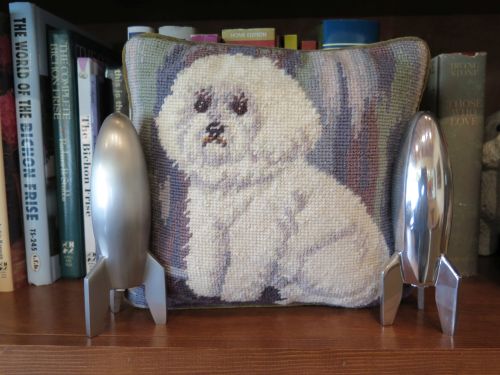
Sad Bichon Pillow - 500 Wide.jpg

As I mentioned a month or so ago, the whole Sad Puppies thing took me completely by surprise. I’ve been researching it pretty intensely for a couple of months now. I’m getting the impression that I’ve probably read everything useful about it, and what I’m seeing are mostly rehashes of things I’ve already read. So what I want to do today is summarize my research, then call it done and go back to my regularly scheduled life.

First, for those just tuning in, here in brief is what happened: Brad Torgersen, a writer of military SF, broadened Larry’s Correia’s notion of two years ago that more people should be brought into the Worldcon and to the Hugo Awards process. He explained how the Hugo Awards are decided, including the (suspiciously) obscure fact that $40 buys you a supporting membership in Worldcon that allows you to nominate and vote on the Hugos as well as vote on sites for upcoming Worldcons. Even I didn’t know that recent Worldcon members can download ebook versions (or at very least substantial excerpts) of most nominated works, which is a spectacular deal, and well worth the $40 whether or not you’re interested in the awards at all.

All of this was done out in the open. Nothing was sub rosa. Brad told people to go buy supporting memberships and nominate. He then presented a slate of works/artists that he and others in his orbit thought worthy of consideration, especially those who have been too obscure to be considered in the past. Brad’s slate leans heavily toward what Sarah Hoyt describes as “human wave” science fiction and fantasy; that is, fiction that embraces a wider range of techniques and themes than those popular with modern academic writing programs.

Some time in the past year, an author named Theodore Beale (AKA Vox Day) created his own similar slate of Hugo Awards recommendations and called it the Rabid Puppies. Vox Day is difficult to describe, much less explain. He’s a very bright guy with controversial opinions, and he suffers fools far more badly than I thought fools could be suffered. His opinions are off-topic here; don’t bring them up. He created his own slate similar to the Sad Puppies, and that’s pretty much all that matters for the current discussion.

There was some bitching about all this, just as there had been some bitching in the two previous years since Larry Correia had originally created the Sad Puppies concept. Nothing odd there; bitching about one damned thing or another has been the lifeblood of SFF fandom in all the 42 years I’ve been involved. The bitching and butthurt has gotten much worse in the last 20 years or so, which is one reason I’ve become steadily less interested in fandom, and have attended only a handful of cons since the 80s.

Then April 5 happened, and egad: The Sad Puppies recommendations swept the ballot. That’s when the hatefest began.

Some notes on terminology here: I use the abbreviation SP to stand for Sad Puppies, and to some extent the more general “puppies” notion of offering recommendation slates to the SFF-reading public. I use the term APs to indicate the Anti-Puppies, people who for whatever reason oppose the idea. I do not use the term “SJWs” for the APs because it’s inaccurate: I know people who oppose the SPs who are not themslves social justice warriors, and I suspect that the vast majority of SJWs have never even heard of the Hugo Awards, and would not care about the argument even if they had.

So that’s the short summary. Here are the points that I want to make:

  • First and foremost and above all else: The Sad Puppies organizers broke none of the rules established for the Hugo Awards process. None. All the Powers agree on this, including Patrick Neilsen-Hayden and George R. R. Martin.
  • There was no ballot-box stuffing. There are explicit rules against someone buying supporting Worldcon memberships in bulk and then voting them. This has been tried before, but the SPs were not doing it. Brad’s instructions to his readers were basically this: Go buy supporting memberships and vote them according to your judgment; here are some people who ought to be considered.
  • One of the APs came a lot closer to ballot-box stuffing by encouraging people to buy supporting memberships for people who can’t afford them. She emphasized that no effort would be made to influence how the recipients would vote, but c’mon: People know where the goodies are coming from, and the likelihood that the recipients of these gifts agree with their benefactors on the subject approaches unity.
  • The response of the APs to the SPs was venomous in the extreme. Brad Torgersen was called a racist mysogynist and much else. In truth, he’s happily married to an African-American woman whom he clearly loves and respects. The rotter haters among the APs who suggested that he was hiding his racism behind his wife and daughter did more damage to the APs’ arguments than anything the SPs said before or later. If I had to point to one single thing that turned me against the APs, it was this.
  • The media tried to slam the SPs, and mostly soiled itself in the process. Entertainment Weekly actually slid into libel and had to publish a retraction. Other outlets including Salon, The Guardian, Io9, HuffPo, Slashdot etc. published accusations that were all suspiciously alike, as though someone had offered a pre-written summary for them to follow. Most egregious of several lies was the claim that the slate was composed entirely of conservative white men. In fact, there were plenty of women and non-caucasians on the slate, as well as what might be a slight majority of liberals.
  • Several people hit me with the “You must condemn the Sad Puppies because GamerGate” gambit. I looked for a causal connection and didn’t find it. The SPs have been around two years longer than GG, and, yes, there is a certain amount of overlap between the two groups. There is also a lot of overlap between the gang attacking the SPs and the one attacking GG. I’m not a gamer and this entry is not about GG. I consider it off-topic; don’t bring it up.
  • As I said several weeks ago, the slobbering, high-volume, high-profile hate hurled by the APs probably took the SPs from a fluke to an ongoing institution. I call this “adverse attention,” and it cooks down to the Streisand Effect: Screaming about something attracts attention that makes that something a lot more visible. The sensible response to the SPs would have been silence.
  • Voting “No Award” against SP-recommended authors/artists is unfair in the extreme to those who were nominated. It’s an attempt to punish the SPs by hurting innocent bystanders, some or many of whom genuinely deserve the recognition. I predict that this strategy, if it succeeds, will destroy whatever credibility the Hugos have left.

And finally, the largest insight that I had, and the one that I think explains almost everything else:

  • The fight over the Hugo Awards is really about humiliation and loss of face. The Insider Alphas (i.e., the Right Men and Right Women) of the SFF community were humiliated on their home turf, and suffered a tremendous loss of face. High-status individuals can tolerate almost anything but humiliation. Their response to loss of face is generally one of igneous fury, and where violence is possible, physical violence. The fury was tactile, and Brad Torgersen received death threats. That pretty much nailed it for me.

Eveybody’s got a theory on how to fix the Hugo Awards process, but to me the process is fine; what’s missing is about 25,000 more involved nominators and voters. A large enough voter base is unlikely to be swept by something like a slate of recommendations. Whether so many new people can be brought into the Worldcon/Hugos community is unclear, but I doubt it.

That’s about all I’m going to have to say about the Sad Puppies topic for awhile. I’m turning my attention back to writing, to the concept of the Human Wave, and perhaps to a suspicion I have that fandom is in the process of splitting. The problems of fandom are caught up in the problems of publishing. Once Manhattan-style traditional publishing becomes more or less irrelevant, fandom may become an overlapping group of online communities centered on authors and genres. Each will probably have its own awards, and the Hugos will become only one among many. Is this a good thing?

You bet!

Rant: You Can’t Shame a Puppy

Really. You can’t. Lord knows, we tried. But Dash just keeps trying to pee on the furniture, and if we hadn’t discovered Pants for Dogs, the ottoman (at very least) would now be a total loss.

So I have to grin a rather sour grin to see people suggesting that the way to defeat the Sad Puppies and others like them (which are coming, trust me!) is to shame authors who were chosen to be on their slates, and keep shaming them until they withdraw their nominations. Several authors did in fact refuse the Hugo Awards nominations that they received back on April 5. Larry Correia refused his because he was the originator of the Sad Puppies idea, and felt that benefitting from it was unseemly. That’s legit, and he gets big points for doing the right thing. Marko Kloos and Annie Bellet withdrew because they didn’t want to be at the center of the ruckus, especially one with political overtones. Bellet said it very well:

I find my story, and by extension myself, stuck in a game of political dodgeball, where I’m both a conscripted player and also a ball.

I can sympathize here. I wouldn’t want to be the ball, either, and we have to respect their decisions. Trouble is, you can’t win, you can’t break even, and you can’t get out of the game. My suggestion would have been to ride it out. Nobody has blamed the authors who were on the slate (yet) and anyone who would is a moron. (Alas, the world suffers no shortage of morons. We’ll have to remain on guard.)

The more important reason for authors not to withdraw is that withdrawing gives the anti-puppies (APs) this peculiar notion that they can use social pressure (shaming) to get authors to do things their way, up to and including refusing a major honor in the field. Note very well: I am not suggesting that either Kloos or Bellet withdrew because of social pressure. I take their explanations at face value. What I’m suggesting is that a certain nontrivial number of APs may assume it, and may further assume that social pressure is a tactic that can win, going forward. I’m already hearing that the 2015 Hugos need to be “asterisked;” that is, marked as disreputable, dishonest, and something that no upright fan or author will have anything to do with. The message is pretty clear: Any Puppy nominee who keeps their place on the ballot is to be shamed and shunned.

Now we can get down to business. The first of my two points today is this: Shaming is bullying. Shaming is about fear. Shaming is thug tactics. I’ll tell you what I hear when I hear people talking about shaming authors: “Nice little career you’re starting up here. Shame if anything happened to it.” Or, another interpretation that’s pretty much the same thing: “Stay on the ballot, and you’ll never work in this town again.”

In other words, we’re supposed to use mafia persuasion to get authors to refuse nominations that just might have been influenced by slatemakers like the Sad Puppies. (What if the works are just really good?) That’s bad enough. However, if you think about it a little more, you come to my second point for today’s entry: Shaming only works on people who value the esteem of the shamer.

That’s how shame works: You know that certain people are going to be displeased with you if you do something, so you don’t do it. You don’t do it because you like / respect / want to retain the goodwill of those certain people. The problem is this: The shamers will thus force only their own people–the people who agree with them and want to be liked by them–off the ballot. The people who then move up to take the vacated slots are more likely to be sympathetic to the Puppies.

Is that what you want? Really?

There’s this peculiar notion among some people that shame is the ultimate weapon, one that works every time, on everybody. My research suggests that it works best on heavily networked depressive teenagers, which would be all of us, right? Heh. So let’s try a thought experiment: Shame Vox Day off of…anything. (Divide by zero much?) Try shaming any of the Puppy sympathizers off the ballet. I’m sure I’d hear the laughter halfway up the side of Cheyenne Mountain. See what I mean?

There may be a way to “save” the Hugos from the depredations of the Sad Puppies. I think we first we need to agree on what those depredations actually are, and no such agreement currently exists. But whether such a fix exists or not, shaming authors is not only thug-like and unethical, it comes around like a boomerang and rips you a new one by driving your own people (the only ones who might conceivably be shame-able) off the ballot.

I honestly don’t think the Sad Puppies are any kind of problem for the Hugo Awards, Worldcon, or most ordinary fans. The whole business cooks down to this: A group who broke no rules made fandom’s Insider Alpha clique lose face in a very big way. Everything in the Sad Puppies dustup follows from that.

The Puppies are unshameable. Get over the butthurt, or bad things will happen, things that have nothing to do with shame, but everything to do with money, demographics, and the shape of SFF going forward. Give me a week or so (it’s nuts here) and I’ll tell you a little more about that.

Rant: Sad Puppies vs. Anti-Puppies, as the Kilostreisands Pile Up

Yes, I’ve been scarce in recent weeks, but bear with me: I’m off doing something difficult but important, which I’ll tell you about later.


Although it’s been going on now for three years, I hadn’t ever heard of the Sad Puppies phenomenon until a couple of months ago, and what brought it to my attention was an ongoing rumble raging up and down the social networks and blogosphere. The rumble was just a rumble until April 4, when the Hugo Award nominations for 2015 were announced. Then, ye gods and little fishes, the Puppies swept the slate and it became Hugogeddon. I’ve already described the Sad Puppies thing here as part of a series that I’d originally intended to focus on Sarah Hoyt’s Human Wave SF manifesto. It’s a movement to bring new people into the Worldcon culture and perhaps get some attention for writers who for whatever reason are never considered for the Hugo Awards. The Sad Puppies 3 effort was all very much up-front and out in the open. The most powerful man in SFF publishing, Patrick Neilsen-Hayden, stated quite clearly that the group violated no rules whatsoever.

But oh, my, the dudgeon, the squealing, the bright purple faces, the curses and threats and slobbering on the floor. Writers of considerable stature, whom I had read and long respected, lost that respect instantly and went onto my Seventh-Grade Playground Tantrum-Throwers List. They seemed to think that anyone who put forth a list of recommended authors or works was trying to dynamite the awards, and (worse) that this was a brand-new thing that had never been tried before. Well…Mike Glyer, who belongs to the Anti-Puppy (AP) faction, pointed out that slatemaking has been practiced erratically since the very first Hugo Awards season in…1953. Apparently the difference between recommendations and a slate is that a slate is put forth by people we dislike.

Takeaway: Hugo Award slatemaking is nothing new, and does not violate the rules. You have a constitutional right to be upset about it. I have a constitutional right to think of it as a nonissue. I’m not going to argue that point any further in this entry. (I doubt I will argue that point further at all. Don’t even bring it up in the comments.) I have something else in mind entirely. Let me phrase it as a question:

How in hell could a couple of mostly unknown authors turn the venerable Hugo Awards inside-out?

My answer: adverse attention. For a definition, let me quote from a textbook that I made up just now: Zoftnoggin & Wiggout’s Fundamentals of Sociometry.

Adverse attention is a rise in the attention profile of a previously obscure phenomenon caused by the actions of an entity that opposes that phenomenon. In the vast majority of cases, the triggering force is outrage, though it sometimes appears through the action of envy, pride, lust, asshattedness, butthurt, or other largely emotional psychopathologies.

This being sociometry, adverse attention may be quantified, and there is a standard unit for expressing it:

The fundamental unit of adverse attention is the streisand, defined as one previously uninterested person achieving a degree of interest in a phenomenon sufficient to compel them to email, share, or retweet information about that phenomenon to one other person in a social network. As the information propagates across a social network, the connectedness of the network influences the total amount of adverse attention that arises. For example, if each of ten previously uninterested persons receiving the information passes it on to only one previously uninterested person, eleven streisands of adverse attention have been created. If one of those previously uninterested persons has 200 followers on Twitter or 1000 Facebook friends, the number of streisands increases rapidly. In a sufficiently dense network, the rate of increase can become close to exponential until the number of previously uninterested persons asymptotically approaches zero.

I’ve seen evidence for this in the comment sections of many blogs that have criticized or condemned the Sad Puppies. A common comment goes something like this: “Wow! I never knew that you could vote for the Hugos without going to Worldcon! And I just downloaded the free preview of Monster Hunter International. This is way cool!” Zing! The world gets another Puppy.

The emotional tenor of the criticism matters too. I’ve seen a few comments that go something like this: “I’d never heard of the Sad Puppies before. I’ve been trying to figure out which side is right, but the sheer nastiness of the Sad Puppies’ critics makes me think they’re just sore losers. I’m more or less with the Puppies now.”

Then, of course, there are the hatchet-job articles (all of them roughly identical) in what most people consider legitimate media, like Entertaintment Weekly, which later retracted the article once it became clear that it was libelous. The Guardian wrote another hit-piece that fell short of libel but still misrepresented the phenomenon. These are not just blogs. These are significant publications that have a lot of readers.

And those streisands just keep piling up.

It’s something like a sociological law: Commotion attracts attention. Attention is unpredictable, because it reaches friend and foe alike. It can go your way, or it can go the other way. There’s no way to control the polarity of adverse attention. The only way to limit adverse attention is to stop the commotion.

In other words, just shut up.

I know, this is difficult. For some psychologies, hate is delicious to the point of being psychological crack, so it’s hard to just lecture them on the fact that hate has consequences, including but hardly limited to adverse attention.

My conclusion is this: The opponents of Sad Puppies 3 put them on the map, and probably took them from a fluke to a viable long-term institution. I don’t think this is what the APs intended. In the wake of the April 4 announcement of the final Hugo ballot, I’d guess the opposition has generated several hundred kilostreisands of adverse attention, and the numbers will continue to increase. Sad Puppies 4 has been announced. Larry Correia and Brad Torgersen have lots of new fans who’d never heard of them before. (I just bought the whole Monster Hunter International series and will review it in a future entry.)

To adapt a quote from…well, you know damned well whose quote I’m adapting: “Attack me, and I will become more popular than you could possibly imagine.”

Or, to come closer to home, and to something in which I have personal experience: “Feed puppies, and they grow up.”

Actions have consequences. Who knew?

The Human Wave, Sad Puppies, and SFF Monoculture, Part 5

(This series began here.)

I held back Part 5 of this series because the Hugo nomination finalists were announced yesterday, and I wanted to see whether the Sad Puppies (and a separate but related slate, Rabid Puppies) would make their mark on the ballot. The answer is, egad: What a broom does.

But I’ll get back to that.

First I wanted to mention a little pushback on a different subtopic of the series: The Human Wave. A guy I’ve known (if vaguely) for a long time backchanelled me a short note, the gist of which was this: “So you want to destroy literary SF.”

This is a familiar tactic in many brainless headbumps I’ve seen down the years: When somebody proposes that something you oppose should be permitted, you strike back by accusing them of wanting everything except what they propose to be forbidden. This tactic probably has a name, and a place of honor in some online Gallery Of Stupid Argument Tricks. I mention it simply to point out the general level at which much discussion of SFF issues these days operates.

I told him to go back and read the series again, quoting the significant bits.

I’ll say in summary what I said here: The Human Wave is about allowing things, not forbidding things. Yes, what the Human Wave stands against is mostly a certain brand of pessimistic literary fussiness. The solution, however, is to broaden the field. Do litfic if you want. But don’t claim that litfic is the best or only thing worth writing. If the Human Wave movement pushes literary SF out of the spotlight, that’s a choice made by the readers, not me. My take: We need a much, much bigger spotlight.

Now, to the Hugo nominations. The full list from Locus is here. I’ve been a little out of touch with recent SFF (for reasons laid out earlier in this series) and am not familiar with most of them. I got a little discouraged last year when I picked up Redshirts, which turned out to be the biggest piece of crap I’d read out of all Hugo novel winners. (I have not read every single one, obviously, so bigger stinkers than that may be still be lurking somewhere in the past.)

The really, really big question on everyone’s minds today is whether the Puppies had any effect on the final ballot. Mike Glyer did an excellent summary on File 770, with more detailed analysis here. Two-digit takeaway: 71% of the finalists were on either Sad Puppies or Rabid Puppies, or both. Only 24 finalists were not on either slate. A record 2,122 valid nominations were submitted. John C. Wright picked up six slots, a new record for a single year. Some other notes:

  • Brad Torgersen, coordinator of Sad Puppies 3, was very careful to keep everything legal and above-board. Even Patrick Nielsen-Hayden admitted that the Sad Puppies campaign had broken no rules.
  • Sad Puppies concept creator Larry Correia withdrew his nomination for Best Novel, received for Monster Hunter Nemesis . He did not want anyone to be able to say that he proposed Sad Puppies just to win awards. He now has the moral high ground against any accusations of corruption that will invariably be thrown his way. Larry’s a class act, in spades.
  • There will be a Sad Puppies 4, to be coordinated next year by Kate Paulk.

Heads are now exploding all over the Internet, which is the least surprising thing about the whole kerfuffle. Puppy haters are trying to figure out what changes might be made to the Hugo rules to make such a sweep impossible. The truth is that as long as you have supporting memberships who can vote, slatemakers will offer slates to their supporters. Eliminating supporting memberships would make Worldcon financially impossible. (I don’t see anybody complaining about the additional money that all those Puppy supporters added to Worldcon coffers.)

So: If you want to stop the Sad Puppies, you have to propose your own slates. (And have the followers to vote them, which is really the hard part.) Bored Beavers? Aggrieved Alligators? Mourning Meerkats? Go for it. The goal is to reduce monoculture, and broaden the spotlight. That’s ultimately what the Puppies thing is about. Let 2E20 slates bloom!