Jeff Duntemann's Contrapositive Diary Rotating Header Image

music

Kiddie Phonographs, the Speed Lever, and the Nutty Squirrels

My sister complained a year or two ago that most of Katie’s and Julie’s toys talk. Some talk and sing songs, though a few–I remember a circus train that was one of Katie’s first toys–actually play classical music. When most of your day is spent in the company of toddlers and their toys, I’m guessing silence is in short supply, because when the toddlers aren’t make noise themselves, their toys pick up the slack.

Which brings me back to 1957. My parents had a record player, though it was old and cranky and built into a piece of furniture. I’m sure they didn’t want me messing with it, so they bought a small, portable kiddie phonograph of my own. I had a few kid records, some that told stories, some that played songs, and some–like the Maury Bunin Puppets’ “Foodini’s Trip to the Moon” that did both. (Alas, none that I recall played classical music.) I enjoyed the phonograph a lot, and given that the single active component was a 117L7 tube (capable of 0.85 watts into a 4,000 ohm load) it didn’t generate enough volume to bother my folks much–until I discovered the speed lever.
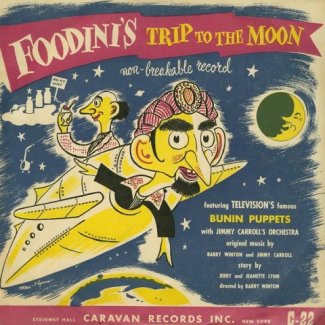
foodinimoon325wide.jpgLike most record players in that era, it could do 33 1/3, 45, and 78 RPM. Most of my records were 45s. (The older ones, including Foodini, were 78s.) Playing a 45 at 33 1/3 was interesting for a moment but ultimately boring: Small children run at inherently higher clock rates than adults, and slow music is not a big draw. 78, now: I had a Disney extended-play 45 containing music from the 1955 “Lady and the Tramp” and I loved it a lot. One cut in particular was my favorite: “Lady,” the instrumental theme for the female cocker spaniel lead. It was bouncy (like me) and I quickly learned how to pick up the needle and drop it again at the beginning of the track, playing it again and again. And when that got boring, I nudged the speed lever up to 78.

Nirvana! I still remember the sped-up recording clearly, and I think it may well beat Khachaturian’s “Saber Dance” as the most manic single piece of music in my experience. I got bored with the item before my parents could sell me to the gypsies (maybe–I wonder if the 45 simply disappeared one day) but I continued my experiments with the speed lever.

We had the 45 of David Seville’s “The Chipmunk Song” (1958) and when I cranked the lever down to 33 1/3, I realized to my six-year-old astonishment that it wasn’t chipmunks at all, but ordinary guys singing the song reeeeeeeeeeeal slow. My cousin Diane had another similar 45, of The Nutty Squirrels doing a scat song called “Uh-Oh.” Same deal: Dial down the speed and it was just a couple of guys singing slower than I could imagine–or tolerate.
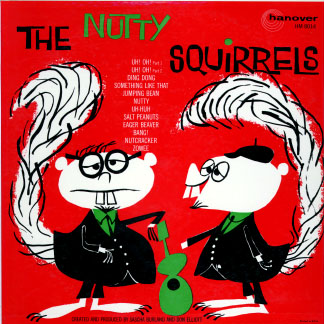
NuttySquirrels.jpgThis was a fad in the late 1950s, starting with Sheb Woolley’s “Purple People Eater,” which had a couple of sped-up spoken vocals (“I wanna get a job in a rock and roll band…”) but no sped-up singing. That was a Seville invention, with his 1958 song “Witch Doctor,” setting the stage for The Chipmunks at Christmas time that year.

The Nutty Squirrels (basically, jazz musicians Don Elliot and Sascha Burland) had their own TV cartoon show, which came out about the same time as Rocky and Bullwinkle but was not as brilliantly silly and by now is mostly forgotten. Their music was better, and not as kid-centric as the Chipmunks always were, which I’m sure doomed them.

I’ve often wondered how one learns to scat-sing at half-speed without muffing the tempo for the sped-up version. Of all the peculiar and now-forgotten human skills that you might name, that may be the most peculiar of all.
Odd Lots

Scheherazade Live

Carol and I cruised out to Manitou Springs last night to pick up our friends David Beers and Terry Blair, and we all went downtown to the Pikes Peak Center to take in the Colorado Springs Philharmonic‘s last concert of the season. On the program were Wagner’s Prelude from Die Meistersinger, Mozart’s Symphony #40, and Rimsky Korsakov’s Scheherazade. It had been way too long since we’d heard live music of any kind, and it was about damned time.

I was familiar with all three pieces, though I doubt I’ve listened to any least scrap of Die Meistersinger since Dr. Raymond Wilding-White‘s courses in college. Opera isn’t a big thing with me, and Wagner never takes ten minutes when fifty will do. Mozart? What can I say? Reliable and familiar, and great stuff when you want a graceful background for good conversation. But Scheherazade, wow. Conductor Lawrence Leighton Smith gave it all he got, and it was one of the most amazing classical performances I’d ever experienced.

It’s a stunning piece to begin with, an interweaving of a dozen or so Russian-ish themes with enormous energy and a loose program following the old tale of the 1001 Arabian Nights. Smith and the orchestra put their backs into it, and I found myself sitting on the edge of my seat in concentration. It was one of the few live performances I can recall which was better than the recordings in my own collection. I know the piece very well, and I found myself waiting anxiously to see how well they would do a particular passage. In every single case, it was well indeed–and by the end of the concert (it was the final item) I was exhausted. The temptation to treat music as background for other activities is strong, but when you’re paying thirty bucks for the seat, you pay attention. That may be the biggest single upside to live music heard in concert: It’s you and the music, nose to nose. We forget that at our peril.

Scheherazade and I have an interesting history. When I was 7 we got a very early stereo record player, and not long after that, my mother started bringing home a classical LP every month from the local A&P food store in Edison Park. (The remarkably durable independent Happy Foods is in the building now, and has been since the 70s.) I don’t precisely recall the deal, but I think they were a dollar if you bought ten dollars’ worth of food. My mother played the records a lot, hoping to instill a love of classical music in Gretchen and myself. It worked, at least until the first sparks of the British Invasion (not the Beatles–Chad & Jeremy) drew me to pop music in 1963. However, by that time I had heard six or eight well-known classical pieces dozens of times, including Scheherazade. I assumed at first that Rimsky & Korsakov were a duet of some kind, but hell, I was 8. (I’m not sure I even knew that there were detailed jacket notes inside the cardboard sleeves until I was well into my teens.)

The Colorado Springs Philharmonic concerts begin with an optional half-hour lecture given by the conductor, asssisted by the concertmaster and sometimes other members of the orchestra. Smith is a good presenter, and explained how the Great Russians took simple Russian folk music and made it into orchestral battleships like Scheherezade. He spoke of The Five, and reminded me of something that I’ve never entirely understood: Why don’t we ever heard the music of Cesar Cui and Mily Balakirev? I went through the classical side of my CD case and didn’t find a single piece by either composer, peppered as it is by Borodin, Mussorgsky, Rimsky-Korsakov, and several other famous Russians. Their contribution may have been organizational (Balakirev did a lot to point them in the right direction and keep them all focused) but I’ll have to go looking for some of their work.

Hearing Scheherazade, Night on Bald Mountain, the William Tell Overture, and the several other pieces in the grocery store music collection made the back of my 8-year-old head just go wild with images and crazy ideas. It may not be far from the truth that classical music pushed me over the edge into writing fiction. Even today, when I need to crack a plot problem, I stick an upbeat classical CD into the player and crank it up loud. Eight times out of ten, the plot problem is toast, and the story continues. Music is good that way. I need to do more of it.

Odd Lots

Daywander

KetchupRagCover.jpgWe’re going to see just how fat our pipes are tomorrow, when Canonical cranks open the spigot for Ubuntu 10.04 Lucid Lynx. It’s an LTS release, and I’m guessing that a lot more people will be grabbing it than usual. I may download it just to see how well the torrent works on Day One; in fact, I have a new hard drive on the shelf for my SX270 here and if abundant time presents itself this week (possible) I may swap in the new drive and install the release. This is the second-to-last machine I have that still uses the System Commander bootloader app, and I’d really much rather have grub everywhere.

Other pipes will also be in play: We got a note from the condo association last week telling us that the water will be shut off for eight hours tomorrow while the plumbers fix our backflow valves. We may fill the bathtub for emergencies tomorrow morning, but I suspect that Carol and I will go shopping (there’s a Mephisto store in Deerfield) and then stop over at Gretchen and Bill’s to run the dogs and take a bathroom break.

Interestingly, the sunspot machine more or less shut down two weeks ago, after switching on roughly January 1 and keeping a spot or two (though mostly small ones) in view almost all the time since then. Some have been predicting a double bottom to the current solar minimum, and if we run a long stretch of spotless days going forward, this may be Bottom 2.

Speaking of double bottoms…while I was in the checkout line at Bed, Bath & Beyond the other day buying Tassimo coffee disks, I was confronted with a POS display for a product called BootyPop. I guess the best way to describe it is a padded bra for your butt. Really; I write SF, not fantasy, and couldn’t make up anything that bizarre.

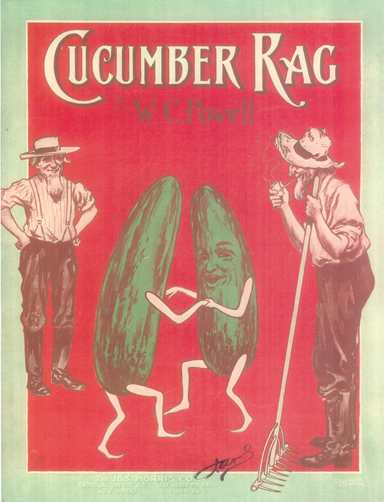
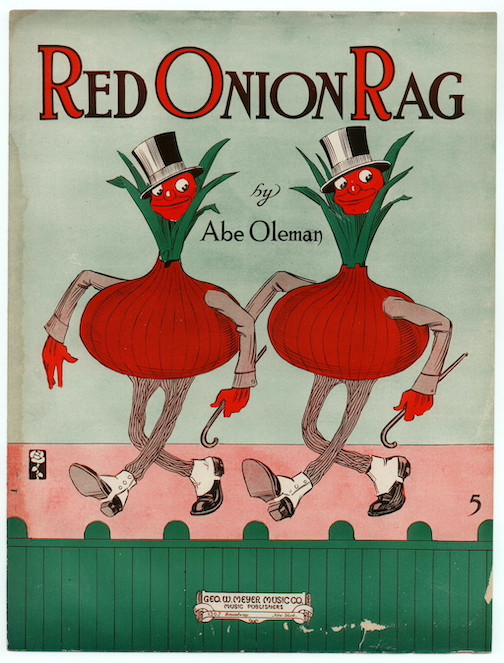
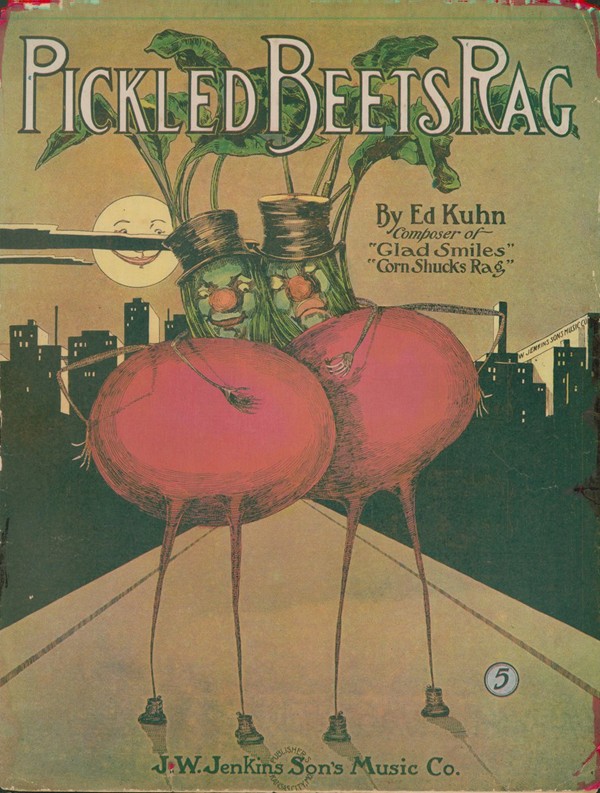
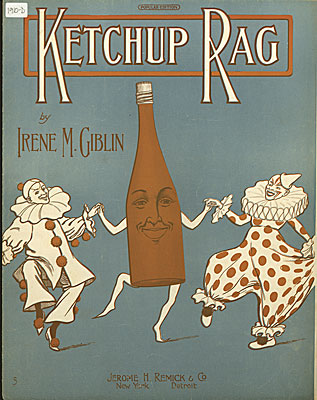
RedOnionCover.jpgWe had dinner with the family the other night at Portillo’s in Crystal Lake, and whenever we eat at a place like that, I wander around gaping at what I call “junkwalls”–old stuff tacked to the wallboard to make the place look atmospheric and (in this case) 1925-ish. Close to our table was a framed piece of sheet music for a song called “Ketchup Rag.” It was published in 1910 and is now in the public domain, and you can see the piece here. Writing entire songs about condiments seemed peculiar, but once I got online, I discovered that ragtime had an affinity for food, and there were in fact a Cucumber Rag, a Red Onion Rag, an Oyster Rag, and a Pickled Beets Rag, among many, many others. I confess a curiosity as to what the Ketchup Rag sounds like (it’s a complicated piece, that’s for sure) and discovered to my abject delight that there is such a thing as sheet music OCR. One example that particularly intrigues me is Audiveris, a Java app that can evidently scarf down a PDF and spit out a MIDI file. I’m downloading it even as I type, and with some luck will get it working later this evening. If it works (or even if it doesn’t) you’ll see a summary in the next Odd Lots.

Daywander

Boy, I’ve never been gladder that I no longer live in Baltimore. Local snow totals there went well over 40 inches, which is pretty scary. Right before we moved to California, we had a freak late-season storm (it was mid-March!) that dumped 24″ or so, and the movers had to dig a path between the van and the front door. We got about 8″ here across the last two days, but it was a slow and steady fall that I blew out of the driveway twice, as our little mini-blower won’t chomp that much snow in one gulp.

The neighborhood is now a winter wonderland, which is great as long as you don’t have to go anywhere. City government is currently throwing a raging tantrum because we told them to stuff it when they demanded a huge tax increase, so they’re not plowing anything, and have turned half our streetlights off. There will be no familiar faces there after November, trust me.

But if you ever wanted to live in a palace on the slopes of a mountain, here’s your chance: A house right around the corner from us and probably 1500′ from my front door went into foreclosure, and you can now get it for $690K, and probably less. It’s a weird house, once the most expensive in the neighborhood (originally listed at $1.2M!!) but whoever built it put all the money into interior touches like marble columns and art niches. (Check out those stairways!) The exterior is plain as can be, and the house does not look anywhere near as large nor as luxurious as it actually is. Great city lights views off the back deck, and you get a free beehive in one of the pines close to the street. We walk the dogs past it almost every day, at least when it’s not a winter wonderland here. The bees are courteous, as bees go.

Dogs, yes. Tomorrow afternoon we take QBit over to Sunrise Kennels and blast north to Denver with the other three, for the Rocky Mountain Cluster Dog Show, a 4-day all-breed yapstravaganza. (QBit is not show-quality, but is still Lord of the Pack.) Carol has shown Aero intermittently over the last two and a half years, but this is the first time we have ever tried to show more than one dog at a show. And we have three. Yes indeedy, Dash makes his debut in the 6-9 mo. Puppy Dog category, with Aero and Jack competing in Open Dog. (“Dog” in dog show jargon specifically means “male dog” and “bitch” is an ordinary word without any negative connotations.) Carol is in the laundry room even as I type, touching up Jack’s hairdo. Aero is next. (Dash’s turn was yesterday.)

The show is actually four consecutive one-day shows, and thus four opportunities to win points, with four “major wins” on the table. Aero has one major win and six points. He needs a second major win and another nine points to be declared a champion. Given that there are at least four points at stake each day, Aero could come home the champ we always knew he could be. In fact, although very unlikely, Jack could do the same thing, even though he has neither points nor major wins to his credit. He would have to grab all points all four days, which would be something of a grand slam for a dog who is about 15% larger than most judges would like him to be. Sure, we’d prefer Aero get the points, but we’re curious to see what Jack can do. He’s always been something of a “practice dog” in the past (I learned to handle in the show ring by showing Jack two years ago, and Carol practices grooming on him) but he’s never looked better and could do well, especially if Aero shies away from the judges, as he often does.

There is always a bichon frise grooming area somewhere in the vast cattle pens of the National Western Complex, and that’s where we’ll be. So if you’re in the Denver area and have some time on your hands, come see us. Watch for the blinding white off the dogs, or the glint off the top of my head. Early is better, and ring time for bichons is 9:30, unless I misrecall.

We still need effective “query by humming,” as the formidable David Stafford once put it. Carol and I don’t watch much TV, and what we watch consists mostly of Weather Channel forecasts. Every so often they’ll play a piece of music I like during a forecast, but they don’t say what it is. There’s supposedly a list online, but January wasn’t added to it until last night. All through January I heard a rousing piece that sounded like John Williams movie music, and vaguely familiar at that. I quickly memorized it, and whistled it for several people, to no avail. Finally, the list went live last night, and I discovered that the mystery song was in fact a John Williams piece, composed for the 1988 Summer Olympics. Amazon sells a DRM-free MP3 for 99c. In less than 90 seconds, I had it on disk and it was coming out my speakers. They had my dollar. Everybody’s happy.

Heh. That ain’t tricky. That’s the way you do it: You sell an unencumbered MP3. No, that ain’t tricky, that’s the way you do it: Get a dollar fer nuthin’; stampin’ bits is free!

Whiskey Handed ‘Round in Tumblers

We’ve just gotten back Midnight Mass…for small values of “Midnight.” Very small values. Ok, ok, I know…I’m not a night person. For me and for today, midnight comes at 4:00 PM. I like to be awake when I worship; inflicting my dreams on God would be cruelty to deity: A few nights ago I dreamed of three life-size crowns of thorns, each of which had three little legs, and the whole group was chasing some poor guy up a steep hill. God’s been there and done that; no need to put Him through it again.

And on the CD player is Golden Bough doing a very English sort of Christmas Carol that also mentions Midnight Mass: “Christmas Comes But Once a Year.” (The link is to the Clancy Brothers cover, but it has the lyrics.) The song describes the sort of feasting I can barely imagine, especially the line describing “Whiskey handed round in tumblers…”

Wow.

Maybe “tumbler” means something different these days, or to us Yanks. When I was a kid a “tumbler” was what I also called a “jelly glass”: a tall, fairly narrow glass that we had because we bought jelly in it at Certified, and after we cleaned out the jelly (which was a week or so’s worth of PBJ school lunches) we had a glass. These probably held a pint or maybe a little less; perhaps 12 ounces at very least. They were our everyday drinking glasses, and we used them until we got a little jittery and broke them, one by one.

Jelly no longer comes in useful glasses, but there was a time about twenty-five years ago when peanut butter did. I don’t remember the brand, but we bought our peanut butter in glass jars that held about 14 fluid ounces, and after we finished the peanut butter, we washed out the jars and kept them for everyday drinking glasses. We went through a lot of peanut butter in those days, and before we decided that enough was enough, we had twelve glasses in the cabinet.

Then either the peanut butter went away, or we did. (That may have been when we moved to Arizona.) And over the years, I have downed an enormous amount of Diet Mountain Dew in those glasses. One by one, I’ve gotten jittery and dropped them, and there are now only six. (The half-life of a dozen peanut butter jars used as Mountain Dew glasses is evidently twenty-five years.)

Regardless of what was originally in the glass, 12 or 14 ounces seems like an astonishing amount of whiskey to put away at one meal. I have a bottle of Evan Williams Bourbon Whiskey Egg Nog in the fridge, and typically drink about 50 ml in an evening, which is plenty. Given that it’s a 15% cordial, my limit (for 86-proof whiskey, at least) is about .15 X 2.3 X 50, or 17 ml. A hard drinker I am evidently not. (And clearly, not English.)

Or maybe “handed ’round in tumblers” means what my friends used to do with a joint back in the 70s: Pass it from person to person, with each person taking a draw and then passing it on. Or maybe people really do drink 14 ounces of whiskey at one sitting. Again, I boggle.

Doesn’t matter. We’re about to sit down to a feast of smoked turkey slices, cranberry sauce, and a loaf of home-made apple-pecan bread that Jimi Henton gave us for Christmas. I opened a bottle of Whitewater Hill Sweetheart Red, and poured each of us a glass that might be a full 100 ml. We may go a little nuts later on and have some of the Evan Williams, handed around in (one) peanut-butter jar. I may eat my two allotted slices of Jimi’s bread and then cut a third. Hey, Christmas comes but once a year!

Contest: 1-Verse Filk

I’ve had a bummer couple of weeks for many reasons, most of them relating to Global Cooling and a mild skin rash on several of my knuckles. So I need to increase the silliness factor a little, and am hereby mounting a contest, with real prizes.

The challenge: Submit a 1-verse filk; that is, a short parody song with original funny words to only one verse, what ur-filker Allan Sherman called a “schtick.” It has to be a funny filk, and the contest will be judged by people who know what “funny” means. (They will not necessarily be filkers. I will have a vote.) The tune can be anything, but it has to be a tune that has some chance of being recognized by a reasonable number of people. The song should only be one verse long; brevity is the soul of damned near everything, humor not the least of it. You can send me more verses, but your chances of winning decrease with each verse submitted beyond the first.

All entries should be submitted as comments to this blog. Your choice which site, and if you feel so inclined, submit entries to both sites. Being in both places does not increase your chances, though it may increase the number of people who see your entry. The two sites, in case you only ever read one, are LiveJournal, and WordPress.

No other rules except: Use no dirty words that will get either of us into trouble. Numerous things rhyme with “duck” and even more with “wit.” (Here’s a rhyming dictionary, in case you get stuck.)

The winner will be judged by Thanksgiving Day, or as soon thereafter as I get at least three entries. If I don’t get three entries by Christmas, we’ll call it done and both entries will get prizes. The prize will consist of your choice of one from the following list:

  • One copy of any title from the Copperwood Press catalog.
  • One copy of Assembly Language Step By Step.
  • A variable capacitor from my collection. I’ll test it for shorts before shipping.
  • A TO-36 auto radio power transistor from my collection. Sub a 6SN7 if you’re allergic to germanium.
  • Anything else somebody sends me to be a prize, to be listed later.

Hey, if that don’t get your mouth watering, what will? And in case you’re not sure what a one-verse filk is, let me show you:

Let There Be Fleas on Earth

(To: “Let There Be Peace on Earth”)

Let there be fleas on Earth, but keep them away from me;

Let there be toads and snails, but not where I can see!

To love each creature’s obnoxious features would drive me up a tree–

So let there be fleas on Earth, but keep them away….from me!

Shirley, you can all do better than that. So get on it!

Odd Lots

  • German model train manufacturer Marklin has filed for bankruptcy, though there is still some hope that the 150-year-old firm will remain in business. Thanks to Pete Albrecht for the link.
  • Scientific American has an interesting retrospective on the infamous nuclear-powered B-36 that actually flew back in the late 1950s, with a live, air-cooled fission reactor in its rear bomb bay. I’m less twitchy about nuclear than almost anyone I know, and that item still gives me pause. (I do think that the stock B-36 was the coolest military aircraft of the transition period between props and jets, and one of the coolest of all time, period.)
  • From Rich Rostrom comes an aerial photo of the Fovant Badges, which are a group of military insignia cut into the Wiltshire chalk downs in southern England. They date back to WWI, and have been laboriously maintained since then–a job and a half, considering that some are over 200 feet wide.
  • When I first heard Cher’s uber-irritating hit “Believe” years ago I wanted to know what sort of processing was going on with her audio. I didn’t want to know enough to search too deeply, but it recently turned up on Slashdot. The gadget is called Auto-Tune. And Cher can actually sing when she wants to; one wonders what it could do for no-voicers like Bob Dylan.
  • I’ve never paid much attention to KDE’s Kate editor, but discovered today to my delight that it has syntax highlighting for NASM. I’d basically given up trying to find a lightweight Linux assembly language IDE to describe in my book, but half an hour of lightweight fooling around with it makes me think that Kate might be the one. Now all I have to do is become an expert in the next couple of weeks. Are there any books on it, print or e? I looked around and have found nothing so far.
  • From the Words I Didn’t Know Until Yesterday Department: interpunct, which is a small dot used originally in Latin to unambiguously mark the spaces between words. It’s still used today to show you where the invisible characters are on your screen, and I recognized the concept immediately, but never knew what it was called.
  • From ditto: A placket is a flap of cloth that hides a button on fancy clothes. I have a pair of pants with one, and again, never knew what it was called until very recently.
  • Pete Albrecht pointed out a source of very nice cast aluminum house numbers in the Craftsman style–though at prices like these, I’m glad I have only a 3-digit address.
  • From the Painting the Devil on the Wall Department: One of the nation’s leading promotors of monster truck shows was run over and killed by a monster truck at one of his own shows. (Again, thanks to Pete for the link.)
  • From Ed Keefe comes a pointer to a stunt kite fitted out with a microcontroller, an accelerometer, and LEDs so that it could be flown at night and turn different colors depending on how fast it’s going and which way it’s pointing. I flew a kite at night in 1965 and only knew what it was doing by the crackle noise it made and how hard it pulled on the string. Technology advances…

Odd Lots

  • Don Lancaster sent me a link to the Draganfly, a mighty cool RC/GPS guided helicopter for
    aerial photography or police/military applications. MIT has worked out an algorithm for swarming these things, which isn’t too
    mind-blowing when you have three or four…but how about a few thousand?
  • On the other end of the scale for flying machines, Wired
    reports the opening
    of the Jumbo Hostel, a pulled-from-service 747 jumbo jet that was gutted and fitted out with (small) rooms for Stockholm airport travelers who simply can’t get enough claustrophobia.
  • And if you’re looking for something that will not only fly but fly high, there’s the unfortunately named Skylon, to which I call your attention because it reminds me of those Bonestell drawings of the canonical 50’s three-stage orbital rocket, particularly the nose section. Alas, we won’t see it for ten years, which is about how far into the future such things always are. (The only thing farther out is commercial nuclear fusion.)
  • Here’s another very spooky atmospheric phenomenon described on Spaceweather. This is not a sundog but a subsun, which is much brighter and I’m guessing a lot more startling.
  • Fractal woodburning, anyone?
  • While American technical and scientific magazines seem to be cratering right and left, Steve Moulding writes to tell us that Elektor Electronics , a longstanding European publication catering to hobby electronics, will be launching a printed North American edition. It’s unclear how this will differ from the UK edition (which is the only one I’ve ever seen) but anything that helps promote hands-on electronics here is welcome. (There’s not much left on the home front but QEX and Nuts & Volts .)
  • And if the loss of paper magazines depresses you, consider that just a few days ago, the last paper player-piano music roll came off the assembly line in Buffalo. Interestingly, brand new player pianos of this sort were being sold well into the 1960s; the family down the street where I grew up had one when I was tweve or so.
  • A Japanese chap built himself an automated book scanner using Lego. (!!!) It’s a delightfully Goldbergish contraption that basically holds the scanner upside down and presses an opened book up against the inverted scanner glass, dropping the book between scans to turn the pages. (Watch the video!) Big Pub seems excessively worried about ebooks and feels that their refuge still lies in paper. Maybe not. (I’ll bet I could do up something like this in Meccano, of which I have much. Just another three hours in the day, fersure…)