I’ve been writing my memoirs for a couple of years now, little bits here and little bits there as time allows. I don’t intend to publish them, though I may give them to people who request them. But having researched and meditated on the fluky nature of human memory, I want to record what I remember now, against the strong possibility that the remembering will not get any better.
One of my friends (who knows about my memoir-ing because she’s in my memoirs) asked me if it was a painful process. That’s a good question that I hadn’t considered; after all, I was trying to remember and record as much as I could, the bad along with the good. So was writing about the occasional tragedy in my life painful? Remarkably, no. In fact, the more I write about my life, the better I feel about it. I’ve always attributed this to the value of emotional release (especially of suppressed emotion) as documented by James W. Pennebaker in his book, Opening Up. But earlier today, while reading Daniel Gilbert’s Stumbling on Happiness, I came across another possibility: That explaining personal tragedy, even in a purely intellectual way, feels good and is healing in and of itself. There is, however, a bit of intriguing weirdness in it: It appears to work even if your explanation is bogus.
The human mind seems to like a coherent narrative, and when coherence is in short supply will manufacture as much as it needs. This may be one reason that we discover faulty memories of our past, as I’ve documented here: We value continuity over accuracy, and abhor blank spots. So when we’re telling a remembered narrative and come across something we don’t remember or don’t understand, it’s very tempting to guess and then build the guess into the narrative. (This can be and I think often is an unconscious process.)
I noticed this process at work some months back, when I was writing an account of my early relationships. Girlfriends #2 and #3 very clearly and explicitly rejected me because of my eccentricity. (I married Girlfriend #4.) Weirdly, what happened with Girlfriend #1 I simply don’t recall. I remember when the end came (August 1968) and I remember being miserable about it. I just don’t have the slightest idea what the issue was.
When I wrote about it, my first draft was the honest one: “I no longer remember why Judy and I broke up.” I didn’t like admitting that, but further thought brought no new memories to light. I do remember arguing with her and being a jerk about it. I just don’t remember what we were arguing about.
So for my second draft, I added speculation: “I no longer remember precisely why Judy and I broke up, but considering my later experiences with girls, I’m pretty sure my eccentricity had begun to wear on her after ten months of being inseparable.” That sounded a lot better to me, even though there’s not a lick of memory to back it up.
It is, however, a much better story. It ties in with my later experience and clearer memories. It just isn’t true. (I will admit that it’s a reasonably good guess.) Alas, I think that if I told the story often enough, the fact that this was simply a guess would get lost, and the guess would melt into my personal history and absorb credibility from everything else I’ve written. I wonder now how much of this has already happened.
Bottom line: Our memories may not decay naturally. We may unconsciously corrupt them by trying to knit them together into a coherent narrative, inventing or reshaping facts where facts either don’t fit well or don’t exist. That done, we convince ourselves that our guesses are true, at least until we encounter independent evidence that they’re not.
I don’t think it’s an honesty issue. If it were, you’d think it would feel better to just admit ignorance than tell a tall tale, especially when the tall tale puts the teller in a bad light. To the contrary, I think that devising narratives is a basic human need, and even when we don’t have to, some of us do it anyway, simply because it feels good. (This is how novels happen.)
Memoirists: Admit your ignorance. Label guesses honestly. The better a story your memoirs tell, the less likely it is that they really happened. (I’ll do my best to take my own advice here. Corrections gracefully accepted.)

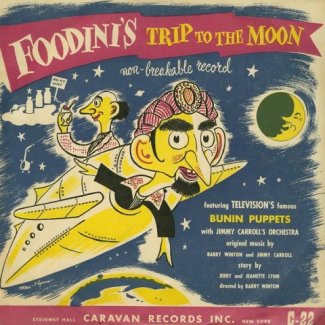 Like most record players in that era, it could do 33 1/3, 45, and 78 RPM. Most of my records were 45s. (The older ones, including Foodini, were 78s.) Playing a 45 at 33 1/3 was interesting for a moment but ultimately boring: Small children run at inherently higher clock rates than adults, and slow music is not a big draw. 78, now: I had a Disney extended-play 45 containing music from the 1955 “Lady and the Tramp” and I loved it a lot. One cut in particular was my favorite: “Lady,” the instrumental theme for the female cocker spaniel lead. It was bouncy (like me) and I quickly learned how to pick up the needle and drop it again at the beginning of the track, playing it again and again. And when that got boring, I nudged the speed lever up to 78.
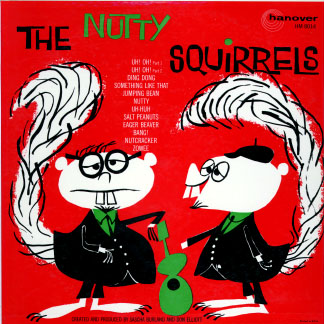 This was a fad in the late 1950s, starting with Sheb Woolley’s “Purple People Eater,” which had a couple of sped-up spoken vocals (“I wanna get a job in a rock and roll band…”) but no sped-up singing. That was a Seville invention, with his 1958 song “Witch Doctor,” setting the stage for The Chipmunks at Christmas time that year.
 I’m slowly coming out from under something very like bronchitis, but I wanted to get this item posted because I see nothing about it online: When