- Here’s how the ancient Greeks calculated the distance between the Earth and the Moon. If the notion surprises you, well, you were reading comic books during geometry class, weren’t you?
- Although I’d heard of the Millionaire Calculator, a sort of mechanical uber-sliderule used circa 1890-1940, I did not know that it had helped to discover Pluto.
- From The Words I Didn’t Know Until Yesterday Department: materteral, of or pertaining to an attentive aunt–basically the female analog of avuncular. Less commonly, materterine. Thanks to Jonathan O’Neal for calling them to my attention.
- I was going to cite Sion , Philip Boast’s outrageous but hugely fun riff on the whole Da Vinci Code thing, as an example of a print book you can’t buy in the US (see yesterday’s entry) but I was wrong: You can get used copies here for a dollar. No extra charge for either the zombies nor the angels with pubic hair.
- Dell has not handled its notorious SX270 capacitor problem especially well. “Hide the corrosion” might have been the company line, and the results could be Capacitorgate. That said, Dell is not the only vendor to have had this problem. (There’s a whole forum devoted to bad PC capacitors.) I’ve been lucky so far…but I’ve also switched to SX280 machines, which are not as prone to the problem.
- They Don’t Make ‘Em Like This Anymore…and when they did, I missed them. Dayum. (More if not quite as cool at Gizmodo.)
- Alfred Powell Morgan basically got me started on electronics when I was 11, through his decades-spanning series of books on electronics for boys. Here’s a nice bio sketch of the Dan Beard of electronics from the ARRL Web site.
- The late Thomas Gold (author of The Deep Hot Biosphere) may have been right. I certainly hope so.
- Honda, I know you’ll never actually build that car, so that being the case, could I have an SUV painted the same color?
- If ski season seems to have come early this year, you aren’t being singled out. It’s snowing on Comet Hartley 2. (Hey, spin that dogbone and make a habitat out of it!)
- 70 is the new 40, and zombies are the new vampires. Let’s talk about this again when I’m the new 40.
- I’ve never been a beer guy, but if I did drink beer, it would probably be this one.
- And pertinent to the above, here’s an elegant solution to a problem that I myself will never have.
- This, on the other hand, is something I could definitely get into.
books
Odd Lots
EBooks, Foreign Rights, and Reluctant Pirates
Alana Joli Abbott reminded me that I hadn’t read Rose Fox in awhile, so I spent an hour yesterday catching up at the Publishers Weekly Genreville blog. Highly recommended. This post from last week was important because people higher in the publishing food chain than I have begun to admit that the foreign rights business model is already doing and could do hugely more damage to the ebook business.
An awful lot of people think that the Internet, being global, is truly a global marketplace. The sad truth is that if you’re in Australia, you may not be able to buy an ebook offered from England, or the US, or along many other vectors that cross a border. People in France often cannot buy English translations of French works, and in fact the world is carved up into regional and language ghettos that ebooks cannot legally leave. I’m not making this up, nor exaggerating: See Lost Book Sales for more examples than you could want.
The problem is an ancient carryover from the print book business, where publication rights to a book are brokered by language and often by nation. This used to be necessary to get international distribution at all, since gladhanding and then coddling multiple retailers on the other side of the planet is an expensive business that most publishers (especially small ones) simply can’t do. Applying the international rights/publishing/distribution model to ebooks is idiotic, since any IP address can connect with any other IP address and there is no physical inventory to manage, move, or return.
It’s easy to blame authors (which publishers are glad to do) for shouting “Mine! Mine! Mine! Mine!” about international rights, amidst fever dreams of making a fortune brokering Urdu translations of their books to the Pakistani equivalent of Macmillan–assuming that there is a Pakistani equivalent of Macmillan. In truth, midlist foreign rights sales don’t make a huge amount of money for publishers, and very little money at all for authors. (I’ve been both an author and a publisher and have worked both sides of that street.) It’s probably something like a 97/3 rule: A tiny handful of authors and books make a fortune on foreign rights, and everybody else gets peanuts, or just empty (contractual) shells.
Authors don’t help by vastly overestimating the commercial potential of their work, but the reality is this: Foreign rights sales are an easy and reliable (if minor) revenue stream for publishers, and the publishers will not give them up without a fight. There’s a lot of rentseeking involved and a lot of ego on the line. National governments generally support foreign rights agreements because local activity generates local tax revenue, whereas an EPub file flying over a national border generates nothing.
And so we have the absurdity of purchasers, money in hand, pleading in vain with retailers to sell them the product. The publishing industry is in deep denial about what comes next: The spurned buyers run over to RapidShare or Usenet and simply download the product for free. Online content is basically sold on the honor system, and if the author/publisher/retailer side of things doesn’t appear to be serious about being a business, why should readers be serious about being paying customers? I’ve often wondered whether a thwarted purchaser who figures out how to download ebooks from Usenet (it’s not trivial) will ever rejoin the legal marketplace at all.
The solution is simple, if not easy: One ebook, one world, one market. How we get there is unclear. Authors may need to get tough with publishers in peculiar and counterintuitive ways: “Take these global rights or I’ll throw them at you!”
Or maybe authors just need to take over the publishing industry. No, this doesn’t mean self-publishing. (If only it were that easy.)
More as time allows.
Odd Lots
- I meant to post this back in May but the item went into a notefile while I was traveling and got misplaced: Larry O’Brien did a very nice detailed comparative review of my Assembly Language Step By Step, Third Edition and Randy Hyde’s Art of Assembly Language, Second Edition over at SDTimes. Larry understands better than most people that there are multiple ways to approach learning a topic, and that both books have value and don’t completely overlap one another.
- Another tardy item from that same missing notefile: Scientific American must be desperate for subscribers, as it had the courage to challenge the biggest sacred cow in medical science: the Fat Bad, Carbs Good nonsense that has blown us up like carnival ballooms since it was declared health dogma in the early 1970s.
- Part of the problem: Most medical studies are utter crap, and here’s why.
- And here’s an excellent example. Sadness makes me neither creative nor energetic. Furthermore, all the most creative people I know are borderline manic. Insane, maybe. Sad? Not in the least.
- In 1970, I built a vertex-first projection model of the 600-cell regular polytope in four space using D-stix. My senior-year math teacher hung the model from the steam pipes and I never saw it again, but here’s a photo of one made out of ordinary drinking straws. (Scroll down.)
- What is the frequency of a dog shaking water off its fur? The answer: greater than or equal to 4 Hz.
- Slate asked “Is the movie that almost killed Disney animation really that bad?” My answer: Yes. It’s the Seventies car in Disney’s otherwise reasonable animation garage, full of uninteresting things indifferently drawn, with the possible exception of the weird half-dog, half-leprechaun whatchamacallit Gurgi. The Horned King is the least menacing of all Disney cartoon villains, and certainly can’t hold a candle to Maleficent, Hades, or even Gaston. The Chronicales of Prydain is a decent kid-series, and deserves a remake.
Odd Lots
- Don Lancaster has released a free PDF of his classic RTL Cookbook . No catch. Just go get it.
- One serious problem with legalizing marijuana, for medical use or otherwise, is that there is no one “marijuana.” Like breeds of dogs, weed comes in a multitude of varieties, with various strengths and compositions and effects on human beings. You simply can’t predict what will happen to you when you take it, which isn’t what I like to see in medical therapies–or, for that matter, recreational activities.
- This is good, but not for the reasons you might think: If Macmillan is consigning much of its backlist to a POD agreement with Ingram/Lightning Source, the line between “conventional” publishers and POD publishers begins to get blurry indeed. That’s good, as discrimination against POD titles by reviewers and other gatekeepers in the publishing and retailing businesses has been very discouraging. Mainstreaming POD has got to happen at some point, and the gatekeepers will have to–gasp!–evaluate titles on their own merits. (But that’s…work!)
- Those who think cellular phones were the first mobile phone technology are almost forty years off, as this excellent detailed history of mobile (car) telephony shows. This stuff was huge (as in takes up much of your trunk), hot (as in temperature), and fiendishly expensive, but over a million people were using it in 1964. Love those early-60s control heads!
- I just heard that a lost and never-performed composition by Ralph Vaughan Williams has been discovered in the Cambridge University Library, and will soon be performed for the very first time. He’s my all-time favorite composer, and it’s delightful to think that there’s still something he’s written that I have never heard. (Thanks to Scott Knitter for the link.)
- We got missed (barely) by a 35-foot asteroid yesterday, but I’m guessing that there are plenty more where that came from. And does 35 feet qualify one as an asteroid? I would think they had to be bigger than that. I would call it “modestly scary space debris.”
- Maybe you have to have been an electronics geek for 47 years (like me) to appreciate the humor, but this made me laugh. Hard.
Insight Is Gone From Ubuntu…
…and in fact from everything else based on Debian. Not six months after I saw Assembly Language Step By Step, Third Edition hit the shelves, the Debian team decided to pull the Insight debugger package from their seminal Linux distribution, on which Ubuntu, Kubuntu, Mint, and several others are based. Come Ubuntu 10.04 Lucid Lynx at the end of this past April, and suddenly people reading my book can’t work through the examples, because the software that I used in those examples (for single-stepping and examining registers and memory) is no longer available for their version of the OS.
This isn’t new news, and I’ve been trying to figure out how to finesse the problem ever since I heard about it mid-May. I got a number of queries this past week, suggesting that I had better get on it. (This is why you haven’t seen much from me in recent days.) Assuming at first that Insight had been dropped just to keep the distro CD-size, I tried to install it under Lucid from Software Center (not found), next a deb package, and finally from source, but nothing worked quite right. As the months have passed and more and more people are installing Lucid, I’m getting more and more mail about this. It’s a serious problem: A lot of the skill of assembly programming lies in debugging at the instruction level, and much of the tutorial depends on being able to run a debugger. Insight was that debugger. It’s GUI-based, rather than purely textual, and I think it’s a great deal easier to grasp, especially for newcomers.
So why didn’t I just use gdb?
Um…I did. Or at least I thought I did. Insight is an odd case. Most people assume (as I did) that it works the same way that Nemiver, KDbg, and DDD work, as independent front ends for gdb, passing textual commands to gdb and getting textual data back for display. Not so: Insight is gdb, and therein lies (in my opinion) most of the problem. What Insight’s originators did was take the gdb source code and add a built-in GUI, using Tcl/Tk. In effect, they forked gdb and produced a new custom version that contains all of gdb (at least gdb as of 2007) plus a windowing visual wrapper.
That in itself is unorthodox but not necessarily damaging, though forking something as fundamental as gdb should not be done lightly. Still, if you do it, you have to do it well, and I’m seeing indications that Insight isn’t nearly as clean a product as it should be. The Debian team spoke tersely; see the bug report and resolution here: “RoQA; insane packaging; unmaintained; low popcon.” (Yes, I read “popcorn” at first too.) More details may be found here. (Warning! DDG: Deep Debian Geekery.)
Quick translation:
- RoQA means “Request of Quality Assurance”; basically, Debian’s QA team decided that the package was too broken to keep in the Debian distribution and requested that it be removed.
- Two release candidate (RC) bugs were reported by the Debian team to Insight’s maintainer, but no one there responded. This is odd, because the maintainer is none other than Red Hat.
- An NMU is a non-maintainer upload, which is when a package is sent to the distro team by someone other than the package maintainer of record. It is often a sign that the maintainer has abandoned the package, especially if the maintainer never acknowledges the third-party fix.
- “Low popcon” is a reference to Debian’s unique “popularity contest” system for gaging how much individual distro packages are being used. Insight got 36 votes, which, in browsing the rest of the stats, seems low but not fatally low.
The real problem is that “insane packaging” issue. Insight contains embedded copies of software that is maintained by others and would be better linked in as libraries. The embedded bits “age” with respect to the current release of the OS and its libraries, eventually getting out of sync to the point that the package will not understand the current system well enough to function correctly. Tcl and Tk are either part of or easily installable to any Linux distro there is; you do not have to cut’n’paste them into your program source. With old software copied into its sources the package may build correctly, but might not necessarily run.
That said, the right way to approach the problem may be no more complex than taking the most recent release of Insight and making a proper Debian package out of it. The version I used last year in Karmic Koala goes back to 2007, and that’s the version pulled from Debian. The July 2009 release may be better. I’ve read enough on building Debian packages to know that I’m not the guy to do it, but I hope that somebody with better Debian chops will eventually try it, so that we can tell if Insight was just wounded, or if it’s really and quite sincerely dead.
In the meantime, the best fix appears to be falling back to Ubuntu 9.10. More here as I learn it.
Cold Hands and Other Stories

I’m sure I’d be a lot more famous if I weren’t so slow, but better late than never: I’m pleased to announce that Cold Hands and Other Stories is now available from Lulu.com in print form, with cover art by the estimable Richard Bartrop. Trade paperback, 230 pp. $11.99.
The body of my short fiction divides pretty much in halves: Stories focused on AI, and stories focused on everything else. I published all of my AI shorts in Souls in Silicon back in 2008. Cold Hands and Other Stories contains everything else, albeit with a new excerpt from my nanotech AI novel, The Cunning Blood. And “everything else” covers a lot of ground: spaceflight, aliens, religion, calculus, witchcraft, and steam locomotives, or at least steam locomotives hacked together from alien parts that probably weren’t intended to go into steam locomotives.
Most of the stories have appeared in print before, and one, “Cold Hands,” was on the final Hugo ballot in 1981. There are a few new ones, including one as new as late last week. Here’s the lineup:
- “Cold Hands” (from IASFM, June 1980)
- “Our Lady of the Endless Sky” (from Nova 4, 1974)
- “Inevitability Sphere” (from IASFM, Sept./Oct. 1978)
- “Whale Meat” (from Starwind Magazine, August 1977)
- “Born Again, With Water” appears for the first time.
- “Drumlin Boiler” (from IASFM, April 2002)
- “Drumlin Wheel” appears for the first time.
- “Roddie” appears for the first time.
Rounding it out is another excerpt from The Cunning Blood, different from the one I published in Souls in Silicon, and not available anywhere else but in the novel itself.
A big chunk of the book involves the Drumlins world, which I introduced in 2002 and intend to do a lot more with. Calling it steampunk isn’t quite fair, as it doesn’t take place in Victorian times and corsets are mentioned exactly once. Someone described “Drumlin Boiler” to me as “hillbilly steampunk” (steambilly?) and while that’s a surreal notion, it may be as close as you’ll come.
Yes, an ebook edition is planned, though given the sad, fragmented state of the ebook world right now, it’s going to take some time to kick the file down the tool chain into all the requisite formats. Fortunately, Lulu is a certified aggregator for iBooks, so once I have an EPub that passes the gnarly epubcheck test for standards compliance, I’m going to give it an ISBN and let Lulu list it on iBooks.
As always, blog mentions and reviews are much appreciated!
CBZ Files as Image Archives
Last fall, I gathered a stack of Alma-Tadema‘s paintings from my pre-1923 images folder, wrapped them up into a ZIP file, and sent them to a friend who was looking for a copyright-free color cover for a novel. Some weeks ago, I learned that the CBZ (Comic Book Zip) file format is nothing more than a ZIP file with a different extension. I downloaded and installed a free CBZ reader called Comical. After changing the extension on the Alma-Tadema archive to .cbz, I double-clicked on it, and boom! There it was, beautifully presented and trivially easy to click through. And if you change the extension back to .zip, you can de-archive the images in the usual fashion using any ZIP-capable archiver. It’s all in the extension; no changes to the binary archive need to be made.
Not being a comics guy, I’d never heard of the CBZ format, though it’s been around since 2004. It’s basically an ebook reader protocol (since it is, after all, simply an ordinary ZIP archive) that opens a .zip file and displays the files in alpha order by filename. If the files are displayable as images, the reader displays them. If the files are not displayable as images, a well-behaved reader will ignore them. (Comical, one of the simplest free readers, sometimes crashes when it encounters a non-image binary.) If you need an indicia page, some readers will display text if it’s in an .nfo file. The .nfo will appear in a separate text window on opening the file, rather than in the page display area.
I’ve tested four free CBZ readers: ComicRack and Comical under Windows, and QComicBook and Comix under Linux. All but ComicRack are open-source. ComicRack is overkill in a lot of ways, though it works very well. (It requires the .NET framework, if that’s significant to you.) Comical is much simpler, and my only gripes are that it doesn’t display .nfo files, and it crashes when it finds certain kinds of non-displayable files in a .cbz archive. QComicBook is a Qt4/KDE app, and the one I find myself using under Linux. Comix (a Python app) works well but is not as capable as QComicBook. (Feature-wise, it’s on a par with Comical.) Others exist. Okular will open CBZ files without complaint, but it simply scrolls vertically through the images without attempting to show one per click.
Most of the comic book readers also read CBR and CBT files, which are RAR and TAR archives, respectively, and work almost exactly the same way. (I haven’t tested those formats.)
The CBZ system works best when all the images in the archive are the same dimensions and aspect ratios. I’m putting together some photo albums for showing the folks back home that are collections of digital photographs in one (big) .cbz file. The bigness is mostly unavoidable, since JPG files don’t compress very well. Still, it makes file management simpler
Here are some sample CBZ archives that I put together for testing: Alma-Tadema (14 MB). Hi-Flier Kite Catalog 1977 (6 MB). The “Elf” Space-Charge Receiver (1.7 MB).
The Pulps Reconsidered, Part 2
Back in my Febrary 23, 2010 entry, I began a series about the pulp fiction mags of the first half of the 20th Century. Because most people would assume I’ll be talking about SF, I deliberately went elsewhere, to a category most of my readers have probably never even heard of: railroad fiction. I bought and have been reading some 1930s issues of Railroad Stories magazine, published by the Frank A. Munsey Company, which in 1882 basically invented pulp fiction mags as we know them.
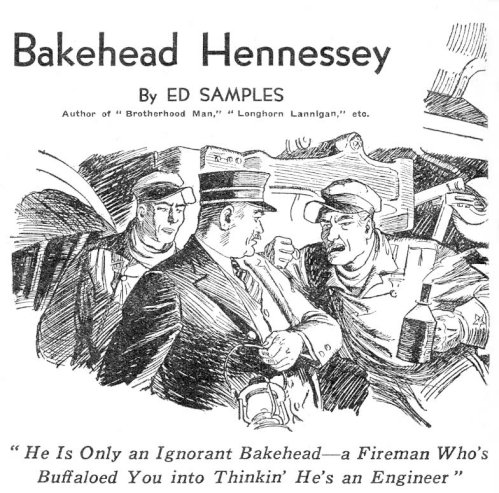
I can give you a good flavor for the genre with a single 300-word excerpt, from a story called “Bakehead Hennessey,” by Ed Samples, in the August 1935 issue:
Barney softly coupled his two engines into the head car. An “air” man connected the hose. The compressors on the head engine cut in, racing, clicking, thumping, forcing the train line pressure up to ninety pounds. Barney glanced at his gage, then out toward the yard office, where Conductor Gardner was running to the platform with two sheaves of green and white tissue in his hands. Behind him waddled stout Superintendent Moran. A second later Old Tom Ryan was climbing down upon the brick platform to meet Gardner.
Barney watched him, glanced once more at his air gage, then toward the rear. An inspector’s light was saying: “Set the air.” He opened the valve, watched the needle swing back, then closed it; and wiping his hand on a piece of cotton waste, went striding toward the men who were comparing watches and reading train orders.
The conductor handed him his set of flimsies in silence. There were only three: two slow orders and the running order. He glanced at the latter.
“Running us as Second Seven?” he asked, looking at Gardner.
Gardner nodded. Barney read the order through. He knew that never in the history of the road had such a task been laid out for an engineer: to clip sixty minutes off the time of No. 7, the fastest train through the Rockies on any line.
Air pumps were racing. The pop valve on the 3775 opened and white steam climbed skyward. A dozen lights darted hither and yonder about the steel mail cars. Superintendent Moran came panting up to the group.
“We want action on this run tonight,” he began.
“What the hell’s the use uh puttin’ out a fast schedule for that sizzlin’ bakehead?” snarled Old Tom. “He’s got you fellers all buffaloed into thinkin’ he’s a hoghead. Hoghead! Bakehead! Bakehead Hennessey!”
‘Nuff train talk for ya? I’m the son of a passionate railfan and have researched railroads more than most people, but I still had to look some of this stuff up. A “bakehead” is a locomotive fireman, who stokes the engine manually or maintains the stoking machinery. A “hoghead” is the engineer of a freight train. “Flimsies” are train orders, often printed on something just a hair better than tissue paper. Nonetheless, if you know the jargon, this scene will be utterly clear to you, and back in 1935, this was not nostalgia but the way the railroad industry actually worked.
Nor is this unusual within the genre. In the two issues I’ve read so far, all the writing is precisely like this, in that what matters are the trains. The people are types, which isn’t to say they didn’t exist in the real world or are somehow badly drawn in the tale itself. (Not everyone is an American Original.) But descriptions of their internal conflicts and personal growth were not what the reader was paying for. In a way very much like the Tom Swift books I read in the early 60s, the railroad pulp stories (and I’m guessing all pulp stories) were created to help people imagine themselves in certain roles and in certain situations. The people (thinly) depicted in the stories were like halloween costumes, in a way, to be put on by people who wanted to imagine themselves as railroad engineers and brakemen, or perhaps remember being railroad engineers and brakemen years ago.
This should be obvious, and it may be obvious to you, but I’m amazed at how some people just don’t understand why pulp fiction was ever popular. A lot of people would consider the railroad pulps bad fiction because they focus on technology (railroad tech, such that it was in 1935) rather than inner conflict and growth. Swap in “spaceflight” for “railroads” and you’ll have pulp SF of the same era. The railroad pulps had their share of adventure and fistfights and gunplay, but I was amazed at how close the action stayed to the tracks. And just as superb writers like Robert A. Heinlein stepped aside from the action to teach lessons on orbital dynamics, the railroad pulp authors sometimes taught lessons about their beloved technology. Read this excerpt from “When Destiny Calls” by E. S. Dellinger, the cover story in the August 1935 issue. It’s dense, but if you love trains you’ll understand the frightening energy contained in a boiler full of steam (enough to lift a 100-ton locomotive two and a half miles into the air) as well as how the devastating boiler explosions common during the steam era actually happened. I’ve ridden behind a couple of steam locos on tourist lines. That excerpt gave me chills.
Which, of course, was part of the package. The firms that published pulp fiction knew exactly what their customers wanted: a sense of being somewhere else, somewhere vivid and colorful, somewhere better and more exciting than a boarding house during the Great Depression, after a twelve-hour day at a mindless job in a sweltering factory that paid a quarter an hour.
The pulps were hugely successful for quite awhile. The writing wasn’t great, but it was nowhere near as bad as people make it out to be. Much of its “badness” was the focus on action, setting, ideas, and a certain sort of culture. The words could be carelessly arranged, but words can be fixed, and there is a particular skill in creating vivid settings and action scenes that few people understand until they realize that they don’t have it. The concept of pulp fiction deserves better than it’s gotten in recent decades. It didn’t even completely disappear, though the psychology is a little different these days. More in Part 3.
Odd Lots
- Here’s the best discussion I’ve yet seen on why Flash may never work well–or perhaps at all–on touchscreen devices like the iPad.
- Most recent laser printers have Ethernet ports, and some older printers (like my Laserjet 2100TN) can accept a JetDirect network adapter. Installing a printer on a network port means you don’t have to worry about whether the machine it’s attached to is turned on. If you’d like to do this but you’re not a network geek, here’s the best XP-based step-by-step on the topic I’ve ever run across. Same tutorial for Windows 2000.
- Bruce Baker passed me a link to a nice item on the issue of broadening publisher book production to allow all formats to be generated from a single master file. Follow and read the link to The New Sleekness as well. Pablo should take it down a notch; XML is not a markup language; it’s a general mechanism for creating markup languages, and what may happen eventually (perhaps in ten years or so) is a standard book-production markup language derived from XML and built into a new generation of word processors. Still, what nobody in either article mentions is the problem of pages verses reflowable, which is the 9 trillion pound gorilla in the business. If you don’t solve that problem, absolutely nothing else matters. (And it is not as easy to solve as some may claim–I’ve been thinking about it for several years now and see no solution whatsoever on the horizon .)
- Kompozer 0.8b2 has been released. I just got it installed in a VM and will be poking at it in coming days. According to Kaz, most of the changes are code cleanups, but any progress on the editor is a fine, fine thing.
- I’ve done model rocketry here and there over the (many) years, and I’ve seen some very odd things lofted on D engines. Back in high school, my friend George built a Harecules Guided Muscle (which was from the Beany & Cecil cartoon show) in the form of a big whittled balsa wood fist on a short, thick body. I’m amazed it flew as well as it did. Well, here’s a fire-’em-together pack of 8 rockets shaped and colored like Crayola crayons. The guy took his time (six years) but he did a great job–and created a spectacular Web page documenting the project.
- We rarely go to WalMart, but last time we did, I picked up a bottle of Diet Mountain Lightning. It has nothing on Kroger’s Diet Citrus Drop, easily the best of all the Diet Mountain Dew clones I’ve ever had the opportunity to try.
The Pulps Reconsidered, Part 1

How bad were the Golden Age pulps, really? Thirty-odd years ago I had a few SF pulps from the late 1930s, and while I’m not sure where they ended up, I remember the cognitive dissonance that arose from knowing that I should despise them–while in fact enjoying them a lot. Reading them was a little like watching old B-movies like The Crawling Eye: You know damned well they weren’t literature, but somehow they kept your attention and made the time pass..which is exactly what they were created to do.
Few people–especially those under 40–realize just how broad a phenomenon the pulps were, and how small a part of it SF actually was. Beyond SF and fantasy there were sports pulps, many subspecies of crime/detective pulps, adventure pulps, romance pulps, aviation pulps, western pulps, railroad pulps, and doubtless others that I’ve never heard of. The SF pulps were better than I’d been led to believe, and I started wondering recently whether the SF pulps were outliers, or whether the pulps as a phenomenon and even a literary form have been slandered out of proportion by the ultrasophisticated artsy elite.
I bought a couple of railroad pulps pretty much at random on eBay not long back, and have been reading them as time permits. The cover above is from the May 1933 issue of Railroad Stories. I also bought the August 1935 issue and found with a grin that the cover author and the cover artist were the same in both issues: E. S. Dellinger writing the cover stories (both novelettes of about 10,000 words) with Emmett Watson on watercolors. I chose railroad pulps because I like railroads; I’m not sure I could have bulled through a sports pulp or a true crime pulp.
Being a magazine guy myself, at my first flip through the issue I was startled: These books had almost no ads! The back cover and inside covers were full-pagers, and the single-page TOC was set within a 4-page block of fractional ads, generally 1/8 page items hawking hair tonic or remedies for hemmorhoids. And that was it. There were no ads whatsoever set in or between the stories themselves. It’s obvious that they didn’t pay much for the paper (and we know they paid almost nothing for the stories) but I boggle that the 15c for a single issue or $1.50 for a full year carried that much of the operation.
The inside front cover ad seemed odd for a railroad pulp: Dr. Frank B. Robinson pushing his artificial religion Psychiana. On the other hand, readers of Popular Mechanics were never too far from discovering the secrets of the Rosicrucians, and this was clearly their competition.
The TOC divides each issue into three sections: Fiction, nonfiction, and departments. Fiction was less of it than I had thought. A quick tally shows about a third of the editorial to be fiction, and probably half nonfiction. The departments include a joke page, a question-and-answer column about railroad history and tech, news items submitted by readers, short items from readers who worked at railroad jobs, and a scattering of railroad poems.
So…how bad was the writing? What were the stories about? Tune in next time, kids!