- Eating fat, protein, or vegetables before eating carbs can slow blood sugar spikes. I read that in a book decades ago, and it’s a pattern that Carol and I follow in our everyday meals. When possible, well, we just don’t eat the carbs. Works.
- If you have any desire to look at or find something in Turbo Technix (the magazine Borland paid me to create and edit for six issues before laying us off) it’s here, all six issues, in PDF format. We had a seventh issue complete and in flats, but the end came before we could publish it.
- If you need to do OCR on a .jpg file, you might try OCR Online. It’s free, but it makes you wait for several seconds before starting to work on each image, thus making massive use of the free site impractical. You can buy a subscription for $30/month, or a lifetime subscription for $80. Worked well for OCRing some text out of a Visual Developer issue from which I’d scanned a couple of pages.
- Hans Schantz posted a link to James Macleod’s Truth Decay Substack page about the hidden Internet—which is hidden because Google doesn’t make any money bringing back its pages from searches. I did a test, looking for “Jeff Duntemann” on Google and then on a site called Marginalia Search—and discovered that Marginalia brought back a lot of mentions of me that I’ve never seen before, on Google searches or anywhere else. It’s a long article but worth reading top to bottom.
- My friend WA4GIM sent me a link to a WordPress blog by Dave Richards AA7EE….in 2014. And I never cited it here on Contra, whoops. (That was a kind of busy time for me, moving back to AZ. And there’s still old email piled up…) The site is about homebrewing ham gear, especially kits, and what’s remarkable is the quality of the photos, and the discussion about kits, their quality, and their operation. Go take a look.
- I stumbled across a short essay on how a nuclear explosion at the sea bottom would proceed—and it was not what I thought. Don’t be swimming above the bomb—but what kills you isn’t radiation or a fireball.
- And after reading that item, I fell upon another one. When I was 15 (1967) I wrote a story about a starship with a new hyperdrive that allows it to go so fast that it circumnavigates the cosmos and returns to Earth from the opposite direction. “A Straight Line Is the Shortest Distance” was the first SF short story that I ever wrote. (It was never published.) But the story gimmick that I freely admit I pulled out of thin air may in fact be the way the universe works. (Alas, the story has been lost, or I might post parts of it if they don’t make me laugh too hard.)
- Popular Science has a section called “That Time When,” a collection of stories about weirdness in science and human culture generally. I’d heard of several of the topics, like the dancing plague of 1518. Perhaps the weirdest—one I hadn’t ever heard of—was “Lewis and Clark’s mercury-laced poop helped archaeologists trace their expedition.” Read ‘em all: They’re short and more interesting than I had expected.
October, 2026:
Odd Lots
Flashback: I’ve been to Distraction on a Thing with No Name
Decades back (in the early 80’s, I think) I got a late evening call from my friend and SF writer Nancy Kress. She was something close to frantic.
“Jeff! You gotta help me!”
“Anything, Nan.” Far be it from me to leave a beautiful woman in a bad situation.
“Then quick: What do they call that tubey thing that pulls screen doors closed when you let go of them?”
Ulp. She could have asked me how to do I/O redirection under DOS. She could have asked me whether Millard Fillmore had ever been on a US postage stamp. She could have asked me the atomic weight of Ruthenium. But no: She asked me for the name of a Thing With No Name.
Not a horse. A thing.
So tell me: What is the name of that long aluminum hydraulic gizmo that hisses coming and going and needs to be propped open with that little skewed iron washer that always lets go just when you’re heading out the door with the old dresser that must not be scratched? I doubt you’ll do any better than I did. Sheesh; I could go out in the garage and build one for you—but I can’t tell you what it’s called.
Nan and I finally decided that knowing precisely what it was called wasn’t germane to her story—a little item called “Out of All Them Bright Stars,” which went on to win a Nebula award for her—so we did the best we could and called it a “door closer.” That was its job, after all, scratched dressers notwithstanding.
The following weekend I went down to Ace Hardware and prowled the aisles until I found a blister-packed replacement unit hanging on a peg. It was…drum roll, please…a door closer.
I was shattered. Surely it was a wheezyank or a tugtube or an Albemarle cylinder. Could there possibly be something that exists by the tens or even hundreds of millions around the country that has no name, and thus drives people to do the obvious and punt with so boring an appellation as…door closer?
Yes, there is. And by paying attention since then I’ve run into a few of the others.
One is a dog thing. Back when we lived in Rochester, New York I was sitting on the couch, watching Mr. Byte squirming around on his back on the living room floor, rubbing his nose on the carpet while making a don’t-bug-me-I’m-heavily-involved sort of noise halfway between a groan and a growl. It occurred to me that I had watched every other dog I had ever owned do exactly the same thing: Rebel, Yankee, Smoker, and now Mr. Byte. This was obviously Important Dog Behavior, at least as important as peeing on things when you’ve long since run out of pee. So what the hell was he doing? There was no word for it, so I made one up: He was schnauzing. From the German for "muzzle." What schnauzers do. And all other dogs as well.
Fits, doesn’t it? Now, please use this word every chance you get so that I can be cited in the Oxford English Dictionary as the person who coined it.
Moving further out into the realm of abstraction, there is the problem that in English we have no single word for “it is to be hoped that…” Most people probably don’t lose a lot of sleep over this one, but it does bother me. I used to admire the French for their terseness, after Sister Agnes Eileen explained to us in third grade that the last Tuesday before Lent was called "Mardi Gras" in French. As she put it, “‘Mardi’ means ‘Tuesday,’ so ‘Mardi Gras’ means ‘the Tuesday on which meat may be eaten.’” Junior logician that I was, I unrolled the syllogism and assumed that “gras” in French meant “on which meat may be eaten.” A dinner plate was thus an “assiette gras,” as was someone’s upper plate, which most certainly is an artifact with which meat may be eaten. Don’t tell me that “gras” means “fat.” Sister wouldn’t lie. Maybe you got the accent marks wrong.
So although I seek in vain, others in my condition have done the obvious thing and stolen another word that isn’t used nearly as often: hopefully. Now, this word really and legally means, “with hope in one’s heart,” as in, “Expecting some word about her order, she rummaged hopefully through the day’s mail.” That is, she rummaged through the mail, filled with a feeling of hope that PC Nirvana will finally either ship her damned mouse or send her a refund.
Desperate word hijackers have taped hopefully’s mouth shut to muffle its screams and begun using the word to mean “it is to be hoped that…” as in, “‘Hopefully, my mouse will show up tomorrow,’ she said, wiping the blood from her arrow keys.” Complain though purists might, the crime’s been committed, and the Law of Conservation of Syllables has been satisfied. Besides, people rarely use the word “hopefully” to mean “with hope in their hearts” anymore, especially when they’re dealing with mail order computer retailers.
Finally, there is what I can only assume is a Jeff thing, because I have never seen or heard anyone else encounter it. It’s a Jeff thing in part because I keep my money loose in my right pants pocket, whereas most people keep theirs in a wallet. When I was fourteen I lost my wallet, and it had the $10 bill in it that I had received for Christmas from my godmother Aunt Kathleen. This cauterized me for all time on the issue of placing so vulnerable a substance as money in so losable a container as a wallet, which hangs precariously off your butt in the embrace of a loose fabric attachment that is far wider (but never deeper) than it needs to be. (Remember, when I was fourteen, $10 was way more money than it is today.)
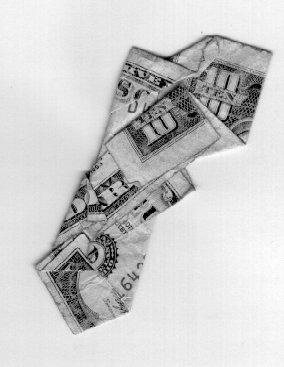 The Jeff thing in question is what to call the bills that have been sitting in the bottom of your pocket for several weeks. Cash always begins its life in a nice tight roll, but as you peel off a crisp 20 and hand it to the guy at Taco Bell, he hands you back a tatterdemalion wad of greasy ones and fives, which join their fellows in the bottom of your pocket, wrestling and twisting and doing everything but (sigh) reproducing.
Years’n’years ago, before there were ATMs, I went too long without cashing a check, and finally had the occasion of pulling the very last bill out of the bottom of my pocket. It was a remarkably shaped thing indeed, a $10 bill that had spent time in the arms of the Muse, and emerged as something one might call “wealth art” with something approaching (but not achieving) a straight face. Hell, call it whatever you want to; I call it moneygami.
Everything should have a name. If you spot something without a name, give it one quickly, before somebody decides to call it a door closer.
Not entirely sure when I wrote this; I think 2004 but it might have been later. It was too big to put on Contra back then, so I posted it as a separate article on my site.
50 Years of Our Lives Shared in Marriage
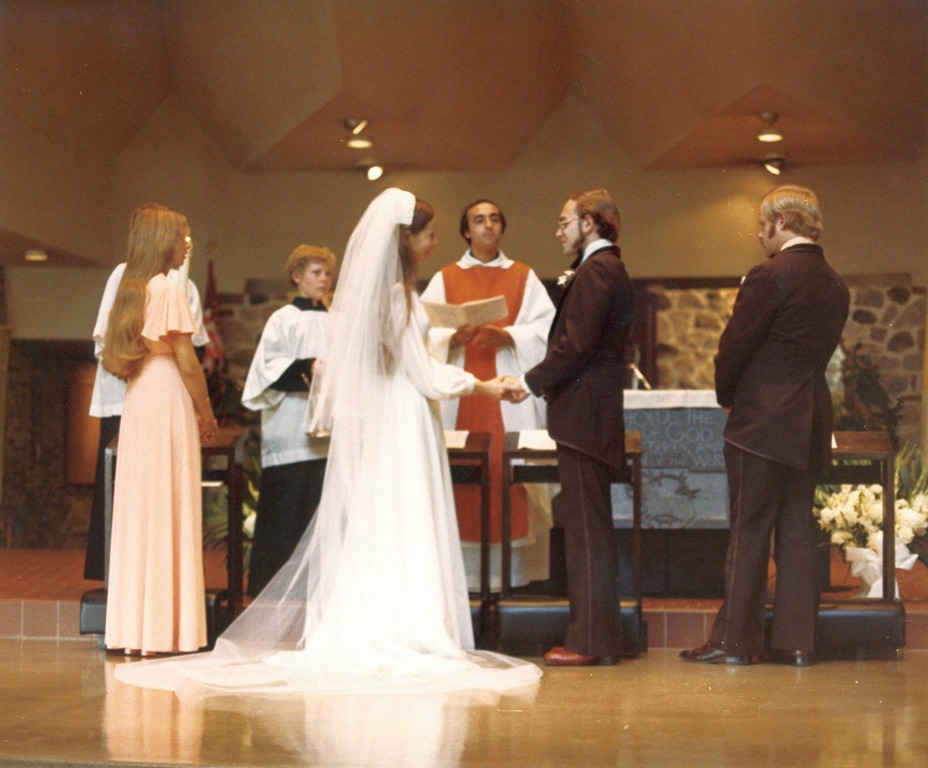
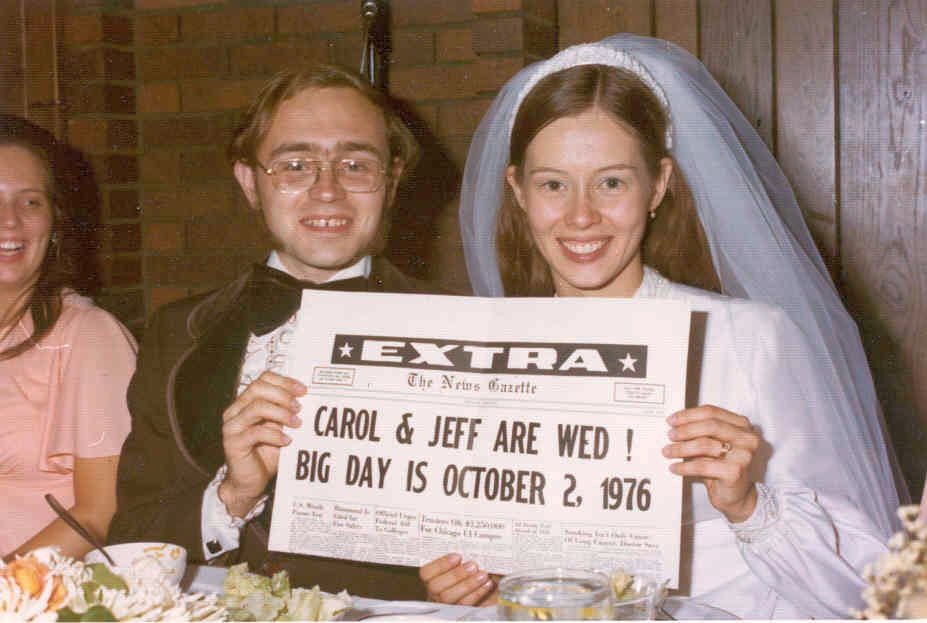
Fifty years ago today, Carol and I clasped hands at the altar of St. John Brebeuf Church in Niles, Illinois, and spoke our vows, each to the other:
My beloved, over these past seven years you have become my best friend. By these words we are one, and let this path we are beginning have no end.
I promise always to listen, for you have much to say and I have much to learn.
When there is conflict I will compromise; when there is triumph I will rejoice.
When I err I will ask forgiveness. When you ask for forgiveness I will forgive.
Let my embrace be your refuge. Your touch will be my peace.
I give you all I am, in the hope that you may become all you can be.
All of these promises have been kept, in both directions. Our secret? We met when we were young (16 and 17), and built our shared lives on a transcendent friendship that emerged slowly from conversation, respect, kindness, and a strong desire to share time and (eventually) our lives with one another. We talked, we took walks, we flew kites, we danced (she is a spectacular dancer—and I tried my best) went to movies, concerts, plays (including one that she was in!), picnics, family dinners, and had quiet evenings of conversation while the music of our vinyl albums played on the family stereo. We kissed and we cuddled, but did not let lust dominate our feelings for one another. We spoke in depth about marriage and shared lives, and in 1975 we proposed to one another on a bluff in Wisconsin overlooking the Mississippi river. It took a year to get our wedding together, but we got there, in high style.
Fifty years later, we have never been more in love, more committed to one another, and more grounded in unshakable friendship. I call friendship the cornerstone of the human spirit because it is (and has long been) the cornerstone of our lives together. Our lives continue, and we will celebrate each year that passes as we celebrate today, savoring our memories and looking forward to as much life as by God’s grace we may share, here and hereafter.
To life, love, and friendship! 50 years is only the beginning!