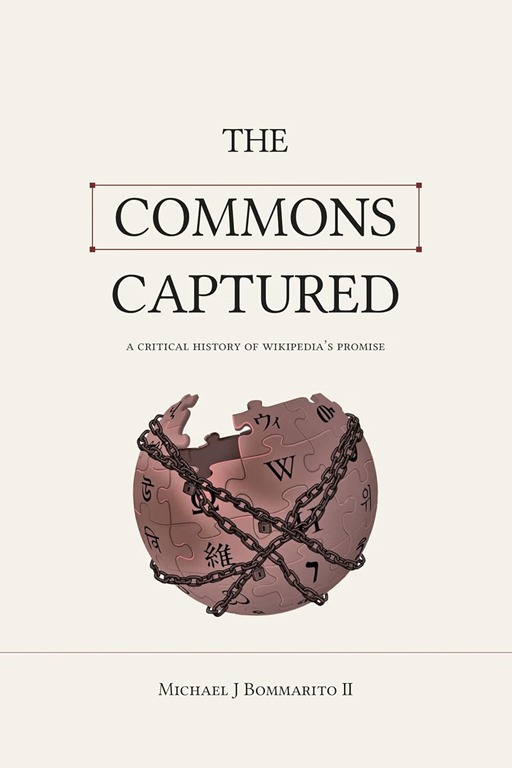
 I’ve had an eye out for a history of Wikipedia for some time, and the other day stumbled across The Commons Captured, by Michael J. Bommarito II. And yes, it does provide a reasonably detailed history going back to Wikipedia’s origins in 2001. But that’s not really the book’s focus, as the title suggests.
In addition to the history of Wikipedia, the book provides a history of what Richard Stallman created and called “copyleft:” a system of licensing that provides intellectual property for free, with the caveat that all derivative works maintain the price tag of $0.00. It’s the Creative Commons, along with ShareAlike, generally abbreviated as CC BY-SA, now at version 3.0. (See this link for details.) I released my Free Pascal from Square One ebook under CC BY-SA 3.0. From a height, this means that you can share it, pass it around, and borrow parts of it for your own projects, but you cannot sell it. This is the license that supposedly surrounds Wikipedia and its (now) seven million articles. And it worked great for over 20 years.
Then alluvasudden AI happened, and everything changed.
That’s the book’s focus: How AI took advantage of Wikipedia’s freeness, and how the powers that operate Wikipedia broke Creative Commons and licensed Wikipedia’s content to AI companies…for money.
Really. Wikipedia’s operators created the Wikimedia Foundation as a licensed nonprofit. AI tech firms had begun training their AIs on Wikipedia’s content almost as soon as there were AIs, without paying or asking permission. Hey, reading Wikipedia is free, right? So why not? Well, because the AI companies sold access to their AIs to the public for money. And having digested Wikipedia’s seven million articles, those AIs began answering questions from AI firms’ customers using Wikipedia’s content.
The Wikimedia Foundation created a licensing system that offered a license to AI firms. Many (but not all) of the AI firms paid money—big money—for the right to train their AIs on Wikipedia’s content. Granted, it takes money for servers to host something as big and as popular as Wikipedia. But the Foundation brought in way more cash from licensing AI training than it needed to keep the servers pumping.
The real bummer is that Wikipedia’s articles are written and edited by volunteers who pocket nothing for their time and effort. And none of that license money ended up in those volunteers’ pockets. None. Also, as more people hooked up with AI, fewer people went up to read Wikipedia itself.
So what’s the end of the story? Well, the story hasn’t ended. Michael Bommarito sketched out four possible outcomes of the AI licensing issue over the coming years, but he isn’t optimistic, and I won’t summarize those here. Buy the book.
What I found most fascinating was the gray haze that still surrounds the issue of what AIs store, how they store it, and whether or not training AIs falls under the legal category of fair use. Wikipedia is not copyrighted, but copylefted, so that shouldn’t matter. But…the Foundation is selling Wikipedia access to the AI firms, who sell access to their trained AIs to a (mostly) paying public. So much for copyleft.
The book is very well-written but dense, and demands close attention. I found it puzzling that the book makes no mention of Justapedia, which is a very good Wikipedia fork that I use and may someday (as time permits) attempt to write some articles for. The book does mention Grokipedia and Everipedia, though not at length. So I’ll keep looking.
But if you’re interested in the emerging legal issues surrounding AI training, this is definitely the book to read.