Jeff Duntemann's Contrapositive Diary Rotating Header Image

Daybook

Descriptions of what I did recently; what most people think of when they imagine a “diary entry.”

Taos Toolbox 2011, Part 1

SnowBearLodge500Wide.jpg

I got home yesterday afternoon, and the smoke is still coming out of my ears. I haven’t posted here recently because it was all I could do to stay ahead of the coursework and the critique. My friend Jim Strickland described it as “a 500-level course on the art of the novel crammed into two weeks.”

That’s putting it mildly.

What I’m talking about is Walter Jon WilliamsTaos Toolbox writers’ workshop, which just concluded yesterday morning at the Snow Bear Inn at Taos Ski Valley, New Mexico. The workshop was taught this year by Walter Jon Williams and Nancy Kress, with a guest lecture by Jack Skillingstead. Jim Strickland drove down from Denver Sunday morning and stashed his car in our garage, then joined me in the 4Runner for the 225 miles to Taos. I took my completed steampunk computer table, to which I had grafted the Aethernet Concentrator scant days before we left. Carrying the table, the pipe legs, the Concentrator mast, a Dell GX620 system with 20″ monitor, an ammo can full of tools, plus clothes and a cooler full of food up the stairs from the parking lot took some doing, as we were at 9,800 feet. Mountain geek I may be, but one chases oxygen atoms like fireflies up there.

SteampunkWorkstation500Wide.jpg

This is not a workshop for beginners. Jim and I were two of fourteen students, of which I was the oldest. Not one was under thirty. Most of us had already sold one or more short stories, and at least three of us have sold novels. Jim has two novels in print (plus a short Drumlins novel), and astrophysicist Alan Smale was recently nominated for the Sidewise Award for alternate history. Christie Yant is Assistant Editor at Lightspeed Magazine. One had the sense of a mass of talent around the common-room table that could (with just a few more neutrons) go critical.

For two weeks we heard lectures, took notes, discussed the issues, and presented both written and oral critiques of one another’s work. Oh, and sometimes we ate and (more occasionally) slept. When we were not at the big conference table, we were back in our respective lairs, reading manuscripts and hammering on laptops or (like me) larger iron. All told, we each read and critiqued about 200,000 words of material. It took ten days for us to loosen up sufficiently to set aside time to crack a few bottles of wine and a bottle of The Kraken 94-proof dark rum. (This was highly appropriate, as student Jeffrey Petersen had presented a novel starring a giant…flying…squid.) Walter complimented us as being the hardest-working class he’s hosted in several years conducting the workshop. We worked so hard that almost nobody hit the hot tub. By the last day, Nancy Kress herself told the class, “I am just about out of words.”

Words. It was about words. It was about making our words do precisely what we want them to do, and then getting them into the hands of our readers. It was one of the most intellectually challenging things I have ever done. I left emotionally and physically exhausted and am still catching up. It was expensive, but worth every penny. It may have rebooted my career as an SF writer.

More tomorrow.

Finished: Steampunk Computer Table

SteampunkTableLegs500Wide.jpg

Well, as much as any project is ever really finished. And with the deadline for Taos Toolbox closing in (I’m leaving for Taos a week from tomorrow) I’ve had to make some serious progress on a number of things. The table is a biggie–if you don’t have a table to write on, not much else matters, especially if it’s a writers’ workshop.

I first mentioned the project here. In truth, it looks pretty much like it does in that photo, but there’s a big difference: The 20″ X 28″ tabletop is now connected (securely) to the legs. In the July 7 photo, the top is simply resting on the legs. In addition, there were labels on some of the fittings, and one galvanized pipe tee that I’ve since changed out for brass. I’ve also added four brass caps on the ends of the legs, to allow adjustment for wobble on uneven surfaces. (Like the tile floor here in my office.)

The photo above shows how the legs are lashed up with pipe fittings. (I hadn’t added the pipe caps to the ends of the legs yet.) Yes, there are two pipe tees that have unused openings. I’m considering using them to mount a pair of thin steampunkish speakers, once I find (or build) a pair of thin steampunkish speakers. In the meantime, I may put two more 6″ brass pipe sections on them and claim that they’re handles. The reason for using tees all the way around is simple: Not all pipe fittings are precisely the same length, even though in a proper tinkertoy system they should be. A simple pipe coupling, although available in brass, is not the same length as a tee. Because there are tees in two of the legs, there need to be tees in all of them, or the legs will not be of the same length. See the photo below, which is just a still life of pipe fittings. At the front edge are a tee and a coupling, and they are not the same length, even though both are threaded for 1/2″ pipe.

I didn’t use four brass unions just to look pretty. (Not at $15 a pop!) The unions allow the tabletop to be removed from the legs, which will make things tamp down a little harder in the back of the 4Runner next Sunday. The flanges are not conventional pipe floor flanges, but TracPipe AutoFlare natural gas flanges. And that wasn’t an accident or simple good looks either, but a consequence of their length. I needed the table surface at 26″ from the floor, and the TracPipe combos plus the union, the tee, and three 6″ brass pipe sections are just about precisely 26″ long. (The caps at the ends of the legs add about 3/8″, which I can deal with.)

The finished item is shown below, with the Aethernet Concentrator tossed in for atmosphere. Much remains to be done before the workshop, but almost all of that is reading and note-taking. My first 10,000 words of Ten Gentle Opportunies has already been submitted. The Concentrator will be along at the workshop, and my updates from Taos will almost certainly go through it.

The tabletop may seem off-center, and it is: I and my legs need to be centered in front of the keyboard, with some mouse-surface to the right. The table is designed to be about as compact as would still be useful, and asymmetry, well, it appeals to me.

Now, how about a fifth flange set into the top side of the table, holding a vertical pipe section to mount the Concentrator about three feet above the table? Hmmmmm…not this week, but the idea is calling to me.

Waiting for Godot…No, Make That s-static.ak.facebook.com

Not much about this to be found online, but for the past couple of days, Facebook has been waiting eternally on one of several servers after displaying the first page of entries. The commonest address it hangs on is:

s-static.ak.facebook.com

Any thoughts about this? Chrome does the same thing, suggesting that it’s not a browser issue but a local configuration issue…except that I haven’t done anything to the router configuration or the XP network configuration for a long time.

Javascript is enabled, and unloading NoScript doesn’t help. If this doesn’t get fixed soon I’m going to simply stop reading the damned thing. Software that breaks itself without provocation is not generally welcome around here. Not for long, anyway.

UPDATE: The fix (for me at least) was to enable the MTU setting in my Linksys router and set the MTU value to 1454. That’s a sort of “golden” value that appears to be the optimal packet size on PPPoE connections. I’m still puzzled as to why this would alluvasudden be a problem  (I’ve had the MTU setting disabled and the default value of 1500 in force for years) unless Facebook were doing some tweaking on the server side.  That said, modernmechanix.com now works as well, and I had pretty much given up on it. If you have problems with Web sites hanging unpredictably, this is an easy fix (assuming your router provides the option) and should be the first thing you try.

Sampling Yesterday’s Output: Ten Gentle Opportunities

Getting back from Chicago a few days ago took a fair amount of doing: Our 8:30 PM flight did not take off until 11:45, and when we landed in Denver we called for a shuttle to the hotel. It was 2 AM, and the driver who handled such calls after midnight served a whole list of hotels. Alas, he didn’t know where ours was. He got lost. After half an hour of confused wandering around the wide empty spaces in the vicinity of DIA, a young woman in the first row of the shuttle bus looked up the hotel on her GPS smartphone, touched a button, and held the phone up in the air. The phone then began dictating directions to the hotel right out loud–and the driver, perhaps a little reluctantly, obeyed. Ten minutes later we were at the hotel, though I doubt we were asleep until 3:45 ayem.

It sounds like a story, but no, it really happened. I’ll have to tuck it away for future reference.

In the meantime, I’ll give you a sample of the novel I’m working on, a bit of whimsy involving magic-as-alternate-physics and spells-as-software. It involves a jump between a magical universe and ours. It also involves 2018-era AI, and a robotic copier factory in a town I’ll call Merriam, NY. Here’s a representative 850 words of what came out of the keyboard yesterday:

Simple Simon’s office didn’t look like an office. Simple Simon’s office did not have a desk or a chair. “Simple Simon” had not even been his original name. The space in which he worked was not fully rendered, though there were artifacts here and there, most of them gifts from the painfully earnest Dave Mirecki and the infuriating Dr. Adele Sanderson. Simple Simon removed his five-pointed jester’s cap (which had once had bells, now mercifully deleted) and hung it on the hook beside the door. The lights came up, and Simon was now officially on the job.

To Simon’s perception, his office was a pale blue ellipsoid formed of countless minute polygons, and no matter where he walked within the ellipsoid, he was always at the center of the ellipsoid. Walking was therefore pointless.

So much, so infuriatingly much of the Tooniverse was simply pointless.

Like his costume: a particolored tunic over green tights, and shoes with points that curled up over the toes he didn’t have. They could have dressed him in a business suit like the managers wore, or (better) a polo shirt and khaki slacks like Dave. There had been a time, a comfortable, reasonable time, when he had been an unrendered polygon model like the Kid-until Dr. Sanderson began speaking of “resonances” and “human interface friction.” Dr. Sanderson was not the author of his archetype–that had been Dr. Emil Arenberg, founder of Zircon’s AI division and architect of its AI technology–but rather his Human Interface, what in older times was called his “skin.” She looked at his job, and declared him a jester. It was a metaphor, and wrong, at that. But nobody dared tell her that she was wrong, so they made him look the part.

On the wall hung a framed image containing three words:

Be the metaphor.

It was Dr. Sanderson’s slogan, and (evidently) a direct order. Simon resisted the order with all his might. He was not a jester.

He was a juggler.

“Thirty minutes,” said the Shift Clock. Simon nodded, and took a step backwards. He didn’t move, but the step was significant: All around him on the inner surface of his ellipsoid, Windows appeared and illuminated. Some were Windows to the desks of the humans who supervised the assembly floor, and the engineers who had designed it and were constantly perfecting it. Not all Windows were open. Dr. Sanderson’s was (mercifully) closed, as was Mr. Romero’s. (Ditto.) Dave was there, and waved to him. So did nine or ten others.

Most of the Windows were views of the Floor. 90% of Building 800 was a cavernous hall filled with industrial robots. There were seven-hundred fifty-seven robots in Building 800. Simon knew them all as though they were extensions of his own mind-which they were.

The boundaries between his mind and the building were “soft.” Simon leaned his head back slightly, and relaxed. The optical network channels opened to receive him, and he slipped into them, sending his awareness out to control hubs all over the building. At his touch, each robot on the assembly floor came to fluid life, testing the quality of its communication and the limits of its motion, all the while diagnosing its own condition. Each returned a status to Simon, and with each status signal Simon felt himself growing more and more complete.

The welders pivoted their laser heads down toward their testplates, and fired. Sensors measured the strength and purity of their beams, and responded. Parts bins vibrated and checked for the presence of parts in their chutes. Hydraulic drills spun up and down again, indexing forward and back.

He felt them self-test. He felt them reply. He became one with them. Ready. Ready. Ready. Ready…Ready!

Most critical were the Positioners. Nearly half the robots on the Floor did not wield lasers or wrenches or drills. Their job was to move assemblies and ultimately finished copiers around the Floor. At one time this had been done with motorized rollers and belts. No more. The Positioners were arms, with exquisitely controllable wrists and hands. The hands were coated with foam and equipped with hundreds of minute pressure sensors. Some were only inches wide. The largest had grips six feet across, on hydraulic arms as thick as a human’s thigh.

Together, they implemented Transfer Over Separated Spaces. Parts, assemblies, and finished copiers were not rolled around the building. They were thrown, on minutely calculated paths, each path computed and timed so that a part would arrive precisely when needed, with a Positioner’s hand opened to grip it, slow it, and then hand it to whatever device required the part to continue the assembly process. With the Floor running at full speed, as many as five hundred separate objects were in the air at once. Every single one of them was thrown, and tracked, and caught by the GAI Simple Simon, Factory Automation Real-Time Supervisor.

Simon’s smile broadened as the last of the robots responded. Jester, no way. Juggler, yeah.

Uncle Jeff Tricks

Katie-Julie-06-13-2011.jpgTricks? Oh…one of them is that I just disappeared for a week, but I’m now back, having spent five days tending small girls while their parents took a much-needed jaunt to Las Vegas for the wedding of a close friend. Carol and I kept Katie and Julie fed and entertained and (mostly) happy, which is no small feat. We have never had children. We don’t have any real kid experience, especially with girls. We spent plenty of time with our nephews at the same age 20-odd years ago, but boys are…different.
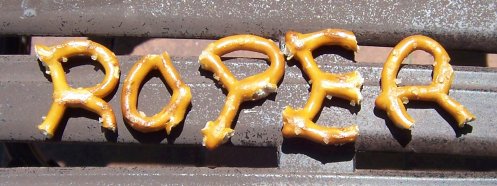

We did our best. A lot of it comes down to devising Uncle Jeff Tricks that interest them for more than a few minutes. I had some success there. Trick #1: The three of us sat on a blanket on the grass in the backyard for some time, eating pretzels. Julie evidently feared that I would starve, for each time I crunched down a pretzel she kept handing me another. Never willing to let a learning opportunity pass by, I began biting portions off the pretzels and making them into letters.

“What’s this say?” I asked Julie, holding up a suitably mutilated pretzel. (Katie is now four and a half, and has her letters down cold.)

“R!” shouted Julie, obviously delighted. I put the pretzel down. She handed me another. I nibbled off a different set of bits, and held it up.

PretzelRoper500Wide.jpg

“O!” she shouted, giggling. And so it went. Soon I had spelled their last name out in multilated pretzels. (See above.) That “E” was a bitch. I ended up eating ten or twelve before I got one that E-ified without crumbling into loose punctuation.

JulieAndPullup300Wide.jpgTrick #2: I tried to use the large population of balls in the backyard to model the Solar System. The colors were wrong, but I got the sizes in the ballpark–right down to a slightly greenish tennis-ball Moon for the Earth. Alas, before the lecture began Julie decided she wanted to play planet-soccer, and whap! Uranus got kicked down the gravity well into the bushes. To celebrate, our junior niece ran into the house and came out a minute later with a (clean, whew!) pullup on her head. This was not an Uncle Jeff trick. Really.

Trick #3 worked out a little better, especially for Katie. I poked around the edges of the yard until I found a reasonably intact maple seed from last year’s crop, and tossed it into the air. The girls had doubtless seen them spiraling down from the trees the previous fall, but hadn’t yet hit upon relaunching them. I explained that to work the seeds must be intact and complete (the squirrels eat the seeds and leave empty wings that don’t fly well) and challenged them to dig around the yard to find a special seed that flew better than all the others.

Julie was stumped, so I handed her the one I had picked up and launched several times. Katie, however, ran and got a Jewel grocery bag and spent the better part of half an hour walking around the yard, singing a song to herself while picking up any flyable maple seeds she could find and stuffing them in the bag. I’m not sure many seeds got launched, but trust me, there won’t be any new maple seedlings in the yard this year.

Katie did pick a favorite, and she’s holding it in the photo above.

Trick #4 fell flat: I tried to teach them to make grass whistles. This was a stretch, and they don’t (yet) have the manual dexterity to hold a blade of wide grass between their thumbs in such a way as to make the monumentally irritating sound that grass makes when blown on just so. Katie, frustrated, decided to simply imitate the whistles I was making with a blade of grass, and Julie soon joined in. They are excellent mimics. The two of them sat screeching along with Uncle Jeff’s blade of grass until the blade disintegrated and the two of them got bored. I imagine the neighbors were grateful that grass is as flimsy as it is.

Herding girls is hard work, and it took a day or so for the two of us to fully recuperate. I expect to be back at full vigor tomorrow, and need to be flailing at Ten Gentle Opportunities in a very big way. I’ll let you know how it goes.

A Compact Steampunk Computer Table

SteampunkComputerTable2-500Wide.jpg

Here’s a recent project of mine that isn’t quite finished yet, but it’s a beautiful illustration of why I love pipe fittings. I’m attending Walter Jon Williams’ Taos Toolbox writers’ workshop in July, and I needed a compact computer and a small table to set it on. The computer is hiding behind the 20″ LCD: It’s a Dell Optiplex GX620 USFF (below), stuffed to the gills and tricked out right.

GX620USFF.jpgThe table is entirely my own design. I had the Unfinished Furniture Warehouse here in Colorado Springs make me an oak tabletop 20″ X 28″, stained to match the woodwork in my office. Back in 2006 they built my primary computer table, and did a wonderful job of it. Ditto this project. The legs are all standard pipe fittings and standard lengths of 1/2″ pipe, as many in brass as I could find. I’m short one brass tee (and some of the fittings still have label cruft on them) but that’s an hour’s work to fix.

Why bother? I’m very particular about the height of my keyboard relative to my chair. I like to be slightly above and look slightly down at my monitor. Having to look up even a little kinks my neck and gives me splitting headaches. Experimentation years ago showed 26″ to be an almost ideal surface height, at least when using one of my treasured Northgate keyboards, and that’s what I did here. The four brass unions in the legs add 2″ to the table height, which would otherwise be 24″ and a hair low. The unions also allow the legs to be easily removed from the tabletop for transport in the back of the 4Runner, as they will next month.

I couldn’t find copper or brass threaded pipe in sections longer than 6″, so there will be some galvanized iron in the final product. I may buy a buffing wheel and shine the hell out of the zinc, and in the end it’ll definitely be a striking piece. Best of all, it didn’t take a huge amount of time to do, compared to some of the boggling steampunk craft creations you see online. I’m trying to see if I can finish a novel a year for the next several years, and that will require not spending a huge amount of time on unnecessary refinement. Pipe fittings are steampunk Tinkertoys, and I was good at Tinkertoys. I’m also good at pipe fittings, and it was a fine thing to find myself elbow-deep in them again.

Sampling Today’s Output: Ten Gentle Opportunities

Having gotten stuck on The Everything Machine a couple of days ago, I went back to my whimsical novel of magic-as-alternate physics (and spells-as-software), Ten Gentle Opportunities. Sales of my 99c ebook fantasy novelette “Whale Meat” (epub) have been unexpectedly good. You guys want magic? I give you magic: object-oriented magic. Oh, and zombies. Gotta have zombies these days. Here’s a snippet from this morning’s work, which comes immediately after the short piece I posted last Halloween:

Styppkk’s snerf-sense brought him fresh indication that Jrikkjroggmugg was hard at work on something on the other side of the wall. The angry Adamant had his number by now, and would not use any cheap stock spell that could be subverted by a mere Hkkrr.

Quickly, then! Using his left pinkie as a lamp, Styppkk dumped both the material and immaterial contents of one of his many pants pockets on the ground. A zombie activator: basically a quarter of a prtynytty, ground fine and mixed with some blood, bile, and toad stool, all rolled into the payload of a small black-powder bottle rocket. A packet of obedience dust clipped to a packet of etheric intelligence booster might also be useful, assuming the trigger spell wasn’t broken. (Always a risk when you bought cheap magic at Shazam’s Club.) A reputedly unreliable can of generic zombie repellant rounded out the kit; next time he would pay another bkk to get real Zom-B-Gone, and worry less.

Styppkk stuck the little rocket’s bamboo tail into the eyesocket of a nearby skull and struck a match. After a moment for the very short fuse to sizzle, the activator rode a little arc of fire four or five cubits into the noisome air. With a quick pop! it burst, scattering its foul-smelling dust in every direction. Styppkk ran out toward the center of the lychfield, rubbing his hands in anticipation.

Through the twin daggers in the visor of his iron helmet he watched the process begin: little glowing wisps twisting and darting in short motions synchronized to the unheard but deeply felt double beat of the World Heart. Twist-twist and pause, dart-dart and pause, descending and flowing into the stiff bodies lying everywhere around him.

He watched them shudder and stretch, gathering limbs beneath them and shoving away from the ground. The odor in the air changed from the dull, dank smell of stagnation to the sharp reek of rot. In waves radiating out from the center of the lychfield they stood, staggered, and scratched their heads. Those that still had noses raised them, turning to follow the strong scent of magic that surrounded Styppkk. Step by shambling step, they lurched toward him.

Styppkk gave himself a few quick schpritzes with the bargain-bin zombie repellent–head, crotch, and armpits–in case things got a little too cozy. He then picked up a sit-by-nellie spell from the pile of oddments at his feet.

“You guys need something to do,” he said aloud. The spell seemed reasonably well-made and certainly strong enough, somewhere past yellow if not quite green. Styppkk cranked the range up as high as it would go, poked the repeat-until-break spot to set it, and then hit the trigger.

Tapping his teeth together to keep the beat, Styppkk began a hoary old folk dance he’d learned at his cousin’s wedding years ago: Hands out, hands flipped, hands on hips, hands behind head, wiggle butt, jump and turn 90 degrees. All around him the newly animated zombies imitated his every move. He went through it a second time (more slowly, to go easier on decomposing limbs) and then, spinning his middle finger for emphasis, poked the segno.

The auto-arrange property of the spell worked beautifully: In perhaps a score of beats the zombies had spaced themselves equally into a perfectly rectangular constellation of wiggling, writhing doom.

Styppkk had the cover he needed. It was now Jrikkjroggmugg’s move.

A Steampunk Aethernet Concentrator

Concentrator500Wide.jpg

Those who tuned in to my March 18, 2011 entry will recall that I spotted a Star-Rite copper parabolic resistance heater at a consignment store, and brought it home thinking it would make a good Wi-Fi antenna. I put a proof-of-concept lashup together last week and found that it worked very well, even though its diameter is on the low side for 13 cm microwaves. I spent half an hour or so digging through my several bins of odd plastic looking for just the right center insert, and stumbled on a pill bottle that ProbeExposed200Wide.jpgactually pressure-fit into the center hole without any modifation of the bottle or the center hole. (This may seem remarkable if you’ve never seen the quanity of pill bottles and other odd plastic (s)crap I keep out in the garage.)
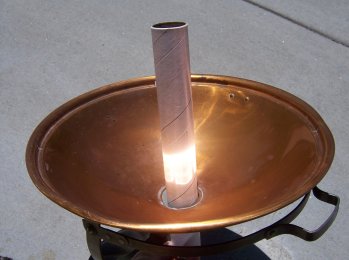
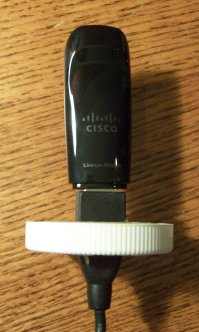
The Wi-Fi element is a Cisco AE1000 USB 2.0 Wi-Fi adapter, connected to the PC through a 3′ USB extension cable. The female end of the extension cable is glued into a rectangular hole I made in the pill bottle’s white lid with a nibbling tool, and the AE1000 plugs into the adapter cable.

Even with the number of pill bottles I have, finding this particular bottle was a huge break. I still have to figure a way to get the probe fastened into the hole by something better than friction, but that’s just engineering. The bottle works extremely well for another simple but fortuitous reason: It puts the long axis of the AE1000 right where the focus of the copper parabola falls.

I tested for this out in the driveway in an interesting way: I pointed the parabola at the Sun as closely as I could, and then stuck a paper towel tube into the center hole to see where the sunlight would be most intense. The strongest part of the focus is about 3″ from the bottom of the bowl. (I didn’t leave the paper towel tube at the focus for very long, trust me.) This is just about where the AE1000’s antennas sit, if its interior construction is anything like the USB Wi-Fi dongle I sacrified some years back to see how it was done.

FocusTest350Wide.jpgFor as lucky as I got, the position of the adapter isn’t especially critical. We’re not trying to create an image or even intense heat. We’re just trying to concentrate a distant microwave signal on the AE1000, and focus the signal that it emits into a narrower steerable beam. Nor am I going for moonbounce–the real mission of the device is to make sure I can get into the resort Wi-Fi access points when I’m at the Taos Toolbox writers’ workshop this summer. That always depends on where your room is relative to the access points, and in the past, I’ve pulled rooms in dead spots about two throws out of five.


Well, not this time.

Jim Strickland suggested calling it an Aethernet Concentrator, and so it is. (The name of the Wi-Fi adapter is peculiarly appropriate.) I’m not entirely finished yet. I need to paint the pill bottle so that it looks less like a pill bottle, and the copper bowl needs cleaning and polishing generally. But I’ve already tested it, and it increases the strength of my access point downstairs radically. Aiming it up and down the street from here at my desk, it detected nine APs that the naked AE1000 didn’t see plugged into the back of my GX620. (I call this “warsitting.”)

I’m going to do a larger article on the project once I tie the ribbons on it, and I’ll let you know where to find it when I do.

Now Available: Copperwood Double #1

Copperwood Double #1: Drumlin Circus and On Gossamer Wings

I am pleased (and you wouldn’t believe how relieved!) to announce the availability of the first Copperwood Double, Drumlin Circus / On Gossamer Wings, in both print and ebook editions. The ebook edition is available from Amazon’s Kindle store in mobi format, and from B&N in epub format, both at $2.99. No DRM in either case. And because there’s no DRM, you can download the free app Calibre and use its excellent conversion utilities to convert mobi or epub to any of several additional ebook formats. The print edition is distributed through Ingram/Lightning Source and is thus available from online retailers who work with Ingram, which would be basically all of them. $11.99. (Note: The print book is not available from Lulu.com. This was a major decision that I’ll talk about in a future entry.)

If the cover image above seems bizarre to you, well, you’re younger than you look. The grayhairs among us know precisely what I was reaching for: The Ace Doubles of the period 1952-1973. Each volume consisted of two short novels from 25,000-50,000 words in length, bound back-to-back and inverted, each with its own cover image. Ace did not invent the physical print/bind arrangement, which is called tete-beche (head-to-tail) and has existed for almost 200 years. They did make it a mainstay of recreational reading for two decades, and most of us back then had a pile of them.

A lot of people thought it was a weird idea (and many made fun of it) but we forget that the short novel as a form essentially vanished from SFF after Ace stopped publishing doubles. The magazines won’t publish something 40,000 words long, and 40,000 words is too short for a conventional print book unless you’re way out there in small and very small press. So there was this huge hole between 20,000-word novellas and 80,000 word novels. I fell into that trap in 1981, when my Firejammer clocked in at just under 30,000 words. I shopped it, but unless you’re Larry Niven no one’s going to seriously look at something that length.

I like the short novel as a distinct literary form. It’s long enough to develop some ideas and a few interesting characters, but short enough to require a certain focus, and a fairly linear plot line. It deserves to have a place in the SFF world, and two recent developments have conspired to give it one: ebooks and print-on-demand publishing. Ebooks have no strong length requirements, and from what I’ve read, the length of original ebook novels is drifting downward. More to the point, a story can be given the length it needs, and authors aren’t under pressure to pad an idea out to print novel length, or compress it to magazine novella length or less.

Print-on-demand publishing allows publishers to try interesting things without betting the house on the outcome. I will always love print books and still buy them in respectable quantities, but in these troubled times print publishers must be conservative to avoid going broke. (Do I know a little bit about that or what?) The beancounters require that a book recoup its capital costs, which means that books hover within certain boundaries set by retailer expectations. (Remember that if retailers won’t stock a book, customers never get the chance to vote on it. Retailers therefore have what amounts to a veto on print publisher publishing programs.) Slightly whacky things like tete-beche double novels fall outside ordinary bricks’n’mortar retail channel expectations, but POD manufacturing and online ordering make a lot of things possible.

So I offer you a book with two covers, and two authors telling two stories in one world, the Drumlins world that I introduced in Asimov’s back in 2002 with “Drumlin Boiler”. There’s much more to say, and I’ll continue the discussion (with specifics on both stories) in days to come.

Dell’s USFF Internal Amplified Speaker

DellMiniSpeaker.jpgI bought a Dell Optiplex GX620 USFF (Ultra-Small Form Factor) machine last week, and it came without an internal speaker. I didn’t know the speaker was optional until a machine turned up without one, but a look at my three SX280 USFF machines (built in exactly the same case) showed a very small plastic unit that pulls easily out of the chassis when you lift a plastic tab. It’s wired to the mobo through a conventional 4-pin header. And most interesting of all, it has circuitry on its back.

A look through a loupe showed four solder pads (on the left in the photo above) labeled P5V IN, SPK DET, GND and AUD MONO. These correspond to the red, white, black, and green leads respectively. It took me ten minutes to lash up a test on my Heath ET-3200 breadboard. With 5V on the red lead, common on the black lead, and some sine wave from my audio generator on the green lead, that one tiny little doodad filled the shop with an 800 Hz tone.

I’m pretty sure the SPK DET lead allows the computer to know if there’s a speaker in place; my VOM shows it tied to ground. The IC is almost certainly an LM4871 1.1W audio amp. The National Semi logo is on the chip, and the printed number is RA4871. The Dell part number for the assembly as a whole is Y2298.

I needed to order one for the GX620, so I ordered two, and if I need a subminiature speaker amp for a project, it’ll be in the drawer with my other small speakers, ready to go. $2.69 at the CompuFlea eBay store.