- Jim Strickland sent word that Lindsay’s Technical Books is shutting down next year, not for financial reasons but simply because Lindsay is retiring. Their last print catalog has been sent. Order the stuff you’ve been procrastinating about for years–I will be. (Recommendation: Radio for the Millions.) Tip for those who haven’t heard of him before: Lots of steampunk-pertinent do-it-yourself there.
- Amazon can wipe any Kindle it wants to, anytime, without telling you. We’ve known this since the 1989 dustup over the rights to Orwell’s 1984. It’s still a risk, and you can trigger it by trying to sneak around region restrictions. Now, Ars Technica explains how to keep what you’ve bought by removing the DRM. I object to region restrictions in digital content because it makes piracy a safer way to acquire content. Don’t train your customers to be pirates. When are we going to learn?
- I knew this, but not in detail: Kodak had a working digital camera prototype in 1975, and it used a casette tape to store photos–which took 23 seconds per photo. Here’s more on the device from the man who invented it.
- If that sort of thing intrigues you, here’s the motherlode.
- In case you’ve never actually seen it (I hadn’t) here’s where you can stream the video of Doug Engelbart’s prophetic (to put it mildly) Mother of All Demos, during which he showed how a mouse could be used to help with various computer tasks like word processing.
- I bought the original Microsoft Mouse in 1983 and still have it. It still works. It had better, as I paid $200 for it.
- The placebo effect may be genetic–which is a far less significant question than how the hell it works to begin with.
- The first mirror for this telescope has now been completed. The finished telescope will have seven of them. I struggled to grind, polish, and figure a ten-inch mirror when I was 15. This helps me put the whole thing in perspective. Wow.
- Slate seems to think that humans would win fights with Neanderthals. Having seen a number of skeletal and muscle reconstructions of those gnarly guys, I tend to doubt it. Why, then, did they go extinct if we didn’t kill them? My guess: They killed each other. Why do I think that? I read human history and anthropology.
- You can now buy a brand-new, reinforced and factory rustproofed body for a 1940 Ford Coupe…from Ford. If they made an AWD minivan I’d already have one. Here’s hoping.
astronomy
Odd Lots
Odd Lots
- I’ve installed Lazarus 1.0 without mayhem, and have created a few simple programs with it. So far, no glitches. My recommendation is still cautious. Nonetheless, I’d be interested in hearing other people’s experiences with the new release.
- Carmine Gallo wonders why more people aren’t doing image-rich PowerPoint presentations. Um…it’s because drawing pictures is way hard compared to writing text. Why is there no mention of this either in the article or in the comments?
- Here’s a great timesaver: Instead of making political posts on Facebook, point to this. Done! Effortless! (Link courtesy S. Hudson Blount.)
- And if that doesn’t work for you, this may. (Link courtesy Jim Mischel.)
- I guess the evidence is piling up: It’s time to stand in front of the bathroom mirror and ask yourself: Does this political opinion make my head look small?
- I’m glad that somebody else besides me noticed that The Atlantic came back from the dead mostly by publishing articles calculated to raise people’s blood pressure. I was a very satisfied subscriber back in the 90s and early oughts, but I suspect now that I never will be again.
- Don’t believe what the MSM says about volcanoes. Or about DNA. Or maybe anything else.
- Maybe we can give them (the MSM) something for Christmas this year. And then tell them to put a sock in it.
- The article I mentioned in my September 8, 2012 Odd Lots about transistor radio manufacturers tacking unused transistors onto their circuit boards to up the transistor count was in fact “The Transistor Radio Scandal” by H. M. Gregory, in Electronics Illustrated for July, 1967; p. 56. Some manufacturers used transistors for diodes, which was maybe half a notch better. The article includes some mighty weird schematics, too. Worth digging for, if you have piles of old mags somewhere.
- If our understanding of solar physics is accurate, sunspots might become impossible (at least for awhile) by 2015 or 2020. (Full paper here.) The magnetic fields that create sunspots have been getting weaker by about 50 gauss per year for some time. Field strength is now at about 2000; once that value hits 1500 gauss, some research suggests that sunspots may not form at all. This is not new news, but it’s interesting in that it’s a bit of poorly understood science that most of us will live to see confirmed or falsified. At any rate, I’m guessing we will not be working Madagascar on half a watt into a bent paperclip again for awhile, as the late George Ewing WA8WTE used to say.
- I’ve identified a new trigger for Creeping Dread: Hearing the fans incrementally rev up on what was assumed to be an idle computer.
Odd Lots
- I didn’t know this until the other day: The instrumental riff in ELP’s “Touch and Go” is not ultimately from Ralph Vaughan Williams’s “Variations on Greensleeves.” It’s a far older folk melody called “Lovely Joan,” and the song is about a girl who, when asked by some aristocratic lout to hand over her virginity in exchange for a ring and a roll in the hay, keeps her virginity and steals his horse instead. Much better deal.
- Here’s a tool to see if your email was on one of the 400,000 accounts recently leaked from Yahoo.
- One of the big downsides of the ASUS Transformer Prime is that the micro SD card pops out of its slot very easily. I found mine on the cushion of my reading chair the other day, and have no least clue how I managed that, apart from sitting there and looking at some weather maps. I’m evidently not the only one with this problem.
- I haven’t been over to The Consumerist in some time, but when I tried to go there the other day, Google marked it as an attack site. There’s not much to go by in Google’s details page, but it looks like an ad vector. This is why I use AdBlock Plus. (I went there from Linux and nothing bad happened.) UPDATE: They fixed the problem. Lesson: Nobody’s immune. Use AdBlock Plus.
- Be sure to watch for auroras tonight, as far south as (I hope!) Colorado. Look east just before dawn and you’ll catch Jupiter, Venus, and maybe the crescent Moon.
- A ride-em Iron Trilobyte! Yee-hah!
- From the Utterly Obscure But Brilliant Music Department: Hunt down “The Last Farewell” by the New Christy Minstrels, from their ambum Ramblin’ (1964.) Bone-chilling harmony on the ancient melody “O Waly, Waly.”
- From the Found Quotes Department: “It is all but impossible to sit quietly by while someone is throwing salad plates.” –James Thurber
Sic Transit Gloria Veneris…
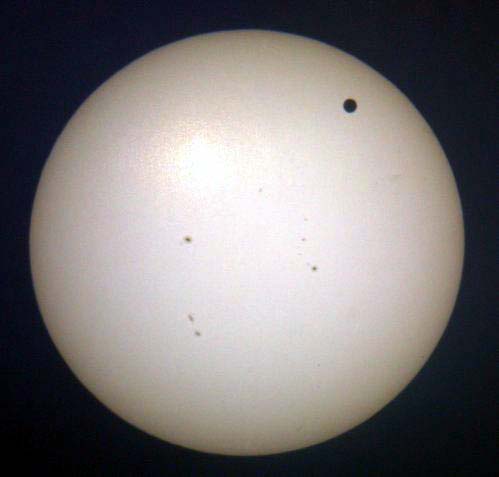
…for another 105 years. By 2117, I’ll be heavily involved in other pursuits and may not be able to watch–but man, did we get a show this time!
Catching any short-lived astronomical phenomenon always involves a strong measure of luck. In 1972, seven friends and I drove 1200 miles to Cap Chat, Quebec, to see a total solar eclipse. We brought out the big guns–my 10″ telescope looks superficially like a big gun, and took a little explaining at customs both coming and going–but alas, two hours before totality the clouds rolled in. We had the novel experience of watching the umbra hurtling toward us by the darkening of the undersides of the high clouds, but of totality we saw nothing.
Luck, yeah. While planning for the event I noticed that my sister Gretchen’s back yard has a near-optimum line-of-sight to the place on the NW horizon where the Sun would set on June 5, 2012. Her lot fronts on a large open space running roughly E-W, with high-tension lines and their towers the only significant obstruction. Given that my western horizon is a 9,800 foot mountain and I see granite up to about 35 degrees, Gretchen’s back yard seemed flukily ideal.
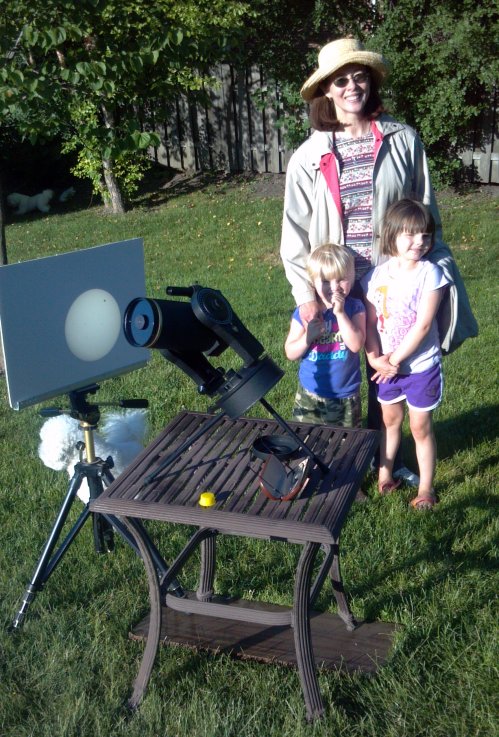
So there we chose our ground. (Without hawks but with hounds–sort of–and elves be damned.) The instrument was my Bausch & Lomb Criterion 4000 suitcase scope, which has gone on a number of expeditions with us, including two total solar eclipses and Halley’s Comet in 1986. The technique was what I generally do for solar observing: project an image on a piece of foamcore supported by a separate tripod. The image at the top of this entry was a shot of the foamcore, taken with an ordinary and slightly ancient Kodak V530 pocket camera.
I logged first contact at 5:05 PM. Second contact (when the trailing edge of the disk of Venus enters the disk of the Sun) came at 5:22 PM. After that it was the long slow crawl of Venus downward (on the foamcore) as the Sun slowly set in the northwest. Gretchen’s girls thought it was interesting, and before the transit I showed them how the telescope brings in a magnified but inverted image of things far away, like a 55-gallon trashcan across the open space. I’m sure they didn’t completely understand what was going on, but as with all Uncle Jeff tricks they did consider it a lot of fun.
The weather was nothing short of astonishing: high 60s F, light breeze, crystal blue skies down to the horizon. So it had been the whole day, and so it stayed every minute until the Sun vanished behind some trees at 8:03 PM. I got a lot of good photos, considering that the photos were of an image projected on cardboard. Toward the end of visibility, the scope was directed square across the approach to O’Hare Field, and five, count ’em, five jet aircraft crossed the disk of the Sun while we watched. The exhaust from the engines, though invisible directly, distorted the solar image in an interesting way.
Fifteen minutes before the Sun vanished, it passed behind one of the high-tension towers across the open space, allowing me to fiddle the focus a little and get some remarkable shots, like the one below:

Gretchen made one of her trademark pot roast feasts, with Yukon Gold mashed potatoes almost the color of the solar disk. (A dollop of real butter yellowed ’em up gorgeously.) Dash and QBit ran around in circles, chased balls, and slept like rocks last night. As did we all.
Success just don’t get any more successful than that.
Odd Lots
- In the wake of the recent eclipse, the best photo I’ve seen: One ring to woo them all!
- Although we missed seeing the thin crescent Venus on Sunday night, I saw it again last night (Monday) and through a 12mm Plossl it was spectacular. Probably the thinnest crescent I’ve seen in 25 years. You can discern the “horns” of the crescent easily in good binoculars. It’s quite close to the Sun now and getting closer all the time, but if you can catch it immediately after sunset you’ll have a good chance for the next several days.
- And if you’re into crescents (I have a drawer full; whoops, wrong category) tonight just after sunset you’ll be able to see a very thin crescent moon right beside that very thin crescent Venus. Go get some lemon crescent cookies from Maggiano’s, pour some iced tea, and watch the crescents set in the west. Life is good.
- Time to admit it: I pulled the trigger (finally) and bought an ASUS Transformer Prime TF201 tablet, plus its brilliant keyboard/battery/port extender/charging dock. I’m still studying it and testing it, and will report in detail later on.
- Cell phones are not the same UI challenge as tablets, and there’s a site listing tablet-friendly apps for Android. I’ve been cruising it a lot the last few days. Some good stuff in there.
- TV numbers are imploding across the board. The NYT is muttering something about “nonlinear viewing,” but I think NPR has it right: People are getting wise to the fact that they’re paying $150 a month for overripe weasel manure. What all those people are doing instead is obscure. Dare we hope…books?
- Maker Jeri Ellsworth rocks. And what makes her rock is the wonderful gizmo she rocks on.
- As this article suggests, I had forgotten about ReRAM, thinking it was yet another oddity that would never escape the labs into real products. I guess being 10,000 times faster than Flash memory got somebody’s attention, along with the fact that CPUs based on the technology are possible, if still perhaps a ways off.
- Why are so many of the world’s collection of leaning towers in Italy?
- Here’s a good illustration of why I rarely take “medical studies” seriously anymore.
- Everything else has been built out of Lego. Why not the Nine Circles of Hell? (Thanks to Bruce Baker for the link.)
Eclipse Wrapup
By four PM yesterday I knew we were in trouble: The western sky was overcast, and weather radar showed various precipitation clouds squirming around in our line of sight to the western horizon. However, the scope and the folding chairs were already packed in the back of the 4Runner, so on the outside chance a miracle might happen, we put QBit and Dash in the back seat (Aero and Jack don’t like crowds of admirers as much) and steamed six miles east to St. Raphael’s Episcopal Church.
We had announced the event at both morning services, and several of our fellow parishioners were waiting eagerly for us as we got there about 5:30. I chose a spot in the parking lot to maximize western coverage, then stood around talking to our friends with one eye on the sky. Well, call it miracles or just call it a side benefit of chaos (in the rigorous sense, as the math that governs complex systems like weather and climate) but a little before six the sky in the northwest started to clear.
With a little help from fourteen-year-old Fred Jones (below left) I got my vintage 8″ vent-pipe junkbox scope (details and better photos here) set up in record time. We put it in the wind-shadow of the 4Runner, and while I adjusted the optics Fred went and got some additional folding chairs from the parish hall. By then a few more people had arrived, and by 6:15 we had a small crowd of chairs in a half-circle around the scope and its foamcore screen.

The skies were not great. We had runs of clear air and runs of dense cloud. While it was clear I pointed out the several sunspots, and at 6:24 Fred announced that there was a flat edge to the Sun’s image at the bottom of the screen. We had a chance to see that flat edge grow to a small scallop before the clouds closed in again.
At about 6:45 it cleared up, and for over half an hour we actually had a decent line on the Sun as the Moon took a greater and greater bite out of it. The coolest event of the evening happened so quickly that only a few of us caught it: A jetliner clipped across one of the horns of the sun’s roughly 50% eclipsed disk. Remarkably, Dianna Jones was taking a video of the foamcore screen when it occurred, and she’s going to try and fish out the frame or two of the plane’s passing when she goes through the video on her PC.
 We had a decent view up to about 65% or so coverage, when the clouds closed in what turned out to be for good. In the meantime, there was a profound weirdness: A southeast wind blew light rain out of clouds that had already passed over us, and even though it was (mostly) clear from well east of the zenith to the Sun, we watched the best part of the eclipse in the rain. As God may well have been telling us: “Here’s your miracle. Just don’t get cocky.” And to seal the deal He gave us an intense double rainbow. What does it mean? It means we didn’t mind getting a little wet, we laughed, and we all had a wonderful time. (I threw my jacket over the most vulnerable portions of my scope.)
My emphasis was not to take great photos but to make the eclipse accessible to people who would otherwise have to be content with a few shots on TV. Our friends were able to walk right up to one side of the foamcore and see the umbrae and penumbrae of sunspots on the image. Most snapped their own pictures of the Sun’s disk, and we talked about things like heat distortion at the edges of the image (because the Sun was very low in the sky) how reflector telescopes differed from refractors, and much else.
I had hoped to catch the crescent Venus after sunset, but by then the western sky was solid clouds. We packed up and went home. I still call it a great success. After all, in 1972, a group of my friends and I drove 1400 miles from Chicago to the mouth of the St. Lawrence River for a total solar eclipse, only to be clouded out a bare hour before totality. Carol and I have seen two unobstructed total solar eclipses since then, including the “big one” in Baja in 1991. Two out of three ain’t bad.
Next stop: Grand Island, Nebraska on August 21, 2017.
Ready for the Eclipse

I put the 8″ scope together on the driveway to make sure nothing was amiss (and to be sure I could find all the parts) before packing the whole thing off to the parking lot of St. Raphael’s Episcopal Church. Observing the eclipse where I live is impossible, because I’m on the eastern slopes of Cheyenne Mountain, which rises almost 30 degrees above the western horizon. Today’s eclipse will occur while the Sun is setting here in Colorado Springs. In fact, even with a perfect western horizon, the Sun will set before the eclipse is fully past.
The church is almost seven miles east of us, and while there will still be mountains on the horizon, they will obstruct nowhere near as much of the sky as they do from my driveway. It also becomes an opportunity to have parishioners who may be interested come out and see what of the eclipse can be seen from here. The full annular eclipse will be visible from Albuquerque, about 250 miles south of us. We’d considered heading down for it, but there’s just too going on in our lives right now to spare the time.
The projection screen is simple Hobby Lobby foamcore attached to a length of aluminum angle stock with a 1/4-20 threaded hole at its center. I had to crank up my tripod almost to its vertical limit to get it to catch the image of the noonday Sun. The eclipse here doesn’t begin until 6:27 PM, when the Sun will be a great deal lower in the sky. Maximum coverage is about 7:30. The Sun sets here at 8:09.
Of course, all of this assumes that it will be clear later this afternoon. There are a lot of big puffy cumulus clouds up there now, and we had a thuderstorm here yesterday evening. So far so good. I’ll let you know how it goes tomorrow.
Odd Lots
- Don’t forget the annular solar eclipse that will touch the Southwestern US this Sunday, May 20.
- From the Words-I-Didn’t-Know-Until-Yesterday Department: Ignorosphere, the region from about 120,000 feet altitude to the lowest stable orbit. (It’s a flip term for the mesosphere.) It’s too high for winged aircraft or balloons, and not empty enough for orbiting spacecraft. Sampling it is difficult (one-shot sounding rockets are all we have in terms of tools) and we know less about it than any other region of near space.
- After a long conversation on the subject with mobile developer David Beers the other day, I stumbled on an article that drives home the problematic nature of Android app development: There are actually four thousand different Androids. (Maybe more.)
- I’m seeing more and more videos in, um, bad taste being posted to my friends’ Facebook feeds by something called Socialcam. The suggestion is that those who post have actually viewed the videos, but that’s not true. Socialcam reserves the right to post stuff to your Facebook feed that you have not viewed and have no knowledge of. Tear that damned thing out by the roots.
- This certainly makes me wish that I liked corn more than I do.
- An interesting study here adds fuel to the fire over suggestions that keeping a consistent sleep schedule helps you lose weight. I.e., don’t try to “make up” lost sleep on the weekends. Doesn’t work. I’ve been saying this for years, based on a lecture series I took at the Mayo Clinic: Getting five hours of sleep a night will make you fat and kill you before your time. People get angry at me for suggesting that they be in bed, lights-out, between 9:30 and 10 PM if they have to get up at six to get to school or work, but that’s probably what it takes. A handful of people may be able to get by on five or six hours a night. The usual human-traits bell curve suggests that you are almost certainly not one of them.
- If you remember a speculation I made some time back about dogs and human origins, well here’s another: That dogs helped us drive the Neanderthals to extinction. I’m dubious. My sense is that their lack of dogs allowed the Neanderthals to drive themselves to extinction via dawn raids. Dogs made dawn raids difficult, and so we failed to wipe our own species out. (I haven’t seen any evidence yet that Neanderthals kept dogs, but of course I’m still looking.)
- If you don’t know what a “zoetrope” is, go look it up before you behold the pizzoetrope, which is essentially an edible animation created by spinning a pizza. Sounds loopy (as it were) but it works.
Odd Lots
- One of the best parts of Wired‘s site is their volcano blog, run by geologist Erik Klemetti. He currently has a delicious demolishment of all the panic over this weekend’s perigee moon up over there, and the only sad part is that the people who need to read it the most won’t read it at all.
- I am pondering a trip to Lake McConaughy in western Nebraska on or about my 60th birthday on June 29th. I’m going to park on the beach, throw an antenna into a tree and crank up the Icom, run the dogs around, look at the stars, and roast marshmallows over a fire. The schedule isn’t clear yet, but I would be most honored to have any of you join me. More here as I know it.
- The more choices purchasers have, the harder it is for any individual seller to get a product noticed. Here are some hard facts about iOS apps and their very unevenly distributed success. I intuit that an identical model already holds sway in ebooks, or will very soon.
- Listen to yourself…then check to see if what you’re saying is described on this poster. What they call “Tu quoque” is what I call “the Fifth-Grade Defense;” i.e. “Your guy is a crook!” answered instantly by “Your guy is a crook too!” Wonderful summary that should be on everyone’s wall. (Thanks to Michael Covington for the link.)
- From Bruce Baker comes a link to a decent piece in Scientific American on the notion that dogs take humans into account within their problem-solving minds, and their doing so might be considered “tool use”…with us as the tools. Recall how Dash brought me his empty food bowl for a refill.
- A new twins study suggests that sleeping for less than seven hours a night activates a gene that causes weight gain. I first heard this at a Mayo Clinic lecture twelve years ago, and it’s nice to see it finally elbowing its way into conventional wisdom.
- Here’s yet another very good piece on the 1859 Carrington Event, which was the strongest solar storm in recorded history.
- Somebody did some analysis on 37,000 Billboard chart song titles since (egad) 1890, and learned that those song titles had a vocabulary of only 9,000 words. Here’s a cloud chart of the most common song title words. Betcha can’t guess the #1 word. Actually, betcha can. Try before you click to the chart.
- Evidently identity theft is still a problem even after you’re dead.
- Speaking of dead…here’s an interesting story on the near-death experience, which is interesting as much for the type of surgery they describe (basically, kill the patient, fix the artery, and then bring her back to life) as what the patient experienced while she was “dead.” (Thanks to Frank Glover for the link.)
- I like the dog…but I don’t get the joke.