- Author Nick Cole has his finger on what’s wrong with print publishing. A big chunk of it is Barnes & Noble. He says what I’ve been saying for some time: The fate of the Big 5 print publishers is tied to B&N’s. When B&N goes under, there will be blood in the streets of Manhattan.
- Great article on that 1920s curiosity, spinning-disk television, with the first actual videos I’ve ever seen of the bottle-cap sized screens in action.
- And more cool hacks, if newer ones: A home-made full-auto crossbow. Dip it in holy water and the vampires will run screaming, like they did in Van Helsing. (Thanks to Bradford C. Walker for the link.)
- The cool hacks never quit! Here’s some basic information on using an SDR dongle with the Raspberry Pi. There’s actually a lot of activity on SDR for the RPi these days. Google it, but budget an hour or two for the browsing. One note up front: Consensus is that the original RPi doesn’t have the muscle to do SDR well. Use a version 2 or 3. (Thanks to Rick Hellewell for the link.)
- The science just keeps piling up: Eating fatty foods can make you healthier and slimmer. You can do the science yourself, as I explained in a series some time back.
- The Chicago Tribune has declared that Obamacare has failed. When you lose the mainstream media, methinks it’s well and truly over.
- The history of Radithor, the first nuclear energy drink. Not a good idea, to put it mildly. Me, when I need more energy I just suck a few more Penguin Peppermints, or run up to 64th & Greenway and get a 44 oz Diet Mountain Dew. Works. (Thanks to Esther Schindler for the link.)
- Yeah. Radium, the gift that keeps on giving: Madame Curie’s notebooks, furniture, clothes, and other personal effects are still radioactive, and will be for another 1,500 years or so. They’re considered national treasures by the French, and are stored in lead-lined boxes. You need to sign a waiver to unbox and view them. You go. I’ll watch the slide show.
- A nuclear energy company has applied to the NRC to build a small modular nuclear reactor. ‘Bout damned time. There is NO solution–and I mean NO with a capital NO–to global warming that is not based on nuclear. If you do not enthusiastically support nuclear energy, don’t talk to me about global warming.
- Several Spanish towns saw their first significant snowfalls in 90 years recently. One report like that means nothing. But I’m seeing more and more of them all the time. Also, teaching people that weather = climate cuts both ways; a couple of bad winters will have them thinking that the world is actually cooling.
electronics
Odd Lots
LED Bulbs, RF Noise, and a Crazy Idea
Carol and I were in Costco last week, stocking up on consumables (everything from toilet paper to Hoody’s Peanuts) when we spotted something that made me do a double-take: a package of four Feit LED dimmable 60W equivalent light bulbs for $10. I’ve never seen them for less than twice that. We grabbed a pack to try at home, because our new house here contains a lot of 60W bulbs.
How much of a lot? There are nine Hampton Bay ceiling fan/lamp fixtures, each holding three 60W bulbs. (We found later that the fixture over the dining room table had three 75s in it.) That’s 27 bulbs right there, plus another twelve or fifteen in bathrooms and outside light fixtures. Figuring 40 60W bulbs, that’s 2,400 watts. Granted, not all of them are on at once, and several fixtures (like the one in the guest room and the two outside on the patio) are rarely on at all. However, there are another eighteen 65W ceiling floods, so I’m guessing our typical evening use is about 2,500 watts overall. It adds up. If bulbs are now as cheap as Costco was offering them, I was ready to jump.
A sidenote: There was some sort of utility company instant rebate, so the register price was about 1/3 less than the package price. Outside the Phoenix area, your prices may (and almost certainly will) vary.
This being Arizona, there was a thick layer of brown dust (over and above the dead bugs) on the lamp globes and on the existing bulbs themselves. We ran three loads of lamp globes through the dishwasher because their spatter finish tears threads off the ScotchBrite pad by the sink. I put three bulbs in the fixture in Carol’s office, then stood back to gauge the quality of the light.
Marvelous! Three $2.50 LED bulbs gave brighter and slightly whiter light for a total power draw of 28.5 watts. We went back to Costco and bought 24 more, plus a test pack of 65W equivalent LED ceiling floods. I spent a day on a ladder swapping out bulbs, and although the ceiling floods aren’t all done yet, we’re looking to cut our lighting power draw to 1/6 of what it would be on incandescents.
This isn’t all about money. It gets hot in Phoenix in the summer (duhh!) and the heat that you pay for when you light your bulbs you then have to pay to pump out of your house with the AC. Ok, so maybe it is all about money. In some respects, LED bulbs are a twofer.
Now, there’s a downside. Both CFL and LED bulbs require power at entirely different voltages than incandescent lamps. Every bulb has a little power supply in it, and to keep the power supply circuitry small, the supply uses a technology that generates a lot of RF noise. If the whole house is running LED bulbs, I’m guessing that my IC736 will deliver audio that sounds like the center of a raging thunderstorm, only 24/7. I don’t have my shack wired up yet, but it’ll be interesting to see what happens when I run a temporary longwire out to the pool shed later this year.
Now, it won’t happen this year and perhaps not next year, but the 5-year plan includes a new building in the NW corner of our 5/8 acre lot to house my workshop and radio shack. (I’m using the small garage for now, and although I was clever and got everything in, it’s…cramped.) I’m sure I’ll hear our LED bulb symphony (and perhaps the neighbors’) but if I don’t use LEDs or CFLs in the shack, things may be a lot better.
So…what are the chances of opening up the bulbs, pulling out or bypassing the power supplies, and running them at the LEDs’ native voltage? This isn’t an idea original with me, and in fact one chap has a very nice article up on Instructables. The 40W bulb he dissected delivers 30VDC to its LED array, and he had to do some major surgery to rewire the array to take 12VDC instead. My approach would be to figure out what DC voltage a given type of bulb generates for its LEDs, and then build a high-current passive (i.e., non-switching) power supply to deliver exactly that voltage to all the modded bulbs in the building. (Note that there’s nothing magical or standard about his 30V figure. That’s just what the maufacturer happened to use in that particular model of bulb.) This would require running a separate 30VDC (or whatever) power network inside the workshop building, but since it’s going to be a custom building, I can do that.
We’re not nearly done with the house and landscaping here yet, and I won’t have a great deal of loose time until the summer. (We still have work to do on our Colorado house before we sell it.) I’ll start a research binder on LED bulbs in the meantime, and maybe allow myself a few hours at some point to pull a cheap bulb apart to see what its LEDs are eating. If any of you have played around with LED bulb internals, (or have come across any pertinent links) by all means share in the comments. I have a hunch that a lot of very clever guys are pondering this problem right now, and I’m looking forward to hacking the hardware myself. I haven’t done much building in the last couple of years for various reasons, and damn, I miss it!
Odd Lots
- Lazarus 1.6 has been released. It was built with FreePascal 3.0.0, a first for Lazarus. Mostly incremental changes, but there’s a new rev of the docked form editor that looks promising, even though it’s not quite stable yet. Wish I had more time to play with it!
- Older versions of Lazarus have run well on the Raspberry Pi for me. However, installation on the newer Raspberry Pi 2 is much trickier. This installation tutorial is almost a year old, and I haven’t yet installed Lazarus 1.4 or 1.6 on my Pi 2, but it’s the best how-to I’ve yet seen.
- From Glenn Reynolds: Indie author Chris Nuttall lays out his journey as an indie, emphasizing that all but the biggest names are being driven to indie by publishers who simply don’t understand which way the wind is blowing. Read The Whole Thing, as Glenn says.
- Back when I reviewed the Baofeng handhelds, there was some discussion in the comments about the RDA-1846S SDR chip. Gary Frerking pointed me to the HamShield project on Kickstarter, which is an Arduino add-on board (a shield, in their jargon) that uses the RDA-1846S to transceive on 2M, 220 MHz, and 450 MHz. Like the Baofeng radios, HamShield will also operate on FRS, MURS, and GMRS, though the group doesn’t say that explicitly. (This is an SDR, after all.) It’s not shipping yet, but they’ve raised a fair amount of money (well over $100,000) and appear to be making progress. Definitely one to watch.
- Cool radio stuff is in the wind these days. One of Esther Schindler’s Facebook posts led me to Beartooth, which is an SDR roughly similar to HamShield built into a smartphone battery case that snaps onto the back of your phone. Unlike HamShield, beartooth is going for FCC type acceptance and will operate on MURS. However, there’s been no activity on their Web site since mid-December and I wonder if they’re still in business. It’s not an easy hack; see this discussion from midlate 2014.
- Oh, and I remembered GoTenna, which is similar to Beartooth except that it’s limited to texts and geolocation data. (That is, no voice.) It’s a Bluetooth-powered stick that hangs on your belt and uses your smartphone as a UI, basically, and allows you to text your hiking buddies while you’re out beyond the range of cell networks. I guess that makes it a sort of HT…a Hikey-Textie. Unlike HamShield and Beartooth, GoTenna is shipping and you can get two for $300.
- Twitter continues to kill itself slowly by shadowbanning users for political reasons. What the hell is in it for them? When they collapse, something else will appear to take their place. They’re a tool. (Take it any or every way you want.) When a tool breaks, I get another tool, and generally a better one.
- In case you’ve never heard of shadowbanning…
- I stumbled on something called Roblox, which is evidently a high(er) res take on the Minecraft concept. It’s looking more and more like what I was thinking about when I wrote my “RAD Mars” piece for the last issue of Visual Developer Magazine in late 1999. Anybody here use it? Any reactions?
- Slowly but steadily, reviews are coming in on my Kindle ebooks. Here’s one that I particularly liked.
- The Obamacare exchange in Colorado “smelled wrong,” so Carol and I avoided it. We were right. (Thanks to Sarah Hoyt for the link.)
- I don’t care how many tablets and smartphones you have. Paper is not dead.
Odd Lots
- Yes, I know: I haven’t posted an Odd Lots since late October. A few of the items here have been in the notefile for awhile and may be a little stale, but I’ve had other things on my mind than scanning the Web for links, heh.
- Forbes.com will not let you in if you’re using an ad blocker. G’bye, Forbes. You were barely worth reading even without the risk of your ads serving malware.
- Vegetable oils can kill you. If you must use them, use coconut oil, which is by far the best of the bunch. As for me and my house, well, we serve butter. (Thanks to Tom Roderick for the link.)
- Nice short historical piece on the Apollo Guidance Computer.
- Global warming may be caused, in part, by ozone depletion, in a subtle pas de deux with volcanoes. We’ve done a good job protecting the ozone layer in recent years, which may account (again, in part) for the Inconvenient Pause.
- Related: Excellent long-form article on climate and human civilization over the past 18,000 years. Make sure you get a good close look at that poster.
- Free Pascal 3.0 is out. Get it here. Lazarus 1.6 is being built with it, and should be out later this month.
- While you’re at it, see this interview with Florian Klaempfl, creator of Free Pascal.
- A satellite abandoned almost 48 years ago has begun transmitting again. Nobody knows why. (Thanks to Jonathan O’Neal for the link.)
- The common contention that 97% of the world’s scientists agree that global warming is an urgent problem is a lie. Repeating that lie doesn’t make it true…but it does make you a liar. (Thanks to Charlie Martin for the link.)
- When electronic surplus shops die, a little bit of geek culture dies with them. We have OEM Parts in the Springs, and Apache Surplus and Reclamation here in Phoenix, but I’ve seen any number of others go belly-up in the last twenty years.
- A gunmaker is going to carve up a chunk of meteoric iron and create a number of pistols. Not quite the “space gun” we imagine (and nowhere near as badass as Vera) but a space gun nonetheless.
- $40 of the $100 or so you pay for cable TV goes to sports content. This is one reason (and perhaps the main one) that Carol and I dropped TV when we ordered cable here in Phoenix. TV sports can’t die fast enough to suit me.
- Winemakers say that consumers want fuller-bodied and fruitier wines, but less alcohol. Those two factors are incompatible with the winemaking process, so wineries routinely under-report alcohol content in wine. Incredibly, the article’s author managed to blame part of this on global warming.
- 12 reasons you should not own a bichon. Hey, I own four. I’m a contrarian, after all.
Odd Lots
- My collection Cold Hands and Other Stories is now available to Kindle Unlimited subscribers.
- Well, judging by its website it may seem a little wobbly, but Heathkit has a new owner, and is actually selling radio kits. Let us wish them the best and watch what happens. (Thanks to Tom Byers, Michael Covington, and several others for alerting me.)
- Smart bullets appear early in The Cunning Blood, which I wrote in 1998. (You can read that part of the story in the Amazon “Look inside” ebook preview.) Seventeen years later, we’re starting to pursue that line of research, with the Army’s XM25, which us about ready to test. By 2374, those little devils are going to be pretty damned dangerous.
- Lazarus 1.4.4 has been released. Mostly bug fixes, but it’s free and well worth having if you program for Delphi or Pascal generally. Plus, it can be installed and works very well on the Raspberry Pi 2.
- Here’s David Archibald’s solar update for October, 2015. I find the trend lines in the graph of F10.7 flux fascinating: They’ve been in a pretty linear decline since the beginning of the year. Anything under 100 signals a cooling trend. We’re now at 84, and the reading may “bottom out” at the lowest possible reading of 64 by January of 2016.
- As if a quieting Sun weren’t enough, there’s a newly discovered mechanism pushing the planet in the direction of global cooling, via volatile organic compounds, particularly isoprene.
- Roy Harvey pointed me to MakerArm, a sort of general-purpose 3-D positioner that can be used to mill PCBs, print 3-D artifacts, and draw things on cakes with frosting. This is definitely second-gen, or maybe third (I lose track) and something in me seriously wants one.
- Esther Schindler sent a link to word that high-fructose corn syrup apparently slows recovery from brain injury. It also overloads your liver, especially downed 44 convenience-store ounces at a time.
- I’m considering renting a short cargo container as a temporary storage shed in our new (large) back yard. We did this at our second house in Scottsdale in the 90s, and it worked very well. Researching containers led me to this writeup of the world’s largest container ship, MSC Oscar, which can hold 19,224 containers. Me, I’d call it Darth Freighter.
- This is very cool: Brilliant color photographs of an era (1940-1942) we remember almost entirely in black and white. (Thanks to Pete Albrecht for the link.)
- More Oldiana, for early vintage Boomers and before: An Old-Time Chicago Quiz. This one is not easy: I got less than half of them right, granting that most of the ones I missed were sports-related. (Thanks to Pete Albrecht for the link.)
- We’re getting closer to being able to prevent Lyme disease, though injection of lab-engineered antibodies.
- Megan McArdle thinks it makes sense. I think it’s their last swing around the drain marked “DOOMED MAGAZINES.” Whoever turns out to be right, Playboy is eliminating nudity. Wow. Isn’t that kind of like caffeine-free diet Jolt?
Odd Lots
- In order to adfertote plus catuli, you had better facite plus catuli first. A number of very sharp people I know are working on this. Their feckless critics will doubtless help.
- September 12 was the annual peak in hurricane activity. Alas, there were no tropical depressions, tropical storms, or hurricanes anywhere on Earth. And as best I can tell from the National Hurricane Center sit, there still aren’t.
- I said this back in 2010. Now, according to a book reviewed by National Geographic, I was right. I love being right. (Thanks to Bill Roper for the link.)
- Carol and I tried several flavors of this stuff when we were in Phoenix recently, and it’s mighty good in coffee. (I also poured some of the black cherry flavor into a bottle of not-quite-meh Reisling and found it much more drinkable.) The manufacturer told me that Wal-Mart sells it, but we looked in two stores and didn’t find any. However, you can order it from Amazon.
- Here’s a nice article on the world’s first science fiction convention, held in Leeds, England, in 1937. Arthur C. Clarke and Eric Frank Russell were there.
- Reader Scott Schad put me on to a phenomenon he’s discovered on Amazon, in which somebody is concocting fake tech books and publishing them under the titles of popular books, including my own Assembly Language Step By Step. I’m looking into this, but (as if it needs saying) be careful what you buy online.
- Esther Schindler sent a link to the earliest use of the F-word, which appears in 1310. I’m guessing it goes back a little farther than that.
- What are asteroids made of? No snipes or snails, one would hope. However, 810 times the amount of ruthenium in the Earth’s crust sounds really good. (Thanks to Charlie Martin for the link.)
- While we’re talking exotic metals, here’s a YouTube video of gallium melting in someone’s hand. (It’s a slow process; FF to about 4:30, where it starts getting interesting.)
- And another showing what happens when you pour liquid gallium on your iPhone 6. I love the way the guy picks up liquid metal with his fingers and drops it on the phone. Mercury doesn’t work that way. Then again, mercury doesn’t eat aluminum phones, either.
- Gallium became a short-term character in Metal Men, the only comic book I ever paid my own money for and read regularly.
- From the ya-gotta-see-this department: My old friend Doug Rice was a designer and storyboard artist on a cartoon filk parody of the Macarena, starring the Animaniacs.
- Take a look at Pastime Projects for vacuum tube ham radio kits, mostly centering around the 6V6 power pentode. There’s an associated blog for the site, and it’s worth reading if tubes are your thing.
Odd Lots
- If you’re considering self-publishing, here’s a site you should read, and follow.
- We’ve discovered a couple of what I guess we could call owie-hot superconductors (room temp is for wimps!) with critical transition temperatures as high as 141C. (Alas, none of the alloys contain ytterbium.) The larger site is a good resource for superconductivity freaks.
- Frank Glover pointed me to something I wouldn’t have expected: an Airbus recoverable orbital cargo module that flies back to ground with…propellers.
- Esther Schindler sends a link to an article graphing 144 years of stats on American marriage and divorce. Marriage rates are now the lowest they’ve been in recorded history.
- Matt Ridley absolutely shreds the 60-year-old war on fat and cholesterol.
- It’s possible (not easy, but possible) to turn your Windows 10 upgrade to a bootable ISO.
- Roy Tellason has a marvelous index to nearly all useful vacuum tubes, with basing, filment voltage and current, description, and uses. (Thanks to Pat for the link.)
- Don’t stop there: Roy also has indexes for 2N, 2SA, 2SB, 2SC, 2SD, 2SH-2SJ, and odd-numbered transistors. Also diodes, optoisolators, and bridge rectifiers. ICs too, in too many separate indexes to list here. Go to the index of indexes and see it all.
- The Foundation for Individual Rights in Education (FIRE) has a summer conference teaching students how to fight campus speech codes. Applications are due by July 3, so if you’re a student or know one, the time to act is now.
- A big sorry-you-insufferable-idiots goes out to our snooty urban elite: Both malls and suburbs are doing fine, and in some places are roaring back.
- One man designed Tobor the Great, Robbie the Robot, and the Lost in Space robot, and he lived to be 100.
- More robots: Among the least-appreciated funny robots in film history are the one-eyed robotic lawnmowers that chase Jerry Lewis around in the mayhem-filled action climax of his 1962 film It’s Only Money. Here’s the original trailer. Watch it to the end, where the lawnmowers steal the scene even from Lewis.
- Presidential portraits from another universe by artist Jason Heuser. My favorite is Richard Nixon with brass knuckles punching a smilodon’s lights out, though Ben Franklin fighting Zeus while riding an American Beauty-style kite is right up there.
Odd Lots
- Hurricane activity is at a 45-year low, and no major hurricane has achieved landfall on US soil in almost ten years. Tornadoes have been pretty scarce recently as well. Then again, it’s mid-April and snowing like hell outside right now. Two outa three ain’t bad.
- The Food Babe gets her you-know-what handed to her. This, after all, is the woman who said, “There is just no acceptable level of any chemical to ingest, ever.” Wow. I probably shouldn’t exist, then. (Thanks to Pete Albrecht for the link.)
- More evidence that salt isn’t the demon that government guidelines insist that it is. Remember, you can do the experiment on this one, as it applies to yourself: Give up salt for a month and record your blood pressure every day. Then go back on salt and record your blood pressure every day. If your BP doesn’t change significantly, you can pretty much assume that salt isn’t an issue.
- Red meat is not the enemy. And yes, the science is complicated. What science isn’t?
- Crickets are not superfood. Who knew?
- Carol and I have tried this Moscato and found it good.
- Someone pointed out that my Low-Voltage Tubes page on junkbox.com had gotten corrupted. Indeed it had–and I had unknowingly copied that corruption (which was present in my HTML source files)–onto all the backups I have here. So I pulled a trick I had thought about for a long time: I looked up the site on the Internet Archive’s Wayback Machine, and checked their images of junkbox.com until I found one with an intact copy of the article. I then just lifted the portion of the file that had gotten corrupt and dropped it into the newest copy of the corrupted file. Fixed.
- Amazon has a new contract with Harper-Collins that gives the publisher full agency; that is, the freedom to set its own prices. Amazon is posting a notice on the sales pages of full-agency titles telling the customer that the publisher has set the price, not Amazon.
- Here’s some actual data crunching of the Sad Puppies phenomenon, along with a good deal of sane and rational analysis. Stop hurling hate, and understand what’s going on. Hating isn’t helping your cause one bit.
- ESR thinks that the real problem dividing SFF right now is literary status envy. The piece goes back to last summer, which was before the whole industry went nuts over Sad Puppies. Worth reading, maybe twice.
- If you’re an SP3 supporter, you can get all kinds of Sad Puppies 3 merchandise at the logo artist’s Cafe Press studio shop.
Review: The Impossible Baofeng HTs
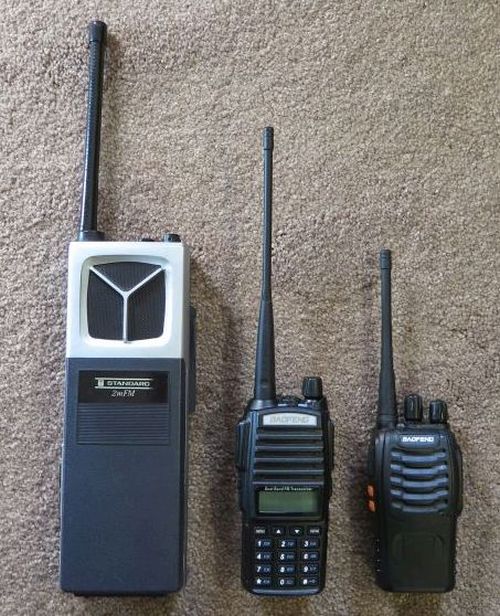
I bought my first ham radio handheld (“handied-talkie” or HT) back in 1977. The Standard Radio SR-C146 had five crystal-controlled channels and weighed two pounds. (No wonder they called it a “brick.”) No TT pad, no CTCSS. I don’t recall what I paid for it new, but I’m thinking $350–and that didn’t even include a charger. (I built a charger for it from scratch!) That would be about $1400 today. It was a really big deal, and I used it for almost ten years, until I bought an Icom HT at Dayton in 1986.
In truth, I never used HTs all that much except at hamfests. I’ve had 2M mobiles in various cars, and for the past 18 years or so have used an Alinco mobile rig as a base. I still have the Icom in a box somewhere, but the case is cracked and it’s been in the corner of my mind to get a new HT for almost ten years.
Then Bob Fegert mentioned the Baofeng dual-band UV-82 HT, which now sells on Amazon for $37 brand new. (I actually paid $35.) In 1977 dollars, that would have been…ten bucks. So I ordered one. While cruising the Web looking at reviews and commentary on the unit, I happened upon the Baofeng BF-888S. Amazon had those for $15. $3.85 in 1977 funds. So I bought one of those as well, just to see what a $15 HT could do.
Both radios put out 1W or 4W selectable. The UV-82 covers the 2M and 70cm bands. The BF-888S covers only the 70cm band. Well, actually not only the ham bands, which is an issue worth a little discussion here. Many commenters on the ham boards loathe these radios, for a simple reason: They claim the ham radio positioning is only a ruse, to get around FCC type acceptance.
The problem is that for use on the several business bands, the Family Radio Service (FRS), the General Mobile Radio Service (GMRS) and the Multi-Use Radio Service (MURS), a transceiver must meet certain FCC requirements and pass tests to ensure that it meets those requirements. This is called type acceptance. A type-accepted radio will transmit only where its type acceptance allows. There are other requirements that aren’t about frequency. FRS radios, for example, may not have removable antennas. Ham radio gear, on the other hand, does not require FCC type acceptance at all.
These are software-defined radios. Within a broad band of frequencies dictated by the output power amp, they can receive or transmit anywhere you want them to. A free program called CHIRP allows you to create a special-purpose database of frequencies and other settings, save it as a file, and then squirt it into the radio through a USB cable. It’s nominally illegal to use a radio like the BF-888S on FRS or GMRS, but a quick Web scan shows that it’s evidently done quite a bit. The type acceptance process takes time and money, so a radio pitched for amateur use can cost less.
The flexibility of using CHIRP to set frequencies and settings allows these radios to also act as scanners and receive public safety and weather channels. It’s possible to disable transmit on any frequency, which I did for the weather channels. (One of the downsides of the display-less BF-888S is that it’s not always obvious what frequency you’re tuned to. Mistakes are possible, and in this case may be rule violations that may cause interference.)
As 2M and 70cm radios, they’re pretty good. I can hit all the repeaters I usually reach from here, just using the “rubber duckie” antennas. Audio is clean and strong. The UV-82 has a better receiver: Weak local signals will break squelch on the UV-82 when they won’t budge the BF-888S.
There are some downsides:
- Neither radio has a squelch knob. Squelch levels are parameters that you set from the keypad (for the UV-82) or in CHIRP. This can be annoying if your noise level rises and falls for some reason, or if a weak signal is right on the edge of squelch. (The BF-888S has a button that turns squelch off while pressed, which is better than nothing.)
- The chargers are flimsy and almost weightless. I’m not sanguine about how long they’ll last, and they certainly aren’t physically stable. Nor are the chargers or charge voltages the same for the two radios.
- The antenna connectors are SMAs. I had to order some SMT-UHF adapters so that I could use my discone antenna up in the attic.
- Both radios “speak” a channel number when you move up or down the channel set. With the BF-888S this is the only reliable way to know where you’re sitting, as the numbers on the channel select knob are almost invisible.
- The UV-82 has a broadcast FM radio feature, which works fairly well but is not easy to use, especially if you switch stations a lot. (It is a little weird hearing classical music coming out of a ham radio HT.)
- Although it would be very useful, I don’t think it’s possible to control (rather than simply program) either radio through the USB cable.
Both radios have white LED flashlights built-in, for what it’s worth.
So. I’m sure a Yaesu or an Icom HT would be better in a great many ways. However, Icom HTs don’t cost $35. Given how little I use HTs, the price was irresistable. How well they will serve over time is an open question. They seem rugged enough to withstand a certain amount of outdoor rough-and-tumble. If they break (or if anything weird happens) I’ll certainly tell you here.
So far, recommended.
Odd Lots
- Scott Adams reminds us that science has failed us on diet and health so often that some people assume that science itself is unreliable. His point is good: Being wrong is part of the scientific method, but humans see patterns in things, and that pattern simply means that science is slower than we’d like, and refines knowledge over time by identifying our mistakes. We forget this at our peril.
- Intel’s latest rev of its NUC (Next Unit of Computing) has a Broadwell CPU and a swappable lid that provides a standard form factor for 3rd party extensions. The only big mistake is the total lack of SD card slots. We’re well along toward my 15-year-old prediction that computers will ultimately be swellings on the backs of monitors.
- Why the Feds are terrified of hobby helicopters. (Drones? No, you’ve got it backwards. Those are the Feds.) This is nonsense, and the whole thing is a dodge. I made this point some time back: Governments do not want to be watched. No governments, anywhere. That’s what the whole “drones” thing is about, top to bottom.
- Wired staffers bid farewell to Radio Shack. Me too. I considered a TRS-80 in 1978, and occasionally regretted not getting one once my friend Jim Dunn bought one in 1979.
- Radio Shack, yes. We also forget how the Model 100 (noisily) transformed tech journalism. In 1984 Xerox tried to field a competitor to the Model 100, which I evaluated for our department. It was hideous, and (worse) cost $2500, which would be $5700 today!
- Here’s the mother lode of scanned and browsable Radio Shack catalogs. I still have a few of these. (Thanks to Esther Schindler for the link.) As an example, here’s the page describing the stereo I bought the first Christmas Carol and I were married, 38 years ago. It still works, and we still use it.
- Very cool physics demo on YouTube: An AA battery and four disk magnets pull themselves around inside a tube made of coiled copper wire. (Thanks to Bob Fegert for the link.)
- A supercapacitor made from nanoelectrodes and a kitchen sponge. (Again, thanks to Bob Fegert for the link.)
- Tides do not seem to affect earthquakes and volcanic eruptions. The discussion is plainly written and I think anybody can follow it.
- I hadn’t heard of the Sad Puppies before a few days ago. (Whatever you may think of the concept, they have a great logo.) I guess I’ve been away from Fandom for awhile.
- Lileks has a feed on Tumblr. Worth following, as is Weird Vintage.