- The rate of toxoplasmosis infection in a given nation appears correlated to the level of neuroticism in that nation. I’ve mentioned toxo before, but it appears that we have better numbers now, and that the UK is nowhere near 50% infected, as the source I quoted in 2003 implied. France, well, now…
- Here’s a nice piece that explains why the atmospheric CO2 measurements taken atop Mauna Loa are accurate. And here is NOAA’s explanation of how they do it.
- Bruce Baker sent a link to an article describing how a few scraps of odd film allowed some dogged engineers to re-create the long-lost pallophotophone technology (later known as RCA Photophone), and by doing so give voice to 1920’s recordings of Thomas Edison speaking affectionately about his friend Henry Ford.
- This weekend is ARRL Field Day, in which ham radio ops head out to the hinterlands to see how well they can get up to radio speed from a dead stop, using portable (not mains) power, from a place not previously set up for radio gear. I’ll be trekking out to my back deck and working the world on an inverted vee, draining 829Bs (Diet Mountain Dew over ice in peanut butter jars) Saturday afternoon, and showing all my geek friends how it works that evening during one of our semiregular geek parties.
- We can look forward to the Roman Missal on iBooks soon. But will the priest process down the center aisle holding an iPad over his head?
- I’ve been testing Windows-based EPub-capable reader apps for the last week or so, and guess what: They all suck. Bigtime. Why is it so hard to render reflowable documents that are basically HTML-in-a-sack?
- If you’ve seen The Music Man as often as I have, you’ll remember how there’s trouble in River City, because the kids are memorizing jokes out of Captain Billy’s Whizbang. Well, I’d long thought that Meredith Willson had made it up, but not so: I found a scan of a 1921 issue of Captain Billy’s Whizbang (which is now in the public domain) and put it up in my pub directory so you can see it too. (Note: It’s a 15 MB .cbr.) My reaction? It’s not very funny, but in a world without Lileks, I guess people laughed at whatever they had on hand.
- Ok, there’s a little profanity in it (like that’s unusual in Slashdot comments?) but damn, I like this one.
ebooks
Odd Lots
Atlantis and the EPub Toolchain
You’ve heard me say this before, and I suspect you’ll hear it again and again: Creating ebook files is much harder than it needs to be, and creating ebooks in the EPub format is particularly–and inexplicably–hard. In my June 9, 2010 entry, I spoke about the EPub format itself, and how it’s not a great deal different from a word processor file format. In fact, Eric Bowersox pointed out that OpenOffice’s ODF files are also based on XML and organized in a similar way.
Bogglingly, most people appear to be hand-coding EPub XML. In recent days I’ve been looking for better ways to create EPub ebooks. Many places online cite Sigil as the only WYSIWYG EPub editor in existence right now, and I grabbed it immediately. It’s a very nice item, but appears to be an undergraduate’s Google Code project, and I certainly hope he will hand it off to others if he ever gets tired of hammering on it. Version 0.2.1 has just been released, and it fixes a number of bugs that I stumbled over in the last couple of weeks that I’ve been using it.
Then, yesterday, without any need for ancient maps or Edgar Cayce, I found Atlantis.
The Atlantis word processor is a $35 shareware item created by a very small company in France. It’s portable software, meaning it can live on a thumb drive and does not have to be installed in the usual fashion. It’s tiny; nay, microscopic (the executable is 1.1 MB!!) and lightning fast. It doesn’t have all the fancy eye candy of modern software, but it’s amazingly capable, and highly focused on the core mission of getting documents down and formatted. It has a spellchecker and other interesting features like an “over-used words” detector. It reads and writes .doc, .docx, and .odt (ODF) files, and here’s the wild part: It exports to EPub.
Furthermore, it does a mighty good job of it. I loaded a .doc of my story “Whale Meat” into Atlantis and then exported it to EPub. The generated EPub file passed the very fussy EPubCheck validator immediately with flying colors. Now, this was pure text, without any images or embedded fonts or other fanciness, but that’s ok. You have to start somewhere, and I would prefer to start with a genuine word processor.
I then loaded the EPub file that Atlantis had generated into Sigil, which I used to divide the story into chapters and add a cover image. Sigil isn’t really a word processor in the same sense that Atlantis or Word are, but it allows split-screen editing of WYSIWYG text on one side and XML/XHTML code on the other. Sigil 0.2.0 had a bug that generated an incomplete and thus illegal IMG tag (XHTML requires the ALT attribute) but I see that the new 0.2.1 release fixes that. Adding the ALT attribute manually in Sigil 0.2.0 allowed the EPub file to pass EPubcheck without further errors.
I have not yet generated a TOC in Sigil, nor have I attempted to create an EPub of any significant size. (“Whale Meat” is only 8,700 words long.) When I’m through playing around, I’m going to load the entire .doc image of Cold Hands and Other Stories into Atlantis, export it to EPub, semanticize it in Sigil, and see what I have. At some point along the way I may be forced to hand-code (or at least hand-correct) the XML or XHTML, and you’ll hear me bellyache about it when I do. But I will admit that I’m pleased with what I have so far. Yes, Atlantis and Sigil ought to be one product, or at least two closely-knit utilities in the same product family. Still, given the primitive state of the EPub reader business (I have yet to find a Windows or Linux-based EPub reader that I’m willing to use) I’m satisfied with the way that Atlantis and Sigil cooperate. Now that Apple has anointed the EPub format for iBooks, I’m guessing that EPub-related improvements will be arriving thick and fast in coming months.
EPub and Word Processors
Well. Got your heart medicine handy? Jeff is considering a Mac. Well, not exactly. (Put down that nitroglycerine.) I’m strongly considering getting an iPad. And I’ll bet you didn’t know that I already have an iPod, thanks to Jim Strickland, who may in fact persuade me to get a Mac someday. I worry about some of Apple’s cultural issues (like not providing clear guidelines on what you can sell in their stores and what you can’t, and changing your &!$#*% mind about it every other week) but their engineering is extremely good. I spent some quality time with an iPad at a recent Enclave Meetup, and basically, I’m sold. Those guys pretty much nailed the ebook experience, or at very least came up with the best possible compromise between fixed-page and reflowable presentation that anyone might strike. And I want my books out there in the iBooks marketplace.
This means that I need to be able to create EPub files, and good ones. What boggles me is the scarcity of visual tools for that purpose. Among the mainline desktop publishing apps, only InDesign CS4 and CS5 can export finished EPub files, and some people think the feature itself isn’t finished yet. (I don’t have either version so I can’t do my own testing–and at $700 for the app, I don’t expect to get it.) Some odd comments I’ve seen online suggest that the Scribus developers don’t think that reflowable document export is a suitable task for a fixed-layout desktop pubber, and that they’re not going to do it. There are lots of converter programs for taking various types of files and turning them into EPubs. As best I can tell, most people code their EPubs up manually, as though they were writing a C++ program. Gakkh. But also as best I can tell, affordable WYSIWYG EPub editors begin and end with Sigil.
The format itself is not a skullcracker. You’ve got one or more XHTML files expressing content (plus image files, if present), one or more CSS files defining styles, and one or more XML files describing document structure and metadata, all placed in a container file that’s not much more than a .zip with a different extension. There’s an optional DRM layer in the spec, but it’s technology-agnostic and not much used. The spec is simple enough so that people write the damned things by hand. I can’t imagine that parsing and generating the XML/XHTML/CSS would strain any sort of editor.
My point here is that you don’t need a fixed-layout desktop publishing program like InDesign or Quark to create and maintain EPub ebooks. In a sense, EPub is a modern XML-based word processor file spec, and even a middling WYSIWYG word processor could be twisted a little bit to read, render, edit, and write EPub files that could be loaded right into iBooks without further processing.
Sigil comes close. I’m using it and I’m reasonably impressed, considering that the team is basically writing a brand-new word processor from scratch. What boggles me is that it’s the only WYSIWYG EPub editor in the universe. And as a word processor, well, it’s pretty spare.
There’s no reason for this. Existing word processing apps like OpenOffice Writer and AbiWord could easily be extended to import and export EPub files, or forked to create a ramcharged ebook development system using EPub as its primary file format. Fork or not, I’m convinced of this: All word processors will eventually become ebook editors. The ebook market is closing in on reality. We now have the file format we need. The software will follow.
But sheesh guys, how about picking up the pace a little!
Odd Lots
- I’m not very good at one-liners. So, in my contrarian fashion, I will present an Odd Lots composed entirely of…two-liners.
- Technical material (textbooks, manuals, computer books) rendered on an ebook reader? Now you’re talking.
- As someone fond of both astronomy (especially telescopes) and Star Wars, I consider this a wonderful building hack.
- Harrison Bergeron was evidently a Canadian kid soccer player. (Thanks to Bob Trembley for the link.)
- What’s your favorite app for extracting text from PDFs? Any experience with ABBYY’s PDF Transformer?
- And if you’re going the other way, slow but sure pays off: PDFCreator has finally reached version 1.0, after only seven years.
- Sigil is the only WYSIWIYG editor for EPUB-format ebooks. Why? When will we start editing ebooks and stop coding them?
- One of my cousins once had a sandbox in an enormous worn-out tractor tire. Now somebody’s recycled such a tire into a bike.
Odd Lots
- Well, Ubuntu 10.04 Lucid Lynx is out there, but I had other committments yesterday and couldn’t download it on Day One. This may have been a good thing; there was a last-minute bootloader bug that interefered with dual-booting with Windows. Still, I’ll be installing it on one machine or another ASAP and will report here.
- Tom’s Hardware posted a solid comparison of Linux office apps yesterday, and if you’re considering Linux for day-to-day work, it’s worth a close read.
- I got the Audiveris sheet music OCR app installed the other night, and it does work–however, it requires 300 DPI sheet music scans in order to operate, and none of the ragtime sheet music I found online was anything close to that high-resolution. (I tested it using high-res example scans installed with the app.) As with most Java apps, it is agonizingly slow: It took seven seconds to pop up a simple Save As dialog, on a 3.2 GHz SX270 with 1 GB RAM. I also had trouble getting audio output via its MIDI support; however, after saving the generated MIDI to a disk file, the MIDI file played normally through several different player apps.
- Rich Rostrom did send me a link to another composition by Irene Giblin, the author of the Ketchup Rag: The Chicken Chowder Rag. Here’s a video of an ancient record playing it, and another (far better) video of a piano roll of the song playing on a player piano. Here’s a short bio of the long-lived composer…and (finally) a MIDI file of the Ketchup Rag itself.
- ZDNet posted one of the better ebook reader evaluations I’ve seen lately, and while it appears to be Kindle vs. iPad, it’s really e-ink vs. backlit LCD. I’m currently with LCD. I don’t read outside for many reasons, including a lack of comfortable chairs out there, and a feeling that if I’m outside I should be walking or climbing or digging or something.
- Making large numbers of books portable is what the ebook thing is all about. Here’s another approach: Climb inside your circular bookshelf and start walking.
- Of course there’s lots of 2010 still ahead of us, but charts from the NOAA indicate that severe weather in the first four months of the year has fallen to what looks like a ten-year low.
- The post was 23 days late, but better late than never: Fear the homeopathic bomb!
CBZ Files as Image Archives
Last fall, I gathered a stack of Alma-Tadema‘s paintings from my pre-1923 images folder, wrapped them up into a ZIP file, and sent them to a friend who was looking for a copyright-free color cover for a novel. Some weeks ago, I learned that the CBZ (Comic Book Zip) file format is nothing more than a ZIP file with a different extension. I downloaded and installed a free CBZ reader called Comical. After changing the extension on the Alma-Tadema archive to .cbz, I double-clicked on it, and boom! There it was, beautifully presented and trivially easy to click through. And if you change the extension back to .zip, you can de-archive the images in the usual fashion using any ZIP-capable archiver. It’s all in the extension; no changes to the binary archive need to be made.
Not being a comics guy, I’d never heard of the CBZ format, though it’s been around since 2004. It’s basically an ebook reader protocol (since it is, after all, simply an ordinary ZIP archive) that opens a .zip file and displays the files in alpha order by filename. If the files are displayable as images, the reader displays them. If the files are not displayable as images, a well-behaved reader will ignore them. (Comical, one of the simplest free readers, sometimes crashes when it encounters a non-image binary.) If you need an indicia page, some readers will display text if it’s in an .nfo file. The .nfo will appear in a separate text window on opening the file, rather than in the page display area.
I’ve tested four free CBZ readers: ComicRack and Comical under Windows, and QComicBook and Comix under Linux. All but ComicRack are open-source. ComicRack is overkill in a lot of ways, though it works very well. (It requires the .NET framework, if that’s significant to you.) Comical is much simpler, and my only gripes are that it doesn’t display .nfo files, and it crashes when it finds certain kinds of non-displayable files in a .cbz archive. QComicBook is a Qt4/KDE app, and the one I find myself using under Linux. Comix (a Python app) works well but is not as capable as QComicBook. (Feature-wise, it’s on a par with Comical.) Others exist. Okular will open CBZ files without complaint, but it simply scrolls vertically through the images without attempting to show one per click.
Most of the comic book readers also read CBR and CBT files, which are RAR and TAR archives, respectively, and work almost exactly the same way. (I haven’t tested those formats.)
The CBZ system works best when all the images in the archive are the same dimensions and aspect ratios. I’m putting together some photo albums for showing the folks back home that are collections of digital photographs in one (big) .cbz file. The bigness is mostly unavoidable, since JPG files don’t compress very well. Still, it makes file management simpler
Here are some sample CBZ archives that I put together for testing: Alma-Tadema (14 MB). Hi-Flier Kite Catalog 1977 (6 MB). The “Elf” Space-Charge Receiver (1.7 MB).
Odd Lots
- A lot of Catholics (and doubtless a few others) would like to see some rabbit control on Easter.
- That said, Easter has done much better resisting commercialism than Christmas. Basically, the Christmas story is unreservedly delightful, whereas the Easter story is sobering. Happy beginnings are easier to come by and much more common than happy endings, as I’ve noted here before. The real message of Easter is solidarity with God, who is born, lives, suffers, and dies, like all of us–with the promise of a happy ending, even if the nature of that happy ending is obscure to us right here and right now.
- Early reports of Amazon giving in to demands from major publishers that they be able to set prices for their ebooks were evidently premature, but I’ve seen more reliable reports that the deal is now done, and that ebook prices will rise. This is not a bad thing: Publishers should compete on price, not retailers. And if Macmillan wants to charge $15 for an ebook, that provides some wiggle room for upstart and smaller publishers to get a place in the channel charging $10, or $8, or $5.
- Many photos have just gone up for EntConnect 2010.
- Ubuntu 10.10’s code name will be Maverick Meerkat. And hearing that reminded me that Lucid Lynx is just around the cornah. (The small photo of some meerkats devouring a Halloween pumpkin is worth the click!)
- I’ve been having some very odd problems creating good audio CDs with InfraRecorder Portable, and now recommend that you don’t use it. Some of the tracks just don’t “take,” but when I burn the very same MP3s to a blank disc from the same spindle using Gnome app Brasero, the disc is perfect.
- It’s far from complete but it’s a damned good start: A listing of electronics surplus houses by state. Sadly, they don’t list Apache Reclamation & Electronics, which suggests that Phoenix’s Mother of All Junkpiles has passed into history.
- From the Words-I-Didn’t-Know-Until-Yesterday Department: Mumblecore, a film genre characterized by improvised scripts, inexperienced actors, and lousy video equipment. (Sounds like my home movies.)
Odd Lots
- Here’s a great article from NASA on the unexpected success it’s had with the WISE (Wide-field Infrared Survey Explorer) spacecraft in spotting previously unknown asteroids in the infrared spectrum. WISE is detecting hundreds of new asteroids every day, which is unnerving, since a rock no bigger than a Motel 6 could cause regional devastation greater than any nuclear weapon yet produced.
- From Larry Nelson comes a pointer to the AirStash, an interesting $100 USB Wi-Fi gadget that can accept up to a 32 GB SD card and act as a content server over Wireless b/g. Anthough nominally a thumb drive, the USB plug also charges the internal battery, and (though it’s not screamed from the rooftops) the thingie works all by itself, no computer connection required. This suggests “wearable file sharing”: Drop one in your pocket and nearby people can download files from the device without having any idea where it actually is. Little by little, the jiminy (an AI wearable computer I thought up in 1983, and figured would be mature by 2027) creeps toward realization. The AI is actually the tough part; everything else already exists, if not in as small a package as I imagined 25 years ago.
- And if you ever wanted to run Linux on one of your fillings (ok, one of your elephant’s fillings) this would be the solution. (Thanks to Bill Cherepy for the link.)
- Here’s a gadget that builds you an external USB storage device by dropping in (literally) a naked SATA hard drive. I may not need it, but I admire the elegance of the concept.
- I’ve been arguing in favor of dual-screen reader devices for years, and this one is a good start. Sounds like the user interface software needs work…but when has that not been an issue for a first-gen device? We’re closing in on it, though.
- Nice status update on some of the current non-Tokamak fusion research approaches, link thanks to Frank Glover.
- Also from Frank comes a reasonable article on how people would die in a vacuum and how they wouldn’t. I had heard of lung shredding; heart failure was new to me. But take, um, heart: Your blood wouldn’t boil.
- If you ever wondered why you cry when you slice onions, well, it’s the sulfuric acid released by cells in the onion when they’re cut open. Supposedly living things evolved this mechanism (or at least key parts of it) half a billion years ago. Onions evolved their chemical weapons to avoid being laid on hamburgers in slices–but we evolved Vidalias to prove that we were smarter than onions, and that fast food will prevail against all threats.
- Interestingly, the Canon G11 camera reduces the size of the image sensor to 10 megapixels, down from the 12.5 on the G10. The new sensor gives you fewer pixels but better ones, and faster, which is all for the best.
- Burger King is testing a new retailing feature in Brazil. When you order a burger, they take your picture and print your face on the burger wrapper.
Odd Lots
- Here’s the best discussion I’ve yet seen on why Flash may never work well–or perhaps at all–on touchscreen devices like the iPad.
- Most recent laser printers have Ethernet ports, and some older printers (like my Laserjet 2100TN) can accept a JetDirect network adapter. Installing a printer on a network port means you don’t have to worry about whether the machine it’s attached to is turned on. If you’d like to do this but you’re not a network geek, here’s the best XP-based step-by-step on the topic I’ve ever run across. Same tutorial for Windows 2000.
- Bruce Baker passed me a link to a nice item on the issue of broadening publisher book production to allow all formats to be generated from a single master file. Follow and read the link to The New Sleekness as well. Pablo should take it down a notch; XML is not a markup language; it’s a general mechanism for creating markup languages, and what may happen eventually (perhaps in ten years or so) is a standard book-production markup language derived from XML and built into a new generation of word processors. Still, what nobody in either article mentions is the problem of pages verses reflowable, which is the 9 trillion pound gorilla in the business. If you don’t solve that problem, absolutely nothing else matters. (And it is not as easy to solve as some may claim–I’ve been thinking about it for several years now and see no solution whatsoever on the horizon .)
- Kompozer 0.8b2 has been released. I just got it installed in a VM and will be poking at it in coming days. According to Kaz, most of the changes are code cleanups, but any progress on the editor is a fine, fine thing.
- I’ve done model rocketry here and there over the (many) years, and I’ve seen some very odd things lofted on D engines. Back in high school, my friend George built a Harecules Guided Muscle (which was from the Beany & Cecil cartoon show) in the form of a big whittled balsa wood fist on a short, thick body. I’m amazed it flew as well as it did. Well, here’s a fire-’em-together pack of 8 rockets shaped and colored like Crayola crayons. The guy took his time (six years) but he did a great job–and created a spectacular Web page documenting the project.
- We rarely go to WalMart, but last time we did, I picked up a bottle of Diet Mountain Lightning. It has nothing on Kroger’s Diet Citrus Drop, easily the best of all the Diet Mountain Dew clones I’ve ever had the opportunity to try.
Odd Lots
- Wow! The Authors’ Guild finally had a good idea a couple of weeks ago: Who Moved My Buy Button, a Web site that tracks Amazon’s “Buy” button for any given title. If the Buy button goes away (for example, if the book goes out of stock or if the publisher places it out of print–or if Amazon gets in another cage fight with a major publisher) you get an email to that effect. Don’t miss their “Buttonology” page, which explains how to interpret Buy button disruption by inspection. (Thanks to Bruce Baker for the link.)
- So what exactly is this, anyway? It looks like what used to happen to me when I tried to develop my own film (briefly) in 1966, and found these odd (and similar) little anomalies on my negatives. Dirt, or perhaps the edge of the film contacting the center. Nothing says he wasn’t using a film camera, but film is pretty uncommon these days. If I had to guess (and assuming it isn’t some flaw in the camera optics) I like the idea of a meteor passing through the ionized region of the atmosphere where the aurora display was happening. (Thanks to Frank Glover for the link.)
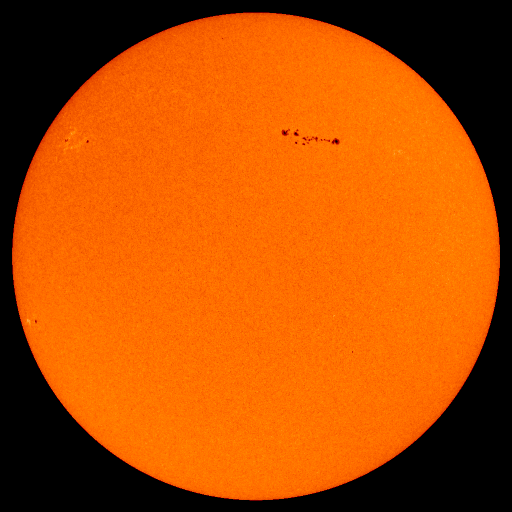
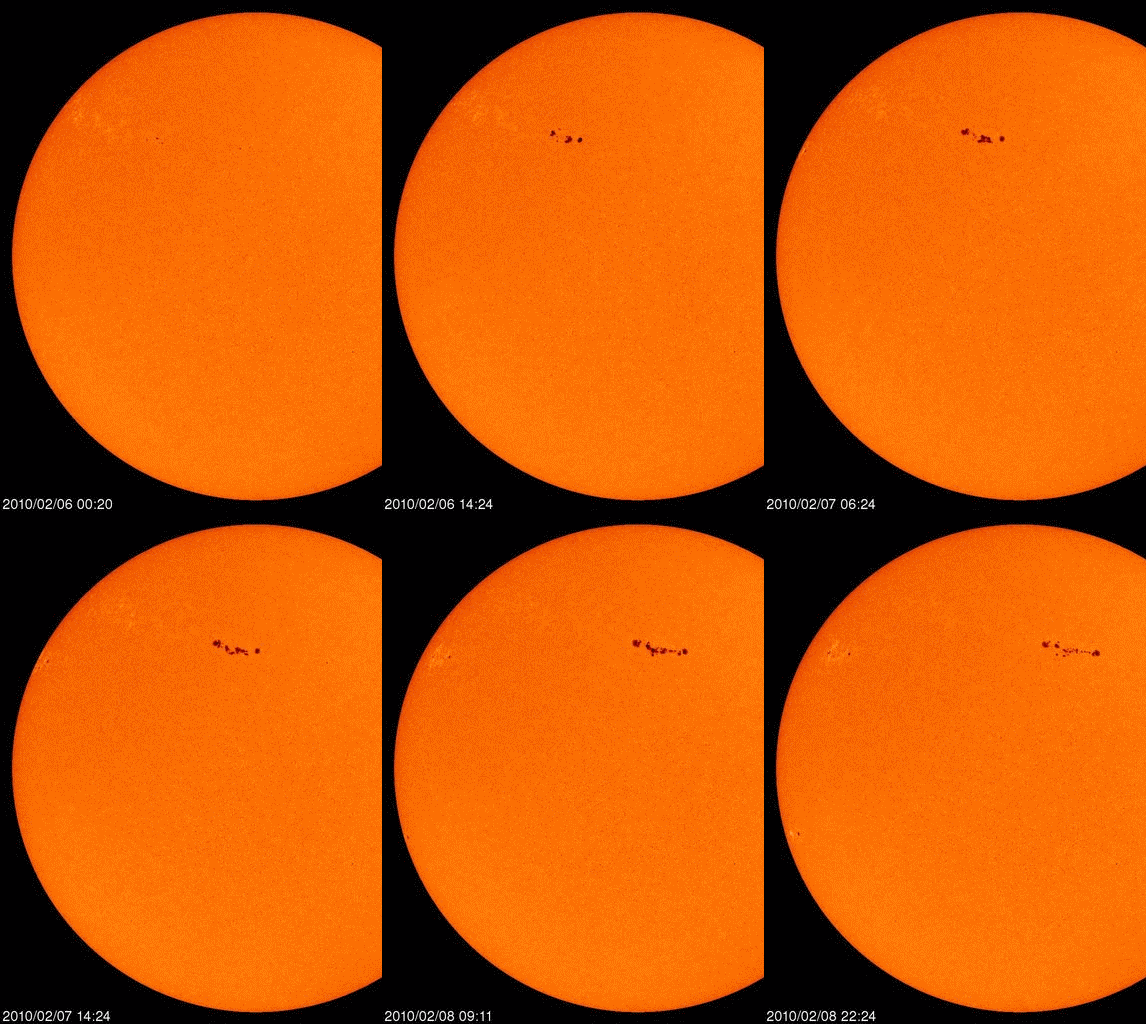
- While we’re talking high-energy physics, I’m finding it remarkable how rapidly an apparently dead Sun came back to life, on or about January 1. We now have three significant sunspots on the visible face, including a genuine monster. (Here’s an animated GIF of spot 1045 growing.) This gives us a sunspot number of 71, the likes of which I haven’t seen in three or four years. I’ve been spinning the dials downstairs, and have heard openings on 18 MHz and even 21 MHz. Gonna get those wires shielded before the next solar minimum, fersure.
- Integrated reader/bookstore systems have made me a little bit nervous ever since the Kindle Orwell debacle last year, and the iPad, if anything, will be even more vulnerable to that sort of remote meddling. It’s not so much malfeasance by the system operators as their vulnerability to government corruption and coercion. Here’s a perspective from a French chap.
- Still wedged on VMWare Workstation, but Bp. Sam’l Bassett pointed me to a site providing lots of free VirtualBox VMs. The question of how trustworthy such downloadable images are is a good one, but they’re certainly one way to mess with a new OS without having to fuss with hard disk partitioning and installation.
- I know it’s really her name, and no disrespect is intended, but when I read a headline like: “Costa Rica Elects Chinchilla First Woman President” I don’t see what I’m supposed to see. Journalists used to be taught to avoid gaffes like this, and many other news organizations did. Including her first name would have helped.
- I kid you not: Pepsico is wrapping up a limited-edition, 8-week-only campaign for Mountain Dew Throwback, which contains Real Sugar instead of high-fructose corn syrup. I’m a diet soda guy and won’t partake, but that’s a quarter step in the right direction. (My guess: The ridiculous ethanol-as-fuel scam is making corn expensive enough so that HFCS is not the big win that it used to be.)
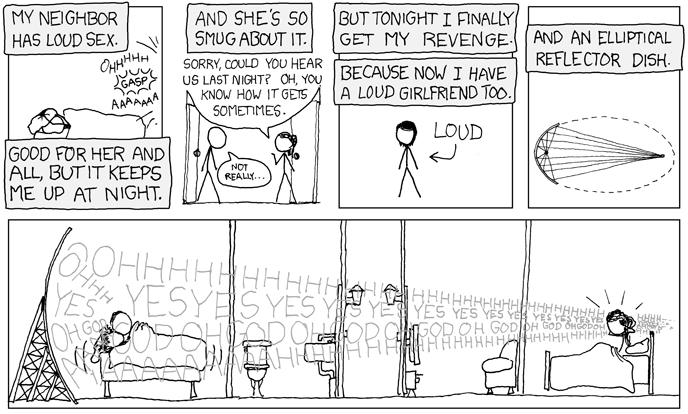
- Once again, XKCD scores big–and loud. (SNSFW.) (Thanks to Baron Waste for the link.)