Jeff Duntemann's Contrapositive Diary Rotating Header Image

Daybook

Descriptions of what I did recently; what most people think of when they imagine a “diary entry.”

Insight Is Gone From Ubuntu…

…and in fact from everything else based on Debian. Not six months after I saw Assembly Language Step By Step, Third Edition hit the shelves, the Debian team decided to pull the Insight debugger package from their seminal Linux distribution, on which Ubuntu, Kubuntu, Mint, and several others are based. Come Ubuntu 10.04 Lucid Lynx at the end of this past April, and suddenly people reading my book can’t work through the examples, because the software that I used in those examples (for single-stepping and examining registers and memory) is no longer available for their version of the OS.

This isn’t new news, and I’ve been trying to figure out how to finesse the problem ever since I heard about it mid-May. I got a number of queries this past week, suggesting that I had better get on it. (This is why you haven’t seen much from me in recent days.) Assuming at first that Insight had been dropped just to keep the distro CD-size, I tried to install it under Lucid from Software Center (not found), next a deb package, and finally from source, but nothing worked quite right. As the months have passed and more and more people are installing Lucid, I’m getting more and more mail about this. It’s a serious problem: A lot of the skill of assembly programming lies in debugging at the instruction level, and much of the tutorial depends on being able to run a debugger. Insight was that debugger. It’s GUI-based, rather than purely textual, and I think it’s a great deal easier to grasp, especially for newcomers.

So why didn’t I just use gdb?

Um…I did. Or at least I thought I did. Insight is an odd case. Most people assume (as I did) that it works the same way that Nemiver, KDbg, and DDD work, as independent front ends for gdb, passing textual commands to gdb and getting textual data back for display. Not so: Insight is gdb, and therein lies (in my opinion) most of the problem. What Insight’s originators did was take the gdb source code and add a built-in GUI, using Tcl/Tk. In effect, they forked gdb and produced a new custom version that contains all of gdb (at least gdb as of 2007) plus a windowing visual wrapper.

That in itself is unorthodox but not necessarily damaging, though forking something as fundamental as gdb should not be done lightly. Still, if you do it, you have to do it well, and I’m seeing indications that Insight isn’t nearly as clean a product as it should be. The Debian team spoke tersely; see the bug report and resolution here: “RoQA; insane packaging; unmaintained; low popcon.” (Yes, I read “popcorn” at first too.) More details may be found here. (Warning! DDG: Deep Debian Geekery.)

Quick translation:

  • RoQA means “Request of Quality Assurance”; basically, Debian’s QA team decided that the package was too broken to keep in the Debian distribution and requested that it be removed.
  • Two release candidate (RC) bugs were reported by the Debian team to Insight’s maintainer, but no one there responded. This is odd, because the maintainer is none other than Red Hat.
  • An NMU is a non-maintainer upload, which is when a package is sent to the distro team by someone other than the package maintainer of record. It is often a sign that the maintainer has abandoned the package, especially if the maintainer never acknowledges the third-party fix.
  • “Low popcon” is a reference to Debian’s unique “popularity contest” system for gaging how much individual distro packages are being used. Insight got 36 votes, which, in browsing the rest of the stats, seems low but not fatally low.

The real problem is that “insane packaging” issue. Insight contains embedded copies of software that is maintained by others and would be better linked in as libraries. The embedded bits “age” with respect to the current release of the OS and its libraries, eventually getting out of sync to the point that the package will not understand the current system well enough to function correctly. Tcl and Tk are either part of or easily installable to any Linux distro there is; you do not have to cut’n’paste them into your program source. With old software copied into its sources the package may build correctly, but might not necessarily run.

That said, the right way to approach the problem may be no more complex than taking the most recent release of Insight and making a proper Debian package out of it. The version I used last year in Karmic Koala goes back to 2007, and that’s the version pulled from Debian. The July 2009 release may be better. I’ve read enough on building Debian packages to know that I’m not the guy to do it, but I hope that somebody with better Debian chops will eventually try it, so that we can tell if Insight was just wounded, or if it’s really and quite sincerely dead.

In the meantime, the best fix appears to be falling back to Ubuntu 9.10. More here as I learn it.

Classmates: Hacked, or Poor Proctoring?

Quick update: Either Classmates.com was hacked, or nobody over there is paying the least attention to user activity. Textual obscenities and dirty pitchers abound; those with strong stomachs may see it for the time being here.

I’m divided as to whether I should alert them to it. There are 17,000 Lane alumni in the system online, and I can’t imagine that at least one of them hasn’t complained about it yet. (Lane is a big school, and has been around for a very long time.)

I’m definitely watching it, and am still interested in reports from people (especially from other schools) who have gotten forged emails from Classmates lately, containing obscenities or not.

Was Classmates.com Hacked?

Something very weird is going on here: I’ve gotten a scattering of emails in the last 18 hours from Classmates.com. Nothing new in that, except that these are obviously fakes, albeit very convincing fakes. The subject line for the first is:

“You are invited to the Naked Fest with Lane Technical High School.”

The From: field contains a multi-word obscenity that I won’t even try to repeat. (You know what dash characters look like.) The body of the message is pure Classmates, but in the Received: field in the headers is a bogus domain and an IP that doesn’t match classmates.com:

Received: from mta10.prod.iad1.cmates.com (va-in-svc-lb1-mip.iad1.cmates.com [10.12.208.10])

It’s not malware, came in with no attachments, and contains no scripting whatsoever.

One of my friends from Lane got the identical messages about the same time that I did. So: Did anyone else get anything like this? Or is it just the two of us who are being scammed? I don’t see anything about this online, which suggests that somebody is having some fun with him and me and not with Classmates.com as a whole.

Do let me know. Thanks!

“Click the Word That Describes Them…”

ClassmatesLaneTechGirl500Wide.jpg

How about… “imaginary”?

As I’ve said before with respect to fraudulent pitches like this, there were no girls in Lane’s Class of 1970. And I’ve heard from others who have paid up for the service in response to Classmates’ endless emails, only to find that no one had signed their guestbooks, and no one was looking for them. Once I’d call a mistake. But this is actually the third such pitch I’ve received (I mentioned the second back in January) and three’s a pattern. I suspect I will get another every so often.

Simple lesson, put bluntly: Assume that everything you receive from Classmates.com is a scam.

How Old Am I Again?

58 today. (I checked.) However, some weeks ago, when Carol asked, “What do you want for your birthday?” I had to think a little bit to remember which one it was. Am I 57? Or 56? Oh yeah, I’m 58. Wait…not yet. 10-2=8. I think…

This isn’t a classic 50s moment. I recall the occasional mental strain of remembering how old I was back in my late 30s. Am I 36? or 37? Same deal in my early 50s. 52, 53, well, they all run together. Sometimes the remembering is easier: Nice round numbers like 50 and 55 come easily to mind. 55 had the memorable cachet of granting me senior discounts at places like Denny’s. I’m guessing that when I’m 60 I won’t have any trouble.

It was easier knowing how old I was when I was a kid. Part of it was a constant if poorly understood preverbal ache for the privileges of age; more freedom, bigger toys. When I was 10 I was desperate to be 11, and when I was 11 I was desperate to be 12. If I’d known what was waiting behind 13 I might have turned around and been happy to stay 12. I liked 12. I hated 13. And 14. And 15. And 16. 17, now…

Like them or not, the ache made sure I always knew which year I was. However, once you’re in your 20s, the things you want aren’t strongly tied to age, and a lot of the birthday magic just goes away. Besides, much of the American Dream was mine before I even turned 30: I had a cool job writing computer programs, an active SF group that met twice a month, several SF stories in print, a pretty white house around the corner from the Cleavers, a great dog who could dance on his hind legs, milk cartons full of tube sockets, and a loving wife who looked like a supermodel and was my best friend. I lived as men might choose, and mostly what I wanted for my birthday was to keep what I already had.

So far so good. I now have an amazing house with CAT5e in the walls, twice as many tube sockets, four dogs who can dance on their hind legs (though one of them still needs a little prodding) a nerd gang I can hang out with, computers stacked like cordwood, and the love of a brilliant and interesting woman who has remained my best friend past forty (count ’em!) birthdays, and was always there to keep me aimed in the right direction when the inevitable bad patches turned up.

58, heh. It is a happy birthday. Thanks to all of you who sent best wishes and wrote on my Facebook Wall. You’re all a big part of the reason I don’t mind being 58. Oh brave and always new world, that has such people in it!

Ursa Muncher

BearUnderTree2.jpg

I got home from shopping for tonight’s nerd party an hour or so ago to find a phone message from Collette next door. She told me that there was a very large bear sitting in the trees behind our houses, eating a bag of dog food. I grabbed my V530 and snuck out the back door. Well, yup: There he was, about forty feet from our lower deck, with his nose stuck in a huge honking bag of Old Roy or something. Crunch, crunch, crunch.

Wow. We’ve seen bears here a time or three, though generally at dawn or dusk. Pete Albrecht and I were hanging out on our back deck a few years ago, talking astronomy about 11:30 PM, when we heard some crunching down in the gully. We looked over the deck railing, and there he was, looking up at us. He’d been harvesting the summer’s choke cherries, I’d guess. One leg of my improvised Field Day inverted vee terminates down there a few yards from the bear, and I was doing that only yesterday.

We went back and looked again when Carol got home a few minutes ago, but he was gone. So was the dog food bag–so I guess he got tired of being stared at, packed up his Old Roy, and went elsewhere.

Don’t know whose dog food it was, but in any event, better the dog food than the dogs.

Cold Hands and Other Stories

CHCoverPrototype.png

I’m sure I’d be a lot more famous if I weren’t so slow, but better late than never: I’m pleased to announce that Cold Hands and Other Stories is now available from Lulu.com in print form, with cover art by the estimable Richard Bartrop. Trade paperback, 230 pp. $11.99.

The body of my short fiction divides pretty much in halves: Stories focused on AI, and stories focused on everything else. I published all of my AI shorts in Souls in Silicon back in 2008. Cold Hands and Other Stories contains everything else, albeit with a new excerpt from my nanotech AI novel, The Cunning Blood. And “everything else” covers a lot of ground: spaceflight, aliens, religion, calculus, witchcraft, and steam locomotives, or at least steam locomotives hacked together from alien parts that probably weren’t intended to go into steam locomotives.

Most of the stories have appeared in print before, and one, “Cold Hands,” was on the final Hugo ballot in 1981. There are a few new ones, including one as new as late last week. Here’s the lineup:

  • “Cold Hands” (from IASFM, June 1980)
  • “Our Lady of the Endless Sky” (from Nova 4, 1974)
  • “Inevitability Sphere” (from IASFM, Sept./Oct. 1978)
  • “Whale Meat” (from Starwind Magazine, August 1977)
  • “Born Again, With Water” appears for the first time.
  • “Drumlin Boiler” (from IASFM, April 2002)
  • “Drumlin Wheel” appears for the first time.
  • “Roddie” appears for the first time.

Rounding it out is another excerpt from The Cunning Blood, different from the one I published in Souls in Silicon, and not available anywhere else but in the novel itself.

A big chunk of the book involves the Drumlins world, which I introduced in 2002 and intend to do a lot more with. Calling it steampunk isn’t quite fair, as it doesn’t take place in Victorian times and corsets are mentioned exactly once. Someone described “Drumlin Boiler” to me as “hillbilly steampunk” (steambilly?) and while that’s a surreal notion, it may be as close as you’ll come.

Yes, an ebook edition is planned, though given the sad, fragmented state of the ebook world right now, it’s going to take some time to kick the file down the tool chain into all the requisite formats. Fortunately, Lulu is a certified aggregator for iBooks, so once I have an EPub that passes the gnarly epubcheck test for standards compliance, I’m going to give it an ISBN and let Lulu list it on iBooks.

As always, blog mentions and reviews are much appreciated!

Las Vegas Quarters

LasVegasQuarter500Wide.jpg

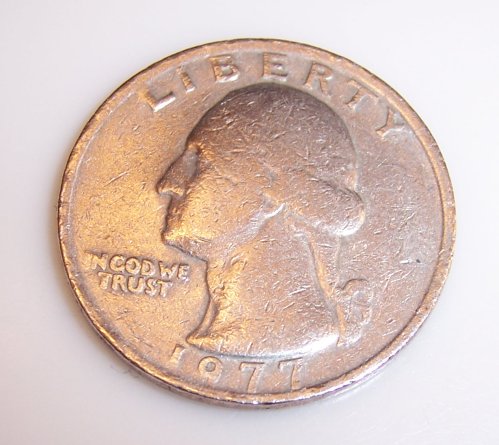
I got a Las Vegas quarter in change the other day. This is a term I use for certain coins (generally quarters but occasionally nickels) that (after spending decades ricocheting from one slot machine to another) have a distinctive beat-to-hell appearance that can’t be mistaken for anything else. Las Vegas quarters don’t wear smooth and shiny like quarters that people use to buy burgers at McDonald’s. They’re full of dents and nicks and more matte than polished. They also look like they were dug up in some Roman ruins in Gaul after a century or three of service.

Vegas fired its quarters back in the late 90s, when computerized slotless slot machines began replacing electromechanical slot machines with a vengeance. They’re now gradually filtering out into general circulation. This is the second I’ve seen this year, after never getting one outside the city itself prior to that.

I never entered a Las Vegas casino before my first trip to Comdex in 1985, and I remember that the metallic racket of quarters being spit into stainless-steel pans at the Continental Hotel and Casino was continuous and never stopped for even a second. The psychological effect was intentional and obvious: People weren’t just winning now and then. People were winning constantly. And the quarters paid the price.

By the time Carol and I took a short trip to Las Vegas a few years ago, the coin machines were gone. The racket of interacting metal objects had been replaced by a continuous cacophony of crude digital jingles, a sort of MIDI hell that I found a lot harder to take than the now-vanished quarter clatter.

I have a little dish of odd coins that I’ve gotten in change over the years (mostly foreign ones and American coins with weird damage) and my 1977 Vegas quarter will join them. Such quarters are tokens (literally) of a piece of technology that slipped away when nobody was looking, and a hundred years from now, I wonder if someone will pick up such a quarter and think, “My God, what happened to that poor thing!”

Bichonicon 2010 Wrapup, with Ribbons

ThreeRibbons.jpg

The show portion of the Bichon Frise National Specialty 2010 finished out today, and I’ll take a break from cleaning up and packing (which includes washing all the dog towels we brought) to summarize.

I made a McDonald’s run for the gang this morning at oh-dark-30, all the while that Carol and our friends were furiously brushing and tipping down in the grooming area. Both Aero and Dash were showing today, so I got a chance to put on my best suit and parade our puppy around the ring. Dash doesn’t like leashes, but he held his head up a little better today, and picked up Fourth Place in Open Puppy Dog 10-12 Months, out of a field of nine, again including most of the Bichon Powers. (Bogglingly, we beat a couple of nationally known handlers and their dogs.) Carol says that I’m picking up the dog handling thing pretty well, and although I could smell myself sweat, the judge evidently liked what she saw.

Carol handled Aero in Amateur Owner/Handler, and although it was a small category, she took First Place, just as she did last year. Aero is a very good dog, and few dogs that good are handled by their owners. (Most show dogs of Aero’s quality are owned by wealthy people who hire professional handlers to take them around the country and show them.) Ordinarily, being a champion would disqualify Aero for any category except Best of Breed, but since we entered Aero in the show before he completed his championship, he got to stay in the category. Carol and Aero did not place in later rounds, but considering who we were up against, that isn’t really surprising.

So we’re taking home three ribbons this year: Two Fourth Places for Dash, and one First Place for Aero. Overall a fine showing, and we’re lookiung forward to the big Colorado Springs show in June, where Dash has his first serious shot at a major win. We’ve decided to spend another night here for reasons of simple exhaustion, which was fortunate because there’s a tornado watch in force for most of our path back to Chicago. (By tomorrow morning all that should have passed on over Ohio.) As the bichon crowd leaves the hotel, other groups are filtering in (including a hot-air balloon convention) and we’ve begun hearing an old line that curdles any bichon person’s blood: “Look at the pretty poodles!” Yup. Time to go home.

A Kingly Gift

NGUltraCloseup.jpg

Last night, my brother-in-law Bill Roper presented me with a truly kingly gift: An unused Northgate Ultra keyboard, which he bought many years ago but never attached to any machine. I’ve been using Northgate Omnikey 102 keyboards almost without interruption since 1991 or so, and whenever we upgraded an early system at Coriolis to something that came with its own keyboard, I snatched the old Northgate and took it home with me. Several have died since then, though they may be repairable and still live in a box in my shop closet.

As I’ve reported here on a couple of occasions, I bought an Avant Stellar (an OmniKey clone) a couple of years ago, only to find that the decal keycap legends have begun wearing off on the most popular keys. “Double shot” key caps (one shot of plastic into the mold for the cap, a second for the legend) are mostly extinct, which is yet another reason I value the keyboards that I still have.

This one will take up its position as King of Duntemann Keyboard Country when I get it back home and attach it to the primary system in my office. It will go home by UPS (in a box surrounded by boxes of Trader Joe’s Joe’s O’s cereal) so to minimize the risk of getting dog piddle or McDonald’s iced coffee on it while we trek back to Colorado Springs.

There is a little exploring to be done. As shown above, the numeric keypad is significantly different from the Omnikey 102s that I’ve been using all these years. There are five keys I’ve never seen before:

  • comma Period Lock
  • Rate Select
  • SF Select
  • Pause
  • OMNI

Bill did not have the booklet that came with the keyboard and I have no idea yet what any of these do, although the SF Select key is intriguing. (And sure, an OmniKey should have an OMNI key, right?) The rest of the keyboard is basically an OmniKey 102 with the second set of function keys across the top, just below the thumb-drive groove.

All in all, a truly kingly gift. I’ve never had an Ultra before. Now I do–and it’s NOS. Bill, you are a prince!