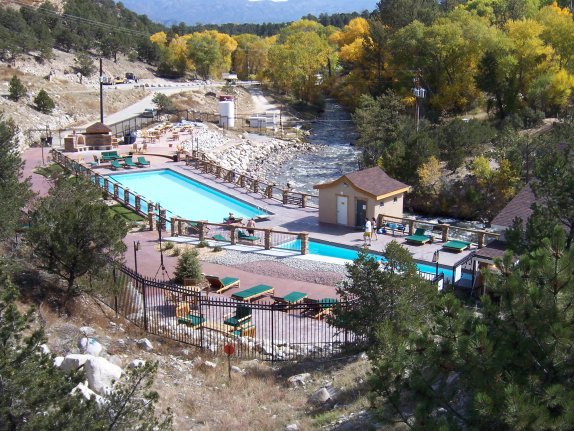
Yesterday was our 32nd wedding anniversary, so Carol and I took the puppies up to Woodmen Kennel on Wednesday and then blasted over Ute Pass to one of our favorite places: Mt. Princeton Hot Springs Resort. It's a little south of Buena Vista, Colorado, and only 110 miles from our front door. I reported on it briefly back in 2004, but the resort has changed hands in the past four years and the new owners are putting a lot of work and money into it. Brand new log cabins are going up on both sides of Chalk Creek, and there's a pavilion for weddings and other events. All that being the case, it's no longer the cheap date it was in 2004, but I definitely feel it's still worth the price. (~$120/night in the off season, including October.)
The gimmick is that by the side of the creek, water comes bubbling up from parts unknown at 133° F. By judiciously mixing the hot springs water with filtered creek water (which is Rocky Mountain snowmelt and generally in the mid-high 40s) they keep two huge pools steaming away at human-tolerable temps. The large pool (at left in the photo above) is a trifling 95°. The small pool is kept at 104° and is basically a 35' by 15' hot tub. If that's not hot enough for ya, there's a steam room in the middle. The resort's most unique gimmick is the creek pools: Because the water comes up from the ground on one bank of the creek, the resort has artfully arranged boulders on the creekbed so that the hot water mixes dynamically with water from the creek, keeping the temps generally in the 102° vicinity. And they're adjustable: If you want a cooler pool, you shove a boulder a little to let more of the creek in. If you want a hotter pool, you put small stones and creekbed sand in the cracks to keep more of the creek water out. Part of the fun is that the seep rate changes from second to second, so now and then you get a burst of hot water or ice water and there's no way to know what's coming. The brave are regularly observed to hop from the hot pools right into Chalk Creek. They always seem to sound European when they yelp. You'd think that they don't have cold rivers in Germany or something.
The resort is open year-round, irrespective of temperature. (They do close when snow makes the county road impassable.) This includes the creek pools. We want to go back in January to see how much steam comes off the 104° pool, and whether the Europeans are still hopping into the creek.
The resort uses the hot water for everything. They have to; every well on the property brings up hot water, though not all of it is at 133°. The rooms are heated with hot springs water. There are little radiator/fan things in the walls and if you want heat, you turn on the fan. If you don't want heat you get some anyway; there are pipes everywhere full of 133° water. The solution: Open the windows. The toilets flush with hot springs water. Think about it. (And don't flush while sitting down…) The faucets run hot springs water from both the hot and cold spigots, but the water going to the cold spigot runs through pipes somewhere that bleed some of the heat off, probably into the creek. The downside there is that the longer you run the cold water, the hotter it gets. Showers are of necessity quick.
The food is good, and the restaurant plays some satellite channel that specializes in top 40 songs from the 80s, everything from Roseann Cash to Dire Straits. Lots of Dire Straits. Out by the hot pools, they play jazz banjo improv, or else whatever the crew on duty happens to like. It was tough to predict, but after a couple of days, I realized that I will take jazz banjo over jazz sax six throws out of four.
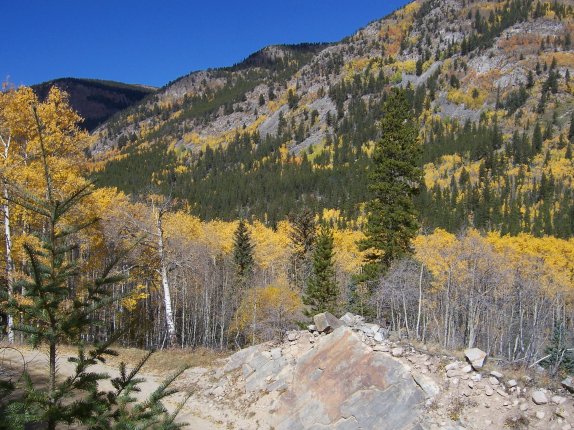
Yesterday morning we took the road west, up into the mountains, to see the fall colors. We chose wisely: The colors were at their peak, and were breathtaking. You could trace the paths that water takes flowing down the mountains by the bands of yellow aspen groves. After the first hour or two, I was very glad I have a 2GB SD card in my camera.
At the end of the “good” dirt road pavement was the famous Colorado sort-of-a-ghost-town, St. Elmo. The opening of the central Colorado mineral district in the early 1880s made St. Elmo happen, and the Denver, South Park, and Pacific narrow-gauge railroad kept the supplies flowing in and the ore flowing out for almost forty years. St. Elmo is not quite dead; people still live in some of the ancient buildings, which are painstakingly kept looking ramshackle because it's what people expect, even though the old photographs make the town look far better, and almost sprightly. Land there is mind-bogglingly expensive, and encumbered by deed restrictions that require that your buildings look “historically accurate,” which as best I can tell means looking like they're about to fall over. Maybe living at 10,000 feet will do that to you.
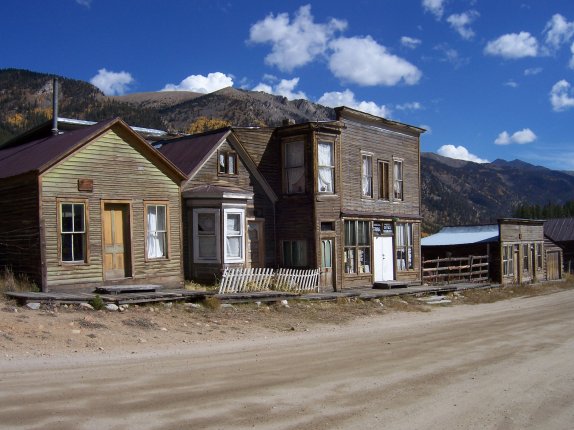
The old DSP&P right of way is still there and can be traced, and parts of it are now a hiking trail. I tried to climb a 100-foot embankment up to the trackbed from one of the small lakes that the Forest Service maintains along Chalk Creek, but 10,000 feet will do other things to you as well, especially when you're 56. Note that it didn't stop me; it just made me angry, and I will return and get up to the alignment at some point in the future.
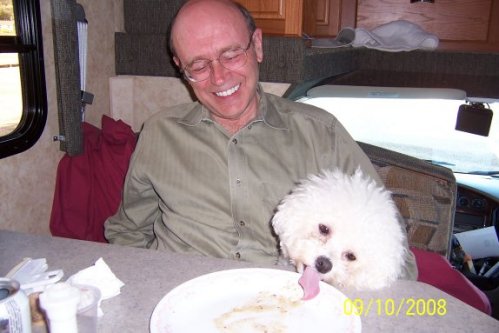
In summary: Our trip was a complete success. Carol and I allowed ourselves the privilege of staying in bed and cuddling until 8:00AM—which is easier when Aero hasn't been throwing himself bodily against the walls of his kennel to get our attention since 6:15. We took care to remember not only why we fell in love but why we stayed in love all these years: We continue to look at the world like a couple of wide-eyed kids, practicing the art of being delighted. Taking delight in one another makes it easier to take delight in the world, and vise versa. (Being jaded is for statues.) 32 years? Heh. We're just getting into second gear!
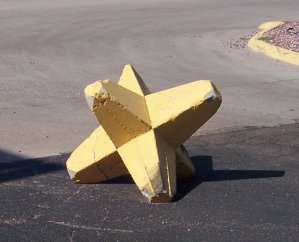 While filling up at the local Shell station for the last stretch home, I spotted the item at left used as a traffic barrier. It was about waist high. I've seen these before, mostly larger and piled up on shorelines as breakwaters, but I've never been able to determine what they're properly called. They're not exactly
  About an hour after parting with Laurraine and Mike, a carload of friends also on their way to Worldcon arrived, this time from Chicago, to spend the night and then head up to set up Steve Salaba's huckster table early this morning. Now, I'm a black belt car packer, but I have met my match, and then some: There wasn't a wasted cubic centimeter in that minivan. There was just enough room in the back seat for one person, blocked in on all sides by coolers and shelves and boxes of plush puppets and stuffed animals. (Note the “Bambi butt” that worked its way out of an overstuffed box toward the left.) It's not how I would have chosen to travel to Worldcon, but Steve, Bonnie (shown), and Eloise are all Worldcon pros from way back, and rotated positions in the vehicle often enough so the person in back didn't get suicidal.
 You've been warned.
 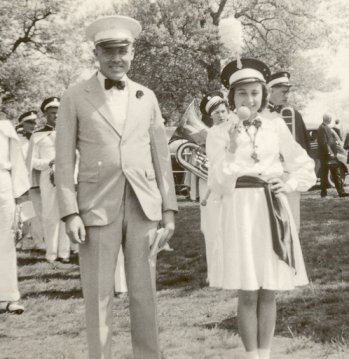 We got back from Wisconsin yesterday, having had a very good time getting soaking wet and eating perhaps a little too much. I had forgotten how pretty that part of the country was, even though my family went there often in the early 1960s. It was where my mother grew up, between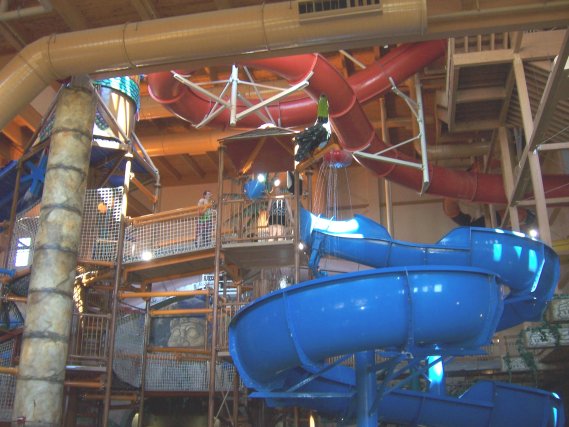

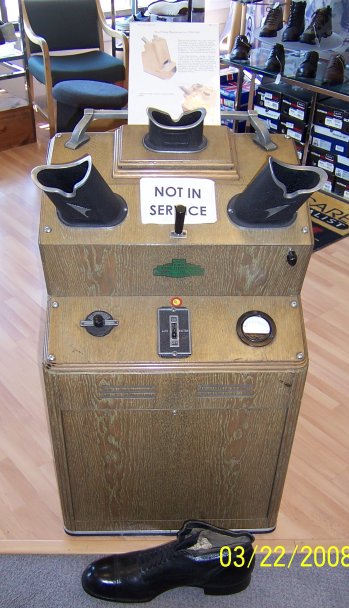 Just got back from Chicago and there's way too much to do (and I have a six-hour dental appointment scheduled for Thursday!) but I did want to report on something I saw on our trip that I haven't seen for a very long time: A shoe-fitter X-ray machine. People my age or older may remember going to a shoe store in the 1950s or earlier, and having your parents and the shoe store man look at your feet inside a new pair of shoes to make sure they fit correctly. I know I did this, and I vaguely remember the humming machine, but I suspect I was just too short to get to look into the machine myself. (I doubt I would forget a real-time X-ray image of my own bones. Urrrrp…)
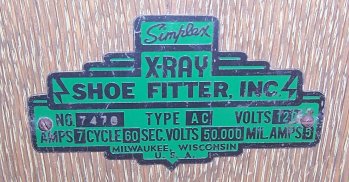 plate (below) indicates that the power supply drew 7 amps and put out 50,000 volts at 5 milliamps. That kind of power will generate considerable radiation out of an X-ray tube, and the associated hazards eventually put an end to continuous-beam fluoroscopy by untrained operators, in shoe stores and elsewhere. The hazards appeared not so much to the occasional shoe store customer as to the sales reps who ran the machines and sometimes to professional shoe models who tested shoes for manufacturers using machines like this; one woman's foot was damaged so badly in testing shoes that it had to be amputated.