Jeff Duntemann's Contrapositive Diary Rotating Header Image

Memoir

Remembrances of things past, in my own life and those near to me

Missed Opportunities

Carol and I had lunch today at the Black Bear Cafe, and while working on my canonical half Carson Club (a ham-and-swiss with bacon; I tell ’em to hold the tomatoes) the muzak played “Down Under” by Men At Work. I recalled that, back in (presumably) 1982, when the song hit #1 here, I missed an opportunity to actually try Vegemite, famously mentioned in the song. We lived in Rochester, NY at the time, where I was writing data validation software for Xerox. At one of the Rochester Science Fact and Fiction Association potlucks, somebody had brought a jar of vegemite and put it out in a bowl for us to try. I looked at it with some interest, but Alice Insley (now Bentley) leaned over and said “Don’t. It’s awful.” (At least I think it was Alice, but sheesh, that was 27 years ago!)

So I passed on Vegemite, and it and I have not crossed paths at all in the ensuing years. Reading about the famous brown beer-yeast goop on Wikipedia made me ponder what other opportunities I have missed in my life. One was Microsoft stock: I told my broker to buy some when MS went public in 1986, and she didn’t, telling me later that she “couldn’t find any.” Bummer. (I’d be worth about $20M now if she had.) I passed on a very good job right out of college, working as a tech editor for an orthopedic surgery magazine associated with the Northwestern University medical school. It involved scrubbing up and observing surgeries right there in the operating room, and then documenting the procedures that they were developing at the time. The job paid $12.5K/year, which was a fortune for a liberal arts grad during the 1974 recession. I took a job performing surgeries on Xerox machines instead, for about 35% less money. Hey, I have a touchy stomach. Nothing like explosive vomiting in the operating room, eh? But I could have gotten into publishing eleven years sooner than I eventually did.

That’s about it. Keith and I talked vaguely about starting a magazine called Digital Camera Techniques back when digital cameras were still mighty exotic (I think 1995 or 1996) and decided not to. Shame. That might have been fun, but whether I could have masterminded two magazines simultaneously was a serious question. A digital camera mag was not a sure thing, either–one can be too far ahead of the curve as easily as too far behind it.

Life did not offer me a great many interesting opportunities, and those that it did offer I mostly took: Carol, Clarion, Ziff-Davis, Borland, and Keith’s famous interjection, “Hey, we could publish our own damned magazine!” I had a chance to resurrect Carl & Jerry, and I did. Mostly I was careful, and kept a low profile compared to some of my gonzo friends.

It’s a family tradition. In late 1951, when my father was about to graduate from engineering school, he was offered a job with an oil company in downtown Caracas, Venezuela. He wanted to go, but my mother was sure that Venezuela was nothing but steaming jungle. (She was a nurse; I suspect she was worried about malaria, etc.) I was born less than a year later. What would life have been like had I spent my first ten years in South America? I’d speak fluent Spanish now. I’d have seen the Magellanic Clouds. Beyond that, who knows? There are linear lives, and fractal lives. I have instinctively chosen a linear life. I’m good with that–but sometimes it makes ya wonder…

Red Swill and Warfarin

Today’s entry is about classic rat poison. Or maybe a Georgian folk band. (From our Georgia.) Or perhaps the mis-persistence of memory, mine specifically. And certainly about the power of true names.

Hokay. Calling all Baby Boomers formerly of Chicago: Do you recall seeing signs tacked to the wooden power poles in the alley, warning us that the City of Chicago had set out “Red Swill and Warfarin” to combat rats? The memory came to mind in an odd way: I had remembered my writer friend Chuck Ott casually remarking, some time back in the 70s, that “Red Swill and Warfarin” would be a great name for a fantasy thief and his barbarian sidekick. The signs were a commonplace when I was ten or twelve. And whereas it’s been my experience that absolutely everything has been mentioned somewhere on the Web at least once (and thus findable via Google) I found nothing about “red swill and warfarin.” I did find a decent folkie band in Macon called Red Swill. I found plenty about warfarin, which is a medical anticoagulant that was toxic in rats until the rats ate a little too much of it and started developing tolerance in the 1960s. But no mention of the signs, which all my Boomer friends knew as just part of the alley background in our home town.

Pete Albrecht mentioned on Skype last night that there is an herbal called red squill that is toxic in large doses, and (significantly) an emetic. That’s a big deal if you’re a rat, because rats can’t vomit, and emetics put them into convulsions. Aha! So we do find mention of the thief and his barbarian:

It was the spring of 1967 [in Lincoln Park, Chicago] when I came up with a plan. Spring was when they baited Pearl Court with Red Squill and Warfarin, and every few days you’d see a dead rat lying there. Many of them were decomposing and maggot-eaten but one day I found one in perfect condition. I picked up that rat by the tail and put it in a shoebox. I took it to my grandmother’s house, the back yard of which adjoined Pearl Court, wrapped the box with brightly colored paper and tied it with a shiny ribbon. I then took it over to Robin’s house a block away. He wasn’t home, but his older sister was outside with some of her friends. “Hi, Debbie,” I said in as casual a tone as I could muster, “I have a present for Robin. Please give it to him and make sure you tell him it’s from me.” The next day in school he approached me, grinning like a jackal, and spoke his first, but not last words to me. “Thanks for the present!”

Yet another example (in my long list) of the truth that if you don’t know what something is called, you can’t find it. The last time it was coupler nuts, but the nice man at Ace Hardware looked at the sample I had found in my junkbox and took me right to them. The time before that it was golabki. (I know a few Polish words, but can’t spell them.) This may be an unsolveable problem, or at least one with no general solution.

And while I’m at it, here is more than you probably wanted to know about all the various concoctions used to kill rats. Bad beer with a little food coloring might work too, but I’ll leave that experiment to others.

FuzzyMemories of Classic Chicago TV

I have a lot of things on my mind (and plate) today, but I did want to pass along a pointer to a site that I received from Kevin Anetsberger: FuzzyMemories.TV, the Museum of Classic Chicago Television. What we have here is a large collection of short video clips from Chicago TV, the bulk of it from the 1977-1990 era. The clips are mostly short snippets of local TV shows, local TV station IDs and transitions, and especially commercials. I haven’t had the time to go through much of it, but the Empire Carpet Man is in there, along with Boushelle Rugs (“Hudson 3-2700” sung in that boomy, basso profundo voice) and clumsy pitches for a lot of other local companies, including McDade (now long extinct), Zayre (ditto, though not exclusively of Chicago), Jewel, Venture (gone), Kiddieland (still there), Victory Auto Wreckers, and lots of TV ads for Chicago radio stations, like “FM 103 and a half.” Plenty of kid stuff from Bozo, Ray Rayner, Garfield Goose, Svengoolie, Son of Svengoolie, and Gigglesnort Hotel. The clips that aren’t commercials often include commercials, and the site provides abundant evidence that 70s hairdos and clothes really were as bad as we remember them, and not just in Chicago. (WFLD news anchor Kathy McFarland looks better than most, but oh, those guys on Fernwood 2 Night…)

Carol and I left Chicago when I got a transfer to Rochester, NY in early 1979, so nearly all of this stuff dates from after my era, but there are a handful of things from the early 70s, and some clips from an early educational cartoon called “The Funny Company” from 1962. Home videotaping first became a big thing in the late 70s, and that’s probably why there isn’t much there from the 60s, as much as I would have liked to see it.

Here’s an interview with Rick Klein, FuzzyMemories.TV’s creator. The site is on my short list of things to spend some time on when I have time to spend, but if you’re in that space right now, go take a look.

The Turtle Wax Turtle

Somewhere in Chicago (Pete Albrecht and I are still trying to figure out precisely where) there was once a very Gothic-looking building with a giant turtle on top of it. It was the Turtle Wax turtle, of course, and it existed when I was quite young. Any time we'd be in the car passing by it, my folks would very carefully point it out. That would have been 1958-1962 or so. Pete thinks the building is the Wendell Bank Building at the intersection of Madison, Ashland, and Ogden, and it certainly looks right, though Pete remembers the sign being somewhere on Cicero and not Ashland. I confess that I have no idea, but that intersection would have been on the way to visit my grandfather and Uncle Louie, so it's a plausble hypothesis.
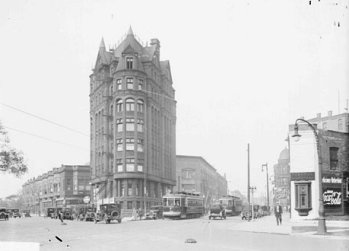
The search for the abode of the Really Big Turtle did turn up an interesting little video on the main Turtle Wax history page about Ben Hirsch and the genesis of Turtle Wax. Hirsch invented Plastone Car Polish, which became Turtle Wax after Hirsch stopped by Turtle Creek near Beloit and had the brainstorm that his car polish created a “hard shell finish.” Hirsch also invented the chocolate-covered banana on a stick and a few other things, though I suspect he made most of his money on Turtle Wax. The video shows some stills of the Big Turtle being erected and is worth a look, especially since it shows the monumental size of the statue. The video also includes an animated ad from the 1950s that's worth the cost of admission. The turtle sounds like Jimmy Durante.
I'm a little surprised that something that big and that iconically Chicago has been so little recorded online. It may be that it existed for only a few years, and it may have been moved to another location at some pont. We're looking for better information and I'll post any updates here as they happen.

Off By One Error

Carol and I got up at 3:30 AM last night and found the skies crystal clear, so we hauled out onto the back deck in our fuzzy robes (along with a couple of doubtless-puzzled bichons) sat down in two of the patio chairs, and leaned back, facing generally east. The Perseids did not disappoint; in forty minutes we saw twenty or so, and most of them were quite bright. We didn't have access to the whole sky with the house behind us, so I'm sure we missed quite a few. Still, the count is about in line with what we've seen in past years, and for Carol and me (and the Perseids) there have been a lot of past years.

In fact, I'm pretty sure we watched them from her back yard two weeks after we met in 1969, though not at three in the morning. No matter. I see meteors almost any time I spend more than a minute or two scanning the skies, even from as light-befouled a place as the close-in Chicago suburbs. One reason Carol came to love as scruffy and odd a specimen as me was that I was willing to talk science with her. I pointed out the constellations to her, and dragged my junkbox telescope out into her driveway to show her the moons of Jupiter. Over the years, the Perseids have become something of a tradition for us.

I have a talent for pastiche, and when I was young it was almost a compulsion: If I read enough of something I almost always tried to imitate it, with greater or lesser success. During my sophomore year in the English Literature program at De Paul I was taking one damned poetry course after another, so it was inevitable that I would try my hand at poetry. During my Robert Frost period (which was roughly the last three weeks of April, 1972) I penned a lot of metered drivel in down-home country dialect. One effort was a sonnet, just so I could say I had written a sonnet. Even though I was a New Formalist long before there was a New Formalism, I knew the Prime Directive of modern poetry (Thou Shalt Not Rhyme) and withheld any rhyme until the final couplet. I gave the poem to Carol the night we watched the Perseids from my parents' summer home at Third Lake, Illinois:

Perseid

I saw a shooting star last night, you see.
It bothered me to think that golden streak
That split the sky half-raw and hung awhile
As though to rub the wound with pale white salt
Was washed clean-gone by night's soft-rushing flood
In just the time you'd take to poke the coals.
You know, they say it's just a grain of sand
So small you'd never see it in your cup
Once all the tea was gone. I wonder now
What made God give a speck like that such spunk
While here I balk and eye our road so roundly…

You know, I think I'd not so fear the night
If, going out, I knew I'd make such light.

Carol read it appreciatively (as she always did, irrespective of what it was I had handed her) and then, giving me a peck on the check, asked, “Don't sonnets have 14 lines?”

“Well, sure!” I said, taking the sheet back from her hands. A quick count reassured me that it had…13 lines. Damn.

Ever since then, I've been famous around the house as The Guy Who Writes 13-Line Sonnets. Clearly, rhyme was good for something—like helping numerically illiterate poets keep track of the number of lines they were producing. After that, I returned to my more freeform e. e. cummings period (which had been the first three weeks of May, 1972) until I found the wisdom to understand that I was a better astronomer than I was a poet. I've stopped writing poems, but the Perseids—heh, like Carol and me, that's forever.

LOLMonsters

We were just BSing a couple of nights ago over wine and beers at Julie's christening, and LOLCats came up. I'm not a regular reader of LOLCats, but I've seen it enough to get a sense for the genre, and the addition of a little zinfandel reminded me that this is not a new thing.
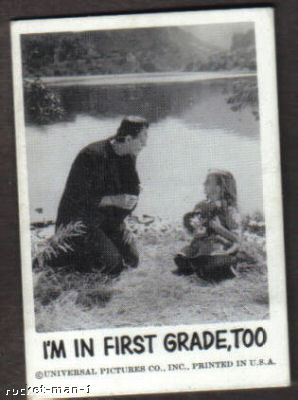
Nossir. I remember Monster Cards.

Back in 1961 or 1962, a fad was raging in my corner of the Immaculate Conception grade school playground: Monster cards. These were a little like baseball cards (and about the same size) but instead of sports heroes, they had stills from old monster movies, with a silly caption at the bottom. This was in plain English and not LOLCats-speak (which itself is a parody of IM shorthand) else the card at left would be captioned PUT ME ON UR FRENZ LIST? On the flipside was a drawing of a ghost over a joke calculated to make fourth-graders laugh. (As you might imagine, the bar was not very high.) The whole thing was wrapped up in plastic with a card-sized rectangle of some tepid and invariably stale bubble gum. My friends were all collecting them, and even though I spent my money on Hi-Flier kites and Tom Swift books rather than monster cards or comics, I flipped through my friends' stacks, grinning at some and rolling my eyes at others.

There were two types that I remember, both available from Perlen Drugs at the corner of Canfield and Talcott. The larger cards had “Spook Stories” printed on the back and were copyrighted by Universal Films. These had the most famous and recognizable monsters: Frankenstein, the Mummy, the Creature from the Black Lagoon, and the Wolfman. The jokes on the back were sometimes even clever. The smaller cards had “Monster Laffs” printed on the back over the jokes (which were invariably stupid and rarely funny) and were printed in sheets of three with bad perfs between them. My duller friends who didn't catch on to folding at the perfs before separating them often had to Scotch tape their cards back together after inadvertently ripping them in half. These smaller cards (which collectors have dubbed “Monster Midgees”) were copyrighted by cheapo fright house American International Films, and apart from the several incarnations of the She Creature and the memorable Colossal Beast, showed monsters that few of us had ever seen, even with Chicago Channel 7's perpetual scraping of the bottom of the monster movie barrel. Mostly they were hokey-looking paper mache alien things or brains with eyes, over even hokier (and generally un-funny) captions.

I'm surprised at how little there is online today about monster cards, at least the ones that I recall. The genre continued long after I left grade school, mutating as it went, but I ignored them because they dropped the humor. The legendary Mars Attacks! cards were in no way funny; in fact, they were a gruesome comic book presented one frame at a time. (I wonder sometimes if they were a poke in the eye of the Comics Code Authority.) Cards from mid-60s TV series like The Outer Limits and Star Trek had stills from the shows but no funny captions and no jokes—and sheesh, guys, I had already seen the TV shows. I half-expected full indices of the cards and their captions online, but apart from a few fan pages and pictures of cards for sale on eBay, they've mostly been forgotten. “Caption humor” seemed to go into eclipse for forty years, not to emerge until the Internet Age and LOLCats. I guess everything comes back eventually. I used to wear purple bell-bottoms and worse in the late 60s and early 70s. Are they next?

Father’s Day

To the eternal memory of Frank W. Duntemann (1922-1978), engineer, who said, “When you build 'em right, they fly.”

You did. And I do.

Contra Is Ten Years Old

I know I'm older than dirt. What still boggles me a little to think on is that I'm older than…blogging. Yes indeedy: Ten years ago today, I wrote the first entry for something I called VDM Diary. (VDM, of course, being Visual Developer Magazine, which I owned and edited until we shut it down in early 2000.) I had no idea what I was doing, and certainly had no idea that what I was doing would soon become a global phenomenon that would put whole newspapers in their graves and change the shape of information dissemination.

It's amusing to go scanning around the Web to read the heated arguments about who invented blogging. I'll pull an Al Gore here and say that I did. So did a number of other people. It's not like it's rocket science to take a literary form that goes back to at least 1660 and put it…on a Web server. Oh, the genius!

Actually, I'm even more like Al Gore in that I didn't invent blogging—I just like to say that I did. In truth, Lisa Marie Hafeli did, and she simply pestered me into implementing it. Lisa was my ad sales rep at VDM, and she wanted me to figure out how to get more product mentions associated with the magazine, so that she could get a little more credit with developer tools companies. We only had so many pages for reviews and news releases, but…how about talking about products online? How about just writing a little something every day or two about a product?

I remember her bringing up the idea at the beginning of 1998, and I thought about it for months before giving it a try. I had never kept a paper diary, though I wrote a lot of email and posted on forums, so I was used to writing in short pithy snippets. I was leery of pandering to advertisers, so I tried hard to avoid the appearance of just doing VDM Diary to work in product mentions. It was by intention that I sprinkled in little weirdnesses like the FBI's database of UFO sightings (June 17, 1998) and odd observations from my own work in technology, like how Word 97 irritatingly autoconverted the sequence “:)” to a smiley icon. I did the product mentions, but they didn't seem to make much difference in our ad sales efforts. So I branched out, adding personal observations on my own life, and by the middle of 1999 I was thoroughly hooked. Alas, that was about the time that VDM began imploding, and I was depressed for a solid year after Coriolis shuttered the magazine. (Coriolis itself didn't last much longer.) But even though I no longer had a magazine, by the middle of 2000 I re-established a Web diary on my own domain (duntemann.com) and have been doing it ever since.

ContraPositive is not the oldest blog still posting regularly. I think Lileks' Daily Bleat (which goes back to early 1997) has that honor, though if you know of any older ones still posting, please send a pointer. Bob Thompson's Daynotes Journal started up less than two weeks after Contra did, and is still going strong. Jerry Pournelle has been doing something with regular postings on his Web site for a very long time, but it's not organized like a diary, and very hard to figure out where everything is and how long it's been there. (This doesn't mean it's not worth reading.)

Interestingly, I've been told by a couple of people that what I do is not really a blog, and is actually more like a daily newspaper column. There's something to that. When I was a kid, I used to admire writers like Jack Mabley and Bert Bacharach (not his composer/musician son Burt) who wrote daily columns in the local newspapers. (Jack Mabley wrote a blog for a time when he was 90, until he passed away in 2006.) The energy that sustains Contra comes from a conviction learned from far better writers than I (like Gene Wolfe) that no matter what else they might do, writers should write something coherent every day. I usually manage that, though understand that I write on a lot of different projects, of which Contra is only one. Doing it daily isn't difficult. Being coherent, now, well…

In the last year or so, I've been doing fewer Contra posts and longer ones, and gathering shorter items (usually focusing on links) up into regular Odd Lots posts. I'm trying not to split my concentration too many ways on any given day (context changes are costly!) and if I'm working intensely on something like Degunking Essentials or Old Catholics, I tend not to work on Contra that same day. I have bookmark and email folders for items to address later on, and periodically go through it, deleting or archiving items once I've covered them here. The system works, and I'll use it until I think of something better.

As I've said here in a number of contexts, writing benefits the writer as well as the reader. It's good practice, it's discipline, it dissipates tension, and it's one way to stay current in the world. Having something coherent to say requires that you live an attentive life and remain curious about many different things, and the best way to learn something yourself is to explain it to someone else. Contra works for me. I hope it works for you. Thanks for reading, and stay tuned.

The D-Stix Kite Flies Again!

As we concluded our first date back on July 31, 1969, I somewhat apprehensively asked Carol if she would go out flying a kite with me on the following Saturday. I was building a tetrahedral kite out of my D-Stix set, and although my intuition was that this was not the way to impress girls, I gave it a shot, and she accepted. And so it was that we piled into my mom's '65 Biscayne and took my D-Stix tetra out to the huge Forest Preserve field at Irving Park Road and Cumberland.

The kite didn't fly well, if I recall correctly (and in truth, most of what I remember about that Saturday afternoon was Carol) but we both had a great time. An hour or so in, the kite smashed into the ground and broke a couple of sticks, but I salvaged the yellow connector pieces—and when I recently pulled down the butter dish that the D-Stix connectors had been in since who knew when, begorrah, they were still in there, including one with some kite string still tied through the hole.

It was a natural. I took the same damned D-Stix pieces, bought some 1/8″ dowels, and I made us another tetrahedral kite. At some point I will create a Web page describing its construction in detail, but I'll just insert a few photos here. A typical joint is at right. The yellow connector originally had eight “ears,” but I snipped two off with a dykes to make the requisite six. (The four outer vertices were six-bangers from which I snipped three.) The paper was ordinary Hobby Lobby artsencrafts tissue, which I glued with Elmer's glue. Mucilage would be better—or at least more historically accurate—but they don't sell that at Hobby Lobby anymore.

Building the kite didn't take much doing. I assembled the D-Stix frame, cut out some conjoined equilateral triangles of tissue, and glued the tissue to the frame. There were a couple of tricky glue joints, but nothing that a protruding corner of a chunk of plywood didn't finesse. All in all, it took maybe an hour.

And it flew. Sorta. Carol and I got it into the air down at the park along Highway 115, but the wind was strong and erratic and I had to hang some tail on it to keep it aimed skyward. It had a tendency to lean left, and after a few minutes of tearing around the great blue sky like a puppy suddenly released from its kennel, it did The Dive, and mashed itself against the grass just like its previous incarnation had, almost 39 years earlier. Two sticks popped out of their sockets, and the tissue ripped in two places, but it's nothing a clever geek can't fix.

It was beautiful. (And weird.) Just like Carol (and me.) We laughed, and laid back in the grass, and reflected that life can be good on a brisk Saturday, with a kite and some string and a willingness to let all the rest of it just blow away for awhile.

My Favorite (Or Maybe Second Favorite) Year

Harry Helms recently sent me something he thought I might enjoy: A copy of the 1964 Allied Radio catalog. When I opened the package and sat down with it, I realized that 1964 might well be my favorite year, if second to any then second only to the magical summer of 1969, when I met Carol. (1969 was painful at times for reasons that had nothing to do with Carol, first of which being that in 1964 my father was not dying of cancer.) I turned 12 in the summer of 1964, and had not yet begun to feel the hormone storm that would close in by the summer of '65 and make me crazy for years to come. Granted, many of the girls returned to IC School that September with a couple of things they didn't have the previous June, but apart from a passing fascination with a little girl named Laura that fall (which she never found out about—whew!) the whole girl thing blew past me. Halloween was on a Saturday that year—what luck!—and it was warm. Ten full hours to scavenge sugar from the neighbors, and we didn't need three sweaters under our costumes!

But for me in 1964, electronics was the thing. I had discovered electronics when I was 10, began seriously reading library books about it and building things when I was 11, and had begun to achieve some modest success by the time I turned 12. Simple radios were problematic, because my antenna looked right down the throat of hillbilly rock station WJJD's 50,000 watt directive array a mile or so northwest of me in Park Ridge, so I built other things: A two-transistor organ (with keys made of strips of tin can metal) a cigar-box intercom (put to good use by the Fox Patrol at Camp Owassipe that summer) and a capacity-operated proximity relay, which (being “spooky action at a distance”) was about as close to magic as it came.

That summer my father taught me how to take the CTA bus down to Six Corners (over my mother's strident objection) and always gave me a couple of dollars to spend at Olson Electronics on Milwaukee Avenue, back at a time when a couple of dollars would buy a pocketful of resistors, capacitors, and transistors. Allied was also in town (at 100 N. Western Avenue) but that was a lot farther away, and not in an especially good neighborhood. I knew Allied from its catalog and its catalog alone.

But what a catalog! Anything a boy teetering on the edge of the Age of Lust might want was right there: Ham radio, CB, shortwave, hi-fi stereo, tape decks, portable radios, test equipment, speakers, tools, parts cabinets, resistors, capacitors, transformers, Miniboxes, plugs and sockets and chassis punches and antenna insulators, everything. The first 77 pages of the catalog was the full list of Knight Kits, which were cheaper than finished gear because you put them together yourself. I later went on to build a few and own many more Knight items, including the wonderful T-60 CW/AM transmitter, the nice LC-1 CPO, the so-so R-55A receiver, and the totally wretched T150A VFO transmitter, which wandered across more territory and with more brute persistence than an alley cat. Interestingly, the Knight Kit I wanted the most in 1964 I never got: The Span Master shortwave radio (at left) which I thought then (and may still) to be the coolest-looking radio in history.

The back of the catalog was fascinating, as it listed in minuscule type endless small electronic parts and hardware, some of which I ordered through the mail, careful to send enough money to cover the goods and postage, and often (to be sure I hadn't messed up the shipping calculations) a little more—which Allied always honestly refunded, in the form of 4c and 7c credit slips to be applied to my next order. That part of the catalog is still useful as a reference: If you run across a Knight 61G466 power transformer at a hamfest, the catalog will tell you what the output voltages of its various windings are.

Some of the stuff I didn't want, and often had no clear concept of why it was useful: What good, after all, was a clock radio? I have an inner alarm clock that I can “set” to any arbitrary time and have never had any trouble bouncing out of bed at 6 ayem, often singing. (Carol is a very patient woman.) “You can wake up to music!” said the ad. Indeed. And you could plug your coffee pot into the back of the radio, which I just couldn't figure, as we were a gas household and an electric coffee pot was heresy, pure and simple. Tachometers and electronic ignition systems—no visceral response; when you're 12 and “small for your age” driving is almost unimaginable. The Blonder-Tongue (now there's a name for you!) TV mast signal amplifiers puzzled me; in Chicago you could practically get Channel 9 on your fillings. (You would, if WJJD hadn't already saturated them.)

1964 was the last great year of tube electronics, and the transmitters, receivers, and test gear units were not only big enough to see, they were big enough to cause serious injury if dropped on body parts. (I dropped a Central Electronics 100V transmitter on my thumb in 1998, and my thumbnail has never been the same since. And hey, in 1998 I was 46 and careful.) The prices on much of it were daunting: The Hallicrafters SR-150 SSB transmitter was $689—what the Inflation Calculator tells me would cost over $4600 today. The best a 12-year-old boy could do was look at the pictures and think, Hey, someday I may have this thing! The Allied catalog was the drool book of all drool books.

Yes, it was a great year. When my family went out to California on the Union Pacific that summer, my Allied catalog went with me (along with several issues of Popular Electronics and a couple of Alfred Morgan's books) and I got past the endless wheat fields of eastern Wyoming doodling chassis layouts on a pad of paper. That fall I built a regenerative receiver from a Popular Electronics article, with $15 worth of parts carefully ordered (and paid for by my saintly father) from the 1965 Allied catalog, which arrived without being summoned in October. I could never make it work well (though it picked up WJJD without any trouble) and there were times when I was tempted to give up electronics and just stare at Laura in English class like all the other guys did. But no: Girls were mysterious, and I would be years'n'years figuring them out. (I may still have a few years to go on that score.) But electronics? You flip a switch, and things happen. That was my kind of magic, and the Allied catalog was where it all came from, whether in grand dreams or grubby reality. I had both, and Halloween was on a Saturday! Life was good.