- At our most recent nerd gathering here, four of my friends and I managed to carry our 1997-vintage, 198-pound Sony CRT TV set up our precipitous stairway out to the 4Runner, and a few days later I paid Blue Star recycling $37 to see it to its final rest. Many thanks to the guys–we had been pondering how to get rid of it for the past several years. Friends are most excellent to have, especially for people like me who can’t lift 100 pounds anymore.
- And this means we’re shopping for a downstairs TV. I came across a good site focused on plasma TVs, which as a class may be problematic at our current altitude of 6600 feet. Apparently they buzz and run far too hot, though the physics of the phenomenon remain obscure to me.
- I’ve found the first (thin) review of the Motorola Xoom. Few details yet, but I will say up front that the cloud-based ebook system doesn’t thrill me. Early releases of Honeycomb may not support the XD card slot, but Motorola hints that an OS update will take care of that. That’s important here: Given that 16GB MicroSD cards are already down to $35, sideloading my entire ebook library would be a snap, with room left over for lots of music and videos.
- I also recently found out that the Xoom GUI borrows from the quirky but interesting BumpTop, recently bought by Google and then pulled from general distribution.
- I may be too old to appreciate the BumpTop 3D metaphor (I always think it looks like working inside a refrigerator box) but some good themes have been created for it, including this steampunk specimen.
- Xoom has a “barometer.” Most commenters, including the LA Times , don’t seem to understand that a barometer can measure altitude with more accuracy than GPS. I doubt that the Xoom’s barometer will have anything to do with weather reports. (Else there’d be a thermometer and a hygrometer as well.)
- There’s a long-running feud between Samsung and US cell carriers over who pays for Android updates, with the result that many Samsung phones are stuck at Android 2.1 and may never get an update from the vendor. (Applying the update yourself is not for the squeamish.) Yesterday afternoon, of course, Samsung denied it all. As intriguing as the Galaxy Tab looked when I played with it back in November, issues like this may keep me away from Samsung wireless products entirely.
- Some images speak for themselves. Like this one. (Thanks to Pete Albrecht for the link.)
- Oxytocin may be the biochemical basis for tribalism, racism, political parties, and just about everything else that the human species would be better off without. “Cuddle hormone” my ass.
- Good-bye to seigniorage, not that one person in ten thousand ever knew what it was–or how to spell it.
- Ahh, well. I may have eaten my last pistachio.
science
Odd Lots
Odd Lots
- I may be the last person to aggregate this, but if you haven’t seen it yet, consider: The Sun being eclipsed simultaneously by the Moon…and the ISS! Thanks to Bill Higgins for pointing it out. (Talk about having to set up a shot!!!)
- And for further astronomical boggle-fodder, consider this: A ten-year-old girl discovered a supernova a few days ago, and is the youngest person ever to do so.
- Here’s a site listing a great many 19th Century and early 20th Century studio photographers, many with addresses and sometimes timeframes. All but one of the studios I’ve seen on old family photos I’ve scanned (circa 1880-1910) are listed. How useful this might be is hard to tell, but if you’re currently doing genealogical research it’s worth a bookmark.
- RF Cafe has a nice table of dielectric constants, useful if you’re winding coils on odd scraps and not commercial forms or cores.
- The same research yielded this short discussion of how good PVC piping is for RF use. Quick form: Most plastics are better, but they don’t make polystyrene pipe. They don’t even make polystyrene vitamin bottles anymore. (Fortunately, I still have a few in the scrap box.)
- From my old friend Dennis Harris comes a pointer to Televisiontunes.com, which has short MP3 clips of 18,351 TV theme songs and all their variations. Elmer the Elephant is missing, but damn near everything else is there, from Supercar to The Ugliest Girl in Town .
- Last week while we were in Chicago, my nephew Brian showed me Google Sky Map on his Android smartphone. Basically (assuming your phone “knows where it is” and when) you can hold your phone up against the sky, and it will show you what stars and planets lie in that direction, even in broad daylight. Aim the camera at your feet, and you’ll see what’s on the other side of the planet, swinging toward rising or circling the opposite pole. Way cool.
- From the Words I Haven’t Heard In A Long Time Department: bric-a-brac , a collective term for odd items of low value. I realized, digging through a box in the garage, that I must hold one of the world’s largest reserves of bric-a-brac. Damn. I shoulda invested in rare earths.
- Related to the above: Rubrique-a-Brac , a long-running cartoon strip by French cartoonist Gotlib. His 1971 Taume 2 collection of strips is the funniest book in French I ever read without knowing French. (I do have a French-English dictionary, which helps, but the art largely speaks for itself.)
- As if the Nazgul weren’t enough: We’ve gotten word that there was once a giant stork that preyed on the Flores Island hobbits.
Odd Lots
- I’ve been maxed out for the last week or ten days on numerous things, not excluding Christmas, which is why you haven’t heard from me here. So even if the Odd Lots file is a little short this time (who’s had time to wander online in search of Interesting Things?) it’s the best I can do for the moment.
- There is a very-close-to-optimal total lunar eclipse tonight, with totality beginning at 11:40 Pacific Standard Time, 12:40 Mountain, 1:40 Central, and 2:40 Eastern. Totality lasts for 72 minutes. Because we’re at the Winter Solstice, the eclipsed Moon will be as high in the sky for North Americans as it ever gets; you will be looking very close to straight up, especially if you’re on the West Coast. Here’s the NASA page on the eclipse. I don’t boggle at this kind of trivia anymore, but we haven’t seen a total lunar eclipse on the WInter Solstice since 1638. (I believe there will be another, however, in 2094.)
- In other astronomy news, the Sun is dead quiet again, and we are in our second day without sunspots at all on its visible face, at a point in the sunspot cycle when the sunspot number should be at least 30 or 40 at minimum. With the solar magnetic field continuing to drop, suggestions that we are in for another Dalton-scale solar minimum seem less outlandish than they did a year or so ago. So much for 10M DX.
- I’m still trying to determine if this is a hoax or not. If not, I might order some to calibrate my still-incomplete (if haltingly functional) Geiger counter. Don’t skim past without reading the first comment: 4,182 of 4,252 people thought it was useful!
- Apple is keeping certain iBooks layout features to itself, sharing them (under NDA and perhaps at a high price) with large publishers only. WTF? How can this possibly help them?
- Perhaps (finally!) realizing that annoying your honest customers is a dazzlingly stupid thing to do, Microsoft has quietly retired its Office Genuine Advantage program, which required users to verify the propriety of their copies of Office before allowing them to download templates and so on. This does not mean that Office activation has been abandoned, only that MS will no longer give you the third degree for existing Office installations, especially 2000 and 2003.
- The term “non-Newtonian fluids” makes them sound a lot more exotic than they really are, but as materials go, they’re pretty cool. I borrowed the concept (which I read about years ago) for a bullet-proof cloak in my in-progress short novel Drumlin Circus, but it looks like that idea may become real-life at some point. (Hey, doesn’t “Bullet-Proof Custard” make a great imaginary band name?)
- Not sure what to think about an assertion that C. S. Lewis is the Elvis Presley of Christian publishing.
- Don’t have a Chester A. Arthur bobble-head? Want one? Grab some old photos online and send them to Sculpteo, and get a hand-painted bobbler of the guy and his muttonchops. Not cheap–$80 to $100–but we’re seeing the first wave of commercial 3-D printing apps here. Why not be an early adopter?
Odd Lots
- I got an email recently from ABEBooks inviting me to their Weird Book Room. They were telling the truth, and I was not disappointed. I was a little surprised that I only own two of the titles on the list (guess which ones!) but I’ve already ordered another: How to Be Pope by Piers Marchant. I mean, c’mon, how could I not?
- I complain a lot about pocket camera latency, but check this one out: A seminal 1990 digital camera from Leica took three minutes to grab a shot. Those handles are cool, sure, but I’ll guess that a tripod works better.
- Think of Constantine at the Milvian Bridge for a moment: “In This Sign, Conquer.”
- Various party poopers emailed me this story about an Antarctic cruise ship that lost an engine and got pounded by 45-foot waves somewhere in the Drake Passage. Yes, I feel better already, thanks.
- Don’t forget the Geminids meteor shower late Monday night/Tuesday morning early. It’s probably cold where you are, but the show might be worth it.
- There will also be a total lunar eclipse the night of December 20/21.
- I used to pick up The Fortean Times at the Village Green Bookstore in Rochester, NY in the early 80s, and it was fine bathroom reading. I’m delighted to report that their Web site is still good, albeit less convenient in the bathroom. I wasn’t aware that no viable peas were found in King Tut’s tomb, but that sort of ignorance is easily corrected. Ditto the feral parrots of London, which have been there long before Jimi Hendrix made the scene and felt that it needed some color. Hey, paint’s cheaper, and it doesn’t poop on you when you’re sitting under a tree.
- I guess the primary virtue of The 100 Best Movie Spaceships is that 100 spaceships is a lot of spaceships, so just about everybody gets in. (Thanks to Frank Glover for the link.)
- David Stafford provides a link to a functional re-creation of the Antikythera Device…in Lego! (I’m guessing that it’s also been done in Meccano, but I’ve not gone looking.)
- Here’s a remarkably long and detailed (for attention-challenged io9, at least) essay on the biological effects of sudden exposure to vacuum, a la Dave Bowman in 2001. As a bonus, author Geoff Landis explains (with equations) how quickly your spacecraft will lose atmosphere if punctured. I’d read this site more frequently if there were more of that and less of this.
- My old friend Neil Rest is right: These are about as cool as artistic representations of cities get. And they’re all made of techie castoffs, including cardboard. Wow! (And in the comments is a link to a chess set made of various coax connectors. Way wow!)
- I wouldn’t have thought of this: Coat a few bazillion tobacco mosaic viruses with conductive material, and you can use them make batteries with ten times the capacity of lithium-ion tech. Well, with the ongoing decline in smoking, what else are all those poor unemployed tobacco viruses gonna do? (Thanks to Roy Harvey for the link.)
- From David Stafford comes a pointer to instructions on how to determine either the speed of light or the operating frequency of your microwave oven by tormenting marshmallows.
- With that, I think I’m caught up on the Odd Lots file. More as they come in.
Odd Lots
- Maxwell’s Demon as Web comic. (Thanks to GMcDavid for the pointer.)
- Here’s a tutorial on adding a MicroSDHC card to the Nook ebook reader. Looks like a mechanically touchy business (be careful!) and nothing substantive is said about sideloading content on the inserted card. Sideloading of content is something I’m less and less willing to compromise on, as I do not want a censor between my slate and material that I want to read.
- I’m due-ing diligence on the very impressive, Android-powered Nook Color, but the frontrunner in the Great Jeff Slate Project continues to be the Galaxy Tab, especially since Samsung is offering this keyboard dock. That said, Nook Color is the right idea for ebook freaks: Approach a general-purpose slate from the ebook side, starting with a killer ebook store and working toward everything else. (Supposedly, V2.2 and access to the Android app store is coming soon.) My view: Dedicated e-readers like Sony’s and even Kindle will eventually give way to more general-purpose slates of similar size, though slates may “lean” toward one enthusiasm (like ebooks) or another.
- Back in 1983 and 1984, I did about 10,000 words on a since-abandoned novel that included a species of road surface that charged your car’s batteries as the car moves over the road. A pickup called the “board” (after surfboard) was suspended beneath a vehicle and hovered over the road surface via maglev to generate current like a linear alternator. I was pleased to see that Wired posted a news item on some guys in New Zealand who are developing almost precisely that. Not sure how well the math works out (especially with respect to infrastructure costs) but it’s a cool idea. I added another small touch: Ohmic losses in the “voltway” surface kept it snow-free in winter.
- Pope John Paul II was an idealist. Pope Benedict XVI is a pragmatist. My SF prediction: As he grows older and sees the problems besetting the Church getting no better and possibly worse, he will begin considering other reforms that his uncompromising predecessor would have considered impossible. Hey, Bennie! How ’bout Vatican 3!
- People who have lots of moles have longer telomeres. Or at least look younger than they are. Carol and I are both so blessed, mole-wise, but I think it worked better on her than on me.
- If you spend a lot of time in the car but off the Interstates, take a spin through RoadsideAmerica, a bemused compendium of eccentric stuff you can see on road trips. I liked the entry on smiley-faced water towers, since we pass one in Adair, Iowa every time we blast back and forth to Chicago. And Adair is far from the only one.
- From the above site: When we left Arizona seven years ago, some people nodded and said, Cool! Colorado isn’t as crazy as Arizona. Well…I’m not sure that’s true.
Odd Lots
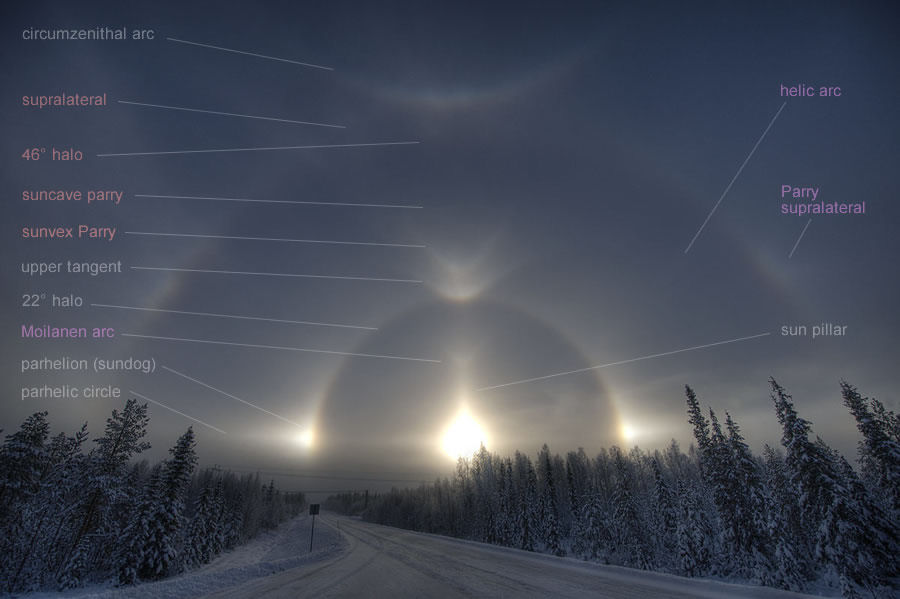
- Finland has some of the coolest sky phenomena on Earth.
- Sterile neutrinos? I think particle physics has gotten away from me. At least they didn’t discover it on the bridge of the Enterprise, with the Klingons closing in, right before the last commercial. (Thanks to Frank Glover for the link.)
- Are hipsters gone yet? Does their Weltanschauung capture the Zeitgeist? Or is it only a façade hiding the real bête noir? Will we miss them? Are you sick of dumb-ass questions yet? (Thanks to Pete Albrecht for the link.)
- And just when you think politics (even in my own relatively sane state of Colorado) can’t get any weirder, well…
- Several people sent me links to reports of an Irish chap who’s spotted a passerby in a 1928 Charlie Chaplin film talking on a cellphone. Gomog’s Razor (i.e., when all possibilities are equally unlikely, the craziest one is true) suggests time travel, but the little old lady in question may also be holding a compact mechanical trumpet hearing aid. Or maybe her ear is just cold. I’ll bank on time travel, and I know what she’s muttering into her Thiotimoline Smartphone: “Look, you idiots, I said send me to the year 2819, not the year 1928!”
- Samsung’s upcoming Galaxy Tab is getting a lot of press these days, but note that this review does not mention ebooks. At all. Wow.
- The Pontiac marque officially died this past Sunday. My grandfather Harry Duntemann always bought Pontiacs. His ’53 had an amber-colored glass Indian as a hood ornament, and my mother owned his loaded ’57 Chieftan from 1961-1967. It was a cool car with a very big engine, and given that my mom was used to driving tiny little Nash Ramblers from the mid-1950s, it was easy for her her to daydream and suddenly realize she was doing 80. I’ll miss Pontiacs. And my next car will almost certainly be a Ford, for reasons I don’t need to explain.
- Sportscasting can be hazardous to your hairdo.
- What if we stopped trying to immunize people against malaria and tried to immunize mosquitoes instead? Takes only one gone link to break a chain.
- “UCLA Seeks to Avoid Turnovers.” Me, I’m leery of cheese Danish.
- Dude, where’s my external tank? (Thanks again to Pete for this and the above link.)
- This is not a hoax. Really, it isn’t. I checked.
Odd Lots
- My Geiger counter project is still alive, but I ordered an old telephone magneto from eBay and it just got here. Now I have to work up a scheme to transform its hand-cranked 120VAC to 900VDC in the capacitor bank. Will report back once that section of the device is in the can.
- I’ve seen these people in used bookstores and tent sales, and although I knew (vaguely) what they were doing, I hadn’t seen a detailed description of the culture. Here’s why you don’t find lots of bargains at used book sales.
- A correspondent who will remain nameless suggested that, since I’m fighting ongoing shingles pain, I should get a Colorado medical marijuana card and do a series on the Colorado weed scene. After all, an MMD is the third-closest retail establishment to my home (after Blockbuster Video and a nail shop.) Well, no. I’ll go with gabapentin. But if you’re curious about the kind of nuthouse medical marijuana has become (at least in Michigan and probably Colorado as well) read this.
- Taco sauce cleans the oxide layer off of pennies, leaving bright metal in its wake. How? We’re not entirely sure, but here’s an interesting discussion of the question–and some fun citizen science.
- The Soviet Union had a lot of hardware done and mostly tested for a lunar landing circa 1970, but it didn’t have the required launch power of a Saturn V, so the program was mothballed and the landers abandoned. (Thanks to Frank Glover begin_of_the_skype_highlighting end_of_the_skype_highlighting begin_of_the_skype_highlighting end_of_the_skype_highlighting for the link.)
- On the same site, and in the same vein, are some photos of early Soviet snowmobiles, many of which were powered by aviation engines and air propellers rather than treads of some kind.
- This may be TMI about chicken nuggets. You judge. I’ll stick with beef.
- Here’s an interesting take on the Periodic Table, called Helix Chemica, from the 1944 book Hackh’s Chemical Dictionary. “Hackh” is a wonderful name. I think I’ll steal it.
- Our President wants a better America through science, technology, engineering, and math. A little more glue behind the Presidential Seal would be a good start.
- Ok. This is silly. But there is something wonderfully, goofily likeable about it.
- Like I predicted, people are going to be making jokes about this thing forever. I liked this one. Not only epic fail, but epic humilation. Anger is deadly.
Odd Lots
- Several people have written to say that green neon sign crosses are common in Europe (where I’ve been all of twice, sigh) and indicate conventional pharmacies having no necessary connection with marijuana. That would explain a lot; Europe has certainly led the world in marijuana tolerance. Here, however, green crosses have clearly become culural icons for the medical marijuana industry.
- Here’s a very nice introduction to the meteorology behind the El Nino and La Nina Pacific weather events.
- From the Epic Failure of Imagination Department: I’m holding out for STORMY, MACS, Laura, Launce, CardShark #17, and Sangruse V9…but William Gibson is throwing in the towel and settling for Google.
- The fine structure constant, which governs the strength of electromagnetic interaction (and thus many properties of matter, including important things like star formation) may not be constant across the entire cosmos. We should be lucky that we’re here, because if we were somewhere else we might not be possible. (Thanks to Frank Glover for the link.)
- Sheer marketing brilliance: A small brewer is printing a level indicator on his beer bottle labels so that you know how far to fill the bottle with water (or leave it filled with beer) to generate a given musical tone when you blow across the top.
- I am much impressed with Samsung’s new Galaxy Tab Android slate, but I’m afraid it may force me to contact with the colleague for the urgent work during a cosy time.
- So much for lounging around the house in your ratty underwear.
- Evidence continues to accumulate that the BMI is not only utterly useless, but in some areas misleading. (It can’t even predict obesity.) There are better methods and just as simple. But like the “carbs good, fat bad” mantra, BMI just won’t go away, even if it’s contributing to early death. (Thanks to my own Carol for the link.)
- Yes, it’s true: There was just something different about ’60s and ’70s SF book covers.
Odd Lots
- In my last very mobile couple of years, I’ve had some of my best ideas while driving across the featureless plains of Nebraska, including a way to solve a plot/tech issue that had prevented me from further progress on The Molten Flesh: How Protea sampled the powerful and very paranoid Sangruse Device. In looking back, this has been a pattern: In times of enforced boredom, ideas happen. Here’s some insight on that issue, which matters a lot to me, who loves ideas but loathes boredom.
- Here’s a very good tutorial on how to take photos of electronics projects, and by implication any small object shot for detail on a neutral background.
- The causes of “the French Paradox” (the French eat loads of fat and yet have little heart disease) have long been argued about, but it may simply be due to the fact that the French government makes sure that its pregnant women are well-fed, and has been doing so since the 1870s. (See next link.) Low fetal weight (often caused by poor maternal nutrition) correlates strongly to heart disease, diabetes, and much else later in life. Modern declines in heart disease may have nothing to do with red wine, dietary fat, or even smoking. Pregnant women may just be eating better.
- Sometimes a simple animation can explain a difficult mechanical mechanism. Hey, how many of you dudely dudes really understand how a sewing machine works?
- Grab a look at this bogglingly clear close-up of a sunspot, taken with an Earth-based telescope. The key is the deformable mirror and its overall mechanism of adaptive optics, which continuously corrects for atmospheric turbulence and other disturbing factors.
- Google’s spider evidently crawled Contra thirty seconds after I posted yesterday’s entry. Not complaining, but…how often does that damned thing come by?
- Here’s everything you’ll probably ever need to know about four-leaf clovers. It confirmed what I knew from experience probing our lawn in Chicago as a kid: five-leaf clovers also exist (I found more than one) even if they’re not as legendary.
- Double resistor color codes! So intense! What does it mean? (It means 230K.)
The Mutability of Immutable Decay
Boy, did this come out of left field: Something in the Sun alters the rates of radioactive decay of certain isotopes. Read that again, and slowly. You are in the presence of an exceedingly rare thing: experimental results that call into question something once thought to be about as settled as science gets.
To summarize for those in too much of a hurry this morning to click to the article: Scientists at Stanford and Purdue (hardly cranks or lightweights) have measured differences in the decay rates of certain short-lived radioisotopes. That’s boggling enough, given my own science education (granted, now 35+ years old) which indicated that decay rates were utterly immutable. But your boggler isn’t finished yet: The differences in decay rate appear to be synchronized to the period of rotation of the core of the Sun–33 days. So something the Sun is doing is influencing the timing of nuclear decay, way out here at just short of a hundred million miles’ distance.
Wow. Like, wow.
Because the core of the Sun is where solar neutrinos happen, the assumption is that neutrino flux is what does the job, as strange a notion as that is. Neutrinos are as close to nothing as things come without actually being nothing, and they can pass right through the core of the Earth without slowing down, much less hitting something two millimeters wide sitting on somebody’s lab bench. The effects are minute but measurable, and not an illusion. Somebody, somewhere (perhaps more than one somebody) is going to score a Nobel for this.
It’s too early to say much more, but I’ll put on my Scientific Wild-Assed Guesser’s Hat here and suggest that there’s another, more intriguing explanation: gravity waves generated by the rotation of the Sun’s considerable mass, particularly its core, where most of its mass lies. The rate of decay of radioisotopes might depend on the local curvature of space. If that curvature changes, as by a passing gravity wave, the rate may change. (Don’t ask for references here; I made it up on the spot and it’s nothing more than a wild speculation.)
The cool thing about this is that it might be testable, with patience and better instruments than we have right now. (Having a small black hole to play with would help a lot, but I won’t wait up for that.)
The Universe, my friends, is full of surprises!