- Printed book sales fall, and ebook sales rise by 115%. Something’s Going On Here.
- I bought an iPod Touch from Jim Strickland and am currently figgering it out. Although I was surprised that it won’t display .mov videos, this article makes much clear about Apple’s video formats.
- Michael Covington’s 2008 tutorial on reading email headers to spot phish and phakes is worth reading again.
- Richard McConachy sent me a link to The Great Wetherell Refractor, a hand-made 200mm F9 with some of the guldurndest metalwork in it.
- There was a horned gopher during the Pleistocene. Really. It is the only horned rodent known, and the smallest horned mammal.
- From Henry Law comes a reminder of an xkcd item from a while back. For heavenly performance, ground your receiver in a jar of holy water!
- And that led to this one, which (Ben Franklin groupie that I am) has always been one of my favorites.
- I haven’t had a monster zin in some time, but last night I opened the bottle of Klinker Brick 2007 Old Vine Zinfandel that’s been sitting on the rack for almost two years. About $18 if I recall. At 15.8% alcohol, it’s among the strongest reds you’re likely to find that aren’t port. Dry but not bitter, with strong spice and enough fruit to balance the buzz. I had about 100ml. Puh-lenty!
- A cool hack and great visual humor. I have a couple of these little KingMax USB sticks (courtesy Eric Bowersox) and although it would be a bad use of my time, I’m sorely tempted.
- Accidental visual feast: Search for “steampunk jewelry” on Google Images. My favorite would be this one, which I would title “Time Flies.”
- In addition to bathroom heaters like the one I bought the other day, the Fitzgerald Manufacturing Company was well-known for making vibrators, (PDF) albeit not the kind that generated plate voltage for car radios! (Could this have been the original killer app for mains electricity?) Thanks to Jim Strickland for the link.
ebooks
Odd Lots
Odd Lots
- A 20-year study does suggest that personality affects longevity, though interpreting the results sounds tricky. The question arises whether personality can be changed, and if not, well, longevity is (as I’ve long suspected) almost entirely in the genes. (Thanks to Frank Glover for the link.)
- I had never heard of Kindle novelist Amanda Hocking until a week or two ago, but she’s obviously doing something right. What I think she may be doing right is accruing fans, as Kevin Kelly suggested back in 2008. Get to 1000 fans, and you can make a living. (She clearly has more than 1000 fans.)
- A Wi-Fi only Xoom will go on sale at the end of March at a $599 price point. I’m still waiting for them to make the SD card slot work, but it’s nice to see some flexibility in other areas.
- A 128GB SDXC card was inevitable (and still expensive–though check back in an hour or so) but I wonder what devices can actually use it. Most of the “barrier” issues are with Windows; Linux does not differentiate between SDHC and SDXC cards as long as they have compatible filesystems.
- It’s not blogs that have debased American politics. It’s email–email sent to you by your aunt, who tells you to forward it to everyone in your address book. We laugh, but new research suggests that the strategy works.
- Digging around in the shop the other night I found an envelope of crystal pairs for my old Standard 2M HT, which I bought in 1976. That was a great radio, built like a brick, and I’m looking to get another one. I’m watching eBay, but if you have one in the pile somewhere you might part with, I’m interested.
- OMG! There are still potato chips fried in lard! Glorioski!
- We’re finally starting to admit it: Fruit will make you fat. I ration fruit to three or four servings a week. Fruit is candy and almost entirely sugar, much of it fructose, which basically goes straight to your gut.
- And while we’re talking food, consider: If a dozen eggs cost about $2 where you live (as they do here, sometimes cheaper) that means that two eggs plus a little butter to fry them in will set you back about 35 cents. That’s cheap calories, and good ones.
- While listening to the 1968 Association song “Six Man Band” the other day, a line in the lyrics caught my attention: “We’ve got the seventeen jewels that dictate the rules…” How many people under the age of 25 or so have any idea what this refers to?
Odd Lots
- Finally, the epic review of the Motorola Xoom that we assumed we’d eventually see from Ars Technica. My only gripe is that somebody over there needs to learn how to take sharp, close-in photos of hardware.
- While we’re talking Xoom, I learned that my Degunking collaborator Joli Ballew is doing a Xoom book for Wiley. According to Amazon, it will be out on June 7.
- Ibuprofen (Advil etc.) may provide some protection against Parkinson’s. It may also tear up your stomach lining, as happened to me in 1999. Be careful.
- And damn, I shoulda gone to Polish school when I was four, like my mom wanted. (Thanks to Pete Albrecht for the link.)
- Here’s a list of the ten most powerful earthquakes since 1900. (They have not yet included the Japanese quake, which has recently been promoted from 8.9 to 9.0.) I remember the stories in the papers about the 1964 Alaska quake. Man, that was ugly. Let’s be glad it wasn’t in the Cascades.
- My assembly language book is now for sale on both the Kindle and the Nook stores. Kindle: $36.86. Nook: $52.00. Print: $65.00. (But nobody pays cover anymore.)
- I’ve been called a crank for my position on this, but I don’t care: Sleep is more important than food. (If you won’t listen to me, maybe you’ll listen to Harvard.)
- Here’s a nice page on magic eye tubes, which are remarkably little-known (especially among the young) given their off-the-charts coolness factor. And another photo page. Some of the miniature types were used well into the 1960s. We had a Grundig tape recorder from 1961 or so, and it incorporated a DM70, which I still have in a box somewhere, along with a 6AL7 and a couple of 6U5’s.
- From the Ideas You Can Have For Free And Are Worth Every Nickel Department: Somebody should start a Wikipedia extension wiki that automatically grabs and posts anything deleted from Big Wiki for that peculiarly intense Wikipedia fetish, non-notability. In this era of pervasive broadband and $50 terabytes, why shouldn’t the 6U5 get its own page? It’s certainly notable to me.
- From the Law of Unintended Consequences Department: Scrupulously green San Francisco is turning brown because government-mandated low-flow toilets aren’t moving solid waste through the system quickly enough to forestall clogging. Be glad you live in New Yawk, Ed. (Thanks again to Pete Albrecht for the link.)
- Although I’ve always known what hops are used for (beer, basically) I realized this morning that I had no idea what a hop looked like. Now I know.
- Classmates.com has evidently been bought out by a nostalgia site called Memory Lane. I haven’t gotten any email pitches from them lately, so I’m quietly hoping that either Memory Lane has reformed their fraud-laced marketing practices (telling me of girls who supposedly attended my all-male high school back when I did) or that the whole mess will soon sink into bankruptcy and vanish.
Odd Lots
- Okay, I promised more about circuses and steampunk today, but odd lots are piling up.
- From the Words I Didn’t Know Until Yesterday Department: spudger, a small tool like a miniature putty knife that helps you pry the backs off of watches and electronics, like the monitor I repaired last month. (Thanks to Tom Roderick for alerting me to its existence.)
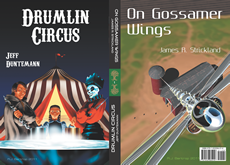
- Also from the Words I Didn’t Know Until Yesterday (ok, last month) Department: algophilist , a person who takes sexual pleasure in pain. Broader and more ancient term than “masochist” or “sadist.” (One such appears in Drumlin Circus.) And to think I first thought it was a guy who liked algorithms…
- Given that Amazon buries the cost of Kindle’s 3G connection in publisher content fees, the lack of graphics (big) within text (small) makes sense. I always thought it was about the crappy low-res e-ink display. It’s not. Here’s how it works.
- Alas, this may be too late for me. (Thanks to Pete Albrecht for the link.)
- From Bill Higgins comes a link to a list (alas, not searchable) of the 200 Borders bookstores that will be disappeared shortly. (PDF) Bogglingly, neither of the Colorado Springs stores are on the list, even the small, always empty, and mostly pointless one at Southgate. I will miss the one in Crystal Lake, though.
- Guys who come up with schemes like this talk about avoiding government censorship and such, but what will actually drive adoption (if it ever happens) is anonymous file sharing. And nertz, I outlined a novel a couple of years ago describing a technology very much like it. The late George Ewing called this The Weaselrats Effect.
- Years ago I remember reading somewhere that steam calliopes are hard to keep tuned because the metal whistles expand as steam passes through them, throwing their notes off enough to easily hear. Can’t find a reference now. Running a calliope on compressed air from a tank might be problematic as well, because air stored under pressure gets cold when it’s released. Surprisingly (perhaps unsurprisingly) good technical information on calliopes is hard to come by.
- Whoa! If you’re interested in solar astronomy, do not miss this video of new monster sunspot 1158 forming out of nothing. It will give you a very crisp feeling for the tubulent nature of the photosphere. Those aren’t spots: They’re solar hurricanes!
- If you’re reasonably high-latitude (45+ degrees) look north after dark for the next few days. That giant sunspot 1158 is spitting a great deal of energetic chaos in our direction, and the sky could light up as a result.
- Samsung has announced a new, larger 10.1″ Galaxy Tab, running Android Honeycomb. Details are sparse, but I’m wondering if we’re not ultimately going to see the slate market divide into 7″ and 10″ form factors.
- Beating cancer may mean we’ll have to be three and a half feet tall, like these mutant Ecuadorians. I’d be good with that–as long as everyone else was three and a half feet tall as well.
- Gawker Media has a new Web UI that I find so annoying that I’ve mostly stopped reading their sites, which include Io9 and Gizmodo. I could do without sites like Jalopnik and Jezebel, but damn, I’m gonna miss those other two.
- I have yet to find a good popular history of refrigeration. Somehow I doubt people are going to feel sorry for me about that.
Odd Lots
- I’d heard of MEMS vibrational gyroscopes (used in handheld devices to track changes in orientation) but my understanding was a little fuzzy. This essay will fix that. Click to it for the pictures if nothing else! (Thanks to David Stafford for the link.)
- The New York Times Bestseller List now includes ebooks. Bout damned time, doodz.
- Motorola’s Xoom will apparently be released for public sale on February 17. I hope to lay hands on it at Best Buy, but one wonders how many other people will be thronging it that week as well.
- And, of course, while Xoom may arrive early, it won’t be lonely for long.
- One interesting argument for the iPad is all the stuff you can buy for it. The ZaggMate keyboard is striking: When you need a keyboard, you’ve got it. When you don’t need one, it’s not weighing down the gadget and getting in your way.
- Samsung’s Galaxy Tab has sold enough units to attract some accessory action too–including its own version of the ZaggMate. Dare we hope that Xoom will be popular enough to do the same?
- Border’s could file for bankruptcy as early as Monday. All the financials I’ve seen on them are horrendous, and people are starting to compare them with Circuit City. When’s the last time you saw a Circuit City?
- This was evidently a real research project in the mid-60s. It would certainly make it easier to scratch.
- Here’s a gallery of “modern ruins,” which are nothing if not sobering. I’m not sure I’d go quite as far as “creepy.” (Thanks to Pete Albrecht for the link.)
- And that collection led to this one, which edges more toward creepy, and somehow reminded me of walking Mr. Byte in Santa’s Village in Scotts Valley in 1987, amidst feral chickens and strong evidence of squatter inhabitation. (Santa’s Village was later razed and Borland’s HQ built on the site.)
- No, if you want creepy, consider that a town right here in Colorado is one of the few places in the US where funeral pyres are legal. (Thanks to Terry Dullmaier for the link.)
The Importance of Sideloading
You haven’t seen much of me here since the first of the year because I set myself a target for writing fiction, and, micracles of miracles, I’m sticking to it. Blogging is second priority, and if I spend my creative hours working on stories, I’m likely to post a lot less in this space. (What posts I do write I hope to make longer.)
Anyway. CES 2011 is now history, and I followed it more closely than I might have in past years because I’m actively shopping for an Android slate. (I hate to call them “tablets;” we’ve had tablet PCs for almost ten years and there’s one on my desk.) I played a little with a Samsung Galaxy Tab at a Verizon store in Tampa in late November and was much impressed, even though the demo unit did not have any kind of ebook reader installed. (Wireless carriers are pushing video hard, because video will use up a lot of deliciously profitable minutes.) I’ve played with Apple’s iPad as well and have been just as impressed, but there’s a huge worm in it for me: Apple wants to absolutely control its content ecosystem, and sideloading of apps is a gnarly business. Sideloading an iPad is easier with books and music, but I’d like to try my hand at slate apps, and I’m not going to work in a playground with barbed wire around it. The open-source Android just suits my temperament better. I have some faint hope of programming Android apps in FreePascal, but Android is really a Java-like platform (apps run on the Dalvik VM, which has its own specific register-based bytecode set) and a Pascal-to-Dalvik compiler is unlikely, as much as it has precedent in the ancient UCSD P-system.
Sideloading is important in a number of ways. (The term as I use it simply means the ability to get apps and content onto a device locally through a cable or a plug-in memory unit, rather than from a tightly-controlled online store or cloud locker of some kind.) I don’t have a lot of ebooks yet, primarily because the e-ink display on my Sony Reader makes my head hurt. Furthermore, the ones I do have are a very mixed bag, from many different sources and in many different formats. I have novels, but I also have tech books, many of which have intricate art and layouts that don’t reflow. A lot of things I’ve picked off Usenet are image scans of transformer catalogs and ancient manuals for Fifties Heathkits, none of which are legible on low-res e-ink screens. I need a good high-res color display, but more significantly, I need the ability to install arbitrary apps to render any arbitrary content format, including minority formats like DjVu, which I don’t favor but must deal with occasionally. I could readily sideload the files on an iPad, but the apps to render them are another matter.
Sideloading of ebooks is still a geek thing, primarily because the ebook business is so damned young. If you can get everything you want from Amazon or Apple, cool–and almost everybody is starting from scratch, with little or no existing ebook library to deal with. In years to come, people will be jumping from device to device and reader to reader and store to store, and at each jump must face the question of how to pack along the books they’ve already paid for. DRM makes this hugely more difficult, but even in a world without DRM, different kinds of content would require local storage transfer and different rendering apps, not all of which will be readily available from the current vendor’s store, especially for new devices incorporating new OSes.
Sideloading also allows local scanning for malware, which will become increasingly important in coming years, certainly for apps but probably for compromised content files as well.
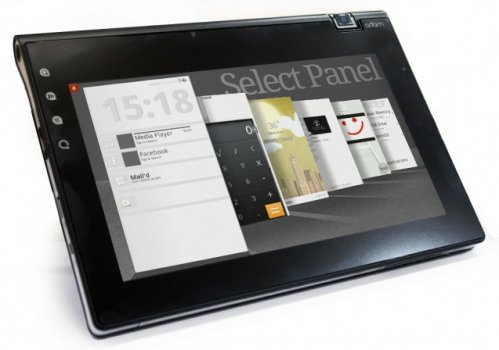
Any slate I buy will have to support sideloading of both apps and content. Android seems to be the OS for that, and I’m now watching the Motorola Xoom, a dual-core 10″ Android slate running the Honeycomb version of Android. There’s some weirdness involving the SD slot (the CES prototypes didn’t have it) but without that, there’s no sale. More intriguing for many reasons is the Notion Ink Adam, (above) which does have a MicroSD slot and 2 USB ports, and the intriguing PixelQi display. Its Android OS is a custom version that anticipates some of the Honeycomb features but is technically V2.2 Froyo with a proprietary UI. (Their blog is worth following if you’re interested in slate technology.) I just hope they don’t do a FusionGarage thing, but if they can hang in there they’ll be a contender.
I must emphasize that I’m being careful and I’m not in any particular hurry. Much of my personal Jedi self-training in recent years could be summarized as Stop wanting stuff. Buy, or buy not. There is no “want.” When jump I, know you will!
Odd Lots
- I was pleased to see this writeup on the XB-70 Valkyrie, which I consider the coolest and most intimidating aircraft ever created by any nation, anywhere, even though the article is lightweight and the author is unsure what a “ballistic missile” is. Click to it for the photos and videos.
- Runner-up, of course, is the A-10 Warthog, which is a lot more intimidating if you happen to be in its gunsights, in which case your ace (our ace, actually) kisses you goodbye.
- There are iceberg cowboys, and every now and then they rope a really odd one. (Thanks to Pete Albrecht for the link.)
- Pertinent to yesterday’s post, Pete also sends a link to a toy Triceratops that apparently comes pre-shredded.
- This list of the most-pirated ebooks of 2009 is now 18 months old, but it may still say something about your average ebook pirate: sex trumps almost eveything else, except possibly Photoshop.
- On a whim, I went up to the Pirate Bay just now, and discovered that, 18 months later, sex and Photoshop still trump everything else, at least in terms of pirated ebooks. (And Photoshop is, by a factor of 2.5, the most popular Windows app on Pirate Bay.)
- The magazine guy in me mourns, but the magazine guy in me whispered that this was going to happen before it even started: Magazines sold in iPad versions started out strong but went into steep decline after a few months. Read the comments: The electronic Wired is 5X more expensive than the paper one, which just maybe possibly might (d’ya think?) have a little tiny bit of something to do with it.
- As a book lover of long standing (read ’em, write ’em, publish ’em) I declare this little invention freaking brilliant.
Odd Lots
- I’ve been maxed out for the last week or ten days on numerous things, not excluding Christmas, which is why you haven’t heard from me here. So even if the Odd Lots file is a little short this time (who’s had time to wander online in search of Interesting Things?) it’s the best I can do for the moment.
- There is a very-close-to-optimal total lunar eclipse tonight, with totality beginning at 11:40 Pacific Standard Time, 12:40 Mountain, 1:40 Central, and 2:40 Eastern. Totality lasts for 72 minutes. Because we’re at the Winter Solstice, the eclipsed Moon will be as high in the sky for North Americans as it ever gets; you will be looking very close to straight up, especially if you’re on the West Coast. Here’s the NASA page on the eclipse. I don’t boggle at this kind of trivia anymore, but we haven’t seen a total lunar eclipse on the WInter Solstice since 1638. (I believe there will be another, however, in 2094.)
- In other astronomy news, the Sun is dead quiet again, and we are in our second day without sunspots at all on its visible face, at a point in the sunspot cycle when the sunspot number should be at least 30 or 40 at minimum. With the solar magnetic field continuing to drop, suggestions that we are in for another Dalton-scale solar minimum seem less outlandish than they did a year or so ago. So much for 10M DX.
- I’m still trying to determine if this is a hoax or not. If not, I might order some to calibrate my still-incomplete (if haltingly functional) Geiger counter. Don’t skim past without reading the first comment: 4,182 of 4,252 people thought it was useful!
- Apple is keeping certain iBooks layout features to itself, sharing them (under NDA and perhaps at a high price) with large publishers only. WTF? How can this possibly help them?
- Perhaps (finally!) realizing that annoying your honest customers is a dazzlingly stupid thing to do, Microsoft has quietly retired its Office Genuine Advantage program, which required users to verify the propriety of their copies of Office before allowing them to download templates and so on. This does not mean that Office activation has been abandoned, only that MS will no longer give you the third degree for existing Office installations, especially 2000 and 2003.
- The term “non-Newtonian fluids” makes them sound a lot more exotic than they really are, but as materials go, they’re pretty cool. I borrowed the concept (which I read about years ago) for a bullet-proof cloak in my in-progress short novel Drumlin Circus, but it looks like that idea may become real-life at some point. (Hey, doesn’t “Bullet-Proof Custard” make a great imaginary band name?)
- Not sure what to think about an assertion that C. S. Lewis is the Elvis Presley of Christian publishing.
- Don’t have a Chester A. Arthur bobble-head? Want one? Grab some old photos online and send them to Sculpteo, and get a hand-painted bobbler of the guy and his muttonchops. Not cheap–$80 to $100–but we’re seeing the first wave of commercial 3-D printing apps here. Why not be an early adopter?
Odd Lots
- Needles to say, at 70 cents a minute I wasn’t going to be doing much Internet research while we were on our recent cruise. So most of today’s Odd Lots are from my tireless friends, whose efforts are very much appreciated. (Hey, next year let’s all get together on a cruise, and experience Internet withdrawal around the stern pool with mojitos in our hands!)
- During mealtime cruise ship chitchat, we learned that an enormous new cruise ship was so big it had a hard time getting under a bridge that blocked its maiden voyage from the shipyard in Finland to the sea. Aki Peltonen sent a nice news item on Allure of the Seas, which holds 8,500 people. The 200+ foot high boat cleared the bridge by one foot. Clearly, Allure might be considered a…brinkmanship.
- My cell contract comes up next year, and just in time, Consumer Reports has published its January 2011 cover story on cell phones and (more significantly) cell providers and plans. Well worth buying the print magazine for. Right on the cover is the money quote: “Sorry, AT&T.” (And guess which provider I have now? Changes are acumen in…)
- Don Lancaster has released his TV Typewriter Cookbook as a free PDF. And speaking as I was of memoir the other day, here’s a bio sketch Don sent me, Yes, he’s a few years older than I am, but it’s uncanny how much his story aligns with mine, right down to the planetarium, the acorn tube radios, Carl & Jerry, and much else.
- Pertinent to my entry of November 30, 2010, there is apparently a term for memoirs written without the intent to publish generally: legacy writing, which is writing one’s life story for recreational, family, or therapeutic purposes. The definition comes from this article, sent to me by Pete Albrecht.
- Also pertinent to that same entry: A longish but very good article from Smithsonian about how memories form in the brain, and why they sometimes don’t reflect precisely how reality happened. (Thanks to Dave Lloyd for the link.)
- From the FB In The Original Sense File: Popular Mechanics mailed a box containing a thermometer and a three-axis accelerometer, both feeding a data logger, to see how much trauma a package would undergo from each of the major courier services. Summary here. (Thanks to Bruce Baker for the link.)
- I’ve heard rumors of this, but now it’s official: Borders is going to try to acquire Barnes & Noble. So we’ll soon be down to one major national book retailer. Dare we hope that the doors will re-open to the knowledgeable one-off shop or local chain? Owned and run by people who actually read books? (Thanks to Pete Albrecht for the link.)
- Neat short article on other approaches to manned moon landings considered in the 1960s, some of which would have been cheaper and perhaps more sustainable than our historical use of the Saturn V stack. (Thanks to Frank Glover for the link.)
- From the With Delegates Like These, Who Needs Skeptics? Department: A group of college students attending the UN’s COP 16 climate change conference in Cancun this week circulated a hoax petition calling for the banning of dihydrogen monoxide, a widely used industrial solvent that, while harmless in liquid form, contributes strongly to greenhouse heating as a vapor. Video of delegates cheerfully signing the petition here. (Don’t those people watch Penn & Teller?)
Odd Lots
- Maxwell’s Demon as Web comic. (Thanks to GMcDavid for the pointer.)
- Here’s a tutorial on adding a MicroSDHC card to the Nook ebook reader. Looks like a mechanically touchy business (be careful!) and nothing substantive is said about sideloading content on the inserted card. Sideloading of content is something I’m less and less willing to compromise on, as I do not want a censor between my slate and material that I want to read.
- I’m due-ing diligence on the very impressive, Android-powered Nook Color, but the frontrunner in the Great Jeff Slate Project continues to be the Galaxy Tab, especially since Samsung is offering this keyboard dock. That said, Nook Color is the right idea for ebook freaks: Approach a general-purpose slate from the ebook side, starting with a killer ebook store and working toward everything else. (Supposedly, V2.2 and access to the Android app store is coming soon.) My view: Dedicated e-readers like Sony’s and even Kindle will eventually give way to more general-purpose slates of similar size, though slates may “lean” toward one enthusiasm (like ebooks) or another.
- Back in 1983 and 1984, I did about 10,000 words on a since-abandoned novel that included a species of road surface that charged your car’s batteries as the car moves over the road. A pickup called the “board” (after surfboard) was suspended beneath a vehicle and hovered over the road surface via maglev to generate current like a linear alternator. I was pleased to see that Wired posted a news item on some guys in New Zealand who are developing almost precisely that. Not sure how well the math works out (especially with respect to infrastructure costs) but it’s a cool idea. I added another small touch: Ohmic losses in the “voltway” surface kept it snow-free in winter.
- Pope John Paul II was an idealist. Pope Benedict XVI is a pragmatist. My SF prediction: As he grows older and sees the problems besetting the Church getting no better and possibly worse, he will begin considering other reforms that his uncompromising predecessor would have considered impossible. Hey, Bennie! How ’bout Vatican 3!
- People who have lots of moles have longer telomeres. Or at least look younger than they are. Carol and I are both so blessed, mole-wise, but I think it worked better on her than on me.
- If you spend a lot of time in the car but off the Interstates, take a spin through RoadsideAmerica, a bemused compendium of eccentric stuff you can see on road trips. I liked the entry on smiley-faced water towers, since we pass one in Adair, Iowa every time we blast back and forth to Chicago. And Adair is far from the only one.
- From the above site: When we left Arizona seven years ago, some people nodded and said, Cool! Colorado isn’t as crazy as Arizona. Well…I’m not sure that’s true.