Jeff Duntemann's Contrapositive Diary Rotating Header Image

astronomy

Redeye-ing the Perseids

Just a quick reminder: The Perseid meteor shower should peak tonight just before dawn, so if you can manage to haul outside between three and four ayem you are almost guaranteed to see some interplanetary grit hit the fan.

Look east, but pay attention to your peripheral vision, because the meteors can appear in any part of the sky. If your skies are good you might well see one every minute or so, and sometimes they come in bursts. And there’s always that long-shot hope of catching a bolide.

I’m about shot for tonight, but I will draw your attention to a previous entry I did on the Perseids, which are something of a tradition for Carol and me. (It also contains my now-legendary 13-line sonnet on the meteor shower, which demonstrates that I am neither poet nor mathematician.)

Take the Off! with you, especially if you live in Chicago. Trust me on that one.

Odd Lots

Odd Lots

  • Jupiter has always looked better with a few belts, but now, astonishingly enough, one of them has gone missing.
  • Ever want a stuffed muon? Head right over to the Particle Zoo, where that and many other cuddly plush species of atomic debris can be had, including a few (like the tachyon) that have never been observed and probably don’t exist. Oh, you can get stuffed dark matter too–and does that Higgs Boson look happily stoned or what?
  • I’d heard about it a while ago, but only recently began reading up on the Haiku OS, inspired by ahead-of-its-time BeOS. What intrigued me is Haiku’s inherent suitability for multicore CPUs, since it’s pervasively multithreaded, and damned near every piece of an app is spun off into a separate thread. Alpha release 2 is now available. I’ve downloaded the ISO and will report back here when I test it on my quad core.
  • One of the more interesting issues involving the iPad is where to put it: Do all of us macho geeks need to get used to carrying man-purses? Hardly. We wore our leather-holstered slide rules on our hips like mathematical six-guns back in the 60s. A quick check online showed nothing comparable for the iPad and its inevitable imitators, but trust me: Leather belt holsters for slates will be the Christmas gift in 2010. Draw, pardner! Whoops. Visio isn’t available for the iPad yet. Surf, pardner!
  • The Hong Kong knockoff artists are beginning to fill the Fake iPad niche, and according to Wired may well clone the Google Android slate before Google even admits that it exists.
  • And Bill Roper sent a link to a barely $100 Android slate shaped to better fit your stylish black leather belt holster. With one of the new Android-based e-reader software packages like FBReader and Aldiko, a gadget like that could serve as a socko indoor ebook reader.
  • From Pete Albrecht comes a link to Lehman’s, a vendor offering mostly non-electrical products and catering (presumably) to an Amish clientele. (Preppers too, I suspect.) An amazing number of items in the catalog (the red rubber hot water bottle, for example) were commonplaces in my youth, and some (like the strangely retro-deco Stirling engine fans) would be right at home on planet Hell from my novel, where electrical devices don’t work. All in all, a fascinating flip.
  • The May 2010 Scientific American published an article suggesting that carbohydrates may be worse for you than saturated fats. This is not news to me (when I eat carbs I gain weight rapidly, and lose just as rapidly when I stop) but it’s encouraging to see a “big-time” publication take the notion seriously. After all, the Federal government has been telling us that fat makes us fat for thirty years now, and all we could do in response has been to…get fatter. I’ve doubled my fat intake in the last year or two, and have remained at my customary 155 pounds. Something’s screwy somewhere. (Found via The Volokh Conspiracy. Read the comments; amazingly good signal-to-noise ratio there.)

Odd Lots

mysteryimage500wide.jpg

  • Pete Albrecht sent the above image, and challenged me to characterize it. What would you call it? (Answer at the end of this entry.)
  • The people who created the indie WWII film The Downfall have had enough, and persuaded YouTube to pull hundreds of parodies of the well-known scene in which Hitler freaks out when he learns that the Soviets are closing in on Berlin and the war is lost. The film is in German, with English subtitles. People were swapping in their own subtitles, and whereas the first one (or maybe two) were funny in a painful way, after I watched three or four I had had enough myself. On the flipside, it was a fortune in free publicity for a film I’d never even heard of before people started sending me links to various parodies.
  • Another Web site (following the example of Ars Technica) started banning people for even mentioning AdBlock on their forums. They retreated, defending their position all the way. The problem here is that ads can be malware injectors, and unless Web sites can guarantee clean ads (which isn’t easy, given how current ad systems work) I’m with the blockers here.
  • Assuming that this is legit, it may be our best hope yet for fighting cancer after metastasis.
  • Ditto a new broad-spectrum mechanism for knocking out viruses. (Thanks to Frank Glover for the link.)
  • For people who hadn’t read my earlier entries about it, Fat Dogs (see the photo of their sign in my April 19th entry) is a small chain of gas stations/convenience stores in western Nebraska. They’re so small they don’t have a Web site. That doesn’t mean they don’t have a great sign and motto. (“You Are Nowhere.”)
  • Book publisher Penguin Australia published a pasta cookbook, one recipe of which calls for “finely ground black people” instead of “finely ground black pepper.” Although Penguin hasn’t copped to it yet, this reeks of an instance in which a mispelled form of “pepper” generated the suggestion “people” in the spell checker, and some underpaid knucklehead editorial staffer clicked on “accept all.” I gave that lecture to a couple of my staffers ten years ago. You’d think the publishing world at large would have internalized the danger by now.
  • NASA’s Solar Dynamics Observatory satellite goes live today, promising the best solar images we’ve ever obtained.
  • Give up? (See first item in this entry.) It’s a…bichon frieze.

Odd Lots

  • Here’s a great article from NASA on the unexpected success it’s had with the WISE (Wide-field Infrared Survey Explorer) spacecraft in spotting previously unknown asteroids in the infrared spectrum. WISE is detecting hundreds of new asteroids every day, which is unnerving, since a rock no bigger than a Motel 6 could cause regional devastation greater than any nuclear weapon yet produced.
  • From Larry Nelson comes a pointer to the AirStash, an interesting $100 USB Wi-Fi gadget that can accept up to a 32 GB SD card and act as a content server over Wireless b/g. Anthough nominally a thumb drive, the USB plug also charges the internal battery, and (though it’s not screamed from the rooftops) the thingie works all by itself, no computer connection required. This suggests “wearable file sharing”: Drop one in your pocket and nearby people can download files from the device without having any idea where it actually is. Little by little, the jiminy (an AI wearable computer I thought up in 1983, and figured would be mature by 2027) creeps toward realization. The AI is actually the tough part; everything else already exists, if not in as small a package as I imagined 25 years ago.
  • And if you ever wanted to run Linux on one of your fillings (ok, one of your elephant’s fillings) this would be the solution. (Thanks to Bill Cherepy for the link.)
  • Here’s a gadget that builds you an external USB storage device by dropping in (literally) a naked SATA hard drive. I may not need it, but I admire the elegance of the concept.
  • I’ve been arguing in favor of dual-screen reader devices for years, and this one is a good start. Sounds like the user interface software needs work…but when has that not been an issue for a first-gen device? We’re closing in on it, though.
  • Nice status update on some of the current non-Tokamak fusion research approaches, link thanks to Frank Glover.
  • Also from Frank comes a reasonable article on how people would die in a vacuum and how they wouldn’t. I had heard of lung shredding; heart failure was new to me. But take, um, heart: Your blood wouldn’t boil.
  • If you ever wondered why you cry when you slice onions, well, it’s the sulfuric acid released by cells in the onion when they’re cut open. Supposedly living things evolved this mechanism (or at least key parts of it) half a billion years ago. Onions evolved their chemical weapons to avoid being laid on hamburgers in slices–but we evolved Vidalias to prove that we were smarter than onions, and that fast food will prevail against all threats.
  • Interestingly, the Canon G11 camera reduces the size of the image sensor to 10 megapixels, down from the 12.5 on the G10. The new sensor gives you fewer pixels but better ones, and faster, which is all for the best.
  • Burger King is testing a new retailing feature in Brazil. When you order a burger, they take your picture and print your face on the burger wrapper.

Odd Lots

  • It happens all the time, but it’s rare that we actually watch it happen: a comet falling into the Sun. (It’s unclear to me what the brief tiny streaks are, since SOHO is a spacecraft and the image was not taken through Earth’s atmosphere, where meteors would look like that. Meteors in the solar atmosphere?)
  • The SOHO spacecraft may also be shedding some light on why the recent solar minimum was so deep.
  • We’ve identified what may be a much better proxy for ancient climate: clam shells. Unlike tree growth rings, which may be affected by several factors like rainfall, sunlight, soil chemistry, and so on, clam shell growth (and the mix of isolotopes, particularly oxygen) seem very closely correlated to the temperature of the water in which the clam lived out its life.
  • Intel’s Nehalen-based Gulftown CPU has been officially announced, with six 3.33 GHz cores and 32 nm traces connecting a boggling 1.2 billion transistors. They’re calling it the Core I7-980X Extreme Edition, and it fits the LGA 1366 socket, which implies than it can be swapped in as an upgrade. (No confirmation on that yet.) You may be able to get an overclocked desktop system running all six cores at 4.3 GHz by April. And if that’s not enough cores for you (four is way more than enough for me, if this past year’s experience is any guide) we’ll be seeing the eight-core Nehalen-EX (with 2.3 billion transistors) later this year, nominally for the server market.
  • I know, I know, AMD has its Magny-Cours 12-core Opteron server CPU, but the cores only run at 1.7 GHz–and more to the point, exist on two separate side-by-side six-core dies, which may be cheating a little. I’m sure they’re very good chips, but sheesh! We still don’t know how to do parallelism in general terms. Even AMD is puzzled, so they launched a contest titled, “What would you do with 48 cores?”
  • And if you don’t believe me, open Windows Task Manager, click the Performance tab, and watch all your cores but one do nothing. To paraphrase George Carlin: What do cores do on their day off? They can’t just lay around…that’s their job!
  • Frank Glover put me on to an interesting hand-drawn animated movie that I hope to see fairly soon, if I can find anywhere playing it. (Distribution in the US is inexplicably a problem for them.) The Secret of Kells is about the Book of Kells, and (more intriguingly) is drawn in the style of medieval manuscript illumination. It took a few seconds watching the trailer to catch on, but eventually I had the feeling that I was watching manuscript illuminations come to life. Damned cool.
  • And 229 years ago today, Sir Frederick William Herschel first spotted Uranus.

Odd Lots

  • Wow! The Authors’ Guild finally had a good idea a couple of weeks ago: Who Moved My Buy Button, a Web site that tracks Amazon’s “Buy” button for any given title. If the Buy button goes away (for example, if the book goes out of stock or if the publisher places it out of print–or if Amazon gets in another cage fight with a major publisher) you get an email to that effect. Don’t miss their “Buttonology” page, which explains how to interpret Buy button disruption by inspection. (Thanks to Bruce Baker for the link.)
  • So what exactly is this, anyway? It looks like what used to happen to me when I tried to develop my own film (briefly) in 1966, and found these odd (and similar) little anomalies on my negatives. Dirt, or perhaps the edge of the film contacting the center. Nothing says he wasn’t using a film camera, but film is pretty uncommon these days. If I had to guess (and assuming it isn’t some flaw in the camera optics) I like the idea of a meteor passing through the ionized region of the atmosphere where the aurora display was happening. (Thanks to Frank Glover for the link.)
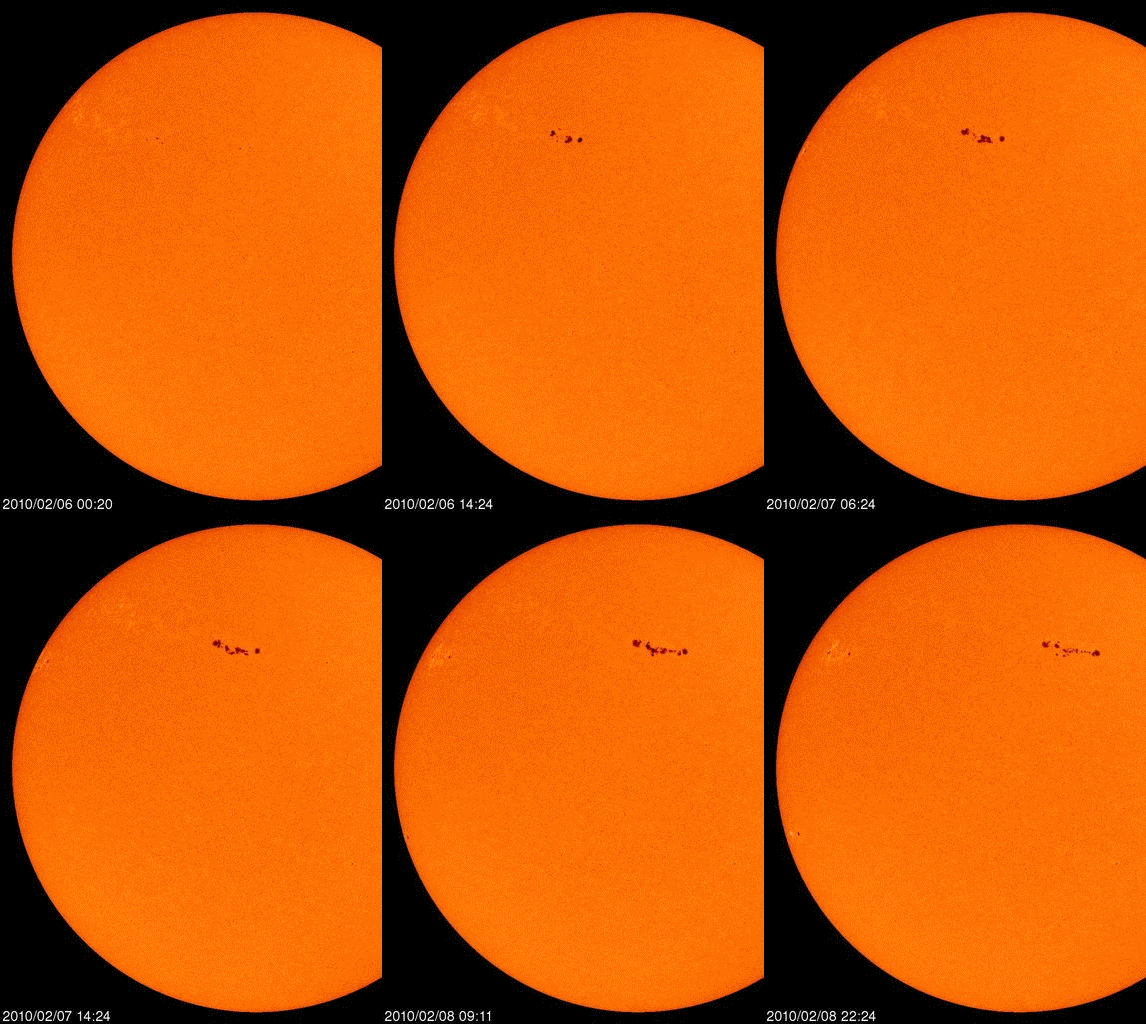
  • While we’re talking high-energy physics, I’m finding it remarkable how rapidly an apparently dead Sun came back to life, on or about January 1. We now have three significant sunspots on the visible face, including a genuine monster. (Here’s an animated GIF of spot 1045 growing.) This gives us a sunspot number of 71, the likes of which I haven’t seen in three or four years. I’ve been spinning the dials downstairs, and have heard openings on 18 MHz and even 21 MHz. Gonna get those wires shielded before the next solar minimum, fersure.
  • Integrated reader/bookstore systems have made me a little bit nervous ever since the Kindle Orwell debacle last year, and the iPad, if anything, will be even more vulnerable to that sort of remote meddling. It’s not so much malfeasance by the system operators as their vulnerability to government corruption and coercion. Here’s a perspective from a French chap.
  • Still wedged on VMWare Workstation, but Bp. Sam’l Bassett pointed me to a site providing lots of free VirtualBox VMs. The question of how trustworthy such downloadable images are is a good one, but they’re certainly one way to mess with a new OS without having to fuss with hard disk partitioning and installation.
  • I know it’s really her name, and no disrespect is intended, but when I read a headline like: “Costa Rica Elects Chinchilla First Woman President” I don’t see what I’m supposed to see. Journalists used to be taught to avoid gaffes like this, and many other news organizations did. Including her first name would have helped.
  • I kid you not: Pepsico is wrapping up a limited-edition, 8-week-only campaign for Mountain Dew Throwback, which contains Real Sugar instead of high-fructose corn syrup. I’m a diet soda guy and won’t partake, but that’s a quarter step in the right direction. (My guess: The ridiculous ethanol-as-fuel scam is making corn expensive enough so that HFCS is not the big win that it used to be.)
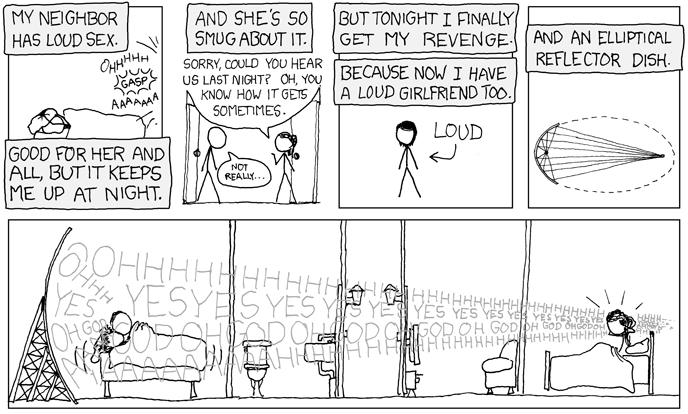
  • Once again, XKCD scores big–and loud. (SNSFW.) (Thanks to Baron Waste for the link.)

Odd Lots

  • Here’s a nice detailed article about how Linux treats hard disks and how Linux partitioning works.
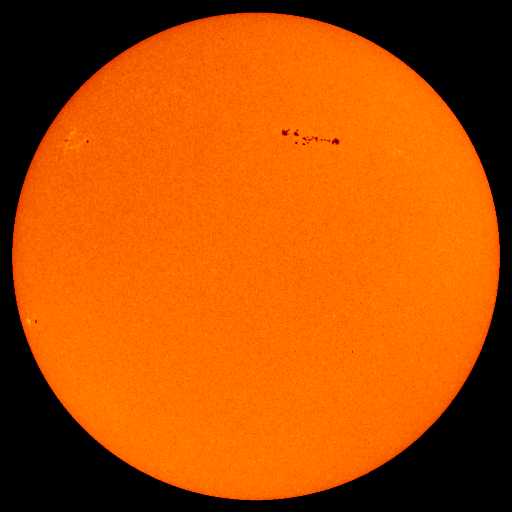
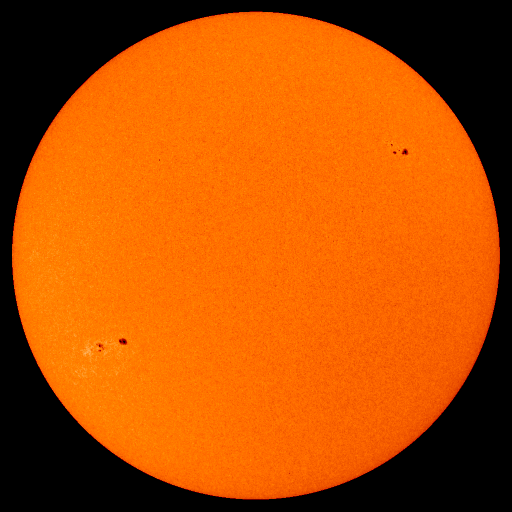
  • We now have two major sunspots on the visible face of the Sun. I don’t remember the last time I saw that. (Most of the specks we’ve been giving sunspot numbers to in the last couple of years don’t count, in my book.)
  • The New York Times has finally shone their light on an ebook marketing technique that Baen Books pioneered years ago. (Thanks to Pete Albrecht for the link.)
  • Version 4.0 of the FastStone Image Viewer is out, and well-worth having. It’s the best image browser I’ve ever used, and if you have to sort an SD card full of digital photos and cull marginal shots quickly, there’s nothing like it. Make sure you get the portable version; it lacks nothing and doesn’t make any changes to your system. Freeware. Highly recommended.
  • Rich Rostrom sent a pointer to a fascinating article on Moscow’s stray dogs. They’re going feral, but it’s a peculiar sort of urban feral that considers humans and all their gadgetry to be just another part of the landscape. They’ve learned how to ride the subway, for pete’s sake!
  • I’d read in a number of places that faces judged as beautiful are generally “average” faces, without a lot of distinguishing characteristics. Because I could never quite get a grip on what an “average” face would be, I always took the notion with a grain of salt. But this site, assuming it really is creating a “facial average” from a gallery of headshots, suggests that there’s something to it. Start with two faces, then add faces one by one, and see if the average face doesn’t become more beautiful (and distinctly ambisexual) as you go. It did for me.
  • Here’s a short interview with Bob Silverberg, describing his writing life during the Golden Age of Pulps. A million words a year…
  • Cracking ice in the surface of a frozen lake sounds like a blaster battle.
  • From the That-Certainly-Has-To-Count-For-Something Department: Behold the world’s largest disco ball.

Odd Lots

  • So here, on the eve of the end of a year I’d just as soon forget, the last Odd Lots of 2009. Carol’s in Chicago and I’m staying home tonight with a lapful of dogs and a good book, which on this occasion will be Brian Fagan’s The Long Summer, his history of the Holocene Warm Period. Carol will be back on Saturday. Getting tired of meat. May have some mashed potatoes tonight.
  • The Christmas tree is no longer taking water, and I perceive that’s it’s begun to dry out. We brought it home on December 10, so it has been standing guard in our living room for three weeks. This may be a new record for us. We’ve had trees stand (a little) longer, but their final two weeks were a rain of needles.
  • The day after Carol and I showed Carol’s mom our Christmas tree via Skype video call, this Zits strip was published. (Thanks to Roy Harvey for letting me know–I read Zits but generally in the newspaper, and not every day.)
  • 2009 is ending with 260 sunspotless days. 2008 had 266, and December was the most active month of the year, so we’re guessing that the Long Solar Minimum is mostly over. Can 15M skip be far behind?
  • Ray Kurzweil has announced a new ebook software reader package called Blio. Not a lot of detail and no software to download yet, but it’s going to be a free product, with versions for both mobile devices and the desktop. Introduction will be at CES next week.
  • The ebook technology to watch in 2010 is Qualcomm’s Mirasol, which promises color without sacrificing battery life or readability. Looks good, but what we need much worse are larger displays and higher resolution.
  • Once again, Bruce Schneier nails it: The bulk of our antiterrorist strategies rely on magical thinking. This is not the way to win; alas, magical thinking appears to be a pervasive part of modern culture, and I’m not talking about Harry Potter.
  • Recent discussions of digital media piracy reminded me of the 2005 article in Wired describing the media piracy “scene” ecosystem (topsites, couriers, races, etc.) and how it works. Big Media may be paranoid, but that doesn’t mean that no one is out to get them.
  • Pete Albrecht photographed two UFOs flying in formation (big animated GIF) while taking a long-exposure shot of M42, the Orion Nebula, through his big Meade telescope. Nothing spooky or alien about it, but before you click on the explanation (in his December 28 entry) think for a second and see if you can figure it out on your own.
  • From the Words I Didn’t Know Until Yesterday Department: murse, more often called a “man bag,” which is basically a purse carried by a guy.
  • Ditto above: prepper , a person who prepares for the end of the world by stockpiling peanut butter etc. They called themselves survivalists until survivalism became equated in the public mind with psychos packing machine guns; watch for the word to vanish when 2012 ends but the Earth is still here. (Thanks to Pete Albrecht for the link.)

Odd Lots

  • Hard drives are cheap, and I still have one free SATA port on my desktop system, so I ordered another drive as a Linux playground to solve the problem described in my entry for December 19, 2009. This time I’m going with a Seagate, since for reasons still obscure, the Linux kernel seems to like Seagate drives better than Western Digital drives.
  • And while we’re talking drives, Seagate has just announced the 2.5″ Momentus Thin, which at 7mm is about as thick as a vanilla wafer (you can tell I’m off my diet for the holidays) and will definitely bring down the BMI of netbooks and other portable gadgetry.
  • I think most people may have seen this by now (I forgot to Odd Lot it back when it appeared a couple of weeks ago) but wow: video footage of an underwater volcanic eruption under three klicks of water. Man, this is what robotics is for. (Thanks to Aki Peltonen and several others for the link.)
  • I just received my brand-new Dell Inspiron Mini 10 netbook here, and all I know so far is that it powers up and boots reasonably quickly into Windows XP Home. The unit as configured to order has both a built-in TV tuner and a GPS receiver. It’s going to be my travel computer and replace my knuckleheaded Lenovo 2005 Thinkpad X41 Convertible Tablet PC. I’m going to mess with it for a little while and will post something here as soon as I have a feel for it.
  • We’ve been hearing about Apophis for years: the 900-foot asteroid that will swing by in 2029 and say hello. And for an unnerving change of perspective, check out the close encounter from the asteroid’s point of view, in a JPL animation that counts as the scariest thrill ride I’ve taken in awhile. (Have not seen Avatar yet.)
  • Speaking of asteroid collisions, if you’re an SF writer spinning a plot involving big rocks and the sudden release of kinetic energy, look for Hazards Due to Asteroids and Comets, Tom Gehrels, ed. (University of Arizona Press, 1994.) It’s a 1300-page compendium of academic papers on big things hitting even bigger things, with lots of formulas, charts, and analysis. Dense and not an easy read (and also not cheap–it was a steal years ago for $40) but I’ve learned a great deal from it.
  • It’s interesting to read the reasons why good and intelligent men do not believe in God, and here’s Gregory Benford’s testimony, which is a lot more cogent than most I’ve seen. (Thanks to Frank Glover for the link.)
  • Finally, if there’s some source code in your past that you regret (I’m thinking of a few lines right now that I’d like to wipe from this space-time continuum if I could) maybe the answer is Bad Code Offsets. Debug-and-Trade, anyone? (Thanks to Bruce Baker for the link.)