Jeff Duntemann's Contrapositive Diary Rotating Header Image

ebooks

Now Available: Copperwood Double #1

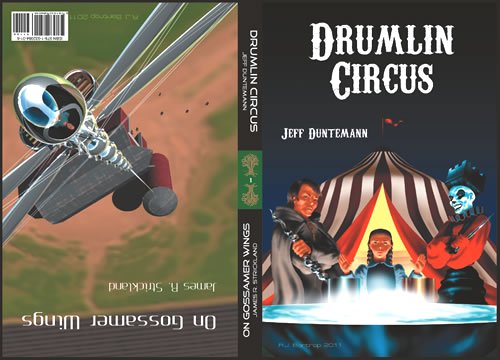
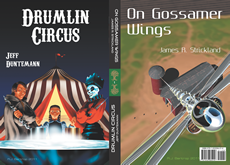
Copperwood Double #1: Drumlin Circus and On Gossamer Wings

I am pleased (and you wouldn’t believe how relieved!) to announce the availability of the first Copperwood Double, Drumlin Circus / On Gossamer Wings, in both print and ebook editions. The ebook edition is available from Amazon’s Kindle store in mobi format, and from B&N in epub format, both at $2.99. No DRM in either case. And because there’s no DRM, you can download the free app Calibre and use its excellent conversion utilities to convert mobi or epub to any of several additional ebook formats. The print edition is distributed through Ingram/Lightning Source and is thus available from online retailers who work with Ingram, which would be basically all of them. $11.99. (Note: The print book is not available from Lulu.com. This was a major decision that I’ll talk about in a future entry.)

If the cover image above seems bizarre to you, well, you’re younger than you look. The grayhairs among us know precisely what I was reaching for: The Ace Doubles of the period 1952-1973. Each volume consisted of two short novels from 25,000-50,000 words in length, bound back-to-back and inverted, each with its own cover image. Ace did not invent the physical print/bind arrangement, which is called tete-beche (head-to-tail) and has existed for almost 200 years. They did make it a mainstay of recreational reading for two decades, and most of us back then had a pile of them.

A lot of people thought it was a weird idea (and many made fun of it) but we forget that the short novel as a form essentially vanished from SFF after Ace stopped publishing doubles. The magazines won’t publish something 40,000 words long, and 40,000 words is too short for a conventional print book unless you’re way out there in small and very small press. So there was this huge hole between 20,000-word novellas and 80,000 word novels. I fell into that trap in 1981, when my Firejammer clocked in at just under 30,000 words. I shopped it, but unless you’re Larry Niven no one’s going to seriously look at something that length.

I like the short novel as a distinct literary form. It’s long enough to develop some ideas and a few interesting characters, but short enough to require a certain focus, and a fairly linear plot line. It deserves to have a place in the SFF world, and two recent developments have conspired to give it one: ebooks and print-on-demand publishing. Ebooks have no strong length requirements, and from what I’ve read, the length of original ebook novels is drifting downward. More to the point, a story can be given the length it needs, and authors aren’t under pressure to pad an idea out to print novel length, or compress it to magazine novella length or less.

Print-on-demand publishing allows publishers to try interesting things without betting the house on the outcome. I will always love print books and still buy them in respectable quantities, but in these troubled times print publishers must be conservative to avoid going broke. (Do I know a little bit about that or what?) The beancounters require that a book recoup its capital costs, which means that books hover within certain boundaries set by retailer expectations. (Remember that if retailers won’t stock a book, customers never get the chance to vote on it. Retailers therefore have what amounts to a veto on print publisher publishing programs.) Slightly whacky things like tete-beche double novels fall outside ordinary bricks’n’mortar retail channel expectations, but POD manufacturing and online ordering make a lot of things possible.

So I offer you a book with two covers, and two authors telling two stories in one world, the Drumlins world that I introduced in Asimov’s back in 2002 with “Drumlin Boiler”. There’s much more to say, and I’ll continue the discussion (with specifics on both stories) in days to come.

Ebooks and Adding Value to the Public Domain

I just got our first two Copperwood Press ebooks posted to the Kindle store, and they’re now available for sale: Drumlin Circus / On Gossamer Wings and “Whale Meat.” No DRM. I’m still working with Ingram’s Lightning Source to get the double mounted and sellable in its print edition. It won’t be available from Lulu, and over time I will be migrating my other print books from Lulu to Lightning. Learning their relatively unforgiving system the first time involves a little hair-tearing, but once learned it’s learned.

There’s certainly plenty to do in coming months to get the rest of my material converted to good ebooks and posted on the major retailers. One issue I’ve found troubling for some months now is the ambiguity regarding public domain material. Both B&N and Amazon make a big deal about whether a work is in the public domain. PD titles get lower royalty rates and just generally seem libri non grati on the retailer sites. This isn’t surprising in some ways. The retailers are trying to avoid having 2,774 versions of The War of the Worlds on their servers, taking up space and confusing the readership. The definition of “public domain” varies legally by country, and what may be free in Australia or Chile is not necessary free here. So they do have to be careful on the rights front.

The issue matters to me because of The Old Catholic Studies Series, a project that I’ve been tinkering for ten years now. The goal was to scan, OCR, edit, and lay out clean, indexed versions of the foundational texts of Old Catholicism so that people wouldn’t have to pay $200 to read yellowed, crumbly, scribbled-in books printed in 1874. I have two such texts currently available in print editions: The New Reformation and The Pope and the Council. They were a lot of work, but they’ve sold reasonably well, and I consider the effort worthwhile. (It was also damned good practice in making books.) Not a lot of people want them, but the people who do want them have been very happy with them. I would have done another two or three, but John Mabry’s Apocryphile Press got there ahead of me, and put out facsimile print editions of the other major works I had considered. I prefer new layouts to facsimile editions, but Apocryphile’s scans are fairly clean and I do recommend them.

It’s true that the source materials are long in the public domain (which at least in the US includes all books published before 1923) but technically, what I’m offering are derivative works. I scanned them, page by page, OCRed them to extract the text, and then went over the text character by character to eliminate OCR errors. (Some were a hoot: “The Frankish King Pepin…” became “The Prankish King Pepin…”) The books were not indexed, and I indexed them. I fixed a few typos (especially in The Pope and the Council, which was a hurried English translation of a work written originally in German) and Americanized the British spelling. Although I don’t claim to have done a copy edit on either book, I fixed a number of examples of what I consider regrettable diction. I wrote an introduction explaining what I did and how. I gave them nice covers. If I had another hundred years to live and no need to make a living, I would do a strong edit on both.

By any legal definition what I’ve produced are derivative works that are not themselves in the public domain. That said, anybody who took an OCR of The War of the Worlds and changed three words could make the same claim, and if enough people do that, the noise level at ebook retailer sites would go through the roof. Nobody’s PD ebooks would sell well enough for it to make anything like a reasonable new edition of any PD book worthwhile.

I don’t know precisely what the answer is. Vetting tens of thousands of $2.99 ebooks is a labor-intensive business, and what sorts of standards would apply? Refusing facsimile editions is obvious and easy, but I doubt anyone would even try to read 50MB page-image PDF facsimiles on a Kindle. (On the Nook Color it might be practical; grab something 1875-ish from Google Books and let me know!) A better suggestion might be to require an up-front payment from publishers for posting anything either fully in the public domain or significantly derived from the public domain. That would cut down on bothouse publications and allow people like me to genuinely add value to public domain material without drowning in unmodifed or barely modified PD books. I’d think $25 would be about right. My books would earn that back in a month or six weeks, and the bothouses couldn’t justify it.

It’s not often that I’d willingly ask to have my own costs raised, but publishing has always been a weird business, and sometimes, well, free is less than worthless.

Odd Lots

  • Good Friday — bad weather, at least where I am. When I was in second grade, Good Friday included a whomping thunderstorm that rolled over the Northwest Side about 3PM. It got very dark and scary looking, and (after several days of intensive Holy Week preparation in school, especially about Christ’s death on the cross) it was natural for me to think that Good Friday was always dark and stormy, a reflection of what happened in our Bible stories. Alas, the next year Good Friday happened on a beautiful warm spring day. Lesson: Characterization matters more than setting. Don’t get distracted by the special effects.
  • Besides, Friday is, well, Friday. How bad could it get? (Jesus could have died on a Monday.)
  • Finally, if you haven’t seen this, do take a look. (2.4 MB PDF but well worth it.) You may miss some of the humor if you don’t know theology-geek things like who Bart Ehrman is, but overall it’s hilarious, and in a weird way rather touching. “Roman Soldier is considering early retirement.” I’ll bet.
  • Carl Elkin has given the Jewish Haggadah the Facebook treatment as well. I’m sure I miss most of the humor by simply not being Jewish, but I do like God’s comments.
  • This is an old article (2003) but allowing a little for inflation it looks to me like an accurate systematic treatment of the costs inherent in mass-market print book publishing. The takeaway is that print publishers were suffering even eight years ago (they’ve been suffering since midlate 2000, in fact) and that it’s miserable trying to turn a profit on an $8 mass-market paperback.
  • The author of the above piece doesn’t talk much about per-book author earnings, but some quick envelope math indicates that (with some variance by contract terms) MM paperback authors get about 35c – 40c per book sold. (Note that I have never sold a MM paperback myself, nor did my company publish them.) This may explain why indie authors are willing to sell ebook novels for 99c: Authors get about the same amount per sale on a dollar ebook as they do on an $8 print book.
  • Here is a slightly scary but as best I can tell accurate description of the problems confronting print publishers. From the same author come unsettling hints that traditional publishers are botching the ebook business, and botching it badly. Misfeasance or malfeasance? What’s going on here is unclear, but the situation bears watching. (Thanks to Amy Ranger for putting me on to it.)
  • Pointers to this article by Gary Taubes have been coming in from all sides, but Dave Lloyd was the first to send it to me. The question of whether or not sugar should be called “toxic” is far less important than the question of whether sugar makes you fat–and whether some types of sugar (i.e., that ol’ devil fructose) make you fatter faster than others. Sure looks like it from here.
  • I don’t know how well this works, but it’s a brilliant concept: Put a pico projector in an unused laptop optical drive bay. Not cheap. Not now, at least.
  • How well things work? Wow: I haven’t seen a hardware review this negative in a long, long time. A tablet that won’t do anything useful unless it’s tethered to your Blackberry? WTF?
  • Hey guys! Long integers!

Daywander

It’s half-past April. Do you know where your seasons are?

One of ours is missing. My nephew Brian and I woke up this morning to find a blanket of snow on Alles Street, and while Carol out in Crystal Lake reported less, it seems like everybody in greater Chicago got whitened sometime during the night.

So it was a good day to stay inside and continue my ongoing struggle with malformed epubs. I created a number of them a few years back when the epub format was new and the tools barely past primordial, and I’ve been meaning to fix their innards for awhile now. The tools are better these days. One I upgraded just this morning was Sigil, a (mostly) WYSIWYG editor designed specifically for epub-formatted ebooks. Version 0.3.4 (released March 8, 2011) is a huge improvement on 0.2.1, which I’d been using for some time, and if you haven’t upgraded yet, go for it.

Sigil 0.3.4 provided my first look at FlightCrew, an epub format validator created by the Sigil team to do a better job of what the EPubCheck utility does: Test to see if an EPub file is intact, structurally complete, and internally consistent. FlightCrew is installed with Sigil and can be invoked by clicking a button in the Sigil UI. It detects more problems than EPubCheck does, and will tell you things like whether a graphics object shown in the manifest is unreferenced, and whether any essential element of the document is missing. (For some reason, my older epubs had no <language> element, which FlightCrew caught instantly–and then Sigil fixed automatically.) Passing FlightCrew does not mean your epub file is perfect, but it does mean that it will probably render correctly in any epub reader written with half a brain.

Sigil is a good first step toward pure WYSIWYG epub development, and it still has a code view for things not yet doable from the GUI, or imported from an old or incompetent editor. I’m still fooling with my epub edition of Willibald Beyschlag’s The Origin and Development of the Old Catholic Movement 1870-1897, but it now passes FlightCrew and I should post it sometime in the next few days. Better news is that I got my epub of “Whale Meat” clean enough to make available on the B&N Nook store, where you can find it for 99c. The first Copperwood Double went live there today as well, and I’ll have a lot more to say about the project once the book is available on Kindle and in print, which should be within a week or so.

This is my first foray onto the Nook store (with Kindle coming up next) and I will say that the B&N PubIt system was trivial to figure out and use. It does come with some small weirdnesses: The book description and author bio fields for the Nook store give you no way to italicize, so if you mention your other books, you either have to uppercase them or just live with un-italicized titles. There’s also a check box for specifying when an ebook is public domain material, but B&N doesn’t make any distinction between works in the public domain and works derived from public domain sources. Beyschlag’s original article is in the public domain, but I’ve done some edits to make it read more easily, and I would like to retain copyright on the edited text. (This is legal and there’s nothing dicey about it.) I guess it’s not an issue of huge importance, especially if I don’t charge for it.

One thing I looked at today that I don’t recommend is NookStudy. It’s an app for Windows and Mac that establishes a 180-day rental market for ebook textbooks. There is no iPad nor Android version. The app is basically a DRM wrapper for Adobe Digital Editions, and to even install it you have to have an Adobe account. NookStudy ties rented textbooks to specific computers (a maximum of two), not to a user ID, and if you need to change out a computer, you have to do all the legendary begging and pleading that you have to do to move Adobe’s Creative Suite to a new system. Worse, when the 180-day rental period expires, all your marginal notes vanish with the textbook itself. Sniffing around online shows that almost no one is happy with the system, which is a buggy and extremely limited way to use some very expensive ebooks. (The rentals are about the cost of a used copy of the printed book.) It’s not usable outside the US because of longstanding geographic rights issues that plague many areas of book publishing. Publishers are obviously terrified of what ebooks might do to the textbook industry, and in consequence, NookStudy is 40% barbed wire by weight–and made me glad I graduated 37 years ago, when textbooks were printed on rugged stuff and would last forever.

Odd Lots

  • Here’s a nice graph of the smoothed sunspot number for the last four solar cycles (21-24.) Our current Cycle 24 is still young, but it stands fair to be the weakest solar cycle in 200 years. It may mean nothing, but 200 years ago we saw cycles like that frequently and were in the worst part of the Little Ice Age.
  • Darrin Chandler pointed out Maqetta to me: an HTML5 WYSIWYG Web editor, free and open-source. And from IBM, yet. Haven’t tried it but hope to in coming days. Has anybody else played with it at any length? I use Kompozer for Web work right now, and it’s not evolving very quickly, let’s say.
  • And what we may need more than Maqetta for Web pages is Maqetta for epub ebooks. I remain appalled at how much kafeutherin’ it still takes to do an epub with a cover image and even the simplest forms of paragraph differentiation. (Like no first indent to indicate a new scene in a story.) People continue to hand-code ebooks. This is idiocy to the seventeenth power.
  • Sometimes you read a short, casual mention of something in a book or article, and the weirdness of it doesn’t really hit you. So stand ready for some pretty boggling astronomical weirdness: A 400-meter asteroid that moves in a horseshoe-shaped orbit. And guess who’s in the gap of the horseshoe?
  • At our most recent nerd party, my new friend Aaron Spriggs mentioned Chisanbop, a method of finger arithmetic created by the Koreans and little known here in the US. This is very cool, and would be extremely handy on fictional planets (like my own Hell and the Drumlins world) where electronic computation either doesn’t work and hasn’t been invented.
  • A brilliant new method of imaging underground structures like magma plumes shows that the Yellowstone supervolcano is bigger than we thought. The imaging is done by measuring electrical conductivity in the rock rather than the transmission of physical (seismic) vibration. The images give us no additional information on how close (or far) we may be to another eruption, but it may help us to interpret what little data we already have.
  • Hoo-boy, here’s a problem I don’t think anyone anticipated in the wake of Japan’s recent catastrophic tsunami: Safes full of (soggy) money washed out of individual homes are now washing up on the seashore.

The Terror of Customer Expectations

As I’ve said any number of times, I loathe DRM and have since I first understood what it was. My reasons are these:

  • It makes content delivery systems fragile. DRM adds complexity to a system, and by its nature is constantly looking for a reason to cut people off. Jerry Pournelle made this point at least 30 years ago, when DRM was “copy protection” and floppies ruled the world.
  • DRM inconveniences paying users and does very little (if anything) to stop piracy. Because…
  • A DRM system only needs to be broken once. A single very bright individual (or a small cadre of them) figures out the crack, then wraps it up in a script or a simple utility that any fool can use. Bruce Schneier made this point at least twenty years ago.
  • DRM often ties content to one single company, generally through some kind of Internet permissions system. If that company goes under, DRMed content can become unavailable.
  • Related to the above: DRM often (admittedly, not always) ties content to a single device or family of devices. Users who want to move to a different content rendering system can lose everything they’ve paid for.
  • Very Large Companies Run By Comittees Of Clueless Egotists (VLCRBCOCEs) forget that the ultimate goal is to curry favor with customers so as to sell them stuff, and allow the pursuit of DRM to make them do really stupid things. Google “sony rootkit” to see how that works. Oh, and Amazon’s private dustup with the 1984 rightholders that led them to “repossess” books right off customer Kindles.
  • Consequences of much or all of the above: DRM turns paying customers into pirates. Piss off honest customers a few times, and they’ll start looking on the pirate sites before heading over to your online bookstore.

In short, DRM creates an adversarial relationship between content providers and content purchasers that benefits neither side. As a publisher, I have promised never to force it on my readers.

Which brings us to today’s issue: What happens when online stores force DRM on me? Jim Strickland and I are preparing ebook editions of all our SF, and as time allows I’m going to do the same for my Carl & Jerry books, and even the Old Catholic Studies Series. It’s not news, and certainly not news to me, but we’ve had to confront the fact that Apple forces DRM on book publishers who want access to its store. Jim and I will probably go along, and think of a clever way to get unencumbered epubs to paying iBooks customers.

I don’t know what that clever way will be yet, but you’ll hear more about it as we figure it out. In the meantime, it’s a headscratcher: Why the hell would Apple do this? I’ve been sniffing around and there’s no clear answer. Some think it’s because Apple owns the DRM technology (FairPlay) and it’s in their interest to sell books with FairPlay gunked to them. I doubt that it’s true (it’s like paying yourself for something you already own) and given that you can download bookstore apps from other vendors to iOS, encumbered ebooks are at a competitive disadvantage, right there on Apple’s home turf. (Amazon allows unencumbered ebooks on Kindle.)

If I had to guess, it would be this: One or more VLCRBCOCEs in the print publishing industry, as part of their deals with Apple, demanded that everybody selling on iBooks must be required to use DRM–or no deal. What’s really at stake are customer expectations. Big Print is in a panic over ebook pricing to begin with, as we learned a year or so ago when Amazon and Macmillan jumped down one another’s throats. Macmillan didn’t want Amazon to “train” customers to think that ebooks should cost $9.99. (I was on Macmillan’s side that time, though for a different reason: If they jack their ebook prices up to the sky, I can undercut them much more easily. Amazon, please let publishers control their own pricing–especially huge, clueless, suicidal publishers.) In this case, Big Print doesn’t want customers to think of unencumbered ebooks as normal and expected, and DRM-encumbered ebooks as undesirable anomalies.

That particular war has already been lost, pretty much. Conventional wisdom among the tech savvy is that DRM is bad, and few of the indies use it. Nontechnical ebook buyers will figure it out when they decide to move to another reader system and can’t take their purchases with them. (The ebook business is so new that most people are still on their first reader and their first forty or fifty ebooks.) The day will come in the next few years when Big Print will be a lot less big, and competing against a lot more ebook publishers who have long understood that DRM does no one any good.

And price expectations, egad. $9.99 is so 2010. Many independent publishers now think that $3.99 or even $2.99 is the new normal. Furthermore, Amazon is now worried about yet another price point–99c!–at which their own ebook business model becomes unsustainable. Ebook pricing is still a huge imponderable, and I don’t (yet) have much useful to say about it. I hope to have some real data for you by this time next year.

Do I have proof that Apple was railroaded by Big Print into requiring DRM from all comers? No. But it makes sense to me: Apple didn’t have the negotiating leverage that Amazon or B&N had. If they get bigger, things may change. And if they don’t get bigger, it may be because everybody else, and especially the indies, is eating their lunch. Either way, for weal or woe, Big Print is in trouble, and therein lie many more entries that I hope to write in the near future.

Odd Lots

  • From the Words-I-Didn’t-Know-Until-Yesterday Department: mobula, a genus of fish in the general category of ray or skate. They can weigh as much as a ton, and get as high as two meters out of the water when they breach. (Thanks to Pete Albrecht for pointing it out.)
  • From the same department: bodge, a UK-ism for a clumsy or ineffective repair. I’m guessing it’s a portmanteau of “botched kludge.” (In the US, see There I Fixed It.)
  • And for the deep history of the silly, probably racist, and still-undefined phrase “bunga bunga” you can’t do better than the Beeb. (Another one from Pete.)
  • Almost everyone else has aggregated this, but it’s important: A brilliant chart showing relative radiation risks, from (not all that remarkably) xkcd. Everything is radioactive, from bananas to the family dog to…you.
  • I got a smile out of seeing that the latest ABEBooks email newsletter featured (mostly) Victorian-era etiquette guides, and it arrived during Anomaly Con. Do we even know what “etiquette” means anymore? It sure looks like they did.
  • Heat capacitors for your coffee! I put too much cream in mine for these to be useful, but for a novel application of real physics Joulies are hard to beat.
  • For a couple of days now, any attempt to access modernmechanix.com has hung waiting for yui.yahooapis.com. This used to happen, and then it stopped happening, and then it started happening again, and then it stopped (and not just on that site) and nothing has changed here on my part in the meantime. It hangs in all browsers I have installed here. Do I have to call the programmers morons to get their attention? Do I have to call their software dogshit? YUI doesn’t work. It doesn’t. Stop using it.
  • Don Lancaster has just put his two-volume Apple Assembly Cookbook (1984) up on his site as free ebooks. (PDF format.) I guess I should remind the young’uns that these are books focusing on the 6502 assembly language that was used on the Apple II/IIe machines in the 1970s and 80s. Don has been significant in my life for a number of reasons (I learned IC technology from his books back in the mid-70s) but most of all because I learned how to do technical writing by studying his technique. He’s one of the best tech writers ever. Period.
  • You could probably have figgered what this was even before I told you: a steampunk wrist radio.
  • And at the other end of the spectrum (as it were) we have a very nice DIY tutorial on building a standalone Wi-Fi radio. My first thought was to put it into the cabinet of an old “All-American Five” tube radio, but somebody beat me to it.
  • Even more radio: I bought a nice Standard Communications SR-C146 on eBay, for $30 inluding shipping. The unit is dusty but works fine, and looks like it had not been used much. I have a couple of repeater pair crystals for it (though I haven’t tested them yet) but what I really need is a pair for the National Simplex Frequency of 146.52 MHz. Trying to figure out who might still make/sell crystals for the unit.

Daywander

Well, it’s the end of a long March, either way you want to see it, and finally we’re starting to get a little weather I’d consider springish. Old Dan Beard had this at the start of the kites chapter in his Outdoor Handy Book (1900):

Though marble time can’t always last,
Though time for spinning tops is past,
The winds of March blow kite time here,
And April Fool’s Day, too, draw near.

The winds of March were way too strong for any kite I have in the house–they were shoving my 200-pound gas grill all over the back deck and making my fireplace vent pipe sing like Lady Gaga–so here’s hoping April calms down a little and I can get something in the air again.

And on the air, too: For the first time in six or seven years I’ve been seeing daily sunspot counts (not smoothed sunspot numbers) greater than 100. Here and there midafternoon I’ve actually heard human voices on 15 and even 10 meters. Time to get the inverted vee off the shelf and set it up off the back deck again.

The long march this March was getting a new book produced in cooperation with Jim Strickland. I haven’t said much about it because I want it to be available before I start talking it up too much, but we’re finalizing the cover art and getting the ebook versions prepared, looking toward a launch on or about April 15. We read from the book (which consists of two short novels) at Anomaly Con last weekend. I hadn’t read publicly from my own fiction since the mid-80s, specifically at a 1984 SF event at SUNY Brockport where I read one of my stories (“Marlowe”) between Nancy Kress and Norman Spinrad. (No pressure!) I need to work on my presentation skills, which were honed in eighth grade, when I was chosen to be one of the readers for the daily morning masses at Immaculate Conception grade school. Carol critiqued me prior to the con, and suggested that I strive to make Drumlin Circus sound a little less like Paul’s Second Letter to the Corinthians.

If I didn’t intend to make all of my work available in ebook form before, I certainly did yesterday, after finally getting a little hands-on time with the Motorola Xoom at the Verizon kiosk at Chapel Hills Mall. Unlike the Galaxy Tab (which I briefly groped a few months ago) the Xoom has an ebook reader demo, and I spent a minute reading Jane Austen on its very crisp display. I would like to have loaded a technical PDF, but the Xoom’s XD card slot isn’t (yet) recognized by the OS, and that will keep me from pulling the trigger right now. My former collaborator Joli Ballew (Degunking Windows) is much of the way through a Xoom book, and she thinks that the XD slot issue (and a few other loose ends) will be corrected by summer. Let us pray.

freepistol.jpgAnd triggers, yeah. One of the most popular events at Anomaly was a do-it-yourself maker session for building steampunk ray guns. Pete Albrecht sent me a note about a whole category of real-world firearms that has a certain steampunk whiff about it: free pistols, which are highly evolved single-shot .22 caliber handguns designed and often hand-crafted to excel at target accuracy. They must be held in one hand only, and aimed using purely mechanical (i.e., metal) sights. The outlandish-looking wooden grips are designed to enclosed the entire hand for maximum stability, and are often sculpted specifically for a single competitor’s hand. The idea is to sink 60 rounds into the two-inch center of a target at fifty meters, each round loaded by hand and all within two hours. The sport is very old and was practiced in the Victorian era, so it has a steampunk pedigree, at least, even if the machinery is inescapably high-tech.
Much remains to be done here. The SF portions of my Web presence haven’t been touched since the release of The Cunning Blood in 2005, and need to be completely rewritten. The goal is to mount something useful on hardsf.com, a domain I’ve owned for over ten years without ever quite deciding what to do with it. I’m sure I’ll think of something.

Odd Lots

  • Printed book sales fall, and ebook sales rise by 115%. Something’s Going On Here.
  • I bought an iPod Touch from Jim Strickland and am currently figgering it out. Although I was surprised that it won’t display .mov videos, this article makes much clear about Apple’s video formats.
  • Michael Covington’s 2008 tutorial on reading email headers to spot phish and phakes is worth reading again.
  • Richard McConachy sent me a link to The Great Wetherell Refractor, a hand-made 200mm F9 with some of the guldurndest metalwork in it.
  • There was a horned gopher during the Pleistocene. Really. It is the only horned rodent known, and the smallest horned mammal.
  • From Henry Law comes a reminder of an xkcd item from a while back. For heavenly performance, ground your receiver in a jar of holy water!
  • And that led to this one, which (Ben Franklin groupie that I am) has always been one of my favorites.
  • I haven’t had a monster zin in some time, but last night I opened the bottle of Klinker Brick 2007 Old Vine Zinfandel that’s been sitting on the rack for almost two years. About $18 if I recall. At 15.8% alcohol, it’s among the strongest reds you’re likely to find that aren’t port. Dry but not bitter, with strong spice and enough fruit to balance the buzz. I had about 100ml. Puh-lenty!
  • A cool hack and great visual humor. I have a couple of these little KingMax USB sticks (courtesy Eric Bowersox) and although it would be a bad use of my time, I’m sorely tempted.
  • Accidental visual feast: Search for “steampunk jewelry” on Google Images. My favorite would be this one, which I would title “Time Flies.”
  • In addition to bathroom heaters like the one I bought the other day, the Fitzgerald Manufacturing Company was well-known for making vibrators, (PDF) albeit not the kind that generated plate voltage for car radios! (Could this have been the original killer app for mains electricity?) Thanks to Jim Strickland for the link.

Odd Lots

  • A 20-year study does suggest that personality affects longevity, though interpreting the results sounds tricky. The question arises whether personality can be changed, and if not, well, longevity is (as I’ve long suspected) almost entirely in the genes. (Thanks to Frank Glover for the link.)
  • I had never heard of Kindle novelist Amanda Hocking until a week or two ago, but she’s obviously doing something right. What I think she may be doing right is accruing fans, as Kevin Kelly suggested back in 2008. Get to 1000 fans, and you can make a living. (She clearly has more than 1000 fans.)
  • A Wi-Fi only Xoom will go on sale at the end of March at a $599 price point. I’m still waiting for them to make the SD card slot work, but it’s nice to see some flexibility in other areas.
  • A 128GB SDXC card was inevitable (and still expensive–though check back in an hour or so) but I wonder what devices can actually use it. Most of the “barrier” issues are with Windows; Linux does not differentiate between SDHC and SDXC cards as long as they have compatible filesystems.
  • It’s not blogs that have debased American politics. It’s email–email sent to you by your aunt, who tells you to forward it to everyone in your address book. We laugh, but new research suggests that the strategy works.
  • Digging around in the shop the other night I found an envelope of crystal pairs for my old Standard 2M HT, which I bought in 1976. That was a great radio, built like a brick, and I’m looking to get another one. I’m watching eBay, but if you have one in the pile somewhere you might part with, I’m interested.
  • OMG! There are still potato chips fried in lard! Glorioski!
  • We’re finally starting to admit it: Fruit will make you fat. I ration fruit to three or four servings a week. Fruit is candy and almost entirely sugar, much of it fructose, which basically goes straight to your gut.
  • And while we’re talking food, consider: If a dozen eggs cost about $2 where you live (as they do here, sometimes cheaper) that means that two eggs plus a little butter to fry them in will set you back about 35 cents. That’s cheap calories, and good ones.
  • While listening to the 1968 Association song “Six Man Band” the other day, a line in the lyrics caught my attention: “We’ve got the seventeen jewels that dictate the rules…” How many people under the age of 25 or so have any idea what this refers to?